Eyeing a rebound in emergency department volumes

https://mailchi.mp/31b9e4f5100d/the-weekly-gist-june-03-2022?e=d1e747d2d8

This week we heard from three healthcare executives that they’ve seen a recent uptick in emergency department (ED) volumes. As we’ve discussed before, ED visits plummeted at the beginning of the pandemic, and were the slowest class of care volume to rebound. Over the past year, many systems reported that ED volume had remained persistently stuck at 10 to 15 percent lower than pre-COVID levels, leading us to question whether there had been a secular shift in patient demand, with consumers choosing alternative options like telemedicine or urgent care as a first stop for minor acute care needs. 
 
An uptick in ED volume would be welcome news to many hospital executives, as the emergency department is the source of half or more of inpatient admissions for many hospitals. But according to what we’re hearing, the recent rise in emergency department patient volume has not resulted in an expected bump in inpatient volume.

“We’ve dug into it, and it seems like the jump in ED visits is a function of COVID,” one leader shared. “There’s just so much COVID out there now…even though the disease is milder, there are still a lot of patients coming to the ED. But unlike last year, most aren’t sick enough to be admitted.”

And ED visits for other causes have not rebounded in the same way: “We’re hoping patients aren’t still staying away because they’re afraid of catching the virus.” We’ll be watching closely across the summer to see how volumes trend as the pandemic waxes and wanes across the country—we’d still bet that many consumers have changed their thinking on where and how they will seek care when the need arises.   

Hospital volume return remains uneven, while virtual care holds

https://mailchi.mp/df8b77a765df/the-weekly-gist-may-6-2022?e=d1e747d2d8

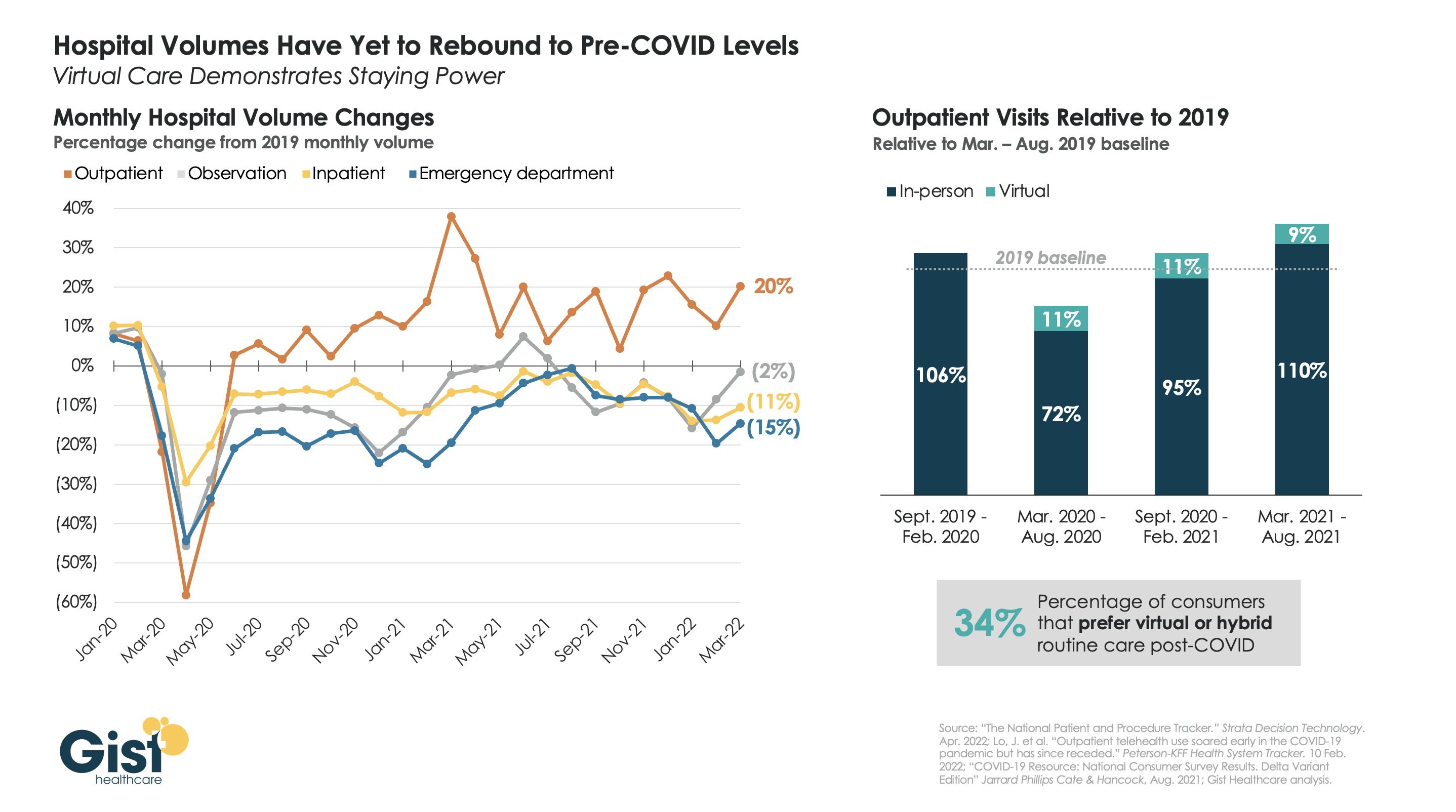
More than two years after the pandemic’s onset, some types of hospital volume still haven’t returned to pre-pandemic levels. The graphic above uses recent data from analytics firm Strata Decision Technology to track monthly hospital volume across various care settings. 

While outpatient volume continues to exceed pre-COVID levels, inpatient, emergency department (ED), and observation volume is still below the 2019 baseline. The unpredictability of volume trends is likely to continue, as COVID continues to ebb and flow regionally, and care continues to shift outpatient.

By contrast, the volume of virtual care visits has remained consistent, even as consumers return to in-person outpatient visits, driving up the overall level above the pre-pandemic baseline. Some of this increase in outpatient visit volume has been driven by consumers turning to urgent care clinics or doctors’ offices—either in-person or virtually—for their lower-acuity care needs.

While temporary reimbursement and licensing policies for telehealth have been the main stumbling blocks for many organizations’ longer-term planning for virtual visits, about half of states have now implemented permanent payment parity for telemedicine. As such, provider organizations that are still taking a “wait and see approach” must develop an economically sustainable virtual care model to reduce costs and meet evolving consumer demands.

7 hospitals cutting inpatient care

Several hospitals are scaling back inpatient services or ending inpatient care. 

Below are seven hospitals that announced plans to scale back or end inpatient care since February. 

1. Marietta, Ga.-based WellStar Health System is closing the emergency department and ending inpatient care at Atlanta Medical Center South in May. The hospital will be converted into an outpatient site, and inpatient services will be consolidated to Atlanta Medical Center’s main campus, Wellstar said. 

2. Tampa, Fla.-based Shriners Hospitals for Children is ending inpatient care at its campus in Springfield, Mass. The hospital gave the Massachusetts Department of Public Health a 120-day notice of the plan on March 31. 

3. Kanakanak Hospital in Dillingham, Alaska, stopped accepting inpatient admissions April 8 because of a staffing shortage. The hospital’s owner said it expects to resume accepting inpatients again on May 1. 

4. Boston-based Tufts Children’s Hospital is closing its pediatric inpatient units in July to convert its 41 pediatric inpatient beds to adult ICU and medical/surgical beds. Tufts will refer children to Boston Children’s Hospital for care. 

5. Henrico Doctors’ Hospital in Richmond, Va., ended pediatric inpatient services April 1. The hospital attributed the decision in part to a low number of patients. The hospital said it’s seeing an increased demand for adult inpatient medical and surgical care. Although the pediatric units are closing, the hospital will continue to provide emergency medical care to children via designated emergency room space. 

6. Mercyhealth ended inpatient care at Javon Bea Hospital-Rockton in Rockford, Ill., and transitioned it to an outpatient facility in March. Inpatient services were consolidated to Javon Bea Hospital-Riverside in Rockford. Javon Bea Hospital-Rockton offers outpatient services, including cancer care, pain management, outpatient surgery and pediatrics. 

7. Ascension St. John Medical Center plans to close its pediatric intensive care and general pediatric inpatient care unit at the end of April. The Tulsa, Okla.-based hospital said the decision was based on a community needs assessment and analysis of services offered in the community. Pediatric ambulatory, surgical and neonatal ICU services will not be affected, the hospital said. 

Shriners to end inpatient care at Massachusetts hospital

Tampa, Fla.-based Shriners Hospitals for Children is transitioning its Springfield, Mass., campus into an outpatient clinic model, NBC/CW affiliate WWLP reported April 20.

Current outpatient services won’t be affected, except that ambulatory surgery will end.

The hospital gave the Massachusetts Department of Public Health a 120-day notice of the plan on March 31, Western Mass News reported April 20.

“The advancement of surgical procedures has resulted in very few patients requiring admission for inpatient pediatric services, which are the cornerstone of a hospital facility,” Shriners said in a letter obtained by Western Mass News. “Accordingly, after evaluating the needs of our patients, we have determined that Shriners Hospitals for Children may best serve our patients and fulfill our charitable mission by transitioning this location from a hospital to an outpatient clinic model.”

New CMS payment rule is good news, bad news for hospitals

https://mailchi.mp/b5daf4456328/the-weekly-gist-july-23-2021?e=d1e747d2d8

Centers for Medicare & Medicaid Services - Wikipedia

Two major policy developments emerged from this week’s release by the Centers for Medicare & Medicaid Services (CMS) of the FY22 proposed rule governing payment for hospital outpatient services and ambulatory surgical centers.

First, CMS proposes to dramatically increase the financial penalties assessed to hospitals that fail to adequately reveal prices for their services, a requirement first put in place by the Trump administration. According to a report by the consumer group Patient Rights Advocate, only 5.6 percent of a random sample of 500 hospitals were in full compliance with the transparency requirement six months after the regulation came into effect, with many instead choosing to pay the $300 per hospital per day penalty associated with noncompliance. The new CMS regulation proposes to scale the assessed penalties in accordance with hospital size, with larger hospitals liable for up to $2M in annual penalties, a substantial increase from the earlier $109,500 maximum annual fine. In a press release, the agency said it “takes seriously concerns it has heard from consumers that hospitals are not making clear, accessible pricing information available online, as they have been required to do since January 1, 2021.” In a statement, the AHA stated that it was “deeply concerned” about the proposal, “particularly in light of substantial uncertainty in the interpretation of the rules.” The penalty hike is a clear signal that the Biden administration plans to put teeth behind its new push for more competition in healthcare, which was a major focus of the President’s recent executive order. We’d expect to see most hospitals and health systems quickly move to comply with the transparency rule, given the size of potential penalties.
 
More heartening to hospitals was CMS’ proposal to roll back changes the Trump administration made, aimed at shifting certain surgical procedures into lower cost, ambulatory settings. The agency proposed halting the elimination of the Inpatient Only (IPO) list, which specifies surgeries CMS will only pay for if they are performed in an inpatient hospital. Citing patient safety concerns, CMS noted that the phased elimination of the IPO list, which began this year, was undertaken without evaluating whether individual procedures could be safely moved to an outpatient setting. Nearly 300 musculoskeletal procedures have already been eliminated from the list, and will now be added back to the list for 2022, keeping the rest of the list intact while CMS undertakes a formal process to review each procedure. Longer term, we’d anticipate that CMS will look to continue the elimination of inpatient-only restrictions on surgeries, as well as pursuing other policies (such as site-neutral payment) that level the playing field between hospitals and lower-cost outpatient providers. 

For now, hospitals will enjoy a little more breathing room to plan for the financial consequences of that inevitable shift.

Hospital volume continues an uneven recovery

Though consumers say they’re increasingly confident in returning to healthcare settings, hospital volume is not returning with the same momentum across the board. Using the most recent data from analytics firm Strata Decision Technology, covering the first quarter of this year, the graphic above shows that observation, inpatient, and emergency department volumes all remain below pre-COVID levels. 

Consumers are still most wary about returning to the emergency department, with volume down nearly 20 percent across the past year. Meanwhile, hospital outpatient visits rebounded quickly, and have been growing steadily month over month, finishing March 2021 at 36 percent above the 2019 level.

Meanwhile, a recent report from the Commonwealth Fund shows that no ambulatory specialty fully made up for the COVID volume hit by the end of last year. But some areas, including rheumatology, urology, and adult primary care, have bounced back faster than others.

With continued success in rolling out vaccines and reducing COVID cases, we’d expect a continued recovery of most hospital visit volume. It may be, however, that some areas, such as the emergency department, will never fully recover to pre-COVID levels. To the extent those visits are now being replaced by more appropriate telemedicine and urgent care utilization, that’s welcome news.

But the continued lag of inpatient admissions indicates that some of the loss of emergency volume is more worrisome—warranting continued efforts on the part of providers to reassure patients it’s safe to use healthcare services. Stay tuned as our team continues to dig into this data.

MedPAC calls for 2% bump to hospital payments, no update for docs in 2022

MedPAC March 2019 Report to the Congress Released - ehospice

A key Medicare advisory panel is calling for a 2% bump to Medicare payments for acute care hospitals for 2022 but no hike for physicians.

The report, released Monday from the Medicare Payment Advisory Commission (MedPAC)—which recommends payment policies to Congress—bases payment rate recommendations on data from 2019. However, the commission did factor in the pandemic when evaluating the payment rates and other policies in the report to Congress, including whether policies should be permanent or temporary.

“The financial stress on providers is unpredictable, although it has been alleviated to some extent by government assistance and rebounding service utilization levels,” the report said.

MedPAC recommended that targeted and temporary funding policies are the best way to help providers rather than a permanent hike for payments that gets increased over time.

“Overall, these recommendations would reduce Medicare spending while preserving beneficiaries’ access to high-quality care,” the report added.

MedPAC expects the effects of the pandemic, which have hurt provider finances due to a drop in healthcare use, to persist into 2021 but to be temporary.

It calls for a 2% update for inpatient and outpatient services for 2022, the same increase it recommended for 2021.

The latest report recommends no update for physicians and other professionals. The panel also does not want any hikes for four payment systems: ambulatory surgical centers, outpatient dialysis facilities, skilled nursing facilities and hospices.

MedPAC also recommends Congress reduce the aggregate hospice cap by 20% and that “ambulatory surgery centers be required to report cost data to [Centers for Medicare & Medicaid Services (CMS)],” the report said.

But it does call for long-term care hospitals to get a 2% increase and to reduce payments by 5% for home health and inpatient rehabilitation facilities.

The panel also explores the effects of any policies implemented under the COVID-19 public health emergency, which is likely to extend through 2021 and could continue into 2022.

For instance, CMS used the public health emergency to greatly expand the flexibility for providers to be reimbursed for telehealth services. Use of telehealth exploded during the pandemic after hesitancy among patients to go to the doctor’s office or hospital for care.

“Without legislative action, many of the changes will expire at the end of the [public health emergency],” the report said.

MedPAC recommends Congress temporarily continue some of the telehealth expansions for one to two years after the public health emergency ends. This will give lawmakers more time to gather evidence on the impact of telehealth on quality and Medicare spending.

“During this limited period, Medicare should temporarily pay for specified telehealth services provided to all beneficiaries regardless of their location, and it should continue to cover certain newly-covered telehealth services and certain audio-only telehealth services if there is potential for clinical benefit,” according to a release on the report.

After the public health emergency ends, Medicare should also return to paying the physician fee schedule’s facility rate for any telehealth services. This will ensure Medicare can collect data on the cost for providing the services.

“Providers should not be allowed to reduce or waive beneficiary cost-sharing for telehealth services after the [public health emergency],” the report said. “CMS should also implement other safeguards to protect the Medicare program and its beneficiaries from unnecessary spending and potential fraud related to telehealth.”

Michigan Medicine to start building $920M hospital

A closer look at plans for the new $920M University of Michigan hospital -  mlive.com

Ann Arbor-based Michigan Medicine will start construction on its $920 million hospital in the coming months, after delaying the project last year amid the COVID-19 pandemic, according to a March 8 health system update.

Michigan Medicine said its planning team has resumed design work on the facility.

The 12-story, 690,000-square-foot hospital is expected to house 264 private rooms, 20 operating rooms and three interventional radiology suites.

Citing a financial loss exacerbated by the COVID-19 pandemic, the academic health system delayed the project in May 2020.

With the delay, the new hospital is slated to open in the fall of 2025.

Chicago’s Mercy Hospital files for bankruptcy

Image result for Chicago's Mercy Hospital files for bankruptcy

Mercy Hospital & Medical Center in Chicago filed for bankruptcy protection Feb. 10, amid its plan to close that has been contested in the community.

The Chapter 11 plan includes the discontinuation of inpatient acute care services, Mercy’s owner, Livonia, Mich.-based Trinity Health, said in a bankruptcy filing

Mercy said it plans to cease operations of all departments, except for basic emergency services, on May 31. 

“There have been many steps that preceded the difficult decision to file for Chapter 11,” Trinity said. 

In a news release announcing the bankruptcy, Mercy said it was losing staff and “experiencing mounting financial losses” that are challenging its ability to provide safe patient care. 

Mercy said its losses have averaged about $5 million per month and reached $30.2 million for the first six months of fiscal year 2021. Further, the hospital has accumulated debt of more than $303.2 million over the last seven years, and the hospital needs more than $100 million in upgrades and modernizations.

The Chapter 11 bankruptcy filing comes just weeks after the Illinois Health Facilities and Services Review Board rejected Trinity’s plan to build an outpatient center in the neighborhood where it is closing the 170-year-old inpatient hospital. The same board unanimously rejected Trinity’s plan to close the hospital in December.

The December vote from the review board came after months of protests from physicians, healthcare advocates and community organizers, who say that closing the hospital would create a healthcare desert on Chicago’s South Side. 

The state review board has a meeting to discuss the closure March 16. 

State-by-state breakdown of 130 rural hospital closures

https://www.beckershospitalreview.com/finance/state-by-state-breakdown-of-130-rural-hospital-closures.html

Rural Hospital Closures Hit Poor, Minority Communities Hardest ...

Nearly one in five Americans live in rural areas and depend on their local hospital for care. Over the past 10 years, 130 of those hospitals have closed.

Thirty-three states have seen at least one rural hospital shut down since 2010, and the closures are heavily clustered in states that have not expanded Medicaid under the ACA, according to the Cecil G. Sheps Center for Health Services Research.

Twenty-one rural hospitals in Texas have closed since 2010, the most of any state. Tennessee has the second-most closures, with 13 rural hospitals shutting down in the past decade. In third place is Oklahoma with eight closures. 

Listed below are the 130 rural hospitals that have closed since Jan. 1, 2010, as tracked by the Sheps Center. For the purposes of its analysis, the Sheps Center defined a hospital closure as the cessation in the provision of inpatient services.

“We follow the convention of the Office of Inspector General that a closed hospital is ‘a facility that stopped providing general, short-term, acute inpatient care,'” reads a statement on the Sheps Center’s website. “We did not consider a hospital closed if it: merged with, or was sold to, another hospital but the physical plant continued to provide inpatient acute care, converted to critical access status, or both closed and reopened during the same calendar year and at the same physical location.”

As of June 8, all the facilities listed below had stopped providing inpatient care. However, some of them still offered other services, including outpatient care, emergency care, urgent care or primary care.

Alabama
SouthWest Alabama Medical Center (Thomasville)
Randolph Medical Center (Roanoke)
Chilton Medical Center (Clanton)
Florence Memorial Hospital
Elba General Hospital
Georgiana Medical Center

Alaska
Sitka Community Hospital

Arizona
Cochise Regional Hospital (Douglas)
Hualapai Mountain Medical Center (Kingman)
Florence Community Healthcare

Arkansas
De Queen Medical Center

California
Kingsburg Medical Center
Corcoran District Hospital
Adventist Health Feather River (Paradise)
Coalinga Regional Medical Center

Florida
Campbellton-Graceville Hospital
Regional General Hospital (Williston)
Shands Live Oak Regional Medical Center
Shands Starke Regional Medical Center

Georgia
Hart County Hospital (Harwell)
Charlton Memorial Hospital (Folkston)
Calhoun Memorial Hospital (Arlington)
Stewart-Webster Hospital (Richland)
Lower Oconee Community Hospital (Glenwood)
North Georgia Medical Center (Ellijay)

Illinois
St. Mary’s Hospital (Streator)

Indiana
Fayette Regional Health System

Kansas
Central Kansas Medical Center (Great Bend)
Mercy Hospital Independence
Mercy Hospital Fort Scott
Horton Community Hospital
Oswego Community Hospital
Sumner Community Hospital (Wellington)

Kentucky
Nicholas County Hospital (Carlisle)
Parkway Regional Hospital (Fulton)
New Horizons Medical Center (Owenton)
Westlake Regional Hospital (Columbia)

Louisiana
Doctor’s Hospital at Deer Creek (Leesville)

Maine
St. Andrews Hospital (Boothbay Harbor)
Southern Maine Health Care-Sanford Medical Center
Parkview Adventist Medical Center (Brunswick)

Maryland
Edward W. McCready Memorial Hospital (Crisfield)

Massachusetts
North Adams Regional Hospital

Michigan
Cheboygan Memorial Hospital

Minnesota
Lakeside Medical Center
Albany Area Hospital
Albert Lea-Mayo Clinic Health System
Mayo Clinic Health System-Springfield

Mississippi
Patient’s Choice Medical of Humphreys County (Belzoni)
Pioneer Community Hospital of Newton
Merit Health Natchez-Community Campus
Kilmichael Hospital
Quitman County Hospital (Marks)

Missouri
Sac-Osage Hospital (Osceola)
Parkland Health Center-Weber Road (Farmington)
Southeast Health Center of Reynolds County (Ellington)
Southeast Health Center of Ripley County (Doniphan)
Twin Rivers Regional Medical Center (Kennett)
I-70 Community Hospital (Sweet Springs)
Pinnacle Regional Hospital (Boonville)

Nebraska
Tilden Community Hospital

Nevada
Nye Regional Medical Center (Tonopah)

New York
Lake Shore Health Care Center
Moses-Ludington Hospital (Ticonderoga)

North Carolina
Blowing Rock Hospital
Vidant Pungo Hospital (Belhaven)
Novant Health Franklin Medical Center (Louisburg)
Yadkin Valley Community Hospital (Yadkinville)
Our Community Hospital (Scotland Neck)
Sandhills Regional Medical Center (Hamlet)
Davie Medical Center-Mocksville

Ohio
Physicians Choice Hospital-Fremont
Doctors Hospital of Nelsonville

Oklahoma
Muskogee Community Hospital
Epic Medical Center (Eufaula)
Memorial Hospital & Physician Group (Frederick)
Latimer County General Hospital (Wilburton)
Pauls Valley General Hospital
Sayre Community Hospital
Haskell County Community Hospital (Stigler)
Mercy Hospital El Reno

Pennsylvania
Saint Catherine Medical Center Fountain Springs (Ashland)
Mid-Valley Hospital (Peckville)
Ellwood City Medical Center
UPMC Susquehanna Sunbury

South Carolina
Bamberg County Memorial Hospital
Marlboro Park Hospital (Bennettsville)
Southern Palmetto Hospital (Barnwell)
Fairfield Memorial Hospital (Winnsboro)

South Dakota
Holy Infant Hospital (Hoven)

Tennessee
Riverview Regional Medical Center South (Carthage)
Starr Regional Medical Center-Etowah
Haywood Park Community Hospital (Brownsville)
Gibson General Hospital (Trenton)
Humboldt General Hospital
United Regional Medical Center (Manchester)
Parkridge West Hospital (Jasper)
Tennova Healthcare-McNairy Regional (Selmer)
Copper Basin Medical Center (Copperhill)
McKenzie Regional Hospital
Jamestown Regional Medical Center
Takoma Regional Hospital (Greeneville)
Decatur County General Hospital (Parsons)

Texas
Wise Regional Health System-Bridgeport
Shelby Regional Medical Center
Renaissance Hospital Terrell
East Texas Medical Center-Mount Vernon
East Texas Medical Center-Clarksville
East Texas Medical Center-Gilmer
Good Shepherd Medical Center (Linden)
Lake Whitney Medical Center (Whitney)
Hunt Regional Community Hospital of Commerce
Gulf Coast Medical Center (Wharton)
Nix Community General Hospital (Dilley)
Weimar Medical Center
Care Regional Medical Center (Aransas Pass)
East Texas Medical Center-Trinity
Little River Healthcare Cameron Hospital
Little River Healthcare Rockdale Hospital
Stamford Memorial Hospital
Texas General-Van Zandt Regional Medical Center (Grand Saline)
Hamlin Memorial Hospital
Chillicothe Hospital
Central Hospital of Bowie

Virginia
Lee Regional Medical Center (Pennington Gap)
Pioneer Community Hospital of Patrick County (Stuart)
Mountain View Regional Hospital (Norton)

West Virginia
Williamson Memorial Hospital
Fairmont Regional Medical Center

Wisconsin
Franciscan Skemp Medical Center (Arcadia)