Treasury Has Hardly Spent Its $500 Billion Coronavirus Relief Fund

https://www.thefiscaltimes.com/newsletter/20200518-500-Billion-Coronavirus-Fund-Has-Barely-Been-Used

Hard News Cafe » Blog Archive » Water-faucet-shutterstock-june-2011

The Treasury Department has disbursed just $37.5 billion out of $500 billion in emergency coronavirus funds approved by Congress as part of the CARES Act passed in March, according to the first report of the congressional oversight commission monitoring the implementation of the law.

Airlines still waiting on billions from relief fund: Congress allocated $46 billion for aid to the air travel industry, but the Treasury Department has yet to disburse any of the money. The funds include $25 billion for airlines and $17 billion for related businesses that are critical to national security.

Lending programs not yet lending: The Federal Reserve and Treasury last month announced five lending facilities meant to help prop up various segments of the economy, including “Main Street” lending programs targeting small- and mid-sized businesses, a program for states and municipalities, and a corporate-bond buying facility. Only one of those programs is fully up and running. Treasury disbursed $37.5 billion to the corporate facility, called the Secondary Market Corporate Credit Facility (SMCCF), earlier this month.

“The Treasury and the Fed have announced these facilities but, with the exception of the SMCCF, the Treasury has not invested in them yet, nor has the Fed put them into operation,” the oversight report says. “Their size and scope may also grow as the Treasury has only pledged $185 billion of the $454 billion appropriated in the CARES Act for investments in Fed lending facilities.”

Changes to lending terms: “The report describes how even before any money from the Main Street program has been lent, the terms of the program already have evolved,” The Washington Post’s Erica Werner reports. “The changes include increasing the size of loans, eliminating a requirement that companies have to attest they need money ‘due to the exigent circumstances presented by’ the coronavirus, and modifying a requirement that companies make ‘reasonable efforts’ to maintain payroll and retain employees during the term of a loan. Instead, they will be required to make ‘commercially reasonable efforts’ to do so.”

The Fed and Treasury also expanded the $35 billion facility to buy debt from states, cities and counties, after criticism that the original guidelines left only a few dozen cities and counties eligible to participate. The facility will now buy notes from counties with a population of at least 500,000 residents (instead of the original floor of 2 million residents) and cities with a population of at least 250,000 residents (instead of a million residents). The program will also buy notes that mature within at least three years instead of two years.

The bottom line: Congress may have moved with unusual speed to provide money to address the pandemic, but while the Treasury Department quickly implemented other elements of the CARES Act, the report highlights how the lending programs have gotten off to a slow start and how many questions remain to be answered about how they will function. Roughly a third of the new report is filled with questions for the Treasury Department and the Federal Reserve about the programs.

Similar questions still hang over the oversight commission and broader oversight of the trillions in new spending approved by Congress. The five-member commission still doesn’t have a chairman, as House Speaker Nancy Pelosi and Senate Majority Leader Mitch McConnell have yet to agree on a person to fill that post. The Senate also has yet to confirm a special inspector general to oversee the $500 billion Treasury fund.

The commission’s next report is reportedly due in mid-June.
 

Jay Powell warns US recovery could take until end of 2021

https://www.ft.com/content/2ed602f1-ed11-4221-8d0b-ef85018c96ea

Fed Makes Second Emergency Rate Cut to Zero Due To Coronavirus ...

Fed chair says economy may not fully bounce back until virus vaccine is available.

Federal Reserve chair Jay Powell has warned that a full US economic recovery may take until the end of next year and require the development of a Covid-19 vaccine.

“For the economy to fully recover, people will have to be fully confident. And that may have to await the arrival of a vaccine,” Mr Powell told CBS News on Sunday. A full revival would happen, he said, but “it may take a while . . . it could stretch through the end of next year, we really don’t know”.

He added: “Assuming there is not a second wave of the coronavirus, I think you will see the economy recover steadily through the second half of this year.”

Mr Powell told CBS it was likely there would be a “couple more months” of net job losses, with the unemployment rate climbing to as high as 20-25 per cent. But he said it was “good news” that the “overwhelming” majority of those claiming unemployment benefits report themselves as having been laid off temporarily, meaning they are expecting to go back to their old jobs.

Oil prices and stocks in Asia rose on Monday despite the gloomy outlook. West Texas Intermediate, the US crude benchmark, climbed 4.4 per cent to take it above $30 a barrel for the first time in two months. Brent crude, the international benchmark, rose 3.6 per cent to $33.67 a barrel. Japan’s Topix was up 0.4 per cent and China’s CSI 300 index of Shanghai- and Shenzhen-listed stocks added 0.6 per cent.

Donald Trump, US president, said last week that he hoped to have a vaccine ready by the end of 2020. But public health experts, including Anthony Fauci, the head of the US National Institute of Allergy and Infectious Diseases, and Rick Bright, the recently ousted head of the US Biomedical Advanced Research and Development Authority, have warned that the process is likely to take longer.

Dr Fauci, a high-profile member of Mr Trump’s coronavirus task force, has said he expects the search for a vaccine to take at least a year to 18 months. But Dr Bright has said that was too optimistic.

Some world leaders have also raised doubts about the immediate prospects for a vaccine. Giuseppe Conte, prime minister of Italy, said at the weekend that his country could “not afford” to wait for a vaccine, while Boris Johnson, UK prime minister, warned that a vaccine “might not come to fruition” at all.

Mr Powell said that while lawmakers had “done a great deal and done it very quickly”, Congress and the Fed may need to do more “to avoid longer-run damage to the economy”.

The Fed chair said fiscal policies that “help businesses avoid avoidable insolvencies and that do the same for individuals” would position the US economy for a strong recovery post-crisis.

Mr Powell also reiterated his position against using negative interest rates, something Mr Trump has called for. The Fed chair told CBS that the Federal Open Market Committee had eschewed negative interest rates after the last financial crisis in favour of “other tools” such as forward guidance and quantitative easing.

The US Congress has already approved nearly $3tn of economic relief measures intended to support struggling businesses and individuals, but there is growing consensus in Washington that more fiscal stimulus will be needed — even if Democrats and Republicans are divided over how to dole out federal funds.

Late on Friday, the Democrat-controlled House of Representatives passed Nancy Pelosi’s plan for $3tn in new stimulus spending.

Mr Trump has repeatedly called for the next stimulus to include a cut to payroll taxes — deductions for entitlements such as social security and Medicare. Last week, Larry Kudlow, the top White House economic adviser, suggested that lower corporate taxes and looser business regulation should be part of any future relief package.

The Trump administration has taken a more bullish stance on the US economic recovery than Mr Powell, with White House officials repeatedly insisting that the economy will bounce back before the end of the year.

Mr Powell told CBS it was a “reasonable expectation that there will be growth in the second half of the year” but “we won’t get back to where we were by the end of the year”.


Fed’s Powell warns unemployment could reach Depression-level 25 percent

https://www.politico.com/news/2020/05/17/powell-unemployment-depression-25-percent-264500

Fed's Powell warns unemployment could reach Depression-level 25 ...

The Fed chief expressed hope that the economy would come out of recession in the second half of the year.

Federal Reserve Chair Jerome Powell on Sunday warned that the nation’s unemployment rate could soar to 25 percent during the worst of the coronavirus crisis, though he said the economy should recover more quickly than during the Great Depression, when joblessness last reached those levels.

“Those numbers sound about right for what the peak may be,” Powell said on CBS’ “60 Minutes” after reporter Scott Pelley asked whether unemployment could reach 20 percent or even 25 percent.

His remarks came just days after the central bank released a survey showing that one in five American workers lost their jobs in March — including almost 40 percent of those in lower-income households.

The Fed chief expressed hope that the economy would come out of recession in the second half of the year, but cautioned that a second outbreak of the coronavirus could derail that path.

“This economy will recover,” he said. “We’ll get through this. It may take a while. … It could stretch through the end of next year. We really don’t know.”

The central bank has taken extraordinary measures to rescue the economy since the pandemic began sweeping through the country — slashing interest rates to zero, rolling out trillions of dollars in lending programs for financial markets, and taking the unprecedented step of bailing out state and city governments.

“There’s really no limit to what we can do with these lending programs,” Powell said. “There’s a lot more we can do to support the economy, and we’re committed to doing everything we can as long as we need to.”

He said the economy stands a good chance of bouncing back more quickly than in the 1930s.

“When the Depression, well, when the crash happened and all that, the financial system really failed,” Powell said. “Here, our financial system is strong.”

But he took the opportunity to again warn that Congress will need to spend more to prevent long-lasting damage, even after U.S. lawmakers have shelled out trillions of dollars for American businesses and consumers.

The most important policy objectives should be to “keep workers in their homes, keep them paying their bills,” he said. “Keep families solvent so that when this comes, we come out the other end of this, we’re in a position to have a strong recovery.”


Cartoon – 100% Tax Cut Today

Recruiting. Talent Management | HENRY KOTULA

Cartoon – Today’s Retirement Reality

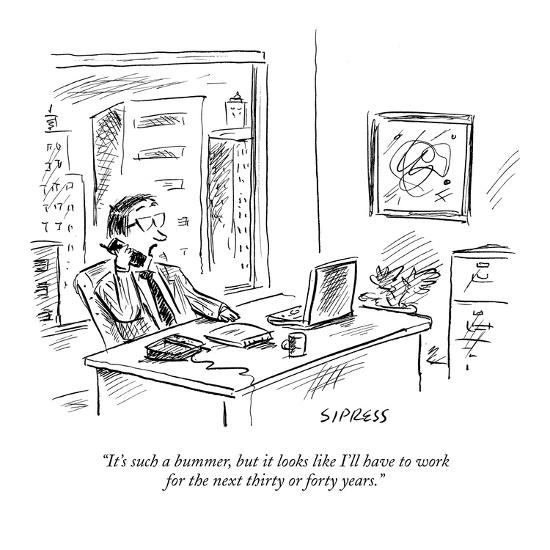
It's such a bummer, but it looks like I'll have to work for the ...

If the White House is struggling, how will ordinary businesses fare? 

https://mailchi.mp/f4f55b3dcfb3/the-weekly-gist-may-15-2020?e=d1e747d2d8

The RAOI Advisory Opinion: A Transformative Moment or a Bump in ...

In a week that saw reopening activity pick up across the country, drawing even more attention to the need for sufficient testing to give employers and workers confidence in returning to work, a new study from researchers at New York University (NYU) suggested that a widely-hailed rapid testing machine from Abbott Labs may be unreliable.

The Abbott ID NOW COVID-19 test produced false negatives a third of the time using nasopharyngeal swabs, and 48 percent of the time with less-invasive “dry nasal swabs”, according to the study, which has not yet undergone peer review. The five-minute, point-of-care test received emergency use authorization from the Food and Drug Administration (FDA) in late March and has been touted as a “great test” by President Trump, whose White House relies on it to test the President and those around him.

On Thursday, the FDA issued a warning about the potential for false negative results using the Abbott test. The company disputes the findings and sent a list of questions to the NYU researchers for clarification. Meanwhile, two White House staffers—an aide to the President and the Vice President’s press secretary—tested positive for coronavirus, causing the White House to mandate masks for all employees starting this week.

The uncertainty around test results, and the ensuing concern about safety at the White House, provides a foretaste of the difficult road ahead for thousands of employers nationwide as stay-at-home orders are lifted, and companies consider when and how to reopen workplaces.

If the White House is struggling, how will ordinary businesses fare?

US coronavirus update: 1.46M cases, 87K+ confirmed deaths, 10.2M total tests conducted.


Seven weeks into coronavirus lockdowns, Fed has a new, darker message

https://www.yahoo.com/news/seven-weeks-coronavirus-lockdowns-fed-182614531.html

Seven weeks into coronavirus lockdowns, Fed has a new, darker ...

One Thursday morning seven weeks ago, Federal Reserve Chair Jerome Powell made a rare appearance on NBC’s “Today Show” to offer a reassuring message to Americans dealing with economic fallout from measures to contain the coronavirus outbreak.

There is “nothing fundamentally wrong with our economy,” Powell told viewers, while pointing out the U.S. central bank’s outsized ability to take on lending risk and provide a financial “bridge” over the temporary economic weakness the country was experiencing.

Speaking after the Fed cut interest rates to near zero and rolled out a plan to backstop credit for small- and mid-sized companies, Powell emphasized the first order of business was to get the virus under control.

“The sooner we get through this period and get the virus under control, the sooner the recovery can come,” said Powell, echoing remarks made the day before by Anthony Fauci, a top U.S. health official helping to coordinate the federal government’s response to the coronavirus crisis.

At the time, Powell said he expected economic activity would resume in the second half of the year, and maybe even enjoy a “good rebound.”

But on Wednesday, he offered a much more sober outlook.

In an interview webcast by the Peterson Institute for International Economics, Powell warned of an “extended period” of weak economic growth, tied to uncertainty about how well the virus could be controlled in the United States. “There is a sense, growing sense I think, that the recovery may come more slowly than we would like,” he said.

Fauci, the director of the National Institute of Allergy and Infectious Diseases, was similarly somber when he told lawmakers earlier this week that the country was by no means in “total control” of the outbreak.

“There is a real risk that you will trigger an outbreak that you may not be able to control and, in fact, paradoxically, will set you back, not only leading to some suffering and death that could be avoided, but could even set you back on the road to try to get economic recovery,” Fauci said.

The pandemic has killed more than 83,000 people in the United States so far, and many epidemiological models now point to a death toll that will surpass 100,000 in a matter of weeks.

Overall new cases of the virus continue to climb as well, as states end lockdowns and reopen local economies without the widespread, uniform testing and contact tracing policies that helped stamp out initial outbreaks in South Korea and Germany.

UNCERTAIN FUTURE

Powell’s remarks on Wednesday mirrored warnings this week from a clutch of regional Fed presidents who outlined the country’s uncertain future.

U.S. central bank officials, and especially the Fed chief, historically choose their words carefully, to avoid alarming or exciting investors or causing swings in financial markets, making their universally dour outlook more remarkable.

St. Louis Fed President James Bullard said the situation could lead to a new Great Depression, with millions of so-far temporary job losses becoming permanent, and businesses failing “on a grand scale.”

“We have to get better at this and get more risk-based with our health policy,” Bullard said.

The U.S. economy can return to growth in the second half of the year, Cleveland Fed President Loretta Mester said on Tuesday, with more testing and contact tracing. If that happens, she said, “as some of the stay-at-home restrictions are lifted, the economy will begin to grow again in the second half of this year and unemployment will begin to move down.”

However, a more pessimistic scenario, in which a surge in infections requires businesses to shut down again or the crisis leads to more bankruptcies or instability in the banking sector, is “almost as likely,” she said.


Another 3 million Americans filed for unemployment last week

https://www.axios.com/jobless-claims-coronavirus-3-million-460364c8-be73-437c-b99c-fa7d75aad87e.html?stream=top&utm_source=alert&utm_medium=email&utm_campaign=alerts_all

Data: U.S. Employment and Training Administration via FRED; Chart: Andrew Witherspoon/Axios

Data: U.S. Employment and Training Administration via FRED; Chart: Andrew Witherspoon/Axios

Another 2.98 million Americans filed for unemployment last week, the Labor Department said on Thursday.

Why it matters: The coronavirus is still forcing a historically high number of Americans out of work. In two months alone, more than 36 million people have filed jobless claims.

Between the lines: The pace of new applications has slowed from its peak in March, but the weekly numbers are still way higher than before businesses shuttered to contain the outbreak.

  • There are more jobless workers that haven’t been able to get their application through. State unemployment offices are racing to get through an avalanche of unemployment filings — with states like New York processing more claims in the past few months than they have in years.
  • Measuring the backlog is “like trying to measure the ocean, it’s constantly moving,” New York Labor Department commissioner Roberta Reardon said in a press call yesterday.
  • While more Americans than ever before are eligible for unemployment, including gig workers, some states are just beginning to scale up to accept those applications.

By the numbers: The total number of people continuing to receive unemployment benefits — after initially applying — rose, bringing the total to a record 22.8 million.

  • A decrease in this figure would be an indication that Americans are returning back to work.

The bottom line: Goldman Sachs estimates the unemployment rate will hit 25%, matching the peak level of joblessness during the Great Depression.


Window of Opportunity is Closing for Coronavirus Response

https://www.axios.com/rick-bright-testimony-opening-statement-6817ae7a-5196-4357-b83c-d3ff96990efd.html?stream=health-care&utm_source=alert&utm_medium=email&utm_campaign=alerts_healthcare

Window of opportunity – definition and meaning – Market Business News

A top vaccine doctor who was ousted from his position in April is expected to testify Thursday that the Trump administration was unprepared for the coronavirus, and that the U.S. could face the “darkest winter in modern history” if it doesn’t develop a national coordinated response, according to prepared testimony first obtained by CNN.

The big picture: Rick Bright, the former head of the Biomedical Advanced Research and Development Authority (BARDA), will tell Congress that leadership at the Department of Health and Human Services ignored his warnings in January, February and March about a potential shortage of medical supplies.

  • He will testify that HHS “missed early warning signals” and “forgot important pages from our pandemic playbook” early on — but that “for now, we need to focus on getting things right going forward.”
  • Bright’s testimony also reiterates claims from a whistleblower report he filed last week that alleges he was ousted over his attempts to limit the use of hydroxychloroquine — an unproven drug touted by President Trump — to treat the coronavirus.

What he’s saying: Bright will testify he urged HHS to ramp up production of
masks, respirators and medical supplies as far back as January. Those warnings were dismissed, Bright says, and he was “cut out of key high-level meetings to combat COVID-19.”

  • “I continue to believe that we must act urgently to effectively combat this deadly disease. Our window of opportunity is closing. If we fail to develop a national coordinated response, based in science, I fear the pandemic will get far worse and be prolonged, causing unprecedented illness and fatalities.”

Bright will call for a national strategy to combat the virus, including “tests that are accurate, rapid, easy to use, low cost, and available to everyone who needs them.”

  • “Without clear planning and implementation of the steps that I and other experts have outlined, 2020 will be darkest winter in modern history.”

Read Bright’s prepared statement.


The latest in the U.S.

https://www.axios.com/newsletters/axios-vitals-72173ec6-3383-4391-afbb-a5ed682e5d7a.html?utm_source=newsletter&utm_medium=email&utm_campaign=newsletter_axiosvitals&stream=top

COVID-19 in the U.S.

As of May 12, 2020, 11pm EDT

Deaths       Confirmed Cases

82,376           1,369,574

Trump and some top aides question accuracy of coronavirus death ...


The U.S. will “without a doubt” have more coronavirus infections and deaths in the fall and winter if effective testing, contact tracing and social distancing measures are not scaled up to adequate levels, NIAID director Anthony Fauci testified on Tuesday.

  • He also said that the “consequences could be really serious” for states and cities that reopen without meeting federal guidelines.

Sen. Mitt Romney (R-Utah) criticized the Trump administration’s coronavirus testing coordinator Adm. Brett Giroir at a Senate hearing Tuesday, accusing him of framing U.S. testing data in a politically positive light: “I find our testing record nothing to celebrate whatsoever.”

Millions of Americans are risking their lives to feed us and bring meals, toiletries and new clothes to our doorsteps — but their pay, benefits and working conditions do not reflect the dangers they face at work, Axios’ Erica Pandey reports.

House Democrats released Tuesday their phase 4 $3 trillion coronavirus relief proposal that would provide billions of additional aid to state and local governments, hospitals and other Democratic priorities.

The American Federation of Teachers launched several capstone lesson plans Tuesday to help K-12 teachers measure student progress during school closures and overcome the challenges of a remote learning setting.

Grocery staples in the U.S. cost more in the last month than in almost 50 years, according to new data out Tuesday from the U.S. Bureau of Labor Statistics.

A new study by economists at the University of Illinois, Harvard Business School, Harvard University and the University of Chicago projects that more than 100,000 small businesses have permanently closed since the coronavirus pandemic was declared in March, the Washington Post reports.