


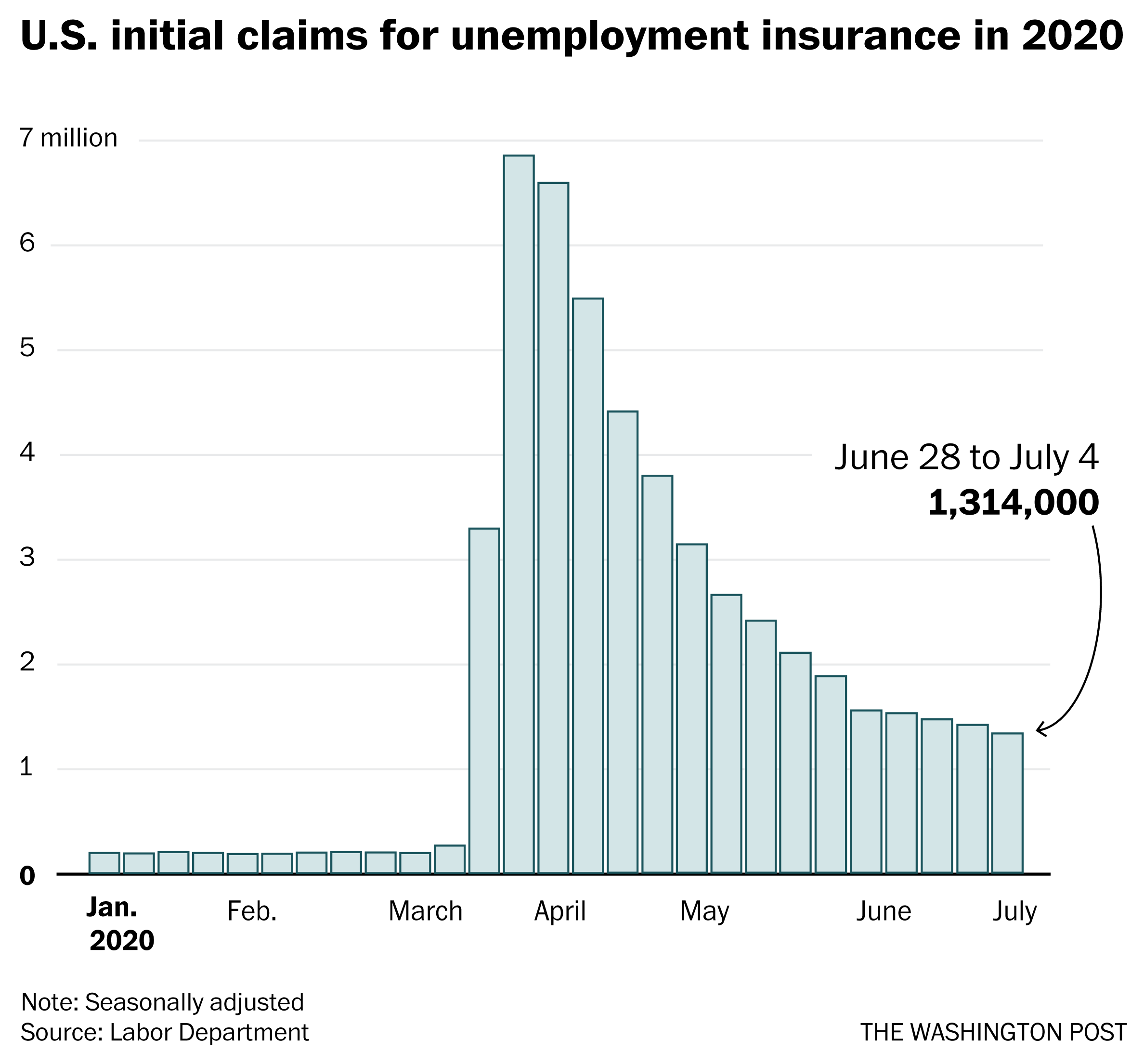
Another 1.3 million people filed for unemployment for the first time last week, a slight decrease from the week before, as novel coronavirus cases and closures surged around the country, according to data released Thursday by the Department of Labor.
The numbers of new unemployment filings have remained above a million each week since the pandemic began mid-March. That number has averaged about 1.4 million the past four weeks.
In addition, states reported that another 1 million claims were made under the Pandemic Unemployment Assistance program, which grants jobless benefits for gig workers, self-employed workers and contractors, the agency reported.
When combined, the two numbers for initial unemployment claims have ticked up the past three weeks, from 2.24 million in mid-June to 2.44 million last week.
The numbers for the first few days of July come as rising cases of coronavirus infections have hit states and counties nationwide, touching off a new round of closures and restrictions and sending some workers back to the unemployment insurance queue for the second time in just a few short months.
“The bad news is that initial claims are still historically very high and they suggest that damage is continuing to accumulate in the economy,” Adam Ozimek, chief economist at Upwork, said in an interview.
The unemployment rate, which is tabulated separately from the weekly jobless claims, has trended downward the past two months, to 11.1 percent last month, as many laid off or furloughed workers in industries like food service and retail were called back to work. Yet a rising number of workers have reported permanent layoffs.
And the jobless statistics don’t capture the damage from the new round of cases yet.
“All these factors look more like an economy that is riding into a recession than out of one,” Ozimek said. “At this stage in the game, when we’re this far from initial shock, it becomes less likely that new layoffs are the types of jobs that snap back.”
The numbers of people continuously receiving benefits at the end of June has also trended gradually downward. The last week of June saw 18.1 million people on unemployment insurance, down from 19.3 million people the week before that, as re-hirings have slightly outpaced new layoffs week by week.
But as hopes fade for a quick rebound from the pandemic — the United States reported more than 60,000 new cases on Wednesday, a new high — signs of longer term economic damage are emerging.
Levi Strauss & Co. said this week that it planned to cut about 15 percent of its nonretail and nonmanufacturing positions, or about 700 jobs this year. United Airlines warned it may need to furlough nearly 40 percent of its workforce this year, about 36,000 employees. Industrial and aerospace manufacturer the Barnes Group said it would layoff 400 workers; BAE Systems, a defense and aerospace company, said it planned to layoff 300 employees.
There are many workers like Samantha Hartman, 29, whose temporary layoff — she was furloughed in March from Rosen Hotels & Resorts, the hospitality company she works for in Orlando — became permanent this week.
Hartman said her supervisor called her this week to tell her that the company had tried to come up with a way to keep employees but found their hands tied with almost no business coming in.
“Everything is up in the air,” Hartman said. “I fully expect not to find another job in this industry.”
The company, which received a Paycheck Protection Program small business loan of more than $6 million according to the Orlando Sentinel, announced Wednesday that it would layoff a “substantial” amount of its workforce by July 31.
Hartman, who has a heart condition, said the company is letting her keep her health care through August. She moved to Orlando two years ago for the job. Now, she says she’ll probably move back with her family in California when her lease is up next year.
She said Florida’s challenges — including large delays in unemployment insurance processing, mishandling of the coronavirus response, a governor she doesn’t trust — make her less likely to stay in Florida. “If I’m going to struggle financially, I’d rather do that back home where I have a support system,” Hartman said.
Plunging consumer demand amid the virus’s surge and ensuing shutdowns have shuttered businesses across the country. Bed Bath & Beyond announced it would close 200 stores; Brooks Brothers, which filed for bankruptcy protection this week, said it would close 51 stores.
And there’s a grim waiting game for what are expected to be widespread layoffs in state and municipal governments, as budgets are drastically pared to meet declining tax revenue.
Initial weekly jobless claims remain well above the record before the pandemic, of 695,000 in 1982. They have dropped every week since the peak of 6.9 million, from a week in late March, but have plateaued for more than a month.

The June unemployment rate of 11.1 percent, down from a peak of 14.7 percent in April, reflects a continuing, cautious economic recovery. What those numbers don’t show is an increase in employment driven disproportionately by part-time work and industries that are vulnerable to another shutdown.
According to the Labor Department’s survey of American households, many of those workers would work full-time if they could and are working part-time only because of poor economic conditions. The number of people pushed into part-time work has more than doubled since February. Meanwhile, the number of people who work part-time by choice is still down by 23 percent.

The unemployment rate isn’t wrong: Part-time work is still work. However, those jobs have already proved to be vulnerable to a slowing economy. Anyone pushed into part-time work by the coronavirus’s initial shock to the economy may be even more vulnerable in the case of future shutdowns. And part-time workers may not have access to benefits such as health insurance that are available to full-time workers.
The industries that bounced back in May and June are also at the mercy of future shutdowns as coronavirus cases surge across the Sun Belt. For instance, unemployment in leisure and hospitality is still very high but dropped by 10 percentage points from April’s staggering 40 percent. Retail and wholesale unemployment dropped by a third. In contrast, finance, government and professional services have had a slow start to recovery. Unemployment in the information industry actually increased from May to June.

If the greatest gains in employment are in industries that suffered most in the early stages of the pandemic, those gains are vulnerable to future waves of shutdowns. Meanwhile, less-volatile industries may continue to be slow to bounce back. A Congressional Budget Office report predicted that the unemployment rate is expected to stay above its pre-pandemic levels through the end of 2030.

To address the financial fallout from the COVID-19 pandemic, hospitals across the nation are looking to cut costs by implementing furloughs, layoffs or pay cuts.
U.S. hospitals are expected to lose $323.1 billion this year due to the pandemic, according to a recent report from the American Hospital Association. The total includes $120.5 billion in financial losses that hospitals are projected to see from July through December, as well as $202.6 billion in losses that were projected between March and June. The losses were largely due to a lower patient volume after canceling elective procedures.
Although Congress allocated $175 billion to help hospitals offset some of the revenue losses and expense increases to prepare for the pandemic, hospitals have said it is not enough.
Nearly 270 hospitals and health systems have furloughed workers in response to the pandemic and several others have implemented layoffs.
Below are 12 hospitals and health systems that have announced layoffs since June 1:
1. Trinity Health furloughs, lays off another 1,000 workers
Trinity Health, a 92-hospital system based in Livonia, Mich., will lay off and reduce work schedules of 1,000 employees.
2. Ohio children’s hospital cuts jobs
Dayton (Ohio) Children’s Hospital said it has cut jobs to help offset financial losses due to the COVID-19 pandemic.
3. Munson Healthcare to cut 25 leadership positions
Traverse City, Mich.-based Munson Healthcare cut 25 leadership positions to help offset financial losses amid the COVID-19 pandemic.
4. Erlanger lays off 93 nonclinical employees
Chattanooga, Tenn.-based Erlanger Health System has cut 93 nonclinical positions to help offset financial damage from the COVID-19 pandemic. The layoffs come after the health system cut 11 leadership positions June 12, including the CEO of Erlanger Western Carolina Hospital in Murphy, N.C., and made staff and pay cuts in March.
5. Michigan Medicine to lay off 738 employees by end of June
Ann Arbor-based Michigan Medicine planned to eliminate 738 positions by the end of June amid financial challenges from the COVID-19 pandemic.
6. Pennsylvania health system cuts 10% of workforce amid pandemic losses
As part of a restructuring effort to cut pandemic-related losses, State College, Pa.-based Mount Nittany Health System plans to lay off 10 percent of its workforce, or about 250 employees.
7. TriHealth eliminates 440 positions to cut costs
Cincinnati-based TriHealth cut 440 positions as part of a plan to trim at least $140 million in expenditures this year.
8. Layoffs hit U of Kansas Health System
The University of Kansas Health System St. Francis Campus in Topeka laid off employees after previously implementing furloughs.
9. Tower Health to cut 1,000 jobs
Citing a $212 million loss in revenue through May due to the COVID-19 pandemic, West Reading, Pa.-based Tower Health plans to cut 1,000 jobs.
10. Colorado hospital cuts 22 positions
Parkview Medical Center in Pueblo, Colo., eliminated 22 positions in response to the COVID-19 pandemic.
11. Arkansas Children’s cuts 42 positions
Little Rock-based Arkansas Children’s Hospital said it is eliminating 42 jobs as part of cost-savings measures in response to the COVID-19 pandemic.
12. North Carolina health system cuts 10% of workforce, closes clinics
Citing a financial hit from the COVID-19 pandemic, Lumberton, N.C.-based Southeastern Health will permanently close several clinics, cut 10 percent of its workforce and reduce executive pay.

Healthcare added 358,000 jobs in June, with hospitals seeing their first modest gain since March, according to the latest jobs report from the U.S. Bureau of Labor Statistics.
The June count compares to 312,400 healthcare jobs added in May, and 1.4 million healthcare jobs lost in April.
Within ambulatory healthcare services, dentist offices saw the biggest job gains in June, with more than 190,000 new jobs. Physician offices saw more than 80,000 job gains, and other healthcare practitioners’ offices had more than 48,000 gains in June.
Hospitals added 6,700 jobs in June, the first job gains seen since losing 26,700 jobs in May and 134,900 positions in April.
Nursing and residential care facilities lost 18,300 jobs last month, compared to 36,600 jobs lost in May.
Overall, the U.S. added nearly 4.8 million jobs in June, marking the second months of gains. The U.S. lost 20.5 million jobs in April, but added 2.5 million in May. The unemployment rate also declined to 11.1 percent in June, compared to 13.3 percent in May.
To view the full jobs report, click here.
The coronavirus has decimated the U.S. economy and benched nearly 40 million American workers. In the past several days, the U.S. has logged its highest number of new Covid-19 cases since the pandemic began. These combined with other factors, which we will discuss, is jeopardizing the future employment of millions of workers and the viability of thousands of businesses. Here’s how unemployment has increased for every state, industry, age group, and race, and why.
Unemployment by State
The coronavirus and subsequent stay at home orders hit the labor force especially hard. As states attempted to reopen, a resurgence in the virus is causing many businesses to close again, some by choice, others by government mandate.
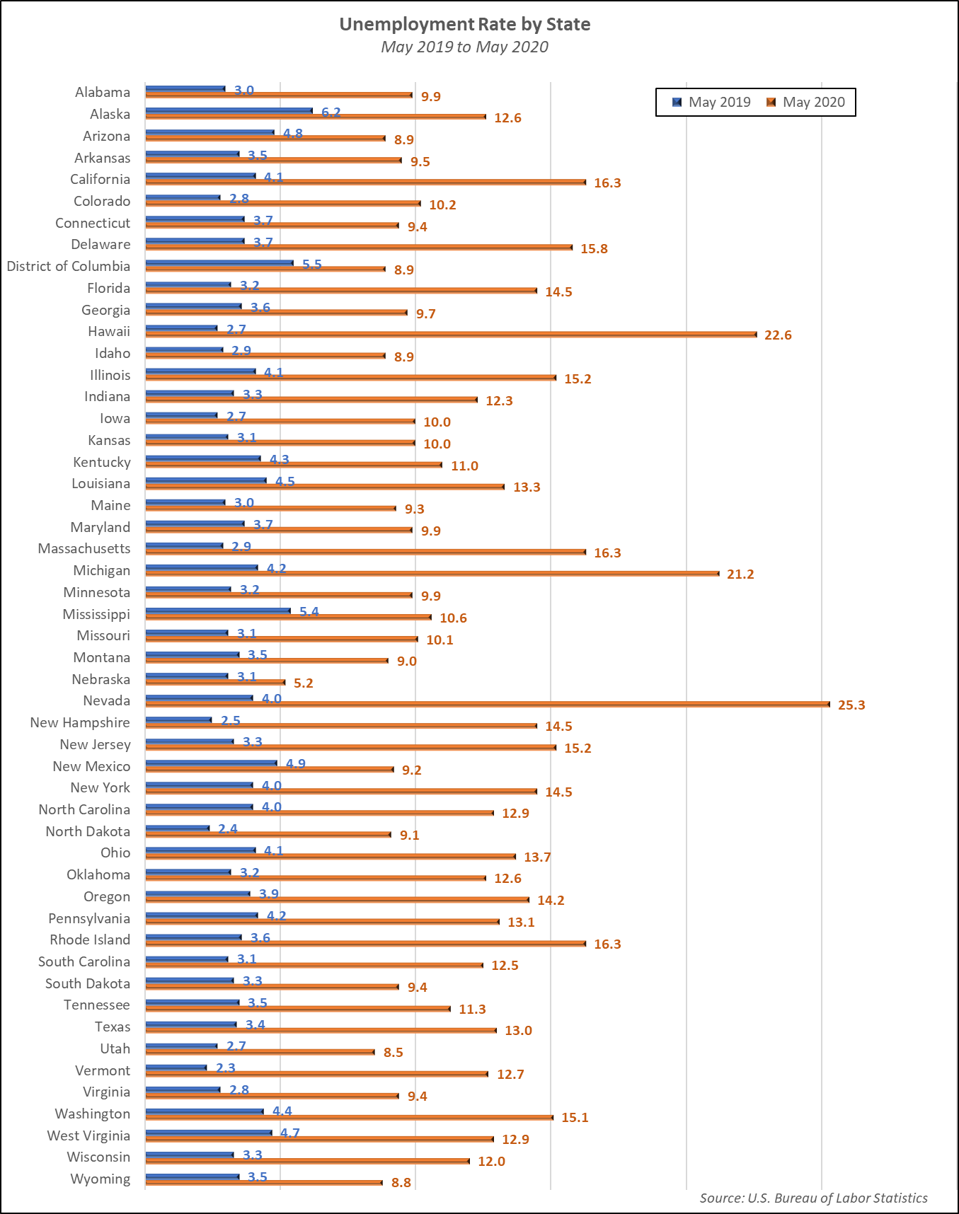
Nevada has been hit the hardest as the unemployment rate in the Silver State rose from 4.0% in May 2019 to a whopping 25.3% in May 2020. Nevada’s economy is heavily reliant on leisure and hospitality, which had the brunt of the job losses. Hawaii, the second hardest hit state saw unemployment rise from 2.7% in May 2019 to 22.6% in May 2020. Which is the only other state with unemployment above 20% in May 2020? Michigan, where unemployment rose from 4.2% to 21.2% year over year. What state has fared best? Nebraska, which also has one of the most diverse economies of all states. Deriving nearly 50% of its total GDP from five different industries, unemployment in the Cornhusker State rose from 3.1% to a modest 5.2% from May 2019 to May 2020. Unemployment numbers for all states are shown in the following chart.
Unemployment by Industry
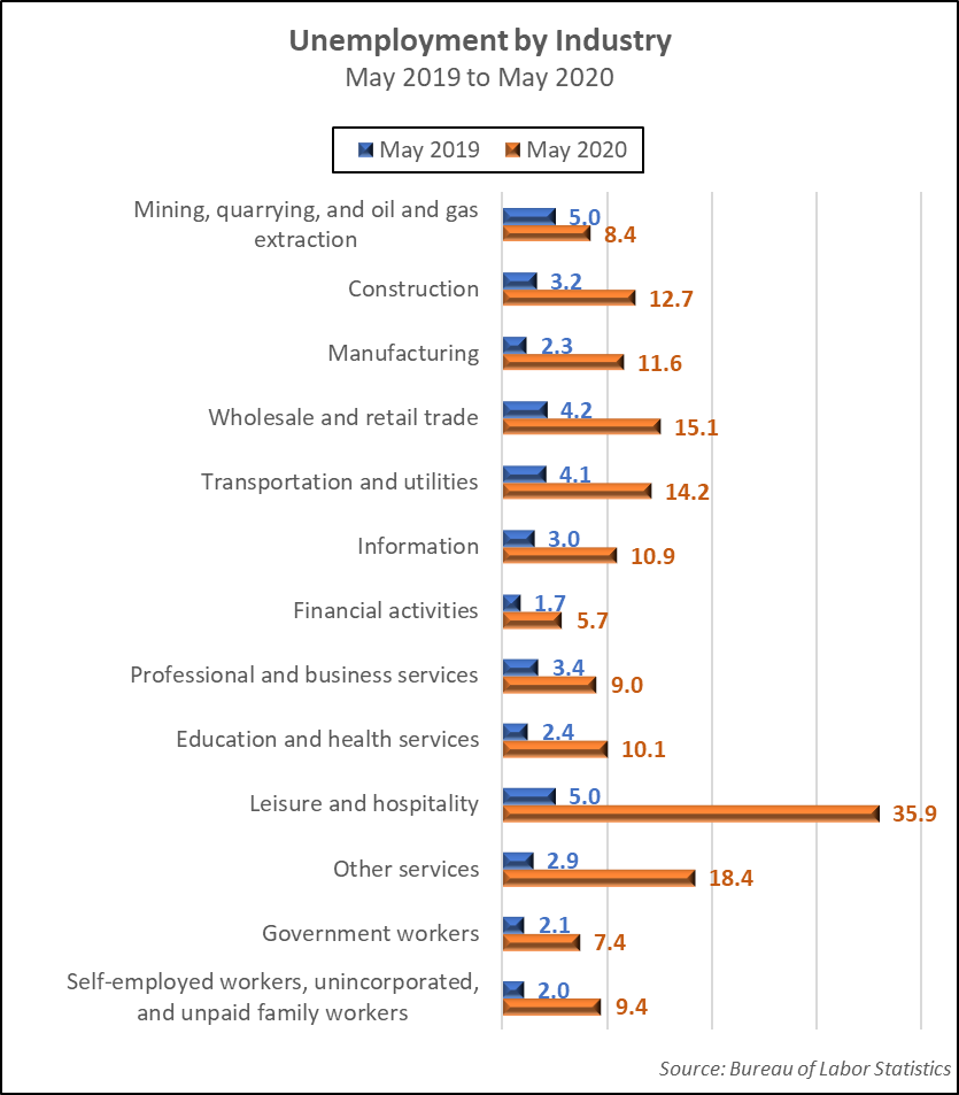
As mentioned in the previous section, the states that have fared best either have a more diverse economy or do not rely heavily on industries that have been hardest hit by the coronavirus. The most negatively affected is the leisure and hospitality industry where unemployment rose 618% from a low of 5.0% in May 2019 to a staggering 35.9% in May 2020. At a distant second, but still reeling, is the wholesale and retail trade industry, which saw unemployment rise from 4.2% to 15.1% during the same period. The rest of the industries are listed in the following chart.
Unemployment by Age Group
Businesses need two things to exist: workers and customers. Without customers, there is no need for workers or the business for that matter. Some businesses require highly skilled workers while others operate well using unskilled labor. It is this unskilled labor group that has been hardest hit.
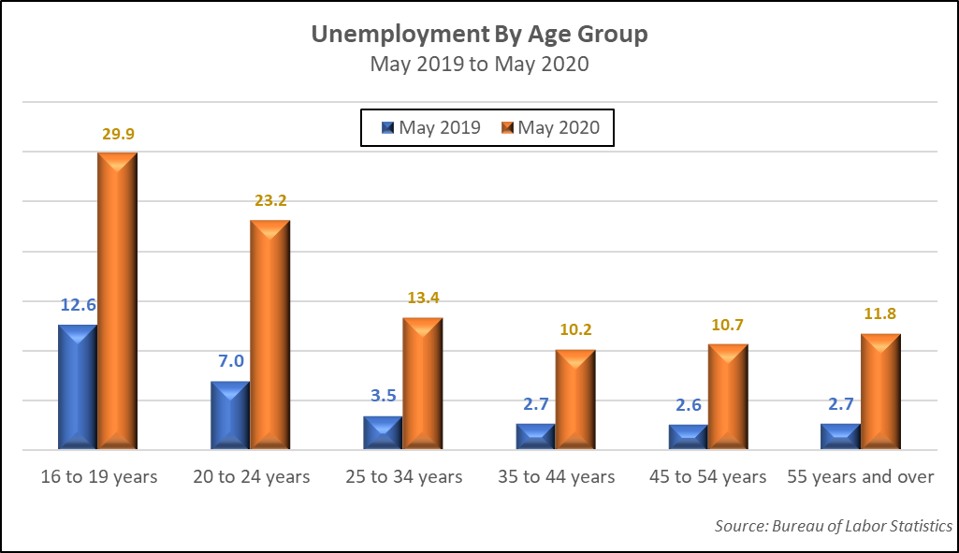
The greatest rise in unemployment is among workers under age 25. This is likely due to three factors. Younger workers typically have fewer marketable skills, less work experience, and less seniority. Many of these workers are in industries that have felt the greatest pain. Unemployment rates by age group are contained in the following chart.
Unemployment by Race/Ethnicity
Question: Prior to Covid-19, was unemployment among blacks / African Americans at a record low as President Trump has claimed? Using the available data, which extends back to January 1972, the answer is yes. This new record low was achieved in October and November of 2019 when unemployment among black or African American workers fell to 5.1%. The previous record low was 5.2% in December 1973. The current rate is 16.8%, which is less than the highest rate of 20.7% logged in December 1982. The most recent high in unemployment for this group was 19.3% in March 2010. It has been steadily declining since then. Numbers for White, Asian, and Hispanic or Latino and black or African American workers are listed in the following chart.
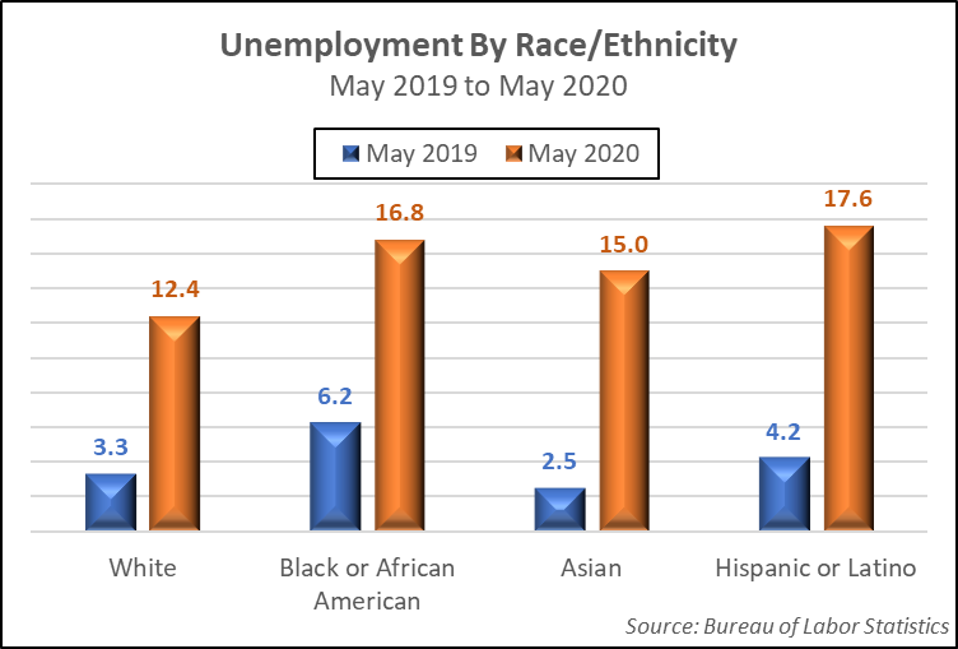
Businesses need workers, workers need businesses, and both depend on customers. Since the pandemic began, consumer demand has fallen sharply. With the probability that a vaccine will not be available until early 2021 at the soonest, plus a disregard for recommended safety protocols by many individuals, namely wearing masks and social distancing, it is highly unlikely that the economy will return to normal for several years.
Will the president continue to hold rallies? Will he set an example by wearing a mask? Will the protests and violence continue? Will other large gatherings continue? Unless Americans make a collective and conscious choice to mask up and social distance, we will be forced to live in a depressed economy for longer than necessary. The choice is up to us.

In May, Trinity said it planned to furlough nearly 12% of its workforce — or 15,000 employees out of the 125,000 nationally.
Trinity, one of the nation’s largest hospital operators with 92 facilities and operations across 22 states, is now broadening that restructuring, extending and adding new furloughs.
In a Monday bond filing, Trinity said its operations were “significantly” impacted by the effects of the pandemic as many operators saw depressed volumes due to shelter-in-place orders, which started in most of Trinity’s markets during the last two weeks of March.
“The effect of COVID-19 on the operating margins and financial results of Trinity Health is adverse and significant and, at this point, the duration of the pandemic and the length of time until Trinity Health returns to normal operations is unknown,” according to Monday’s bond filing.
The system said relief funds provided by the federal government have not been enough to cover its operating losses. Trinity has received $600 million in relief funds that do not have to be repaid and more in loans through the advanced Medicare payment program, according to a previous analysis by Healthcare Dive.
Still, the system said it has drawn on credit facilities totaling $1 billion to provide adequate liquidity during the pandemic. Trinity reported having 178 days cash on hand as of March 30.
Some nonprofits are faring better than Trinity and pulling back on earlier staffing cuts.
Mayo Clinic said last week it will call back its furloughed workers by the end of August and restore pay that had been cut due to the pandemic.
Mayo has some of the most cash on hand in terms of days when comparing other major nonprofit systems. Mayo had 252 days of cash on hand as of March 30, more than the other 20 largest nonprofits except Cleveland Clinic and New York-Presbyterian.
More than three months into the COVID-19 crisis in the U.S., countless Americans are still unemployed. According to the U.S. Labor Department, weekly initial jobless claims data showed yet another week of claims exceeding 1 million.
Another 1.48 million Americans filed for unemployment benefits in the week ending June 20, exceeding economists’ expectations for 1.32 million. The prior week’s figure was revised higher to 1.54 million from the previously reported 1.51 million claims. While this week’s report marked 12 consecutive weeks of deceleration, more than 47 million Americans have filed for unemployment insurance over the past 14 weeks.
“Jobless claims are not falling fast enough,” Renaissance Macro’s Neil Dutta said in an email Thursday. “Everything we have seen in the last week or two between rising case counts/hospitalizations, stalling economic progress in some important states, government job cuts, means one thing: the Phase 4 of fiscal stimulus must be bigger. Things should be better in 3-4 weeks, but the news will get worse before it gets better. Take some chips off the table and reload the chamber for August.”
Continuing claims, which lags initial jobless claims data by one week, totaled 19.52 million in the week ending June 13, down from 20.29 million in the week ending June 6. Consensus expectations were for 20 million continuing claims.
“Initial jobless claims continue to moderate only gradually,” Nomura economist Lewis Alexander wrote in a note Wednesday. “While the labor market remains exceptionally weak, signs of gradual improvement suggest another month of NFP gains during June.”
In the week ending June 20, California reported the highest number of jobless claims at an estimated 287,000 on an unadjusted basis, up from 241,000 in the previous week. Georgia had 124,000, down from 132,000, Florida reported 93,000, New York had roughly 90,000 and Texas reported 89,000 jobless claims.
Additionally, Pandemic Unemployment Assistance (PUA) program claims, which include those who were previously ineligible for unemployment insurance such as self-employed and contracted workers, was also closely monitored in Thursday’s report.
PUA claims totaled 728,120 on an unadjusted basis in the week ending June 20, down from the prior week’s 770,920.
As states reopen their economies, cases and hospitalization figures are back on the rise. As of Thursday morning, there were more than 9.4 million cases and 483,000 COVID-19 deaths around the world, according to Johns Hopkins University data. The U.S. had 2.3 million cases and 121,000 deaths.

 HENRY KOTULA