Trump will urge Supreme Court to strike down Obamacare

https://www.politico.com/news/2020/05/06/trump-supreme-court-obamacare-240366?utm_source=The+Fiscal+Times&utm_campaign=f343554e9c-EMAIL_CAMPAIGN_2020_05_06_09_42&utm_medium=email&utm_term=0_714147a9cf-f343554e9c-390702969

Trump will urge Supreme Court to strike down Obamacare - YouTube

Attorney General Bill Barr had urged the White House to soften its attack on the law during the pandemic.

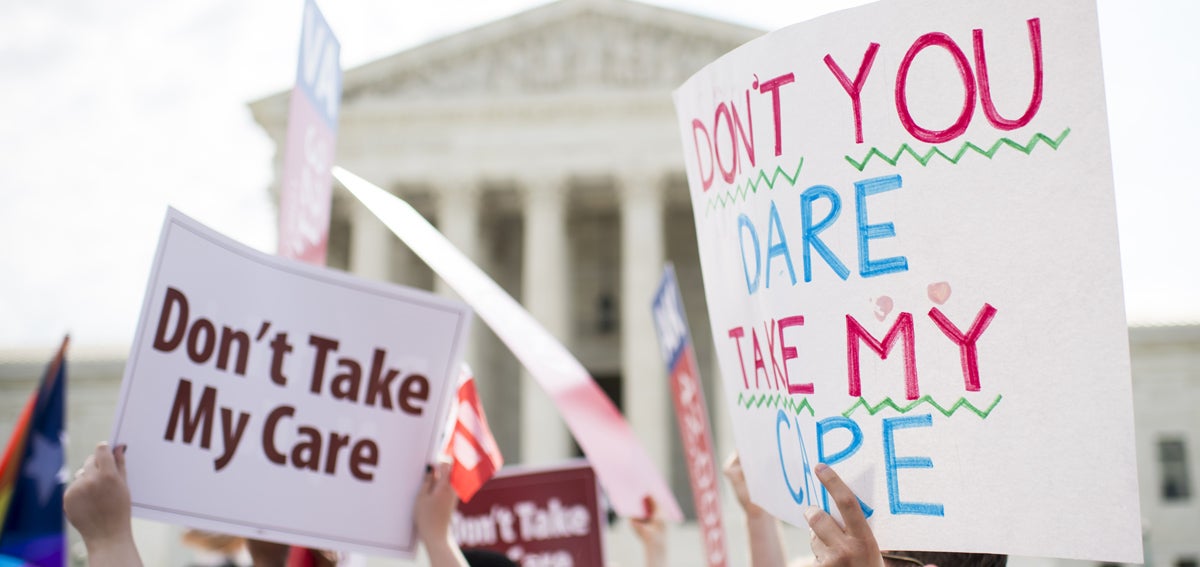
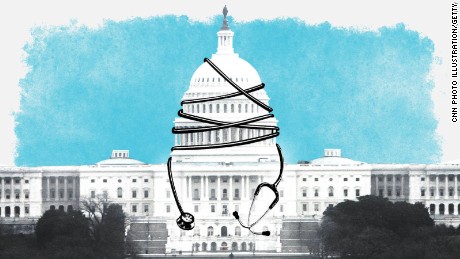
President Donald Trump on Wednesday said his administration will urge the Supreme Court to overturn Obamacare, maintaining its all-out legal assault on the health care law amid a pandemic that will drive millions of more Americans to depend on its coverage.

The administration appears to be doubling down on its legal strategy, even after Attorney General William Barr this week warned top Trump officials about the political ramifications of undermining the health care safety net during the coronavirus emergency.

Democrats two years ago took back the House of Representatives and statehouses across the country by promising to defend Obamacare, in particular its insurance protections that prevent sick people from being denied coverage or charged more because of a health condition. The issue may prove to be even more salient in November amid the Covid-19 outbreak that health experts believe will persist through the fall.

The Justice Department had a Wednesday deadline to change its position in a case brought by Republican-led states, but Trump told reporters Wednesday afternoon his administration would stand firm. DOJ declined to comment.

“Obamacare is a disaster, but we’ve made it barely acceptable,” Trump said.

The Supreme Court later this fall will hear a lawsuit from the GOP-led states that argue the Affordable Care Act was rendered invalid after Congress eliminated its tax penalty for not having health insurance. A coalition of Democratic state attorneys general and the Democratic-led House of Representatives are defending the law in court.

The Trump administration had previously shifted its legal position in this case, but appears to have decided against doing so again. DOJ originally argued the courts should throw out just Obamacare’s preexisting condition protections, before last year urging that the entire law be struck down.

The Supreme Court is expected to hear the case during its next term starting in October, but it hasn’t scheduled arguments yet. A decision is unlikely before the Nov. 3 election. The court has previously upheld Obamacare in two major challenges that threatened the law’s survival.

About 20 million people have been covered by Obamacare, and the law is expected to provide a major safety net during the economic freefall brought on by the coronavirus. Millions more are expected to join the Medicaid rolls, especially in states that joined Obamacare’s expansion to poor adults. Others who lost workplace health insurance can sign up on the law’s health insurance marketplaces, though the Trump administration isn’t doing much to advertise coverage options.

House Democrats in a filing to the Supreme Court on Wednesday said the pandemic showcased why justices should preserve the law.

“Although Congress may not have enacted the ACA with the specific purpose of combatting a pandemic, the nation’s current public-health emergency has made it impossible to deny that broad access to affordable health care is not just a life-or death matter for millions of Americans, but an indispensable precondition to the social intercourse on which our security, welfare, and liberty ultimately depend,” their brief read.

Obamacare has grown more popular since the GOP’s failed repeal bid during Trump’s first year in office, though the law is still broadly disliked by Republicans. Many Democrats are eager to again run on their defense of Obamacare this fall. That includes presumptive presidential nominee Joe Biden, who has advocated for building on the health care law rather than pursuing a comprehensive progressive overhaul like “Medicare for All.”

Top Trump officials have long been split on the legal strategy in the Obamacare lawsuit. Barr and Alex Azar, the Health and Human Services secretary, both opposed a broader attack on the law, but White House officials have been more supportive, seeing it as a chance to fulfill Trump’s pledge to repeal Obamacare. Barr, in a Monday meeting with Vice President Mike Pence and other White House officials, made an eleventh-hour plea for the administration to soften its legal stance ahead of the Supreme Court’s briefing deadline.


Medicaid nearing ‘eye of the storm’ as newly unemployed look for coverage

https://www.fiercehealthcare.com/payer/medicaid-nearing-eye-storm-as-newly-unemployed-look-for-coverage?mkt_tok=eyJpIjoiTXpaa1pEa3pOVGN5T1RnMiIsInQiOiJNbUdDbys5YmFjZDh2MjB2WTd6T0ZRTUg1cGlIYnAyTjNhdzBHdnpEblpZVGxjZEpQM0xPSEFvVG9RdGJQbzdcL21KcmxGV2Vkb1RzWTQ4TnlQQlcxU1BIMXkrZEFMRWwxUDZpTGdpQVlpMVJMR01CRWFDMk1OSGpRSDlLK3RNUTEifQ%3D%3D&mrkid=959610
Medicaid nearing 'eye of the storm' as newly unemployed look for ...

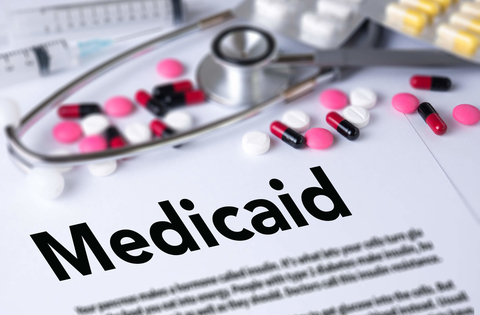
As the coronavirus roils the economy and throws millions of Americans out of work, Medicaid is emerging as a default insurance plan for many of the newly unemployed. That could produce unprecedented strains on the vital health insurance program, according to state officials and policy researchers.

Americans are being urged to stay home and practice “social distancing” to prevent the spread of the virus, causing businesses to shutter their doors and lay off workers.

The Labor Department reported Thursday that more than 6.6 million people signed up for unemployment insurance during the week that ended March 28. This number shattered the record set the previous week, with 3.3 million sign-ups. Many of these newly unemployed people may turn to Medicaid for their families.

Policymakers have often used Medicaid to help people gain health coverage and healthcare in response to disasters such as Hurricane Katrina, the water crisis in Flint, Michigan, and the 9/11 terrorist attacks. But never has it faced a public health crisis and economic emergency in which people nationwide need its help all in virtually the same month.

“Medicaid is absolutely going to be in the eye of the storm here,” said Joan Alker, executive director of the Georgetown University Center for Children and Families. “It is the backbone of our public health system, our public coverage system, and will see increased enrollment due to the economic conditions.”

Meeting those needs will require hefty investments―both in money and manpower.

Medicaid—which is run jointly by the states and federal government and covers about 70 million Americans―is already seeing early application spikes. Because insurance requests typically lag behind those for other benefits, the numbers are expected to grow in the coming months.

“We have been through recessions in the past, such as in 2009, and saw what that meant,” said Matt Salo, who heads the National Association of Medicaid Directors. “We are going to see that on steroids.”

The majority of states have expanded their Medicaid programs since 2014 to cover more low-income adults under a provision in the Affordable Care Act (ACA). That may help provide a cushion in those areas. In the 14 states that have chosen not to expand, many of the newly unemployed adults will not be eligible for coverage.

It’s possible the pandemic could change the decision-making calculus for non-expansion states, Salo said. “The pandemic is like a punch in the mouth.”

But even without expansion in those states, the Medicaid rolls could increase with more children coming into the system as their families’ finances deteriorate. Many states don’t have the resources or systems in place to meet the demand.

“It is going to hit faster and harder than we’ve ever experienced before,” Salo said.

The unique circumstances of social distancing impose new challenges for those whose jobs are to enroll people for coverage. In California, where more than a million people have filed for unemployment insurance since March 13, much of the workforce that would typically be signing people up and processing their paperwork is now working from home, which adds a layer of complexity in terms of accessing files and documents, and can inhibit communication.

“It’s going to be certainly more difficult than it was under the [2008] recession,” said Cathy Senderling-McDonald, deputy executive director for the County Welfare Directors Association of California. She said that although strides have been made in the past decade to set up better online forms and call centers, it will still be a heavy lift to get people enrolled without seeing them in person.

In some states, the challenges to the system are already noticeable.

Utah, for instance, has seen a 46% increase in applications for Medicaid. (These applications can be for individuals or families.) In March 2019, about 14,000 people applied. This March, it was more than 20,400.

“Our services are needed now more than ever,” said Muris Prses, assistant director of eligibility services for the Utah Department of Workforce Services, which processes Medicaid enrollment. The state typically takes 15 days to determine whether someone is eligible, he said, though that will increase by several days because of the surge in applicants and some staff working at home.

In Nevada, where the hotel- and casino-dominated economy has been hit particularly hard, applications for public benefits programs, including food stamps and Medicaid, skyrocketed from 200 a day in February to 2,000 in mid-March, according to the state Department of Health and Human Services. The volume of calls to a consumer hotline for Medicaid and health coverage questions is four times the regular amount.

In Ohio, the number of Medicaid applications has already exceeded what’s typical for this time of year. The state expects that figure to continue to climb.

States that haven’t yet seen the surge warned that it’s almost certainly coming. And as layoffs continue, some are already experiencing the strains on the system, including processing times that could leave people uninsured for months, while Medicaid applications process.

For 28-year-old Kristen Wolfe, of Salt Lake City, who lost her job and her employer-sponsored health insurance March 20, it’s a terrifying time.

Wolfe, who has lupus—an autoimmune disorder that requires regular doctor appointments and prescription medication―quickly applied for Medicaid. But after she filled in her details, including a zero-dollar income, she learned the decision on her eligibility could take as long as 90 days. She called the Utah Medicaid agency and, after being on hold for more than an hour, was told they did not know when she would hear back.

“With my health, it’s scary to leave things in limbo,” said Wolfe, who used her almost-expired insurance last week to order 90-day medication refills, just in case. “I am pretty confident I will qualify, but there is always the ‘What if I don’t?’”

Others have reported smoother sailing, though.

Jen Wittlin, 33—who, until recently, managed the now-closed bar in Providence, Rhode Island’s Dean Hotel―qualified for Medicaid coverage starting April 1. She was able to sign up online after waiting about half an hour on the phone to get help answering specific questions. Once she receives a check for unemployment insurance, the state will reassess her income—currently zero―to see if she still qualifies.

“It was all immediate,” she said.

In fact, she said, she is now working to help newly uninsured former colleagues also enroll in the program, using the advice the state gave her.

In California, officials are trying to reassign some employees—who are now working remotely―to help with the surge. But the system to determine Medicaid eligibility is complicated and requires time-intensive training, Senderling-McDonald said. She’s trying to rehire people who’ve retired and relying on overtime from staffers.

“It’s hard to expand this particular workforce very, very quickly by a lot,” she said. “We can’t just stick a new person in front of a computer and tell them to go. They’re going to screw everything up.”

The move away from in-office sign-ups is also a disadvantage for older people and those who speak English as a second language, two groups who frequently felt more comfortable enrolling in person, she added.

Meanwhile, increasing enrollment and the realities of the coronavirus will likely create a need for costly medical care across the population.

“What about when we start having many people who may be in the hospital, in ICUs or on ventilators?” said Maureen Corcoran, the director of Ohio’s Medicaid program. “We don’t have any specific answers yet.”

These factors will hit just as states―which will experience shrinking tax revenue because of the plunging economy—have less money to pay their share of the Medicaid tab.

“It’s all compounded,” said Lisa Watson, a deputy secretary at Pennsylvania’s Department of Human Services, which oversees Medicaid.

The federal government pays, on average, about 61% of the costs (PDF) for traditional Medicaid and about 90% of the costs for people who joined the program through the ACA expansion. The rest comes from state coffers. And, unlike the federal government, states are constitutionally required to balance their budgets. The financial squeeze could force cuts in other areas, like education, child welfare or law enforcement.

On March 18 (PDF), Congress agreed to bump up what Washington pays by 6.2 percentage points (PDF) as part of the second major stimulus bill aimed at the economic consequences of the pandemic. That will barely make a dent, Salo argued.

“The small bump is good, and we are glad it’s there, but in no way is that going to be sufficient,” he said.


KHN’s ‘What The Health?’: The Affordable Care Act Turns 10

https://khn.org/news/khn-podcast-what-the-health-the-affordable-care-act-turns-10/

Image result for KHN’s ‘What The Health?’: The Affordable Care Act Turns 10

Can’t see the audio player? Click here to listen on SoundCloud.

The past decade for the health law has been filled with controversy and several near-death experiences. But the law also brought health coverage to millions of Americans and laid the groundwork for a shift to a health system that pays for quality rather than quantity.

Yet the future of the law remains in doubt. Many progressive Democrats would like to scrap it in favor of a “Medicare for All” system that would be fully financed by the federal government. Republicans would still like to repeal or substantially alter it. And the Supreme Court recently accepted another case that could invalidate the law in its entirety.

In this special episode of KHN’s “What the Health?” host Julie Rovner interviews Kathleen Sebelius, who was secretary of Health and Human Services during the development, passage and implementation of the health law.

Then Rovner, Joanne Kenen of Politico and Mary Agnes Carey of Kaiser Health News, who have all covered the law from the start, discuss the ACA’s past, present and future.

Among the takeaways from this week’s podcast:

  • Although the creation of the ACA is often attributed to the Obama administration and the Democratic Congress at the time, work on a health care plan actually began well before then with small-group meetings among stakeholders, congressional hearings across the country and efforts by Sen. Ted Kennedy to galvanize interest. Much of those interactions were bipartisan and included industry leaders too.
  • Despite the vehement Republican opposition to the ACA and its many critical junctures (the death of Kennedy and his replacement by Republican Scott Brown; two tight Supreme Court decisions; and the calamitous debut of the marketplace website, among other issues), the law has proved popular. When Republicans gained control of the White House and Congress, their efforts to repeal the law helped focus consumers’ interest on the law and safeguard it.
  • How will the November election affect the law? If President Donald Trump is reelected, he is unlikely to renew the effort to repeal the law, but that doesn’t mean the assault on the law is over. Efforts to change the ACA could continue through the courts and through administrative rulemaking.
  • If a Democrat is elected, modifications to the law are generally expected to be incremental and perhaps deal with changes such as expanding the number of people getting subsidies and fix some glitches in the law.


Ten Years After: The ACA’s Success in Five Charts

Ten Years After: The ACA’s Success in Five Charts


Taking a look at the Biden healthcare plan

https://mailchi.mp/325cd862d7a7/the-weekly-gist-march-13-2020?e=d1e747d2d8


Now that the Democratic primary campaign has produced a clear front runner, it’s worth examining Joe Biden’s healthcare plan, which aims to expand the Affordable Care Act (ACA) by increasing access and affordability. As the graphic above highlights, former Vice President Biden has a broad—if at this point, still fairly high-level—proposal that includes a Medicare-like public option along with a variety of other ACA tweaks that aim to offer consumers more options and lower their healthcare costs.

These include allowing individuals in states without Medicaid expansion to join the pubic option premium-free, providing unlimited subsidy eligibility, and limiting drug price increases to the level of consumer inflation.

An independent analysis projects Biden’s plan would cost $2.25T and add an additional $800B to the deficit over 10 years. While large at first blush, these costs pale in comparison to Sen. Bernie Sanders’ Medicare for All plan, which would add a projected $12.95T to the deficit over the same period.

Of course, there are still many unanswered questions in Biden’s proposal, including how much consumers would pay under the public option, how much the public option plan would reimburse providers as a percentage of Medicare, and how the public option would impact competition among private insurers.

A public option offered at a significant discount has the potential to drive private plans out of business, which some project could eventually result in Medicare for All as an ultimate consequence. The devil will, as always, be in the details.


US Supreme Court Agrees to Review Affordable Care Act — for the Third Time

US Supreme Court Agrees to Review Affordable Care Act — for the Third Time

Image result for US Supreme Court Agrees to Review Affordable Care Act — for the Third Time

The fate of the Affordable Care Act (ACA) is once again in the hands of the US Supreme Court. On March 2, the court announced that it would hear a case challenging the health law, a wide-ranging measure that “touches the lives of most Americans, from nursing mothers to people eating at chain restaurants,” wrote Reed Abelson, Abby Goodnough, and Robert Pear in the New York Times. This will be the third time the court will rule on the ACA since President Barack Obama signed it on March 23, 2010.Essential Coverage

“The justices will review a federal appeals court decision that found part of the law . . . unconstitutional and raised questions about whether the law in its entirety must fall,” reported Robert Barnes in the Washington Post. He noted that it is one of the first cases accepted for the Supreme Court term beginning October 5, which means a decision is not likely until spring or summer of 2021.

Should the court overturn the ACA, many Americans would lose the benefits afforded under the law. As Dylan Scott wrote in Vox, “everything would go: protections for preexisting conditions, subsidies that help people purchase insurance, the Medicaid expansion.”

Let’s break down each of those categories.

Protections for Preexisting Conditions

Before the ACA, people with preexisting conditions, which included common medical conditions like asthma, diabetes, and cancer, were denied health insurance or charged higher insurance premiums. Important benefits like maternity care and mental health services frequently were carved out of the benefit packages in health plans sold in the individual market — that is, outside of employer-sponsored coverage. An issue brief (PDF) by the Department of Health and Human Services estimated that up to 133 million nonelderly Americans have a preexisting condition.

As Andy Slavitt, the former administrator of the Centers for Medicare & Medicaid Services under President Obama, wrote on Twitter, examples of being charged more included “$4,270 more for asthma, $17,060 for pregnancy, and $160,510 for metastatic cancer.”

Under the ACA, insurers are no longer allowed to deny coverage or charge higher prices to people with preexisting conditions. But if the Supreme Court rules against the ACA, these protections would vanish.

Medicaid Expansion

A key provision of the ACA is expanded eligibility for enrollment in Medicaid, a federally funded state option adopted so far by 36 states and the District of Columbia. More than 12 million adults with low incomes have gained Medicaid coverage through this provision, and research comparing expansion and nonexpansion states has linked expanded Medicaid access to better health outcomes.

According to the Urban Institute, if the ACA is repealed, “the uninsurance rate across all expansion states would increase from 9% of the nonelderly under current law to 17% under repeal. In nonexpansion states, the uninsurance rate would increase from 15% of the nonelderly to 21%.” Many of the newly uninsured would be the result of losing the Medicaid coverage the ACA provided.

“The uninsured rate for Black Americans would increase from 11% to 20% without Obamacare,” Scott reported. “There would also be a dramatic spike in uninsurance among Hispanics.”

Subsidies to Help People Purchase Insurance

To expand access to affordable health insurance for those who can’t get it through their jobs, the ACA offers federal subsidies to people with low and moderate incomes who buy insurance through the ACA insurance exchanges. The subsidies take the form of premium tax credits and cost-sharing subsidies.

Approximately 9.2 million Americans receive federal subsidies, reported Abelson, Goodnough, and Pear. “On average, the subsidies covered $525 of a $612 monthly premium for customers in the 39 states that use the federal marketplace,” they wrote.

If the ACA is overturned and the subsidies are eliminated, the cost of health insurance would become unaffordable for many of those 9.2 million people, and the uninsured population would soar.

Polls Show Public Support for the ACA

According to the February 2020 KFF Health Tracking Poll, 55% of Americans say they now favor the ACA, a new high compared to approval ratings below 40% as recently as 2016. Today 85% of Democrats express favorable views of the law, compared to 53% of independents and 18% of Republicans.

Though overall support for the health law remains partisan, many of its provisions have broad bipartisan support, KFF staff wrote in Health Affairs. For instance, large majorities of Democrats (94%), independents (88%), and Republicans (77%) have a favorable view of the ACA’s health insurance exchanges, and most Democrats (80%), independents (71%), and Republicans (54%) view the Medicaid expansion favorably.

Rising Health Costs Worsen California’s Coronavirus Threat

The global spread of the novel coronavirus disease known as COVID-19 puts threats to the ACA into perspective. Despite the coverage gains made under the ACA, nearly 28 million Americans remain uninsured, and that number would rise if the law were overturned. As Chris Sloan, associate principal at the consulting firm Avalere Health, told Caitlin Owens in Axios, we “could see uninsured or underinsured patients . . . skipping necessary treatment because they believe they can’t afford it.”

“Some lawmakers are concerned that the tens of millions who are underinsured — Americans with high deductibles or limited insurance — may also be at risk of unexpected expenses as more and more people are exposed to the virus,” Reed Abelson and Sarah Kliff reported in the New York Times.

Kristof Stremikis, director of CHCF’s market analysis and insight team, wrote in a recent blog post, “In an era when the average deductible facing a working family in California now exceeds $2,700, it’s not hard to imagine how many people missed detection and treatment opportunities because they could not afford to pay for them.”

To address some of these concerns, the California Department of Insurance (PDF) and the Department of Managed Health Care (PDF) directed all commercial health plans and Medi-Cal plans to “immediately reduce cost-sharing (including, but not limited to, co-pays, deductibles, or co-insurance) to zero for all medically necessary screening and testing for COVID-19, including hospital, emergency department, urgent care, and provider office visits where the purpose of the visit is to be screened and/or tested for COVID-19.”

Similar policies have been announced by state regulators in Washington and New York, the San Francisco Chronicle reported.


President Trump releases his budget and suffers a loss in court

https://mailchi.mp/0ee433170414/the-weekly-gist-february-14-2020?e=d1e747d2d8

Image result for healthcare policy

This week, the Trump administration unveiled its $4.8T federal budget for the upcoming fiscal year, including major cuts to spending on healthcare programs.

Rather than proposing specific spending cuts, however, the President’s budget calls for Congress to put forward plans to “advance the President’s health reform vision”—which presumably includes the administration’s recent proposal to allow states to partially convert Medicaid to a block-grant structure—with promised savings of $844B over the coming decade.

Coupled with additional proposals targeting specific changes to Medicaid reimbursement (including further implementation of work requirements for Medicaid enrollees) and reductions in subsidies for Affordable Care Act (ACA) marketplace consumers, the budget envisions a total of $1T in healthcare cuts over the next 10 years.

Complicating the administration’s vision for Medicaid transformation, however, a federal appeals court on Friday unanimously ruled that the version of Medicaid work requirements proposed by Arkansas is unlawful, because it does not further the statutory purpose of the Medicaid program.

Although the ruling does not impact work requirements programs elsewhere, it does cast a shadow over the administration’s larger attempt to encourage states to implement such policies.

Like the broader fate of the ACA, the future of Medicaid work requirements will ultimately lie in the hands of the US Supreme Court.

The President’s budget, however, will face immediate opposition in Congress, where House Speaker Nancy Pelosi (D-CA) called it “a complete reversal of the promises [President Trump] made in the campaign and a contradiction of the statements he made in the State of the Union.”

As the general election approaches, voters will eventually have to choose between the conservative vision for healthcare underpinning the President’s budget, and progressive proposals being advanced by Democratic candidates. With healthcare being the number one issue on the mind of the electorate, that choice could not be more stark.


Appeals court strikes down Trump approval of Medicaid work requirements

Appeals court strikes down Trump approval of Medicaid work requirements

Image result for Appeals court strikes down Trump approval of Medicaid work requirements

A federal appeals court on Friday struck down the Trump administration’s approval of Medicaid work requirements in Arkansas, the latest legal blow to one of President Trump‘s signature health initiatives. 

The U.S. Court of Appeals for the D.C. Circuit affirmed a lower court ruling that the approval of the work requirements was “arbitrary and capricious.

More than 18,000 people lost coverage in Arkansas due to the work requirements before they were halted by a lower court.

The court found that the Trump administration disregarded the statutory purpose of Medicaid — to provide health coverage — and did not adequately account for the coverage losses that would result from the work requirements. 

“Failure to consider whether the project will result in coverage loss is arbitrary and capricious,” Judge David Sentelle, an appointee of President Reagan, wrote in the opinion.

Requiring Medicaid recipients to work or else lose coverage is a top priority of Centers for Medicare and Medicaid Services Administrator Seema Verma. She argues that the policy helps lift people out of poverty by getting them jobs and out of Medicaid into employer-based insurance.

But Democrats and health care advocates have denounced the move, saying it imposes burdensome paperwork requirements on low-income people that cause them to lose coverage even if they are working.

The policy has also faced a string of legal losses, with courts ruling that Congress would need to act to authorize the work requirements. 

Arkansas was the only state where the requirements went into effect before being blocked by the courts. Several other states’ efforts were approved, but the initiatives have been halted as the issue works its way through the courts.

“The Court recognized the tragic harm that these work requirements have caused people in Arkansas doing their best to get ahead,” said Kevin De Liban, an attorney at Legal Aid of Arkansas, which helped challenge the requirements. “Now, more than two hundred thousand Arkansans on the program can rest easier knowing that they’ll have health care when they need it.”

Conservative changes to Medicaid have been a leading priority of the Trump administration, which also recently announced plans to let states block-grant their funding for the program. That move was also denounced by Democrats as inevitably leading to coverage losses and is also likely to be challenged in court.

Kentucky had originally also been part of the work requirement litigation, but a Democratic governor, Andy Beshear, was elected last year and ended the initiative.


President Trump’s budget cuts target Medicaid, Medicare

https://www.healthcarefinancenews.com/news/president-trumps-budget-cuts-target-medicaid-medicare?mkt_tok=eyJpIjoiWVRnM01UZzNaR0V6TTJFNSIsInQiOiJ6aXpsQnNCRjhHdCs4SnN0UytlZnJVUlZUeFdreEZyQ2V6RWE0YklvYmFMOGJnbWpXT3ZHeG0rOHMwNkJPcE9rMUlGb3NzVkpId3NrZHNkZmR2VlZISXZCVGgrbU94cFV3aVlNR1NYamlhazF1R1kzaXd3RXVISm9OSGJoYmVrVCJ9

Image result for medicaid cuts

Blueprint includes cuts for care in hospital outpatient departments, teaching hospitals and post-acute care providers, AHA says.

President Trump’s proposed $4.8 trillion budget slashes billions of dollars from Medicaid, food stamps and other safety net programs in an attempt to shrink the federal deficit.

Medicaid and the Affordable Care Act see about $1 trillion in cuts over the next decade, according to The Hill. The budget eliminates the enhanced federal match for Medicaid expansion enrollees. An additional $150 billion is expected to be shaved off of Medicaid from the implementation of work requirements, which is expected to result in people losing their healthcare coverage.

The “President’s health reform vision” to ax the Affordable Care Act takes $844 billion over 10 years from the ACA, the report said.

The decrease in federal spending on Medicare would total about $750 billion over 10 years, but that includes shifting two programs out of the budget. After accounting for those changes, the reduction is just over $500 billion, according to CNN. Much of that cut comes from reducing payments to providers.

The budget needs Congressional approval and is not expected to get past a Democratic-controlled House without changes.

House Speaker Nancy Pelosi tweeted: “The budget is a statement of values. Once again, the #TrumpBudget makes it painfully clear how little the President values the good health, financial security and well-being of America’s hard-working families.”

Ways and Means Committee Chairman Richard E. Neal, D-MA, said, “When I saw the President’s proposed budget today, I felt an immense sense of relief – relief that there is absolutely no chance of his ruthless cuts to critical programs ever becoming law. Slashing billions from Medicare and Medicaid will only make it harder for Americans to access the healthcare they need.

Cutting nutrition assistance and Social Security benefits for the disabled won’t enable people to get back on their feet financially.”

Senator Lamar Alexander, R-Tenn said, “Under the Constitution, it is Congress’ job to set spending priorities and pass appropriations bills, and as a member of the Senate Appropriations Committee, my priorities will continue to be making sure our national defense, national laboratories, the National Institutes of Health and national parks have the resources they need. I am encouraged to see the president is calling to end surprise medical billing.”

The budget adds money to the National Institutes of Health. The NIH will invest $50 million for new research on chronic diseases, using AI and related approaches, according to the White House briefing. It adds $7 billion over 10 years to fight opioid abuse and for mental health in the Medicaid program.

WHY THIS MATTERS

Cuts to Medicare and Medicaid mean uncompensated care to providers, or a reduction in the government payments.

The American Hospital Association said, “The budget request, which is not binding, proposes hundreds of billions of dollars in reductions to Medicare and Medicaid over 10 years.”

AHA President and CEO Rick Pollack said, “Every year, we adapt to a constantly changing environment, but every year, the Administration aims to gut our nation’s healthcare infrastructure. The proposals in this budget would result in hundreds of billions of dollars in cuts that sacrifice the health of seniors, the uninsured and low-income individuals. This includes the one in five Americans who depend on Medicaid, of which 43% of enrollees are children.

“In addition to the hundreds of billions in proposed reductions to Medicare, the blueprint includes cuts we strongly oppose for care in hospital outpatient departments, teaching hospitals and post-acute care providers. These cuts fail to recognize the crucial role hospitals serve for their communities, such as providing 24/7 emergency services. Post-acute cuts threaten care for patients with the most medically complex conditions.”


Public Charge Rule Could Erode Enrollment in Insurance Coverage

Public Charge Rule Could Erode Enrollment in Insurance Coverage

Mother and baby at clinic with doctor. Baby is looking directly into the camera.

In a 5-4 vote reflecting the ideological split among the justices, the US Supreme Court on January 27 decided to allow the Trump administration to commence enforcement (PDF) of its “public charge” rule nationwide. Only Illinois, where a statewide injunction is currently in effect, will not begin enforcing the rule. The regulation was slated to take effect last October, but federal judges in California, Illinois, Maryland, New York, and Washington blocked its implementation after states and immigrant rights groups challenged its legality. Federal appeals courts later lifted all but New York’s nationwide injunction and Illinois’ statewide injunction. The Supreme Court has now “stayed,” or put on hold, New York’s injunction, allowing the rule to take effect while the litigation continues.Essential Coverage

The US Citizenship and Immigration Services agency said the new rule will become effective February 24.

The public charge rule sparked controversy because it “would expand the government’s ability to refuse green cards or visas for legal immigrants determined to be a ‘public charge,’ or dependent on public assistance,” Susannah Luthi explained in Politico. “Those using or likely to use Medicaid, food stamps, and other safety-net programs would face greater scrutiny from immigration officials.”

Experts have warned of a “chilling effect” among immigrant communities, meaning that even those who are not subject to the public charge rule could disenroll or avoid public benefits out of fear. The Institute for Community Health estimated that 195,000 to 455,000 California children in need of medical attention could leave Medi-Cal if the rule takes effect. Including adults, this estimate grows to between 317,000 and 741,000 Californians disenrolling from Medi-Cal, according to researchers from UCLA and UC Berkeley (PDF).

The chilling effect has been documented on a national scale. According to the Urban Institute, in 2018, the year when the Trump administration proposed expanding the public charge rule, about 14% of adults in immigrant families reported that fear prompted them or a family member not to apply for a public benefit program or to disenroll from one. Of the adults who experienced chilling effects, 42% said they or their family members did not participate in Medicaid or the Children’s Health Insurance Program.

Soon after the rule was finalized last year, Eisner Health, a community clinic in Los Angeles, started getting phone calls from patients enrolled in Medi-Cal and CalFresh who wanted to end their families’ coverage, Claudia Boyd-Barrett reported in California Health Report. Many of those patients were not yet permanent residents or were members of mixed immigration status families who feared being penalized for using public benefits.

New Rule Doesn’t Apply to Many Immigrants

It is important to note that many immigrants are not subject to the new public charge rule. “It is urgent that all of us working with immigrant communities — via government, legal aid, health care, and more — have accurate and accessible information for families,” Sandra R. Hernández, president and CEO of CHCF, wrote on Twitter.

Mark Ghaly, California Health and Human Services Agency secretary, released a statement emphasizing that immigrant families should learn their rights. “You can find a list of nonprofit organizations providing free legal immigration services on the California Department of Social Services (CDSS) website, here,” Ghaly said.

CDSS offers a list of legal services providers across California who can assist with public charge questions. Protecting Immigrant Families (a partnership of the National Immigration Law Center and The Center for Law and Social Policy) also has resources on the public charge rule.

Following the Supreme Court’s order to stay the nationwide injunction, California Attorney General Xavier Becerra reiterated his commitment to fighting the rule. “We are a nation of immigrants, so we will lean forward in the face of heartless attacks on working families,” Becerra said in a statement. “Together, we’ll continue our fight to stand up for the right of each and every person who calls the United States their home.”

The legal challenges to the public charge rule will continue to move forward in courts around the nation — including in California — the New York Times’s Adam Liptak reported.

Medicaid Block Grants Could Reduce Access for Many

The Trump administration has announced its plan to let states volunteer to convert a portion of their Medicaid funding into block grants. The program, which has been branded a “Healthy Adult Opportunity,” represents a radical change in financing for Medicaid. Medicaid programs, which are operated by states with significant federal funding and oversight, constitute the nation’s health insurance program for Americans with low incomes. Covering over 75 million people, or one in five Americans, Medicaid programs provide services to 83% of children from low-income families, 48% of children with special health care needs, and 45% of nonelderly adults with disabilities.

On January 30, the administrator of the US Centers for Medicare & Medicaid Services, Seema Verma, sent to state Medicaid directors a letter (PDF) about the new block grant program. Verma gave states “the possibility of trading away an entitlement program that expands and contracts depending on how many poor people need the government health coverage,” Amy Goldstein wrote in the Washington Post. “In exchange, for able-bodied adults in the program, states could apply to receive a fixed federal payment and freedom from many of the program’s rules.”

Additionally, participating states would be allowed to limit the health benefits and drugs offered by their Medicaid programs, Rachel Roubein and Dan Diamond reported for Politico. According to one official, patients with behavioral health needs or HIV would be protected under the new plan.

Criticism from Medicaid advocates was swift. Twenty-seven patient and consumer groups, including the American Lung Association, American Cancer Society, and National Alliance on Mental Illness, issued a statement expressing strong opposition to the new guidance. “Block grants and per capita caps will reduce access to quality and affordable health care for patients with serious and chronic health conditions and are therefore unacceptable to our organizations,” they wrote.

“Worst Medicaid Idea Ever”

Frederick Isasi, executive director of Families USA, said in a statement, “Having spent many years working with governors and Medicaid programs, block grants are possibly the worst Medicaid idea ever presented to states by a federal administration. They would allow the federal government to off-load shared Medicaid responsibility at the expense of deep cuts to state budgets, vital programs supported by states, and the people who rely on those programs.”

Joan Alker, executive director and a cofounder of Georgetown University’s Center for Children and Families, warned in a statement that “if states accept a fixed cap on federal funding to meet their health care needs, they may be able to get by in the short term, but they put the health of their citizens and future state budgets at serious risk down the road.”

The block grant program is unlikely to affect California, which has invested heavily in expanding Medi-Cal access and is not expected to apply to participate.

Nonetheless, the block grant proposal shows that the Trump administration continues to prioritize changes that weaken the foundation of the nation’s health care safety net and could dramatically reduce health coverage for millions of Americans with low incomes.