


Cartoon – Non-Prophet Healthcare
https://www.miamiherald.com/news/politics-government/state-politics/article248806165.html

The child welfare agency that serves Miami-Dade and Monroe counties pushed back Wednesday against allegations made by the governor’s chief inspector general, denying claims that it used taxpayer funds to pad excessively high salaries of top executives.
In a statement, Citrus Health Network President and CEO Mario Jardon and Citrus Health Network Board of Directors Chair Patricia Croysdale said that the state did not check with them before issuing the preliminary report and Jardon’s salary, and that of chief operating officer Maria Alonso, “do not come from state funds allocated to Citrus as the lead agency, and are provided at no cost to the state.”
Citrus Health Network, a mental health nonprofit, won a half-billion dollar contract in 2019 from the state Department of Children & Families to oversee child welfare cases in Miami-Dade and Monroe. The arrangement is part of the state program that has privatized state services to a patchwork of “lead agencies.”
According to the preliminary findings by the governor’s Chief Inspector General Melinda Miguel, Citrus Health was one of nine agencies that appear to be paying their executives more than the amount allowed by state law.
Florida law prohibits a community-based care lead agency that receives state and federal funding to provide welfare services from paying its executives more than 150% of what the Department of Children and Families secretary makes — a threshold estimated at $213,820.
In response to the Citrus Health comments, Meredith Beatrice, spokesperson for Gov. Ron DeSantis, said that the intent of the report was to highlight agencies that “were either in non-compliance or appeared to have excessive compensation” and will be investigated further.
“Nothing within the document is conclusory or final,’’ she said.
The report says Jardon made $574,660, which the state says includes $360,840 in excess compensation. The state also said Alonso, Jardon’s partner, made $42,379 over the maximum, and the company’s chief information officer, Renan Llanes, made $172 over the limit.
“The Governor’s Office of Inspector General chose to release a preliminary report incorrectly alleging inappropriate use of state funds and excessive executive compensation without first confirming the information in the report directly with Citrus, and without utilizing other publicly available fiscal documents related to our company,’’ the company’s statement said.
The Citrus Health contract began in July 2019, but the state report appears to have used compensation data from tax documents ending in June 2019.
Citrus also pointed to its web site, which has posted a document that shows a 2020-21 budget that includes compensation of $207,711 with “other compensation” of $20,498 for its director. The company said that refers to Esther Jacobo, the director of the Citrus Health Family Care Network, who formerly was the interim secretary at DCF.
A footnote then adds that “CEO and COO are provided at no cost to [Citrus Family Care Network] and DCF.”
“At the beginning of operations as the lead agency, Citrus’ Board of Directors resolved not to burden the budget of the lead agency with the salaries of the CEO and COO of Citrus Health Network,” said Citrus Health Network spokesperson Leslie M. Viega in a statement. “Our CEO and COO’s salaries do not come from any funds allocated to Citrus as the lead agency, regardless of the source, including state-appropriated funds, state-appropriated federal funds, or private funds.”
The company says the salaries are paid through another division, its federally qualified health center which provides behavioral health, primary care, housing for the homeless, and other social services. The Herald/Times asked Citrus Health for a copy of the financial documents that demonstrate this claim but the organization has not provided them.
In 2019, Citrus Health won the child welfare contract from a rival non-profit, Our Kids, after a bruising yearlong fight plagued by allegations that the selection process was marred by the appearance of conflicts of interest. The contract gave the company, which had never handled child welfare before, the job of overseeing about 3,000 vulnerable children in the state’s most populous region.
The inspector general’s investigation is the result of an executive order by DeSantis in February 2020 after the Miami Herald reported and a House of Representatives investigation found that the Florida Coalition Against Domestic Violence paid its chief executive officer, Tiffany Carr, more than $7.5 million over three years.
Carr, who is now a party to two lawsuits, including an attempt by the state to claw back the compensation she was awarded, is currently engaged in negotiations with the attorney general’s office over a mediated settlement.
But it was Carr’s ability to use her network of influential legislators and lobbyists, coupled with the lack of oversight by the Department of Children and Families, that provoked legislators and the governor’s investigators to look into how other non-profits are compensating their executives.
Carr persuaded her board of directors, a close-knit group whom she hand-selected, to approve her compensation package that included thousands of hours of paid leave which she converted to cash.. She justified her salary and bonuses by using comparable salaries of similar organizations but she is alleged to have misrepresented the size of her organization to make the comparisons work to her advantage.
Investigators also suspect Carr avoided declaring millions of dollars in deferred compensation on her tax forms by using a loophole in the tax code.
The inspector general’s report does not name executives but a spreadsheet provided to the Herald/Times from the governor’s office indicates the amounts of compensation by title. The Herald/Times used publicly available tax data to identify the individuals under investigation.
The governor’s office said the next phase of the investigation will be to meet with the nine community-based care organizations early next week “to explain the process” before the final report is completed by June 30.
“It is important to note that the entities impacted from this review will have an opportunity in late May to offer a written response to the draft of the final report,’’ Beatrice said. “Their responses will be included as an attachment to the final report presented to the governor.”


Southfield, Mich.-based Beaumont Health reported a net loss of $278.4 million in the first quarter of 2020, a decrease of $407.5 million compared to the same period one year prior.
The health system said that the loss is largely due to the COVID-19 pandemic, which negatively affected operating and nonoperating income for the three-month period ended March 31.
Beaumont saw its operating revenue fall to $1.07 billion in the first quarter of 2020, compared to operating revenue of $1.15 billion in the same period in 2019.
In addition, the system saw its operating income drop $91.7 million year over year.
Nonoperating losses for the first quarter totaled $224.6 million, compared to a nonoperating gain of $91.6 million in the same period in 2019.
“The shelter-in-place order and community concerns about the virus have led to significant reductions in emergency center visits, nonessential surgeries and diagnostic services. We believe these reductions will continue well into the second quarter and negatively impact financial performance in a significant way,” Beaumont Health CFO John Kerndl said.
To help improve its financial performance, Beaumont said it will defer all nonessential capital expenditures, fine-tune staffing levels and cut other expenses.
“We will continue to explore and pursue all options and plans that will help our organization survive this crisis and return to a position of strength after COVID-19 is no longer a threat to our community,” Mr. Kerndl said.

West Reading, Pa.-based Tower Health and Drexel University completed the $50 million acquisition of St. Christopher’s Hospital for Children in Philadelphia on Dec. 15.
St. Christopher’s was put up for sale after it and Philadelphia-based Hahnemann University Hospital filed for Chapter 11 bankruptcy at the end of June. Hahnemann closed in September, the same month Tower Health and Drexel University entered into a $50 million agreement to acquire St. Christopher’s.
With the sale complete, 188-bed St. Christopher’s will return to nonprofit status.
“We are grateful for the continuing dedication and hard work of the physicians and employees at St. Christopher’s,” Tower Health President and CEO Clint Matthews said in a press release. “We are excited about a bright future for St. Christopher’s as it continues to serve as a center for healthcare, medical education and research, and innovation.”

There may be an opportunity to highlight increased revenues for the benefit of local government, since investor-owned hospitals pay taxes.
Remember: Every hospital, regardless of its tax status, must bring in more dollars than it spends in order to be financially healthy and reinvest.
In most communities, the conversion of a hospital from a not-for-profit to an investor-owned enterprise no longer stirs the heated debate that it did decades ago. Instead, you’re much more likely today to see not-for-profit and investor-owned hospital organizations working in partnership.
Renowned not-for-profit health systems such as Duke Health and the Cleveland Clinic have formed strong affiliations with investor-owned hospital companies. In these and other partnerships, not-for-profits and investor-owned organizations are working together to strengthen hospitals, invest in communities, and serve patients.
In fact, the issues facing investor-owned hospital systems during a partnership are the same as those faced by not-for-profit health systems during a partnership discussion: Local control and governance, cultural compatibility, charity care support, and commitment to local investment are leading hot buttons for both.
Still, the “conversion” of a not-for-profit to an investor-owned organization can represent a change that can raise questions and ignite unhelpful rumors.
To help you be prepared, start by answering these basic questions: What’s the difference? How are not-for-profit and for-profit (investor-owned) hospitals different from one another?
Here’s an overview: Independent, not-for-profit hospitals are, in a sense, owned by the communities they serve. The boards are usually comprised of local leaders and physicians. Excess revenues—profits—are fully reinvested into the community’s care after debt payments, payroll, and other expenses. Hospitals that join a regional or national not-for-profit health system, however, may or may not have a local board with a say in the direction of the facility and may or may not share their profits with the system. (In fact, if your local hospital is in financial trouble, the money flows into your hospital, not out of it!)
Investor-owned hospitals are, as you might guess by the name, owned by investors, who can be private individuals or stockholders. Investors traditionally benefit as the value of the company’s hospitals increases over time, through effective operations and local investments, and as the company overall grows by adding more hospitals.
Adding to this complexity is the trend for hospitals to pursue joint venture partnerships where ownership is shared by two or more organizations, including the “seller.” These partnerships call for strong and trusting relationships by every party. Communications is key to success.
Familiarize yourselves with these terms and issues as you move through a partnership. Be prepared for some myth busting.
That’s where the fundamental structural differences end. The driving forces of both organizations, however, are precisely the same:
Now, consider some specific questions you may hear related to the structure of a not-for-profit to investor-owned conversion.
When there are funds left over from a sale, they are often referred to as the proceeds. These proceeds exist once the hospital’s debt and any other obligations (e.g., a pension fund) have been paid.
The answer as to what happens to those dollars depends on the ownership structure of the selling organization and the terms of the transaction. Here are a few scenarios:
This is really a question of community commitment and may be an indicator of how much the community-based culture is or is not going to change under the new ownership. In most cases, a commitment to either a specific level of charity care or a guarantee to continue the hospital’s existing charitable mission and policy is written into the deal documents. Expect the question and know the answer.
An investor-owned hospital pays taxes that benefit local government. This question is an opportunity to highlight the added contribution as a distinct benefit of investor-owned partnerships.
In many cases, the fire department, police force, schools, parks, and other community assets will benefit on an annual basis from an investor-owned partner paying state and local property and sales taxes.
One cautionary note: In some cases, new hospital owners may seek appropriate tax incentives when entering a new community and investing in a hospital. Be sure you understand the local government strategic thinking before you answer the tax question.
https://www.healthleadersmedia.com/finance/top-5-differences-between-nfps-and-profit-hospitals
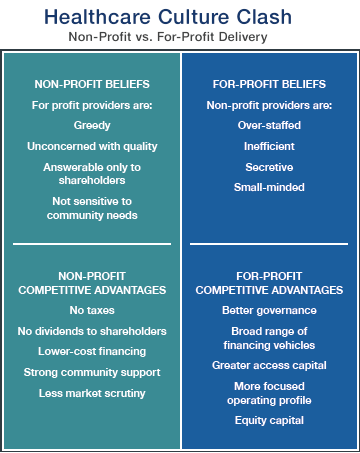
All hospitals serve patients, employ physicians and nurses, and operate in tightly regulated frameworks for clinical services. For-profit hospitals add a unique element to the mix: generating return for investors.
This additional ingredient gives the organizational culture at for-profits a subtly but significantly different flavor than the atmosphere at their nonprofit counterparts, says Yvette Doran, chief operating officer at Saint Thomas Medical Partners in Nashville, TN.
“When I think of the differences, culture is at the top of my list. The culture at for-profits is business-driven. The culture at nonprofits is service-driven,” she says.
Doran says the differences between for-profits and nonprofits reflect cultural nuances rather than cultural divides. “Good hospitals need both. Without the business aspects on one hand, and the service aspects on the other, you can’t function well.”
There are five primary differences between for-profit and nonprofit hospitals.
The most obvious difference between nonprofit and for-profit hospitals is tax status, and it has a major impact financially on hospitals and the communities they serve.
Hospital payment of local and state taxes is a significant benefit for municipal and state governments, says Gary D. Willis, CPA, a former for-profit health system CFO who currently serves as CFO at Amedisys Inc., a home health, hospice, and personal care company in Baton Rouge, LA. The taxes that for-profit hospitals pay support “local schools, development of roads, recruitment of business and industry, and other needed services,” he says.
The financial burden of paying taxes influences corporate culture—emphasizing cost consciousness and operational discipline, says Andrew Slusser, senior vice president at Brentwood, TN-based RCCH Healthcare Partners.
“For-profit hospitals generally have to be more cost-efficient because of the financial hurdles they have to clear: sales taxes, property taxes, all the taxes nonprofits don’t have to worry about,” he says.
“One of the initiatives we’ve had success with—in both new and existing hospitals—is to conduct an Operations Assessment Team survey. It’s in essence a deep dive into all operational costs to see where efficiencies may have been missed before. We often discover we’re able to eliminate duplicative costs, stop doing work that’s no longer adding value, or in some cases actually do more with less,” Slusser says.
With positive financial performance among the primary goals of shareholders and the top executive leadership, operational discipline is one of the distinguishing characteristics of for-profit hospitals, says Neville Zar, senior vice president of revenue operations at Boston-based Steward Health Care System, a for-profit that includes 3,500 physicians and 18 hospital campuses in four states.
“At Steward, we believe we’ve done a good job establishing operational discipline. It means accountability. It means predictability. It means responsibility. It’s like hygiene. You wake up, brush your teeth, and this is part of what you do every day.”
A revenue-cycle dashboard report is circulated at Steward every Monday morning at 7 a.m., including point-of-service cash collections, patient coverage eligibility for government programs such as Medicaid, and productivity metrics, he says. “There’s predictability with that.”
A high level of accountability fuels operational discipline at Steward and other for-profits, Zar says.
There is no ignoring the financial numbers at Steward, which installed wide-screen TVs in most business offices four years ago to post financial performance information in real-time. “There are updates every 15 minutes. You can’t hide in your cube,” he says. “There was a 15% to 20% improvement in efficiency after those TVs went up.”
Accountability for financial performance flows from the top of for-profit health systems and hospitals, says Dick Escue, senior vice president and chief information officer at the Hawaii Medical Service Association in Honolulu.
Escue worked for many years at a rehabilitation services organization that for-profit Kindred Healthcare of Louisville, Kentucky, acquired in 2011. “We were a publicly traded company. At a high level, quarterly, our CEO and CFO were going to New York to report to analysts. You never want to go there and disappoint. … You’re not going to keep your job as the CEO or CFO of a publicly traded company if you produce results that disappoint.”
Finance team members at for-profits must be willing to push themselves to meet performance goals, Zar says.
“Steward is a very driven organization. It’s not 9-to-5 hours. Everybody in healthcare works hard, but we work really hard. We’re driven by each quarter, by each month. People will work the weekend at the end of the month or the end of the quarter to put in the extra hours to make sure we meet our targets. There’s a lot of focus on the financial results, from the senior executives to the worker bees. We’re not ashamed of it.”
“Cash blitzes” are one method Steward’s revenue cycle team uses to boost revenue when financial performance slips, he says. Based on information gathered during team meetings at the hospital level, the revenue cycle staff focuses a cash blitz on efforts that have a high likelihood of generating cash collections, including tackling high-balance accounts and addressing payment delays linked to claims processing such as clinical documentation queries from payers.
For-profit hospitals routinely utilize monetary incentives in the compensation packages of the C-Suite leadership, says Brian B. Sanderson, managing principal of healthcare services at Oak Brook, IL–based Crowe Horwath LLP.
“The compensation structures in the for-profits tend to be much more incentive-based than compensation at not-for-profits,” he says. “Senior executive compensation is tied to similar elements as found in other for-profit environments, including stock price and margin on operations.”
In contrast to offering generous incentives that reward robust financial performance, for-profits do not hesitate to cut costs in lean times, Escue says.
“The rigor around spending, whether it’s capital spending, operating spending, or payroll, is more intense at for-profits. The things that got cut when I worked in the back office of a for-profit were overhead. There was constant pressure to reduce overhead,” he says. “Contractors and consultants are let go, at least temporarily. Hiring is frozen, with budgeted openings going unfilled. Any other budgeted, but not committed, spending is frozen.”
The for-profit hospital sector is highly concentrated.
There are 4,862 community hospitals in the country, according to the American Hospital Association. Nongovernmental not-for-profit hospitals account for the largest number of facilities at 2,845. There are 1,034 for-profit hospitals, and 983 state and local government hospitals.
In 2016, the country’s for-profit hospital trade association, the Washington, DC–based Federation of American Hospitals, represented a dozen health systems that owned about 635 hospitals. Four of the FAH health systems accounted for about 520 hospitals: Franklin, TN-based Community Hospital Systems (CHS); Nashville-based Hospital Corporation of America; Brentwood, TN–based LifePoint Health; and Dallas-based Tenet Healthcare Corporation.
Scale generates several operational benefits at for-profit hospitals.
“Scale is critically important,” says Julie Soekoro, CFO at Grandview Medical Center, a CHS-owned, 372-bed hospital in Birmingham, Alabama. “What we benefit from at Grandview is access to resources and expertise. I really don’t use consultants at Grandview because we have corporate expertise for challenges like ICD-10 coding. That is a tremendous benefit.”
Grandview also benefits from the best practices that have been shared and standardized across the 146 CHS hospitals. “Best practices can have a direct impact on value,” Soekoro says. “The infrastructure is there. For-profits are well-positioned for the consolidated healthcare market of the future… You can add a lot of individual hospitals without having to add expertise at the corporate office.”
The High Reliability and Safety program at CHS is an example of how standardizing best practices across the health system’s hospitals has generated significant performance gains, she says.
“A few years ago, CHS embarked on a journey to institute a culture of high reliability at the hospitals. The hospitals and affiliated organizations have worked to establish safety as a ‘core value.’ At Grandview, we have hard-wired a number of initiatives, including daily safety huddles and multiple evidence-based, best-practice error prevention methods.”
Scale also plays a crucial role in one of the most significant advantages of for-profit hospitals relative to their nonprofit counterparts: access to capital.
Ready access to capital gives for-profits the ability to move faster than their nonprofit counterparts, Sanderson says. “They’re finding that their access to capital is a linchpin for them. … When a for-profit has better access to capital, it can make decisions rapidly and make investments rapidly. Many not-for-profits don’t have that luxury.”
There are valuable lessons for nonprofits to draw from the for-profit business model as the healthcare industry shifts from volume to value.
When healthcare providers negotiate managed care contracts, for-profits have a bargaining advantage over nonprofits, Doran says. “In managed care contracts, for profits look for leverage and nonprofits look for partnership opportunities. The appetite for aggressive negotiations is much more palatable among for-profits.”

Spurred in part by the Affordable Care Act, hospitals across the country have merged to form massive medical systems in the belief it would simplify the process for patients.
But a simpler bill doesn’t always guarantee a cheaper bill.
That’s a key issue in an antitrust lawsuit against one of California’s largest hospital systems set to begin Monday.
The lawsuit alleges Sutter Health gobbled up competing medical providers in the region and used its market dominance to set higher prices for insurance plans, which means more expensive insurance premiums for consumers.
Becerra points to a 2018 study that found unadjusted inpatient procedure prices are 70% higher in Northern California than Southern California. The lawsuit notes Sutter Health’s assets were $15.6 billion at the end of 2016, up from $6.4 billion in 2005.
“We never meant for folks to use integration to boost their profits at the expense of consumers,” Becerra said.
It’s rare for antitrust lawsuits of this size to go to trial because the law allows for triple damages — a prospect that often spooks companies into settling outside of court to avoid an unpredictable jury. Health plans in this case are asking for $900 million in damages, meaning Sutter Health could take a nearly $3 billion hit.
Atrium Health, a North Carolina-based hospital system, settled a similar anti-trust lawsuit with the federal government last year. And CHI Franciscan, a health system based in Washington state, also settled similar claims in March that had been brought by the state.
But Sutter Health is fighting the case. The company says the lawsuit is not about its prices, but about insurance companies who want to maximize their own profits. Sutter Health officials insist the company faces fierce competition, vowing to detail in court the expansion of other health systems in the San Francisco Bay Area and the Sacramento Valley.
Four Sutter Health hospitals had operating losses in 2018, totaling $49 million.
“The bottom line is that this lawsuit is designed to skew the healthcare system to the advantage of large insurance companies so they can market inadequate insurance plans to Californians,” said Sutter Health Director of Public Affairs Amy Thoma Tan.
At issue are several of Sutter Health’s contracting policies that Becerra says have allowed the company to “thoroughly immunize itself from price competition.”
One way insurance companies keep costs down is to steer patients to cheaper health care providers through a variety of incentives. Becerra says Sutter Health bans insurance companies from using these incentives, making it harder for patients to use their lower-priced competitors.
Becerra also says Sutter has an “all or nothing” approach to negotiating with insurance companies, requiring them to include all of the company’s hospitals in their provider networks even if it doesn’t make financial sense to do so.
The case was originally filed by a trust of Northern California’s largest unionized grocery companies in 2014. A representative for the trust said it was “unknowingly forced to pay Sutter’s artificially high prices.”
But the company says these contracting practices are designed to protect patients. People often are unable to pick which hospital they go to in a medical emergency, which can lead to surprise bills when they learn a hospital or doctor was not in their network.
Jackie Garman, lawyer for the California Hospital Association, said these contracting practices are standard at a lot of hospitals. If the lawsuit is successful, she said it could “disrupt contracting practices at a lot of other systems.”
But the consequences of not bringing the lawsuit could be greater, Becerra said.
“We are paying every time we allow an anti-competitive behavior to drive the market,” he said.

The Federal Reserve cut interest rates by a quarter point on Wednesday, bringing the target range for the benchmark Fed Funds rate to 1.75%–2%.
Why it matters: The Fed’s 2nd consecutive rate cut reflects worries about the U.S. economy. The trade war and slowing growth around the world have made corporate executives more worried than they’ve been in years.

The industry continues to experience pressures including slowing inpatient admissions and more patients covered by government-sponsored health insurance such as Medicare, which typically reimburses at a lower rate compared to commercial insurers.
Wages are also under pressure amid a tight labor market, and the need to shift to an environment that is increasingly reimbursing for quality — not quantity.
The question now is whether these recent gains are a “temporary blip” or a major shift, Fitch analysts noted.
“Not-for-profit hospitals are by no means out of the woods yet with sector pressures likely to continue, but there appears to be light at the end of the tunnel in terms of longer-term stability,” Holloran said.
Still, despite the margin improvement, Fitch maintains a negative outlook for the sector.
Even still, “the not-for-profit healthcare sector has shown considerable resiliency over the years, weathering events like the 2008/2009 great recession, sequestration cuts to governmental funding, and a shifting payor mix,” Fitch analysts said.
Fitch believes consolidation among providers will continue. Providers will focus on increasing their size and scale to maintain leverage over insurance companies and allow them to invest in population health.
 HENRY KOTULA