Minneapolis-based Allina Health posted an operating income of $128.8 million for the year ended Dec. 31, up from the $36.3 million loss in 2020, according to its financial results.
The 10-hospital system saw its net income jump 400.8 percent in 2021 to $381.1 million, compared to $76.1 million the year prior.
Allina’s total revenue increased by 11.3 percent, or $493 million, in 2021 compared to 2020. This was directly related to reduced volumes because of the mandatory shutdown in 2020, Allina said in the report. The system’s total patient revenue reached $4.5 billion in 2021, a 14.5 percent increase from the year before at $3.9 billion.
The health system’s operating expenses rose 7.5 percent for the 12 months months ended Dec. 31 to $4.7 billion, compared to $4.4 billion in 2020.
AdventHealth, a 48-hospital system based in Altamonte Springs, Fla., recorded a $417.72 net loss in the first quarter of 2022, driven by both investment and operating losses, according to recently released financial results.
In the quarter ended March 31, AdventHealth saw its revenue increase to $3.67 billion, up nearly 8 percent from the same period last year.
Although revenue was up, so were AdventHealth’s expenses. In the first quarter of 2022, AdventHealth saw its expenses grow to $3.72 billion, up from $3.23 billion recorded in the same period in 2021.
“The increased expense is primarily a result of elevated premium and contract labor costs and wage inflation resulting from workforce shortages,” AdventHealth stated in its financial report. “The system continues to implement workforce stabilization plans to reduce turnover and temporary labor utilization.”
AdventHealth ended the first quarter of 2022 with an operating loss of $46.75 million. In the same quarter of 2021, AdventHealth recorded an operating income of $179.11 million.
After factoring in nonoperating items, including a $372.16 million investment loss, AdventHealth ended the first quarter of 2022 with a net loss of $417.72 million. In the first quarter of 2021, AdventHealth recorded a $94.78 million net income.
St. Louis-based Ascension reported higher expenses in the three months ended March 31 and ended the quarter with a loss, according to financial documents filed April 29.
The 143-hospital system reported operating revenue of $6.69 billion in the first three months of this year, up from $6.56 billion in the same period of 2021.
Ascension’s operating expenses climbed to $7.34 billion in the first three months of 2022, up from $6.59 billion in the same period a year earlier. The increase was attributed to several factors, including higher salaries, wages and supply expenses.
Looking at the first nine months of the current fiscal year, Ascension’s operating expenses increased 8.7 percent year over year. Staffing challenges, increased use of contract labor and overtime spend pushed Ascension’s total salaries, wages and benefits up 10.1 percent year over year in the nine months ended March 31.
Ascension ended the most recent quarter with an operating loss of $671.14 million, compared to an operating loss of $16.71 million in the same period last year.
After factoring in nonoperating items, Ascension reported a net loss of $884.74 million for the three months ended March 31. A year earlier, the health system posted net income of $957.32 million. For the first nine months ended March 31, Ascension reported net income of $145.21 million, compared to $4.77 billion in the same period a year earlier.
As of March 31, Ascension had 295 days cash on hand, compared to 336 days as of June 30, 2021.
For the quarter ending March 31, 2022, Kaiser Foundation Health Plan, Inc., Kaiser Foundation Hospitals, and their respective subsidiaries (KFHP/H) reported total operating revenues of $24.2 billion and total operating expenses of $24.3 billion compared to total operating revenues of $23.2 billion and total operating expenses of $22.2 billion in the same period of the prior year. There was an operating loss of $0.07 billion, or (0.3%) of total operating revenues, for the first quarter of the year compared to operating income of $1.0 billion, or 4.4%, in the first quarter of 2021.
During the first quarter of 2022, a surge in COVID-19 cases — the steepest since the start of the pandemic — led to a substantial increase in the demand for related care and testing. COVID-19 expenses drove an additional $1.4 billion in expenses. Those expenses, along with the costs of providing care to our members that was deferred earlier in the pandemic, were the primary drivers of additional expenses. In the first quarter of 2022, Kaiser Permanente cared for more than 688,000 patients with COVID-19, including more than 26,000 hospitalized patients, performed 2.5 million COVID-19 diagnostic tests, supplied 1.3 million COVID-19 home tests, and administered 1.4 million vaccine doses. In addition, like the rest of the industry, Kaiser Permanente experienced significant increases in labor costs during the first quarter of 2022, compared to the same period last year and when compared to year-end 2021.
“I am incredibly proud of the extraordinary people of Kaiser Permanente, who have stepped up time and time again to provide high-quality care and service to our members and communities during unparalleled challenges,” said chair and chief executive officer Greg A. Adams. “While in the first quarter, the ongoing effects of the pandemic strained our workforce, communities, and operations, our operating model, which provides both care and coverage, enabled us to continue providing that care even in the face of an unprecedented omicron surge and industrywide labor shortage. Our underlying operating performance remains solid and aligned with expectations.”
In the category of other income and expense, the quarterly loss totaled $889 million, driven largely by investment losses, compared to $1.0 billion in income in the same period of the prior year. For the quarter, there was a net loss of $961 million compared to net income of $2.0 billion in 2021.
Capital spending
Capital spending in the first quarter totaled $872 million compared to $906 million in the same period of the prior year. During the first 3 months of 2022, Kaiser Permanente opened a new, 220,000-square-foot medical facility in Timonium, Maryland, that features 24-hour advanced urgent care and a 24-hour pharmacy, along with an ambulatory surgery center.
“While the increase in pandemic-related expenses, overall rising costs, and investment market losses impacted our finances this quarter, Kaiser Permanente navigated this challenging time providing high-quality care and continued investing in our integrated model including ongoing capital investments to best serve our members. We controlled discretionary spending, optimized COVID-19 testing, addressed surgical backlogs, and managed outside medical expenses,” said executive vice president and chief financial officer Kathy Lancaster. “As we face the ongoing uncertainty and prolonged effects the pandemic is having on the health care industry, we are well positioned to continue delivering high-quality, affordable care and remain vigilant stewards of resources entrusted to us in this dynamic environment.”
Membership
Membership as of March 31, 2022, was 12.6 million, reflecting a growth of more than 88,000 members since December 31, 2021. Medicaid enrollees accounted for almost 33,000 of Kaiser Permanente’s new members.
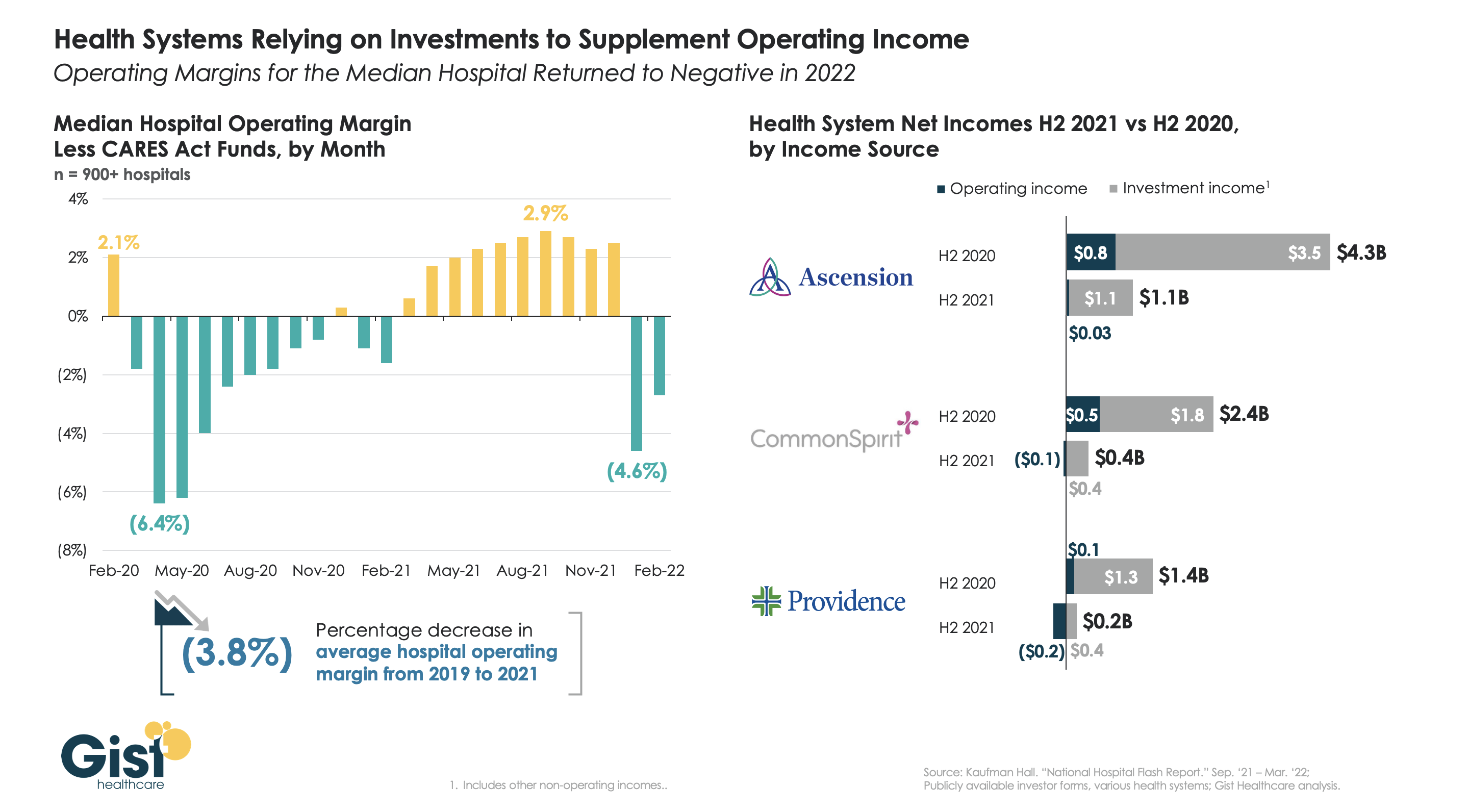
The combination of the Omicron surge, lackluster volume recovery, and rising expenses have contributed to a poor financial start of the year for most health systems. The graphic above shows that, after a healthier-than-expected 2021,the average hospital’s operating margin fell back into the red in early 2022, clocking in more than four percent lower than pre-pandemic levels.
Despite operational challenges, however, many of the largest health systems continue to garner headlines for their sizable profits, thanks to significant returns on their investment portfolios in 2021.
While CommonSpirit and Providence each posted negative operating margins for the second half of 2021, and Ascension managed a small operating profit, all three were able to use investment income to cushion their performance.
A growing number of health systems are doubling down on investment strategies in an effort to diversify revenue streams, and capture the kind of returns from investments generated by venture capital firms. However, it is unlikely that revenue diversification will be a sustainable long-term strategy.
To succeed, health systems must look to reconfigure elements of the legacy business model that are proving financially unsustainable amid rising expenses, shifts of care to lower-cost settings, and an evolving, consumer-centric landscape.
Judging from our recent conversations with health system executives, we’d guess CEOs across the industry woke up this morning glad to see the first quarter in the rearview mirror.
Almost everyone we’ve spoken to has told us that the past three months have been miserable from an operating margin perspective—skyrocketing labor costs, rising drug and supply prices, and stubbornly long length of stay, particularly among Medicare patients.
In the words of one CFO, “I’ve never seen anything like this. For the first time, we budgeted for a negative margin, and still didn’t hit our target. I’m not sure how long our board will let us stay on this trajectory before things change.”
Yet few of the drivers of poor financial performance appear to be temporary. Perhaps the over-reliance on agency nursing staff will wane as COVID volumes bottom out (for how long remains unknown), but overall labor costs will remain high, there’s no immediate relief for supply chain issues, and COVID-related delays in care have left many patients sicker—and thus in need of more costly care. Plus, the lifeline of federal relief funds is rapidly dwindling, if not already gone.
Expect the next three quarters (and beyond) to bring a greater focus on cost cutting, especially as not-for-profit systems struggle to defend their bond ratings in the face of rising interest rates.
While many hospitals face financial hardships and rising expenses from the COVID-19 pandemic, several large health systems ended 2021 with profits above $1 billion.
These big health systems attributed the financial performance to several factors, including bigger investment gains and higher-acuity patients.
Seven health systems that posted net income of $1 billion last year:
1. Pittsburgh-based UPMC, an integrated delivery system with 40 hospitals, recorded a net income of $1.1 billion in 2021, driven by an operating income of $843 million and nonoperating gains of $810 million.
2. AdventHealth, a 48-hospital system based in Altamonte Springs, Fla., recorded a net income of $1.5 billion in 2021. The net income included an operating income of $994.6 million and investment gains of $517.7 million. In 2020, the health system’s net income was $914.8 million.
3. Cleveland Clinicreported a 66.7 percent increase in net income for the 12 months ended Dec. 31. The 19-hospital system saw its net income hit $2.2 billion, including an operating income of $746.3 million and investment gains of $1.4 billion.
4. Rochester, Minn.-based Mayo Clinic’s net income for 2021 was $3.6 billion, up from $2.5 billion a year earlier. The results included an operating income of $1.2 billion.
5. Driven by strong investment gains, Oakland, Calif.-based Kaiser Permanenterecorded a net income of $8.1 billion in 2021, an increase of $1.7 billion from 2020. The sharp rise in net income from the integrated delivery system with 39 hospitals included $7.5 billion in other income, including investment gains, and $611 million in operating income for 2021.
6. Nashville, Tenn.-based HCA Healthcare, a 182-hospital system, reported a net income of $7.7 billion in 2021, including investment gains and operating profits.
7. Tenet Healthcare, a 60-hospital system based in Dallas, reported net income of $1.5 billion on revenues of $19.5 billion in 2021. Tenet ended the 12-month period with an operating income of $2.9 billion, up from $2 billion recorded one year before. It also recorded losses on nonoperating activities and said its results for the year ending Dec. 31 included a pretax gain of $406 million associated with the divestiture of five Miami area hospitals, as well as stimulus funds totaling $205 million.
Driven by strong investment gains, Oakland, Calif.-based Kaiser Permanente recorded a net income of $8.1 billion in 2021, an increase of $1.7 billion from 2020, according to its financial results released Feb. 11. However, its operating income fell sharply.
For the 12 months ended Dec. 31, the integrated healthcare provider with 39 hospitals recorded an operating revenue of $93.1 billion, up from $88.7 billion recorded last year. Additionally, Kaiser saw its expenses rise 6.9 percent to $92.5 billion in 2021.
In 2021, Kaiser saw its operating income fall to $611 million, an operating margin of 0.7 percent. This compares to a $2.2 billion operating income in 2020 and an operating margin of 2.5 percent.
Kaiser attributed the sharp decrease in operating income to an increase in care delivery expenses due to COVID-19 surges.
Total other income and expenses, which includes investment income, reached $7.5 billion in 2021. In 2020, Kaiser saw a gain of $4.1 billion.
“Our financial performance underscores the strength of our integrated model, which allows us to weather unexpected challenges such as the COVID-19 pandemic while continuing to serve our members,” said Kathy Lancaster, Kaiser Permanente executive vice president and CFO.
In 2021, Kaiser also said its health plan membership grew by 185,000 members. It now has more than 12.5 million members.
Hospitals saw operating margins continue to erode in October, declining 12% from September under the weight of rising labor costs, according to a national median of more than 900 health systems calculated by Kaufman Hall. It was the second consecutive monthly drop and comes as facilities are preparing for the fast-spreading omicron variant of the coronavirus.
Although expenses remained highly elevated, patient days and average length of stay fell for the first time in months in October, likely reflecting lower hospitalization rates as the pressure of treating large numbers of COVID cases began to ease, Kaufman Hall said in its latest report.
At the same time, operating room minutes rose 6.8% from September, pointing to renewed patient interest in elective procedures.
Dive Insight:
Doctors and nurses have barely caught a breath from the most recent surge in inpatient volumes driven by the delta variant. Now, hospitals face the possibility of a fresh wave of cases led by omicron.
“Performance could continue to suffer in the coming months as hospitals face sustained labor increases and the uncertainties of the emerging omicron variant,” according to the Kaufman Hall report.
The new variant has not been detected in the U.S. as of Wednesday morning, but Canada is amongthe 20 countries that have confirmed cases.
Scientists are scrambling to understand the characteristics of the omicron variant. Anthony Fauci, director of the National Institute of Allergy and Infectious Diseases, told a White House press briefing Tuesday that omicron’s mutation profile points to “increased transmissibility and immune evasion.” But it is too soon to tell whether omicron will cause more severe disease than other COVID-19 variants, or how well current vaccines and treatments work against it, Fauci said.
Moderna CEO Stéphane Bancel told the Financial Times he thought existing vaccines would be less effective against omicron than earlier variants. Moderna, Pfizer, Johnson & Johnson and other manufacturers are already working to adapt their vaccines to combat the new threat, first reported by South African scientists on Nov. 24.
Regeneron also said its COVID-19 antibody drug, the top-selling treatment in the U.S., might be less effective against omicron. The company said it is now conducting tests to determine how the variant affects its drug.
The median hospital operating margin, not including federal Coronavirus Aid, Relief, and Economic Security Act funding, was down 31.5% in October, compared to pre-pandemic levels in the same month of 2019, according to Kaufman Hall’s snapshot. Hospitals in the West, South and Midwest that were hardest hit by the delta variant saw year-over-year margin declines.
Total labor expenses rose nearly 3% from September to October, 12.6% compared to October 2020 and 14.8% compared to October 2019, Kaufman Hall said. Full-time equivalents per adjusted occupied bed decreased 4.5% versus 2020 and 4% versus 2019, suggesting higher salaries due to nationwide labor shortages, rather than increased staffing levels, are driving up labor expenses.
Total non-labor expenses, however, decreased 1% in October from September for supplies, drugs and purchased services, following months of increases.
“Broader economic trends such as U.S. labor shortages are adding to the extreme pressures of the pandemic. Hospitals face greater uncertainties in the coming months as a result, as COVID-19 cases and hospitalizations appear to once again be on the upswing before many have even had a chance to recover from the last surge,” Erik Swanson, a senior vice president of data and analytics at Kaufman Hall said.
Nashville, Tenn.-based HCA Healthcare saw strong growth in revenue and profit in the third quarter of 2021 compared to the same period last year.
The 183-hospital system posted revenue of $15.3 billion in the quarter ended Sept. 30, up 14.8 percent from the $13.3 billion recorded in the third quarter of 2020.
Compared to the third quarter of 2020, HCA said same-facility admissions increased 6.8 percent; emergency room visits increased 31.2 percent; inpatient surgeries declined 4.9 percent; and same-facility outpatient surgeries increased 6.4 percent.
Revenue per equivalent admission increased 5.2 percent because of increases in the acuity of patients and favorable payer mix, HCA said.
After factoring in expenses and nonoperating items, HCA’s net income totaled $2.3 billion in the third quarter of 2021, more than triple the $688 million recorded in the third quarter last year.
HCA said the results of the third quarter include more than $1 billion in gains on the sale of four hospitals in Georgia and other money from investments.
For the nine months ending Sept. 30, HCA recorded a net income of $5.1 billion on $43.6 billion in revenue. In the same nine-month period in 2020, HCA saw a net income of $2.3 billion on $37.2 billion in revenue.
“During the third quarter we experienced the most intense surge yet of the pandemic, and our colleagues and physicians delivered record levels of patient care to meet the demand caused by the delta variant,” said Sam Hazen, CEO of HCA Healthcare. “Once again, the disciplined operating culture and strong execution by our teams were on display. I want to thank them for their tremendous work and dedication to serving others.”








 HENRY KOTULA