Administration Wants To Cut Back A Billion-Dollar Healthcare Program. Hospitals Say Now Is A Really Bad Time.

https://www.buzzfeednews.com/article/zoetillman/trump-medicare-cuts-hospitals-coronavirus-lawsuits?mkt_tok=eyJpIjoiTVRRd00yUmpZbUV3TVRVeiIsInQiOiJTZ0piR2wyRnBZOU5jR3N2TTNzd3Vrb040dHA5K0hVT0lQRm82YnFkVlNVVko4QlVRU0Z0SVVTQWxZUXJmWTZFTVBqaVh0N1JRWHFJTmg2dkNDb0hQTjBYYmxyUnphMEVGSmhwN0NJWUE3V0FFa2FIenJRZTJjWmliSWZKRVwvcU8ifQ%253D%253D

340B Drug Pricing Program: What Is it, How Does It Work?

The Trump administration has been fighting in court with public and nonprofit hospitals since 2017 over a plan to slash the reimbursement rates for drugs prescribed to Medicare patients.

In 2018, Park Ridge Health, a not-for-profit healthcare network in western North Carolina that serves a large population of lower-income patients, delayed plans to buy a new CT scanner for stroke patients.

The Trump administration had drastically scaled back a federal drug reimbursement program that benefitted public and not-for-profit hospitals. Park Ridge, now called AdventHealth Hendersonville, stood to lose $3.3 million per year, the hospital’s chief financial officer wrote in a court affidavit, and it wasn’t just the CT scanner on the line — that money went toward a variety of services for elderly and poor patients, including new cancer treatment facilities, women’s healthcare, and partnerships with nonprofits on issues like prescription drug abuse.

Park Ridge and other hospitals have been battling with the administration in court for three years over a plan to slash by nearly 30% the reimbursement rate that hospitals get for certain drugs prescribed to Medicare patients. The hospitals won the first round. The US Court of Appeals for the DC Circuit heard arguments in November and has yet to rule, and for now the cut is still in effect. In the meantime, the Centers for Medicare & Medicaid Services (CMS) is exploring another way to make the cut if they lose the case, over the objection of hospitals.

The litigation predates the coronavirus pandemic, but the stakes are higher as hospitals nationwide lose tens of billions of dollars weekly while nonessential services and elective surgeries are on hold because of the ongoing crisis.

“If [hospitals] lost that money now, it would make an already dire financial situation worse,” Lindsay Wiley, director of the Health Law and Policy Program at American University Washington College of Law, wrote in an email to BuzzFeed News.

Hospitals that serve a high proportion of lower-income patients can buy outpatient drugs at a discounted price through what’s known as the 340B program. Until 2017, these hospitals were reimbursed by the federal government for drugs prescribed to Medicare patients at a higher rate than the discounted price the hospitals paid.

The CMS announced in 2017 that it was slashing the reimbursement rate from 6% above the average price of the drugs to 22.5% below the average cost. The agency said the program gave hospitals an incentive to overprescribe drugs and cost patients more money, and shouldn’t provide a windfall to subsidize other services.

Hospitals that opposed the change argued that they had put money earned through the program — which can run in the millions of dollars for a hospital each year — into services for poor and underserved communities, as Congress intended.

The CMS estimated that cutting the reimbursement rate for the drugs would reduce the amount of money paid to hospitals by $1.6 billion in 2018 alone. Scaling back that funding would actually increase the rates paid by the government for other services for Medicare patients — the payment system has to be “budget neutral” — but Park Ridge and other hospitals that took the administration to court said they still expected net losses of millions of dollars.

Many hospitals that participate in the 340B program “are in the red to begin with,” said Maureen Testoni, president and CEO of 340B Health, a membership group for hospitals and health systems that participate.

“So on top of that, you add this pandemic and all the financial turmoil that this has caused,” Testoni said. The pandemic has highlighted “how critical [hospitals] are … and what an important role they play. And, financially, they’re not in a situation where they can play that role when they have this big financial reduction.”

While waiting for the DC Circuit to rule, the CMS is exploring ways to move forward with the rate cut even if it loses. Last month, the agency launched a survey to collect data from 340B hospitals that the CMS says would address the issues that led the lower court judge to rule against the government. Hospitals opposed the survey and asked the agency to at least delay it, saying they’d have to divert resources that are already stretched thin during the pandemic to respond.

“Now is not the time to distract hospitals’ attention from the vital job at hand to complete a CMS survey on drug acquisition costs. By launching the survey with no notice on April 24 and providing less than three weeks to respond, CMS is creating an unnecessary burden on hospitals at the worst possible moment,” Testoni wrote in a May 4 letter to the agency. The agency didn’t respond.

Representatives of hospitals involved in the lawsuits declined interview requests, citing the pending litigation. The American Hospital Association, a lead plaintiff, declined an interview request but sent a statement:

“The COVID-19 pandemic has created the greatest financial crisis in history for America’s hospitals and health systems, with our field losing over $50 billion each month. While it is too soon to have precise data on the full impact of this pandemic, the unlawful Medicare cuts that we are contesting in federal court have added significantly to the financial pressure all hospitals face,” the group said.

A spokesperson for the Department of Health and Human Services did not return a request for comment. In court, the Justice Department has argued that the district court judge lacked authority to review the rate cut at all, and that even if he could, the government had the power to bring the rate in line with what the available data showed hospitals were paying for the drugs.

“[O]vercompensation for some drugs or treatments means reduced payments for other drugs and treatments, and correcting overcompensation permits more equitable distribution of limited funds,” Justice Department lawyers argued in the government’s brief to the DC Circuit. “The result of bringing the Medicare payment amount for 340B drugs into alignment with average acquisition cost was therefore the redistribution of the anticipated $1.6 billion in savings, resulting in a 3.2% increase in the Medicare payment rates for non-drug items and services.”

Congress created the 340B program in 1992. Healthcare providers eligible for the program can buy outpatient drugs at discounted rates from pharmaceutical companies. When hospitals prescribe those drugs to patients covered by Medicare — the federal insurance program for people who are over the age of 65 or have disabilities — they submit claims to the government for reimbursement.

Starting in 2006, Congress gave the CMS two options to set the drug reimbursement rate. It could rely on what hospitals were actually paying to buy drugs if it had “statistically sound survey data” or, if that wasn’t available, the average sales price of the drugs. If the agency used the second, alternative option, Congress set a default rate: the average sales price plus 6%.

In the summer of 2017, the Trump administration announced a plan to change the rate. Under the new rule, the Medicare agency said it would pay the average sales price of drugs minus 22.5%. That rate would come closer to matching the discounted rate hospitals were paying through the 340B program, the agency said.

Hospitals don’t have to track or disclose how they use money saved through the program. Kelly Cleary, who spent three years as the chief legal officer for the CMS, said hospitals had provided examples of how they were using the funds to expand services into underserved areas and provide free or low-cost care.

“The money was going toward a purpose that was consistent with their mission,” said Cleary, who was involved in the CMS’s effort to change the rate and defend it in court. She returned to private practice last month as a partner at the law firm Akin Gump Strauss Hauer & Feld.

The chief financial officer for the Henry Ford Health System, which serves patients in Detroit and Jackson, Michigan, wrote in a court affidavit that even if the cut meant that reimbursement rates increased for other Medicare services, the hospital network still expected to lose around $8.5 million by the end of 2018 — money that had gone toward services for patients with low incomes, such as free and low-cost medications, a free community clinic, and mobile health units.

The margin between what the Henry Ford Health System paid for drugs through the 340B program and what it received back from Medicare helped hospitals in that network provide care for “underserved and indigent populations … that would otherwise be financially unsustainable,” the officer wrote.

In support of the rate cut, the CMS pointed to a 2015 report by the Government Accountability Office that showed hospitals participating in the program had an incentive to prescribe more drugs than hospitals that weren’t in the program, and that meant higher copayments for Medicare patients who were prescribed more drugs or higher-priced drugs. The agency concluded hospitals were receiving too much of a net financial benefit.

“While we recognize the intent of the 340B Program,” the agency wrote in a November 2017 notice in the Federal Register, “we believe it is inappropriate for Medicare to subsidize other activities.”

It’s a position that aligned the government with the pharmaceutical industry, which argued that some hospitals had abused the program. Drugmakers pointed out that even with a cut to the reimbursement rate, the healthcare providers would still get the benefit of discounted drugs. A representative of PhRMA, a membership group for the pharmaceutical industry, declined an interview request, but sent BuzzFeed News a copy of comments the group submitted in support of the cut.

“PhRMA is concerned that the 340B program continues to grow rapidly and without patient benefits, thus increasingly departing from its purpose and statutory boundaries,” the group wrote. “This growth in the 340B program creates market-distorting incentives that affect consumer prices for medicines, shift care to more expensive hospital settings, and accelerate provider market consolidation.”

Hospitals that supported the program, meanwhile, said the proposal punished providers who work with vulnerable patients, and they urged the CMS to focus its efforts instead on bringing down drug costs.

The agency disputed that the plan was punitive and said that “lowering the price of pharmaceuticals is a top priority” but was outside the scope of what it was considering at the time.


Hospitals and hospital associations began suing the administration shortly after the rule became final in November 2017. They argued that the CMS had come up with the new rate using a process that Congress hadn’t approved. The agency admitted that it didn’t have the “statistically sound” survey data on what hospitals were actually paying for the drugs — the first method Congress had laid out — so instead it used an estimate of average purchase costs compiled by the Medicare Payment Advisory Commission, an agency that advises Congress.

The problem with the government’s approach, the hospitals argued, was that Congress had said the CMS could either use survey data on purchase costs or the average sales price of the drugs, but not a hybrid of the two. Congress had given the CMS authority to “adjust” rates, but cutting the reimbursement rate by nearly 30% was more than just an adjustment, the hospitals said.

US District Judge Rudolph Contreras in Washington, DC, sided with the hospitals. In a December 2018 opinion, he wrote that the rate cut’s “magnitude and its wide applicability inexorably lead to the conclusion” that the agency had “fundamentally altered” what Congress had spelled out.

The judge stopped short of blocking the rule and ordering the government to reimburse hospitals for the difference between the previous rate and the CMS’s new, lower rate, however, writing that it was “likely to be highly disruptive.” He noted that the payment system had to stay budget neutral, which meant the money would need to come from another source, a “quagmire that may be impossible to navigate” given how much money the government paid out of Medicare each year. He asked for more briefing on what the agency should do to fix the problem, but that issue was put on hold as the administration took the case to the DC Circuit.

A three-judge DC Circuit panel heard arguments on Nov. 8 and has yet to release a decision. In the meantime, hospitals have continued to file lawsuits as their claims for reimbursement at the previous, higher rate are rejected; earlier this month, a hospital system in Jacksonville, Florida, which is part of the University of Florida, filed a new suit in federal court in Washington. And the CMS is going ahead with its survey over the objections from hospitals.

“The pandemic amplifies the significance of this policy, but the fact remains that there were winners and losers with the policy and it’s always going to be a zero-sum game,” Cleary said. “If the court rules against the agency and the agency is forced to walk back the policy, that stands to negatively impact thousands of hospitals.”

Wiley, of American University, told BuzzFeed News that even before the pandemic, the fight over the 340B program highlighted how hospitals and drugmakers were “actively throwing each other under the bus” in the broader debate about who was to blame for the high cost of prescription drugs and what the federal government should do about it.

“Which stakeholders voters perceive to be the heroes of the pandemic response could affect health reform and reimbursement politics for years to come,” she wrote.


Coronavirus still has a foothold in the South

https://www.axios.com/coronavirus-cases-south-a271a295-eb5a-4ad0-a961-252d2279e039.html?mkt_tok=eyJpIjoiTVRRd00yUmpZbUV3TVRVeiIsInQiOiJTZ0piR2wyRnBZOU5jR3N2TTNzd3Vrb040dHA5K0hVT0lQRm82YnFkVlNVVko4QlVRU0Z0SVVTQWxZUXJmWTZFTVBqaVh0N1JRWHFJTmg2dkNDb0hQTjBYYmxyUnphMEVGSmhwN0NJWUE3V0FFa2FIenJRZTJjWmliSWZKRVwvcU8ifQ%3D%3D

Change in new COVID-19 cases in the past week

Percent change of the 7-day average of new cases on May 19 and May 26, 2020


Coronavirus still has a foothold in the South - Axios


Overall, new coronavirus infections in the U.S. are on the decline. But a small handful of states, mainly clustered in the South, aren’t seeing any improvement.

The big picture: Our progress, nationwide, is of course good news. But it’s fragile progress, and it’s not universal. Stubborn pockets of infection put lives at risk, and they can spread, especially as state lockdowns continue to ease.

Where it stands: Each week, Axios is tracking the change in confirmed coronavirus infections in every state.

  • We’re using a seven-day average, to minimize the distortions of reporting delays or similar technical issues.

Ten states have not seen a single week of significant improvement — their caseloads have either gotten worse or have held steady all month.

  • Most of them are in the South: Alabama, Mississippi, North Carolina, South Carolina and Virginia.
  • But a handful of other, more populous states —California, Minnesota and Wisconsin — also stand out for their consistently lagging progress. Maine and Utah also have not reported a single week of significant improvement.
  • Neither has Puerto Rico.

Between the lines: The number of total cases is a flawed but important metric.

  • The number of confirmed cases will go up as testing improves, so spikes in some areas may simply reflect a more accurate handle on the situation, and not a situation that’s getting worse.
  • Even so, to get this pandemic under control and safely continue getting back out into the world, we still need the total number of new cases to decline.

The other side: The areas making the most progress — those reporting the biggest, steadiest declines in new cases — are, for the most part, the places that had it worse to begin with.

  • New York, New Jersey and Massachusetts— all one-time hotspots — have reported fewer cases every week.
  • A handful of other states, including Colorado and Pennsylvania, have either gotten better or held steady each week.

What we’re watching: This analysis is a snapshot. Any number of states have seen their case numbers yo-yo — up one week and down the next, or vice versa.

  • Every reduction in new cases is a good sign, and there are a lot of those good signs, but we’re still not quite to the point of a sustained, across-the-board improvement.


2M more Americans file new jobless claims, pushing coronavirus toll past 40M

https://finance.yahoo.com/news/coronavirus-covid-weekly-initial-jobless-claims-may-23-164848387.html

(Yahoo Finance/David Foster)

COVID-19’s impact on the U.S. labor market was in focus after the U.S. Labor Department released weekly initial jobless claims data Thursday morning.

Another 2.123 million Americans filed for unemployment benefits in the week ending May 23, exceeding economists’ expectations for 2.1 million initial jobless claims. The prior week’s figure was revised higher to 2.446 million from 2.438 million jobless claims. Over the past 10 weeks, more than 40 million Americans have filed for unemployment insurance.

Continuing claims, which lags initial jobless claims data by one week, totaled 21.05 million in the week ending May 16, down from the prior week’s record 24.91 million. Consensus estimates were for 25.68 million continuing claims for the week.

“This marked the first weekly decline in the [continuing claims] data since the end of February. Continuing claims are still up substantially relative to the pre-virus norms but it will be important to see if this recent weekly decline marks a turning point in the data,” J.P.Morgan wrote in a note Thursday. “Moves down in continuing claims generally suggest that the number of unemployed people is moving lower, but we also want to keep in mind that unemployed people might not be receiving unemployment insurance through the regular state programs.”

After hitting a record in the week ending March 28, the weekly initial jobless claims figure has been on a steady decline.

“Although initial claims are declining, the pace may only be plateauing. If UI claims remain in the millions for the next few weeks, it may signal that relaxed state-mandated restrictions alone aren’t enough to staunch the flow of unemployed Americans,” Glassdoor Senior Economist Daniel Zhao said in an email Thursday.

In the week ending May 23, California reported the highest number of jobless claims at an estimated 212,000 on an unadjusted basis, down from 244,000 in the previous week. New York had 192,000, down from 224,000. Florida reported 174,000 and Georgia had roughly 164,000 jobless claims.

Economists have been paying close attention to the Pandemic Unemployment Assistance (PUA) program figures, which include those who were previously ineligible for unemployment insurance such as self-employed and contracted workers.

In the week ending May 23, the Labor Department reported 1.19 million initial PUA claims, following 1.2 million in the week prior.

“The 2.2 million in new claims reported for last week was a reporting error: the actual number was closer to 1.2 million. More than a dozen states have not reported their initial PUA claims and could be a source of increase in coming weeks,” UBS economist Seth Carpenter explained in a note May 22.

The Bureau of Labor Statistics will release the May jobs report June 5, and the unemployment rate is expected to have skyrocketed to 19.5% from 14.7% in April.

“Since the May employment report reference period started, roughly 15.8mn initial jobless claims have been filed, 10.9mn through regular state programs and 4.9mn in PUA,” Nomura economist Lewis Alexander wrote in a note May 22.

The employment crisis in the U.S. will likely weigh on the economy for some time, according to Goldman Sachs.

“The U.S. unemployment crisis will not stand in the way of a near-term economic recovery but is also unlikely to go away quickly. Although the uncertainty is unusually large, we still see the U.S. unemployment rate around 8% in late 2021, well above the levels in most other advanced economies,” the firm wrote in a note Tuesday.

As of Thursday morning, there were 5.72 million coronavirus cases and 356,000 deaths worldwide, according to Johns Hopkins University data. In the U.S., there were 1.7 million cases and 100,400 deaths.


How South Korea prevented a coronavirus disaster—and why the battle isn’t over

https://www.nationalgeographic.com/science/2020/05/how-south-korea-prevented-coronavirus-disaster-why-battle-is-not-over/

How South Korea prevented a coronavirus disaster—and why the ...

The nation beat back COVID-19 with more than its large number of tests. Can it maintain this success?

The COVID-19 testing center at H Plus Yangji Hospital in southern Seoul doesn’t look like much from the outside. Resembling a mobile home, the temporary building sits in a parking lot near a loading ramp, propped up on one end by a wooden plank. Its walls are wrapped in red and white, and billboard-like signage proclaims that the hospital was named one of the 100 best in the Republic of Korea.

But inside is a gleaming bank of four booths with transparent plastic walls; rubber gloves embedded through them in a manner similar to a high-grade biosafety lab. When a person walks into a booth, they consult over an intercom with a doctor who remains outside. The doctor can swab their nose and throat using the gloves without ever coming into contact with the patient. The booths maintain negative air pressure, which sucks in any virus-carrying airborne droplets. After the test, a staff member in protective gear disinfects the booth, scrubbing the walls with a squeegee.

Hundreds of similar “walk-in” testing booths located all over the country have been one of the pillars of South Korea’s highly successful strategy to contain COVID-19, helping officials roll out rapid and extensive diagnostic testing.

The nation of 51 million people has also taken a big data approach to contact tracing, using credit card history and location data from cell phone carriers to retrace the movements of infected people. Surveys show most Korean citizens are OK with sacrificing digital privacy to stop an outbreak. At the same time, authorities have pushed an intense—but mostly voluntary—social distancing campaign, leaving most bars, restaurants, and movie theaters free to operate.

The viral scourge is far from over in South Korea—a recent outbreak connected to several nightclubs was reported with 102 cases as of May 12. Despite this, the country’s response could serve as a model for the rest of the world, but achieving this level of speedy success in the face of a pandemic was not easy.

Lessons from the past

A major factor shaping South Korea’s response was its ability to apply lessons learned during previous outbreaks, especially the country’s MERS coronavirus outbreak in 2015, which resulted in 186 cases and 38 deaths.

In the immediate aftermath, South Korea’s legislature created the legal foundation for a comprehensive strategy for contact tracing—whereby anyone who has interacted with an infected person is traced and placed in quarantine. Amendments explicitly authorized health authorities to request patients’ transaction history from credit card companies and location data from cell phone carriers—and to release the reconstructed movements in the form of anonymous “travel logs” so people could learn the times and places where they might have been exposed.

A huge push with contact tracing and testing managed to corral an early rise in cases that threatened to spiral out of control—hundreds were reported each day, peaking at 909 cases on February 29 with most associated with a religious sect in the city of Daegu. The strategy also managed to snuff out several subsequent coronavirus clusters at churches, computer gaming cafes, and a call center. By April 15, South Korea safely held a national election, in which 29 million people participated. Voters wore masks and gloves; polling centers took everyone’s temperature and separated anyone with a fever. No cases have been traced to the election.

While people in other countries may consider Korea’s data collection a violation of patient privacy, the measures have broad support from the South Korean public. In a March 4 poll led by the Seoul National University Graduate School of Public Health, 78 percent of 1,000 respondents agreed that human rights protections should be eased to strengthen virus containment efforts. Experience with past outbreaks also meant people were quick to stay at home and wear masks in public even before the government began issuing formal guidelines.

Crucially, South Korea had built up its diagnostic testing capabilities after the 2015 MERS outbreak. Unlike the U.S., which relied on testing kits developed by its Centers for Disease Control and Prevention (CDC) in Atlanta, South Korea enlisted the private sector. At a meeting in late January, officials urged local biotech companies to develop testing kits. Within a month, the nation was running more than 10,000 tests daily.

A recent boom in South Korea’s biotech scene, long predating the pandemic, helped with the ramp-up, says Thomas Shin, the CEO of TCM Biosciences, a company in Pangyo, south of Seoul. “During the last five years, there were many new bioscience companies,” says Shin. TCM was one of the companies that heeded the government’s call to develop kits, and it received approval from the country’s Ministry of Food and Drug Safety in April.

Shin says the decision wasn’t necessarily an easy one from a business perspective—new diseases are difficult to forecast, and if they’re snuffed out quickly, it can be hard to recoup the costs of initial development. But with South Korea’s close connections to the outbreak’s epicenter in China, Shin says TCM could see a similar situation developing rapidly on the home front—and projected a business opportunity in the global market. So far, the company has shipped kits worth roughly $2.6 million.

On April 30, the nation reported just four cases, all of them travelers arriving from abroad, marking the first day with zero local infections in two and a half months. As case numbers have continued to fall, the government has cautiously relaxed its guidelines, while signaling a shift to “everyday quarantine” measures, such as wearing masks and temperature checks at schools.

People’s attitudes have also relaxed, leading some officials to worry about complacency and a second wave of infections. The nightclub outbreak may heighten those fears, but the government has already responded aggressively, tracing and testing thousands of people in a matter of days.

Last mile is the toughest

Though testing companies were quick to respond to the demand, rolling out the kits presented difficulties. Through February, demand for tests was still outpacing supply, and there were only enough kits to distribute to a select number of hospitals.

Furthermore, hospitals struggled to administer the tests to potentially contagious patients safely and quickly—testing areas needed to be sanitized after each patient, long queues meant the virus could spread while people waited in line, and health workers were running low on protective gear. At Yangji Hospital, this also led to exhausted staff, says hospital director Sang Il Kim.

“Even when we did have kits, the waiting times were just too long for everybody to get tested, so they would have to go to other hospitals,” adds Yoona Chung, a doctor in the hospital’s surgery department.

According to Yangji’s data, the hospital was conducting roughly 10 tests a day by late February—but many more were being turned away due to the wait. Other hospitals in Korea started experimenting with drive-through testing centers, where patients could get tested without leaving their cars. But Yangji Hospital is near a subway station in a crowded neighborhood in southern Seoul; for many of its patients, cars aren’t an option.

So, Kim devised the walk-in booths, which went into pilot operation on March 10. Within days, the number of tests administered in a day had tripled. By the end of the month, the hospital could handle more than 90 patients a day. Hospitals elsewhere in Korea and around the world quickly adopted their own variations on the concept. A hospital in Busan had a similar idea independently but others have had help from Kim.

At Massachusetts General Hospital in Boston, hospital leadership saw news reports on Yangji’s booths and asked an in-house team to create a version, hoping to better protect their health workers and conserve precious protective gear. A bit of Googling and two phone calls later, hospital staff connected her with Kim via email.

“I remember it was 10 p.m., we’re all frustrated, up all night, trying to figure out how to make this work,” says Nour Al-Sultan, a business strategy analyst at the MGH Springboard Studio, the team of researchers and designers tasked with reverse engineering the booths. “I go to bed, and I wake up the next morning, and Dr. Kim is the one who answers all of my questions.”

MGH has now installed about eight booths at three hospitals in the Boston region. According to preliminary data, they’ve reduced the need for protective gowns, which are in short supply, by 96 percent, saving more than 500 gowns a week. The MGH team is now working with colleagues in Uganda to help them develop their own versions of the booths.

“The fact that he took the time to provide me with such generous insights is just a testament to this spirit of global collaboration against the pandemic,” Al-Sultan says.


Boeing laying off 6,770 employees, with more to come

https://www.politico.com/news/2020/05/27/boeing-layoffs-coronavirus-284453

Boeing (BA) Layoffs Start With 6,770 Jobs in U.S. This Week ...

The numbers publicized Wednesday “represent the largest segment of layoffs” that are expected, a Boeing spokesperson said.

Boeing said Wednesday that nearly 7,000 of its U.S. employees will be involuntarily laid off, a bloodletting that is part of a plan for the aerospace giant to shrink its overall workforce by 10 percent amid the new aviation landscape created by Covid-19.

In addition, about 5,500 U.S. workers are being laid off voluntarily.

In a message to employees sent Wednesday, Boeing CEO Dave Calhoun said the pandemic’s impact “means a deep cut in the number of commercial jets and services our customers will need over the next few years, which in turn means fewer jobs on our lines and in our offices.”

“We have done our very best to project the needs of our commercial airline customers over the next several years as they begin their path to recovery,” Calhoun said. “I wish there were some other way.”

The numbers publicized Wednesday “represent the largest segment of layoffs” that are expected, a Boeing spokesperson said. “The several thousand remaining layoffs will come in additional tranches over the next few months.”

The coronavirus pandemic has crushed demand for passenger airline travel, and the Boeing spokesperson said its biggest workforce cuts are to “areas that are most exposed to the condition of our commercial customers,” but that “our defense, space and related services businesses will help us limit overall impact.”

In his message to workers, Calhoun pointed to some initial indications of recovery for the industry, saying some airlines are “reporting that reservations are outpacing cancellations on their flights for the first time since the pandemic started,” and a number of “countries and U.S. states are starting cautiously to open their economies again.”

Still, it will take years for the industry to “return to what it was just two months ago,” Calhoun said.

He said Boeing will need to work with airlines to “assure the traveling public that it can fly safe from infection.”

“We also will have to adjust our business plans constantly until the global pandemic stops whipsawing our markets in ways that are still hard to predict,” he said.

Later Wednesday, Boeing said it had restarted production of its beleaguered 737 MAX in Renton, Wash., after a monthslong suspension. The MAX has been grounded around the world since March 2019, following two fatal crashes.


Goldman Sachs Forecasts Unemployment To Peak At 25%, Remain High For Next Two Years

https://www.forbes.com/sites/sergeiklebnikov/2020/05/27/goldman-sachs-forecasts-unemployment-to-peak-at-25-remain-high-for-next-two-years/?utm_source=newsletter&utm_medium=email&utm_campaign=news&utm_campaign=news&cdlcid=#7fd6f24de01c

Goldman Sachs Forecasts Unemployment To Peak At 25%, Remain High ...

With the coronavirus pandemic wreaking havoc on the U.S. economy, the unemployment rate has skyrocketed, and it could remain high for the next two years as many job losses won’t recover quickly, Goldman Sachs says in a recent note.

KEY FACTS

Goldman expects the U.S. unemployment rate to peak at 25% amid the coronavirus pandemic, according to a recent note from its chief economist Jan Hatzius.

The national jobless rate is likely to remain high for longer than expected: While many workers are on “temporary layoff,” not all of them will be rehired quickly, the firm points out.

High unemployment will linger because of policies that discourage workers from returning to their jobs, Goldman says: “Compared with a European-style system that is more focused on job preservation [via wage subsidies], many more will thus have to find truly new jobs.”

Countries like the United States that rely on enhanced unemployment benefits have thus “created significant incentives against maintaining existing employment relationships,” which will weaken over time. 

A majority of American workers now get higher incomes from unemployment than they do from being employed, especially in low-wage sectors, Hatzius notes.

That will result in a situation where the U.S. jobless rate will stay around 12% by the end of 2020 and still be at 8% through 2021—“well above the levels in most other advanced economies,” Goldman’s top economist predicts.

CRUCIAL QUOTE

“We conclude that the U.S. unemployment crisis will not stand in the way of a near-term economic recovery but is also unlikely to go away quickly,” Hatzius summarized.

SURPRISING FACT

Unemployment rose to record highs in nearly every state last month: 43 of them surged to historic levels of joblessness in April, according to a recent breakdown from the Bureau of Labor Statistics.

BIG NUMBER: OVER 38 MILLION.

That’s how many Americans have filed for unemployment benefits over the past nine weeks, according to the Labor Department’s weekly jobless claims reports.

KEY BACKGROUND

The coronavirus has caused the highest rate of U.S. unemployment seen since the 1929 Great Depression. The national jobless rate hit a post-World War II era high, soaring to 14.7% last month—up from 4.4% in March. Before the outbreak hit the U.S. in late February, the unemployment rate had been at a 50-year low of 3.5%.


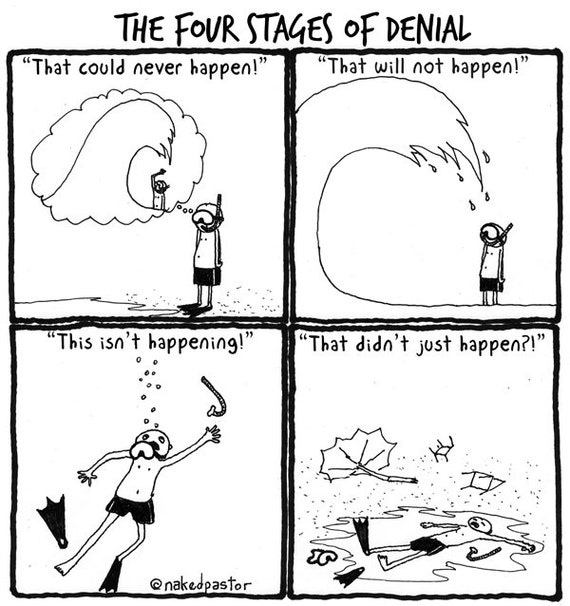
Cartoon – The Four Stages of Denial

The Four Stages of Denial CARTOON | Etsy

As the 1918 Flu Emerged, Cover-Up and Denial Helped It Spread

https://www.history.com/news/1918-pandemic-spanish-flu-censorship?cmpid=email-hist-inside-history-2020-0527-05272020&om_rid=5444b0eacc03f23065f305c9fea74958a7fc07af4357c4a980be55258fa8db43

As the 1918 Flu Emerged, Cover-Up and Denial Helped It Spread ...

Nations fighting in World War I were reluctant to report their flu outbreaks.

Spanish flu” has been used to describe the flu pandemic of 1918 and 1919 and the name suggests the outbreak started in Spain. But the term is actually a misnomer and points to a key fact: nations involved in World War I didn’t accurately report their flu outbreaks.

Spain remained neutral throughout World War I and its press freely reported its flu cases, including when the Spanish king Alfonso XIII contracted it in the spring of 1918. This led to the misperception that the flu had originated or was at its worst in Spain.

“Basically, it gets called the ‘Spanish flu’ because the Spanish media did their job,” says Lora Vogt, curator of education at the National WWI Museum and Memorial in Kansas City, Missouri. In Great Britain and the United States—which has a long history of blaming other countries for disease—the outbreak was also known as the “Spanish grip” or “Spanish Lady.”

Historians aren’t actually sure where the 1918 flu strain began, but the first recorded cases were at a U.S. Army camp in Kansas in March 1918. By the end of 1919, it had infected up to a third of the world’s population and killed some 50 million people. It was the worst flu pandemic in recorded history, and it was likely exacerbated by a combination of censorship, skepticism and denial among warring nations.

“The viruses don’t care where they come from, they just love taking advantage of wartime censorship,” says Carol R. Byerly, author of Fever of War: The Influenza Epidemic in the U.S. Army during World War I. “Censorship is very dangerous during a pandemic.”

The Flu in Europe

1918 Flu, U.S. Army Camp Hospital in France, WWI

Patients lie in an influenza ward at the U.S. Army Camp Hospital No. 45 in Aix-les-Baines, France, during World War I.

Corbis/Getty Images

When the flu broke out in 1918, wartime press censorship was more entrenched in European countries because Europe had been fighting since 1914, while the United States had only entered the war in 1917. It’s hard to know the scope of this censorship, since the most effective way to cover something up is to not leave publicly-accessible records of its suppression. Discovering the impact of censorship is also complicated by the fact that when governments pass censorship laws, people often censor themselves out of fear of breaking the law.

In Great Britain, which fought for the Allied Powers, “the Defense of the Realm Act was used to a certain extent to suppress…news stories that might be a threat to national morale,” says Catharine Arnold, author of Pandemic 1918: Eyewitness Accounts from the Greatest Medical Holocaust in Modern History. “The government can slam what’s called a D-Notice on [a news story]—‘D’ for Defense—and it means it can’t be published because it’s not in the national interest.”

Both newspapers and public officials claimed during the flu’s first wave in the spring and early summer of 1918 that it wasn’t a serious threat. The Illustrated London News wrote that the 1918 flu was “so mild as to show that the original virus is becoming attenuated by frequent transmission.” Sir Arthur Newsholme, chief medical officer of the British Local Government Board, suggested it was unpatriotic to be concerned with the flu rather than the war, Arnold says.

The flu’s second wave, which began in late summer and worsened that fall, was far deadlier. Even so, warring nations continued to try to hide it. In August, the interior minister of Italy—another Allied Power—denied reports of the flu’s spread. In September, British officials and newspaper barons suppressed news that the prime minister had caught the flu while on a morale-boosting trip to Manchester. Instead, the Manchester Guardian explained his extended stay in the city by claiming he’d caught a “severe chill” in a rainstorm.

Warring nations covered up the flu to protect morale among their own citizens and soldiers, but also because they didn’t want enemy nations to know they were suffering an outbreak. The flu devastated General Erich Ludendorff’s German troops so badly that he had to put off his last offensive. The general, whose empire fought for the Central Powers, was anxious to hide his troops’ flu outbreaks from the opposing Allied Powers.

“Ludendorff is famous for observing [flu outbreaks among soldiers] and saying, oh my god this is the end of the war,” Byerly says. “His soldiers are getting influenza and he doesn’t want anybody to know, because then the French could attack him.”

The Pandemic in the United States

Patients at U. S. Army Hospital No. 30 at a movie wear masks because of an influenza epidemic.

Patients at U. S. Army Hospital No. 30 at a movie wear masks because of an influenza epidemic.

The National Library of Medicine

The United States entered WWI as an Allied Power in April 1917. A little over a year later, it passed the 1918 Sedition Act, which made it a crime to say anything the government perceived as harming the country or the war effort. Again, it’s difficult to know the extent to which the government may have used this to silence reports of the flu, or the extent to which newspapers self-censored for fear of retribution. Whatever the motivation, some U.S. newspapers downplayed the risk of the flu or the extent of its spread.

In anticipation of Philadelphia’s “Liberty Loan March” in September, doctors tried to use the press to warn citizens that it was unsafe. Yet city newspaper editors refused to run articles or print doctors’ letters about their concerns. In addition to trying to warn the public through the press, doctors had also unsuccessfully tried to convince Philadelphia’s public health director to cancel the march.

The war bonds fundraiser drew several thousand people, creating the perfect place for the virus to spread. Over the next four weeks, the flu killed 12,191 people in Philadelphia.

Similarly, many U.S. military and government officials downplayed the flu or declined to implement health measures that would help slow its spread. Byerly says the Army’s medical department recognized the threat the flu posed to the troops and urged officials to stop troop transports, halt the draft and quarantine soldiers; but they faced resistance from the line command, the War Department and President Woodrow Wilson.

Wilson’s administration eventually responded to their pleas by suspending one draft and reducing the occupancy on troop ships by 15 percent, but other than that it didn’t take the extensive measures medical workers recommended. General Peyton March successfully convinced Wilson that the U.S. should not stop the transports, and as a result, soldiers continued to get sick. By the end of the year, about 45,000 U.S. Army soldiers had died from the flu.

The pandemic was so devastating among WWI nations that some historians have suggested the flu hastened the end of the war. The nations declared armistice on November 11 amid the pandemic’s worst wave. 

In April 1919, the flu even disrupted the Paris Peace Conference when President Wilson came down with a debilitating case. As when the British prime minister had contracted the flu back in September, Wilson’s administration hid the news from the public. His personal doctor instead told the press the president had caught a cold from the Paris rain.


100,000 Lives Lost to COVID-19. What Did They Teach Us?

https://www.propublica.org/article/100000-lives-lost-to-covid-19-what-did-they-teach-us?utm_source=pardot&utm_medium=email&utm_campaign=dailynewsletter&utm_content=feature

May 27 data: Four new Utah COVID-19 deaths as US count tops ...

Each person who has died of COVID-19 was somebody’s everything. Even as we mourn for those we knew, cry for those we loved and consider those who have died uncounted, the full tragedy of the pandemic hinges on one question: How do we stop the next 100,000?

The United States has now recorded 100,000 deaths due to the coronavirus.

It’s a moment to collectively grieve and reflect.

Even as we mourn for those we knew, cry for those we loved and consider also those who have died uncounted, I hope that we can also resolve to learn more, test better, hold our leaders accountable and better protect our citizens so we do not have to reach another grim milestone.

Through public records requests and other reporting, ProPublica has found example after example of delays, mistakes and missed opportunities. The CDC took weeks to fix its faulty test. In Seattle, 33,000 fans attended a soccer match, even after the top local health official said he wanted to end mass gatherings. Houston went ahead with a livestock show and rodeo that typically draws 2.5 million people, until evidence of community spread shut it down after eight days. Nebraska kept a meatpacking plant open that health officials wanted to shut down, and cases from the plant subsequently skyrocketed. And in New York, the epicenter of the pandemic, political infighting between Gov. Andrew Cuomo and Mayor Bill de Blasio hampered communication and slowed decision making at a time when speed was critical to stop the virus’ exponential spread.

COVID-19 has also laid bare many long-standing inequities and failings in America’s health care system. It is devastating, but not surprising, to learn that many of those who have been most harmed by the virus are also Americans who have long suffered from historical social injustices that left them particularly susceptible to the disease.

This massive loss of life wasn’t inevitable. It wasn’t simply unfortunate and regrettable. Even without a vaccine or cure, better mitigation measures could have prevented infections from happening in the first place; more testing capacity could have allowed patients to be identified and treated earlier.

The COVID-19 pandemic is not over, far from it.

At this moment, the questions we need to ask are: How do we prevent the next 100,000 deaths from happening? How do we better protect our most vulnerable in the coming months? Even while we mourn, how can we take action, so we do not repeat this horror all over again?

Here’s what we’ve learned so far.

Though we’ve long known about infection control problems in nursing homes, COVID-19 got in and ran roughshod.

From the first weeks of the coronavirus outbreak in the United States, when the virus tore through the Life Care Center in Kirkland, Washington, nursing homes and long-term care facilities have emerged as one of the deadliest settings. As of May 21, there have been around 35,000 deaths of staff and residents in nursing homes and long-term care facilities, according to the nonprofit Kaiser Family Foundation.

Yet the facilities have continued to struggle with basic infection control. Federal inspectors have found homes with insufficient staff and a lack of personal protective equipment. Others have failed to maintain social distancing among residents, according to inspection reports ProPublica reviewed. Desperate family members have had to become detectives and activists, one even going as far as staging a midnight rescue of her loved one as the virus spread through a Queens, New York, assisted living facility.

What now? The risk to the elderly will not decrease as time goes by — more than any other population, they will need the highest levels of protection until the pandemic is over. The CEO of the industry’s trade group told my colleague Charles Ornstein: “Just like hospitals, we have called for help. In our case, nobody has listened.” More can be done to protect our nursing home and long term care population. This means regular testing of both staff and residents, adequate protective gear and a realistic way to isolate residents who test positive.

Racial disparities in health care are pervasive in medicine, as they have been in COVID-19 deaths.

African Americans have contracted and died of the coronavirus at higher rates across the country. This is due to myriad factors, including more limited access to medical care as well as environmental, economic and political factors that put them at higher risk of chronic conditions. When ProPublica examined the first 100 recorded victims of the coronavirus in Chicago, we found that 70 were black. African Americans make up 30% of the city’s population.

What now? States should make sure that safety-net hospitals, which serve a large portion of low-income and uninsured patients regardless of their ability to pay, and hospitals in neighborhoods that serve predominantly black communities, are well-supplied and sufficiently staffed during the crisis. More can also be done to encourage African American patients to not delay seeking care, even when they have “innocent symptoms” like a cough or low-grade fever, especially when they suffer other health conditions like diabetes.

Racial disparities go beyond medicine, to other aspects of the pandemic. Data shows that black people are already being disproportionately arrested for social distancing violations, a measure that can undercut public health efforts and further raise the risk of infection, especially when enforcement includes time in a crowded jail.

Essential workers had little choice but to work during COVID-19, but adequate safeguards weren’t put in place to protect them.

We’ve known from the beginning there are some measures that help protect us from the virus, such as physical distancing. Yet millions of Americans haven’t been able to heed that advice, and have had no choice but to risk their health daily as they’ve gone to work shoulder-to-shoulder in meat-packing plants, rung up groceries while being forbidden to wear gloves, or delivered the mail. Those who are undocumented live with the additional fear of being caught by immigration authorities if they go to a hospital for testing or treatment.

What now? Research has shown that there’s a much higher risk of transmission in enclosed spaces than outdoors, so providing good ventilation, adequate physical distancing, and protective gear as appropriate for workers in indoor spaces is critical for safety. We also now know that patients are likely most infectious right before or at the time when symptoms start appearing, so if workplaces are generous about their sick leave policies, workers can err on the side of caution if they do feel unwell, and not have to choose between their livelihoods and their health. It’s also important to have adequate testing capacity, so infections can be caught before they turn into a large outbreak.

Frontline health care workers were not given adequate PPE and were sometimes fired for speaking up about it.

While health workers have not, thankfully, been dying at conspicuously higher rates, they continue to be susceptible to the virus due to their work. The national scramble for ventilators and personal protective equipment has exposed the just-in-time nature of hospitals’ inventories: Nurses across the country have had to work with expired N95 masks, or no masks at all. Health workers have been suspended, or put on unpaid leave, because they didn’t see eye to eye with their administrators on the amount of protective gear they needed to keep themselves safe while caring for patients.

First responders — EMTs, firefighters and paramedics — are often forgotten when it comes to funding, even though they are the first point of contact with sick patients. The lack of a coherent system nationwide meant that some first responders felt prepared, while others were begging for masks at local hospitals.

What now? As states reopen, it will be important to closely track hospital capacity, and if cases rise and threaten their medical systems’ ability to care for patients, governments will need to be ready to pause or even dial back reopening measures. It should go without saying that adequate protective gear is a must. I also hope that hospital administrators are thinking about mental health care for their staffs. Doctors and nurses have told us of the immense strain of caring for patients whom they don’t know how to save, while also worrying about getting sick themselves, or carrying the virus home to their loved ones. Even “heroes” need supplies and support.

What we still have to learn:

There continue to be questions on which data is lacking, such as the effects of the coronavirus on pregnant women. Without evidence-based research, pregnant women have been left to make decisions on their own, sometimes trying to limit their exposure against their employer’s wishes.

Similarly, there’s a paucity of data on children’s risk level and their role in transmission. While we can confidently say that it’s rare for children to get very ill if they do get infected, there’s not as much information on whether children are as infectious as adults. Answering that question would not just help parents make decisions (Can I let my kid go to day care when we live with Grandma?) but also help officials make evidence-based decisions on how and when to reopen schools.

There’s some research I don’t want to rush. Experts say the bar for evidence should be extremely high when it comes to a vaccine’s safety and benefit. It makes sense that we might be willing to use a therapeutic with less evidence on critically ill patients, knowing that without any intervention, they would soon die. A vaccine, however, is intended to be given to vast numbers of healthy people. So yes, we have to move urgently, but we must still take the time to gather robust data.

Our nation’s leaders have many choices to make in the coming weeks and months. I hope they will heed the advice of scientists, doctors and public health officials, and prioritize the protection of everyone from essential workers to people in prisons and homeless shelters who does not have the privilege of staying home for the duration of the pandemic.

The coronavirus is a wily adversary. We may ultimately defeat it with a vaccine or effective therapeutics. But what we’ve learned from the first 100,000 deaths is that we can save lives with the oldest mitigation tactics in the public health arsenal — and that being slow to act comes with a terrible cost.

I refuse to succumb to fatalism, to just accepting the ever higher death toll as inevitable. I want us to make it harder for this virus to take each precious life from us. And I believe we can.


Ascension reports $2.7B net loss in Q3

https://www.beckershospitalreview.com/finance/ascension-reports-2-7b-net-loss-in-q3.html?utm_medium=email

Ascension, Google working on 'secret' patient data project, says ...

St. Louis.-based Ascension saw revenue decline in the three months ended March 31, and it ended the period with a net loss, according to unaudited financial documents

The 150-hospital system reported operating revenue of $6.1 billion in the third quarter of fiscal year 2020, down 2.5 percent from the same period a year earlier. Net patient service revenue dramatically declined in March due to a drop in patient volume attributed to the COVID-19 pandemic.

“COVID-19 has been encountered across all Ascension markets, to varying degrees, and has had an adverse effect on the system’s revenues and operating margin,” management wrote in comments on the financial results.

Looking at the nine months ended March 31, net patient service revenue was up 1.9 percent year over year due to several factors, including an increase in physician office visits and expansion of service lines and sites of care. 

The health system’s expenses climbed more than 3 percent year over year to $6.4 billion in the third quarter, and expenses were up nearly 4 percent in the nine months ended March 31. Higher expenses related to expanded service lines and the transition toward standardized revenue cycle services pushed the system’s expenses higher before the COVID-19 pandemic, Ascension said. 

Ascension ended the most recent quarter with an operating loss of $429.4 million, compared to operating income of $80.1 million a year earlier. During the nine months ended March 31, the health system’s operating loss totaled $344.9 million.

After factoring in nonoperating items, including losses from investments of nearly $2.5 billion, Ascension reported a net loss of $2.7 billion in the third quarter of fiscal year 2020. In the same period a year earlier, the system recorded investment income of $1.1 billion and net income of $1.2 billion.

To help offset financial damage caused by the COVID-19 pandemic, Ascension received funds from the $175 billion in relief aid Congress has allocated to hospitals and other healthcare providers to cover expenses and lost revenue tied to the pandemic. The health system received $211 million in federal grants, according to The New York Times.

Ascension also applied for and received about $2 billion of Medicare advance payments in April, which must be repaid.