U.S. Still in First Wave of COVID-19, Fauci Says

https://www.webmd.com/lung/news/20200925/us-still-in-first-wave-of-covid-19-fauci-says

US still in first Covid-19 wave and should be prepared for 'challenge' of  fall and winter, Fauci says

Anthony Fauci, MD, says talk about a second wave of the coronavirus is premature because the United States is still dealing with the first one.

The idea of a second wave is based on the 1918 flu pandemic, when many cases were seen in the spring, he says. The spring cases “literally disappeared” and were followed by a spike in flu cases in the fall, he told CNN’s Sanjay Gupta, MD, on Thursday in an online conversation organized by Emory University.

“Rather than say, ‘A second wave,’ why don’t we say, ‘Are we prepared for the challenge of the fall and the winter?’” said Fauci, director of the National Institute of Allergy and Infectious Diseases and a member of the White House coronavirus task force.

Flu shots are an important measure to help the U.S. get through the winter, he said.

He and other health care professionals have observed that the Southern Hemisphere has had a very light flu season, probably because measures to curb the coronavirus, such as social distancing and mask-wearing, have limited the spread of the flu.

“If we listen to the public health measures, not only would we diminish the effect of COVID-19, we might get away with a very, very light flu season if we combine that with getting the flu vaccine,” Fauci said.

In a separate interview, he said the arrival of the coronavirus vaccine will not stop the need for tried-and-true measures such as mask-wearing, hand-washing, and social distancing.

In a Facebook Live conversation with New Jersey Gov. Phil Murphy, Fauci said the coronavirus vaccine will not be 100% effective and won’t be taken by the entire population. That means the virus could still spread.

“So when a vaccine comes, we look at it as an important tool to supplement the public health measures that we do,” he said. “It will allow us to more quickly and with less stringency get back to some degree of normal. But it is not going to eliminate the need to be prudent and careful with our public health measures.”

Fauci said that vaccinating 75% to 80% of the population “would be a really good accomplishment.” He expects 700 million doses to be produced by the end of this year or early 2021.


Medicare won’t cover coronavirus vaccines approved under emergency use authorization

https://www.beckershospitalreview.com/pharmacy/medicare-won-t-cover-coronavirus-vaccines-approved-under-emergency-use-authorization.html?utm_medium=email

Medicare Wouldn't Cover Costs of Administering Coronavirus Vaccine Approved  Under Emergency-Use Authorization - WSJ

Medicare won’t cover the cost of a COVID-19 vaccine if it is approved under an emergency use authorization, according to The Wall Street Journal. 

The White House recently concluded that Medicare’s exclusion of emergency-use drug costs could mean 44 million Americans, or 15 percent of the U.S. population, may have to pay out-of-pocket for a vaccine if it is approved under an emergency use authorization, the Journal reported.

HHS is now exploring coverage options, and a spokesperson told the Journal any vaccine doses bought by the government will be provided free.

The administration of President Donald Trump has pushed for a COVID-19 vaccine to be approved and distributed before the presidential election, which would likely only come with an emergency use authorization, since FDA approvals take more time.

In March, lawmakers passed the Coronavirus Aid, Relief, and Economic Security Act, or CARES Act, which ensures no out-of-pocket costs for COVID-19 vaccines for people on Medicare.

HHS also said in August that government health insurance programs, including Medicare and Medicaid, would cover the costs of administering a COVID-19 vaccine. 


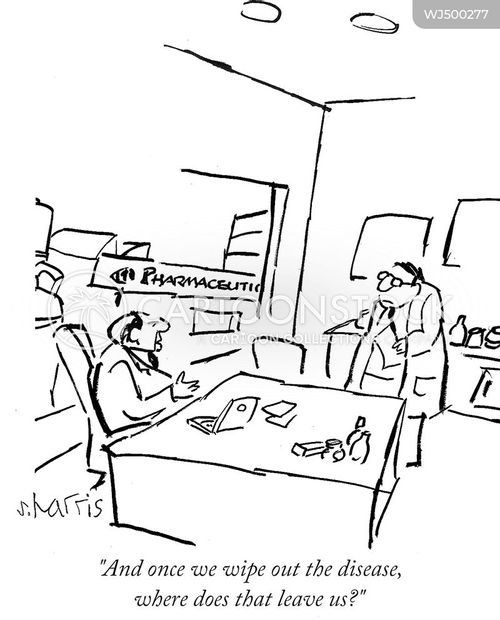
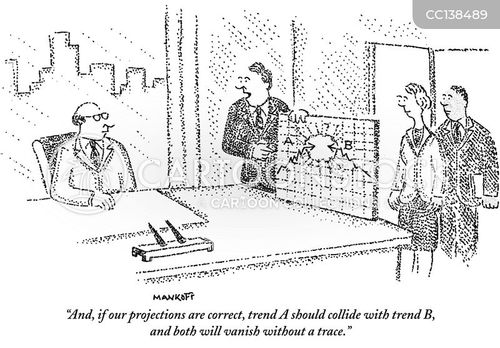
Cartoon – Coronavirus Projections

Cartoon – Coronavirus Projections | HENRY KOTULA

Visualizing the State of Democracy, by Country

Visualizing the State of Democracy, by Country

Visualizing The State Of Democracy, By Country | The Daily Reformer

https://www.visualcapitalist.com/wp-content/uploads/2020/09/state-of-democracy.html


Visualizing the State of Democracy, by Country

View the full-sized interactive version of this infographic by clicking here

From Norway to North Korea, governing systems differ around the world. But has the world become more or less free in the past decade?

This visualization from Preethi Lodha demonstrates how democracy levels of 167 countries have changed since 2006. The original data comes from the Democracy Index, which is compiled annually by the Economist Intelligence Unit.

Four Levels of Democracy

First, it’s important to understand the classifications made by the Democracy Index.

Based on answers to 60 questions across a nation’s electoral process, civil liberties, government functions, political participation and political culture, countries are assigned a range of scores in the Democracy Index.

Based on these scores, a nation automatically falls into one of the following four types of governance. Here’s which category fits the bill, depending on the range of scores:

Visualizing The State Of Democracy, By Country – Investing Matters

One thing that stands out is that many hybrid regimes and flawed democracies are also considered high potential emerging markets, but are held back by their political instability.

Notable Improvements

In recent times, public demonstrations have been a major cause behind increases in Democracy Index scores and changes in governance classifications.

Algeria moved from authoritarian to hybrid regime in 2019, the only country in the Arab region to do so in the index. This came after sustained protests against the previous president, Abdelaziz Bouteflika—who had served for 20 years.

Chile experienced similar turmoil, for the better. After a spike in the scale of middle class unrest over inequality and unfair policies in late 2019, the political participation moved it up from a flawed to full democracy.

Sliding Countries

The U.S. has one of the oldest democracies in the world. However, it was downgraded from a full to a flawed democracy as of the 2016 index, a status that had been “teetering” since before then, according to the report that year.

Venezuela dropped into an authoritarian regime in 2017, and it doesn’t seem to be improving anytime soon. The state was found to use the COVID-19 pandemic as an excuse to crack down on any dissent against the government.

Global Change in Democracy Levels

All in all, the average global democracy score worldwide emerged at 5.48 in 2019, although it’s clear that certain countries pull this value towards the opposite extremes.

North Korea, an authoritarian regime with a 1.08 score, has remained consistently one of the lowest ranked countries in the index. Meanwhile, its alphabetical successor Norway steadily keeps up its high score streak, with 9.87 being the best example of a full democracy in 2019.

Here’s how many countries made up each system of governance over the years, and the global Democracy Index score for that year.

Visualizing The State Of Democracy, By Country | NewsLinks.Net |  Conservative News

Authoritarian regimes peaked in 2010 with 57 countries, whereas the full democracy category peaked in 2008 with 28 countries.

Since 2006, the average global score has slid from 5.52 to 5.48, and the total of countries categorized under full democracy decreased from 26 to 22.

Does this signal an increasingly divided world? And will the global pandemic—which is already delaying elections—have a further pronounced effect on backsliding these democracy scores?


‘People should worry:’ ACA in limbo after Bader Ginsburg’s passing

https://www.healthcaredive.com/news/people-should-worry-aca-in-limbo-after-bader-ginsburgs-passing/585545/?utm_source=Sailthru&utm_medium=email&utm_campaign=Issue:%202020-09-22%20Healthcare%20Dive%20%5Bissue:29794%5D&utm_term=Healthcare%20Dive

In less than two months, the Supreme Court is set to hear the case that could overturn the Affordable Care Act — without Ruth Bader Ginsburg on the bench, fanning anxieties the landmark law is in greater jeopardy due to her passing. 

“People should worry,” Nicholas Bagley, a health law expert and professor at the University of Michigan, said.

The death of the liberal justice on Friday at the age of 87 means that of the nine justices, there are now only three appointed by Democratic presidents instead of four.

Assuming the liberal wing was set to uphold the ACA, with Bader Ginsburg they would have only needed to pick up one more conservative justice to vote in favor of preserving the law. Chief Justice John Roberts has been a swing vote in several cases involving the law. Roberts’ 2012 vote saved the law from a fatal blow in a 5-4 decision when he deemed the individual mandate could be considered a tax. 

Without Bader Ginsburg, they’ll now need to sway two — raising concerns about whether that’s possible. 

“This opens it wide up and I really do think the law could be at risk,” Katie Keith, another legal expert who has followed the case closely, agreed.

The landmark but politically polarizing legislation ushered in health coverage gains and basic protections for millions under President Barack Obama (who appointed two of the three remaining liberal justices). The law’s latest time at the Supreme Court comes after a group of red states argued the law was moot after Republicans zeroed out a key part of it — a tax penalty for those that did not get insured as was required in the law.

However, a split decision may be welcome by ACA proponents.

If the the liberal wing is only able to sway one conservative justice, resulting in a 4-4 split case, it will buy more time for the law and its defenders, a set of blue states lead by California’s Attorney General Xavier Becerra. 

In that instance, the case would be punted all the way back down to Judge Reed O’Connor. The Fifth Circuit, which oversaw the appeal following a decision by O’Connor, ruled the individual mandate was unconstitutional but did not weigh in on whether the rest of the ACA could stand without the mandate. It sent that question back to O’Connor, and that’s where the case would land again, before O’Connor, in the event the Supreme Court punts.

That outcome buys more time, plus another opportunity to appeal and for the case to again work its way back before the Supreme Court.

But one legal expert said based on cases from this past term there is reason to be hopeful that two conservative justices could be swayed to leave the remainder of the ACA intact even if the mandate is ruled unconstitutional.

Legal experts point to cases from the most recent term in which Brett Kavanaugh and Roberts — both appointed by Republicans — weighed in on severability in a way viewed as favorable for the outcome of the ACA case. 

“I’m pretty hopeful,” Tim Jost, emeritus professor at Washington and Lee University School of Law, said.

Severability is an important question in the challenge to the ACA. The crux of the lawsuit centers on the argument that the individual mandate is so essential and intertwined into the fabric of the ACA that if the mandate is deemed unconstitutional than the entirety of the ACA must fall.

In their legal challenge, the red states and two individual plaintiffs argued that the individual mandate cannot be severed from the rest of the law, so the entire law should be overturned. That’s why ACA case watchers have tried to read the tea leaves by reviewing how justices have weighed in on severability in earlier cases.

Kavanaugh seemed emphatic about his belief that unconstitutional pieces of a larger law should not spell the demise for the entire law.

In a case decided this summer, political organizations were seeking to make robocalls to cell phones. However, a law, barred robocalls to Americans’ cellphones but was later amended by Congress to include an exception for the collection of debt. The plaintiffs argued this was a violation of the First Amendment, favoring debt-collection speech over political speech. The plaintiffs wanted the entirety of the robocall law overturned, not just the exception allowing robocalls for debt collection.

Kavanaugh wrote the 6-3 opinion, finding the exception for debt-collection unconstitutional, but ruling that the remainder of the law can stand. 

In his opinion, Kavanaugh wrote that the court’s preference has been to “salvage rather than destroy” the rest of the law in the event a part is deemed unconstitutional.

“The Court’s precedents reflect a decisive preference for surgical severance rather than wholesale destruction, even in the absence of a severability clause,” Kavanaugh wrote in his opinion in the case, Barr v. Association of Political Consultants.

And Roberts showed similar favor for surgically precise decisions when it comes to severability.  “We think it clear that Congress would prefer that we use a scalpel rather than a bulldozer,” he wrote in a separate 5-4 decision from this latest term regarding a challenge to the Consumer Financial Protection Bureau.


U.K. upgrades COVID alert level as Europe sees worrying rise in infections

https://www.axios.com/coronavirus-united-kingdom-european-cdc-4856ab47-29b2-43f2-b6c4-9a62d6867830.html

U.K. upgrades COVID alert level as Europe sees worrying rise in infections  - Axios

The U.K. could see up to 50,000 coronavirus cases per day by mid-October if current growth continues, top scientific advisers warned in a televised address from Downing Street on Monday.

The big picture: The U.K. has upgraded its coronavirus alert level from three to four as infections appear to be “high or rising exponentially.” Meanwhile, recent European Center for Disease Prevention and Control (ECDC) data shows that over half of all European Union countries are seeing an increase in COVID-19 cases.

What they’re saying: “At the moment, we think that the epidemic is doubling roughly every seven days” in the U.K., chief scientific adviser Patrick Vallance said.

  • England’s chief medical officer Chris Whitty stressed that unemployment and poverty are risks of taking strong action against the virus — like enforcing stay-at-home orders — but that more deaths will occur if aggressive action is not taken.

Where it stands: ECDC data shows that Spain, France, the Czech Republic, Croatia and Romania have recorded more than 120 confirmed COVID-19 cases per 100,000 inhabitants in the last 14 days, according to AP.

  • In Madrid, the rate of infection is nearly three times higher than the national average, at 683 cases per 100,000 inhabitants, per AP. Spain, one of the first epicenters of the virus in Europe, is faring the worst of countries tracked by the ECDC.
  • France has seen 31,285 deaths since the start of the pandemic, one of the highest death tolls in Europe. This weekend, France reported a record 13,000 new infections in 24 hours.
  • The Czech Republic reported 3,000 new cases on Thursday, almost as many as the country saw in all of March.
  • Croatia has recorded over 14,000 new COVID-19 cases per day since Sept. 16, while Romania is seeing over 11,000 new infections per day, according to Johns Hopkins data.

What to watch: Analysts expect the British government to announce short-term restrictions after Prime Minister Boris Johnson met with ministers over the weekend, AP reports.

  • German Chancellor Angela Merkel is planning second-wave prevention with her “Coronavirus Cabinet.” These plans include walk-in “fever clinics” to separate coronavirus patients from others.
  • Police in Madrid are limiting travel in working-class neighborhoods that have seen high transmission rates, while parks are closed and restaurants and shops must limit their occupancy at 50%.
  • Czech Republic’s Health Minister Adam Vojtech resigned Monday because of rising cases.
  • There are 20 new testing centers set to open in Paris and surrounding suburbs this week.


U.S. reaches 200,000 coronavirus deaths

https://www.axios.com/united-states-200000-coronavirus-deaths-17dc9d72-933b-473d-aa65-b7887eafffa2.html?stream=top&utm_source=alert&utm_medium=email&utm_campaign=alerts_all

The U.S. now has more than 200,000 coronavirus deaths - Axios

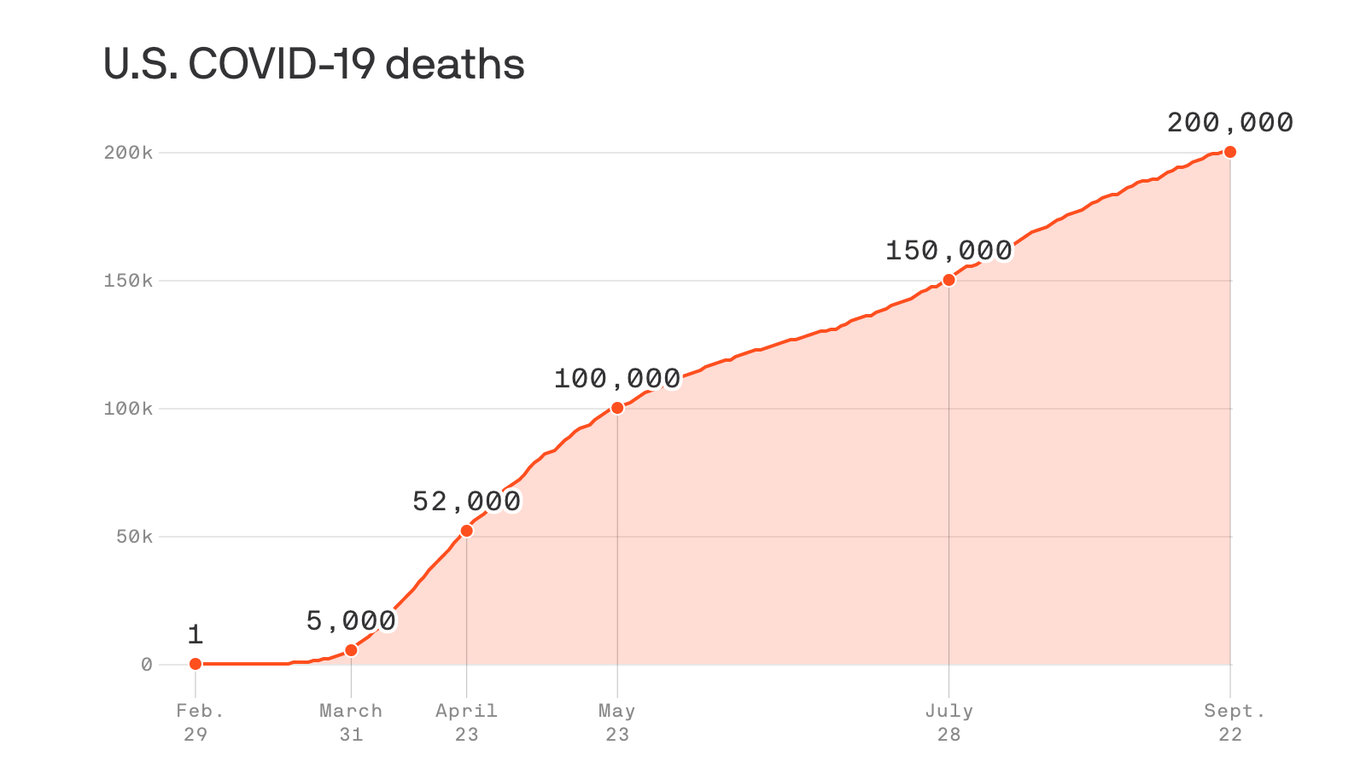
The coronavirus has now killed 200,000 Americans, according to Johns Hopkins data.

The big picture: Whatever context you try to put this in, it is a catastrophe of historic proportions — and is yet another reminder of America’s horrific failure to contain the virus.

  • The coronavirus has killed a bigger share of the American population than it has in almost any other wealthy country.
  • The death toll here is equivalent to roughly 65 Sept. 11 attacks. Three times more Americans have died from COVID than died in the Vietnam war — in only a fraction of the time.

This crisis has hit people of color especially hard.

  • Black and Latino Americans are dying at about three times the rate of white Americans.
  • They have also suffered far more from the economic fallout, which has fallen largely on lower-wage, service-industry workers.

And deaths keep coming — we’re averaging roughly 830 per day — even as the country increasingly sees the pandemic as background noise, as live sports resume and schools reopen and interest in news about the pandemic wanes.

Between the lines: The percentage of infected people who ultimately die from the coronavirus is lower now than it was in the outbreak’s earliest months, partly because doctors have gotten better at treating the virus and partly because outbreaks are now occurring within younger and lower-risk groups.

  • Overall cases are on a downward trajectory right now, following an enormous spike over the summer.
  • But the U.S. has never managed to get the virus firmly under control. Cases and deaths could get worse again as the weather gets colder and people move indoors, and the onset of flu season could make treatment more difficult.


COVID-19 vaccine verdicts loom as next big market risk

https://finance.yahoo.com/news/covid-19-vaccine-verdicts-loom-050615809.html

Optimism that vaccines are on the way to end the coronavirus pandemic has been a major factor in this year’s U.S. stock resurgence. That will face a critical test in coming weeks, as investors await clinical data on whether they actually work.

A UBS analysis found that about 40% of the market’s gains since May can be pegged to hopes for vaccines to protect against COVID-19, which has killed over 960,000 worldwide and rocked the global economy.

Global efforts to develop a vaccine are coming to a head, with late-stage data on trials by companies such as Pfizer Inc <PFE.N> and Moderna Inc <MRNA.O> possible as soon as October or November. Disappointing results could further shake markets that have recently grown turbulent on worries over fiscal stimulus delays and uncertainty around the Nov. 3 U.S. presidential election.

“The anticipation is that this stuff is going to work,” said Walter Todd, chief investment officer at Greenwood Capital in South Carolina. “So any news to the contrary could be a risk to the market.”

The number of vaccines in development could blunt the negative market impact of any single setback. More than a half-dozen vaccines globally are in late-stage trials out of over 30 currently being tested in humans, according to the World Health Organization.

“We are setting ourselves up for success in the sense of if you throw enough spaghetti at the wall, hopefully at least one noodle sticks,” said Liz Young, director of market strategy at BNY Mellon Investment Management.

That could explain why stocks overall barely reacted earlier this month, when AstraZeneca Plc <AZN.L> and partner Oxford University paused global trials of one of the leading vaccine candidates after a participant in its U.K. trial became seriously ill. The trials have resumed in Britain, Brazil and South Africa, but remain on hold in the United States.

Some forecasts on vaccine availability have grown less optimistic. Good Judgment, a company whose forecasters make predictions based on publicly available evidence, put the chances that a vaccine will be widely distributed in the United States by the end of March at 54%. That is up from an estimate of less than 20% in early July, but down from above 70% earlier this month.

Pfizer and Moderna could report initial efficacy results in October or November based on an early read of data, followed by data from companies such as AstraZeneca, Johnson & Johnson <JNJ.N> and Novavax Inc <NVAX.O>.

An approval or emergency use authorization this year could lead to a surge in travel, leisure and other stocks that have been decimated by pandemic-related shutdowns, while also fueling a long-awaited shift into value stocks from tech and other growth names that have led the market for years.

Even if a vaccine is approved, questions persist about how easily and quickly it can be distributed. President Trump and his health officials have issued conflicting predictions about when the general public could have access.

“The potential for market disappointment will likely come from the realization that manufacturing and broad distribution will take longer,” said Art Hogan, chief market strategist at National Securities.

An approved, broadly distributed and accepted vaccine could result in a gain of about 300 points to the S&P 500, or more than 8% at the index’s current level, according to Keith Parker, head of U.S. and global equity strategy at UBS.

If a vaccine is widely distributed in the first quarter, BofA Global Research projects global gross domestic product (GDP) growth of 6.3% in 2021, compared with 5.6% if that does not occur until the third quarter.

Disappointing clinical trial news could result in a loss of 100 points from the S&P 500, or about 3%, Parker estimates.

While the market might be able to handle one vaccine setback “reasonably well,” several setbacks could cause a rethink of the vaccine race, he said.


Bill Gates: U.S. Needs To ‘Own Up To The Fact That We Didn’t Do A Good Job’

https://www.forbes.com/sites/mattperez/2020/09/20/bill-gates-us-needs-to-own-up-to-the-fact-that-we-didnt-do-a-good-job/?utm_source=newsletter&utm_medium=email&utm_campaign=coronavirus&cdlcid=5d2c97df953109375e4d8b68#54d6544f3fb8

TOPLINE

The United States needs to “own up to the fact that we didn’t do a good job” up until this point of the Covid-19 pandemic, billionaire and philanthropist Bill Gates said during a Fox News Sunday interview, adding that the slow turnaround for testing results remains “outrageous.”

KEY FACTS

“Unfortunately we did a very poor job and you can just see that in the numbers,” Gates said.

Despite having around 4% of the world’s population, the U.S. has around 22% of all cases with 6,782,083 and about 21% of all reported deaths with 199,411.

The inability to create a testing structure as seen in countries like South Korea “led to us having not just a bad spring, we’ve had a pretty tough summer and sadly because of the seasonality, until we get these new tools, the fall is looking to shape up as pretty tough as well,” Gates said.

“Part of the reluctance I think to fix the testing system now is that nobody wants to admit that it’s still outrageous,” Gates said, adding, “The U.S. has more of these machines, more capacity than other countries by a huge amount, and so partly the reimbursement system is creating perverse incentive.”

After remaining fairly stagnant through the end of summer into September, the U.S. performed a record 1,061,106 Covid-19 tests on Saturday, according to Johns Hopkins University, but labs are still dealing with supply shortages and delays in results.

“We’ll have time to look at those mistakes, which in February and March were really super unfortunate, but we can’t pretend like we get a good grade even today,” Gates said.

CRUCIAL QUOTE

“Even today, people don’t get their results in 24 hours, which it’s outrageous that we still have that,” Gates said.

BIG NUMBER

4.7%. That’s the average positivity percentage in the past week, according to Johns Hopkins.

TANGENT

President Trump has excused the world-leading cases of the coronavirus as a result of the number of tests performed in the country, even saying that he instructed officials to slow testing down. The Centers for Disease Control and Prevention sparked outrage in August when it published new guidelines on testing, recommending people exposed to the virus but not showing symptoms should not get tested. Reports indicate that the guidance was dictated by the Health and Human Services and Trump administration as opposed to CDC scientists. The guidelines were changed again on Friday.