The Value-based Care Agenda in Trump 2.0 Healthcare

This week, the House Energy and Commerce and Ways and Means Committees begins work on the reconciliation bill they hope to complete by Memorial Day. Healthcare cuts are expected to figure prominently in the committee’s work.

And in San Diego, America’s Physician Groups (APG) will host its spring meeting “Kickstarting Accountable Care: Innovations for an Urgent Future” featuring Presidential historian Dorris Kearns Goodwin and new CMS Innovation Center Director Abe Sutton. Its focus will be the immediate future of value-based programs in Trump Healthcare 2.0, especially accountable care organizations (ACOs) and alternative payment models (APMs).

Central to both efforts is the administration’s mandate to reduce federal spending which it deems achievable, in part, by replacing fee for services with value-based payments to providers from the government’s Medicare and Medicaid programs. The CMS Center for Medicare and Medicaid Innovation (CMMI) is the government’s primary vehicle to test and implement alternative payment programs that reduce federal spending and improve the quality and effectiveness of services simultaneously.

Pledges to replace fee-for-service payments with value-based incentives are not new to Medicare.  Twenty-five years ago, they were called “pay for performance” programs and, in 2010, included in the Affordable Care as alternative payment models overseen by CMMI. But the effectiveness of APMs has been modest at best: of 50+ models attempted, only 6 proved effective in reducing Medicare spending while spending $5.4 billion on the programs. Few were adopted in Medicaid and only a handful by commercial payers and large self-insured employers. Critics argue the APMs were poorly structured, more costly to implement than potential shared savings payments and sometimes more focused on equity and DEI aims than actual savings.

The question is how the Mehmet Oz-Abe Sutten version of CMMI will approach its version of value-based care, given modest APM results historically and the administration’s focus on cost-cutting.

Context is key:

Recent efforts by the Trump Healthcare 2.0 team and its leadership appointments in CMS and CMMI point to a value-agenda will change significantly. Alternative payment models will be fewer and participation by provider groups will be mandated for several. Measures of quality and savings will be fewer, more easily measured and and standardized across more episodes of care. Financial risks and shared savings will be higher and regulatory compliance will be simplified in tandem with restructuring in HHS, CMS and CMMI to improve responsiveness and consistency across federal agencies and programs.

Sutton’s experience as the point for CMMI is significant. Like Adam Boehler, Brad Smith and other top Trump Healthcare 2.0 leaders, he brings prior experience in federal health agencies and operating insight from private equity-backed ventures (Honest Health, Privia, Evergreen Nephrology funded through Nashville-based Rubicon Founders). Sutton’s deals have focused on physician-driven risk-bearing arrangements with Medicare with funding from private investors.

The Trump Healthcare 2.0 team share a view that the healthcare system is unnecessarily expensive and wasteful, overly-regulated and under-performing. They see big hospitals and drug companies as complicit—more concerned about self-protection than consumer engagement and affordability. They see flawed incentives as a root cause, and believe previous efforts by CMS and CMMI veered inappropriately toward DEI and equity rather than reducing health costs. And they think physicians organized into risk bearing structures with shared incentives, point of care technologies and dependable data will reduce unnecessary utilization (spending) and improve care for patients (including access and affordability).

There’s will be a more aggressive approach to spending reduction and value-creation with Medicare as the focus: stronger alternative payment models and expansion of Medicare Advantage will book-end their collective efforts as Trump Healthcare 2.0 seeks cost-reduction in Medicare.

What’s ahead?

Trump Healthcare 2.0 value-based care is a take-no prisoners strategy in which private insurers in Medicare Advantage have a seat at their table alongside hospitals that sponsor ACOs and distribute the majority of shared savings to the practicing physicians. But the agenda will be set, and re-set by the administration and link-minded physician organizations like America’s Physician Groups and others that welcome financial risk-sharing with Medicare and beyond.

The results of the Trump Healthcare 2.0 value agenda will be unknown to voters in the November 2026 mid-term but apparent by the Presidential campaign in 2028. In the interim, surrogate measures for performance—like physician participation and projected savings–will be used to show progress and the administration will claim success. It will also spark criticism especially from providers who believe access to needed specialty care will be restricted, public and rural health advocates whose funding is threatened, teaching and clinical research organizations who facing DOGE cuts and regulatory uncertainty, patient’s right advocacy groups fearing lack of attention and private payers lacking scalable experience in Medicare Advantage and risk-based relationships with physicians.

Last week, the American Medical Association named Dr. John Whyte its next President replacing widely-respected 12-year CEO/EVP Jim Madara. When he assumes this office in July, he’ll inherit an association that has historically steered clear of major policy issues but the administration’s value-based care agenda will quickly require his attention.

Physicians including AMA members are restless: at last fall’s House of Delegates (HOD), members passed a resolution calling for constraints on not-for-profit hospital’ tax exemptions due to misleading community benefits reporting and more consistency in charity care reporting by all hospitals. The majority of practicing physicians are burned-out due to loss of clinical autonomy and income pressures—especially the 75% who are employees of hospitals and private-equity backed groups. And last week, the American College of Physicians went on record favoring “collective action” to remedy physician grievances. All impact the execution of the administration’s value-based agenda.

Arguably, the most important key to success for the Trump Healthcare 2.0 is its value agenda and physician support—especially the primary care physicians on whom the consumer engagement and appropriate utilization is based. It’s a tall order.

The Trump Healthcare 2.0 value agenda is focused on near-term spending reductions in Medicare. Savings in federal spending for Medicaid will come thru reconciliation efforts in Congress that will likely include work-requirements for enrollees, elimination of subsidies for low-income adults and drug formulary restrictions among others. And, at least for the time being, attention to those with private insurance will be on the back burner, though the administration favors insurance reforms adding flexible options for individuals and small groups.

The Trump Healthcare 2.0 value-agenda is disruptive, aggressive and opportunistic for physician organizations and their partners who embrace performance risk as a permanent replacement for fee for service healthcare. It’s a threat to those that don’t.

America’s newest doctors fuel efforts to unionize

https://www.axios.com/2024/04/15/doctors-union-gen-z-millennial

A new generation of doctors struggling with ever-increasing workloads and crushing student debt is helping drive unionization efforts in a profession that historically hasn’t organized.

Why it matters: 

Physicians in training, like their peers in other industries, increasingly see unions as a way to boost their pay and protect themselves against grueling working conditions as they launch their careers.

What they’re saying: 

“We deserve an increased salary to be able to afford to live in one of the most expensive areas in the United States,” said Ali Duffens, a third-year internal medicine resident at Kaiser Permanente’s San Francisco Medical Center.

  • She’s among the 400 residents at Kaiser’s Northern California system filing to unionize earlier this month.
  • Duffens earns about $82,000 per year, while paying $3,000 a month for rent and facing $350,000 in medical school loans.

The big picture: 

The Kaiser residents are part of a growing number of younger peers in medicine who have been unionizing in recent years.

  • The number of medical residents in unions has about doubled to more than 32,000 in three years, per CalMatters.
  • In the last year, residents at Montefiore Medical Center, Stanford Health Care, George Washington University and the University of Pennsylvania voted to unionize, per WBUR.
  • “The cost of day care … in a month is about half of my salary in total, and the cost of a nanny is essentially the entirety of my salary,” Leah Rethy, an internal medicine resident with Penn Medicine, told NPR last year.
  • Residents can work as much as 80 hours per week while earning far less than their older colleagues.

Yes, but: Just about 6%-7% of physicians are estimated to be in unions.

  • Historically, doctors have thought they could just suck up the long hours and relatively low pay in training as part of the tradition of medicine, said Robert Wachter, chair of the department of medicine at the University of California, San Francisco.
  • “For a new generation, they look at it and say, ‘That’s crazy. I can’t believe you did that. I want to work hard, but I also want a life and I want a family, and I want a reasonable income,'” he said.

And it’s not just younger doctors. 

Those more established in their careers are also unionizing as they see the industry changing in ways that they think undermine their profession.

  • In recent months, attending physicians at Salem Hospital, owned by Mass General Brigham, and a Cedars Sinai-owned anesthesiology practice filed to unionize.
  • About 600 doctors at Allina Health in Minnesota and Wisconsin last fall agreed to form what appears to be the largest union of private sector physicians.

Zoom in: 

The corporatization of American medicine is seen as a key driver. More than half of all U.S. doctors now work for a health system or large medical group rather than running an independent practice.

  • This shift has brought heavier workloads and less control over how they care for patients, said John August, director of health care labor relations in the Scheinman Institute on Conflict Resolution at the ILR School at Cornell.
  • That could mean demands to see more patients, limiting the time that doctors can spend with them.
  • “What you will hear from them 100% of the time in every conversation they have is they feel that they have lost control over the patient-physician relationship. I mean, every single physician says that now,” August said.

The other side: 

Health systems and large practices generally say they value their doctors and the relationships they hold with patients.

  • Hospitals have also struggled with pandemic-era financial shortfalls, including increasing labor costs.

The bottom line: 

While this is a labor issue, it ultimately trickles down to quality and safety for patients, said Rachel Flores, organizing director of the Union of American Physicians and Dentists.

  • Patients should care because that’s less time to address their issues,” she said. “Patients should care because there’s not enough staff to support the physician.”

Physician burnout persisting above pre-pandemic levels

https://mailchi.mp/f9bf1e547241/gist-weekly-february-23-2024?e=d1e747d2d8

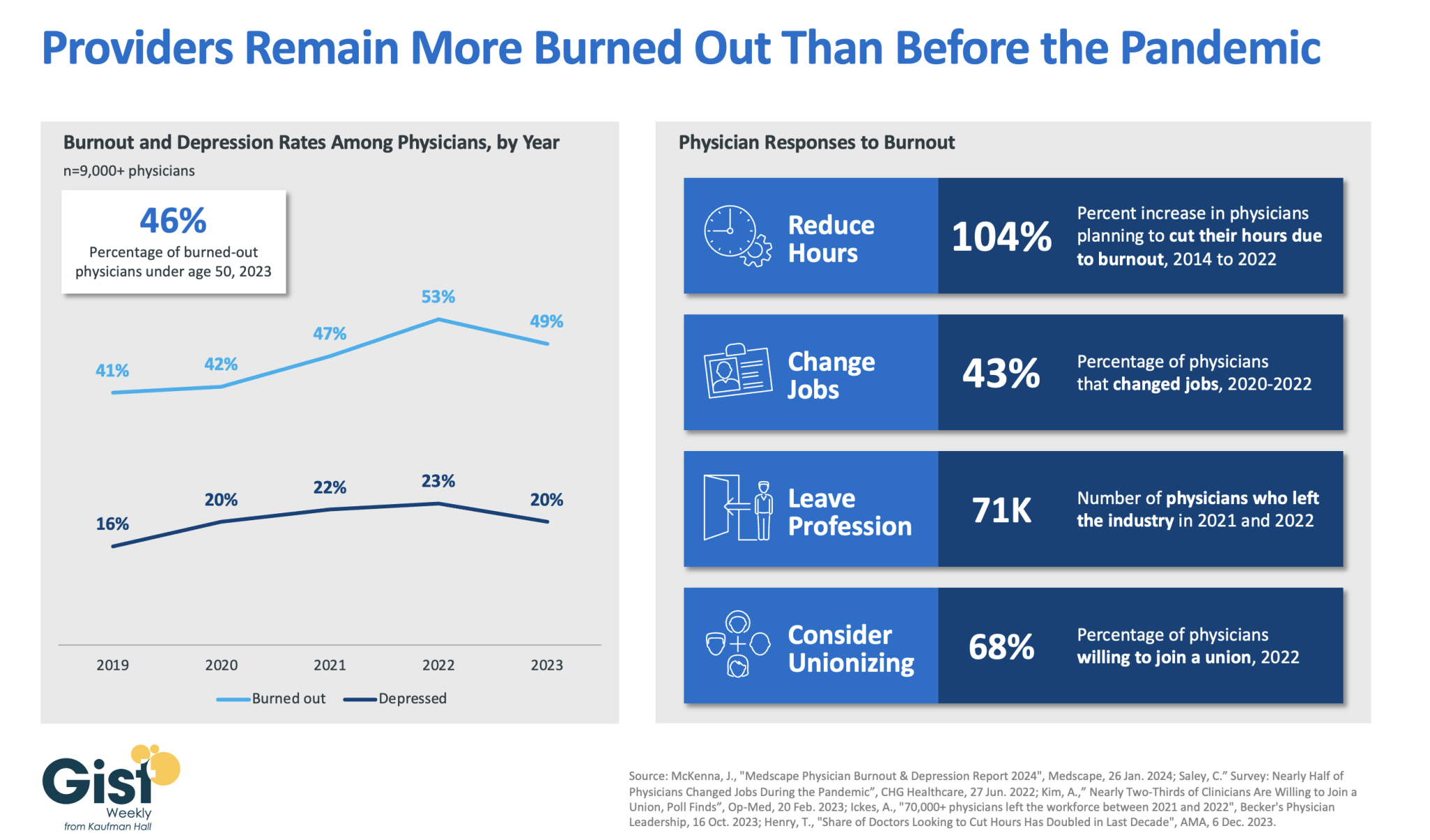
In this week’s graphic, we highlight new data from the 2024 Medscape Physician Burnout & Depression Report on the sustained high rates of physician burnout. 

In 2023, nearly half of physicians reported feeling burned out, and a fifth reported feeling depressed. Although this does represent a drop from 2022’s peak, physicians remain more distressed than they were before the pandemic. 

These numbers reveal some of the toll that the continued labor shortages, financial challenges, and payment changes of the past few years have taken on providers. In response to feeling burned out, an increased number of physicians say they are planning to cut their hours and over a third say they actually have changed jobs. Many have left the industry all together and the majority now say they are willing to join a union.

Health systems have long prioritized addressing provider burnout, but tighter operating margins have heightened both the challenge and the importance of helping to relieve it. 

Continuing to find solutions to reduce administrative tasks, enhance team-based care models, and empower providers in decision-making processes are as important as ever for provider organizations today. 

Allina Health doctors unionize over health system’s objections

Dive Brief:

  • The National Labor Relations Board has certified the union election of more than 130 Allina Health doctors at Mercy and Unity Hospitals, nearly a year after they voted to join the Doctors Council Service Employees International Union (SEIU).
  • The certification follows objections from the Minneapolis-based nonprofit health system, which said that physicians active in the union drive held supervisor or managerial positions and may have unlawfully pressured colleagues into supporting the union. The NLRB rejected that claim.
  • It’s another victory for Doctors Council SEIU at Allina facilities. In October, more than 500 Allina doctors, physician assistants and nurse practitioners at over 60 facilities voted to join the union, according to NLRB documents.

Dive Insight:

Allina doctors and physician assistants said that chronic understaffing, high levels of burnout and compromised patient safety due to the corporatization of care motivated them to seek union representation.

“We have been seeing the shift of healthcare control going to corporations and further and further away from patient voices and patient advocacy. That really fell apart during the pandemic,” said Allina physician Liz Koffel during a press conference on Aug. 15 announcing primary care physicians’ unionization drive.

Koffel detailed workplace grievances that she said occurred due to Allina’s push for profits, including high productivity demands backed by few support staff and the health system’s now-abandoned policy of interrupting non-emergency medical care for patients with high levels of debt

In a statement to Healthcare Dive, an Allina spokesperson said the system had “committed to taking steps to make sure the National Labor Relations Board’s process was fair to all involved,” and that it would not take further procedural action against the union.

Across the country, physicians’ feelings of limited autonomy is driving similar interest in unionization, according to John August, director of healthcare labor relations at Cornell’s School of Industrial and Labor Relations. 

“Frankly, I’ve never seen anything like it in my whole career — where so many people are saying exactly the same thing at the same time, from a profession that heretofore has been essentially not unionized,” he said.

Although doctors have historically shown little interest in unionization — the physician unionization rate was under 6% nationwide in 2021 — the tide is beginning to turn

Doctors are increasingly working in consolidated hospitals owned by larger health systems or private equity firms. They report consolidation limits the influence they have on their day-to-day jobs, according to a December study from the Physician Advocacy Institute.

In addition, other options, such as physician-owned practices, are disappearing, with the percentage of owned practices falling 13% between 2012 and 2022, according to an analysis from the American Medical Association.

Elsewhere in the healthcare industry, unionization and strikes have led to gains for workers.

Last year, nurses at Robert Wood Johnson University Hospital successfully negotiated nurse-to-patient ratios by holding the picket line for nearly four months in New Jersey, and more than 75,000 healthcare workers secured a 20% raise over four years at Kaiser Permanente by staging the largest healthcare strike in recent history.

ChatGPT will reduce clinician burnout, if doctors embrace it

Clinician burnout is a major problem. However, as I pointed out in a previous newsletter post, it is not a distinctly American problem.

A recent report from the Commonwealth Fund compared the satisfaction of primary care physicians in 10 high-income nations. Surprisingly, U.S. doctors ranked in the middle, reporting higher satisfaction rates than their counterparts in the U.K., Germany, Canada, Australia and New Zealand.

A Surprising Insight About Burnout

In self-reported surveys, American doctors link their dissatisfaction to problems unique to the U.S. healthcare system: excessive bureaucratic tasks, clunky computer systems and for-profit health insurance. These problems need to be solved, but to reduce clinician burnout we also need to address another factor that negatively impacts doctors around the globe.

Though national healthcare systems may vary greatly in their structure and financing, clinicians in wealthy nations all struggle to meet the ever-growing demand for medical services. And that’s due to the mounting prevalence and complications of chronic disease.

At the heart of the burnout crisis lies a fundamental imbalance between the volume and complexity of patient health problems (demand) and the amount of time that clinicians have to care for them (supply). This article offers a way to reverse both the surge in chronic illnesses and the ongoing clinician burnout crisis.

Supply vs. Demand: Reframing Burnout

When demand for healthcare exceeds doctors’ capacity to provide it, one might assume the easiest solution is to increase the supply of clinicians. But that outcome remains unlikely so long as the cost increases of U.S. medicine continue to outpace Americans’ ability to afford care.

Whenever healthcare costs exceed available funds, policymakers and healthcare commentators look to rationing. The Oregon Medicaid experiment of the 1990s offers a profound reminder of why this approach fails. Starting in 1989, a government taskforce brought patients and providers together to rank medical services by necessity. The plan was to provide only as many as funding would allow. When the plan rolled out, public backlash forced the state to retreat. They expanded the total services covered, driving costs back up without any improvement in health or any relief for clinicians.

Consumer Culture Can Drive Medical Culture

Ultimately, to reduce burnout, we will have to find a way to decrease clinical demand without raising costs or rationing care.

The best—and perhaps only viable—solution is to embrace technologies that empower patients with the ability to better manage their own medical problems.

American consumers today expect and demanded greater control over their lives and daily decisions. Time and again, technology has made this possible.

Take stock trading, for example. Once the sole domain of professional brokers and financial advisors, today’s online trading platforms give individual investors direct access to the market and a wealth of information to make prudent financial decisions. Likewise, technology transformed the travel industry. Sites like Airbnb and Expedia empowered consumers to book accommodations, flights and travel experiences directly, bypassing traditional travel agents.

Technology will soon democratize medical expertise, as well, giving patients unprecedented access to healthcare tools and knowledge. Within the next five to 10 years, as ChatGPT and other generative AI applications become significantly more powerful and reliable, patients will gain the ability to self-diagnose, understand their diseases and make informed clinical decisions.

Today, clinicians are justifiably skeptical of outsized AI promises. But as technology proves itself worthy, clinicians who embrace and promote patient empowerment will not only improve medical outcomes, but also increase their own professional satisfaction.

Here’s how it can happen:

Empowering Patients With Generative AI

In the United States, health systems (i.e., large hospitals and medical groups) that heavily prioritize preventive medicine and chronic-disease management are home to healthier patients and more satisfied clinicians.

In these settings, patients are 30% to 50% less likely to die from heart attack, stroke and colon cancer than patients in the rest of the nation. That’s because their healthcare organizations provide effective chronic-disease prevention programs and assist patients in managing their diabetes, hypertension, obesity and asthma. As a result, patients experience fewer complications like heart attacks, strokes, and cancer.

Most primary care physicians, however, don’t have the time to accomplish this by themselves. According to one study, physicians would need to work 26.7 hours per day to provide all the recommended preventive, chronic and acute care to a typical panel of 2,500 adult patients.

GenAI technologies like ChatGPT can help lessen the load. Soon, they’ll be able to offer patients more than just general advice about their chronic illnesses. They will give personalized health guidance. By connecting to electronic health records (EHR)—even when those systems are spread across different doctors’ offices—GenAI will be able to analyze a patient’s specific health data to provide tailored prevention recommendations. It will be able to remind patients when they need a health screening, and help schedule it, and even sort out transportation. That’s not something Google or any other online platform can currently do.

Moreover, with new tools (like doctor-designed plugins expected in future ChatGPT updates) and data from fitness trackers and home health monitors, GenAI will be capable of not just displaying patient health data, but also interpreting it in the context of each person’s health history and treatment plans. These tools will be able to provide daily updates to patients with chronic conditions, telling them how they’re doing based on their doctor’s plan.

When the patient’s health data show they’re on the right track, there won’t be a need for an office visit, saving time for everyone. But if something seems off—say, blood pressure readings remain excessively high after the start of anti-hypertensive drugs—clinicians will be able to quickly adjust medications, often without the patient needing to come in. And when in-person visits are necessary, GenAI will summarize patient health information so the doctor can quickly understand and act, rather than starting from scratch.

ChatGPT is already helping people make better lifestyle choices, suggesting diets tailored to individual health needs, complete with shopping lists and recipes. It also offers personalized exercise routines and advice on mental well-being.

Another way generative AI can help is by diagnosing and treating common, non-life-threatening medical problems (e.g., musculoskeletal, allergic or viral issues). ChatGPT and Med-PaLM 2 have already demonstrated the capability in diagnosing a range of clinical issues as effectively and safely as most clinicians. Looking ahead, GenAI’s will offer even greater diagnostic accuracy. When symptoms are worrisome, GenAI will alert patients, speeding up definitive treatment. Its ability to thoroughly analyze symptoms and ask detailed questions without the time pressure doctors feel today will eradicate many of our nation’s 400,000 annual deaths from misdiagnosis.

The outcomes—fewer chronic diseases, fewer heart attacks and strokes and more medical problems solved without an office visit—will decrease demand, giving doctors more time with the patients they see. As a result, clinicians will leave the office feeling more fulfilled and less exhausted at the end of the day.

The goal of enhanced technology use isn’t to eliminate doctors. It’s to give them the time they desperately need in their daily practice, without further increasing already unaffordable medical costs. And rather than eroding the physician-patient bond, the AI-empowered patient will strengthen it, since clinicians will have the time to dive deeper into complex issues when people come to the office.

A More Empowered Patient Is Key To Reducing Burnout

AI startups are working hard to create tools that assist physicians with all sorts of tasks: EHR data entry, organizing office duties and submitting prior authorization requests to insurance companies.

These function will help clinicians in the short run. But any tool that fails to solve the imbalance between supply (of clinician time) and demand (for medical services), will be nothing more than a temporary fix.

Our nation is caught in a vicious cycle of rising healthcare demand, leading to more patient visits per day per doctor, producing higher rates of burnout, poorer clinical outcomes and ever-higher demand. By empowering patients with GenAI, we can start a virtuous cycle in which technology reduces the strain on doctors, allowing them to spend more time with patients who need it most. This will lead to better health outcomes, less burnout for clinicians and further decreases in overall healthcare demand.

Physicians and medical societies have the opportunity to take the lead. They’ll have to educate the public on how to use this technology effectively, assist in connecting it to existing data sources and ensure that the recommendations it makes are reliable and safe. The time to start this process is now.

Searching for new hope in primary care

https://mailchi.mp/377fb3b9ea0c/the-weekly-gist-august-4-2023?e=d1e747d2d8

A physician who has led the primary care enterprise for a large health system for over twenty years told us he’s never seen physician morale as low as it is now:

Burnout is bad across the board for all specialties, but I’m having a really hard time finding the bright spots for primary care”.

We recalled a recent survey of primary care physicians that confirmed his observations, with 61 percent of doctors stating that primary care is “crumbling”. But it struck us that we’ve been seeing these kinds of dire surveys about the state of primary care for the entire quarter-century we’ve been doing this work.

What’s different now?


He posited one critical change. Ten years ago, during the heyday of accountable care, primary care was central to health system strategy. Systems were devoting resources to converting practices to patient-centered medical homes. “We felt like primary care was at the heart of transforming health systems, and that we were finally getting resources to help patients,” he shared.

Now it feels like the health system has moved away from ‘value’, the focus is all on specialists and growing procedure volume again, and we’re being treated as a cost center and told to cut staff and up our referral targets.”

We agree. Although large independent primary care groups continue to command record valuations, overall, the transition to value has slowed, and work burden has increased given staffing shortages.

Where could optimism come from now?

We both agreed that workflow innovations to ease documentation burden and help the transition to virtual care appear closer to reality than ever before.

And the increased focus on “consumerism” has many systems recognizing that primary care is the first—and principal—touchpoint for most patients and will be key to winning consumer loyalty.

Conditions are right for physicians to seize the moment in US healthcare but are they ready?

Here’s where we are:

Physician income has not kept pace with inflation and administrative costs prompting 70% to leave private practice. Half are now employed by hospitals and another 20% by private equity-backed practice managers. Both trends began before the pandemic in response to tougher financial conditions for physicians across all specialties. While hospitals held their own at the sector level, physicians lost ground. Per CMS’ NHE analysis, from 2000 to 2021:

  • Spending in hospitals increased from 30.4% of total spending to 31.4%
  • Spending for prescription drugs was essentially unchanged from 8.95% to8.88%
  • Public health spending. increased slightly from 3.2% of total spending to 4.4%.
  • But spending for physician services shrank from 21.1% to 15.6%.

In tandem with the erosion of finances for medical practices, investments in medical practices by private equity grew. Per Pitchbook, there have been 874 practice acquisitions by PE/Venture backed sponsors in the last 12 years with 20 in the first half of this year alone. Most of these are small ($7.53 million/transaction) and most involve a tuck-in to an existing PE backed platform (i.e., Privia, Sheridan, et al). Rightfully, physicians point out that while hospitals and drug companies have protected their piece of the health care pie successfully for 20 years while physicians have lost ground.

Physicians are not happy and burnout is pervasive. The employment of physicians in hospital and private equity settings has not made life happier for physicians. Per Medscape’s most recent assessment, burnout increased to 53% in 2022–up from 47% in 2021 and 26% since 2018. More than one in five physicians (22%) reported experiencing depression—up from 15% since 2018. They’re anxious about the future and increasingly sensitive to compensation comparisons with professions that require less training and earn more. They’re suspicious of consultants, lawyers and bankers whose experience is limited but fees inexplicably high They’re incensed by executive compensation in hospitals, drug companies, and health insurer settings they deem overpaid and overhyped. And they resent execs in for-profit and private equity companies who achieve astronomical wealth via their stock-option packages earned on the backs of the physicians they control.

The realities are these:

Physicians lack a strong voice. The American Medical Association’s membership includes less than a third of active-practice physicians. It is increasingly under-fire for under-representing primary and preventive health providers in its government-authorized monopoly on coding, its lobbying efforts against scope of practice expansion for APNs and pharmacists, its opposition to medical training innovations that could significantly improve the readiness and effectiveness of the physician workforce and more. The AMA’s influence is strong on a shrinking number of issues and increasingly resonate out of touch on issues that resonate with voters and lawmakers (expanded scope of practice for nurses and pharmacists, price and outcome transparency, et al).

Physicians operate in a buyers’ market but behave like it’s a sellers’ market. Physicians are trained to think of themselves as the hub of a system in which what they say determines what everyone else does…including patients. They are conditioned in medical school, residency and practice to be self-centered and resist efforts via data, clinical practice redesign or even “value-based incentives” to change their behaviors. They despise the notions of price transparency, cost effectiveness and outcome-based comparisons to their peers while calling for more accountability from hospitals, insurers and drug companies. They discount notions of consumerism and self-care and believe report cards over-rate patient experiences since medical practice is uniquely complicated.

Most live in a buyers’ market mentality unwilling/unable to see the sellers’ market healthcare has become. Otherwise, price transparency would be prevalent, operating hours and support services more conducive to the needs of patients and digital investments to maintain connectivity significant…but most don’t.

My take:

The U.S. economy will be testy for the 12 months: bringing down inflation will require interest rate hikes. Unemployment will increase slightly, wage inflation will slow, and the 2024 election cycle will draw unwelcome attention to healthcare spending and its affordability as root causes of growing financial insecurity in American households

Given this backdrop, the profession of medicine faces a tipping point: become an integral part of the system’s solution or a vestige of its past. That solution should address medicine’s role in…

  • Addressing affordability for households and patients and the direct role it plays.
  • Integrating generative AI into more accurate diagnostics and more accessible, efficient treatment methods.
  • Embracing transparency about medical services pricing, costs, outcomes, business relationships and conflicts of interest.
  • Creating care plans around individualized social determinants of health and distinctions in populations.
  • Streamlining medical training toward competency-based lifelong learning, data-driven technology support, a team-based delivery and ‘whole person’ orientation to individuals.
  • Accepting full accountability for their effectiveness in reducing unnecessary costs and spending, increasing equitable access and engaging consumers in self-care.

How value-based and alternative payment models figure into this is anyone’s guess. Some physician organizations (AAPG, NAACO, et al) are all-in for expansion of these while others note their lackluster results to date. And physician calls for a replacement to RVU-based conversion-factor will grow louder as Congress revisits MACRA and how Medicare pays physicians.

These are important and require urgent attention, but they do not elevate the profession to its rightful place at the center of system transformation.

I hold the profession of medicine in high regard. I respect and trust my physicians—Ben, Ben and Blake are trusted friends in my personal journey to health. But their profession as a whole appears stuck in the past and unable to play a central role in the health system transformation. Until and unless new physician leaders with fresh thinking about the entire system step up, the profession’s role will continue to erode.

Playing the victim card and blame game against Medicare, hospitals, insurers, drug companies and everyone else they deem unworthy will not solve the health system’s problems.

I believe conditions are right for physicians to seize the moral high ground and lead the needed reset of the health system but most aren’t ready.

Special Report: Physicians on the Brink or At the Starting Line?

Tomorrow, America’s Physician Groups (APG) will kick-off its Annual Spring Conference “Going the Distance” in San Diego with breakout sessions focused on wide ranging operational issues and 3 general sessions that address restoring trust in the profession, lessons from the pandemic and Medicare Advantage.

Next Thursday, the American Medical Association (AMA) will kick off its 5-day House of Delegates session in Chicago with a plethora of resolutions and votes on the docket and committee reports on issues like the ethical impact of private equity on physicians in private equity owned practices, health insurer payment integrity and much more.

These meetings are coincident with the expected resolution of the debt-ceiling dispute in Congress which essentially leaves current Medicare and Medicaid payments to physicians and others in tact through 2025. So, for at least the time being, surprises in insurer payments to physicians are not anticipated.

Nonetheless, it’s a critical time for APG and AMA as their members face unparalleled market pressures:

  • Trust in the profession has eroded. Media attention to its bad actors has expanded.
  • Settings have changed: the majority now work as employees of large groups owned by hospitals or private equity sponsors.
  • Consumer (patient) expectations about physician quality, access and service are more exacting.
  • Technologies that improve precision in diagnostics and therapies and integration of social determinants in care planning have altered where, how and by whom care is delivered.
  • Affordability and lack of price transparency are fundamental concerns for U.S. consumers (and voters), employers and Congress. While drug PBMs, hospitals and health insurers are a focus of attention, physicians are not far behind.
  • Private equity and retail giants are creatine formidable competition in primary and specialty care.
  • Media coverage of “bad actors” engaged in fraudulent activity (i.e. unnecessary care, medications, et al) has increased.
  • Operating losses in hospitals remain significant limiting hospital investments in their employed medical practices.

Both organizations remain steadfast in the belief that the future for U.S. healthcare is physician centric:

  • For APG, it’s anchored in a core belief that changing payer incentives from fee-for-service to value is the essential means toward the system’s long-term sustainability and effectiveness. (APG represents 335 physician organizations)
  • For AMA, “true north” is the profession’s designated role as caregivers and stewards of the public’s health and wellbeing. (AMA’s membership includes 22% of the nation’s 1.34 million practicing physicians, medical students and residents).

But market conditions have taken their toll on physician psyche even as CMS has altered its value agenda.

Physicians are highly paid professionals. Per Sullivan Cotter and Kaufman Hall, their finances took a hit during the pandemic and their finances in 2022-2023 has been stymied by inflationary pressures. Thus, most worry about their income and they’re hyper-sensitive to critics of their compensation.

Fueling their frustration, virtually all believe insurance companies are reimbursement bullies, hospitals spend too much on executive salaries (aka suits) and administration and not enough on patient care and patients are increasingly difficult and unreasonable. Most think the profession hasn’t done enough to protect them and 65% say they’re burned out. That’s where APG and AMA find themselves relative to their members.

My take:

The backdrop for the APG and AMA meetings in the next 2 weeks could not be more daunting. Inflationary pressures dog the health economy as each advances an advocacy agenda suitable to their member’s needs.

But something is missing: a comprehensive, coherent, visionary view of the health system’s future in the next 10-20 years wherein physicians will play a key role.

That view should include…

  • How value and affordability are defined and actualized in policies and practice.
  • How the caregiver workforce is developed, composed and evaluated based on shifting demand.
  • How incentives should be set and funding sourced and rationalized across all settings and circumstances of service.
  • How consumerism can be operationalized.
  • How prices and costs in every sector (including physician services) can become readily accessible.
  • How a seamless system of health can be built.
  • How physician training and performance can be modernized to participate effectively in the system’s future.

The U.S. health system’s future is not a repeat of its past.  Recognizing this, physicians and the professional associations like APG and AMA that serve them have an obligation to define its future state NOW.

Some physicians are on the brink of despair; others are at the starting line ready to take on the challenge.

15 innovative ideas for fixing healthcare from 15 brilliant minds

https://www.linkedin.com/pulse/15-innovative-ideas-fixing-healthcare-from-brilliant-pearl-m-d-/

After 18 years as CEO in Kaiser Permanente, I set my sights on improving the heatlh of the nation, hoping to find a way to achieve the same quality, technology and affordability our medical group delivered to 5 million patients on both coasts.

That quest launched the Fixing Healthcare podcast in 2018, and it inspired interviews with dozens of leaders, thinkers and doers, both in and around medicine. These experts shared innovative ideas and proven solutions for achieving (a) superior quality, (b) improved patient access, (c) lower overall costs, and (d) greater patient and clinician satisfaction.

This month, after 150 combined episodes, three questions emerged:

  • Which of the hundreds of ideas presented remain most promising?
  • Why, after five years and so many excellent solutions, has our nation experienced such limited improvements in healthcare?
  • And finally, how will these great ideas become reality?

To answer the first question, I offer 15 of the best Fixing Healthcare recommendations so far. Some quotes have been modified for clarity with links to all original episodes (and transcripts) included.

Fixing the business of medicine

1. Malcolm Gladwell, journalist and five-time bestselling author: “In other professions, when people break rules and bring greater economic efficiency or value, we reward them. In medicine, we need to demonstrate a consistent pattern of rewarding the person who does things better.”

2. Richard Pollack, CEO of the American Hospital Association (AHA): “I hope in 10 years we have more integrated delivery systems providing care, not bouncing people around from one unconnected facility to the next. I would hope that we’re in a position where there’s a real focus on ensuring that people get care in a very convenient way.”

Eliminating burnout

3. Zubin Damania, aka ZDoggMD, hospitalist and healthcare satirist: “In the culture of medicine, specialists view primary care as the weak medical students, the people who couldn’t get the board scores or rotation honors to become a specialist. Because why would you do primary care? It’s miserable. You don’t get paid enough. It’s drudgery. We must change these perceptions.”

4. Devi Shetty, India’s leading heart surgeon and founder of Narayana Health: “When you strive to work for a purpose, which is not about profiting yourself, the purpose of our action is to help society, mankind on a large scale. When that happens, cosmic forces ensure that all the required components come in place and your dream becomes a reality.”

5. Jonathan Fisher, cardiologist and clinician advocate: “The problem we’re facing in healthcare is that clinicians are all siloed. We may be siloed in our own institution thinking that we’re doing it best. We may be siloed in our own specialty thinking that we’re better than others. All of these divides need to be bridged. We need to begin the bridging.” 

Making medicine equitable

6. Jen Gunter, women’s health advocate and “the internet’s OB-GYN”: “Women are not listened to by doctors in the way that men are. They have a harder time navigating the system because of that. Many times, they’re told their pain isn’t that serious or their bleeding isn’t that heavy. We must do better at teaching women’s health in medicine.”

7. Amanda Calhoun, activist, researcher and anti-racism educator: “A 2015 survey showed that white residents and medical students still thought Black people feel less pain, which is wild to me because Black is a race. It’s not biological. This is actually an historical belief that persists. One of the biggest things we can do as the medical system is work on rebuilding trust with the Black community.”

Addressing social determinants of health

8. Don Berwick, former CMS administrator and head of 100,000 Lives campaign: “We know where the money should go if we really want to be a healthy nation: early childhood development, workplaces that thrive, support to the lonely, to elders, to community infrastructures like food security and transportation security and housing security, to anti-racism and criminal-justice reform. But we starve the infrastructures that could produce health to support the massive architecture of intervention.”

9. David T. Feinberg, chairman of Oracle Health: “Twenty percent of whether we live or die, whether we have life in our years and years in our life, is based on going to good doctors and good hospitals. We should put the majority of effort on the stuff that really impacts your health: your genetic code, your zip code, your social environment, your access to clean food, your access to transportation, how much loneliness you have or don’t have.”

Empowering patients

10. Elisabeth Rosenthal, physician, author and editor-in-chief of KHN“To patients, I say write about your surprise medical bills. Write to a journalist, write to your local newspaper. Hospitals today are very sensitive about their reputations and they do not want to be shamed by some of these charges.”

11. Gordon Chen, ChenMed CMO: “If you think about what leadership really is, it’s influence. Nothing more, nothing less. And the only way to achieve better health in patients is to get them to change their behaviors in a positive way. That behavior change takes influence. It requires primary care physicians to build relationship and earn trust with patients. That is how both doctors and patients can drive better health outcomes.”

Utilizing technology

12. Vinod Khosla, entrepreneur, investor, technologist: “The most expensive part of the U.S. healthcare system is expertise, and expertise can relatively be tamed with technology and AI. We can capture some of that expertise, so each oncologist can do 10 times more patient care than they would on their own without that help.”

13. Rod Rohrich, influential plastic surgeon and social media proponent: “Doctors, use social media to empower your audience, to educate them, and not to overwhelm them. If you approach social media by educating patients about their own health, how they can be better, how can they do things better, how they can find doctors better, that’s a good thing.”

Rethinking medical education

14. Marty Makary, surgeon and public policy researcher: “I would get rid of all the useless sh*t we teach our medical students and residents and fellows. In the 16 years of education that I went through, I learned stuff that has nothing to do with patient care, stuff that nobody needs to memorize.”

15. Eric Topol, cardiologist, scientist and AI expert: “It’s pretty embarrassing. If you go across 150 medical schools, not one has AI as a core curriculum. Patients will get well versed in AI. It’s important that physicians stay ahead, as well.”

Great ideas, but little progress

Since 2018, our nation has spent $20 trillion on medical care, navigated the largest global pandemic in a century and developed an effective mRNA vaccine, nearly from scratch. And yet, despite all this spending and scientific innovation, American medicine has lost ground.  

American life expectancy has dropped while maternal mortality rates have worsened. Clinician burnout has accelerated amid a growing shortage of primary care and emergency medicine physicians. And compared to 12 of its wealthiest global peers, the United States spends nearly twice as much per person on medical care, but ranks last in clinical outcomes.

Guests on Fixing Healthcare generally agree on the causes of stagnating national progress.

Healthcare system giants, including those in the drug, insurance and hospital industries, find it easier to drive up prices than to prevent disease or make care-delivery more efficient. Over the past decade, they’ve formed a conglomerate of monopolies that prosper from the existing rules, leaving them little incentive to innovate on behalf of patients. And in this era of deep partisan divide, meaningful healthcare reforms have not (and won’t) come from Congress.  

Then who will lead the way?

Industry change never happens because it should. It happens when demand and opportunity collide, creating space for new entrants and outsiders to push past the established incumbents. In healthcare, I see two possibilities:   

1. Providers will rally and reform healthcare

Doctors and hospitals are struggling. They’re struggling with declining morale and decreasing revenue. Clinicians are exiting the profession and hospitals are shuttering their doors. As the pain intensifies, medical group leaders may be the ones who decide to begin the process of change.

The first step would be to demand payment reform.

Today’s reimbursement model, fee-for-service, pays doctors and hospitals based on the quantity of care they provide—not the quality of care. This methodology pushes physicians to see more patients, spend less time with them, and perform ever-more administrative (billing) tasks. Physicians liken it to being in a hamster wheel: running faster and faster just to stay in place.

Instead, providers of care could be paid by insurers, the government and self-funded businesses directly, through a model calledcapitation.” With capitation, groups of providers receive a fixed amount of money per year. That sum depends on the number of enrollees they care for and the amount of care those individuals are expected to need based on their age and underlying diseases.

This model puts most of the financial risk on providers, encouraging them to deliver high-quality, effective medical care. With capitation, doctors and hospitals have strong financial incentives to prevent illnesses through timely and recommended preventive screenings and a focus on lifestyle-medicine (which includes diet, exercise and stress reduction). They’re rewarded for managing patients’ health and helping them avoid costly complications from chronic diseases, such as heart attacks, strokes and cancer.

Capitation encourages doctors from all specialties to collaborate and work together on behalf of patients, thus reducing the isolation physicians experience while ensuring fewer patients fall through the cracks of our dysfunctional healthcare system. The payment methodology aligns the needs of patients with the interests of providers, which has the power to restore the sense of mission and purpose medicine has lost.

Capitation at the delivery-system level eliminates the need for prior authorization from insurers (a key cause of clinician burnout) and elevates the esteem accorded to primary care doctors (who focus on disease prevention and care coordination). And because the financial benefits are tied to better health outcomes, the capitated model rewards clinicians who eliminate racial and gender disparities in medical care and organizations that take steps to address the social determinants of health.

2. Major retailers will take over

If clinicians don’t lead the way, corporate behemoths like Amazon, CVS and Walmart will disrupt the healthcare system as we know it. These retailers are acquiring the insurance, pharmacy and direct-patient-care pieces needed to squeeze out the incumbents and take over American healthcare.

Each is investing in new ways to empower patients, provide in-home care and radically improve access to both in-person and virtual medicine. Once generative AI solutions like ChatGPT gain enough computing power and users, tech-savvy retailers will apply this tool to monitor patients, enable healthier lifestyles and improve the quality of medical care compared to today.

When Fixing Healthcare debuted five years ago, none of the show’s guests could have foreseen a pandemic that left more than a million dead. But, had our nation embraced their ideas from the outset, many of those lives would have been saved. The pandemic rocked an already unstable and underperforming healthcare system. Our nation’s failure to prevent and control chronic disease resulted in hundreds of thousands of unnecessary deaths from Covid-19. Outdated information technology systems, medical errors and disparities in care caused hundreds of thousands more. As a nation, we could have done much better.

With the cracks in the system widening and the foundation eroding, disruption in healthcare is inevitable. What remains to be seen is whether it will come from inside or outside the U.S. healthcare system.

Fewer medical students pursuing emergency medicine

https://mailchi.mp/6f4bb5a2183a/the-weekly-gist-march-24-2023?e=d1e747d2d8

With recent residency match data showing a 26 percent drop in applications to emergency medicine training programs since 2021, this article in the Washington Post grapples with why the once sought-after profession is now struggling with recruitment

Some point to high rates of pandemic burnout and the unappealing nature of the work: emergency departments (EDs) are increasingly overcrowded, understaffed, and violent—turning ED docs into “the cops of medicine,” as one ED residency program leader put it. Others suggest that residents are simply following the money elsewhere, discouraged by reports of an impending oversupply of ED physicians in coming years.

The Gist: The days of the television drama ER, which inspired a generation of would-be doctors to pursue emergency medicine, are gone—most  medical students graduating today weren’t even born when the show first aired in 1994. The article fails to note the changes in EDs brought on by investor-backed staffing companies, which now staff anywhere from an estimated quarter to half of the nation’s EDs

They’re accused of cutting costs by hiring fewer ED docs, as well as funding more ED residency spots in an attempt to flood the market and drive down their future labor costs even further. In the wake of COVID, emergency physicians find themselves in EDs largely staffed by advanced practice providers.

While in the near-term hospitals will surely face challenges in staffing these critical roles, shortages may drive momentum to refine and expand technology- and team-based care models.