Brazil has become South America’s superspreader event

LIMA, Peru — The doctor watched the patients stream into his intensive care unit with a sense of dread.

For weeks, César Salomé, a physician in Lima’s Hospital Mongrut, had followed the chilling reports. A new coronavirus variant, spawned in the Amazon rainforest, had stormed Brazil and driven its health system to the brink of collapse. Now his patients, too, were arriving far sicker, their lungs saturated with disease, and dying within days. Even the young and healthy didn’t appear protected.

The new variant, he realized, was here.

“We used to have more time,” Salomé said. “Now, we have patients who come in and in a few days they’ve lost the use of their lungs.”

The P.1 variant, which packs a suite of mutations that makes it more transmissible and potentially more dangerous, is no longer just Brazil’s problem. It’s South America’s problem — and the world’s.

In recent weeks, it has been carried across rivers and over borders, evading restrictive measures meant to curb its advance to help fuel a coronavirus surge across the continent. There is mounting anxiety in parts of South America that P.1 could quickly become the dominant variant, transporting Brazil’s humanitarian disaster — patients languishing without care, a skyrocketing death toll — into their countries.

“It’s spreading,” said Julio Castro, a Venezuelan infectious-disease expert. “It’s impossible to stop.”

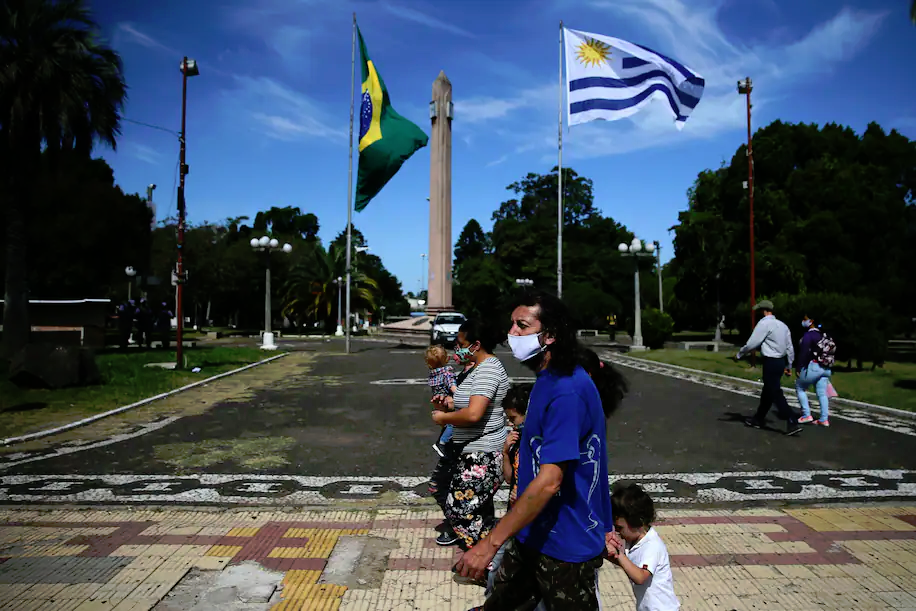
In Lima, scientists have detected the variant in 40 percent of coronavirus cases. In Uruguay, it’s been found in 30 percent. In Paraguay, officials say half of cases at the border with Brazil are P.1. Other South American countries — Colombia, Argentina, Venezuela, Chile — have discovered it in their territories. Limitations in genomic sequencing have made it difficult to know the variant’s true breadth, but it has been identified in more than two dozen countries, from Japan to the United States.

Hospital systems across South America are being pushed to their limits. Uruguay, one of South America’s wealthiest nations and a success story early in the pandemic, is barreling toward a medical system failure. Health officials say Peru is on the precipice, with only 84 intensive care beds left at the end of March. The intensive care system in Paraguay, roiled by protests last month over medical shortcomings, has run out of hospital beds.

“Paraguay has little chance of stopping the spread of the P.1 variant,” said Elena Candia Florentín, president of the Paraguayan Society of Infectious Diseases.

“With the medical system collapsed, medications and supplies chronically depleted, early detection deficient, contact tracing nonexistent, waiting patients begging for treatment on social media, insufficient vaccinations for health workers, and uncertainty over when general and vulnerable populations will be vaccinated, the outlook in Paraguay is dark,” she said.

How P.1 spread across the region is a distinctly South American story. Nearly every country on the continent shares a land border with Brazil. People converge on border towns, where crossing into another country can be as simple as crossing the street. Limited surveillance and border security have made the region a paradise for smugglers. But they have also made it nearly impossible to control the variant’s spread.

“We share 1,000 kilometers of dry border with Brazil, the biggest factory of variants in the world and the epicenter of the crisis,” said Gonzalo Moratorio, a Uruguayan molecular virologist tracking the variant’s growth. “And now it’s not just one country.”

The Brazilian city of Tabatinga, deep in the Amazon rainforest, where officials suspect the virus crossed into Colombia and Peru, is emblematic of the struggle to contain the variant. The city of 70,000 was swept by P.1 earlier this year. Many in the area have family ties in several countries and are accustomed to crossing borders with ease — canoeing across the Amazon River to Peru or walking into Colombia.

“People ended up bringing the virus from one side to the other,” said Sinesio Tikuna Trovão, an Indigenous leader. “The crossing was free, with both sides living right on top of one another.”

Now that the variant has infiltrated numerous countries, stopping its spread will be difficult. Most South American countries, with the exception of Brazil, adopted stringent containment measures last year. But they have been undone by poverty, apathy, distrust and exhaustion. With national economies battered and poverty rising sharply, public health experts fear more restrictions will be difficult to maintain. In Brazil, despite record death numbers, many states are lifting restrictions. (SOUND FAMILIAR)

That has left inoculation as the only way out. But coronavirus vaccines are South America’s white whale: often discussed, but rarely seen. The continent hasn’t distributed its own vaccine or negotiated a regional agreement with pharmaceutical companies. It’s one of the world’s hardest-hit regions but has administered only 6 percent of the world’s vaccine doses, according to the site Our World in Data. (The outlier is Chile, which is vaccinating residents more quickly than anywhere in the Americas — but still suffering a surge in cases.)

“We should not only blame the policy response,” said Luis Felipe López-Calva, the United Nations Development Program’s regional director for Latin America and the Caribbean. “We have to understand the vaccine market.”

“And there is a failure in the market,” he said.

The vaccine has become so scarce, López-Calva said, that officials are imposing restrictions on information. It’s nearly impossible to know how much governments are paying for doses. Some regional blocs, such as the African Union and the European Union, have negotiated joint contracts. But in South America, it has been every country for itself — diminishing the bargaining power for each one.

“This has been harmful for these countries, and for the whole world to stop the virus,” López-Calva said. “Because it’s never been more clear that no one is protected until everyone is protected.”

Paulo Buss, a prominent Brazilian scientist, said it didn’t have to be like this. He was Brazil’s health representative to the Union of South American Nations, which negotiated several regional deals with pharmaceutical companies before the coronavirus pandemic. But that union came apart amid political differences just before the arrival of the virus.

“It was the worst possible moment,” Buss said. “We’ve lost capacity and our negotiation attempts have been fragmented. Multi-lateralism was weakened.”

Vaccine scarcity has led to line-jumping scandals all over South America, but particularly in Peru. Hundreds of politically connected people, including cabinet ministers and former president Martín Vizcarra, snagged vaccine doses early. Now people are calling for criminal charges.

As officials bicker and the vaccination campaign is delayed, the variant continues to spread. P.1 accounts for 70 percent of cases in some parts of the Lima region, according to officials. Last week, the country logged the highest daily case count since August — more than 11,000. On Saturday, the country recorded 294 deaths, the most in a day since the start of the pandemic.

Peruvians have been stunned by how quickly the surge overwhelmed the health-care system. Public health analysts and government officials had believed Peru was prepared for a second wave. But it wasn’t ready for the variant.

“We did not expect such a strong second wave,” said Percy Mayta-Tristan, director of research at the Scientific University of the South in Lima. “The first wave was so extensive. The presence of the Brazilian variant helps explain why.”

How Vaccine Refusal Could Prolong the Pandemic

Stephanie Nana, an evangelical Christian in Edmond, Okla., refused to get a Covid-19 vaccine because she believed it contained “aborted cell tissue.”

Nathan French, who leads a nondenominational ministry in Tacoma, Wash., said he received a divine message that God was the ultimate healer and deliverer: “The vaccine is not the savior.”

Lauri Armstrong, a Bible-believing nutritionist outside of Dallas, said she did not need the vaccine because God designed the body to heal itself, if given the right nutrients. More than that, she said, “It would be God’s will if I am here or if I am not here.”

The deeply held spiritual convictions or counterfactual arguments may vary. But across white evangelical America, reasons not to get vaccinated have spread as quickly as the virus that public health officials are hoping to overcome through herd immunity.

The opposition is rooted in a mix of religious faith and a longstanding wariness of mainstream science, and it is fueled by broader cultural distrust of institutions and gravitation to online conspiracy theories. The sheer size of the community poses a major problem for the country’s ability to recover from a pandemic that has resulted in the deaths of half a million Americans. And evangelical ideas and instincts have a way of spreading, even internationally.

There are about 41 million white evangelical adults in the U.S. About 45 percent said in late February that they would not get vaccinated against Covid-19, making them among the least likely demographic groups to do so, according to the Pew Research Center.

“If we can’t get a significant number of white evangelicals to come around on this, the pandemic is going to last much longer than it needs to,” said Jamie Aten, founder and executive director of the Humanitarian Disaster Institute at Wheaton College, an evangelical institution in Illinois.

As vaccines become more widely available, and as worrisome virus variants develop, the problem takes on new urgency. Significant numbers of Americans generally are resistant to getting vaccinated, but white evangelicals present unique challenges because of their complex web of moral, medical, and political objections. The challenge is further complicated by longstanding distrust between evangelicals and the scientific community.

“Would I say that all public health agencies have the information that they need to address their questions and concerns? Probably not,” said Dr. Julie Morita, the executive vice president of the Robert Wood Johnson Foundation and a former Chicago public health commissioner.

No clear data is available about vaccine hesitancy among evangelicals of other racial groups. But religious reasoning often spreads beyond white churches.

Many high-profile conservative pastors and institutional leaders have endorsed the vaccines. Franklin Graham told his 9.6 million Facebook followers that Jesus would advocate for vaccination. Pastor Robert Jeffress commended it from an anti-abortion perspective on Fox News. (“We talk about life inside the womb being a gift from God. Well, life outside the womb is a gift from God, too.”) The president of the Southern Baptist Convention, J.D. Greear, tweeted a photo of himself receiving a shot.

But other influential voices in the sprawling, trans-denominational movement, especially those who have gained their stature through media fame, have sown fears. Gene Bailey, the host of a prophecy-focused talk show on the Victory Channel, warned his audience in March that the government and “globalist entities” will “use bayonets and prisons to force a needle into your arm.” In a now-deleted TikTok post from an evangelical influencer’s account that has more than 900,000 followers, she dramatized being killed by authorities for refusing the vaccine.

Dr. Simone Gold, a prominent Covid-19 skeptic who was charged with violent entry and disorderly conduct in the Jan. 6 Capitol siege, told an evangelical congregation in Florida that they were in danger of being “coerced into taking an experimental biological agent.”

The evangelical radio host Eric Metaxas wrote “Don’t get the vaccine” in a tweet on March 28 that has since been deleted. “Pass it on,” he wrote.

Some evangelicals believe that any Covid restrictions — including mask mandates and restrictions on in-person church worship — constitute oppression.

And some have been energized by what they see as a battle between faith and fear, and freedom and persecution.

Fear is the motivating power behind all of this, and fear is the opposite of who God is,” said Teresa Beukers, who travels throughout California in a motor home. “I violently oppose fear.”

Ms. Beukers foresees severe political and social consequences for resisting the vaccine, but she is determined to do so. She quit a job at Trader Joe’s when the company insisted that she wear a mask at work. Her son, she said, was kicked off his community college football team for refusing Covid testing protocols.

“Go ahead and throw us in the lions’ den, go ahead and throw us in the furnace,” she said, referring to two biblical stories in which God’s people miraculously survive persecution after refusing to submit to temporal powers.

Jesus, she added, broke ritual purity laws by interacting with lepers. “We can compare that to people who are unvaccinated,” she said. “If they get pushed out, they’ll need to live in their own colonies.”

One widespread concern among evangelicals is the vaccines’ ties to abortion. In reality, the connection is remote: Some of the vaccines were developed and tested using cells derived from the fetal tissue of elective abortions that took place decades ago.

The vaccines do not include fetal tissue, and no additional abortions are required to manufacture them. Still, the kernel of a connection has metastasized online into false rumors about human remains or fetal DNA being an ingredient in the vaccines.

Some evangelicals see the vaccine as a redemptive outcome for the original aborted fetus.

Some Catholic bishops have expressed concerns about the abortion link, too. But the Vatican has concluded the vaccines are “morally acceptable,” and has emphasized the immediate danger posed by the virus. Just 22 percent of Catholics in America say they will not get the vaccine, less than half the share of white evangelicals who say that.

White evangelicals who do not plan to get vaccinated sometimes say they see no need, because they do not feel at risk. Rates of Covid-19 death have been about twice as high for Black, Hispanic, and Native Americans as for white Americans.

White pastors have largely remained quiet. That’s in part because the wariness among white conservative Christians is not just medical, but also political. If white pastors encourage vaccination directly, said Dr. Aten, “there are people in the pews where you’ve just attacked their political party, and maybe their whole worldview.”

Dr. Morita, of the Robert Wood Johnson Foundation, said the method to reach white evangelicals is similar to building vaccine confidence in other groups: Listen to their concerns and questions, and then provide information that they can understand from people they trust.

But a public education campaign alone may not be enough.

There has been a “sea change” over the past century in how evangelical Christians see science, a change rooted largely in the debates over evolution and the secularization of the academy, said Elaine Ecklund, professor of sociology and director of the Religion and Public Life Program at Rice University.

There are two parts to the problem, she said: The scientific community has not been as friendly toward evangelicals, and the religious community has not encouraged followers to pursue careers in science.

Distrust of scientists has become part of cultural identity, of what it means to be white and evangelical in America, she said.

For slightly different reasons, the distrust is sometimes shared by Asian, Hispanic and Black Christians, who are skeptical that hospitals and medical professionals will be sensitive to their concerns, Dr. Ecklund said.

“We are seeing some of the implications of the inequalities in science,” she said. “This is an enormous warning of the fact that we do not have a more diverse scientific work force, religiously and racially.”

Among evangelicals, Pentecostal and charismatic Christians may be particularly wary of the vaccine, in part because their tradition historically emphasizes divine health and miraculous healing in ways that can rival traditional medicine, said Erica Ramirez, a scholar of Pentecostalism and director of applied research at Auburn Seminary. Charismatic churches also attract significant shares of Black and Hispanic Christians.

Dr. Ramirez compares modern Pentecostalism to Gwyneth Paltrow’s Goop, with the brand’s emphasis on “wellness” and “energy” that infuriates some scientists: “It’s extra-medical,” she said. “It’s not anti-medical, but it decenters medicine.”

The Centers for Disease Control and Prevention and Dr. Anthony Fauci are not going to be able to persuade evangelicals, according to Curtis Chang, a consulting professor at Duke Divinity School who is leading an outreach project to educate evangelicals about the vaccine.

The project includes a series of short, shareable videos for pastors, answering questions like “How can Christians spot fake news on the vaccine?” and “Is the vaccine the Mark of the Beast?” The latter refers to an apocalyptic theory that the AntiChrist will force his sign onto everyone at the end of the world.

These are questions that secular public health entities are not equipped to answer, he said. “The even deeper problem is, the white evangelicals aren’t even on their screen.”

Mr. Chang said he recently spoke with a colleague in Uganda whose hospital had received 5,000 vaccine doses, but had only been able to administer about 400, because of the hesitancy of the heavily evangelical population.

“How American evangelicals think, write, feel about issues quickly replicates throughout the entire world,” he said.

At this critical moment, even pastors struggle to know how to reach their flocks. Joel Rainey, who leads Covenant Church in Shepherdstown, W.Va., said several colleagues were forced out of their churches after promoting health and vaccination guidelines.

Politics has increasingly been shaping faith among white evangelicals, rather than the other way around, he said. Pastors’ influence on their churches is decreasing. “They get their people for one hour, and Sean Hannity gets them for the next 20,” he said.

Mr. Rainey helped his own Southern Baptist congregation get ahead of false information by publicly interviewing medical experts — a retired colonel specializing in infectious disease, a church member who is a Walter Reed logistics management analyst, and a church elder who is a nurse for the Department of Veterans Affairs.

On the worship stage, in front of the praise band’s drum set, he asked them “all of the questions that a follower of Jesus might have,” he said later.

“It is necessary for pastors to instruct their people that we don’t always have to be adversaries with the culture around us,” he said. “We believe Jesus died for those people, so why in the world would we see them as adversaries?”

Vaccine skepticism and disregard for containment efforts go hand in hand

It seems pretty clear the path the United States is on. Within a few months, everyone who wants to be vaccinated against the coronavirus will be, save for those below the minimum age for which vaccines are available. For everyone else, the pandemic Wild West will continue, with the country hopefully somewhere near the level of immunity that will keep the virus from spreading wildly but with large parts of the population — again, including kids — susceptible to infection.

That really gets at one of the two outstanding questions: How many Americans won’t get the vaccine? If the figure is fairly low, the ability of the virus to spread will be far lower. If it’s high, we have a problem. And that’s the other outstanding question: How big of a problem will the virus be, moving forward?

We know that even as vaccines are being rolled out, cases are slowly climbing. While the number of new infections recorded each day is well off the highs seen in the winter, we’re still averaging more cases on a daily basis than we saw even a month into the third wave that began in September. A lot of people are still getting sick, and, even with most elderly Americans now protected with vaccine, a lot more people will probably die.

Data released by Gallup this week shows that both of the questions posed above share a common component. It is, as you probably suspected, those who are least willing to get vaccinated who are also least likely to take steps to contain the virus.

Gallup asked Americans about their vaccination status, finding that about a fifth had been fully vaccinated and an additional 13 percent partially vaccinated. More than a quarter of respondents, though, said they didn’t plan to get vaccinated. It was those in that latter group who were least likely to say that they were completely or mostly isolating in an effort to prevent the virus spreading.

It was also those skeptics who were least likely to say that, in the past seven days, they had avoided crowds, group gatherings or travel. If you’re not inclined to get vaccinated, it is at least consistent that you would be similarly disinclined to take other steps aimed at limiting the spread of the virus.

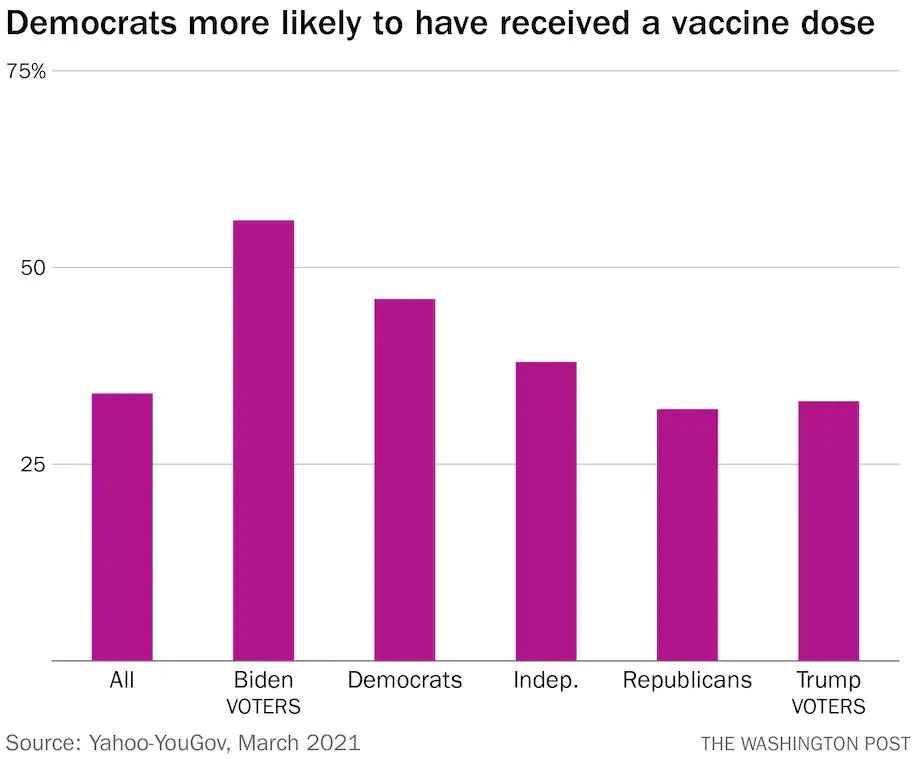
Gallup didn’t break out those groups by party, but it’s clear that few of them are Democrats. Data from YouGov, compiled on behalf of Yahoo News, shows that Democrats (and those who voted for Joe Biden in particular) are more likely to say that they have already received a vaccine dose.

Among those who hadn’t yet received a dose, Democrats were far more likely to indicate that they planned to do so as soon as possible. Among Republicans, half of those who haven’t been vaccinated say that they don’t have any plans to do so at all.

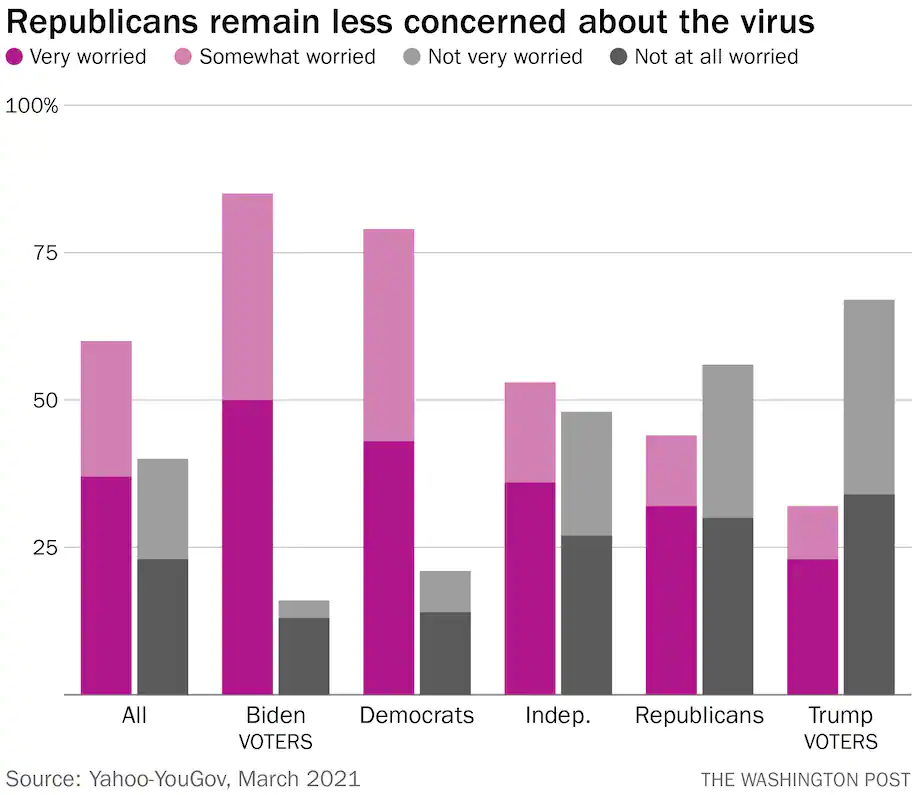
One reason is that Republicans are simply less worried about the virus. More than half say that they’re not very worried about it or not worried at all. Among those who voted for Donald Trump, the figure is over two-thirds. By contrast, more than three-quarters of Democrats say that they are at least somewhat worried about the virus.

In the YouGov polling, 60 percent of Republicans say that the worst of the pandemic is behind us. They’re also much more likely to say that restrictions aimed at preventing the spread of the virus — mask mandates, limits on indoor dining — should be lifted immediately.

As we mentioned Thursday, there are two ways to achieve herd immunity. One is fast and safe: widespread vaccinations. The other — people contracting the virus — is slow and dangerous. The path the United States is on will take us to a place where much of the country has opted for the first option and the rest, the latter.

So the question again becomes: How many people will die, both over the short term and the long term, as a result of those choices?

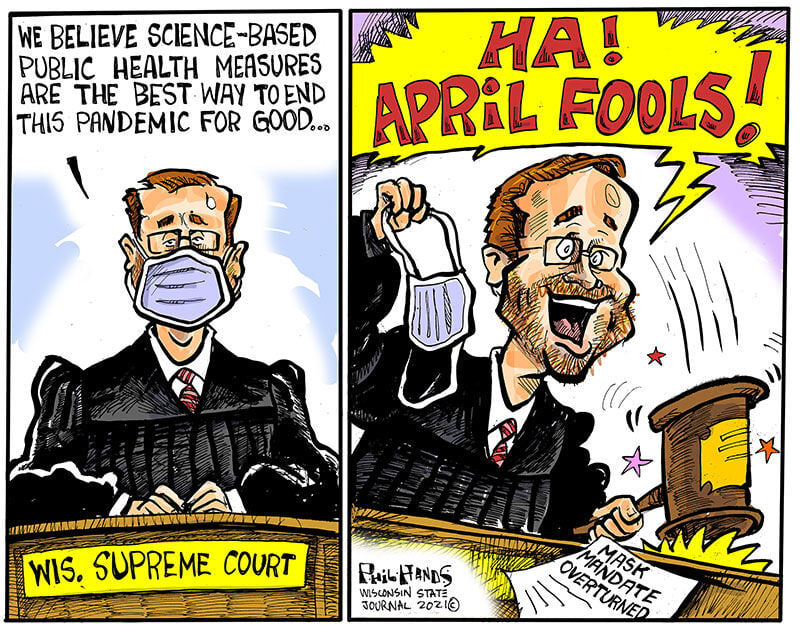
Hands on Wisconsin: Supreme Court plays April Fools’ Day prank on Wisconsin

https://madison.com/wsj/opinion/cartoon/hands-on-wisconsin-supreme-court-plays-april-fools-day-prank-on-wisconsin/article_48f60a90-9ada-502c-a134-e7f3ebbbe77a.html

MY VIEW | PHIL HANDS

The barriers to vaccine passports

https://www.axios.com/barriers-coronavirus-vaccine-passport-ee5ae689-c9e2-4306-9671-0af28bf21445.html

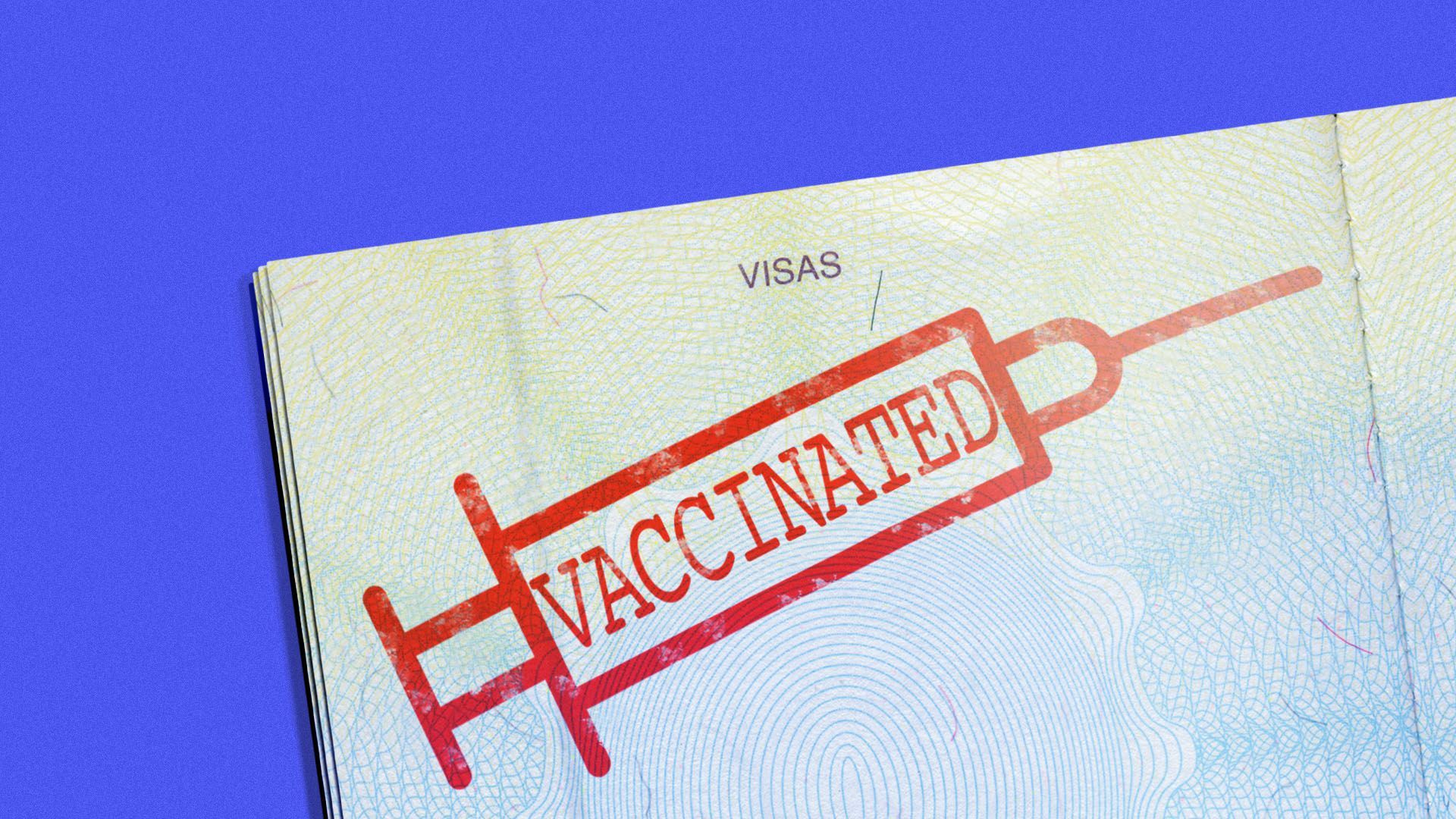
Vaccine passports could become available soon to help people resume their lives — but they face numerous scientific, social and political barriers to being accepted.

The big picture: Reliable and accessible proof of vaccine-induced protection from the novel coronavirus could speed international travel and economic reopening, but obstacles to its wide-scale adoption are so great it may never fully arrive.

Driving the news: The secure digital identity app CLEAR and CommonPass, a health app that lets users access vaccination records and COVID-19 test results, will be working together to offer a vaccine passport service, my Axios colleague Erica Pandey reports.

  • The news comes as a growing number of countries and companies are talking up plans to introduce similar vaccine passports that could help the protected return to normal life and travel as soon as possible.
  • To restart the economy, to save certain industries, I think you need a solution like this,” Eric Piscini, a vice president at IBM who oversaw the development of the company’s new health passport app, told the New York Times.

Yes, but: There are numerous health, ethical and operational questions that need to be resolved before vaccine passports could become an effective part of daily life.

Health: Medical experts still don’t fully know how effective vaccinations — or exposure to the virus — are at preventing onward transmission of COVID-19.

  • While the CDC is set to soon release new guidance around social activity for fully vaccinated people, current recommendations still call for them to keep wearing masks and practicing social distancing.
  • Until it’s clear that vaccination effectively prevents transmission, there’s a limit to how useful any vaccine passport can be for public health — especially if emerging variants render some vaccines less protective.
  • The utility of a vaccine passport is only as good as the evidence of how long the immunity lasts,” David Salisbury, an associate fellow at think tank Chatham House, told Bloomberg. “You could find yourself with a stamp in your passport that lasts longer than the antibodies in your blood.”

Ethical: The most obvious use case for vaccine passports is for international travel, which has been crippled by onerous quarantine restrictions. But such a system risks locking out billions of people who are unable or unwilling to get the vaccine.

  • The EU has been discussing the creation of a vaccine passport, with tourism-dependent countries like Greece leading the charge. But Germany and France — where the vaccine rollout has been low and hesitancy is high — have reservations, and any such system looks to be months away.
  • A bigger ethical concern is the many people in developing countries who may not get access to vaccines of any sort for months or even years while rich nations hoard supplies.
  • And if vaccine passports are used not just for international travel but to allow people to work and engage in social life domestically, they could create cripplingly unequal barriers that might paradoxically reinforce vaccine hesitancy.

Operational: Passports for international travel are regulated by governments and have decades of history behind them, but there’s no such unified system for vaccine passports, which are being introduced by governments and businesses with different standards, making them a target for fraud.

  • The U.S. in particular has a decentralized medical system that can make it difficult for people to easily access their health care records, especially if they lack digital literacy.
  • “I can pretty much 100% guarantee that fraud is going to occur,” says Jane Lee, a trust and safety architect at the cybersecurity company Sift. “We will have a lot of bad actors where they pretend to offer a service that will provide some sort of vaccination passport, but it’s really a phishing campaign.”

Be smart: None of these obstacles are insurmountable on their own. But as we saw with the failures of digital contact tracing, just because a technological solution exists doesn’t mean it will be effective or adopted by the public.

  • “There’s a huge motivation to make this work socially,” says Kevin Trilli, chief product officer at Onfido, an identification verification company. “But there’s a lot of governmental issues that are going to really make the system difficult to implement.”
  • There’s a time pressure at work here as well, especially in the U.S, where vaccination rates have picked up. The more people who are vaccinated, the less value there will be in creating a complex system to sift the protected from the unprotected.

The bottom line: Some form of vaccine visas will likely be introduced for international travel, but it seems unlikely they’ll become a passport to resuming normal life.

Millions of Americans remain vulnerable as cases rise

Coronavirus cases are on the rise again in several states, partially a result of variants of the virus becoming more widespread, experts say.

Why it matters: Even though a remarkable 72% of Americans 65 and older have received at least one dose of the vaccine, millions of Americans — particularly younger Americans with underlying conditions — remain vulnerable.

Driving the news: Coronavirus cases are rapidly rising in places including Michigan, New York, New Jersey and other Northeastern states.

  • In Michigan, the number of hospitalized younger adults has dramatically increased this month. Coronavirus hospitalizations increased by 633% for those aged 30 to 39 and by 800% for those aged 40 to 49, the Detroit Free Press reports.
  • The variant that originated in the U.K., which is partially driving the new surge, appears to be more transmissible and deadlier.

The big picture: “There are certainly many people who are not vaccinated who are still at severe risk themselves because of underlying medical issues,” said Leana Wen, a visiting professor at the Milken Institute School of Public Health at the George Washington University.

  • Because of vaccination demographics and who’s at highest risk of exposure, “the proportion of people who are hospitalized and who will die will likely skew toward a younger subset,” she said.

Between the lines: Those still vulnerable to the virus are disproportionately people of color.

  • That’s because prioritizing people for vaccines based on age disproportionately benefits white Americans, who tend to be older than people of color.
  • But younger people of color are tend to be at higher risk of severe infections because of underlying conditions.

What they’re saying: “To address areas of outbreak, we should allocate more of the increased vaccine supply coming into the market to places where penetration is low and infection rates high, like metro Detroit,” former FDA commissioner Scott Gottlieb tweeted.

Marc Harrison: The nation could learn a thing or two from Utahns about keeping people healthy

https://www.sltrib.com/opinion/commentary/2021/03/12/marc-harrison-nation/

Marc HarrisonM.D., is president and CEO of Intermountain Healthcare.

We are better served by a system that seeks to keep people healthy, not wait until they get sick.

If the pandemic has taught us anything, it’s that there’s a much better way to keep people healthy while reducing stress on our health care system at the same time. This will not only help mitigate risks from any future public health crisis, but also improve the well being and health of people in our community.

Utah’s Intermountain Healthcare, along with our community and health care colleagues, are leading a movement to do just that.

We greatly value and appreciate all our government, community and health care partners that coordinate closely with us to address the pandemic and provide care for our communities. It’s been a statewide team effort and will continue to be a team effort.

The roots of a deeply flawed national health care model that had taken hold long ago proved to create both systemic and personal health risks. According to a recent study, the U.S. had far more people hospitalized, more people with chronic conditions, double the obesity rates and the highest rate of preventable deaths among comparable nations. This was before the pandemic ever started. Our national health system was perfectly designed to be overwhelmed under the COVID-19 stress.

Moreover, many people who have died from COVID-19 were in poor health to begin with or were managing preventable chronic conditions. The flawed national health care system was never designed to support their goal to stay healthy. Instead, it was designed to wait until they got sick and then treat them.

Utah has one of the lowest death rates from COVID-19 in the nation. It’s at least partly true that this can be attributed to the superb care by medical providers in the state. But the data show a more interesting story. People in our state are in better health compared to those in other states.

We play outside more, drink less and smoke less than people in other states. Our rate of obesity is far lower than most other states. It’s no surprise that our recorded COVID-19 death rate is among the lowest in the nation. In fact, three of the top five healthiest states also have the three of the top six lowest recordable death rates from COVID-19. We don’t believe that’s a coincidence.

Over the last several years, Intermountain has focused more resources on keeping people healthy and out of hospitals. Vaccines have long been a critical part of this strategy. And while that garners most of the immediate headlines, we’ve geared our entire system’s strategy to focus on keeping people and communities well.

For example, Intermountain is a world leader in precision genomics medicine that aims to better treat and prevent genetic diseases. The opportunity to participate in the biggest, voluntary research of its kind is available for anyone in our community at no cost. With our community’s help, we can eventually share what we learn with others across the country and the world to help keep everyone healthier.

We are investing in addressing social determinants of health to keep people out of emergency rooms or other clinical settings for unneeded visits. Social determinants of health are influences that affect people’s long-term health, such as stable housing, joblessness, hunger, unsafe neighborhoods and access to transportation.

We’ve been working with and providing funding to multiple local nonprofit agencies that address these issues, and have provided financial support for a three-year pilot in Utah to see how community partnerships can address those influences in low-income ZIP codes. Often, simple and affordable changes can help prevent unnecessary health issues.

We’ve integrated mental health care with primary care because we know that mental health is essential to a person’s overall health. Long before the pandemic hit our shores, we deployed telehealth services that helps care for people closer to their homes and families. It’s not simply a matter of convenience for those we serve, but can lead to better health outcomes for less money.

All of us can’t wait to get back to some sense of normal. But for the nation’s health system, going back to normal shouldn’t be an option. We must do better. And Intermountain is determined to partner with Utahns and do what we all do best – lead the nation and the world by setting a better example.

The COVID-19 relief package: Where the money goes

https://www.politifact.com/article/2021/mar/19/covid-19-relief-package-where-money-goes/?fbclid=IwAR0WSCs9C4Rz9x6n-mlIsg7RY4KYM3byEZ3GdoYp3VWB0AIM8s0p_UUzinU

May be an image of text that says 'American Rescue Plan Act Where the money goes (In $billions) Other $129 Transportation $58 COVID/Public health $143 Stimulus Stimuluschecks checks $410 Schools $169_ Unemployment $242 Families $352 State/local aid $360'

IF YOUR TIME IS SHORT

  • The Democratic bill has $410 billion in stimulus checks and $360 billion in aid to state and local governments.
  • Expanded unemployment benefits cost $242 billion.
  • School spending is nearly $170 billion spread out over 10 years.

There are a few big chunks of money in the American Rescue Plan Act that have generated a lot of news coverage and are pretty well known. In response to a reader’s request, we present the whopping $1.86 trillion spending plan in pie chart form. 

There are the $1,400 checks (or more likely deposits) to many citizens or permanent legal residents and their dependents. That comes to about $410 billion.

Aid to state, local, territorial and tribal governments costs about $360 billion.

The bill boosts and extends unemployment benefits. Add another $242 billion.

Over the next 10 years, the law spends nearly $170 billion on education. That includes $129 billion for K-12 schools — both public and private — and about $40 billion for higher education.

The money for vaccines and corralling the coronavirus became a political talking point. Democrats touted the $20-25 billion they included for vaccine supplies and research. Republicans argued that the bill spent less than 10% of its total cost on COVID-19. 

People will parse the numbers in different ways. Some only count money spent directly on vaccine production. Some look more broadly at the economic damage wrought by the virus. We looked for money that went towards health care, whether that meant improving treatment on tribal lands, adding health care workers at clinics, or anything that reduced the health impacts of the pandemic.

We put the bill’s total public health spending at $143 billion.

Within that, the single biggest line item is $47.8 billion for mitigating the disease, a broad description that includes testing and surveillance. There is also $15 billion for COVID-related health care for veterans, $7.6 billion to help community health centers distribute vaccines, and about the same amount to the Centers for Disease Control and Prevention for roughly the same purpose.

The chart above lays out how the money breaks down.

All of the amounts so far come to $1.3 trillion over 10 years. The bill’s total cost is $1.86 trillion, which leaves about $500 billion dollars to flesh out.

The law has over $40 billion for child care. Money to keep people in their homes and to house the homeless comes to about $44 billion. There is $10 billion to put food on people’s tables. The expected cost of temporarily boosting the child tax credit is $109 billion.

In our chart, we fold all of that, plus subsidies for pensions and health insurance premiums, into the category of support for families. Our total is $352 billion.

Our last distinct category is transportation. Under that umbrella, we put $30 billion for mass transit, $15 billion for the airline industry, $8 billion for airports, and other related activities. That came to $58 billion.

The catch-all bucket of other spending includes items such as $66 billion for businesses, $50 billion for disaster relief at the Federal Emergency Management Agency, and $7 billion to expand broadband internet.

Who Can and Can’t Get Vaccinated Right Now

Who Can and Can’t Get Vaccinated Right Now

Some countries have stockpiles. Others have nothing. Getting a vaccine means living in the right place — or knowing the right people.


A 16-year-old in Israel can get a vaccine.

So can a 16-year-old in Mississippi.

And an 18-year-old in Shanghai.

But a 70-year-old in Shanghai can’t get one. Older people are at high risk for severe illness from Covid-19. But Chinese officials have been reluctant to vaccinate seniors, citing a lack of clinical trial data. Neither can an 80-year-old in Kenya. Low vaccine supply in many countries means only health care employees and other frontline workers are eligible, not the elderly.

Nor a 90-year-old in South Korea. Koreans 75 and older are not eligible until April 1. Only health care workers and nursing-home residents and staff are currently being vaccinated. The government initially said it was awaiting assurances that the AstraZeneca vaccine was safe and effective for older groups.


Anyone in Haiti.

Anyone in Papua New Guinea.

Anyone in these 67 countries. These countries have not reported any vaccinations, according to Our World in Data. Official figures can be incomplete, but many countries are still awaiting their first doses.

It wasn’t supposed to be like this: Covax, the global vaccine-sharing initiative, was meant to prevent unequal access by negotiating vaccine deals on behalf of all participating nations. Richer nations would purchase doses through Covax, and poorer nations would receive them for free.

But rich nations quickly undermined the program by securing their own deals directly with pharmaceutical companies. In many countries, they have reserved enough doses to immunize their own multiple times over.

Anyone who can afford a smartphone or an internet connection in India and is over 60 can get one. Mostly wealthy Indians are being inoculated in New Delhi and Mumbai, hospitals have reported, since vaccine appointments typically require registering online. Less than half of India’s population has access to the internet, and even fewer own smartphones.

And anyone who can pay $13,000 and travel to the U.A.E. for three weeks and is 65 or older or can prove they have a health condition.

A British travel service catering to the rich offered vaccination packages abroad, and wealthy travelers to the U.A.E. have acknowledged they were vaccinated there.


member of Congress in the United States. Friends of the mayor of Manaus, Brazil. Lawmakers in Lebanon. A top-ranking military leader in Spain. The extended family of the deputy health minister in Peru. The security detail to the president of the Philippines. Government allies with access to a so-called “V.I.P. Immunization Clinic” in Argentina. Around the world, those with power and connections have often been first in line to receive the vaccine — or have cut the line altogether.


A smoker in Illinois can get one. But not a smoker in Georgia.

A diabetic in the United Kingdom can. A diabetic in Connecticut can’t.

Countries have prioritized different underlying health conditions, with the majority focusing on illnesses that may increase the risk of severe Covid-19. In the U.S., health issues granted higher priority differ from state to state, prompting some people to travel across state borders.

A pregnant woman in New York. Not a pregnant woman in Germany. Up to two close contacts of a pregnant woman in Germany. Pregnant women were barred from participating in clinical trials, prompting many countries to exclude them from vaccine priority groups. But some experts say the risks to pregnant women from Covid-19 are greater than any theoretical harm from the vaccines.


A grocery worker in Texas, no. A grocery worker in Oklahoma, yes.

Many areas aim to stop the virus by vaccinating those working in frontline jobs, like public transit and grocery stores. But who counts as essential depends on where you live.

A police officer in the U.K. A police officer in Kenya. A postal worker in California. A postal worker in North Carolina. A teacher in Belgium. A teacher in Campeche, Mexico. Other jobs have been prioritized because of politics: Mexico’s president made all teachers in the southern state of Campeche eligible in a possible bid to gain favor with the teacher’s union.


Medical staff at jails and prisons in Colombia. A correctional officer in Tennessee. A prisoner in Tennessee. A prisoner in Florida. The virus spread rapidly through prisons and jails, which often have crowded conditions and little protective equipment. But few places have prioritized inoculating inmates.


An undocumented farm worker in Southern California. A refugee living in a shelter in Germany. An undocumented immigrant in the United Kingdom. Britain has said that everyone in the country is eligible for the vaccine, regardless of their legal status.

A Palestinian in the West Bank without a work permit. Despite leading the world in per-capita vaccinations, Israel has so far not vaccinated most Palestinians, unless they have permits to work in Israel or settlements in the occupied West Bank.


An adult in Bogotá, Colombia. An adult in the Amazonian regions of Colombia that border Brazil. In most of Colombia, the vaccine is only available to health care workers and those over 80.

But the government made all adults in Leticia, Puerto Nariño, Mitú and Inírida eligible, hoping to prevent the variant first detected in Brazil from arriving in other areas. A police officer in Mexico City. A teacher in rural Mexico.The government of populist president Andrés Manuel López Obrador has prioritized vaccinating the poor and those in rural communities, despite the country’s worst outbreaks occurring in major cities.

Native populations not federally recognized in the United States. The pandemic has been particularly deadly for Native Americans. But only tribes covered by the Indian Health Service have received vaccine doses directly, leaving about 245 tribes without a direct federal source of vaccines. Some states, including Montana, have prioritized all Native populations.

Indigenous people living on official indigenous land in Brazil.


These 43 countries, mostly high income, are on pace to be done in a year. These 148 countries, mostly low income, are on pace to take until next year or even longer. Countries like the U.S. continue to stockpile tens of millions of vaccine doses, while others await their first shipments.

“The vaccine rollout has been inequitable, unfair, and dangerous in leaving so many countries without any vaccine doses at all,” said Gavin Yamey, director of Duke University’s Center for Policy Impact in Global Health.

“It’s a situation in which I, a 52-year-old white man who can work from home and has no pre-existing medical conditions, will be vaccinated far ahead of health workers or a high-risk person in a middle- or low-income country.”

Consolidation as a force for good—at least during COVID

https://mailchi.mp/b0535f4b12b6/the-weekly-gist-march-12-2021?e=d1e747d2d8

Countering the Negative Consequences of COVID-Induced Healthcare  Consolidation - 4sight Health : 4sight Health
When Jeff Goldsmith and Ian Morrison talk, people listen (apologies to E.F. Hutton…Goldsmith and Morrison are old enough to get that reference, anyway). These two lions of health policy and strategy came together recently to pen an editorial in Health Affairs examining the impact of large integrated health systems on the nation’s response to COVID-19.

Morrison and Goldsmith admit to often finding themselves on opposite sides of consolidation issue,
but looking back over the past year, both agree the scale systems have built over decades has been foundational to their effective and rapid response to the pandemic, which they rate as “better than just about any other element of our society”.

Larger health systems were able to mobilize the resources to secure protective gear as supplies dwindled. They responded at a speed many would have thought impossible, doubling ICU capacity in a matter of days, and shifting care to telemedicine, implementing their five-year digital strategies during the last two weeks of March.

This kind of innovation would have been impossible without the investments in IT and electronic records enabled by scale—but systems also exhibited an impressive degree of “systemness”, making important decisions quickly, and mobilizing across regional footprints. Given the financial stresses experienced by smaller providers, consolidation is sure to increase. And the Biden healthcare team will likely bring more scrutiny to health system mergers.

Morrison and Goldsmith urge regulators to reconsider the role of health systems. The government should continue to pursue truly anticompetitive behavior that raises employer and consumer prices. But lawmakers should focus less on the sheer size of health systems and rather on their behavior, considering the potential societal impact a combined system might deliverand creating policy that takes into account the role health systems have played in bolstering our public health infrastructure.