The 6 challenges facing health care in 2023—and how to handle them

With input from stakeholders across the industry, Modern Healthcare outlines six challenges health care is likely to face in 2023—and what leaders can do about them.

1. Financial difficulties

In 2023, health systems will likely continue to face financial difficulties due to ongoing staffing problems, reduced patient volumes, and rising inflation.

According to Tina Wheeler, U.S. health care leader at Deloitte, hospitals can expect wage growth to continue to increase even as they try to contain labor costs. They can also expect expenses, including for supplies and pharmaceuticals, to remain elevated.

Health systems are also no longer able to rely on federal Covid-19 relief funding to offset some of these rising costs. Cuts to Medicare reimbursement rates could also negatively impact revenue.

“You’re going to have all these forces that are counterproductive that you’re going to have to navigate,” Wheeler said.

In addition, Erik Swanson, SVP of data and analytics at Kaufman Hall, said the continued shift to outpatient care will likely affect hospitals’ profit margins.

“The reality is … those sites of care in many cases tend to be lower-cost ways of delivering care, so ultimately it could be beneficial to health systems as a whole, but only for those systems that are able to offer those services and have that footprint,” he said.

2. Health system mergers

Although hospital transactions have slowed in the last few years, market watchers say mergers are expected to rebound as health systems aim to spread their growing expenses over larger organizations and increase their bargaining leverage with insurers.

“There is going to be some organizational soul-searching for some health systems that might force them to affiliate, even though they prefer not to,” said Patrick Cross, a partner at Faegre Drinker Biddle & Reath. “Health systems are soliciting partners, not because they are on the verge of bankruptcy, but because they are looking at their crystal ball and not seeing an easy road ahead.”

Financial challenges may also lead more physician practices to join health systems, private-equity groups, larger practices, or insurance companies.

“Many independent physicians are really struggling with their ability to maintain their independence,” said Joshua Kaye, chair of U.S. health care practice at DLA Piper. “There will be a fair amount of deal activity. The question will be more about the size and specialty of the practices that will be part of the next consolidation wave.”

3. Recruiting and retaining staff

According to data from Fitch Ratings, health care job openings reached an all-time high of 9.2% in September 2022—more than double the average rate of 4.2% between 2010 and 2019. With this trend likely to continue, organizations will need to find effective ways to recruit and retain workers.

Currently, some organizations are upgrading their processes and technology to hire people more quickly. They are also creating service-level agreements between recruiting and hiring teams to ensure interviews are scheduled within 48 hours or decisions are made within 24 hours.

Eric Burch, executive principal of operations and workforce services at Vizient, also predicted that there will be a continued need for contract labors, so health systems will need to consider travel nurses in their staffing plans.

“It’s really important to approach contract labor vendors as a strategic partner,” Burch said. “So when you need the staff, it’s a partnership and they’re able to help you get to your goals, versus suddenly reaching out to them and they don’t know your needs when you’re in crisis.”

When it comes to retention, Tochi Iroku-Malize, president of the American Academy of Family Physicians (AAFP), said health systems are adequately compensated for their work and have enough staff to alleviate potential burnout.

AAFP also supports legislation to streamline prior authorization in the Medicare Advantage program and avoid additional cuts to Medicare payments, which will help physicians provide care to patients with less stress.

4. Payer-provider contract disputes

A potential recession, along with the ensuing job cuts that typically follow, would limit insurers’ commercial business, which is their most profitable product line. Instead, many people who lose their jobs will likely sign up for Medicaid plans, which is much less profitable.

Because of increased labor, supply, and infrastructure costs, Brad Ellis, senior director at Fitch Ratings, said providers could pressure insurers into increasing the amount they pay for services. This will lead insurers to passing these increased costs onto members’ premiums.

Currently, Ellis said insurers are keeping an eye on how legislators finalize rules to implement the No Surprise Act’s independent resolution process. Regulators will also begin issuing fines for payers who are not in compliance with the law’s price transparency requirement.

5. Investment in digital health

Much like 2022, investment in digital health is likely to remain strong but subdued in 2023.

“You’ll continue to see layoffs, and startup funding is going to be hard to come by,” said Russell Glass, CEO of Headspace Health.

However, investors and health care leaders say they expect a strong market for digital health technology, such as tools for revenue cycle management and hospital-at-home programs.

According to Julian Pham, founding and managing partner at Third Culture Capital, he expects corporations such as CVS Health to continue to invest in health tech companies and for there to be more digital health mergers and acquisitions overall.

In addition, he predicted that investors, pharmaceutical companies, and insurers will show more interest in digital therapeutics, which are software applications prescribed by clinicians.

“As a physician, I’ve always dreamed of a future where I could prescribe an app,” Pham said. “Is it the right time? Time will tell. A lot needs to happen in digital therapeutics and it’s going to be hard.”

6. Health equity efforts

This year, CMS will continue rolling out new health equity initiatives and quality measurements for providers and insurers who serve marketplace, Medicare, and Medicaid beneficiaries. Some new quality measures include maternal health, opioid related adverse events, and social need/risk factor screenings.

CMS, the Joint Commission, and the National Committee for Quality Assurance are also partnering together to establish standards for health equity and data collection.

In addition, HHS is slated to restore a rule under the Affordable Care Act that prohibits discrimination based on a person’s gender identity or sexual orientation. According to experts, this rule may conflict with recently passed state laws that ban gender-affirming care for minors.

“It’s something that’s going to bear out in the courts and will likely lack clarity. We’ll see differences in what different courts decide,” said Lindsey Dawson, associate director of HIV policy and director of LGBTQ health policy at the Kaiser Family Foundation. “The Supreme Court acknowledged that there was this tension. So it’s an important place to watch and understand better moving forward.”

Adverse events in inpatient care still common

https://mailchi.mp/59374d8d7306/the-weekly-gist-january-13-2023?e=d1e747d2d8

Published this week in the New England Journal of Medicine, this concerning study found that seven percent of all inpatient hospital admissions feature at least one preventable adverse event, and that nearly a quarter of all adverse events are preventable, with drug administration errors the most frequent. While the complexities behind studying adverse events make it difficult to measure progress over time, the authors assert that these episodes are still far too common, and advocate for establishing standard approaches to measure the frequency of adverse events more reliably. 

The Gist: Health systems had been making at least some progress in their decades-long effort to reduce adverse events before COVID turned the industry upside down, drawing clinical leaders’ focus to the crisis and upending industry benchmarks. 

Today’s short-staffed, traveler-dependent labor force presents yet another challenge to hospitals aiming to achieve quality benchmarks. COVID has also accelerated the outpatient shift, heightening the importance of tracking quality metrics in non-hospital settings. 

As more complex procedures are performed in ambulatory surgery centers, and more hospital care is administered at home, there’s also a concern that hospital-based quality measures are not telling the whole story on the state of patient safety. 

A rethinking of quality metrics and processes to measure and prevent adverse events across the continuum is long overdue.  

Understanding the impact of the growing dominance of Medicare Advantage (MA)

https://mailchi.mp/d73a73774303/the-weekly-gist-may-27-2022?e=d1e747d2d8

recent piece in JAMA argues that policymakers need to be proactive in addressing how the rise of MA enrollment will affect the Medicare program as a whole, including its role in national quality and utilization measurement, rural healthcare access, and graduate medical education. The ability to monitor care delivered to the traditional, fee-for-service Medicare beneficiary population has been critical for assessing cost growth and shifting care patterns, distributing subsidies, and basing MA payments—all things that will become increasingly difficult as traditional Medicare becomes both smaller and less representative of the entire Medicare population.  

The Gist: Traditional Medicare has been a springboard for national healthcare policy goals and industry-wide innovations. However, consumers’ preference for, and policy shifts supporting, the growth of Medicare Advantage are proving to be unstoppable.

Providers must prepare for a future in which a shrinking minority of beneficiaries are enrolled in traditional Medicare. If current trends continue, Medicare policymakers must bolster ongoing support for medical education, and build a higher standard of transparency and quality reporting for MA carriers and providers to maintain the sustainability of one of the country’s greatest healthcare data resources.

Tennessee nurse convicted of negligent homicide for fatal medication error

A jury found former Vanderbilt Health nurse RaDonda Vaught guilty of negligent homicide and gross neglect of an impaired adult after she committed a fatal drug error in 2017. Vaught, who gave a patient a lethal dose of the paralytic agent vecuronium rather than the sedative Versed, overlooking several warning alerts, now faces up to six years in prison.

The Gist: Criminal charges for unintentional medical errors like this one are very unusual; discipline is normally the purview of licensing boards and civil courts. While Vaught certainly made an egregious mistake that directly led to a patient’s death, there’s a delicate line between holding caregivers accountable and making them criminally liable for unintentional errors. 

The American Nurses Association warns this verdict could set a dangerous precedent, and have a chilling effect on providers’ reporting errors. Health systems have worked diligently over decades to promote a culture of quality improvement and transparency—central to that is an environment that encourages providers to report all medical errors in order to improve patient safety. Many providers are now concerned that this conviction could reverse that progress. 

Payer contracts, physician pay still anchored in fee-for-service

The healthcare industry has made some strides in the “journey to value” across the last decade, but in reality, most health systems and physician groups are still very much entrenched in fee-for-service incentives.

While many health plans report that significant portions of their contract dollars are tied to cost and quality performance, what plans refer to as “value” isn’t necessarily “risk-based.” 

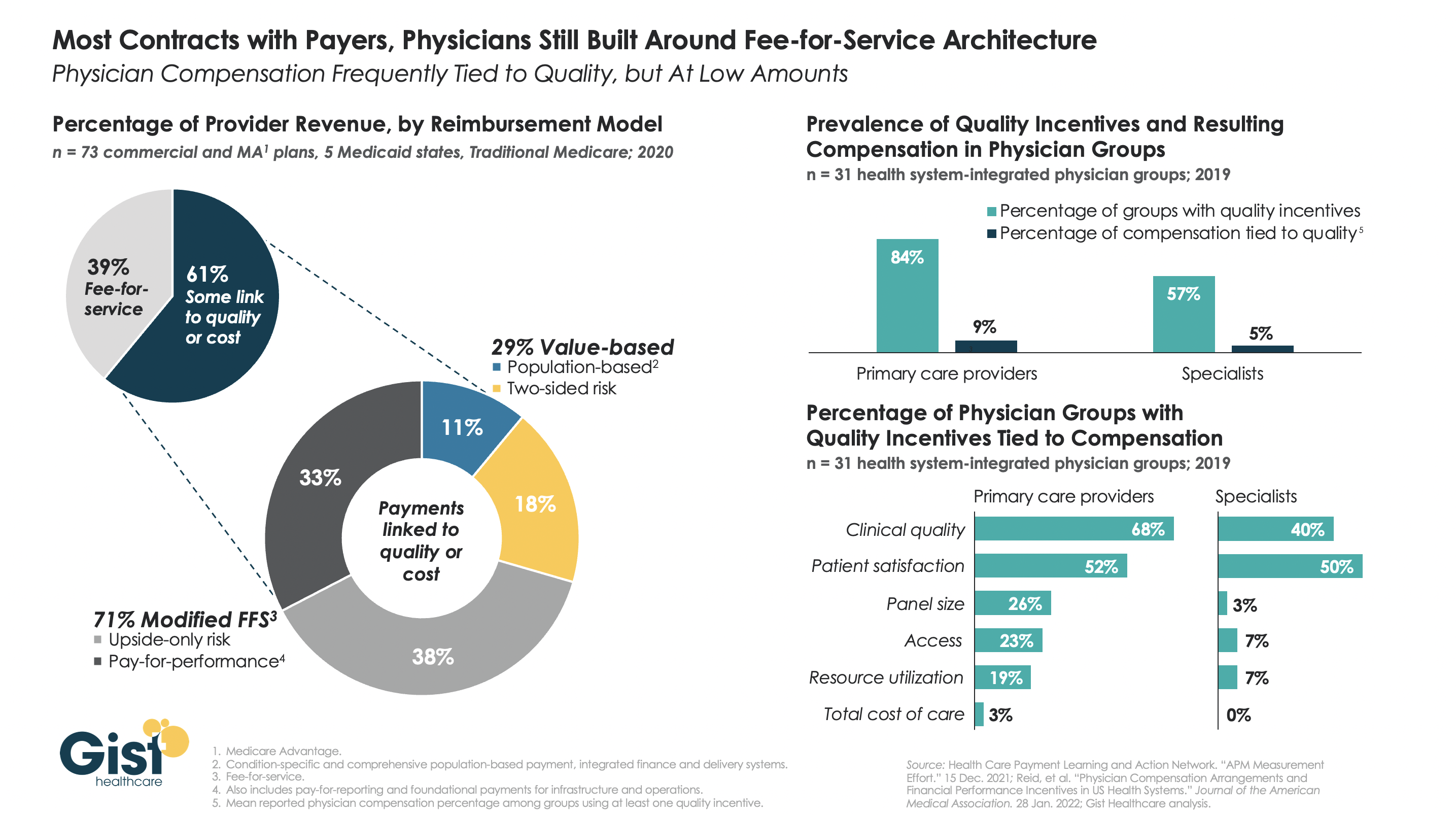
The left-hand side of the graphic below shows that, although a majority of payer contracts now include some link to quality or cost, over two-thirds of those lack any real downside risk for providers. 

Data on the right show a similar parallel in physician compensation. While the majority of physician groups have some quality incentives in their compensation models, less than a tenth of individual physician compensation is actually tied to quality performance. 

Though myriad stakeholders, from the federal government to individual health systems and physician groups, have collectively invested billions of dollars in migrating to value-based payment over the last decade, we are still far from seeing true, performance-based incentives translate into transformation up and down the healthcare value chain.  

Higher prices correlated with lower mortality in competitive hospital markets

https://mailchi.mp/f6328d2acfe2/the-weekly-gist-the-grizzly-bear-conflict-manager-edition?e=d1e747d2d8

A National Bureau of Economic Research working paper found that higher-priced hospitals in competitive markets were associated with lower patient mortality—flying in the face of the common policy narrative that higher-priced care is not higher quality. However, in more concentrated, less-competitive healthcare markets (in which over two-thirds of the nation’s hospitals are located), the study found no correlation between price and quality. Authors of the study analyzed patient outcomes from more than 200K admissions among commercially insured patients, transported by ambulance to about 1,800 hospitals between 2007 and 2014.   

The Gist: As hospitals have consolidated, prices have risen by about 30 percent between 2015 to 2019, leading policy experts and regulators to search for ways to rein in price inflation. 

While there continues to be widespread consensus that industry consolidation has resulted in unsustainable cost growth, the new study’s findings bring a bit of welcome nuance around impact on quality and outcomes to an otherwise one-sided, price-centric policy narrative.

The less-discussed consequence of healthcare’s labor shortage

Patient Safety and Quality Care Movement - YouTube

The healthcare industry’s staffing shortage crisis has had clear consequences for care delivery and efficiency, forcing some health systems to pause nonemergency surgeries or temporarily close facilities. Less understood is how these shortages are affecting care quality and patient safety. 

A mix of high COVID-19 patient volume and staff departures amid the pandemic has put hospitals at the heart of a national staffing shortage, but there is little national data available to quantify the shortages’ effects on patient care. 

The first hint came last month from a CDC report that found healthcare-associated infections increased significantly in 2020 after years of steady decline. Researchers attributed the increase to challenges related to the pandemic, including staffing shortages and high patient volumes, which limited hospitals’ ability to follow standard infection control practices. 

“That’s probably one of the first real pieces of data — from a large scale dataset — that we’ve seen that gives us some sense of direction of where we’ve been headed with the impact of patient outcomes as a result of the pandemic,” Patricia McGaffigan, RN, vice president of safety programs for the Institute for Healthcare Improvement, told Becker’s. “I think we’re still trying to absorb much of what’s really happening with the impact on patients and families.”

An opaque view into national safety trends

Because of lags in data reporting and analysis, the healthcare industry lacks clear insights into the pandemic’s effect on national safety trends.

National data on safety and quality — such as surveys of patient safety culture from the Agency for Healthcare Research and Quality — can often lag by several quarters to a year, according to Ms. McGaffigan. 

“There [have been] some declines in some of those scores more recently, but it does take a little while to be able to capture those changes and be able to put those changes in perspective,” she said. “One number higher or lower doesn’t necessarily indicate a trend, but it is worth really evaluating really closely.”

For example, 569 sentinel events were reported to the Joint Commission in the first six months of 2021, compared to 437 for the first six months of 2020. However, meaningful conclusions about the events’ frequency and long-term trends cannot be drawn from the dataset, as fewer than 2 percent of all sentinel events are reported to the Joint Commission, the organization estimates.

“We may never have as much data as we want,” said Leah Binder, president and CEO of the Leapfrog Group. She said a main area of concern is CMS withholding certain data amid the pandemic. Previously, the agency has suppressed data for individual hospitals during local crises, but never on such a wide scale, according to Ms. Binder.  

CMS collects and publishes quality data for more than 4,000 hospitals nationwide. The data is refreshed quarterly, with the next update scheduled for October. This update will include additional data for the fourth quarter of 2020.

“It is important to note that CMS provided a blanket extraordinary circumstances exception for Q1 and Q2 2020 data due to the COVID-19 pandemic where data was not required nor reported,” a CMS spokesperson told Becker’s. “In addition, some current hospital data will not be publicly available until about July 2022, while other data will not be available until January 2023 due to data exceptions, different measure reporting periods and the way in which CMS posts data.”

Hospitals that closely monitor their own datasets in more near-term windows may have a better grasp of patient safety trends at a local level. However, their ability to monitor, analyze and interpret that data largely depends on the resources available, Ms. McGaffigan said. The pandemic may have sidelined some of that work for hospitals, as clinical or safety leaders had to shift their priorities and day-to-day activities. 

“There are many other things besides COVID-19 that can harm patients,” Ms. Binder told Becker’s. “Health systems know this well, but given the pandemic, have taken their attention off these issues. Infection control and quality issues are not attended to at the level of seriousness we need them to be.”

What health systems should keep an eye on 

While the industry is still waiting for definitive answers on how staffing shortages have affected patient safety, Ms. Binder and Ms. McGaffigan highlighted a few areas of concern they are watching closely. 

The first is the effect limited visitation policies have had on families — and more than just the emotional toll. Family members and caregivers are a critical player missing in healthcare safety, according to Ms. Binder. 

When hospitals don’t allow visitors, loved ones aren’t able to contribute to care, such as ensuring proper medication administration or communication. Many nurses have said they previously relied a lot on family support and vigilance. The lack of extra monitoring may contribute to the increasing stress healthcare providers are facing and open the door for more medical errors.

Which leads Ms. Binder to her second concern — a culture that doesn’t always respect and prioritize nurses. The pandemic has underscored how vital nurses are, as they are present at every step of the care journey, she continued. 

To promote optimal care, hospitals “need a vibrant, engaged and safe nurse workforce,” Ms. Binder said. “We don’t have that. We don’t have a culture that respects nurses.” 

Diagnostic accuracy is another important area to watch, Ms. McGaffigan said. Diagnostic errors — such as missed or delayed diagnoses, or diagnoses that are not effectively communicated to the patient — were already one of the most sizable care quality challenges hospitals were facing prior to the pandemic. 

“It’s a little bit hard to play out what that crystal ball is going to show, but it is in particular an area that I think would be very, very important to watch,” she said.

Another area to monitor closely is delayed care and its potential consequences for patient outcomes, according to Ms. McGaffigan. Many Americans haven’t kept up with preventive care or have had delays in accessing care. Such delays could not only worsen patients’ health conditions, but also disengage them and prevent them from seeking care when it is available. 

Reinvigorating safety work: Where to start

Ms. McGaffigan suggests healthcare organizations looking to reinvigorate their safety work go back to the basics. Leaders should ensure they have a clear understanding of what their organization’s baseline safety metrics are and how their safety reports have been trending over the past year and a half.

“Look at the foundational aspects of what makes care safe and high-quality,” she said. “Those are very much linked to a lot of the systems, behaviors and practices that need to be prioritized by leaders and effectively translated within and across organizations and care teams.”

She recommended healthcare organizations take a total systems approach to their safety work, by focusing on the following four, interconnected pillars:

  • Culture, leadership and governance
  • Patient and family engagement
  • Learning systems
  • Workforce safety

For example, evidence shows workforce safety is an integral part of patient safety, but it’s not an area that’s systematically measured or evaluated, according to Ms. McGaffigan. Leaders should be aware of this connection and consider whether their patient safety reporting systems address workforce safety concerns or, instead, add on extra work and stress for their staff. 

Safety performance can slip when team members get busy or burdensome work is added to their plates, according to Ms. McGaffigan. She said leaders should be able to identify and prioritize the essential value-added work that must go on at an organization to ensure patients and families will have safe passage through the healthcare system and that care teams are able to operate in the safest and healthiest work environments.

In short, leaders should ask themselves: “What is the burdensome work people are being asked to absorb and what are the essential elements that are associated with safety that you want and need people to be able to stay on top of,” she said.

To improve both staffing shortages and quality of care, health systems must bring nurses higher up in leadership and into C-suite roles, Ms. Binder said. Giving nurses more authority in hospital decisions will make everything safer. Seattle-based Virginia Mason Hospital recently redesigned its operations around nurse priorities and subsequently saw its quality and safety scores go up, according to Ms. Binder. 

“If it’s a good place for a nurse to go, it’s a good place for a patient to go,” Ms. Binder said, noting that the national nursing shortage isn’t just a numbers game; it requires a large culture shift.

Hospitals need to double down on quality improvement efforts, Ms. Binder said. “Many have done the opposite, for good reason, because they are so focused on COVID-19. Because of that, quality improvement efforts have been reduced.”

Ms. Binder urged hospitals not to cut quality improvement staff, noting that this is an extraordinarily dangerous time for patients, and hospitals need all the help they can get monitoring safety. Hospitals shouldn’t start to believe the notion that somehow withdrawing focus on quality will save money or effort.  

“It’s important that the American public knows that we are fighting for healthcare quality and safety — and we have to fight for it, we all do,” Ms. Binder concluded. “We all have to be vigilant.”

Conclusion

The true consequences of healthcare’s labor shortage on patient safety and care quality will become clear once more national data is available. If the CDC’s report on rising HAI rates is any harbinger of what’s to come, it’s clear that health systems must place renewed focus and energy on safety work — even during something as unprecedented as a pandemic. 

The irony isn’t lost on Ms. Binder: Amid a crisis driven by infectious disease, U.S. hospitals are seeing higher rates of other infections.  

“A patient dies once,” she concluded. “They can die from COVID-19 or C. diff. It isn’t enough to prevent one.”

CMS proposes 2% pay bump for rehab, psychiatric facilities

The Biden administration has proposed giving rehabilitation facilities a 2.2% payment increase for the 2022 federal fiscal year that starts in October.

The payment rate outlined in a proposed rule released late Thursday is slightly below the 2.4% that CMS gave rehab facilities for the 2021 federal fiscal year. CMS proposed in a separate rule a 2.3% increase for payments to inpatient psychiatric facilities as well.

Both payment rules also give updates on outlier payments, which help facilities deal with the costs of treating extremely costly beneficiaries.

For rehab facilities, CMS proposes to maintain outlier payments to 3% of the total facility payments for fiscal 2022, which begins on Oct. 1.

CMS also aims to keep the outlier payments for psychiatric facilities at 2% for 2022.

A major change for both rules is a new addition aimed to track coverage of COVID-19 vaccinations among healthcare personnel.

CMS also wants to add vaccination coverage among healthcare personnel as a measure to the quality reporting program for psychiatric facilities. The program outlines quality metrics that facilities need to meet.

“This measure would be reported using the COVID-19 modules on the [Centers for Disease Control and Prevention’s] National Healthcare Safety Network web portal,” a fact sheet on the psychiatric payment rule said.

The agency also is proposing a similar measure for rehab facilities to report any vaccinations of healthcare personnel for COVID-19.

“This proposed measure is designed to assess whether [IRFs] are taking steps to limit the spread of COVID-19 among their [healthcare personnel], reduce the risk of transmission within their facilities and help sustain the ability of [rehabilitation facilities] to continue serving their communities through the public health emergency and beyond,” a fact sheet on the rehab rule said.

In the rehab facility rule, CMS also asked for comments on how to improve health equity for all patients.

CMS is seeking comments on whether to add more measures that address patient equity in standardized patient assessment data elements, which must be collected by facilities after post-acute care.

The agency also wants comments on ways to attain health equity for psychiatric facilities as well.

“CMS is committed to addressing the significant and persistent inequities in health outcomes in the United States through improving data collection to better measure and analyze disparities across programs and policies,” the agency said in a fact sheet.

Comments for both rules are due by June 7.