COVID-19 Can Last for Several Months

https://www.theatlantic.com/health/archive/2020/06/covid-19-coronavirus-longterm-symptoms-months/612679/

COVID-19 Can Last for Several Months - The Atlantic - Medium

The disease’s “long-haulers” have endured relentless waves of debilitating symptoms—and disbelief from doctors and friends.

For Vonny LeClerc, day one was March 16.

Hours after British Prime Minister Boris Johnson instated stringent social-distancing measures to halt the SARS-CoV-2 coronavirus, LeClerc, a Glasgow-based journalist, arrived home feeling shivery and flushed. Over the next few days, she developed a cough, chest pain, aching joints, and a prickling sensation on her skin. After a week of bed rest, she started improving. But on day 12, every old symptom returned, amplified and with reinforcements: She spiked an intermittent fever, lost her sense of taste and smell, and struggled to breathe.

When I spoke with LeClerc on day 66, she was still experiencing waves of symptoms. “Before this, I was a fit, healthy 32-year-old,” she said. “Now I’ve been reduced to not being able to stand up in the shower without feeling fatigued. I’ve tried going to the supermarket and I’m in bed for days afterwards. It’s like nothing I’ve ever experienced before.” Despite her best efforts, LeClerc has not been able to get a test, but “every doctor I’ve spoken to says there’s no shadow of a doubt that this has been COVID,” she said. Today is day 80.

COVID-19 has existed for less than six months, and it is easy to forget how little we know about it. The standard view is that a minority of infected people, who are typically elderly or have preexisting health problems, end up in critical care, requiring oxygen or a ventilator. About 80 percent of infections, according to the World Health Organization, “are mild or asymptomatic,” and patients recover after two weeks, on average. Yet support groups on Slack and Facebook host thousands of people like LeClerc, who say they have been wrestling with serious COVID-19 symptoms for at least a month, if not two or three. Some call themselves “long-termers” or “long-haulers.”

I interviewed nine of them for this story, all of whom share commonalities. Most have never been admitted to an ICU or gone on a ventilator, so their cases technically count as “mild.” But their lives have nonetheless been flattened by relentless and rolling waves of symptoms that make it hard to concentrate, exercise, or perform simple physical tasks. Most are young. Most were previously fit and healthy. “It is mild relative to dying in a hospital, but this virus has ruined my life,” LeClerc said. “Even reading a book is challenging and exhausting. What small joys other people are experiencing in lockdown—yoga, bread baking—are beyond the realms of possibility for me.”

Even though the world is consumed by concern over COVID-19, the long-haulers have been largely left out of the narrative and excluded from the figures that define the pandemic. I can pull up an online dashboard that reveals the numbers of confirmed cases, hospitalizations, deaths, and recoveries—but LeClerc falls into none of those categories. She and others are trapped in a statistical limbo, uncounted and thus overlooked.

Some have been diagnosed through tests, while others, like LeClerc, have been told by their doctors that they almost certainly have COVID-19. Still, many long-haulers have faced disbelief from friends and medical professionals because they don’t conform to the typical profile of the disease. People have questioned how they could possibly be so sick for so long, or whether they’re just stressed or anxious. “It feels like no one understands,” said Chloe Kaplan from Washington, D.C., who works in education and is on day 78. “I don’t think people are aware of the middle ground, where it knocks you off your feet for weeks, and you neither die nor have a mild case.”

The notion that most cases are mild and brief bolsters the belief that only the sick and elderly need isolate themselves, and that everyone else can get infected and be done with it. “It establishes a framework in which ‘not hiding’ from the disease looks a manageable and sensible undertaking,” writes Felicity Callard, a geographer at the University of Glasgow, who is on day 77. As the pandemic discourse turns to talk of a second wave, long-haulers who are still grappling with the consequences of the first wave are frustrated. “I’ve been very concerned by friends and family who just aren’t taking this seriously because they think you’re either asymptomatic or dead,” said Hannah Davis, an artist from New York City, who is on day 71. “This middle ground has been hellish.”

It “has been like nothing else on Earth,” said Paul Garner, who has previously endured dengue fever and malaria, and is currently on day 77 of COVID-19. Garner, an infectious-diseases professor at the Liverpool School of Tropical Medicine, leads a renowned organization that reviews scientific evidence on preventing and treating infections. He tested negative on day 63. He had waited to get a COVID-19 test partly to preserve them for health-care workers, and partly because, at one point, he thought he was going to die. “I knew I had the disease; it couldn’t have been anything else,” he told me. I asked him why he thought his symptoms had persisted. “I honestly don’t know,” he said. “I don’t understand what’s happening in my body.”

On March 17, a day after LeClerc came down with her first symptoms, SARS-CoV-2 sent Fiona Lowenstein to the hospital. Nine days later, after she was discharged, she started a Slack support group for people struggling with the disease. The group, which is affiliated with a wellness organization founded by Lowenstein called Body Politic, has been a haven for long-haulers. One channel for people whose symptoms have lasted longer than 30 days has more than 3,700 members.

“The group was a savior for me,” said Gina Assaf, a design consultant in Washington, D.C., who is now on day 77. She and other members with expertise in research and survey design have now sampled 640 people from the Body Politic group and beyond. Their report is neither representative nor peer-reviewed, but it provides a valuable snapshot of the long-hauler experience.

Of those surveyed, about three in five are between the ages of 30 and 49. About 56 percent have not been hospitalized, while another 38 percent have visited the ER but were not admitted. About a quarter have tested positive for COVID-19 and almost half have never been tested at all. Some became sick in mid-March, when their home countries were severely short on tests. (Most survey respondents live in the U.S. and the U.K.) Others were denied testing because their symptoms didn’t match the standard set. Angela Meriquez Vázquez, a children’s activist in Los Angeles, had gastrointestinal problems and lost her sense of smell, but because she didn’t have a cough and her fever hadn’t topped 100 degrees Fahrenheit, she didn’t meet L.A.’s testing criteria. By the time those criteria were loosened, Vázquez was on day 14. She got a test, and it came back negative. (She is now on day 69.)

A quarter of respondents in the Body Politic survey have tested negative, but that doesn’t mean they don’t have COVID-19. Diagnostic tests for SARS-CoV-2 miss infections up to 30 percent of the time, and these false negatives become more likely a week after a patient’s first symptoms appear. In the Body Politic survey, respondents with negative test results were tested a week after those with positive ones, on average, but the groups did not differ in their incidence of 60 different symptoms over time. Those matching patterns strongly suggest that those with negative tests are indeed dealing with the same disease. They also suggest that the true scope of the pandemic has been underestimated, not just because of the widespread lack of testing but because many people who are getting tested are receiving false negatives.

COVID-19 affects many different organs—that much is now clear. But in March, when many long-haulers were first falling sick with gut, heart, and brain problems, the disease was still regarded as a mainly respiratory one. To date, the only neurological symptom that the Centers for Disease Control and Prevention lists in its COVID-19 description is a loss of taste or smell. But other neurological symptoms are common among the long-haulers who answered the Body Politic survey.

As many people reported “brain fogs” and concentration challenges as coughs or fevers. Some have experienced hallucinations, delirium, short-term memory loss, or strange vibrating sensations when they touch surfaces. Others are likely having problems with their sympathetic nervous system, which controls unconscious processes like heartbeats and breathing: They’ll be out of breath even when their oxygen level is normal, or experience what feel like heart attacks even though EKG readings and chest X-rays are clear. These symptoms wax, wane, and warp over time. “It really is a grab bag,” said Davis, who is a co-author of the Body Politic survey. “Every day you wake up and you might have a different symptom.”

It’s not clear why this happens. Akiko Iwasaki, an immunologist at Yale, offers three possibilities. Long-haulers might still harbor infectious virus in some reservoir organ, which is missed by tests that use nasal swabs. Or persistent fragments of viral genes, though not infectious, may still be triggering a violent immune overreaction, as if “you’re reacting to a ghost of a virus,” Iwasaki says. More likely, the virus is gone but the immune system, having been provoked by it, is stuck in a lingering overactive state.

It’s hard to distinguish between these hypotheses, because SARS-CoV-2 is new and because the aftermath of viral infections is poorly understood. Many diseases cause long-lasting symptoms, but these might go unnoticed as trends unless epidemics are especially large. “Nearly every single person with Ebola has some long-term chronic complication, from subtle to obviously debilitating,” says Craig Spencer of the Columbia University Medical Center, who caught the virus himself in 2014. Some of those persistent problems had been noted during early Ebola outbreaks, but weren’t widely appreciated until 28,600 people were infected in West Africa from 2013 to 2016.

The sheer scale of the COVID-19 pandemic, which reached more than 6 million confirmed cases worldwide in a matter of months, means that long-haulers are now finding one another in sufficient numbers to shape their own narrative.

As the pandemic continues, long-haulers are navigating a landscape of uncertainty and fear with a map whose landmarks don’t reflect their surroundings. If your symptoms last for longer than two weeks, for how long should you expect to be sick? If they differ from the official list, how do you know which ones are important? “I’m acutely aware of my body at all times of the day,” LeClerc told me. “It shrinks your entire world to an almost reptilian response to your surroundings.”

If you’re still symptomatic, could you conceivably infect someone else if you leave your home? Garner, the infectious disease expert, is confident that this far out, he’s not shedding live virus anymore. But Meg Hamilton, who is a nursing student in Odenton, Maryland—and, full disclosure, my sister-in-law—said that her local health department considered her to be contagious as long as she had a fever; she is on day 56, and has only had a few normal temperature readings. Davis said that she and her partner, who live in different apartments, talked through the risks and decided to reunite on day 59. Until then, she had been dealing with two months of COVID-19 alone.

The isolation of the pandemic has been hard enough for many healthy people. But it has exacerbated the foggy minds, intense fatigue, and perpetual fear of erratic symptoms that long-haulers are also dealing with. “It plays with your head, man,” Garner said. Some feel guilt over being incapacitated even though their cases are “mild.” Some start doubting or blaming themselves. In her fourth week of fever, Hamilton began obsessively worrying that she had been using her thermometer incorrectly. “I also felt like I wasn’t being mentally strong enough, and by allowing myself to say that I don’t feel good, I was prolonging the fever,” she said.

Then there’s the matter of who to tell—and when. At first, Hamilton kept the news from her parents. She didn’t want them to worry, and she assumed she’d be better in two weeks. But as two weeks became three, then four, then five, the omission started feeling like an outright lie. Her concern that they would be worried morphed into concern that they would be mad. (She finally told them last week; they took it well.)

Other long-haulers have been frustrated by their friends’ and families’ inability to process a prolonged illness. “People know how to react to you having it or to you getting better,” LeClerc said. But when symptoms are rolling instead of abating, “people don’t have a response they can reach for.” They ask if she’s improving, in expectation that the answer is yes. When the answer is instead a list of ever-changing symptoms, they stop asking. Others pivot to disbelief. “I’ve had messages saying this is all in your head, or it’s anxiety,” LeClerc said.

Many such messages come from doctors and nurses. Davis described her memory loss and brain fog to a neurologist, who told her she had ADHD. “You feel really scared: These are people you’re trying to get serious help from, and they don’t even understand your reality,” she said. Vázquez said her physicians repeatedly told her she was just having panic attacks—but she knows herself well enough to discount that. “My anxiety is thought-based,” but with COVID-19, “the physical symptoms happen first,” she said.

Athena Akrami, a neuroscience professor at University College London, said two doctors suggested that she was stressed, while a fellow neuroscientist told her to calm down and take antidepressants. “I’m a very calm person, and something is wrong in my body,” said Akrami, who is now on day 79, and is also a co-author on the Body Politic survey. “As a scientist, I understand there are so many unknowns about the virus, but as a patient, I need acknowledgment.” Every day, Akrami said, “is like being in a tunnel.”

To be sure, many health-care workers are also exhausted, having spent several months fighting a new disease that they barely understand, without enough masks and other protective supplies. But well before the pandemic, the health-care profession had a long history of medical gaslighting—downplaying a patient’s physical suffering as being all in their head, or caused by stress or anxiety. Such dismissals particularly affect women, who are “less likely to be perceived as credible witnesses to our own experiences,” said LeClerc. And they’re especially common when women have subjective symptoms like pain or fatigue, as most long-haulers do. When Garner wrote about those same symptoms for the British Medical Journal’s blog, “I had an unbelievable feeling of relief,” Callard, the geographer, told me. “Since he’s a guy and a professor of infectious disease, he has the kind of epistemic authority that will be harder to discount.”

Garner’s descriptions of his illness are similar to those of many long-haulers who have been taken less seriously. “It wasn’t like he wrote those posts in some arcane language that’s steeped in authority,” said Sarah Ramey, a musician and author in Washington, D.C. “If you took his words, put my name on them, and put them up on Medium, people would say, ‘Ugh, who is this person and what is she talking about?’”

Ramey can empathize with long-haulers. In her memoir, The Lady’s Handbook for Her Mysterious Illness, she writes about her 17-year ordeal of excruciating pain, crushing fatigue, gastro-catastrophes, and medical gaslighting. “Being isolated and homebound, incredible economic insecurity, the government not doing enough, testing not being up to snuff—all of that is the lived experience of someone like me for decades,” she says. “The illness itself is horrible and ravaging, but being told you’ve made it up, over and over again, is by far the worst of it.”

Formally, Ramey has myalgic encephalomyelitis/chronic fatigue syndrome (ME/CFS) and complex regional pain syndrome. Informally, she’s part of a group she has dubbed WOMIs—women with mysterious illnesses. Such conditions include ME/CFS, fibromyalgia, and postural orthostatic tachycardia syndrome. They disproportionately affect women; have unclear causes, complex but debilitating symptoms, and no treatments; and are hard to diagnose and easy to dismiss. According to the Institute of Medicine, 836,000 to 2.5 million people in the U.S. alone have ME/CFS. Between 84 and 91 percent are undiagnosed.

That clusters of ME/CFS have followed many infectious outbreaks is noteworthy. In such events, some people get better quickly, others are sick for longer with postviral fatigue, and still others are suffering months or years later. In one Australian study, 11 percent of people infected with Ross River virus, Epstein-Barr virus, or the bacterium behind Q fever were diagnosed with ME/CFS after six months. In a study of 233 Hong Kong residents who survived the SARS epidemic of 2003, about 40 percent had chronic-fatigue problems after three years or so, and 27 percent met the CDC’s criteria for ME/CFS. Many different acute pathogens seem to trigger the same inflammatory responses that culminate in the same chronic endgame. Many individuals in this community are worried about COVID-19, according to Ramey: “You’ve got this highly infectious virus sweeping around the world, and it would be unusual if you didn’t see a big uptick in ME/CFS cases.”

ME/CFS is typically diagnosed when symptoms persist for six months or more, and the new coronavirus has barely been infecting humans for that long. Still, many of the long-haulers’ symptoms “sound exactly like those that patients in our community experience,” says Jennifer Brea, the executive director of the advocacy group #MEAction.

LeClerc, Akrami, and others have noted that their symptoms reappear when they try to regain a measure of agency by cleaning, working out, or even doing yoga. This is post-exertional malaise—the defining feature of ME/CFS. It’s a severe multi-organ crash that follows activity as light as a short walk. It’s also distinct from mere exhaustion: You can’t just push through it, and you’ll feel much worse if you try. The ME/CFS community has learned that resting as much as possible in the early months of postviral fatigue is crucial. Garner learned that lesson the hard way. After writing that “my disease has lifted,” he did a high-intensity workout, and was bedridden for three days. He is now reading literature about ME/CFS and listening to his sister, who has had the disease. “We have much to learn from that community,” he says.

The symptoms of ME/CFS have long been trivialized; its patients disbelieved; its researchers underfunded. The condition is especially underdiagnosed among black and brown communities, who are also disproportionately likely to be infected and killed by COVID-19. If the pandemic creates a large population of people who have symptoms that are similar to those of ME/CFS, it might trigger research into this and other overlooked diseases. Several teams of scientists are already planning studies of COVID-19 patients to see if any become ME/CFS patients—and why. Brea says she would welcome such a development. But she also feels “a lot of grief for people who may have to walk that path, [and] grief for the time we could have spent over the last four decades researching this so we’d have a better understanding of how to treat patients now.”

Some long-haulers will get better. The Body Politic Slack support group has a victories channel, where people post about promising moments on the road to recovery. Such stories were scarce last month, but more have appeared in the past weeks. The celebrations are always tentative, though. Good days are intermingled with terrible ones. “It’s a reverse-circling of the drain,” Vázquez said. “It has gotten better, but I track that trajectory in weeks, not days.” The COVID-19 dashboard from Johns Hopkins shows that about 2.7 million people around the world have “recovered” from the disease. But recovery is not a simple matter of flipping a switch. For some, it will take more time than the entire duration of the pandemic thus far.

Some survivors will have scar tissue from the coronavirus’s assault on their lungs. Some will still be weak after lengthy stays in ICUs or on ventilators. Some will eventually be diagnosed with ME/CFS. Whatever the case, as the pandemic progresses, the number of people with medium-to-long-term disabilities will increase. “Some science fiction—and more than a few tech bros—have led us to believe in a nondisabled future,” says Ashley Shew of Virginia Tech, who studies the intersection between technology and disability. “But whether through environmental catastrophe, or new viruses, we can expect more, exacerbated, and new disabilities.”

In the early 1950s, polio permanently disabled tens of thousands of people in the U.S. every year, most of whom were children or teenagers who “saw their futures as able and healthy,” Shew says. In the ’60s and ’70s, those survivors became pioneers of the disability-rights movement in the U.S.

Perhaps COVID-19 will similarly galvanize an even larger survivor cohort. Perhaps, collectively, they can push for a better understanding of neglected chronic diseases, and an acceptance of truths that the existing disability community have long known. That health and sickness are not binary. That medicine is as much about listening to patients’ subjective experiences as it is about analyzing their organs. That being a survivor is something you must also survive.

 

Shutdowns prevented 60 million coronavirus infections in the U.S., study finds

https://www.washingtonpost.com/health/2020/06/08/shutdowns-prevented-60-million-coronavirus-infections-us-study-finds/?fbclid=IwAR3J402h_abt63p-JDNEEBrNwrZ_nRjQza8OKxtV9xmtt4n5Oky-droY_-c&utm_campaign=wp_main&utm_medium=social&utm_source=facebook

Shutdowns prevented 60 million coronavirus infections in the U.S. ...

Shutdown orders prevented about 60 million novel coronavirus infections in the United States and 285 million in China, according to a research study published Monday that examined how stay-at-home orders and other restrictions limited the spread of the contagion.

A separate study from epidemiologists at Imperial College London estimated the shutdowns saved about 3.1 million lives in 11 European countries, including 500,000 in the United Kingdom, and dropped infection rates by an average of 82 percent, sufficient to drive the contagion well below epidemic levels.

The two reports, published simultaneously Monday in the journal Nature, used completely different methods to reach similar conclusions. They suggest that the aggressive and unprecedented shutdowns, which caused massive economic disruptions and job losses, were effective at halting the exponential spread of the novel coronavirus.

“Without these policies employed, we would have lived through a very different April and May,” said Solomon Hsiang, director of the Global Policy Laboratory at the University of California at Berkeley, and the leader of the research team that surveyed how six countries — China, the United States, France, Italy, Iran and South Korea — responded to the pandemic.

He called the global response to covid-19, the disease caused by the virus, “an extraordinary moment in human history when the world had to come together,” and said the shutdowns and other mitigation measures resulted in “saving more lives in a shorter period of time than ever before.”

The two reports on the effectiveness of the shutdowns come with a clear warning that the pandemic, even if in retreat in some of the places hardest hit, is far from over. The overwhelming majority of people remain susceptible to the virus. Only about 3 percent to 4 percent of people in the countries being studied have been infected to date, said Samir Bhatt, senior author of the Imperial College London study.

“This is just the beginning of the epidemic: we’re very far from herd immunity,” Bhatt said Monday in an email. “The risk of a second wave happening if all interventions and precautions are abandoned is very real.”

In a teleconference with reporters later, Bhatt said economic activity could return to some degree so long as some interventions to limit viral spread remain in place: “We’re not saying the country needs to stay locked down forever.”

The Berkeley study used an “econometric” model to estimate how 1,717 interventions, such as stay-at-home orders, business closings and travel bans, altered the spread of the virus. The researchers looked at infection rates before and after the interventions were imposed. Some of these interventions were local, and some regional or national. The researchers concluded that the six countries collectively managed to avert 62 million test-confirmed infections.

Because most people who are infected never get tested, the actual number of infections that were averted is much higher — about 530 million in the six countries, the Berkeley researchers estimated.

Timing is crucial, the Berkeley study found. Small delays in implementing shutdowns can lead to “dramatically different health outcomes.” The report, while reviewing what worked and what made little difference, is clearly aimed at the many countries still early in their battle against the coronavirus.

“Societies around the world are weighing whether the health benefits of anti-contagion policies are worth their social and economic costs,” the Berkeley team wrote. The economic costs of shutdowns are highly visible — closed stores, huge job losses, empty streets, food lines. The health benefits of the shutdowns, however, are invisible, because they involve “infections that never occurred and deaths that did not happen,” Hsiang said.

That spurred the researchers to come up with their estimates of infections prevented. The Berkeley team did not produce an estimate of lives saved.

One striking finding: School closures did not show a significant effect, although the authors cautioned that their research on this was not conclusive and the effectiveness of school closures requires further study. Banning large gatherings had more of an effect in Iran and Italy than in the other countries.

In discussing their findings Monday with reporters in the teleconference, leaders of the two research teams said challenges exist in crafting their models and thus there are uncertainties in the final estimates.

Bhatt, for example, said the model used by his team is highly sensitive to assumptions about the infection fatality rate, estimates for which have varied among researchers and from one country to another. He said his team was heartened to see that its estimates for the number of people infected so far is generally consistent with antibody surveys that attempt to calculate the attack rate of the virus.

Ian Bolliger, one of the Berkeley researchers, acknowledged the difficulty in obtaining reliable numbers for coronavirus infections given the haphazard pattern of testing for the virus. Both research teams said the peer review process had made their findings more robust.


How the CDC “missed its moment”

https://mailchi.mp/9f24c0f1da9a/the-weekly-gist-june-5-2020?e=d1e747d2d8

CDC releases new guidance for colleges on reducing coronavirus spread

If, like us, you’ve been wondering exactly why the CDC always seems to be a step behind in responding to the pandemic, a new, in-depth New York Times piece helps elucidate the myriad challenges—structural, cultural and political—that led to the agency’s flawed response.

Given the CDC’s history, it should have been the world’s “undisputed leader” in the pandemic response. But its early reticence to absorb lessons from other countries, combined with flawed testing, slowed down responses across the nation. While much has been made of political machinations within the Trump administration, a deep-rooted bureaucratic and exacting culture left the CDC ill-suited to respond to a crisis of this scale, requiring improvisation and rapid adaptation.

Career scientists and epidemiologists clashed with CDC leader Dr. Robert Redfield, who was eclipsed by Drs. Tony Fauci and Deborah Birx in public communication. But even if it were firing on all cylinders, the CDC is only one of the many parts of government at the table for what should have been a coordinated, all-government response.

Whether led by the CDC or another entity, the pandemic response has highlighted the need for a massive overhaul of the nation’s public health system, so that future challenges—both COVID-related and beyond—are met with a rapid and coordinated response.


The patients stayed away—will they come back?

https://mailchi.mp/9f24c0f1da9a/the-weekly-gist-june-5-2020?e=d1e747d2d8

Emergency Department Patient Resources

new analysis from the CDC this week confirmed what we have been hearing anecdotally from health systems for several weeks—as the coronavirus lockdown took hold, there was a precipitous drop in visits to hospital emergency departments. According to the study, visits were down by 42 percent in the month of April compared to the previous year, and despite a rebound in May, were still 26 percent lower than a year ago. Visits in the Northeast dropped the most, as did those among women, and children under 14.

Although visits for minor ailments and symptoms declined the most, even more disconcerting was the drop in visits for chest pain, echoing the concern we’ve heard in many parts of the country that many patients may have suffered minor heart attacks without being treated, or may have waited to be seen until significant damage had been done.

As non-emergent visits have begun to return to many facilities, we continue to hear that emergency department and urgent care volume remains relatively low.

Survey data indicate that patients are fearful of becoming infected with coronavirus if they visit healthcare facilities—especially, it seems, ones where they’ll be forced to wait.

While many providers are investing in messaging campaigns to assure patients it’s safe to return, this nightmarish first-person account by one healthcare insider provides a useful cautionary tale.

Visiting a surgeon for a pre-op consult, she found the experience of visiting a COVID-era hospital downright dystopian. Simply touting safety precautions by itself won’t make patients more comfortable—they’ll need to see and feel that measures are in place to make time spent in a care setting as efficient and reassuring as possible. Otherwise, like the insider in question, they’ll take their business elsewhere. There’s work to be done.


Hospitals Emptied Out by Pandemic Push for Patients to Return

https://www.bloomberg.com/news/articles/2020-06-04/dear-patient-we-want-you-back-for-that-knee-replacement

Empty Emergency Rooms Worry Doctors as Heart Attack, Stroke ...

After months of lock down, hospitals are eager to get patients back for routine care and elective procedures.

An executive at a Palm Beach hospital stands between a box of surgical masks and a Purell dispenser.

“We understand you haven’t been inside our hospitals for some time,” she says to the camera. The executive is delivering her line for a promotional video intended to get people back to hospitals after almost three months of avoiding the place at all costs. 

Moments later, the film crew records her chatting with a vascular surgeon in an idled operating room, who soothingly reassures that  a hospital is the cleanest place to be outside your home. “The hospital is safer than the grocery store,” the doctor says.

The video published on YouTube in mid-May is part of a marketing campaign by Tenet Healthcare, which operates 65 hospitals and about 250 ambulatory surgery centers. It’s one attempt to solve a problem the entire health-care industry faces: Most patients vanished when Covid-19 swept the country.

Billions in Losses

Much of routine health care came to a halt in March as hospitals cleared space for an expected wave of Covid-19 patients and authorities ordered a halt to surgeries and other procedures that could be postponed. The decline in volume has clobbered hospital finances, with the industry estimating it is losing $50 billion a month.

Emergency visits dropped by 42% in four weeks in April compared to the same period last year, the Centers for Disease Control reported June 3. The number of U.S. patients getting hospital care dropped by more than half in late March and early April compared to 2019, according to data from Strata Decision Technology, which provides software to hospitals.

Some of that rebounded modestly in May as distancing rules eased, but hospital volume is nowhere near pre-Covid levels. With the pandemic ongoing and many states still confirming hundreds of new cases daily, patients are hesitating to rush back to hospitals.

“The main thing that really is a gating factor at this point is patient comfort,” Tenet President and Chief Operating Officer Saumya Sutaria said at a recent virtual conference with investors. Tenet declined interview requests.

Free Masks

To counter the public’s fears, hospitals publicize what they’re doing to keep patients safe. They’re handing out masks at the door and spacing out chairs in waiting rooms. They’re steering Covid-19 patients to dedicated sites and testing staff regularly.

Hospitals need to show patients that their facilities are safe. At Catholic hospital chain Trinity Health, that includes moving patients through “Covid-free” zones with separate doors, elevators and waiting areas.

“We can put all of the outreach and marketing in place, but it’s only as effective as the people who execute those strategies,” said Julie Spencer Washington, Trinity’s chief marketing and communications officer.

The question for the entire industry is how quickly patients come back. The answer will depend on a constellation of related variables, including how reluctant people are to resume care, and the course of the pandemic. Future surges could force hospitals to shut down regular care again — and spook patients further.

Hospitals and doctors are going to have to do as much as they can as fast as they can until they can’t anymore,” said Lisa Bielamowicz, co-founder of consultancy Gist Healthcare.

Many patients, on the other hand, are in no rush. “They’re waiting and watching rather than pulling the trigger and going to see the doctor like they would have in the past,” Bielamowicz said.

The calculation for the health-care industry is different than for many other service businesses resuming operations. A hospital procedure or even a check-up is more intimate than a meal out.

For procedures that require in-patient rehab stints for recovery, the havoc Covid-19 has brought to nursing homes adds another layer of concern. “Those places seem like deathtraps now, so it’s much harder to bring back those patients because you need to find an alternative way for them to rehab,” Bielamowicz said.

And the biggest consumers of health care are the elderly and the chronically ill, the very people Covid-19 most threatens. “From personal discussions with my patients, the older and more co-morbidities that any individual has, the more nervous they are about returning,” said Shauna Gulley, chief clinical officer at Centura Health, which has hospitals in Colorado and Kansas.

Patients with serious ongoing needs like cancer treatment or emergencies like heart attacks and strokes have continued to get care. And many medical problems resolve on their own. The decline in those visits – for a migraine headache, for example – reduces providers’ revenue but may not harm patients in the long-term.

While people often go to the emergency room for needs better treated in other settings, now the concern is the opposite: That true medical emergencies will be neglected.

Ascension, the nation’s largest Catholic hospital chain, has purchased billboards that say “Don’t delay ER care.” On hospital websites and social media posts, Tenet facilities reminded patients that “Emergencies Can’t wait. We’re Open & Safe.”

Deferred Care

Doctors fear that some patients will defer needed care too long, allowing progressive conditions to deteriorate. Clinicians at Maimonides Medical Center in Brooklyn, New York, have seen patients arrive sicker because they didn’t come earlier, said Ken Gibbs, the hospital’s CEO.

“There are unmet needs, I think that’s clear,” he said. “And I think the data on that will emerge, but it will take time.”

Maimonides treated 471 Covid patients at the peak on April 9, Gibbs said, and still had about 100 in late May. The hospital has applied for a waiver from New York State to resume elective surgeries, which are still on hold in New York City.

Some hospitals are preparing for a lasting dent in their revenue. For years, health economists have pointed to waste in the health-care system, with the estimated cost of unnecessary treatments in the hundreds of billions of dollars. Covid-19 may demonstrate that patients are willing to forego some of that care or opt for more conservative treatment.

People who had delayed back surgeries, for example, may now decide that doing physical therapy at home is good enough, said Marvin O’Quinn, president and chief operating officer at CommonSpirit Health, a large Catholic hospital system.

“We’ve all talked about too much intervention in health care in the past,” he said. “I think we’ll see a new normal in terms of what patients want to do and what doctors want to do, and we will have to adjust to that.”


Identifying “triple-threat” counties at higher risk of COVID outbreaks

https://mailchi.mp/9f24c0f1da9a/the-weekly-gist-june-5-2020?e=d1e747d2d8

“Superspreader facilities”—nursing homes, correctional facilities, and meatpacking plants—have become major COVID hotspots across the US. Many counties are dealing with a large outbreak in one type of tightly-packed facility or another.

Case in point: the outbreak at Cook County Jail in Chicago, which now accounts for a whopping 15.7 percent of all COVID cases in the state of Illinois. Some places, like Colorado’s Weld County, are managing outbreaks across all three types of superspreader facilities.

The graphic above highlights the nearly 260 counties that we’ve termed “triple-threat counties”: those which have all three types of superspreader facilities. The counties are mapped using our Gist Healthcare COVID-19 Risk Factor Index, which identifies particularly vulnerable populations using chronic disease, demographic, and acute care access variables.

The top 10 “triple-threat counties” by risk index score are all in more rural areas of the country with limited acute care access and more vulnerable populations—places where a COVID outbreak is likely to be particularly devastating. Seven of the 10 have a high percentage of African-American or Hispanic/Latino residents, groups with a an outsized burden of COVID-19 illness and death. These risk factors are intersectional; for example, food processing plants employ twice as many Hispanic workers as the national average, and a disproportionate share of long-term care workers are black.

[Click here for more information and interactive data from our analysis of the risk impact of these superspreader facilities.]


CDC director: US needs up to 100,000 contact tracers by September to fight coronavirus

https://thehill.com/policy/healthcare/501157-cdc-director-us-needs-30-to-100-thousand-contact-tracers-by-september-to?utm_source=ActiveCampaign&utm_medium=email&utm_content=Does+the+US+Spend+Too+Much+on+Police%3F&utm_campaign=TFT+Newsletter+06042020

CDC director: US needs up to 100,000 contact tracers by September to fight coronavirus

Centers for Disease Control and Prevention (CDC) Director Robert Redfield told Congress on Thursday that the country needs between 30,000 and 100,000 people working on contact tracing in order to help contain the next wave of the coronavirus.

The estimate shows the daunting challenge of hiring an army of people to interview those infected with coronavirus to identify who they have been in contact with so that those people can quarantine and help prevent the spread of the virus.

“I’ve estimated between 30 and 100,000” contact tracers are needed,” Redfield told the House Appropriations Committee during a hearing Thursday. He acknowledged the figure is “sizable,” though it is actually less than the 300,000 people former CDC director Tom Frieden has estimated the U.S. will need.

He said it is crucial to get the contact tracing system in place by September to try to keep the virus in check ahead of an expected surge in the fall and winter. That could help prevent the type of blunt stay-at-home orders that the U.S. had to implement this spring after missing the window to contain the virus earlier this year.

“We really have to get this built and we have to get it built between now and September,” Redfield said.

Redfield said his agency has met with all 50 states to discuss hiring contact tracers and is pleased that some states have already started to do so. New York City, for example, has hired 1,700 contact tracers. 

He said the CDC Foundation is working to hire personnel to augment state efforts and the CDC has distributed funding to states provided by Congress for the purpose. He added he hopes AmeriCorps is a source of additional staff.

“It is fundamental that we have a fully operational contact tracing workforce that every single case, every single cluster, can do comprehensive contact tracing within 24 to 36 hours, 48 hours at the latest, get it completed, get it isolated, so that we can stay in containment mode as we get into the fall and winter of 2020,” he said.


Few U.S. adults say they’ve been diagnosed with coronavirus, but more than a quarter know someone who has

https://www.pewresearch.org/fact-tank/2020/05/26/few-u-s-adults-say-theyve-been-diagnosed-with-coronavirus-but-more-than-a-quarter-know-someone-who-has/?utm_source=Pew+Research+Center&utm_campaign=ef5ba73bf3-EMAIL_CAMPAIGN_2020_05_29_05_11&utm_medium=email&utm_term=0_3e953b9b70-ef5ba73bf3-400197657

28% of U.S. adults say they know someone diagnosed with COVID-19 ...

Relatively few Americans say they have been diagnosed with COVID-19 or tested positive for coronavirus antibodies, but many more believe they may have been infected or say they personally know someone who has been diagnosed.

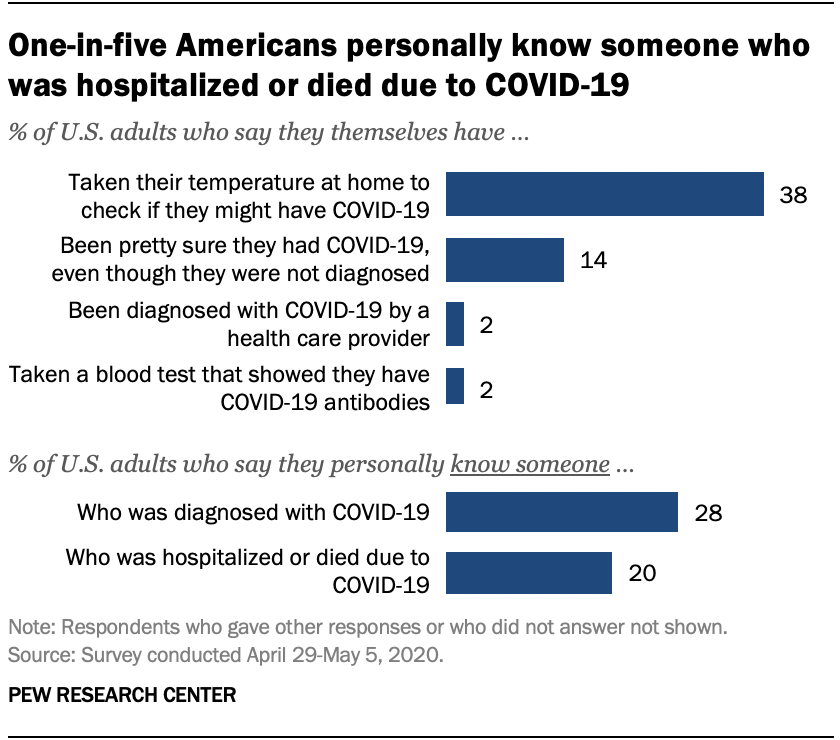
Only 2% of U.S. adults say they have been officially diagnosed with COVID-19 by a health care provider, according to a new Pew Research Center survey. And 2% say they have taken a blood test that showed they have COVID-19 antibodies, an indication that they previously had the coronavirus. But many more Americans (14%) say they are “pretty sure” they had COVID-19, despite not getting an official diagnosis. And nearly four-in-ten (38%) say they’ve taken their temperature to check if they might have the disease.

Although few Americans have been diagnosed with COVID-19 themselves, many more say they know someone with a positive diagnosis. More than one-in-four U.S. adults (28%) say they personally know someone who has been diagnosed by a health care provider as having COVID-19. A smaller share of Americans (20%) say they know someone who has been hospitalized or who has died as a result of having the coronavirus.

Some groups are more likely than others to report personal experiences with COVID-19. For instance, black adults are the most likely to personally know someone who has been hospitalized or died as a result of the disease. One-third of black Americans (34%) know someone who has been hospitalized or died, compared with 19% of Hispanics and 18% of white adults. Black Americans (32%) are also slightly more likely than Hispanic adults (26%) to know someone diagnosed with COVID-19. Public health studies have found black Americans are disproportionately dying or requiring hospitalization as a result of the coronavirus.

28% of U.S. adults say they know someone diagnosed with COVID-19 ...

Areas in the northeastern United States have recorded some of the highest rates of coronavirus cases and fatalities, and this is reflected in the Center’s survey. About four-in-ten adults living in the Northeast (42%) say they personally know someone diagnosed with COVID-19, significantly more than among adults living in any other region. People living in the Northeast (31%) are also the most likely to know someone who has been hospitalized or died as a result of the disease.

One aspect of personal risk for exposure to the coronavirus is whether someone is employed in a setting where they must have frequent contact with other people, such as at a grocery store, hospital or construction site. Given the potential for the spread of the coronavirus within households, risk to individuals is also higher if other members of the household are employed in similar settings. Among people who are currently employed full-time, 35% are working in a job with frequent public contact. Among those working part-time, almost half work (48%) in such a setting. For those living in a household with other adults, 35% report that at least one of those individuals is working in a job that requires frequent contact with other people.

Taken together, nearly four-in-ten Americans (38%) have this type of exposure – either currently working in a job that requires contact with others, living in a household with others whose jobs require contact, or both.

Hispanics (at 48%) are more likely than either blacks (38%) or whites (35%) to have this type of personal or household exposure. An earlier Center analysis of government data found Hispanic adults were slightly more likely to work in service-sector jobs that require customer interaction, and that are at higher risk of layoffs as a result of the virus. In fact, the current Center survey found Hispanics were among the most likely to have experienced pay cuts or job losses due to the coronavirus outbreak.

28% of U.S. adults say they know someone diagnosed with COVID-19 ...

Interpersonal exposure in the workplace is also more widespread among younger adults. And there is a 10 percentage point difference between upper- and lower-income Americans in exposure, with lower-income adults more likely to work in situations where they have to interact with the public, or to live with people who do.

Health experts warn that COVID-19 is particularly dangerous to people who have underlying medical conditions. In the survey, one-third of adults say they have such a condition. Among this group, nearly six-in-ten (58%) say that the coronavirus outbreak is a major threat to their personal health. Among those who do not report having an underlying medical condition, just 28% see the outbreak as a major threat to their health. Americans who have an underlying health condition are also more likely than those who do not to say they’ve taken their temperature to check if they might have COVID-19 (47% vs. 33% of those without a health condition).

Self-reports of an underlying health condition vary greatly by age. Among those ages 18 to 29, just 16% say they have a condition; this rises steadily with age to 56% among those 65 and older. Whites are a little more likely than blacks and Hispanics to report having a health condition, but both blacks (at 54%) and Hispanics (52%) are far more likely than whites (32%) to say that the coronavirus outbreak is “a major threat” to their health.


U.S. adults still afraid to go to a hospital over Covid-19 fears

http://secondscount.org/heart-resources/covid-19-facts?utm_source=STAT+Newsletters&utm_campaign=3d6599c5c4-MR_COPY_01&utm_medium=email&utm_term=0_8cab1d7961-3d6599c5c4-149578673#.XtKpcDpKgdX

Fear Can Spread From Person to Person Faster Than the Coronavirus ...

Seconds Count Survey Highlights
New research shows fear of COVID-19 is stopping people from seeking care during medical emergencies, like heart attacks or strokes.

  • As States start to re-open, more than one-third of Americans (36 percent) consider going to the hospital to be one of the riskiest behaviors to take part in compared to going to a hair salon (27 percent) or going to the beach (16 percent)
  • 61 percent of respondents think they are either somewhat likely or very likely to acquire COVID-19 in a hospital
  • Half of respondents are more afraid of contracting COVID-19 than experiencing a heart attack or stroke
  • Nearly 60 percent of respondents are more afraid of a family member or loved one contracting COVID-19 than experiencing a heart attack or stroke
  • When asked which are you more afraid of, contracting COVID-19, experiencing a heart attack or experiencing a stroke – twice as many people over the age of 60 are more afraid of contracting COVID-19 (52 percent) than they are of experiencing a heart attack (23 percent) or stroke (25 percent)


Trump: U.S. will terminate relationship with the World Health Organization in wake of Covid-19 pandemic

Trump: U.S. will terminate relationship with the World Health Organization in wake of Covid-19 pandemic

Coronavirus Fears Grind International Diplomacy to a Halt

President Trump said Friday the U.S. would halt its funding of the World Health Organization and pull out of the agency, accusing it of protecting China as the coronavirus pandemic took off. The move has alarmed health experts, who say the decision will undermine efforts to improve the health of people around the world.

In an address in the Rose Garden, Trump said the WHO had not made reforms that he said would have helped the global health agency stop the coronavirus from spreading around the world.

“We will be today terminating our relationship with the World Health Organization and redirecting those funds to other worldwide and deserving urgent global public health needs,” Trump said. “The world needs answers from China on the virus.”

It’s not immediately clear whether the president can fully withdraw U.S. funding for the WHO without an act of Congress, which typically controls all federal government spending. Democratic lawmakers have argued that doing so would be illegal, and House Speaker Nancy Pelosi threatened last month that such a move would be “swiftly challenged.”

The United States has provided roughly 15% of the WHO’s total funding over its current two-year budget period.

The WHO has repeatedly said it was committed to a review of its response, but after the pandemic had ebbed. Last month, Robert Redfield, the director of the Centers for Disease Control and Prevention, also said the “postmortem” on the pandemic should wait until the emergency was over.

As the Trump administration’s response to pandemic has come under greater scrutiny, with testing problems and a lack of coordination in deploying necessary supplies, Trump has sought to cast further blame on China and the WHO for failing to snuff out the spread when the virus was centered in China.

During his remarks, Trump alleged, without evidence, that China pressured WHO to mislead the world about the virus. Experts say that if the U.S. leaves the WHO, the influence of China will only grow.

“The world is now suffering as a result of the malfeasance of the Chinese government,” Trump said. “China’s coverup of the Wuhan virus allowed the disease to spread all over the world, instigating a global pandemic that has cost more than 100,000 American lives, and over a million lives worldwide.” (That last claim is not true; globally, there have been about 360,000 confirmed deaths from Covid-19, the disease caused by the coronavirus.)

When Trump earlier this month threatened to yank U.S. funding in a letter, Tedros Adhanom Ghebreyesus, the WHO director-general, would only say during a media briefing that the agency was reviewing it. But he and other officials stressed that the agency had a small budget — about $2.3 billion every year — relative to the impact the agency had and what it was expected to do.

Mike Ryan, head of the WHO’s emergencies program, said the U.S. funding provided the largest proportion of that program’s budget.

“So my concerns today are both for our program and … working on how we improve our funding base for WHO’s core budget,” Ryan said. “Replacing those life-saving funds for front-line health services to some of the most difficult places in the world — we’ll obviously have to work with other partners to ensure those funds can still flow. So this is going to have major implications for delivering essential health services to some of the most vulnerable people in the world and we trust that other donors will if necessary step in to fill that gap.”