Short-term ‘junk’ plans widely discriminate against those with pre-existing conditions, House probe finds

https://www.healthcaredive.com/news/short-term-junk-plans-widely-discriminate-against-those-with-pre-existing/580556/

U.S. Rep. Castor's Statement Following a Federal Judge's Ruling on ...

Dive Brief:

  • A yearlong probe by the House Committee on Energy and Commerce into bare-bones insurance plans encouraged by the Trump administration found widespread discrimination against people with pre-existing conditions, even as a growing number are enrolled.
  • Top congressional Democrats investigated eight insurers selling short-term, limited duration plans, finding they all denied medical care claims if they found a consumer had a pre-existing condition. Some refused to pay for medical claims for no discernable reason, processing them only after consumers sued or complained to state regulators. Most rescinded coverage if they determined a member had a pre-existing condition or developed one later.
  • An HHS spokesperson defended the coverage as an affordable option to pricier Affordable Care Act plans, telling Healthcare Dive, “We’ve been abundantly clear that these plans aren’t for everyone.” America’s Health Insurance Plans made similar points, with spokesperson David Allen noting: “For Americans with pre-existing conditions, they may not be protected at all.”


Dive Insight:

The investigation looked at 14 companies that sell or market the plans, including eight insurers such as market giants Anthem and UnitedHealth Group, and six brokers.

It found insurers frequently turned down consumers with pre-existing conditions and discriminated against women, turning down applicants who were pregnant or planning to become pregnant and charging women more than men for the same coverage.

The plans had significant coverage limitations. Some excluded routine care like basic preventive visits and pelvic exams. Some plans had hard coverage cutoffs that left consumers with massive medical bills.

In one case, a consumer was billed a whopping $280,000 and lost coverage after being treated for an infection. The insurer said the patient previously had gotten an ultrasound that was “suspicious for deep venous thrombosis.”

AHIP spokesman Allen said it is not surprising given the plans are not intended to replace comprehensive coverage.

“They often do not cover the care and treatments that patients need throughout the year — preventive care, prescription drugs, mental health care or treatments for chronic health conditions — or if they do, they may limit or cap the benefits,” he acknowledged.

On average, short-term plans spend less than half of premium dollars collected from consumers on medical care: only 48%, the investigation found. That’s in stark contrast to plans in the ACA’s individual market, which are required to shell out at least 80% of all premium dollars on claims and benefits.

Short-term insurance represents a significant and growing share of the individual healthcare market. Roughly 3 million consumers bought the plans in 2019, a 27% growth from 2018, the investigation launched in March last year found.

The growth came after the Trump administration, in a controversial move, extended the maximum duration of the plans. The skimpy coverage, which isn’t required to cover the 10 essential benefits under the ACA, was originally designed as cheap safety net coverage for three months.

But in August 2018, HHS expanded the plans to 12 months, with a three year renewal period, and opened them up to all consumers, not just for those who can’t afford other coverage.

ACA supporters and patient advocates blasted the move, which sparked an ongoing legal challenge from safety net providers. Reports of consumers purchasing the coverage, believing it was comprehensive, then being shocked by balance bills prompted the House investigation.

The report also found brokers are paid up to 10 times more compensation for peddling short-term plans than ACA-compliant coverage. The average commission rate for short-term plans compared to ACA plans was 23% versus 2%, respectively.

Currently, 24 states ban or restrict the sale of short-term plans. Some states, including California, Massachusetts, New Jersey and New York, prohibit their sale entirely, while others like Colorado, Connecticut, New Mexico and Rhode Island have such strict regulations that no plans are sold.

Democratic leaders unveiled a bill on Wednesday to bolster the ACA and rescind the administration’s expansion of the plans and expand subsidies, allowing more people to qualify for coverage.

The effort has zero chance of moving this year with Republicans in control of the Senate, but both it and the probe are likely to play into the looming 2020 presidential and congressional elections.

“The heavy-handed tactics uncovered in this investigation demonstrate why Congress must reverse the Trump Administration’s expansion of these junk plans,” E&C Chairman Frank Pallone, D-N.J., Health Subcommittee Chairwoman Anna Eshoo, D-Calif., and Oversight and Investigations Subcommittee Chair Diana DeGette, D-Colo., wrote in a joint statement. “It also shows how dangerous a post-ACA world would be if Republican Attorneys General and the Trump Administration are successful in striking down the law and its protections.”

That lawsuit, led by 18 red states, argues the ACA, which expanded insurance to some 20 million people, is unconstitutional because a tax bill passed in 2017 zeroed out the penalty for its individual mandate. It’s currently pending before the U.S. Supreme Court.

President Donald Trump and his health officials have repeatedly promised people with pre-existing conditions will be protected if the ACA is struck down, but neither the administration nor Republicans in Congress have said specifically how.


As Americans lose job-based coverage, ACA marketplace sets record with near 500K signups

https://www.healthcaredive.com/news/as-americans-lose-job-based-coverage-aca-marketplace-sets-record-with-near/580623/

Dive Brief:

  • Millions of individuals have lost their jobs as a result of the pandemic, allowing them to enroll in Affordable Care Act marketplace coverage via Healthcare.gov due to their special circumstances. CMS said this week that this special enrollment coverage due to job loss specifically has reached a record, with about 487,000 consumers gaining coverage, a 46% increase compared with the same time last year.
  • April saw the biggest jump in enrollment following job loss, an increase of 139% compared to April of last year.
  • Due to a number of factors, CMS said it “remains unclear how many people will eventually look to Exchanges using HealthCare.gov to replace job-based coverage.”

Dive Insight:

The pandemic has battered the economy, causing historic levels of unemployment. For many Americans, healthcare coverage is tethered to their jobs. As such, the pandemic is not only a threat to Americans’ health but their ability to pay for the care they need, sick with COVID-19 or not.

As many as 27 million Americans may have lost job-based coverage between March and May of this year, according to a recent analysis from the Kaiser Family Foundation. 

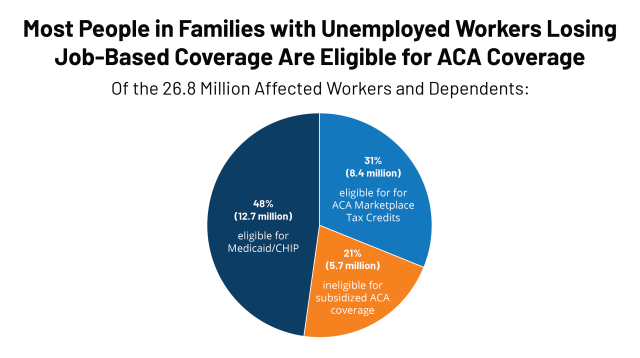
Of the newly uninsured, about half (12.7 million) would be eligible for Medicaid coverage, according to Kaiser’s estimates. There are a few options for workers out of a job and insurance. They can opt to extend their coverage through COBRA, enroll in coverage through the exchanges, or check to see if they qualify for Medicaid.

This week, CMS attempted to quantify just how many out-of-work Americans were turning to the exchanges.

About 500,000 out-of-work consumers enrolled in coverage so far this year. However, there are other life events that qualify a consumer to shop for coverage during a special enrollment period. Overall, special enrollment period sign-ups garnered more than 890,000 enrollees, dwarfing other periods. 

If the trend continues, it may fuel a significant shift in health insurance. For years, a majority have received commercial coverage through work. Even health insurers recognize disruption is on the horizon.

Many of the nation’s largest insurers are bracing for a shift from their commercial book of business to covering more Medicaid enrollees through their contracts with states. Earlier this year, Molina, Centene and Anthem all said they expect upticks in their Medicaid membership and exchange products.

Molina executives said in April they already saw 30,000 more Medicaid members from the prior-year period.


Coronavirus Dashboard

https://www.axios.com/coronavirus-latest-news-quick-highlights-57a186a3-7547-45bf-852a-83019849d8d5.html

Coronavirus dashboard: Catch up fast - Axios


  1. Global: Total confirmed cases as of 9 a.m. ET: 9,635,935 — Total deaths: 489,922 — Total recoveries — 4,861,715 — Map.
  2. U.S.: Total confirmed cases as of 9 a.m ET: 2,422,312 — Total deaths: 124,415 — Total recoveries: 663,562 — Total tested: 29,207,820 — Map.
  3. Public health: America’s workers still aren’t protected from the coronavirus — Gilead says coronavirus drug should likely cost no more than $2,800.
  4. White House: Trump administration asks Supreme Court to overturn ACA during pandemic.
  5. Sports: Universities cut sports teams, as they struggle with coronavirus fallout.


White House set to ask Supreme Court this week to overturn ACA: 4 things to know

https://www.beckershospitalreview.com/hospital-management-administration/white-house-to-ask-supreme-court-this-week-to-overturn-aca-4-things-to-know.html?utm_medium=email

New rules for Supreme Court justices as they plan their first-ever ...

The White House is expected to file legal briefs with the Supreme Court this week that will ask the justices to end the ACA, according to The New York Times

Four things to know:

1. The filings are in relation to Texas v. United States, the latest legal challenge to the ACA. Arguments around the case center on whether the ACA’s individual mandate was rendered unconstitutional when the penalty associated with it was erased by the 2017 tax law. Whether that decision invalidates the entire law or only certain parts of it is at question.

2. The White House is set to ask the Supreme Court June 25 to invalidate the law. The filings come at a time when the COVID-19 pandemic has caused millions of Americans to lose their jobs and their employer-based health coverage.

3. Republicans have said they want to “repeal and replace” the ACA, but there is no agreed upon alternative, according to The New York Times. Party strategists told the publication that Republicans will be in a tricky spot if they try to overturn the ACA ahead of the November elections and amid a pandemic. 

4. In addition to the filings, Democratic House speaker Nancy Pelosi is expected to reveal a bill this week that would boost the ACA. Proposals include more subsidies for healthcare premiums, expanding Medicaid coverage for uninsured pregnant women and offering states incentives to expand Medicaid.

Read the full report here


Supreme Court’s LGBTQ ruling may sideline Trump’s health care rules

https://www.axios.com/supreme-court-lgbtq-trump-health-care-e1328769-3e2f-4dc8-986d-f167de65191e.html

Supreme Court's LGBTQ ruling may sideline Trump's health care ...

The Supreme Court’s historic ruling on LGBTQ nondiscrimination could sideline the Trump administration’s new policies on health care and adoption.

Why it matters: The ruling’s ripple effects will be felt immediately, and could ultimately derail regulations the administration had finalized just days ago.

The big picture: Federal civil rights law prohibits discrimination on the basis of sex, and the Supreme Court said Monday that “sex” includes sexual orientation and gender identity.

  • Monday’s case was specifically about employment, but the same legal interpretation will likely carry over to other areas, most notably health care — and that could cause problems for some of the Trump administration’s policies.

Between the lines: Just a few days before the Supreme Court’s ruling, the Department of Health and Human Services rolled back Obama-era rules that banned health care providers from denying care to trans patients.

  • That was based on the Trump administration’s interpretation of what constitutes “sex” discrimination — that it only encompasses biological traits defined at birth. That is, broadly, the same interpretation the high court rejected on Monday.

What’s next: The court’s ruling does not automatically invalidate the health care rules, but would make them much harder to defend in court. And if the administration doesn’t withdraw the rules, those lawsuits are coming.

  • “The court here today clearly articulated that discrimination based on sexual orientation, discrimination based on gender identity, are forms of sex discrimination,” said Alphonso David, president of the Human Rights Campaign.
  • “So, we are expecting the administration to rescind their rule immediately,” he said. “If they don’t, we are prepared to continue to use all of our resources, including litigation, to sue them and make sure that the rule is never implemented,”

HHS declined to answer questions about the regulations in light of Monday’s ruling.

Federal adoption guidelines could also be affected by the court’s decision.

  • The Trump administration has been working on rules that would make it easier for adoption and foster agencies to refuse to work with same-sex couples. Those rules would also face lawsuits if and when they’re finalized.
  • The specific legal foundations at issue there are somewhat different, but now that the Supreme Court has said civil-rights law prohibits discrimination on the basis of sexual identity and gender identity, any policy allowing such discrimination is going to face a steeper climb in the courts.

The bottom line: It may take a while for some of these issues to work their way through the courts, but the Supreme Court’s ruling Monday will make many forms of LGBTQ discrimination harder to defend, and in the scheme of things, that will likely happen pretty quickly.


Coronavirus likely forced 27 million off their insurance

https://www.axios.com/newsletters/axios-vitals-72173ec6-3383-4391-afbb-a5ed682e5d7a.html?utm_source=newsletter&utm_medium=email&utm_campaign=newsletter_axiosvitals&stream=top

The coronavirus pandemic is hitting Main Street and triggering ...

Roughly 27 million people have likely have lost job-based health coverage since the coronavirus shocked the economy, according to new estimates from the Kaiser Family Foundation.

Why it matters: Most of these people will be able sign up for other sources of coverage, but millions are still doomed to be uninsured in the midst of a pandemic, Axios’ Bob Herman reports.

By the numbers: For the 27 million people who are losing their job-based coverage, about 80% have other options, said Rachel Garfield, a health policy expert at the Kaiser Family Foundation and lead author of the report.

  • Roughly half are eligible for Medicaid or the Children’s Health Insurance Program.
  • Another third are eligible for subsidized health plans on the Affordable Care Act’s marketplaces.
  • The remaining 20% are pretty much out of luck because they live in a state that didn’t expand Medicaid or are ineligible for other kinds of subsidized coverage.
  • House Speaker Nancy Pelosi’s latest coronavirus relief bill would fully subsidize the cost of maintaining an employer plan through COBRA — an option that would otherwise be prohibitively expensive for many people. But that’s a long way from becoming law.

The bottom line: The coronavirus is blowing up health insurance at a time when people need it most.


Eligibility for ACA Health Coverage Following Job Loss

Eligibility for ACA Health Coverage Following Job Loss
Eligibility for ACA Health Coverage Following Job Loss – Methods ...

The economic consequences of the coronavirus pandemic have led to historic level of job loss in the United States. Social distancing policies required to address the crisis have led many businesses to cut hours, cease operations, or close altogether. Between March 1st and May 2nd, 2020, more than 31 million people had filed for unemployment insurance. Actual loss of jobs and income are likely even higher, as some people may be only marginally employed or may not have filed for benefits. Some of these unemployed workers may go back to work as social distancing curbs are relaxed, though further job loss is also possible if the economic downturn continues or deepens.

In addition to loss of income, job loss carries the risk of loss of health insurance for people who were receiving health coverage as a benefit through their employer. People who lose employer-sponsored insurance (ESI) often can elect to continue it for a period by paying the full premium (called COBRA continuation) or may become eligible for Medicaid or subsidized coverage through the Affordable Care Act (ACA) marketplaces. Over time, as unemployment benefits end, some may fall into the “coverage gap” that exists in states that have not expanded Medicaid under the ACA.

In this analysis, we examine the potential loss of ESI among people in families where someone lost employment between March 1st, 2020 and May 2nd, 2020 and estimate their eligibility for ACA coverage, including Medicaid and marketplace subsidies, as well as private coverage as a dependent (see detailed Methods at the end of this brief). To illustrate eligibility as their state and federal unemployment insurance (UI) benefits cease, we show eligibility for this population as of May 2020 and January 2021, when most will have exhausted their UI benefits.

What are coverage options for people losing ESI?

Eligibility for health coverage for people who lose ESI depends on many factors, including income while working and family income while unemployed, state of residence, and family status. Some people may be ineligible for coverage options, and others may be eligible but opt not to enroll. Some employers may temporarily continue coverage after job loss (for example, through the end of the month), but such extensions of coverage are typically limited to short periods.

Medicaid: Some people who lose their jobs and health coverage—especially those who live in states that expanded Medicaid under the ACA— may become newly eligible1 for Medicaid if their income falls below state eligibility limits (138% of poverty in states that expanded under the ACA). For Medicaid eligibility, income is calculated based on other income in the family plus any state unemployment benefit received (though the $600 per week federal supplemental payment available through the end of July is excluded). Income is determined on a current basis, so prior wages for workers recently unemployed are not relevant. In states that have not expanded Medicaid under the ACA, eligibility is generally limited to parents with very low incomes (typically below 50% of poverty and in some states quite a bit less); thus many adults may fall into the “coverage gap” that exists for those with incomes above Medicaid limits but below poverty (which is the minimum eligibility threshold for marketplace subsidies under the ACA). Undocumented immigrants are ineligible for Medicaid, and recent immigrants (those here for fewer than five years) are ineligible in most cases.

Marketplace: ACA marketplace coverage is available to legal residents who are not eligible for Medicaid and do not have an affordable offer of ESI; subsidies for marketplace coverage are available to people with family income between 100% and 400% of poverty. Some people who lose ESI may be newly-eligible for income-based subsidies, based on other family income plus any state and new federal unemployment benefit received (including the $600 per week federal supplement, unlike for Medicaid).2 While current income is used for Medicaid eligibility, annual income for the calendar year is used for marketplace subsidy eligibility. Advance subsidies are available based on estimated annual income, but the subsidies are reconciled based on actual income on the tax return filed the following year. People who lose ESI due to job loss qualify for a special enrollment period (SEP) for marketplace coverage.3 As with Medicaid, undocumented immigrants are ineligible for marketplace coverage or subsidies. However, recent immigrants, including those whose income makes them otherwise eligible for Medicaid, can receive marketplace subsidies.

ESI Dependent Coverage: People who lose jobs may be eligible for ESI as a dependent under a spouse or parent’s job-based coverage. Some people may have been covered as a dependent prior to job loss, and some may switch from their own coverage to coverage as a dependent.

COBRA: Many people who lose their job-based insurance can continue that coverage through COBRA, although it is typically quite expensive since unemployed workers generally have to pay the entire premium – employer premiums average $7,188 for a single person and $20,576 for a family of four – plus an additional 2%. People who are eligible for subsidized coverage through Medicaid or the marketplaces are likely to opt for that coverage over COBRA, though COBRA may be the only option available to some people who are income-ineligible for ACA coverage.

Short-term plans: Short-term plans, which can be offered for up to a year and can sometimes be renewed under revised rules from the Trump administration, are also a potential option for people losing their employer-sponsored insurance. These plans generally carry lower premiums than COBRA or ACA-compliant coverage, as they often provider more limited benefits and usually deny coverage to people with pre-existing conditions. Even when coverage is issued, insurers generally may challenge benefit claims that they believe resulted from pre-existing medical problems; given the long latency between initial infection and sickness with COVID-19, these plans are riskier than usual during the current pandemic. People cannot use ACA subsidies toward short-term plan premiums.

Our analysis examines eligibility for Medicaid, marketplace subsidies, and dependent ESI coverage. We do not estimate enrollment in COBRA, short-term plans, or temporary continuation of ESI. See Methods for more details.

How does coverage and eligibility change following job loss?

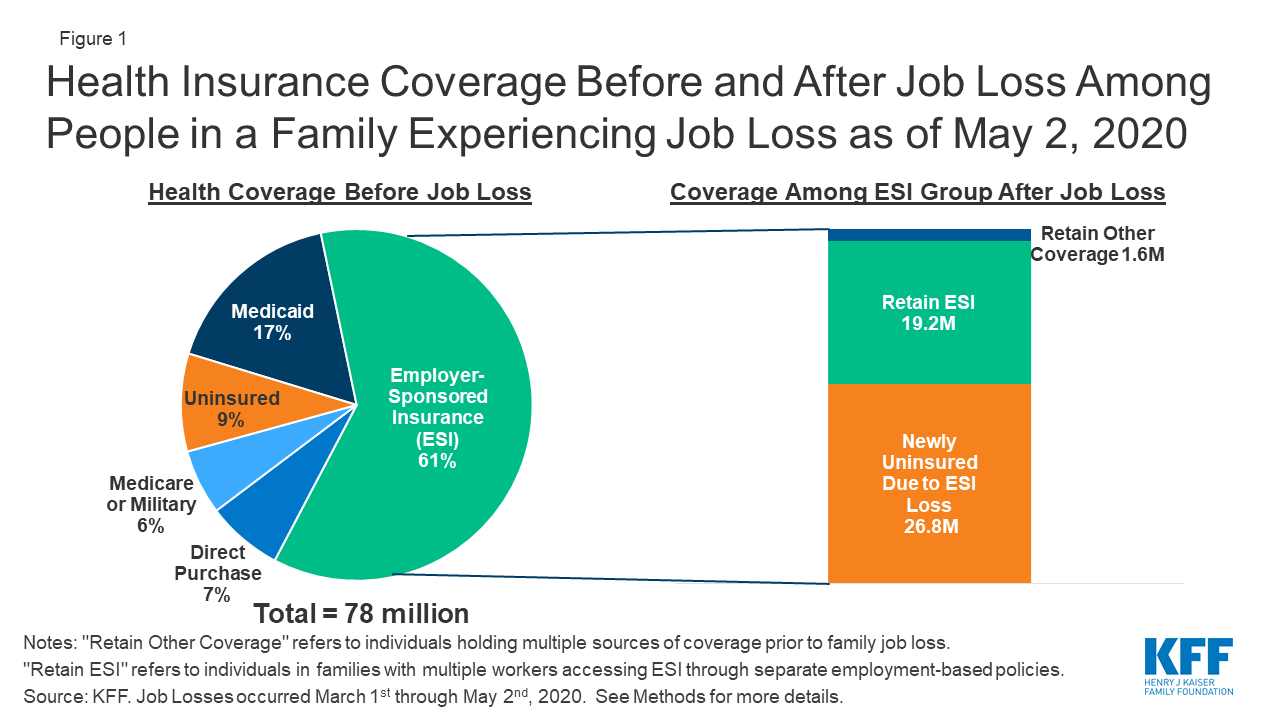
Between March 1st, 2020 and May 2nd, 2020, we estimate that nearly 78 million people lived in a family in which someone lost a job. Most people in these families (61%, or 47.5 million) were covered by ESI prior to job loss. Nearly one in five (17%) had Medicaid, and close to one in ten (9%) were uninsured. The remaining share either had direct purchase (marketplace) coverage (7%) or had other coverage such as Medicare or military coverage (6%) (Figure 1).
Eligibility for ACA Health Coverage Following Job Loss | The Henry ...

We estimate that, as of May 2nd, 2020, nearly 27 million people could potentially lose ESI and become uninsured following job loss (Figure 1). This total includes people who lost their own ESI and those who lost dependent coverage when a family member lost a job and ESI. Additionally, some people who otherwise would lose ESI are able to retain job-based coverage by switching to a plan offered to a family member: we estimate that 19 million people switch to coverage offered by the employer of a working spouse or parent. A very small number of people who lose ESI (1.6 million) also had another source of coverage at the same time (such as Medicare) and retain that other coverage. These coverage loss estimates are based on our assumptions about who likely filed for UI as of May 2nd, 2020 and the availability of other ESI options in their family (see Methods for more detail).

Among people who become uninsured after job loss, we estimate that nearly half (12.7 million) are eligible for Medicaid, and an additional 8.4 million are eligible for marketplace subsidies, as of May 2020 (Figure 2). In total, 79% of those losing ESI and becoming uninsured are eligible for publicly-subsidized coverage in May. Approximately 5.7 million people who lose ESI due to job loss are not eligible for subsidized coverage, including almost 150,000 people who fall into the coverage gap, 3.7 million people ineligible due to family income being above eligibility limits, 1.3 million people who we estimate have an affordable offer of ESI through another working family member, and about 530,000 people who do not meet citizenship or immigration requirements. We project that very few people fall into the coverage gap immediately after job loss (as of May 2020) because wages before job loss plus unemployment benefits (including the temporary $600 per week federal supplement added by Congress) push annual income for many unemployed workers in non-expansion states above the poverty level, making them eligibility for ACA marketplace subsidies for the rest of the calendar year.
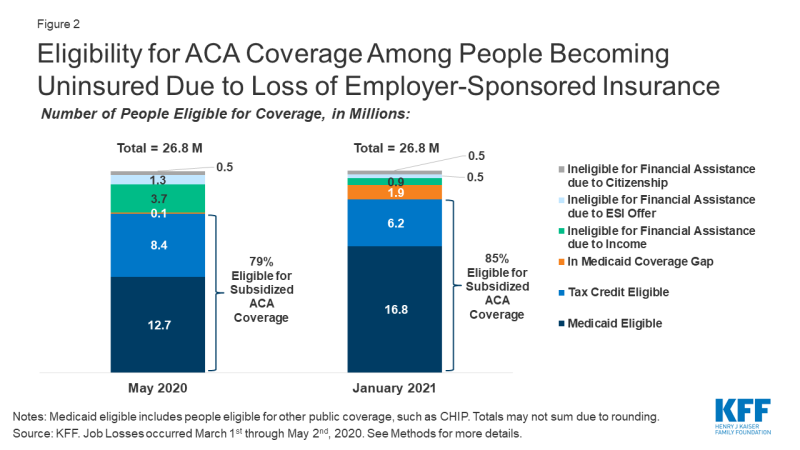
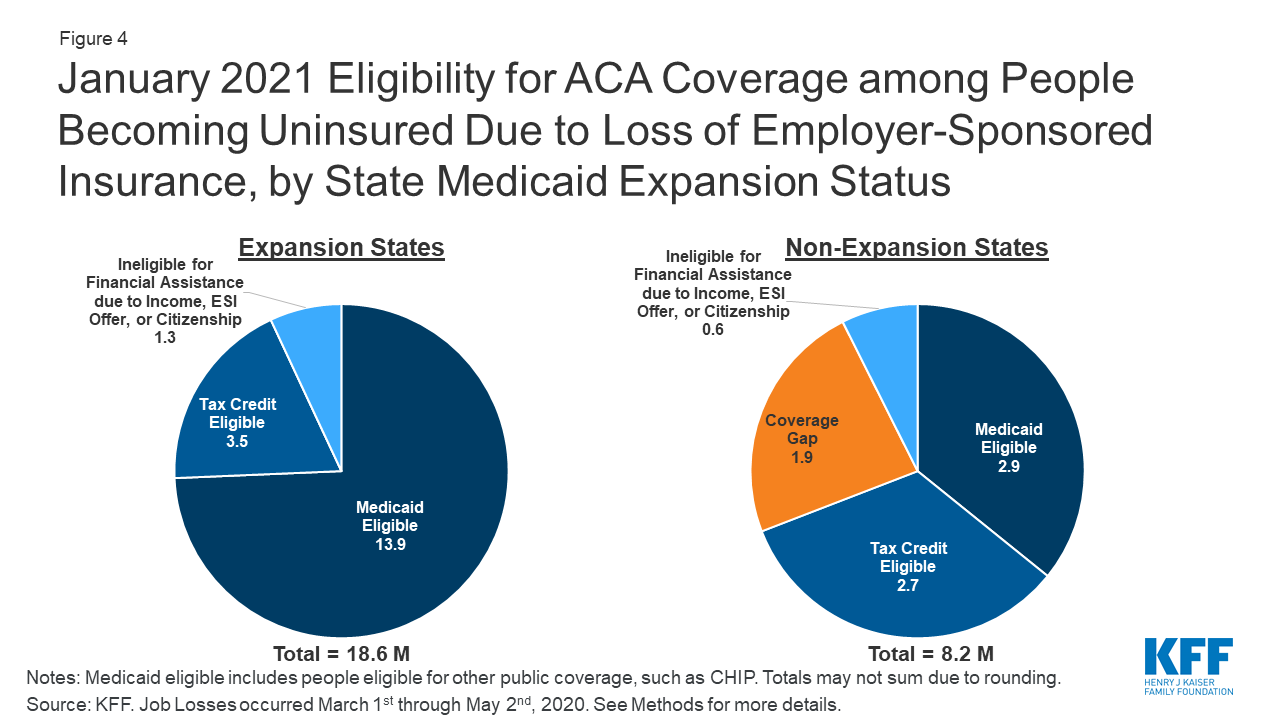
By January 2021, when UI benefits cease for most people, we estimate that eligibility shifts to nearly 17 million being eligible for Medicaid and about 6 million being eligible for marketplace subsidies (Figure 2), assuming those who are recently unemployed have not found work. Many unemployed workers who are eligible for ACA marketplace subsidies during 2020 would instead be eligible for Medicaid or fall into the coverage gap during 2021. The number in the coverage gap grows to 1.9 million (an increase of more than 80% of its previous size), and the number ineligible for coverage due to income shrinks to 0.9 million.

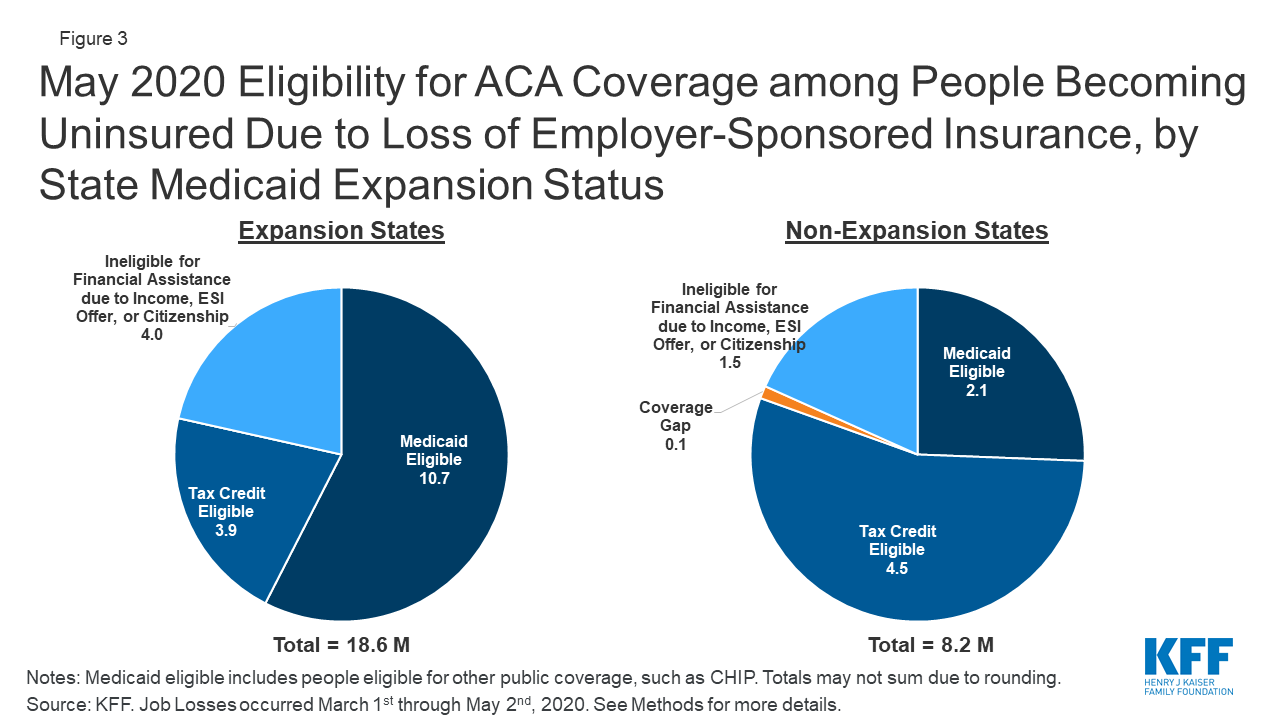
Estimates of coverage loss and eligibility vary by state, depending largely on underlying state employment by industry and Medicaid expansion status. Not surprisingly, states in which the largest number of people are estimated to lose ESI are large states with many people working in affected industries (Appendix Table 1). Eight states (California, Texas, Pennsylvania, New York, Georgia, Florida, Michigan, and Ohio) account for just under half (49%) of all people who lose ESI. Five of the top eight states have expanded Medicaid, and people eligible for Medicaid among the potentially newly uninsured as of May 2020 in these five states account for 40% of all people in that group nationally. Overall, patterns by state Medicaid expansion status show that people in expansion states are much more likely to be eligible for Medicaid, while those in non-expansion states are more likely to qualify for marketplace subsidies (Figure 3). However, the number of people qualifying for marketplace subsidies is similar across the two sets of states, as more people live in expansion states. Three states that have not expanded Medicaid, including Texas, Georgia, and Florida, account for 30% of people who become marketplace tax credit eligible nationally in May 2020. Assuming unemployment extends into 2021 when UI benefits would likely expire for most families, the proportion eligible for Medicaid would increase in expansion states while non-expansion states may see more nonelderly adults moving into the Medicaid coverage gap (Figure 4; Appendix Table 2).
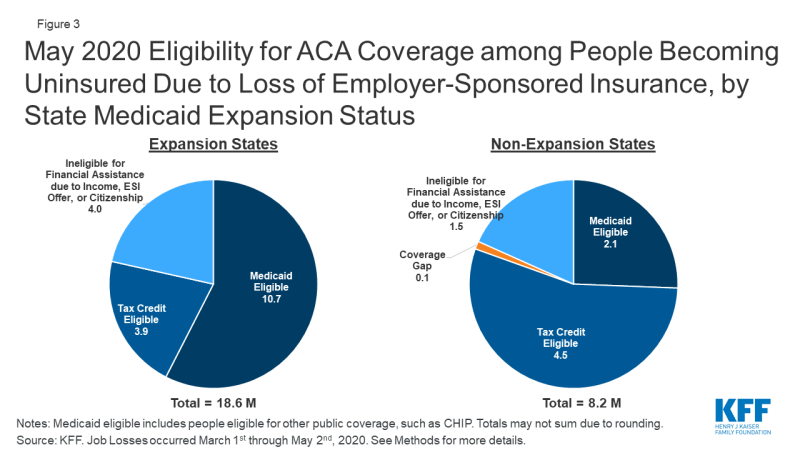
Figure 3: May 2020 Eligibility for ACA Coverage among People Becoming Uninsured Due to Loss of Employer-Sponsored Insurance, by State Medicaid Expansion Status
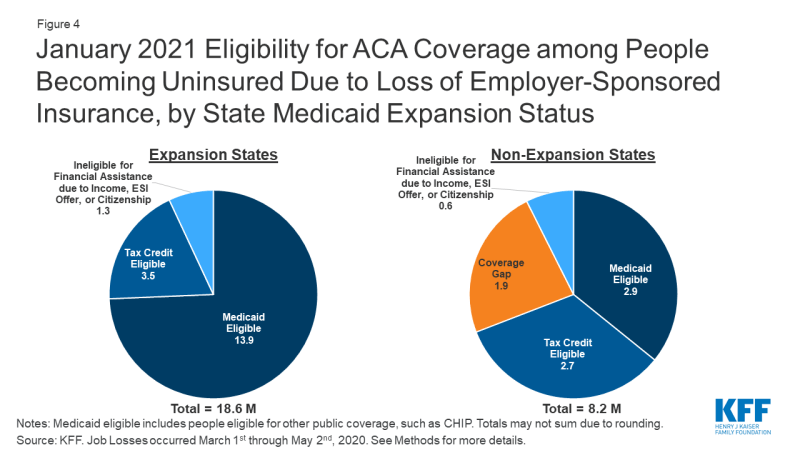
Figure 4: January 2021 Eligibility for ACA Coverage among People Becoming Uninsured Due to Loss of Employer-Sponsored Insurance, by State Medicaid Expansion Status

Nearly 7 million people losing ESI and becoming uninsured are children, and the vast majority of them are eligible for coverage through Medicaid or CHIP. Within the 26.8 million people losing ESI and becoming uninsured in May 2020, 6.1 million are children. Because Medicaid/CHIP income eligibility limits for children are generally higher than they are for adults, the vast majority of these children are eligible for Medicaid/CHIP in May 2020 (5.5 million, or 89%) or January 2021 (5.8 million, or 95%).

Discussion

Given the health risks facing all Americans right now, access to health coverage after loss of employment provides important protection against catastrophic health costs and facilitates access to needed care. Unemployment Insurance filings continue to climb each week, and it is likely that people will continue to lose employment and accompanying ESI for some time, though some of them will return to work as social distancing curbs are loosened. The ACA expanded coverage options available to people, and we estimate that the vast majority of people who lose ESI due to job loss will be eligible for ACA assistance either through Medicaid or subsidized marketplace coverage. However, some people will fall outside the reach of the ACA, particularly in January 2021 when UI benefits cease for many and some adults fall into the Medicaid coverage gap due to state decisions not to expand coverage under the ACA.

Both ACA marketplace subsidies and Medicaid are counter-cyclical programs, expanding during economic downturns as people’s incomes fall. In return for additional federal funding to help states finance their share of Medicaid cost during the public health crisis, states must maintain eligibility standards and procedures that were in effect on January 1, 2020 and must provide continuous eligibility through the end of the public health emergency, among other requirements. These provisions may help eligible individuals enroll in and maintain Medicaid, particularly in light of state and federal actions prior to the crisis to increase eligibility verification requirements or transition people off Medicaid.

Our estimates only examine eligibility among people who lost ESI due to job loss and potentially became uninsured. Additional uninsured individuals—including some of the 9% of the 78 million individuals in families where someone lost employment—may also be eligible for Medicaid or subsidized coverage. It is possible that contact with state UI systems may lead them to seek and enroll in coverage, even if they were eligible for financial assistance before job loss but uninsured.

It is unclear whether people losing ESI and becoming uninsured will enroll in new coverage. We did not estimate take-up or enrollment in coverage options but rather only looked at eligibility for coverage. Even before the coronavirus crisis, there were millions of people eligible for Medicaid or marketplace subsidies who were uninsured. Eligible people may not know about coverage options and may not seek coverage; others may apply for coverage but face challenges in navigating the application and enrollment process. Still others may find marketplace coverage, in particular, unaffordable even with subsidies. As policymakers consider additional efforts to aid people, expanding outreach and enrollment assistance, which have been reduced dramatically by the Trump Administration, could help people maintain coverage as they lose jobs.

This is the first economic downturn during which the ACA will be in place as a safety net for people losing their jobs and health insurance. The Trump Administration is arguing in case before the Supreme Court that the ACA should be overturned; a decision is expected by next Spring. The ACA has gaps, and for many the coverage may be unaffordable. However, without it, many more people would likely end up uninsured as the U.S. heads into a recession.


Trump will urge Supreme Court to strike down Obamacare

https://www.politico.com/news/2020/05/06/trump-supreme-court-obamacare-240366?utm_source=The+Fiscal+Times&utm_campaign=f343554e9c-EMAIL_CAMPAIGN_2020_05_06_09_42&utm_medium=email&utm_term=0_714147a9cf-f343554e9c-390702969

Trump will urge Supreme Court to strike down Obamacare - YouTube

Attorney General Bill Barr had urged the White House to soften its attack on the law during the pandemic.

President Donald Trump on Wednesday said his administration will urge the Supreme Court to overturn Obamacare, maintaining its all-out legal assault on the health care law amid a pandemic that will drive millions of more Americans to depend on its coverage.

The administration appears to be doubling down on its legal strategy, even after Attorney General William Barr this week warned top Trump officials about the political ramifications of undermining the health care safety net during the coronavirus emergency.

Democrats two years ago took back the House of Representatives and statehouses across the country by promising to defend Obamacare, in particular its insurance protections that prevent sick people from being denied coverage or charged more because of a health condition. The issue may prove to be even more salient in November amid the Covid-19 outbreak that health experts believe will persist through the fall.

The Justice Department had a Wednesday deadline to change its position in a case brought by Republican-led states, but Trump told reporters Wednesday afternoon his administration would stand firm. DOJ declined to comment.

“Obamacare is a disaster, but we’ve made it barely acceptable,” Trump said.

The Supreme Court later this fall will hear a lawsuit from the GOP-led states that argue the Affordable Care Act was rendered invalid after Congress eliminated its tax penalty for not having health insurance. A coalition of Democratic state attorneys general and the Democratic-led House of Representatives are defending the law in court.

The Trump administration had previously shifted its legal position in this case, but appears to have decided against doing so again. DOJ originally argued the courts should throw out just Obamacare’s preexisting condition protections, before last year urging that the entire law be struck down.

The Supreme Court is expected to hear the case during its next term starting in October, but it hasn’t scheduled arguments yet. A decision is unlikely before the Nov. 3 election. The court has previously upheld Obamacare in two major challenges that threatened the law’s survival.

About 20 million people have been covered by Obamacare, and the law is expected to provide a major safety net during the economic freefall brought on by the coronavirus. Millions more are expected to join the Medicaid rolls, especially in states that joined Obamacare’s expansion to poor adults. Others who lost workplace health insurance can sign up on the law’s health insurance marketplaces, though the Trump administration isn’t doing much to advertise coverage options.

House Democrats in a filing to the Supreme Court on Wednesday said the pandemic showcased why justices should preserve the law.

“Although Congress may not have enacted the ACA with the specific purpose of combatting a pandemic, the nation’s current public-health emergency has made it impossible to deny that broad access to affordable health care is not just a life-or death matter for millions of Americans, but an indispensable precondition to the social intercourse on which our security, welfare, and liberty ultimately depend,” their brief read.

Obamacare has grown more popular since the GOP’s failed repeal bid during Trump’s first year in office, though the law is still broadly disliked by Republicans. Many Democrats are eager to again run on their defense of Obamacare this fall. That includes presumptive presidential nominee Joe Biden, who has advocated for building on the health care law rather than pursuing a comprehensive progressive overhaul like “Medicare for All.”

Top Trump officials have long been split on the legal strategy in the Obamacare lawsuit. Barr and Alex Azar, the Health and Human Services secretary, both opposed a broader attack on the law, but White House officials have been more supportive, seeing it as a chance to fulfill Trump’s pledge to repeal Obamacare. Barr, in a Monday meeting with Vice President Mike Pence and other White House officials, made an eleventh-hour plea for the administration to soften its legal stance ahead of the Supreme Court’s briefing deadline.


Barr urges Trump administration to back off call to fully strike down Obamacare

https://www.cnn.com/2020/05/05/politics/william-barr-obamacare-supreme-court/index.html?fbclid=IwAR0H0M_pTi9V9W4iEAqWTWKJzopzznh6202z0FgsMbthJS7oS-pDowVGc3M

Barr urges Trump administration to back off call to fully strike ...

Attorney General William Barr made a last-minute push Monday to persuade the administration to modify its position in the Obamacare dispute that will be heard at the Supreme Court this fall, arguing that the administration should pull back from its insistence that the entire law be struck down.

With a Wednesday deadline to make any alterations to its argument looming, Barr made his case in a room with Vice President Mike Pence, White House counsel Pat Cipollone, members of the Domestic Policy Council, press secretary Kayleigh McEnany and several other officials. The meeting ended without a decision and it was not immediately not clear if any shift in the Trump administration’s position will emerge.
Barr and other top advisers have argued against the hard-line position for some time, warning it could have major political implications if the comprehensive health care law appears in jeopardy as voters head to the polls in November.
According to four sources familiar with the meeting, Barr argued for modifying the administration’s current stance to preserve parts of the law, rather than fully back the lawsuit filed by a group of Republican states. As it stands now, the Trump administration’s position seeks to invalidate the entire Affordable Care Act, signed by President Barack Obama in 2010 and commonly known as Obamacare.
Barr and Health and Human Services Secretary Alex Azar have argued against supporting invalidating the law in full, engaging in a heated debate on this point with then-acting White House chief of staff Mick Mulvaney and policy officials allied with him, CNN reported last year. But Barr and others have recently brought an additional dimension to their efforts, highlighting the coronavirus pandemic that has swept the nation. If the justices were to accept the Trump administration position, its decision could cause substantial disruptions to the health care of millions of Americans and cause the uninsured rate to spike.
The Affordable Care Act is expected to serve as an important safety net for the millions of people who lose their jobs and work-based health insurance amid the pandemic. If the unemployment rate hits 15%, nearly 17.7 million Americans could lose their employer-sponsored policies, according to a recent Urban Institute report. More than 8 million people could enroll in Medicaid, particularly in states that expanded the program to more low-income adults under the sweeping health care law. Also, more than 4 million people could obtain coverage through the Affordable Care Act exchanges or other private policies, leaving just over 5 million uninsured, the report found.
Even before the pandemic, more than 11.4 million people signed up for Obamacare coverage for 2020 and roughly 12.5 million were enrolled in Medicaid expansion.
Trump’s domestic policy aides have resisted any change in the Trump administration’s legal arguments at this point, contending that the legal position should move forward without changes because Republicans have campaigned on repealing Obamacare for a decade. Those aides have brushed off the possibility of any new political repercussions, and pushed back on Barr in the meeting Monday.
The Justice Department declined to comment.
The divide has been a long-running battle inside the administration, but it has a new sense of urgency because the administration is up against a deadline on Wednesday if it wants to modify its argument.
The administration currently contends that the individual insurance requirement is unconstitutional, and because that mandate is tied to other provisions of the law, the entire Affordable Care Act must fall. If the administration is going to back off that absolute position, it would likely submit a filing to the Supreme Court within the next 48 hours, based on the court’s current briefing schedule for the dueling parties. Otherwise, the administration’s brief would not be due to the high court until June.
Barr has long favored tempering the administration’s position, which has shifted multiple times since the lawsuit began in early 2018. The administration argued that only two key provisions that protect Americans with pre-existing conditions should fall, but the rest of the law could remain. In a dramatic reversal soon after Barr became attorney general in early 2019, the Justice Department said the entire Affordable Care Act should be invalidated. Several months later, the administration argued before a federal appeals court that the law should only be struck as it applies to the coalition of Republican-led states that brought the challenge.
The argument that the entire law should be struck down already might have been a tough one to make to a Supreme Court majority that has twice rejected broad-scale challenges.
After a decade, the Affordable Care Act has affected nearly every aspect of the health care system. It required all Americans obtain coverage and created a marketplace for purchasing insurance. It also expanded Medicaid for poor people and protected diabetics, cancer patients and other individuals with pre-existing conditions from being denied coverage or charged higher premiums.
The current Supreme Court dispute began when Texas and other Republican-led states sued after the Republican-led Congress in 2017 cut the tax penalty for those who failed to obtain insurance to zero. Because the individual mandate is no longer tied to a specific tax penalty, the states argue, it is unconstitutional. They also say that because the individual mandate is intertwined with a multitude of ACA provisions, invalidating it should bring down the entire law, including protections for people with preexisting conditions.
On the other side are California and other Democratic-led states and the now Democratic-controlled US House of Representatives. The Affordable Care Act has remained in effect through the litigation.
The Supreme Court agreed earlier this year to take up the ACA dispute. The case is likely to be heard in the fall, but a decision would not be expected until 2021, after the November presidential election.
The case will mark the third time that the Supreme Court takes up a major ACA dispute. In 2012, the justices upheld the law, by a 5-4 vote, with Chief Justice John Roberts casting the deciding vote with the four liberal justices over the dissent of four conservatives. Roberts grounded his opinion in Congress’ taxing power.


How the Trump administration accidentally insured over 200,000 through Obamacare

https://theconversation.com/how-the-trump-administration-accidentally-insured-over-200-000-through-obamacare-132312?utm_medium=email&utm_campaign=Latest%20from%20The%20Conversation%20for%20April%2030%202020%20-%201608715418&utm_content=Latest%20from%20The%20Conversation%20for%20April%2030%202020%20-%201608715418+Version+A+CID_88784a86a2c2fddb8969eaf6f2cd84b8&utm_source=campaign_monitor_us&utm_term=How%20the%20Trump%20administration%20accidentally%20insured%20over%20200000%20through%20Obamacare

Silver-Loading Means 28% Uninsured Can Get $0 Premium Bronze Plan

With an eye on replacing the Affordable Care Act, the Trump administration took one particularly critical action in October 2017. It discontinued cost-sharing reduction subsidy payments to health insurers participating in the ACA marketplaces.

But the response to those cuts was likely not what President Trump expected. State insurance commissioners and insurers used them to make marketplace health plans more affordable.

Premium decreases were large – so large that 4.2 million potential enrollees had the option to purchase a marketplace plan for free in 2019.

These changes made us wonder: Did President Trump’s effort to sabotage the Affordable Care Act backfire? I’m a health economist at the University of Pittsburgh. Along with my colleague David Anderson, a policy expert on the Affordable Care Act, we tried to answer that question shortly after the payment cuts. We discovered that more than 200,000 people, using the Healthcare.gov platform in 2019, gained insurance in 37 states due to the Trump administration’s actions. This finding may even be more important now as massive unemployment from the coronavirus pandemic leads to huge losses of employer-based insurance coverage – and ultimately more people enrolling in the marketplaces.

Subsidies and silver loading

People who sign up for a plan in the Health Insurance Marketplaces may qualify for two types of subsidies. The first type is the advanced premium tax credit, which reduces the premium paid by the enrollee; lower-income enrollees receive larger premium tax credits. The second type is the cost-sharing reduction subsidy, which decrease deductibles and co-pays.

Premium tax credits may be applied to any marketplace plan, though they’re based on silver plan premiums, which cover 70% of an average enrollee’s health care expenses. Cost-sharing reduction subsidies can only be applied to silver plans; that means qualifying enrollees in less generous bronze plans and more generous gold plans don’t benefit from reduced deductibles and co-pays provided by these subsidies.

When Trump ended those payments, marketplace insurers were suddenly in a bind. They are legally required to provide cost-sharing reduction subsidies to enrollees whether or not the federal government was paying. The expectation: marketplace insurers, forced to make up the lost revenue, would either increase premiums or exit the marketplaces altogether. And Obamacare would implode.

But that’s not what happened. Why did the plans become more affordable? Insurers increased only the premiums of their silver plans. That approach – known as silver loading – did two things. First, the cost of silver plan premiums rose drastically. Second, premium tax credits increased along with premiums. So those enrollees receiving premium tax credits saw no increase in the premiums of their silver plans.

At the same time, non-silver plans became cheaper. Many bronze plans, already costing less, became so cheap they were free after applying premium tax credit subsidies. Lower-income enrollees benefited the most.

The silver lining in silver loading

In 2019, 4.2 million enrollees could enter the marketplace for free through a zero-dollar bronze plan, largely due to silver loading. Without those zero-premium plans, our analysis showed more than 200,000 lower-income marketplace enrollees would have gone uninsured.

Another 60,000 would have gained insurance had California and New Jersey eliminated regulations that prohibited zero premium plans — and if Indiana, Mississippi and West Virginia had adopted silver loading. Many more likely got coverage in states not included in our study.

All this is clearly not what the Trump administration had in mind when it cut subsidy payments. Other changes to the marketplaces probably masked some coverage gains that occurred. Notably, cuts in the public outreach for Healthcare.gov, along with the elimination of the individual mandate, decreased enrollment. But the popularity of zero premium plans resulting from silver loading likely stopped much of the damage – and Trump’s attempt to destabilize the marketplaces.

Increasing health coverage post-2020

Now states can take advantage of the attractiveness of zero premium plans to increase health coverage through the marketplaces. One way: States requiring marketplace insurers to provide extra benefits – again, like California and New Jersey – can pick up the small tab for those extras. For example, California enrollees pay for abortion coverage through a one-dollar monthly premium surcharge. This is not covered by premium tax credits. By shifting premiums from even one dollar to zero dollars, our estimates indicate enrollment would increase by approximately 13% among those with lower incomes.

Another way: States without silver loading should adopt it. This is not a partisan issue. Conservative states – or at least, GOP-controlled states like Alabama, Wyoming and Florida – have silver-loaded. State governments pay nothing, revenue for insurers is increased, and most critically, lower-income Americans are provided with affordable health insurance. Put simply, there’s no downside for states.

The Trump administration is prevented from restricting silver loading through 2021. However, a forthcoming Supreme Court case, Texas v. Azar, may yet repeal the entire ACA. If the court’s conservative majority rules in favor of the GOP plaintiffs, they will put affordable health insurance out of reach for the 11.4 million Americans that purchased health insurance in the marketplaces. They will also eliminate Medicaid coverage for an additional 16.9 million Americans.

If the case succeeds, the uninsured rate could easily surpass levels not seen since the height of the Great Recession. And for millions of Americans, access to health insurance – desperately needed, particularly during the COVID-19 pandemic – will be eliminated.