New jobless claims totaled 184,000 last week, reaching lowest since 1969

https://finance.yahoo.com/news/weekly-unemployment-claims-week-ended-dec-4-2021-192034644.html
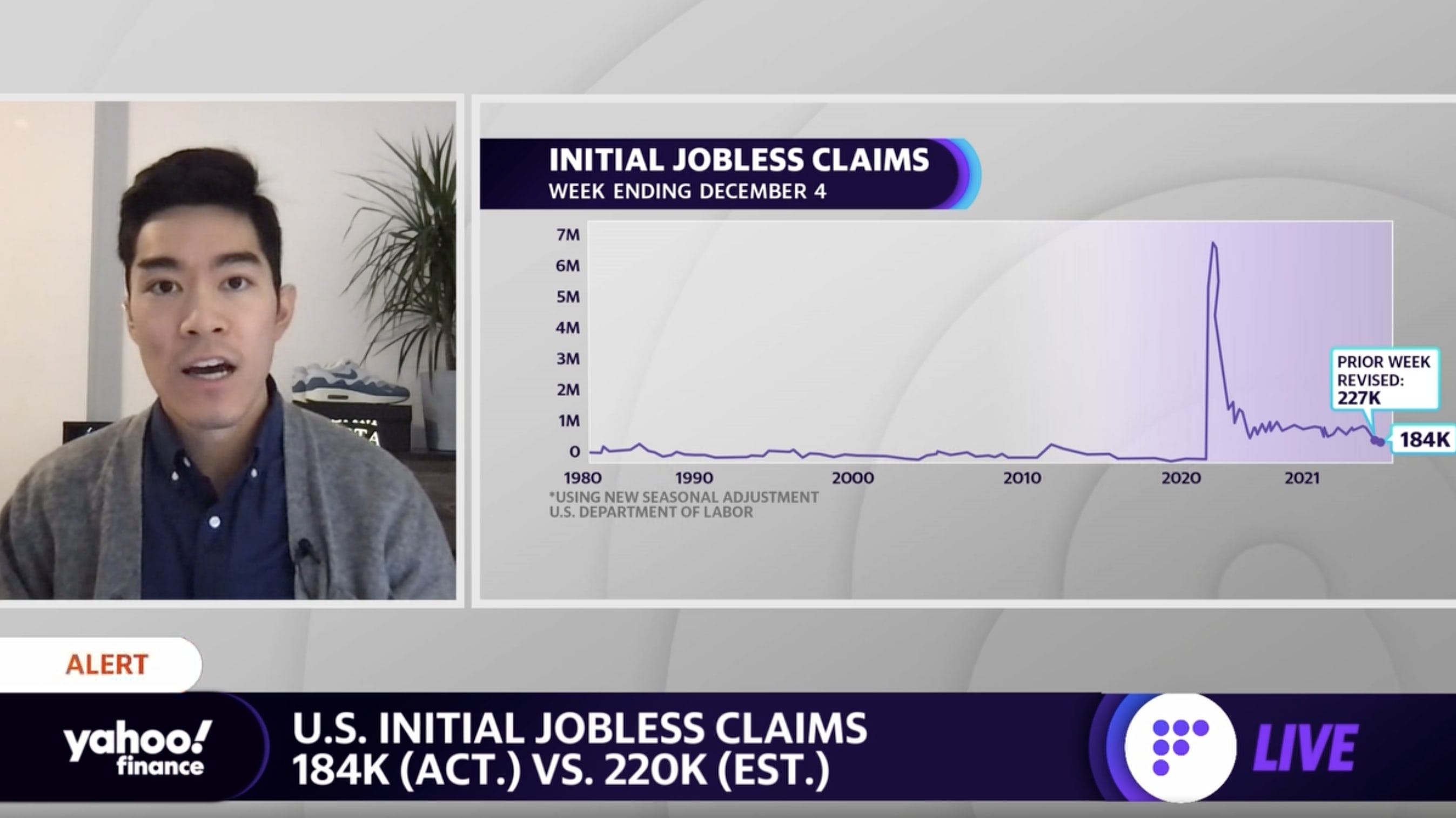
Weekly U.S. jobless claims fell to 184,000, lowest level since 1969

New initial jobless claims improved much more than expected last week to reach the lowest level in more than five decades, further pointing to the tightness of the present labor market as many employers seek to retain workers. 

The Labor Department released its weekly jobless claims report on Thursday. Here were the main metrics from the print, compared to consensus estimates compiled by Bloomberg:

  • Initial unemployment claims, week ended Dec. 4: 184,000 vs. 220,000 expected and an upwardly revised 227,000 during prior week 
  • Continuing claims, week ended Nov. 27: 1.992 million vs. 1.910 million expected and a downwardly revised 1.954 million during prior week

Jobless claims decreased once more after a brief tick higher in late November. At 184,000, initial jobless claims were at their lowest level since Sept. 1969. 

“The consensus always looked a bit timid, in light of the behavior of unadjusted claims in the week after Thanksgiving in previous years when the holiday fell on the 25th, but the drop this time was much bigger than in those years, and bigger than implied by the recent trend,” Ian Shepherdson, chief economist for Pantheon Macroeconomics, wrote in an email Thursday morning. “A correction next week seems likely, but the trend in claims clearly is falling rapidly, reflecting the extreme tightness of the labor market and the rebound in GDP growth now underway.”

After more than a year-and-a-half of the COVID-19 pandemic in the U.S., jobless claims have begun to hover below even their pre-pandemic levels. New claims were averaging about 220,000 per week throughout 2019. At the height of the pandemic and stay-in-place restrictions, new claims had come in at more than 6.1 million during the week ended April 3, 2020. 

Continuing claims, which track the number of those still receiving unemployment benefits via regular state programs, have also come down sharply from pandemic-era highs, and held below 2 million last week. 

“Beyond weekly moves, the overall trend in filings remains downward and confirms that businesses facing labor shortages are holding onto workers,” wrote Rubeela Farooqi, chief U.S. economist for High Frequency Economics, in a note on Wednesday. 

Farooqi added, however, that “the decline in layoffs is not translating into faster job growth on a consistent basis, which was evident in a modest gain in non-farm payrolls in November.” 

“For now, labor supply remains constrained and will likely continue to see pandemic effects as the health backdrop and a lack of safe and affordable child care keeps people out of the workforce,” she added. 

Other recent data on the labor market have also affirmed these lingering pressures. The November jobs report released from the Labor Department last Friday reflected a smaller number of jobs returned than expected last month, with payrolls growing by the least since December 2020 at just 210,000. And the labor force participation rate came in at 61.8%, still coming in markedly below its pre-pandemic February 2020 level of 63.3%. 

And meanwhile, the Labor Department on Wednesday reported that job openings rose more than expected in October to top 11 million, coming in just marginally below July’s all-time high of nearly 11.1 million. The quits rate eased slightly to 2.8% from September’s record 3.0% rate. 

“There is a massive shortage of labor out there in the country that couldn’t come at a worst time now that employers need workers like they have never needed them before. This is a permanent upward demand shift in the economy that won’t be alleviated by companies offering greater incentives to their new hires,” Chris Rupkey, FWDBONDS chief economist, wrote in a note Wednesday. “Wage inflation will continue to keep inflation running hot as businesses fall all over themselves in a bidding war for talent.”

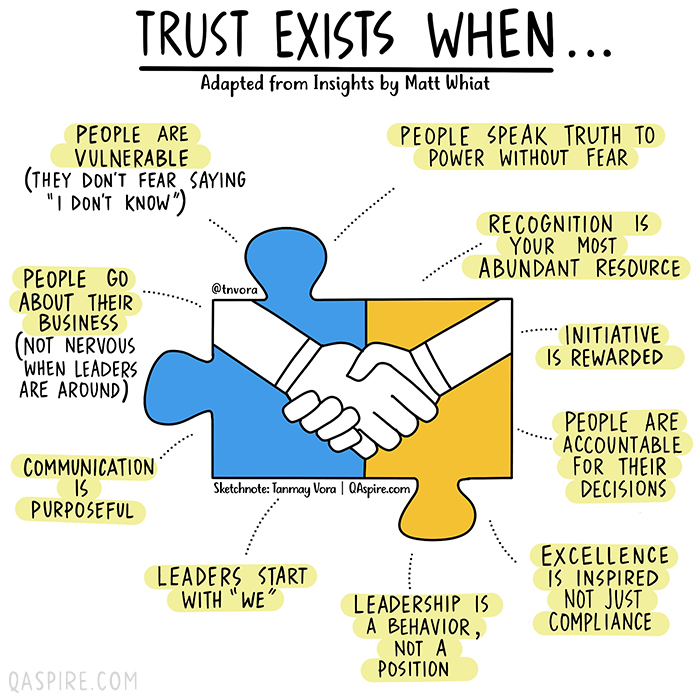
Signs of a High-Trust Environment

In the era of great awakening, leaders have to step up and be conscious about building trust with people they work with.

The old rules and hierarchies, that were already becoming obsolete, have now been thrown out of the window. People look for integration of work and well-being knowing that work is what you do, not a place you go to.

Opportunities are abound and excellent people have ample choices (they always had). It is high time that organizations and leaders think this through carefully to first align their own mindset to this new reality and then take conscious actions to build teams, practices and processes that are not just high-performing but also have a strong fabric of trust woven in.

Employees, after all, are volunteers who exercise their choice of working with you. Effective leadership is about making it worth for them.

Building high-trust environment means putting the human back at the center of how a business functions and building everything – purpose, culture, processes, structures, rituals, systems, tools and mindsets – around it.

How would we know if we are working in an environment where we can trust others and that we are trusted? We can always answer this based on our intrinsic feeling but if you are a leader who is working hard to build trust, here are a few vital signs that you need to look for.

How much nurse pay is rising—and why

Travel Nurse Guaranteed Pay: The Truth - The Gypsy Nurse

Amid a nationwide staffing shortage, rising demand for nurses has led hospitals to increase salaries and other benefits to attract and retain workers, Melanie Evans reports for the Wall Street Journal.

Hospitals increase salaries, benefits to keep up with nursing demand

Hospitals across the country have been struggling amid staffing shortages, particularly of nurses, Evans reports. According to health care consultancy Premier, nurse turnover rates have increased to around 22% this year, up from the annual rate of about 18% in 2019.

“We are employing more nurses now than we ever have, and we also have more vacancies than we ever had,” said Greg Till, chief people officer at Providence Health & Services.

To retain their current nurses and attract new staff, many hospitals have increased their nurses’ salaries to remain competitive in the job market, Evans reports.

For example, HCA Healthcare, one of the largest hospital chains in the country, said it increased nurse pay this year to keep up with Covid-19 surges and compete with rivals also trying to fill vacant positions.

Similarly, Jefferson Health in May raised salaries for its nearly 10,000 nurses by 10% after the system discovered that rivals had increased their compensation. “The circumstances required it,” said Kate Fitzpatrick, Jefferson’s chief nurse executive.

In addition, Citizens Memorial Hospital in Bolivar, Mo., this month raised its nurses’ salaries by up to 5% after rivals in other nearby cities increased their workers’ wages. Sarah Hanak, Citizen Memorial’s CNO, said the hospital also increased the hourly wages of nurses working overnight shifts by around 15% to ensure sufficient staffing for those shifts.

“We were forced to,” Hanak said. “We absolutely have to stay competitive.”

Overall, the average annual salary for RNs, not including bonus pay, grew to $81,376, according to Premier—a 4% increase across the first nine months of the year. This is larger than the 3.3% increase in the average annual nurse salary for 2020 and the 2.6% increase in 2019, Evans writes.

In addition to salary increases, some organizations, such as Providence, are also offering other benefits to attract and retain nurses, such as more time off, greater schedule flexibility, and new career development opportunities. Many hospitals are also hiring new graduates to work in specialized roles in ORs and other areas, allowing them to advance their careers more quickly than they would have before.

Overall, this rising demand for nurses has allowed those entering the workforce to negotiate higher salaries, more flexible working hours, and other benefits, Evans writes.

“I think you get to write your ticket,” said Tessa Johnson, president of the North Dakota Nurses Association.

Nurse compensation increases were inevitable—here’s why

It was inevitable that we would get to this point: baseline nurse compensation on a clear upward trajectory. Inevitable because this boils down to laws of supply and demand. Amid a clear nursing shortage, organizations are being forced to raise baseline compensation to compete for increasingly scarce qualified nurses. This is true in nearly every market, even for those considered to be ‘destination employers.’

If anything, what’s most surprising in the data from Premier is the moderated increase of around 4%. From a worker’s perspective, that’s not even covering cost of living increases due to inflation. However, amid this new data, it’s important to keep two things in mind:

Two considerations for health care leaders

  1. New data only captures baseline compensation.Differentials—which organizations must standardize and expand across shifts, specialties, and even settings—plus overtime put baseline compensation much higher. Not to mention lucrative sign-on bonuses, that members tell us are increasingly table stakes in their markets. In general, we don’t recommend this type of incentive that does nothing for retention. You’re better off investing those resources in baseline compensation as well as beefing up your RN bonus plan to incentivize retention.
  2. There is a new floor for wages (and it’s only going up from here).

Open questions (and important indicators) we are assessing

  • What happens to wages for entry-level clinical roles? As the shortage of RNs persists, organizations will need to make a shift to team-based models of care, and those are only possible with a stable workforce of entry-level personnel. Right now, that part of the health care workforce is anything but stable. When you consider their work and their wages in comparison to out-of-industry players that pay the same or better, that’s a clear area where investment is required. 
  • Will the share of nurses working permanently with travel agencies return to pre-pandemic levels? That’s to say, what will those RNs who experienced the traveler lifestyle and pay value more moving forward: the flexibility and premium pay or stability of permanent employment? Even if this number stabilizes a couple percentage points above pre-pandemic levels, that will aggravate provider’s sense of shortage.

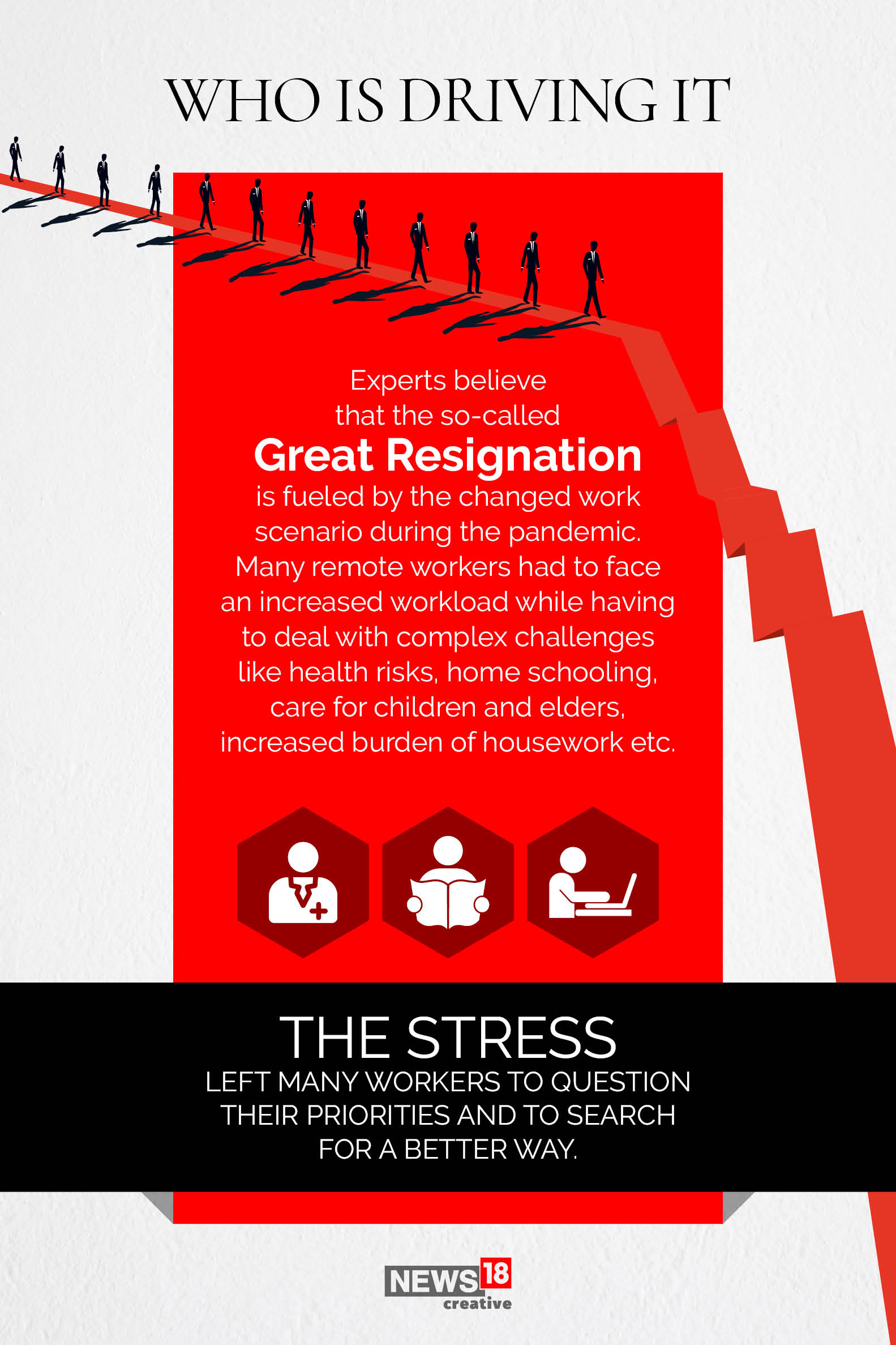
The Great Resignation has burdened those left behind 

Forbes India - Jobs: What Is Fuelling The Great Resignation In America?

The workers who have stayed on at their jobs amid the Great Resignation are struggling to fill the gaps left by former colleagues, CNBC reported Nov. 2. 

The effects of the Great Resignation continue to be felt by companies after a record high of 4.3 million workers quit their jobs in August alone. The workers who remained in their roles, though, are struggling with their new increased workload.

A report by the Society for Human Resource Management that surveyed 1,150 employed Americans in July as well as 220 executives illuminated some of the challenges of the workers who stayed. 

It found that 52 percent of workers who stayed with their companies have taken on more responsibilities, with 30 percent of remaining employees stating they struggle to complete necessary tasks. A majority of workers are questioning whether their pay is high enough, and 27 percent feel less loyalty to their company. 

This worker dissatisfaction opens up a vicious cycle, Johnny Taylor Jr., president and CEO of the Society for Human Resource Management, told CNBC.

“The employees who remain now say, ‘I’m working too hard, I don’t have balance in my life, etc.’ And so then they want to leave and thus a vicious cycle continues” Mr. Taylor told CNBC

Thus, it’s more important now than ever for employers to exercise empathy and listen to what their employees are experiencing in the wake of workplace shifts. 

“Invest in them today,” Alex Durand, a career transition and leadership coach, told CNBC. “Show them you care before they tell you they are leaving.”

UPMC CFO Edward Karlovich advises peers to ‘look beyond the challenges of today’

David B. Yoffie Quote: “The first rule demands that CEOs and entrepreneurs look  beyond the immediate

Edward Karlovich serves as the executive vice president and CFO for UPMC, a $23 billion provider and insurer based in Pittsburgh. 

Since joining UPMC in 1990, Mr. Karlovich has served in several financial leadership roles. Most recently, he was vice president, CFO and chief of staff for UPMC’s Health Services Division. He became CFO of the entire integrated system with 40 hospitals in October 2020, after serving on an interim basis for about a year. 

Here, Mr. Karlovich shares with Becker’s the skills he thinks CFOs need to succeed today, some key capital projects in the works at UPMC and his organization’s top financial priorities. 

Editor’s note: Responses were lightly edited for length and clarity. 

Question: What is the most pressing issue facing hospital CFOs due to COVID-19?

Edward Karlovich: I would say the most pressing issue for me is disruption. COVID-19 has done many things to disrupt the way we think about our organization and business. Some disruptions we faced in the last year include staffing and supply chain challenges. UPMC did a great job weathering through the supply disruptions and labor challenges. We always had adequate personal protective equipment for our folks here. We also really made a conscientious decision last year to keep our workforce intact; we didn’t lay off workers, and we took care of people who needed time off because of COVID-19. We also made sure employees knew they had the support of our executive leadership team. In summary, COVID-19 has created a disruption, and we must think about how things are different now coming out of the disruption. 

Q: What are some things you are doing to work through the change/disruption?

EK: From an organizational perspective, we embarked on what we call the “UPMC experience” a few years ago. We looked at the way we are doing things to understand the experience of our employees and patients. This prepared us to be more creative in our thinking as to how we address challenges and disruption. We also learned through this the importance of interdependencies. Our business, both provider and insurance side, discussed a need to tackle the disruptions in an integrated way and discussed a need to communicate changes effectively. This year, we provided about 40 news conferences to get the standard message out across all of our regions. We also have a 90,000-plus employee organization which allows you to move around resources to deal with some challenges and disruptions. 

Q: What are UPMC’s top financial priorities for 2022?

EK: From a financial perspective, we want to maintain a positive margin to support our capital investments and employees. To do this, we are focused on a few things. First, supporting our operating employees to ensure they can perform to the best of their ability. They are the ones who make the difference each and every day. Second, we want to make sure we, as a finance team, can provide the things that the organization needs to be successful. This includes, but is not limited to, making sure supply chain folks can get all needed supplies and ensuring we have the cash collections needed to fund our organization. Another priority is making sure we provide the advice and guidance needed to invest our dollars effectively so we can prepare for the next challenge.

Q: What are a few key capital projects UPMC has in the works?

EK: UPMC is a premier provider in our community, and we operate a number of specialty hospitals in the area. We are the primary pediatric, psychiatric, women’s health and oncology provider in the region. Over the past couple of years, we’ve embarked on a journey to provide new facilities in western Pennsylvania for these major programs. We are also investing heavily in a vision and rehabilitation institute, which is a $500 million project that will put our clinicians, researchers and other providers together to drive breakthroughs in vision care and rehabilitation.  

We also are going to embark on a new tower for UPMC Presbyterian Oakland Campus [in Pittsburgh]. It is going to be the largest capital project we’ve embarked on since I’ve been here. This project will be more than $1 billion and is so important to the community. 

The third thing we are looking at is enhancing our oncology services and product at UPMC Shadyside [in Pittsburgh]. What we’ve recognized is that we are the provider and insurer of choice in western Pennsylvania, and we have to invest in this community for the next 50 to 100 years. 

Q: What skills are essential for hospital and health system CFOs to thrive in today’s healthcare landscape?

EK: The technical skills are given as CFO. To get in that leadership position, you have to be able to perform the necessary tasks. However, to make your organization better, I could boil it down to four things. First, you have to be a partner to your other senior leaders. Finance doesn’t exist in a vacuum. You have to be in the room with those folks, helping them manage and drive the business. The second thing is flexibility. If you think about what we experienced as an industry over the last two years, if you weren’t flexible, you were going to be seriously challenged.  Flexibility is such an important attribute because the pace of change is going to accelerate in our industry. Third, I’d say talent recognition is a key skill. It is important to be able to find talent as well as mentor and develop them as employees who can provide a great service to the organization. Fourth, you have to embody integrity. There is no doubt in my mind that integrity is a core value that is essential to everything you do as a finance leader. You have to maintain your integrity at all times. Those are essential skills. If you’re going to be a successful CFO now, you have to have those skills outside of the technical.

Q: What is one piece of advice you would offer to another healthcare CFO, and why?

EK: I’d say, look beyond the challenges of today. It’s not just about what you can actually see and envision in front of you. Try to look at the implications that are not necessarily top of mind. What the future holds is uncertain for all of us in healthcare now. You need to be thinking about what things might be coming down the road that will change our business and commitment to our communities dramatically. Try to brainstorm around that. Trying to think forward and speculate about what might happen is very valuable.

The in-person interactions CEOs prioritize in the workplace

The Pandemic Conversations That Leaders Need to Have Now - HBS Working  Knowledge

A lot of communication in the workplace is conducted electronically. However, it is essential for hospital and health system leaders to have face-to-face conversations with employees in some situations.

Becker’s asked healthcare executives to share the interactions they prioritize when they’re in person at their organizations. Many expressed their preference for the deeper connections in-person interactions allow, citing inspiration and team building as reasons to facilitate face-to-face communication. Below are their responses:

Russell F. Cox. President and CEO of Norton Healthcare (Louisville, Ky.): Healthcare, by its very nature, requires in-person interactions.

With the onset of the COVID-19 pandemic, we made a quick and successful shift to virtual visits for the safety of our patients and providers. This enabled patients with a variety of time and transportation constraints to receive convenient care from a trusted provider. However, telemedicine will never completely replace in-person visits, and the opportunity for our patients and community to interact in-person with our patient care providers is very important to me, and to our team.

And, although the pandemic created the need for virtual meetings, I have always prioritized in-person interactions and meetings with all team members. Whether that be rounding in our  hospitals and facilities, holding in-person meetings, celebrating employee accomplishments or milestones, or dropping by one of our community vaccine or testing centers — web meetings will never replace what can be accomplished face to face. It became even more important to interact in person with our caregivers and employees during the pandemic. It was important to show my support for their hard work and extraordinary sacrifices during this time. I’m thankful that with the vaccine, more in-person events, with proper safety precautions, are resuming.

Our motto has been and continues to be: Stay safe. Keep the faith.

Jim Dunn, PhD. Executive Vice President and Chief People and Culture Officer of Atrium Health (Charlotte, N.C.): Recognition is part of our organizational DNA, and in-person delivery is an essential component of that — especially as we continue working through the COVID-19 pandemic. One thing our teammates love is the “Surprise Patrol,” which we employ for some of our most special and meaningful awards, such as our annual Pinnacle Award — the highest award given by our organization to those who best exemplify our Culture Commitments: Belong, Work as One, Trust, Innovate and Excellence. Executives, leaders, teammates and loved ones come together to celebrate honorees with balloons, cupcakes, cheers and even a few happy tears. Our honorees are shocked, uplifted and proud to be recognized in-person for their outstanding accomplishments, and our “Surprise Patrol” participants are honored to be a part of such a special moment. Whether we’re celebrating small wins, personal successes, birthdays or prestigious awards, in-person recognition — where and when possible — is a vital part of the teammate experience and culture at Atrium Health.

Robert Gardner. CEO of Banner Ironwood Medical Center (Queen Creek, Ariz.) and Banner Goldfield Medical Center (Apache Junction, Ariz.): Over the past few years in particular, I’ve spent some time reflecting on the differences between motivation and inspiration. More often than not, it seems like leaders don’t know the differences and often confuse the two as being synonymous or interchangeable. Put in overly simplified terms, I see motivation as being the metaphorical carrot or the stick. We can motivate with reward (aka the carrot) and with discipline (aka the stick), and both are used frequently in life. Motivation tends to be more surface level. However, inspiration is something much deeper, more intimate, and therefore much more complex. Inspiration is getting to a point of genuinely desiring to change, do more, be better, etc.

For me, knowing the differences is critical when it comes to prioritizing being in person in the workplace. Virtual meetings, emails, newsletters and other forms of electronic communication can work incredibly well when it comes to items of motivation; and believe me, there are plenty of these items. However, when it comes time to inspire the team, I heavily prioritize these meetings to take place in person. Items that fall into this category will be mission-critical initiatives and overall reminders on living our mission, purpose values, etc. It’s so ironic to me that despite the increasing complexity, regulation, bureaucracy and proverbial red tape that healthcare has become famous for, that an inspirational dose of simplicity has more effect on change than any other bestseller leadership book on how to motivate performance through some sort of complicated multistep process.

Brian Koppy. Chief Financial Officer of Cano Health (Miami): As a rapidly growing primary care provider, we have found that face-to-face interactions at our offices are as essential as they are in our medical centers. Our providers provide the best care when they see patients in person because it builds lifelong bonds that improve patient outcomes. In our offices, our team members feel more connected and integrated into the Cano Health family when we are together, both formally and informally. This, of course, does not mean we do not have a flexible work environment, which we do. It simply means our priority is on the employee benefits and outcomes that come from working in the office.

At the beginning of the pandemic, we moved many corporate employees to remote work and moved about 95 percent of our patient interactions to televisits. That did not last long, however. Within a month or two, our employees were asking to come back to the office. Our medical centers never closed their doors, and our visits rapidly returned to mostly in person. 

It’s the seemingly inconsequential daily interactions that often have the greatest impact on a company’s employees and their connection to the mission, values and culture of the organization. The quick stop-ins to someone’s workstation, the chance hallway encounters, the team lunches — these are so important in developing relationships and, in turn, maximizing efficiency. Employees who know and personally interact with each other work better together.  They discuss ideas, they strategize freely, and they execute on the company’s goals together and more effectively. 

At Cano Health, our high-touch approach to primary care is key to our success. And we believe that daily face-to-face interactions among employees are equally important to create a rewarding experience for our employees, but also expanding Cano Health’s services across the country.

Christopher O’Connor. President and incoming CEO of Yale New Haven (Conn.) Health:We are prioritizing one-on-one meetings and small groups. With our vaccination mandate, we feel it is critical to have that in-person contact and fill that void that video can’t replicate. This is a relationship business, and spending the time to build and nurture those relationships is critical.

Thomas J. Senker. President of MedStar Montgomery Medical Center (Olney, Md.): Before and especially during the pandemic our priority has been the well-being and engagement of our front-line staff and essential personnel. And while in-person activities have been limited, our executive team makes regular rounds visiting each unit, expressing gratitude, providing snacks and refreshments, and sharing important hospital updates directly. We believe these face-to-face interactions are critical opportunities to gain feedback and focus on areas of improvement across different areas of MedStar Montgomery Medical Center’s operations.

5 new responsibilities for the beyond-finance CFO

https://www.cfodive.com/spons/5-new-responsibilities-for-the-beyond-finance-cfo/607630/

The Urgent Need to Redefine the Office of the CFO

For years, pioneering CFOs steadily extended their duties beyond the boundaries of the traditional finance and accounting function. Over the past year, an expanding set of beyond-finance activities – including those related to environmental, social and governance (ESG) matters; human capital reporting; cybersecurity; and supply chain management – have grown in importance for most finance groups. Traditional finance and accounting responsibilities remain core requirements for CFOs, even as they augment planning, analysis, forecasting and reporting processes to thrive in the cloud-based digital era. Protiviti’s latest global survey of CFOs and finance leaders shows that CFOs are refining their new and growing roles by addressing five key areas:

Accessing new data to drive success ­– The ability of CFOs and finance groups to address their expanding priorities depends on the quality and completeness of the data they access, secure, govern and use. Even the most powerful, cutting-edge tools will deliver subpar insights without optimal data inputs. In addition, more of the data finance uses to generate forward-looking business insights is sourced from producers outside of finance group and the organization. Many of these data producers lack expertise in disclosure controls and therefore need guidance from the finance organization.

Developing long-term strategies for protecting and leveraging data – From a data-protection perspective, CFOs are refining their calculations of cyber risk while benchmarking their organization’s data security and privacy spending and allocations. From a data-leveraging perspective, finance chiefs are creating and updating roadmaps for investments in robotic process automation, business intelligence tools, AI applications, other types of advanced automation, and the cloud technology that serves as a foundational enabler for these advanced finance tools. These investments are designed to satisfy the need for real-time finance insights and analysis among a mushrooming set of internal customers.

Applying financial expertise to ESG reporting – CFOs are mobilizing their team’s financial reporting expertise to address unfolding Human Capital and ESG reporting and disclosure requirements. Leading CFOs are consummating their role in this next-generation data collection activity while ensuring that the organization lays the groundwork to maximize the business value it derives from monitoring, managing and reporting all forms of ESG-related performance metrics.

Elevating and expanding forecasting – Finance groups are overhauling forecasting and planning processes to integrate new data inputs, from new sources, so that the insights the finance organization produces are more real-time in nature and relevant to more finance customers inside and outside the organization. Traditional key performance indicators (KPIs) are being supplemented by key business indicators (KBIs) to provide sharper forecasts and viewpoints. As major new sources of political, social, technological and business volatility arise in an unsteady post-COVID era, forecasting’s value to the organization continues to soar.

Investing in long-term talent strategies – Finance groups are refining their labor model to become more flexible and gain long-term access to cutting-edge skills and innovative thinking in the face of an ongoing and persistent finance and accounting talent crunch. CFOs also are recalibrating their flexible labor models and helping other parts of the organization develop a similar approach to ensure the entire future organization can skill and scale to operate at the right size and in the right manner.