‘That’s Ridiculous.’ How America’s Coronavirus Response Looks Abroad.

WATCH THE VIDEO

Video -'That's Ridiculous.' How America's Coronavirus Response ...

From lockdowns to testing, we showed people around the world the facts and figures on how the U.S. has handled the pandemic.

The United States leads the world in Covid-19 deaths, nearing 150,000 lost lives. The unemployment figures brought on by the pandemic are mind-boggling. The Trump administration’s slow and haphazard response has been widely criticized. But what does it look like to young people around the world, whose governments moved quickly and aggressively to contain the coronavirus?

We wanted to know, so we reached out to quite a few and showed them charts, facts, photos and videos illustrating the U.S. response. Spoiler: They were not impressed.

Many advanced economies, from Germany to Singapore, directly supplemented salaries to save jobs. Other nations with fewer resources started mass testing at the first sign of an outbreak. Many countries mandated universal lockdowns — and successfully flattened the curve. In some parts of Europe, you could be fined for straying too far from your home. And Vietnam, a nation of 95 million people, has not seen a single Covid-19 death.

This Opinion video is a follow-up to a popular video we produced last year, which asked young Europeans to respond to American policies such as health care and parental leave. Many comments suggested we produce a sequel. Well, here it is — the Covid-19 edition.


Pandemic Proves Why Leaders Must Protect Americans From Junk Insurance Plans

https://morningconsult.com/opinions/pandemic-proves-why-leaders-must-protect-americans-from-junk-insurance-plans/?utm_source=ActiveCampaign&utm_medium=email&utm_content=Republicans+Roll+Out+%241+Trillion+Coronavirus+Relief+Plan&utm_campaign=TFT+Newsletter+07272020

Cartoon – Short Term Health Insurance | HENRY KOTULA

The coronavirus pandemic hit the nation hard and fast, infecting Americans from coast to coast, overwhelming health care systems and wreaking havoc on the economy. Those with pre-existing conditions – like diabetes and cardiovascular disease – are more vulnerable to the deadly virus. Americans have higher rates of these chronic conditions than other countries, in part because so many people live without health insurance or have shoddy coverage. This has become increasingly worse over the last four years as underlying health coverage has shrunken for the virus’s hardest hit victims: Black Americans, Native Americans and people of color.

Of the hundreds of thousands of Americans now recovering from COVID-19, many will undoubtedly have new chronic conditions, like lasting lung damage. This will be on top of the pre-existing conditions many who were predisposed to coronavirus already had. Record job losses in the wake of the pandemic have resulted in the loss of employer-sponsored coverage for more than 5 million Americans who are now on the hunt for new, affordable health insurance plans.

This presents the perfect storm for junk insurance plans – short-term limited duration insurance plans – that allow discrimination based on pre-existing conditions, expose consumers to financial risk and provide inadequate coverage. STLDIs are more dangerous now than ever in our new COVID-19 reality. Let’s be clear: These junk insurance plans – touted by the Trump administration and supported through taxpayer dollars – are not the answer. It is time for our leaders to put back the limitations on how long they can be used.

As their name suggests, short-term limited duration plans are meant to be used temporarily to bridge short-term gaps in coverage that arise from a job loss or other extenuating circumstance. However, new federal rules under the Trump administration have allowed the coverage period of STLDI plans to expand from six to 12 months. The administration has also promoted these plans to states as being eligible for federal subsidies, meaning our tax dollars help pay for them. President Donald Trump himself has touted these plans for being more affordable than Obamacare, but that is because they lack the same protections and do not meet minimum essential coverage standards under the law.

That is what makes these plans so dangerous. Though they tend to be less expensive than Affordable Care Act plans, they leave consumers vulnerable to unanticipated out-of-pocket costs by offering bare-bones coverage. Unlike ACA plans, STLDI plans can exclude coverage for pre-existing conditions, do not cover the cost of prescription drugs, have annual or lifetime maximums on covered services, and are not required to cover preventive services like cancer screenings or maternity care.

The lower price tag may lure consumers suffering financially during the pandemic, but they are high risk for those who do not fully understand what they are buying. Without carefully reading the fine print, many may not know before purchasing that STLDI plans are exempt from ACA rules as well as regulations for insurers recently passed in the Families First Coronavirus Response Act and the Coronavirus Aid, Relief, and Economic Security Act. We have already seen the pandemic exacerbate existing health inequalities in America, and now these plans expose consumers, especially low-income individuals and those with chronic conditions, to more discrimination and financial ruin.

The Department of Health and Human Services has already acknowledged that these plans fall short. In fact, the government is having to cover the cost of COVID-19 testing for people with STLDI plans, classifying them as “uninsured.” Yet, they will not cover the cost of COVID-19 treatment, meaning those with STLDI plans could face bills in the thousands of dollars, considering the average cost to treat a hospitalized coronavirus patient is $30,000.

Consumers for Quality Care, a coalition of advocates and former policy makers which provides a voice for patients in the health care debate, recently sent a letter to HHS Secretary Alex Azar and Centers for Medicare & Medicaid Services Administrator Seema Verma asking that they protect consumers from these dangerous plans.

This pandemic has laid bare how dangerously unprepared America’s health care system is for a large-scale public health crisis. People needed high-quality insurance coverage before coronavirus hit, and they will need it long after the pandemic subsides. Let this be a lesson to the Trump administration – it is time to stop backing junk insurance plans and remove them from the open market. If our leaders fail to act, the lives and financial well-being of millions of Americans are at stake.


Administration’s talking health care again, with 2020 in mind

https://www.politico.com/news/2020/07/26/trumps-health-care-again-with-2020-election-381473?utm_source=ActiveCampaign&utm_medium=email&utm_content=Republicans+Roll+Out+%241+Trillion+Coronavirus+Relief+Plan&utm_campaign=TFT+Newsletter+07272020

Tell us: How has Trump handled healthcare in his first 100 days ...

Polls show voters say Joe Biden would handle the issue better. And Trump is running short on options to make concrete changes before November.

President Donald Trump is suddenly talking about health care again.

He signed several executive orders on drug pricing on Friday. He vowed to unveil some new health plan by the end of next week, although he hasn’t provided specifics or an explanation of how he’ll do it. His aides are touting a speech in which Trump will lay out his health care vision. White House counselor to the president Kellyanne Conway has been calling Trump “the health care president.”

Yet it’s unlikely to amount to much in terms of policy ahead of the election. There’s almost no chance Congress will enact any legislation on the issue before November and policy specialists say the executive orders in question will make changes only at the margins — if they make any changes at all. Trump has also previously vowed to roll out a grand health care plan without following through.

That leaves Trump with mostly rhetorical options — even if he insists otherwise — cognizant that voters consistently rank health care as a top priority and say Joe Biden, Trump’s presumptive 2020 rival, would handle the issue better than the president. Meanwhile, Trump is running for reelection having not replaced Obamacare or presented an alternative — all while urging the Supreme Court to overturn the decade-old health law. And millions of Americans are currently losing their health insurance as the coronavirus-gripped economy sputters.

“I think politically, the main objective will be to have something he can call a plan, but it will be smaller than a plan. Just something that he can talk about,” said Drew Altman, president and CEO of the Kaiser Family Foundation, a nonpartisan health policy organization. “But it’s almost inconceivable that anything can be delivered legislatively before the election.”

Trump has long stumped on his pledges to kill Obamacare, the law his predecessor implemented that expanded Americans’ access to health insurance, set baseline standards for coverage, introduced penalties for not having insurance and guaranteed coverage for preexisting conditions. But conservatives say the law introduced too many mandates and drove up costs.

But after winning election in 2016, Trump failed to overturn the law in Congress — or even offer an agreed upon alternative to the law — despite holding the majority in both chambers on Capitol Hill. Democrats then retook the House in the 2018 midterms, essentially ending any chances the law, formally known as the Affordable Care Act, would be repealed.

Even some conservatives said the ongoing failure to present a concrete replacement plan is helping the Democrats politically.

Republicans, said Joe Antos, a health expert at the conservative American Enterprise Institute, “spent basically 2010 to today arguing that the ACA is no good. After 10 years, clearly there are some problems with starting all over again. I haven’t detected very strong interest, at least among elected officials, in revisiting that.”

But the coronavirus pandemic has added pressure to address health care costs, and Trump has lagged behind Biden on his handling of the issue in polls. Fifty seven percent of registered voters recently polled by Quinnipiac said Biden would do a better job on health care than Trump, while only 35 percent approved of Trump’s handling of health care as president. And on the issue of affordability, a CNBC poll found 55 percent of battleground voters favored Biden and the Democrats, compared with 45 percent who preferred Trump and the Republicans.

“At this point, there are two huge issues, jobs and the economy, and health care, i.e., the coronavirus. If anything that’s simply been magnified,” said David Winston, a Republican pollster and strategist. “Given the fact that it’s one of the top issues, it’s not like there’s a choice but to talk about it. If candidates aren’t making statements and proposing solutions around that, it’s a requirement. Both candidates have to address it.”

Biden has campaigned on expanding Obamacare while also promising to implement a “public option” similar to Medicare, which is government-run health insurance for seniors. On drug pricing, he and Trump embrace some of the same ideas, like allowing the safe importation of drugs from other countries where they are cheaper. Biden also supports direct Medicare negotiation of drug prices, a Democratic priority that Trump supported during the 2016 campaign before reversing course.

“Donald Trump has spent his entire presidency working to take health care away from tens of millions of Americans and gut coverage for preexisting conditions,” said Andrew Bates, a Biden campaign spokesman. “If the Trump campaign wants to continue their pattern of highlighting the worst possible contrasts for Donald Trump, we certainly won’t stop them.”

The Trump administration insists it can point to several health care victories during Trump’s term.

Trump frequently notes the removal of the penalty for Americans who do not purchase insurance as a major victory, falsely claiming it is equivalent to overturning Obamacare.

Trump also signed an executive order last year to fight kidney disease to encourage home dialysis and increase the amount of kidney transplants, and he expanded telehealth medicine during the pandemic.

More recently, the U.S. Court of Appeals for the District of Columbia upheld a Trump administration rule expanding the availability of short-term health plans, which Trump has touted as an alternative to Obamacare but Democrats deride as “junk.” The plans are typically cheaper than Obamacare coverage because they don’t provide the same level of benefits or consumer protections for preexisting conditions.

A federal judge in June similarly upheld another Trump administration rule requiring hospitals to disclose the prices they have negotiated with insurers. Price transparency in the health care system has long been a significant issue, with Americans rarely having clarity over how much their treatments will cost ahead of time. Trump called the win “bigger than health care itself,” in an apparent reference to Obamacare. It’s unclear whether transparency will force down health care prices, and hospitals opposing the rule have appealed the judge’s decision.

And on Friday at the White House, Trump held an event to sign four executive orders aimed at slashing drug pricing. The move aimed to tackle a largely unfulfilled signature campaign promise — that he would stop pharmaceutical companies from “getting away with murder.”

“We are ending the sellouts, betrayals and broken promises from Washington,” Trump said Friday.“You have a lot of broken promises from Washington.”

But the orders appeared largely symbolic for now, as they were not immediately enforceable, contained notable caveats and may not be completed before the election anyway. For instance, an order requiring drugmakers to pass along any discounts directly to seniors requires the health secretary to confirm the plan won’t result in higher premiums or drive up federal spending. But the White House had shelved that plan last summer over worries the move might hike seniors’ Medicare premiums ahead of the election and cost taxpayers $180 billion over the next decade.

Conway disputed that Trump had not made progress on issues like drug pricing.

“President Trump is directing the development of therapeutics and vaccines, has delivered lower prescription drug costs, increased transparency in pricing for consumers and is committed to covering preexisting conditions and offering higher quality health care with lower costs and more choices,” she said.

Yet a number of Trump’s other health care initiatives have faced hurdles — especially amid the coronavirus pandemic.

The opioid crisis, which the president had touted as a top priority and campaigned on in 2016, is getting worse. Drug overdose deaths hit a record high in 2019 and federal and state data shows they are skyrocketing in 2020.

“The overdose epidemic will not take a back seat simply because Covid-19 has hit us hard, and that needs to be reflected in policy,” said Andrew Kessler, founder and principal of Slingshot Solutions, a behavioral health consulting firm.

The president’s plan to end HIV by 2030 has similarly receded during the pandemic. And Trump’s proposal on improving kidney care — an issue that affects roughly 15 percent of American adults — is still in its early stages and will not be finalized until next year.


The economy is in deep trouble again. Coronavirus is to blame

https://www.cnn.com/2020/07/23/business/coronavirus-economy-recovery/index.html

The economy is in deep trouble again. Coronavirus is to blame - CNN

Restaurant reservations are waning. The rebound in air travel is leveling off. And foot traffic at stores is dwindling once again. There is mounting evidence that America’s fragile economic recovery is already stalling as the number of coronavirus infections and deaths spike.

Real-time economic indicators bottomed out in May as stay-at-home orders were lifted and many Americans felt safe enough to start visiting shopping centers, restaurants and even airports.
That gave hope, perhaps prematurely, of a rapid V-shaped recovery for the United States from the historic collapse caused by the pandemic.
But there is now a growing sense that the recovery is losing steam as coronavirus infections surge in California, Texas, Florida and other Sun Belt states.
“The premature reopening of the U.S. economy has resulted in an intensification of the pandemic, which is now causing growth in the economy to slow,” Joe Brusuelas, chief economist at RSM International, wrote in a note to clients Tuesday.
The stall of the fragile recovery comes as Congress debates whether the economy needs more stimulus — and if so, how much to provide. The $600 weekly enhanced unemployment benefits expire this month unless lawmakers take action.
Economists say there is nothing to debate: The recovery is faltering.
“Activity is now clearly contracting in COVID hot spots, including the Sun Belt and the West,” Aneta Markowska, chief economist at Jefferies, wrote in a report on Monday.
That is hardly surprising, given that 22 states have either reversed or paused their reopening due to health concerns.

Recovery hopes overdone?

This doesn’t mean the US economy will keep shrinking in the third quarter. Economists are still betting GDP will turn sharply positive after having collapsed by an estimated 34% during the second quarter. But now they worry that the forecasts for blockbuster growth may be overly optimistic.
For instance, S&P Global Economics warned Wednesday that its estimate for a surge in third quarter GDP at an annualized pace of 22.2% is “at risk of weakening” because of the health crisis.
“Although our base case is for a gradual recovery through next year,” S&P economists wrote, “the [recent] surge in COVID-19 and hospitalizations has raised concerns that a more likely scenario is that the COVID-19 recession has not bottomed out.”
The latest real-time economic indicators suggest those concerns are warranted.
More turbulence for air travel: The resurgence of coronavirus infections is derailing the travel industry’s modest recovery. The number of air passengers processed through TSA security lines fell during the week ended July 20, compared with the prior week, according to Bank of America. This metric is down more than 70% from a year ago.
United (UAL) CEO Scott Kirby told CNBC on Wednesday that the airline doesn’t “expect to get anywhere close to normal until there’s a vaccine that’s been widely distributed to a large portion of the population.”
Restaurant trouble: As the CNN Business Recovery Dashboard clearly shows, restaurant reservations on OpenTable have weakened in recent weeks. During March and April, as the pandemic wreaked havoc, reservations were down nearly 100% from a year ago. That figure rebounded to down “only” 50% in mid-June, but has since rolled over and stood at -65% as of Monday.
Foot traffic to Chipotle (CMG) was down 47% during the first week in June, according to Placer.ai, an analytics platform that uses anonymized location data. Traffic improved to down just 30% by the end of June, but has since “stagnated” through mid-July, Placer.ai said.
Retail slowdown: In April, US retail traffic declined by a staggering 98%, according to Cowen. Traffic steadily improved, with June traffic down 57%, but that rebound has stalled. US retail traffic fell 47% from a year ago during the second week of July, Cowen said, a slight deterioration from the first week in July when traffic was down 45%.
Small business shutdowns: As of Sunday, 24.5% of small businesses in the United States were closed, according to Jefferies. That is worse than late June, when only 19% were closed. Jefferies pointed to “particular weakness in COVID hot spots” and noted that small business employment had dropped to levels unseen since the end of May.
Weaker spending: After plunging by as much as 31% year-over-year in early April, purchases on credit cards issued by Synchrony turned positive in late June. However, Synchrony (SYF) said Tuesday that spending during the first two weeks of July was down 2%.
Unemployment website visits: Web traffic to state unemployment portals “leveled off at still-high levels, suggesting labor market momentum has stalled,” Jefferies said. That jibes with official government statistics in the CNN Business Recovery Dashboard that show unemployment claims have tumbled from their spike this spring but remain elevated. In fact, another 1.4 million Americans filed for first-time unemployment benefits last week — the first increase in weekly claims since late March.
“The spread of the virus since mid-June has clearly had an adverse effect on economic activity,” economists at Bank of America wrote in a note to clients Wednesday. “It is clear that the path of the economic recovery cannot be disentangled from the path of the virus.”

No vaccine, no recovery?

That’s not to say all real-time indicators are negative right now. For instance, Jefferies said one of the last metrics to bottom out, a US job listing index that the bank created with alternative data platform Thinknum, continued to improve even last week.
Still, the New York Federal Reserve’s weekly economic index, which is composed of metrics on the labor market, consumer behavior and goods production, dropped for the first time since hitting the pandemic low point in late April.
All of this raises stakes in the race to develop a vaccine that is effective against Covid-19.
Vaccine hopes, on top of unprecedented easy money from the Federal Reserve, have helped catapult the stock market. The S&P 500 has spiked 46% since the March 23 low and is now positive for the year.
Real progress is being made on the vaccine front, underscored by a $1.95 billion deal announced Wednesday for Pfizer (PFE) to produce millions of Covid-19 vaccine doses for the US government.
Yet healthcare execs remain more cautious than Wall Street. Seventy-three percent of healthcare industry leaders polled by Lazard estimate that a vaccine won’t be widely available until at least the second half of 2021.
“It is becoming quite clear that absent an accessible and widely distributed vaccine,” RSM’s Brusuelas said, “there will be no complete economic recovery.”


Initial Unemployment Claims Rise For First Time in 16 Weeks; Air Travel, Restaurant Reservations, and Retail Businesses Face Declines and Closures

https://www.cnn.com/2020/07/23/economy/coronavirus-unemployment-benefits/index.html

Travel fears at their highest since 9/11 due to coronavirus - Axios

On Thursday, for the first time in 16 weeks, the Department of Labor reported an increase in initial unemployment claims, with 1.4 million Americans filing for the first time during the week of July 20. First-time claims peaked in late March with 6.9 million claims, and have fallen each week since until last week. Continued claims for the week were at 16.2 million, showing a drop in almost 1 million claims from the previous week. As unemployment claims look to be increasing, the additional $600 in weekly unemployment benefits is set to expire on July 31 (CNN).

Additional economic indicators point to uncertainty. Air travel continues to drop as cases surge nationwide, with 70 percent fewer passengers traveling through security lines compared to a year ago. As we have previously reported, airlines including United and American Airlines have prepared for massive job cuts, and companies including Southwest and United have cut flight schedules by as much as 65 percent (WSJ).

Restaurant reservations have also plummeted, dropping an additional 15 percent from mid-June to late July. Retail and small businesses are also taking a hit as cases continue to rise, with more than 24 percent of small businesses in the U.S. closed as of Sunday, down from 19 percent in late June (CNN).


New CDC Report Says Nearly Half of U.S. Population Is at Risk of Contracting Severe COVID-19

https://www.cidrap.umn.edu/news-perspective/2020/07/chronic-conditions-put-nearly-half-us-adults-risk-severe-covid-19

Coronavirus Disease 2019 Case Surveillance — United States ...

Chronic conditions put nearly half of US adults at risk for severe COVID-19

About 47% of US adults have an underlying condition strongly tied to severe COVID-19 illness, researchers at the Centers for Disease Control and Prevention (CDC) have found.

The model-based study, published today in the CDC’s Morbidity and Mortality Weekly Report, used self-reported data from the 2018 Behavioral Risk Factor Surveillance System and the US Census.

Researchers analyzed the data for the prevalence of chronic obstructive pulmonary disease (COPD), heart disease, diabetes, chronic kidney disease (CKD), and obesity in residents of 3,142 counties in all 50 states and the District of Columbia. They defined obesity as having a body mass index (BMI) of 30 kg/m2 or higher.

They found that prevalence patterns generally followed population distributions, with high numbers in large cities, but that these conditions were more prevalent in rural than in urban areas. Counties with the highest prevalence of these conditions were generally clustered in the Southeast and Appalachia.

Severe COVID-19 disease, requiring hospitalization, intensive care, and mechanical ventilation or leading to death, is most common in people of advanced age and in those who have at least one of the previously mentioned underlying conditions.

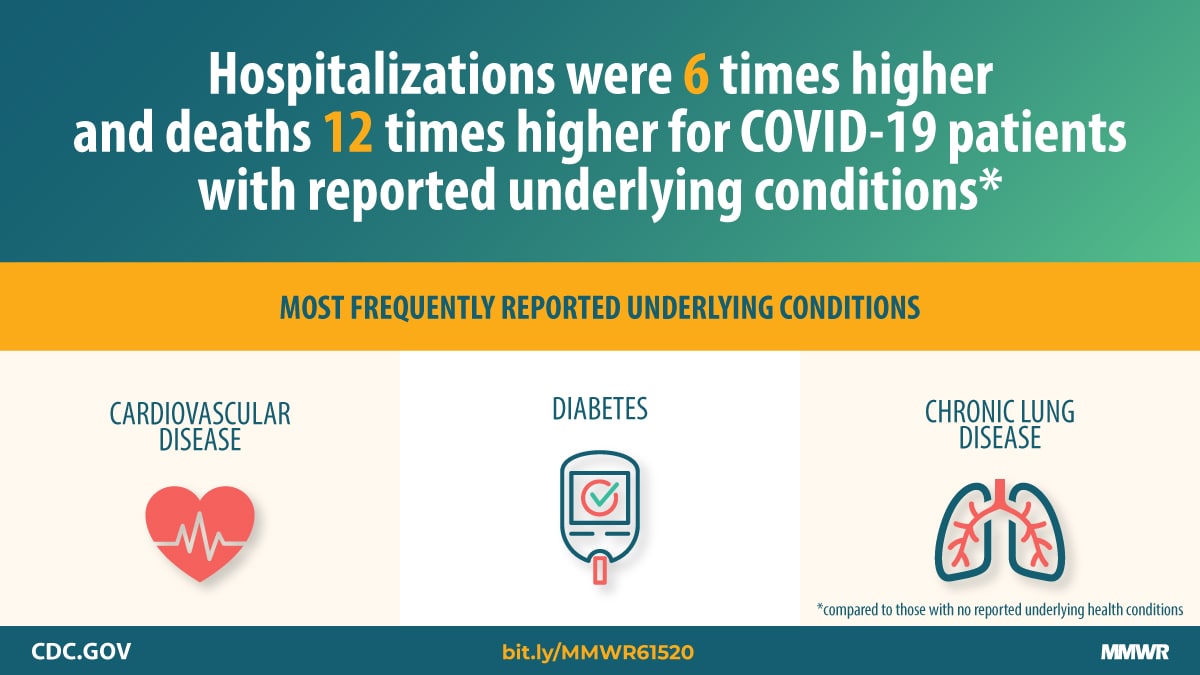
A CDC analysis last month of US COVID-19 patient surveillance data from Jan 22 to May 30 showed that those with underlying conditions were hospitalized six times more often, needed intensive care five times more often, and had a death rate 12 times higher than those without these conditions. But the authors of today’s reported noted that the earlier study defined obesity as a BMI of 40 kg/m2 or higher and included some conditions with mixed or limited evidence of a tie to poor coronavirus outcomes.

Prevalence of underlying conditions in rural, urban counties

Median estimated county prevalence of any underlying illness was 47.2% (range, 22.0% to 66.2%). Numbers of people with any underlying condition ranged from 4,300 in rural counties to 301,744 in large cities.

Prevalence of obesity was 35.4% (range, 15.2% to 49.9%), while it was 12.8% for diabetes (range, 6.1% to 25.6%), 8.9% for COPD (range, 3.5% to 19.9%), 8.6% for heart disease (range, 3.5% to 15.1%), and 3.4% for CKD, 3.4% (range, 1.8% to 6.2%).

Nationwide, the overall weighted prevalence of adults with chronic underlying conditions was 30.9% for obesity, 11.4% for diabetes, 6.9% for COPD, 6.8% for heart disease, and 3.1% for CKD.

The estimated median prevalence of any underlying condition generally increased with increasing county remoteness, ranging from 39.4% in large metropolitan counties to 48.8% in rural ones.

Resource allocation, preventive health measures

The authors noted that access to healthcare resources in some rural counties may be poor, adding to the risk of severe COVID-19 outcomes.

“The findings can help local decision-makers identify areas at higher risk for severe COVID-19 illness in their jurisdictions and guide resource allocation and implementation of community mitigation strategies,” they wrote. “These findings also emphasize the importance of prevention efforts to reduce the prevalence of these underlying medical conditions and their risk factors such as smoking, unhealthy diet, and lack of physical activity.”

The researchers called for future studies to include the weighting of the contribution of each underlying illness according to the risk of serious COVID-19 outcomes and identifying and integrating other factors leading to susceptibility to both infection and serious outcomes to better estimate the number of people at increased risk for COVID-19 infection.