Why Main Street’s pain matters

Illustration of a hanging sign that reads "Main St." swinging and hanging from one chain

The economic fortunes of mom-and-pop businesses are diverging from those of their larger counterparts — a pre-existing gap that now appears to be getting bigger, faster.

Why it matters: 

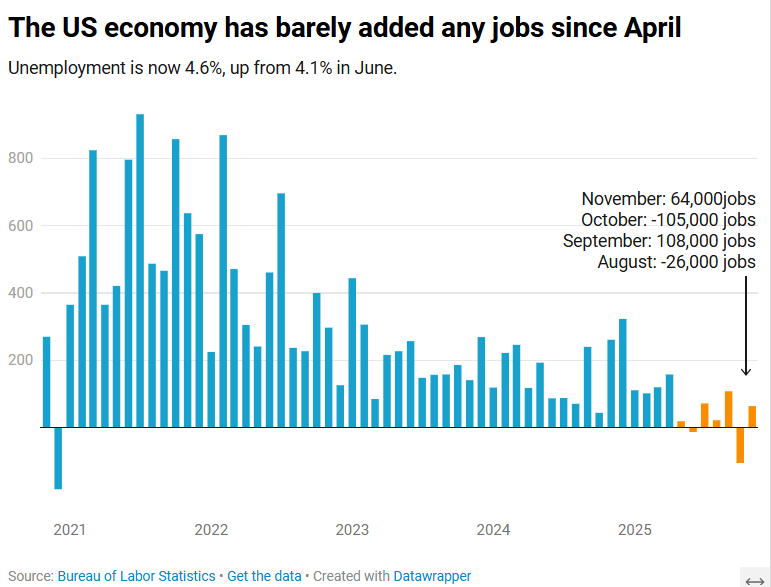
The evidence is in the private-sector labor market, that in recent months, has been propped up by large companies as smaller firms — typically responsible for 40% of U.S. employment — shed workers.

The big picture: 

Larger businesses have been able to adapt to a tough economic backdrop — historic tariffs, high interest rates and a more cautious consumer — in ways far more challenging for small companies with fewer resources.

  • “It’s evident that medium and large firms are better positioned to weather what’s going on,” said ADP chief economist Nela Richardson.
  • “They can set prices, they can change suppliers. They can hire contractors instead of permanent employees in a more sophisticated way. They can hire globally, not just in their local region. They have more tools in the toolbox,” Richardson said.

By the numbers: 

The hiring gap between small and big businesses is getting worse, a fresh sign that small business firings are holding down jobs growth across the economy.

  • As we mentioned yesterday, the private sector shed 32,000 jobs in November, according to payroll processor ADP. Small firms — those with fewer than 50 employees — accounted for all of the losses.
  • Those businesses reported a net loss of 120,000 jobs, the most small businesses have cut since the pandemic’s onset. Larger businesses grew, but not enough to offset the cuts elsewhere.

“Small business hiring really started to slow in April and I attribute some of this to tariffs and the higher cost of doing business that small companies are much less able to absorb,” Peter Boockvar, chief investment officer at One Point BFG Wealth Partners, wrote in a note.

  • “The natural reaction is to cut costs elsewhere and we know that labor is their biggest cost,” Boockvar added.

The intrigue: 

Bloomberg recently reported that there are more small businesses filing for bankruptcy under a special federal program this year than at any point in the program’s six-year history.

  • Subchapter V filings, which allow firms to shed debt faster and cheaper, are up 8% from last year, according to data from Epiq Bankruptcy Analytics.
  • Chapter 11 filings — a process used by larger businesses — are up roughly 1% over the same time frame.

Threat level: 

Main Street is bearing the brunt of an economic slowdown in ways that might make it even harder for small shops to compete with larger companies.

  • One bright spot: Despite that pain, applications to start new businesses — ones likely to employ other people — remain notably higher than in pre-pandemic times, according to the latest data available from the Census Bureau.

What to watch: 

The Trump administration shrugged off the ADP data that indicated a hiring bust. Commerce Secretary Howard Lutnick told CNBC that the cuts were due to factors unrelated to tariffs, like immigration crackdowns.

  • That hints at a debate among monetary policymakers, who are trying to gauge how much weak jobs growth is a byproduct of fewer available workers.
  • But ADP had earlier told reporters that small businesses generally had less demand for workers — not that staff weren’t available for hire.

Why Healthcare Affordability is Increasingly Problematic to Working Age Populations

In what political pundits called a sweeping win by Democrats in Tuesday’s elections, affordability and costs of living emerged as the issues that mattered most to voters. It’s no surprise.

Since 2019 before the pandemic, prices have increased for American businesses and households due to inflation:

Personal Consumption Expenditures (PCE) inflation which measures monthly business spending increased 3.5% annually. The Consumer Price Index (CPI), which measures monthly changes in household spending increased 3.87% annually over the same period (2019-2025).

But in the same period, prices for healthcare services–hospitals, physician services, insurance premiums and long-term care–have taken an odd turn: for businesses, they’ve decreased but for consumers, they increased. 

It reflects the success whereby businesses have shifted health benefits costs to employees or suspended benefits altogether, and it explains why consumers are bearing more direct responsibility for healthcare costs and are increasingly price sensitive.

A proper interpretation of PCE and CPI data points to a bigger problem: household exposure to increased prices hits younger, middle-income households hardest because their housing costs consume 36-60% of their disposable income. Food costs are an additional 13-20%. That doesn’t leave much room for healthcare when child care, student debt and transportation costs are factored.

Category PCE CPI CPI Weight
2019-2025 CumulativeAnnual change+17.3%+3.5%+26%+3.87 100%
2019-2025 Cumulative Healthcare Services Annual Change-11.6%-1.85%+16.8%+2.56%6.7%
2019-2025 Cumulative Food CostAnnual Change+24.5%+3.7%+30.98+4.6%14.5%
2019-2025 Cumulative Housing CostAnnual Change+18-22%+3.2%+25-28%+4.2%44.2%
2019-2025 Cumulative Transportation CostAnnual Change+28-32%+4.8%+35-40%+5.5-6.0%15.1%

Sources: Personal Consumption Expenditures Price Index | U.S. Bureau of Economic Analysis (BEA)CPI Home : U.S. Bureau of Labor Statistics

Increased attention to household affordability and costs of living is uncomfortable in the healthcare industry.  The good news is that expenses for health services represents a small fraction of spending; the bad news is those expenses are increasing along with competing categories and they’re sometimes unpredictable.

The fundamental operating model in healthcare is ‘Business to Business/B2B’ transactions between producers (physicians, hospitals, drug and device makers), middlemen (insurers, PBMs, employers) and users (consumers) reinforced by state and federal regulation that protect the status quo. And ‘users’ are treated as patients or enrollees, not a market that makes buying decisions based on value and costs. Thus, lack of price transparency in healthcare coupled with lack of predictability when services are used lends to public confusion or, in extreme cases, contempt. The public reaction to the murder of UnitedHealth Executive Brian Thompson last year surfaced the public’s latent animosity toward healthcare’s business practices that treat consumers as pawns on a complicated chessboard.

Shifting direct financial responsibility to consumers is the blunt instrument touted by economists who rightly argue informed decision-making by consumers is necessary to lower costs and improved value from the system. It won’t happen overnight if at all, and the system’s affordability in working age households will be the impetus.

The near-term implications are clear:

Increased household discretionary spending for necessities (food, transportation, and housing) will shrink discretionary spending for healthcare products and services:

  • Consumers believe their basic needs—food, shelter, transportation–are easier to predict and manage than their out-of-pocket bills for insurance premiums, co-pays, deductibles, over-the-counter products and more. 60% are financially insecure, and unanticipated medical costs is their biggest concern.
  • Consumers think the healthcare system is ‘dominated by ‘Big Business’ that prioritizes profit before everything else. The majority of consumers in every age, income, education, ethnic and partisan affiliated cohort share this view and are dissatisfied. Elected officials in both parties believe consolidation in health services has increased prices and reduced competition for consumers. The frontline healthcare workforce is demoralized by its corporatization and resentful of leaders they consider overpaid and accountable for financial results only.

Consumers (voters) will support policy changes to the health system that increase its accountability for affordability.

  • Among providers, momentum for price controls, price transparency, executive compensation limits, justification for tax exemptions, revenue cycle management practices, will be strong especially in state legislatures.
  • Among insurers, claims data accessibility, standardization & justification of coverage, denials, prior auth and network adequacy, premium pricing, administrative cost accountability, executive compensation, will be foci of regulation.
  • Among suppliers to the health services industry—drug companies, device makers, information technology solution providers, consultants and professional services advisors, supply chain middlemen et al—disclosure of business relationships and transparency re: direct and indirect costs will be mandated.

Final thought:

Throughout my career, ‘patient centeredness” has been the fundamental presumption on which service delivery by providers has been justified. Affordability has been neglected though increasingly acknowledged in rhetoric. Executives in healthcare services are not compensated for setting household affordability targets and publicly reporting results. Most compensation committees and Boards have marginal understanding of household economics in their communities and depend on “revenue cycle management” to address consumer payment obligations at arms-length. Even the medical community is not immune: one in 5 medical students is food insecure, 4 of 5 medical residents is financially insecure, and their career choices are increasingly dependent on their earning potential. So, calls for greater attention to affordability in healthcare will originate from insiders and outsiders tired of excuses and lip service.

Insecurity about household finances is significant and growing. Per the University of Michigan Index of Consumer Sentiment (50.3 in November 2025) is near an all-time low. It’s reality in the majority of U.S. households. The federal shutdown, discontinuance of SNAP benefits, cuts to ACA subsidies for insurance, corporate layoffs and higher costs for child care, groceries, gas and housing are a tsunami to American households.

Last week, voters elected: Zohran Mamdani, 34 (NYC); Abigail Spanberger, 46 (VA); and Mikie Sherrill, 53 (NJ) in races touted as a weather-vane for elections in 2026 and beyond. It is bigger than partisan elections. Voters in both parties and across the country are worried about affordability. It’s especially true among younger generations who worry about making ends meet and think institutions like the political system, higher education, organized religion and healthcare are outdated.

Healthcare service providers can ill afford to neglect affordability. It more than measuring medical debt, posting prices and referencing concern on websites. It’s about earning the trust and confidence of future generations through concrete actions that increase household financial security beginning with healthcare spending.

Paul

PS As never before, the voices of younger generations are being heard across the country though social media and demonstrations. The health system is among their major concerns as they ponder how they’ll be able to pay for their bills While Medicare seems the focus to policymakers and beltway pundits who rightly recognize seniors as its most costly population, the working age population has been taken for granted. Here’s a voice I follow closely. Fresh Perspective Is Sometimes Needed – by K. Pow

The Perfect Storm has Hit U.S. Healthcare

The perfect storm has hit U.S. healthcare:

  • The “Big Beautiful Budget Bill” appears headed for passage with cuts to Medicaid and potentially Medicare likely elements.
  • The economy is slowing, with a mild recession a possibility as consumer confidence drops, the housing market slows and uncertainty about tariffs mounts.
  • And partisan brinksmanship in state and federal politics has made political hostages of public and rural health safety net programs as demand increases for their services.

Last Wednesday, amidst mounting anxiety about the aftermath of U.S. bunker-bombing in Iran and escalating conflicts in Gaza and Ukraine, the Centers for Medicare and Medicaid Services (CMS) released its report on healthcare spending in 2024 and forecast for 2025-2033:

“National health expenditures are projected to have grown 8.2% in 2024 and to increase 7.1% in 2025, reflecting continued strong growth in the use of health care services and goods.

During the period 2026–27, health spending growth is expected to average 5.6%, partly because of a decrease in the share of the population with health insurance (related to the expiration of temporarily enhanced Marketplace premium tax credits in the Inflation Reduction Act of 2022) and partly because of an anticipated slowdown in utilization growth from recent highs. Each year for the full 2024–33 projection period, national health care expenditure growth (averaging 5.8%) is expected to outpace that for the gross domestic product (GDP; averaging 4.3%) and to result in a health share of GDP that reaches 20.3% by 2033 (up from 17.6% in 2023)

Although the projections presented here reflect current law, future legislative and regulatory health policy changes could have a significant impact on the projections of health insurance coverage, health spending trends, and related cost-sharing requirements, and they thus could ultimately affect the health share of GDP by 2033.”

As has been the case for 20 years, spending for healthcare grew faster than the overall economy in 2024. And it is forecast to continue through 2033:

 2024Baseline2033Forecast% Nominal Chg.2024-2033
National Health Spending$5,263B$8,585B+63.1%
US Population337,2M354.8M+5.2%
Per capita personal health spending$13,227$20,559+55.7%
Per capita disposable personal income$21,626$31,486+45.6%
NHE as % of US GDP18.0%20.3%+12.8%

In its defense, industry insiders call attention to the uniqueness of the business of healthcare:

  • ‘Healthcare is a fundamental need: the health system serves everyone.’
  • ‘Our aging population, chronic disease prevalence and socioeconomic disparities are drive increased demand for the system’s products and services.’
  • ‘The public expects cutting edge technologies, modern facilities, effective medications and the best caregivers and they’re expensive.’
  • ‘Burdensome regulatory compliance costs contribute to unnecessary spending and costs.’

And they’re right.

Critics argue the U.S. health system is the world’s most expensive but its results (outcomes) don’t justify its costs.  They acknowledge the complexity of the industry but believe “waste, fraud and abuse” are pervasive flaws routinely ignored. And they remind lawmakers that the health economy is profitable to most of its corporate players (investor-owned and not-for-profits) and its executive handsomely compensated.

Healthcare has been hit by a perfect storm at a time when a majority of the public associates it more with corporatization and consolidation than caring. This coalition includes Gen Z adults who can’t afford housing, small employers who’ve cut employee coverage due to costs and large, self-insured employers who trying to navigate around the 10-20% employee health cost increase this year, state and local governments grappling with health costs for their public programs and many more. They’re tired of excuses and think the health system takes advantage of them.

As a percentage of the nation’s GDP and household discretionary spending, healthcare will continue to be disproportionately higher and increasingly concerning.  Spending will grow faster than other industries until lawmakers impose price controls and other mechanisms like at least 8 states have begun already.

Most insiders are taking cover and waiting ‘til the storm passes. Some are content to cry foul and blame others. Others will emerge with new vision and purpose centered on reality.

Storm damage is rarely predictable but always consequential. It cannot be ignored. The Perfect has Hit U.S. healthcare. Its impact is not yet known but is certain to be a game changer.

The Summer of 2025 for U.S. Healthcare: What Organizations should Expect

Last Thursday, the Make America Healthy Again Commission released its 68-page report “Making America’s Children Healthy Again Assessment” featuring familiar themes—the inadequacy of attention to chronic disease by the health system, the “over-medicalization” of patient care vis a vis prescription medicines et al, the contamination of the food-supply by harmful ingredients, and more.

HHS Secretary Kennedy, EPA Administrator Zeldin and Agriculture Secretary Rollins pledged war on the corporate healthcare system ‘that has failed the public’ and an all-of-government approach to remedies for burgeoning chronic care needs.

Also Thursday, the House of Representatives passed its budget reconciliation bill by a vote of 215-214. The 1000-page bill cuts federal spending by $1.6 trillion (including $698 billion from Medicaid) and adds $2.3 trillion (CBO estimate/$3.4 to $5 trillion per Yale Budget Lab) to the national deficit over the next decade. It now goes to the Senate where changes to reduce federal spending to pre-pandemic level will be the focus.

With a 53-37 advantage and 22 of the 36 Senate seats facing mid-term election races in November, 2026, the Senate Republican version of the “Big Beautiful Bill” will include more spending cuts while pushing more responsibility to states for funding and additional cuts. The gap between the House and Senate versions will be wider than currently anticipated by House Republicans potentially derailing the White House promise of a final Big Beautiful Bill by July 4.

And, over the last week and holiday weekend, the President announced a new 25% tariff on Apple devices manufactured in India and new tariffs targeting the EU; threatened cuts to federal grants to Harvard and cessation of its non-citizen student enrollment, a ‘get-tougher’ policy on Russia to pressure an end of its Ukraine conflict, and a pledge to Americans on Memorial that it will double down on ‘peace thru strength’  in its Make America Great Again campaign.

These have 2 things in common:

1-They’re incomplete. None is a finished product.

The MAHA Commission, working with the Departments of Health & Human Services, Interior and Agriculture, is tasked to produce another report within 90 days to provide more details about a plan. The FY26 budgeting process is wrought with potholes—how to satisfy GOP deficit hawks vs. centrist lawmakers facing mid-term election, how to structure a bill that triggers sequestration cuts to Medicare (projected $490 billion/10 yrs. per CBO), how to quickly implement Medicaid work requirements and marketplace enrollment cuts that could leave insurance coverage for up to 14 million in limbo, and much more.  And the President’s propensity to “flood the zone” with headline-grabbing Truth Social tweets, Executive Orders and provocative rhetoric on matters at home and abroad will keep media occupied and healthcare spending in the spotlight.

2-They play to the MAGA core.

The MAGA core is primarily composed of older, white, Christian men driven by a belief that the United States has lost its exceptionalism through WOKE policies i.e. DEI in workplaces and government, open borders, globalization and excessive government spending and control. In the 2024 Presidential election, the MAGA core expanded incrementally among Black, Hispanic, and younger voters whose concerns about food, energy and housing prices prompted higher-than expected turnout. The MAGA core believes in meritocracy, nationalism, smaller government, lower taxes, local control and free-market policies that encourage private investment in the economy. The core is price sensitive.

The health system per se is not a concern but it’s the affordability and lack of price transparency are. They respect doctors and frontline caregivers but think executives are overpaid and prone to self-promotion. And the MAGA core think lawmakers have been complicit in the system’s lack of financial accountability largely beneficial to elites.

Looking ahead to the summer, a “Big Beautiful Bill” will pass with optics that allow supporters to claim fiscal constraint and lower national debt and opponents to decry insensitive spending cuts and class warfare against low-and-middle-class households.

Federal cuts to Medicaid and SNAP (Supplemental Nutrition Assistance Program) will be prominent targets in both groups—one a portrayal of waste, fraud and abuse and the other tangible evidence of societal inequity and lack of moral purpose. Each thinks the other void of a balanced perspective. Each thinks the health system is underperforming and in need of transformational change but agreement about how to get there unclear.

As MAHA promotes its agenda, Congress passes a budget and MAGA advances its anti-establishment agenda vis a vis DOGE et al, healthcare operators will be in limbo. The dust will settle somewhat this summer, but longer-term bets will be modified for most organizations as compliance risks change, state responsibilities expand, capital markets react and Campaign 2026 unfolds.

And in most households, concern about the affordability of medical care will elevate as federal and state funding cuts force higher out of pocket costs on consumers and demand for lower prices.

The summer will be busy for everyone in healthcare.

PS: Changes in the housing market are significant for healthcare: 36% of the CPI is based on shelter vs. 8% for medical services & products, 14% for food and 6% for energy/transportation. While the overall CPI increased 2.3% in the last 12 months, medical services prices increased 3.1%. contributing to heightened price sensitivity and delayed payments.

It has not escaped lawmaker attention: revenue cycle management business practices (debt collection) are being scrutinized in hospitals and community benefit declarations by not-for-profit hospitals re-evaluated. The economics of healthcare are not immune to broader market trends nor is spending for healthcare in households protected from day-to-day fluctuations in prices for other goods and services.

From Budget Battles to Consumer Backlash: Paul Keckley on the Future of U.S. Health Care

https://strategichcmarketing.com/from-budget-battles-to-consumer-backlash-paul-keckley-on-the-future-of-u-s-health-care/?access_code=667226

The U.S. health care industry is approaching a critical inflection point, according to veteran health care strategist Paul Keckley. In a candid and thought-provoking keynote at the 2025 Healthcare Marketing & Physician Strategies Summit (HMPS) in Orlando, Keckley outlined the challenges and potential opportunities health care leaders must navigate in an era of unprecedented economic uncertainty, regulatory disruption, and consumer discontent.

Drawing on decades of policy experience and his signature candid style, Keckley delivered a sobering yet actionable assessment of where the industry stands and what lies ahead.

Paul Keckley, PhD, health care research and policy expert and managing editor of The Keckley Report

Health care now accounts for a staggering 28 percent of the federal budget, with Medicaid expenditures alone ranging from the low 20s to 34 percent of individual state budgets. Despite its fiscal significance, Keckley points out that health care remains “not really a system, but a collection of independent sectors that cohabit the economy.”

In the article that follows, Keckley warns of a reckoning for those who remain entrenched in legacy assumptions. On the flip side, he notes, “The future is going to be built by those who understand the consumer, embrace transparency, and adapt to the realities of a post-institutional world.”

A Fractured System in a Fractured Economy

Fragmentation complicates any effort to meaningfully address rising costs or care quality. It also heightens the stakes in a political climate marked by what Keckley termed “MAGA, DOGE, and MAHA” factions, shorthand for various ideological forces shaping health care policy under the Trump 2.0 administration.

Meanwhile, macroeconomic conditions are only adding to the strain. At the time of Keckley’s address, the S&P 500 was down 8 percent, the Dow down 10 percent, and inflationary pressures were squeezing both provider margins and household budgets.

Economic uncertainty is not just about Wall Street,” Keckley warns. “It’s about kitchen-table economics — how households decide between paying for care or paying the cable bill.”

Traditional Forecasting Is Failing

One of Keckley’s key messages was that conventional methods of strategic planning in health care, based on lagging indicators like utilization rates and demographics, are no longer sufficient. Instead, leaders must increasingly look to external forces such as capital markets, regulatory volatility, and consumer behavior.

“Think outside-in,” he urges. “Forces outside health care are shaping its future more than forces within.”

He encourages health systems to go beyond isolated market studies and adopt holistic scenario planning that considers clinical innovation, workforce shifts, AI and tech disruption, and capital availability as interconnected variables.

Affordability and Accountability: The Hospital Reckoning

Keckley pulls no punches in addressing the mounting criticism of hospitals on Capitol Hill, particularly not-for-profit health systems. Public perception is faltering, with hospital pricing increasing faster than other categories in health care and only a third of providers in full compliance with price transparency rules.

“Economic uncertainty is not just about Wall Street. It’s about kitchen-table economics — how households decide between paying for care or paying the cable bill.”

“We have to get honest about trust, transparency, and affordability,” he says. “I’ve been in 11 system strategy sessions this year. Only one even mentioned affordability on their website, and none defined it.”

Keckley also predicts that popular regulatory targets like site-neutral payments, the 340B program, and nonprofit tax exemptions will face intensified scrutiny.

“Hospitals are no longer viewed as sacred institutions,” he says. “They’re being seen as part of the problem, especially by younger, more educated, and more skeptical Americans.”

The Consumer Awakens

Perhaps the most urgent shift Keckley outlines is the redefinition of the health care consumer. “We call them patients,” he says, “but they are consumers. And they are not happy.”

Keckley cites polling data showing that two out of three Americans believe the health care system needs to be rebuilt from the ground up. Roughly 40 percent of U.S. households have at least one unpaid medical bill, with many choosing intentionally not to pay. Among Gen Y and younger households, dissatisfaction is particularly acute.

“[Consumers] expect digital, personalized, seamless experiences — and they don’t understand why health care can’t deliver.”

These consumers aren’t just passive recipients of care; they’re voters, payers, and critics. With 14 percent of health care spending now coming directly from households, Keckley argues, health systems must engage consumers with the same sophistication that retail and tech companies use.

“They expect digital, personalized, seamless experiences — and they don’t understand why health care can’t deliver.”

Tech Disruption Is Real

Keckley underscores the transformative potential of AI and emerging clinical technologies, noting that in the next five years, more than 60 GLP-1-like therapeutic innovations could come to market. But the deeper disruption, he warns, is likely to come from outside the traditional industry.

Citing his own son’s work at Microsoft, Keckley envisions a future where a consumer’s smartphone, not a provider or insurer, is the true hub of health information. “Health care data will be consumer-controlled. That’s where this is headed.”

The takeaway for providers: Embrace data interoperability and consumer-centric technology now, or risk irrelevance. “The Amazons and Apples of the world are not waiting for CMS to set the rules,” Keckley says.

Capital, Consolidation, and Private Equity

Capital constraints and the shifting role of private equity also featured prominently in Keckley’s remarks. With declining non-operating revenue and shrinking federal dollars, some health systems increasingly rely on investor-backed funding.

But this comes with reputational and operational risks. While PE investments have been beneficial to shareholders, Keckley says, they’ve also produced “some pretty dire results for consumers” — particularly in post-acute care and physician practice consolidation.

“Policymakers are watching,” he says. “Expect legislation that will limit or redefine what private equity can do in health care.”

Politics and Optics: Navigating the Policy Minefield

In the regulatory arena, Keckley emphasizes that perception often matters more than substance. “Optics matter often more than the policy itself,” he says.

He cautions health leaders not to expect sweeping policy reform but to brace for “de jure chaos” as the current administration focuses on symbolic populist moves — cutting executive compensation, promoting price transparency, and attacking nonprofit tax exemptions.

With the 2026 midterm elections looming large, Keckley predicts a wave of executive orders and rhetorical grandstanding. But substantive policy change will be incremental and unpredictable.

“Don’t wait for a rescue from Washington. The future is going to be built by those who understand the consumer, embrace transparency, and adapt to the realities of a post-institutional world.”

The Workforce Crisis That Wasn’t Solved

Keckley also addresses the persistent shortage of health care workers and the failure of Title V of the ACA, which had promised to modernize the workforce through new team-based models. “Our guilds didn’t want it,” Keckley notes, bluntly. “So nothing happened.”

He argues that states, not the federal government, will drive the next chapter of workforce reform, expanding the scope of practice for pharmacists, nurse practitioners, and even lay caregivers, particularly in behavioral health and primary care.

What Should Leaders Do Now?

Keckley closed his keynote with a challenge for marketers and strategists: Get serious about defining affordability, understand capital markets, and stop defaulting to legacy assumptions.

“Don’t wait for a rescue from Washington,” he says. “The future is going to be built by those who understand the consumer, embrace transparency, and adapt to the realities of a post-institutional world.”

He encouraged leaders to monitor shifting federal org charts, track state-level policy moves, and scenario-plan for a future where trust, access, and consumer empowerment define success.

Conclusion: A Health Care Reckoning in the Making

Keckley’s keynote was more than a policy forecast; it was a wake-up call. In a landscape shaped by economic headwinds, political volatility, and consumer rebellion, health care leaders can no longer afford to stay in their lane. They must engage, adapt, and transform, or risk becoming casualties of a system under siege.

“Health care is not just one of 11 big industries,” Keckley says. “It’s the one that touches everyone. And right now, no one is giving us a standing ovation.”