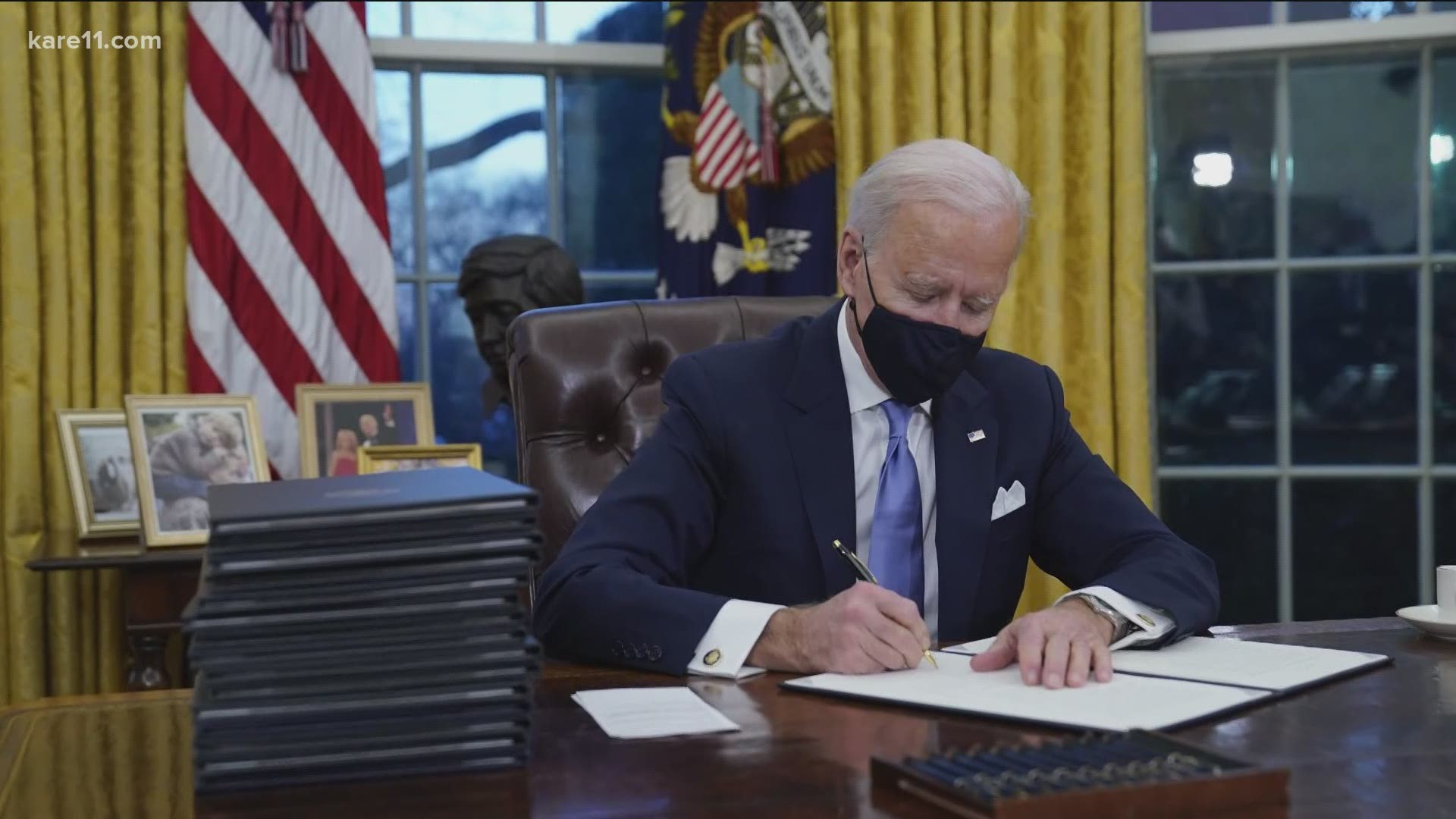
President Joe Biden is expected to sign executive actions this week related to immigration, healthcare and climate, according to a memo obtained by The Hill.
The executive actions would follow 10 he signed Jan. 21 to combat COVID-19 spread.
Here are the three healthcare executive actions to expect Jan. 28, according to The Hill:
1. President Biden is set to rescind a policy banning foreign aid for abortion, known as the Mexico City policy. It prohibits the use of U.S. funds for foreign and national health organizations that perform or actively promote abortion, according to NBC News. The policy was announced by former President Ronald Reagan in 1984. According to The Hill, it has been rescinded by Democratic presidents and reinstated by Republican presidents, including former President Donald Trump, since then.
2. President Biden will also call for a review of the Title X family planning program, according to a memo obtained by The Hill. The federal program provides family planning and related preventive health services for low-income or uninsured people and others. In 2019, the Trump administration issued a final rule prohibiting providers that receive federal family planning money under the program from providing or promoting abortions. NBC News reported that the Biden administration is expected to back off this rule and “restore federal funding for Planned Parenthood,” which left the program in 2019.
3. President Biden plans to sign an executive action on Medicaid and initiate an open enrollment period under the ACA, according to a memo obtained by The Hill. The annual open enrollment period for 2021 closed in December. However, President Biden could initiate a special enrollment period.
Anti-inflammatory oral drug colchicine improved COVID-19 outcomes for patients with relatively mild cases, according to certain topline results from the COLCORONA trial announced in a brief press release.
Overall, the drug used for gout and rheumatic diseases reduced risk of death or hospitalizations by 21% versus placebo, which “approached statistical significance.”
However, there was a significant effect among the 4,159 of 4,488 patients who had their diagnosis of COVID-19 confirmed by a positive PCR test:
25% fewer hospitalizations
50% less need for mechanical ventilation
44% fewer deaths
If full data confirm the topline claims — the press release offered no other details, and did not mention plans for publication or conference presentation — colchicine would become the first oral drug proven to benefit non-hospitalized patients with COVID-19.
“Our research shows the efficacy of colchicine treatment in preventing the ‘cytokine storm’ phenomenon and reducing the complications associated with COVID-19,” principal investigator Jean-Claude Tardif, MD, of the Montreal Heart Institute, said in the press release. He predicted its use “could have a significant impact on public health and potentially prevent COVID-19 complications for millions of patients.”
Currently, the “tiny list of outpatient therapies that work” for COVID-19 includes convalescent plasma and monoclonal antibodies, which “are logistically challenging (require infusions, must be started very early after symptom onset),” tweeted Ilan Schwartz, MD, PhD, an infectious diseases researcher at the University of Alberta in Edmonton.
The COLCORONA findings were “very encouraging,” tweeted Martin Landray, MB ChB, PhD, of the Big Data Institute at the University of Oxford in England. His group’s RECOVERY trial has already randomized more than 6,500 hospitalized patients to colchicine versus usual care as one of the arms of the platform trial, though he did not offer any findings from that study.
“Different stage of disease so remains an important question,” he tweeted. “Maybe old drugs can learn new tricks!” Landray added, pointing to dexamethasone.
A small open-label, randomized trial from Greece had also shown less clinical status deterioration in hospitalized patients on colchicine.
“I think this is an exciting time. Many groups have been pursuing lots of different questions related to COVID and its complications,” commented Richard Kovacs, MD, immediate past-president of the American College of Cardiology. “We’re now beginning to see the fruit of those studies.”
The COLCORONA announcement came late Friday, following closely on the heels of the topline results from the ACTIVE-4a, REMAP-CAP, and ATTACC trials showing a significant morbidity and mortality advantage to therapeutic-dose anticoagulation in non-ICU patients in the hospital for COVID-19.
COLCORONA was conducted remotely, without in-person contact, with participants across Canada, the U.S., Europe, South America, and South Africa. It randomized participants double-blind to colchicine 0.5 mg or a matching placebo twice daily for the first 3 days and then once daily for the last 27 days.
Participants were ages 40 and older, not hospitalized at the time of enrollment, and had at least one risk factor for COVID-19 complications: age 70-plus, obesity, diabetes, uncontrolled hypertension, known asthma or chronic obstructive pulmonary disease, known heart failure, known coronary disease, fever of ≥38.4°C (101.12°F) within the last 48 hours, dyspnea at presentation, or certain blood cell abnormalities.
It had been planned as a 6,000-patient trial, but whether it was stopped for efficacy at a preplanned interim analysis or for some other reason was not spelled out in the press release. Whether the PCR-positive subgroup was preplanned also wasn’t clear. Key details such as confidence intervals, adverse effects, and subgroup results were omitted as well.
While a full manuscript is reportedly underway, “we don’t know enough to bring this into practice yet,” argued Kovacs.
Some physicians also warned about the potential for misuse of the findings and attendant risks.
Dhruv Nayyar, MD, of the University of Toronto, tweeted that he has already had “patients inquiring why we are not starting colchicine for them. Science by press release puts us in a difficult position while providing care. I just want to see the data.”
Angela Rasmussen, MD, a virologist with the Georgetown Center for Global Health Science and Security’s Viral Emergence Research Initiative in Washington, agreed, tweeting:“When HCQ [hydroxychloroquine] was promoted without solid data, there was at least one death from an overdose. We don’t need people self-medicating with colchicine.”
As was the case with hydroxychloroquine before the papers proved little efficacy in COVID-19, Kovacs told MedPage Today: “We always get concerned when these drugs are repurposed that we might see an unintended run on the drug and lessen the supply.”
Citing the well-known diarrheal side effect of colchicine, infectious diseases specialist Edsel Salvana, MD, of the University of Pittsburgh and University of the Philippines in Manila, tweeted a plea for use only in the trial-proven patient population with confirmed COVID-19 — not prophylaxis.
The dose used was on par with that used in cardiovascular prevention and other indications, so the diarrhea incidence would probably follow the roughly 10% rate seen in the COLCOT trial, Kovacs suggested.
In the clinic, too, there are some cautions. As Elin Roddy, MD, a respiratory physician at Shrewsbury and Telford Hospital NHS Trust in England, tweeted: “Lots of drug interactions with colchicine potentially — statins, macrolides, diltiazem — we have literally been running up to the ward to cross off clarithromycin if RECOVERY randomises to colchicine.”
As happened with cars in the 1960s, price competition among brand-name drugs is hard to find.
Before 1973, when the Arab oil embargo upended the U.S. auto industry, Americans witnessed an annual ritual by carmakers. In the late summer, the Big Three — Ford, Chrysler, and General Motors — would release sticker prices for their products, always showing increases, of course.
Almost always, the increases from each company for similar models were nearly identical. If one company’s was out of line — substantially bigger or smaller than its erstwhile competitors’ — it quickly made an adjustment. Explicit collusion to fix prices was never proven, but the effect for consumers was the same.
Now, researchers report that something very similar seems to be occurring for big-market brand-name drugs, including anti-diabetic medications and blood thinners.
Average wholesale prices for products in five classes — direct-acting oral anticoagulants (DOACs), P2Y12 inhibitors, glucagon-like peptide-1 (GLP-1) agonists, dipeptidyl dipeptidase-4 (DPP-4) inhibitors, and sodium-glucose transport protein-2 (SGLT-2) inhibitors — increased in “lock-step” each year from 2015 to 2020, according to Joseph Ross, MD, of Yale University in New Haven, Connecticut, and colleagues writing in JAMA Network Open.
These increases ranged from annual averages of 6.6% for DDP4 inhibitors to 13.5% for P2Y12 inhibitors — far outpacing not only inflation in general, but even the 2.1% average for all prescription drugs.
Within each class, Kendall τb correlation coefficients for average wholesale prices were as follows:
DOACs: 0.98
SGLT-2 inhibitors: 0.98
DPP-4 inhibitors: 0.96
GLP-1 agonists: 0.92
P2Y12 inhibitors: 0.75
“These results suggest there was little price competition among the sponsors of these products,” Ross and colleagues wrote.
Although the analysis came with significant limitations — it didn’t account for rebates or other discounts, for example — the researchers said some patients must suffer from these increases.
“Rebates, list prices, and net prices have been growing for brand-name medications, and rebate growth has been shown to positively correlate with list price growth, thereby impacting costs faced by patients paying a percentage of (or the full) list price,“ the group noted. “Therefore, the lock-step price increases of brand-name medications, without evidence of price competition, raise concerns and would be expected to adversely affect patient adherence to medications and thus clinical outcomes.”
For the car buyers, the solution to lock-step price increases was imposed from outside: soaring gas prices in the mid-1970s prompted demand for vehicles with better fuel economy than domestic makers were prepared to sell. That opened the market to Japanese cars that not only got better mileage, but were also more reliable and (in many cases) cheaper than Big Three products. Thus ended Detroit’s ability to set prices.
How to rein in Big Pharma is less clear. For their part, Ross and colleagues suggested policies to limit such lock-step price hikes, shortened patent exclusivity periods, and faster introduction of generic equivalents.
The owner of two pharmacies and a management company in Florida pleaded guilty Jan. 25 to his role in a $931 million healthcare fraud scheme. He is the seventh defendant to plead guilty in the scheme, according to the U.S. Justice Department.
Larry Smith pleaded guilty to conspiracy to commit healthcare fraud, and his sentencing is set for Oct. 25. In his written plea agreement, Mr. Smith admitted to conspiring with others to defraud pharmacy benefit managers into paying for fraudulent prescriptions. As part of the plea agreement, Mr. Smith agreed to pay restitution of $24.9 million and forfeit approximately $3.1 million.
An indictment charged Mr. Smith and others with a nationwide conspiracy to defraud pharmacy benefit managers by submitting $931.4 million in bills for fraudulent prescriptions purchased from a telemarketing company. After improperly soliciting patient information, the marketing companies received approvals through telemedicine prescribers then sold the prescriptions to pharmacies in exchange for kickbacks, said Derrick Jackson, special agent in charge at HHS’ Office of Inspector General in Atlanta.
In September 2018, HealthRight, a telemedicine company, and its CEO Scott Roix pleaded guilty to conspiracy to commit healthcare fraud for their roles in the scheme. They agreed to pay $5 million in restitution. Mr. Roix’s sentencing is scheduled for Oct. 25.
Mihir Taneja, Arun Kapoor, Maikel Bolos and Sterling-Knight Pharmaceuticals also pleaded guilty in December 2020, according to the Justice Department.
President Biden is scheduled to take executive actions as early as Thursday to reopen federal marketplaces selling Affordable Care Act health plans and to lower recent barriers to joining Medicaid.
The orders will be Biden’s first steps since taking office to help Americans gain health insurance, a prominent campaign goal that has assumed escalating significance as the pandemic has dramatized the need for affordable health care — and deprived millions of Americans coverage as they have lost jobs in the economic fallout.
Under one order, HealthCare.gov, the online insurance marketplace for Americans who cannot get affordable coverage through their jobs, will swiftly reopen for at least a few months, according to several individuals inside and outside the administration familiar with the plans. Ordinarily, signing up for such coverage is tightly restricted outside a six-week period late each year.
Another part of Biden’s scheduled actions, the individuals said, is intended to reverse Trump-era changes to Medicaid that critics say damaged Americans’ access to the safety-net insurance. It is unclear whether Biden’s order will undo a Trump-era rule allowing states to impose work requirements, or simply direct federal health officials to review rules to make sure they expand coverage to the program that insures about 70 million low-income people in the United States.
The actions are part of a series of rapid executive orders the president is issuing in his initial days in office to demonstrate he intends to steer the machinery of government in a direction far different from that of his predecessor.
Biden has been saying for many months that helping people get insurance is a crucial federal responsibility. Yet until the actions planned for this week, he has not yet focused on this broader objective, shining a spotlight instead on trying to expand vaccinations and other federal responses to the pandemic.
The most ambitious parts of Biden’s campaign health-care platform would require Congress to provide consent and money. Those include creating a government insurance option alongside the ACA health plans sold by private insurers, and helping poor residents afford ACA coverage if they live in about a dozen states that have not expanded their Medicaid programs under the decade-old health law.
A White House spokesman declined to discuss the plans. Two HHS officials, speaking on the condition of anonymity about an event the White House has not announced, said Monday they were anticipating that the event would be held on Thursday.
According to a document obtained by The Washington Post, the president also intends to sign an order rescinding the so-called Mexico City rule, which compels nonprofits in other countries that receive federal family planning aid to promise not to perform or encourage abortions. Biden advisers last week previewed an end to this rule, which for decades has reappeared when Republicans occupied the White House and vanished under Democratic presidents.
The document also says Biden will disavow a multinational antiabortion declaration that the Trump administration signed three months ago.
The actions to expand insurance through the ACA and Medicaid come as the Supreme Court is considering two cases that could shape the outcome. One case is an effort to overturn rulings by lower federal courts, which have held that state rules, requiring some residents to work or prepare for jobs to qualify for Medicaid, are illegal. The other case involves an attempt to overturn the entire ACA.
According to the individuals inside and outside the administration, the order to reopen the federal insurance marketplaces will be framed in the context of the pandemic, essentially saying that anyone eligible for ACA coverage who has been harmed by the coronavirus will be allowed to sign up.
“This is absolutely in the covid age and the recession caused by covid,” said a health-care policy leader who has been in discussions with the administration. “There is financial displacement we need to address,” said this person, who spoke on the condition of anonymity to describe plans the White House has not announced.
The reopening of HealthCare.gov will be accompanied by an infusion of federal support to draw attention to the opportunity through advertising and other outreach efforts. This, too, reverses the Trump administration’s stance that supporting such outreach was wasteful. During its first two years, it slashed money for advertising and for community groups known as navigators that helped people enroll.
It is not clear whether restoring outreach will be part of Biden’s order or will be done more quietly within federal health-care agencies.
Federal rules already allow people to qualify for a special enrollment period to buy ACA health plans if their circumstances change in important ways, including losing a job. But such exceptions require people to seek permission individually, and many are unaware they can do so. Trump health officials also tightened the rules for qualifying for special enrollment.
In contrast, Biden is expected to open enrollment without anyone needing to seek permission, said Eliot Fishman, senior director of health policy for Families USA, a consumer health-advocacy group.
In the early days of the pandemic, the health insurance industry and congressional Democrats urged the Trump administration to reopen HealthCare.gov, the online federal ACA enrollment system on which three dozen states rely, to give more people the opportunity to sign up. At the end of March, Trump health officials decided against that.
During the most recent enrollment period, ending the middle of last month, nearly 8.3 million people signed up for health plans in the states using HealthCare.gov. The figure is about the same as the previous year, even though it includes two fewer states, which began operating their own marketplaces.
Leaders of groups helping with enrollment around the country said they were approached for help this last time by many people who had lost jobs or income because of the pandemic.
The order involving Medicaid is designed to alter course on experiments — known as “waivers” — that allow states to get federal permission to run their Medicaid programs in nontraditional ways. The work requirements, blocked so far by federal courts, are one of those experiments. Another was an announcement a year ago by Seema Verma, the Trump administration’s administrator of the Centers for Medicare and Medicaid Services, that states could apply for a fundamental change to the program, favored by conservatives, that would cap its funding, rather than operating as an entitlement program with federal money rising and falling with the number of people covered.
“You could think about it as announcing a war against the war on Medicaid,” said Katherine Hempstead, a senior policy adviser at the Robert Wood Johnson Foundation.
Dan Mendelson, founder of Avalere Health, a consulting firm, said Biden’s initial steps to broaden insurance match his campaign position that the United States does not need to switch to a system of single-payer insurance favored by more liberal Democrats.
The orders the president will sign “are going to do it through the existing programs,” Mendelson said.







/cdn.vox-cdn.com/uploads/chorus_asset/file/18046968/web_1863137.jpg)


 HENRY KOTULA