Fauci: The US is still in the first wave of COVID-19

https://finance.yahoo.com/news/fauci-the-us-is-still-in-the-first-wave-160137351.html

The U.S. is well into its third peak of the coronavirus, marking a new record for daily cases at more than 83,000 over the weekend.

The total case count has surpassed 8.6 million and the death toll rose above 225,000. Globally, more than 43 million have been affected with more than 1.1 million dead.

In recent days, some experts and reports have referred to this as a third wave, while others refer to it as either an elongated first wave or a second wave.

Dr. Anthony Fauci, the nation’s top infectious disease expert, settled the debate with Yahoo Finance this Monday at its annual All Markets Summit.

“I look at it more as an elongated — and an exacerbation of — the original first wave,” Fauci said.

He explained that while the Northeast has been able to reduce its outbreak, the national baseline never fell to a more manageable number like 10,000 cases per day. Instead it’s stayed high at about 20,000 cases per day.

In addition, for areas which chose to open up after the initial brief national lockdown, some states did not follow strict guidelines.

“We started to see a peak that brought us up to around 70,000 per day,” Fauci said, adding that, “Now as we’re getting into the cold weather, we came back up again to the worst that we’ve ever had, which was over 80,000 per day.”

We’ve never really had waves in the sense of up and then down to a good baseline. It’s been wavering up and down. So now, we’re at the highest baseline. … [It’s] kind of semantics. You want to call it the third wave or extended first wave. No matter how you look at it, it’s not good news,” he added.

A similar debate ensued in the summer, with many pointing to the surge hitting parts of the country that had yet been unaffected, thereby making it the first wave. Some experts say they are used interchangeably, and others say the differentiation is actually only between the local and national levels.

Dr. Shira Doron, an infectious disease physician at Tufts Medical Center echoed Fauci’s declaration of an elongated first wave.

“Only when looking back at the shape of a curve can you truly call something a peak or wave. It’s also important to mention that the overall U.S. graph looks very different than individual state graphs,” Doron said.

“The U.S. as a whole, however, never declined to low levels after its first peak, which is why some people say we are still in the ‘first wave,’” she said.

“Overall, I think it’s more a matter of semantics than something scientific.”

Cartoon – Greatest Threat to America?

Editorial Cartoons for Wednesday from Times Wire Services

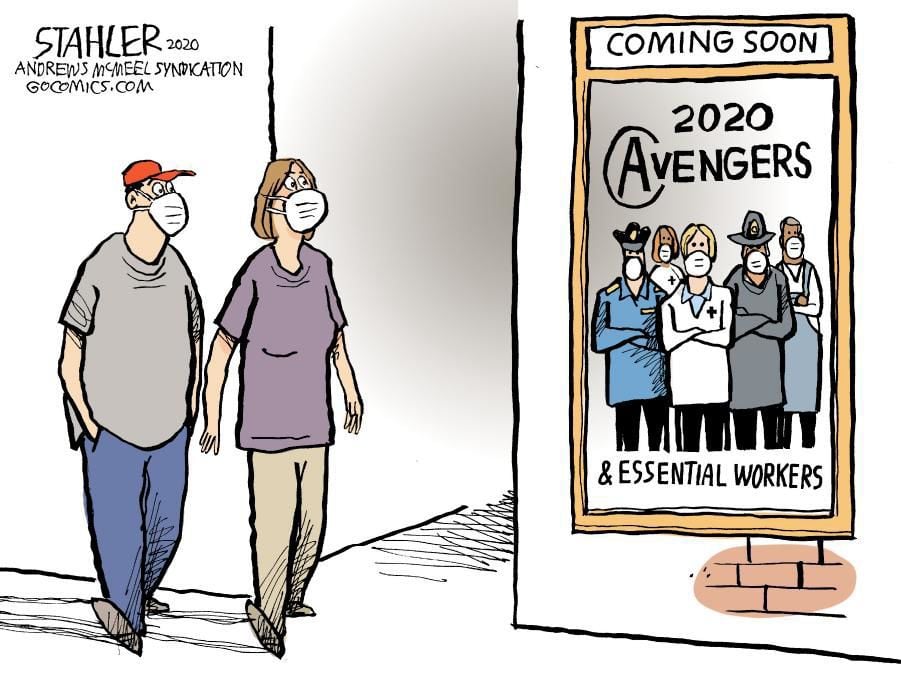
Cartoon – 2020 Avengers

April 17 editorial cartoon | | journaltimes.com

Cartoon – Caught Not Wearing a Face Mask

Granlund cartoon: Face coverings - Opinion - Daily Review Atlas - Monmouth,  IL

What can Whole Foods tell us about integrating telemedicine?

https://mailchi.mp/f2794551febb/the-weekly-gist-october-23-2020?e=d1e747d2d8

How Whole Foods' Suppliers Are Shifting From Shelves to Screens to Better  Sell on Amazon | Inc.com

A quick stop at the local Whole Foods Market recently yielded surprising insights into the dilemma faced by physician practices in the COVID-era telemedicine boom.

The store location opened just last year, part of a brand-new residential and shopping complex designed for busy professionals. It’s larger than the old-style, pre-Amazon era stores, and was designed to integrate Amazon’s online grocery operations into the bricks-and-mortar retail setting. There’s a portion of the store set aside for Amazon “shoppers” to receive and pack online orders for pickup and delivery, along with an expanded array of convenience-food offerings for the app-powered consumer to scan and purchase.

But when COVID hit, the volume of online orders went through the roof, and the store hired a small army of Amazon shoppers (including one of our own adult children who’s on a “gap year”) to keep up with demand. The result has been barely controlled chaos—easily 70 percent of the shoppers in the aisles last weekend were young Amazon employees “shopping” on behalf of online customers. They’re all held to an Amazon-level productivity standard, which makes the pace of their cart-pushing somewhat frantic and erratic. And the discreet area at the front of the store for managing the Amazon orders has become a noisy hub, making entering and exiting the store problematic. Even the “regular” store employees at Whole Foods have begun to complain about the disruption caused by the Amazon fulfillment operation.
 
It’s a cautionary tale for traditional physician practices and other care delivery organizations looking to “integrate” telemedicine into normal operations. Integration sounds great in theory, but in practice raises important questions:

1) What physical space should be set aside for delivering virtual care?

2) Should telemedicine work be done in a separate, centralized location, or in existing clinic space?

3) How does the staffing of clinics need to change to meet the demand for virtual care?

4) How can we flex staffing up and down based on demand for telemedicine?

5) If new staff are required, how will they be incorporated into the existing team—or should they be managed separately?

6) What operational metrics will they be held accountable for, and what impact will those metrics have on other operational goals? 

If Amazon, a worldwide leader online, renowned for running tight, precision, productivity-driven operations, is having trouble figuring out physical-virtual integration at the front end of their business, imagine how difficult these challenges will be for healthcare providers. The sooner we start to dig into these issues and find sustainable solutions, the better.

An early pardon for overweight turkeys?

https://mailchi.mp/f2794551febb/the-weekly-gist-october-23-2020?e=d1e747d2d8

Thanksgiving's new leftovers: Turkeys too big for farmers to sell - The  Washington Post

Overweight patients infected with COVID-19 have a higher risk of severe disease—but it turns out the pandemic may have brought a reprieve for overweight turkeys. According to a recent Washington Post piece, turkey farmers are facing a glut of, ahem, larger birds, as social distancing and reduced travel are expected to result in fewer people around the Thanksgiving dinner table, and fewer families springing for a 20-pound bird.

Farmers commit to their chicks as early as January, making a bet on the ratio of larger (male) toms versus smaller (female) hens to meet holiday demand, so many were locked into their plans before the pandemic hit. Demand for larger birds has also been hit by fewer orders for piece parts: with fall Renaissance festivals canceled, demand for turkey legs cratered. (Spare a thought for mead brewers as well.) Sadly, these soon-to-be-spared holiday heavyweights are unlikely to spend the winter roaming free—look for a rise in ground turkey supply a few months down the road. 

How to safely celebrate Thanksgiving during the pandemic

Smaller birds for smaller gatherings: just another way our “Pandemic Thanksgiving” will look like none we’ve experienced before.

Are health systems ready for “work from home forever”?

https://mailchi.mp/f2794551febb/the-weekly-gist-october-23-2020?e=d1e747d2d8

Can We Just Work From Home Forever?

Over the past few weeks we’ve fielded a spate of questions from health system executives wondering about their peers’ plans for employees to return to the office. Some who have set a January 1st target for employees to return to their physical workspaces are now reconsidering.

“The first of the year sounded good back in the summer, but now it seems kind of arbitrary,” one system COO told us. “And if we really are entering a winter ‘third wave’ of COVID, it may not be a sound decision for health reasons, either.” Many have been positively surprised by the levels of communication and productivity since many employees began telecommuting full-time back in the spring. “It would be one thing to tell people they had to come back if the work wasn’t getting done. But for many, productivity has actually been better,” one executive shared.
 
Eight months into the work-from-home experiment (and with a handful of high-profile companies like Twitter saying employees can work from home forever), some leaders are now wondering whether they too should allow some staff to work from home permanently. The opportunities are obvious: real estate and overhead cost savings, and a potential boost to employee engagement and retention. But contemplating a long-term shift raises big questions.

As remote workers in expensive markets look to move to lower-cost cities, or even to states with lower tax rates, does a geographic connection to the area matter? As new staff who have never met in person are added, can culture and teambuilding be sustained? And how to blend operations and communication across remote staff and those who work in the office, by choice or necessity? (“In-person meetings are great, Zoom meetings have gotten better, but the ones where half of us are in a conference room and the other half are dialing in feel like a death knell,” one physician leader told us.) 

The pandemic has likely launched a lasting shift toward “work anywhere”. But in order to capture the benefits of remote or flexible work, leaders must invest time and resources to rethink and transform the way they onboard, manage, operate, and communicate with the hybrid teams of the future.