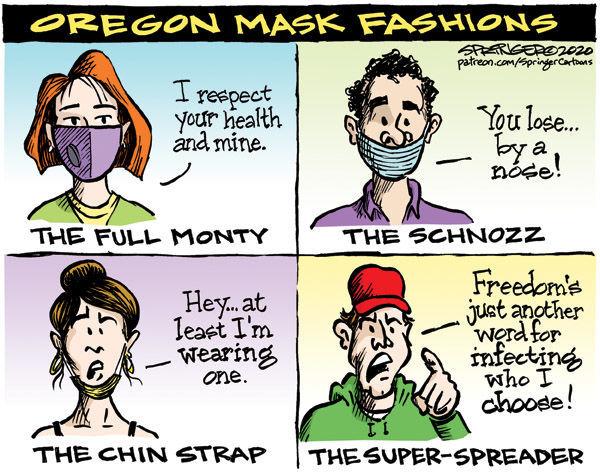
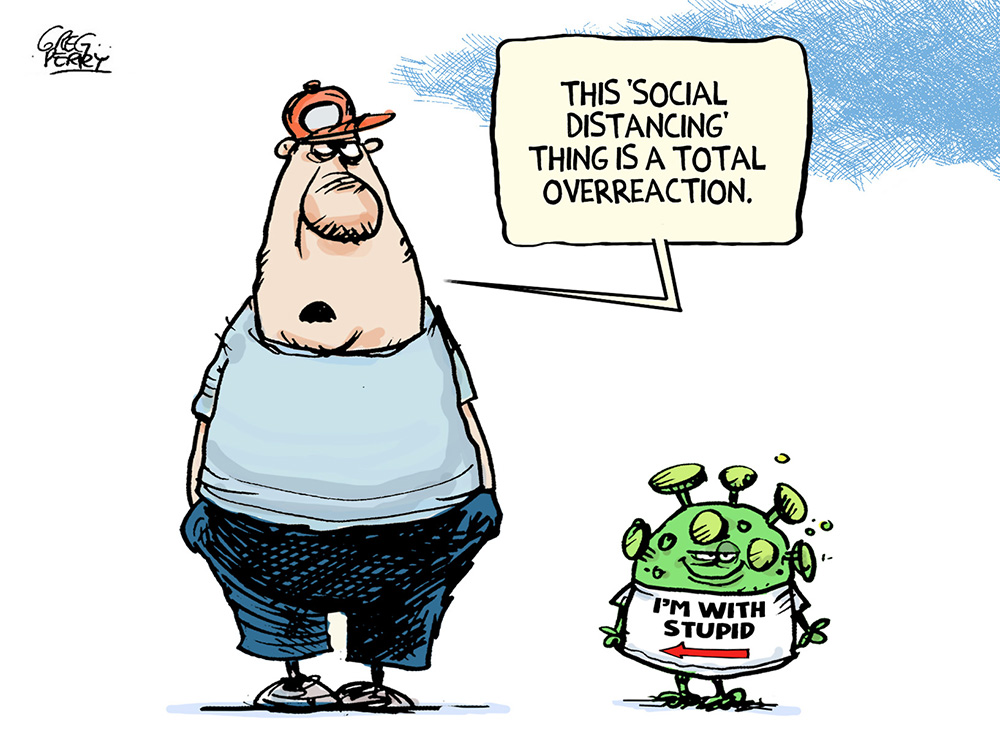
Cartoon – I can’t remember the last time the Cupboards were so bare!


https://www.cnn.com/2020/08/10/us/sturgis-motorcycle-rally-residents-decision

Before deciding on whether to hold the 80th annual motorcycle rally in Sturgis, South Dakota, the local city council turned to its residents to get their take.

Coronavirus infections are swelling in the United States, which hit 5 million cases over the weekend.
There is some very early, tentative evidence suggesting a segment of the world’s population may have partial protection thanks to the immune system’s “memory” T cells, which are trained to recognize specific invaders.
People may derive this protection from standard childhood vaccinations or from previous infections by other coronaviruses, such as those that cause the common cold, my colleague Ariana Eunjung Cha reported.
“This might potentially explain why some people seem to fend off the virus and may be less susceptible to becoming severely ill,” National Institutes of Health Director Francis Collins remarked in a blog post last week.
“On a population level, such findings, if validated, could be far-reaching,” Ariana wrote. “ … In communities in Boston, Barcelona, Wuhan and other major cities, the proportion of people estimated to have antibodies and therefore presumably be immune has mostly been in the single digits. But if others had partial protection from T cells, that would raise a community’s immunity level much higher.”
How many untested Americans have already had the virus?
The head of the Centers for Disease Control and Prevention estimated in June that there were roughly 10 times more coronavirus infections in the United States than had been confirmed through testing.
There were just 2.4 million confirmed cases when CDC Director Robert Redfield made that estimate — which, if accurate, would have translated to 24 million cases at the time. Confirmed cases have since doubled, to more than 5 million — meaning the virus may have swept through tens of millions of people.
Redfield based his estimate on the results of antibody tests, which examine a person’s blood for indicators that the body fought off an infection, Lena H. Sun and Joel Achenbach wrote.
How does the virus travel?
Scientists initially thought the virus easily spread on surfaces, similar to how other viruses operate. That’s why much of the initial public health advice centered around hand-washing and disinfecting surfaces.
Now public health experts think SARS-CoV-2 is primarily spread through person-to-person contact.
In May, the CDC updated guidance on its “How COVID-19 Spreads” website to say that “the virus spreads easily between people.” The agency also acknowledged the virus may spread other ways, such as through touching contaminated objects or surfaces, but clarified “this is not thought to be the main way the virus spreads.”
“The virus travels through the droplets a person produces when talking or coughing,” Ben Guarino and Joel wrote. “An individual does not need to feel sick or show symptoms to spread the submicroscopic virus. Close contact means within about six feet, the distance at which a sneeze flings heavy droplets. Example after example have shown the microbe’s affinity for density. The virus has spread easily in nursing homes, prisons, cruise ships and meatpacking plants — places where many people are living or working in proximity.”
Do children spread it?
Children only rarely get seriously ill or die of covid-19, the disease the virus causes; data on hospitalizations and deaths make that clear. But whether — and to what extent — they can spread the virus to others asymptomatically is still murky.
Studies are also conflicting on whether the age of children affects their likelihood of spreading the virus. One study conducted at a Chicago hospital found children younger than 5 with mild to moderate cases of covid-19 had much higher levels of virus in their noses than older children and adults — suggesting they could be more infectious, Ariana, Haisten Willis and Chelsea Janes reported.
But a study out of South Korea examining household transmission seemed to reach an opposite conclusion. It found children under age 10 did not appear to pass on the virus readily, while those between 10 and 19 appeared to transmit the virus almost as much as adults did, my colleagues wrote.
Which organs does Covid-19 attack?
The lungs appear most susceptible to the virus. Researchers have also found the pathogen in parts of the brain, kidneys, liver, gastrointestinal tract, spleen and in the endothelial cells that line blood vessels, along with widespread clotting in many organs, Ariana and Lenny Bernstein reported.
But researchers have been surprised to discover little inflammation on the brain, despite previous reports about neurological symptoms related to the coronavirus. The same goes for the heart. While physicians warned for months about a cardiac complication they suspected was myocarditis, autopsy investigators found no evidence of the condition.

After negotiations for another stimulus package hit a dead end in Washington last week, President Donald Trump signed executive orders to extend relief in the meantime. One order, according to the president, would extend the federal eviction moratorium.
The original moratorium, included in the CARES Act, prohibited landlords or housing authorities from filing eviction actions, charging nonpayment fees or penalties or giving notice to vacate. It expired on July 24 and only applied to federally subsidized or federally backed housing.
But housing advocates are pushing back, saying Trump’s executive order to extend an eviction moratorium actually does nothing at all—and keeps struggling Americans at risk of losing their housing.
Trump’s order doesn’t actually extend the federal eviction moratorium. Instead, it calls on the Department of Health and Human Services and the Centers for Disease Control and Prevention to “consider” whether an additional eviction ban is needed.
“The Secretary of Health and Human Services and the Director of CDC shall consider whether any measures temporarily halting residential evictions of any tenants for failure to pay rent are reasonably necessary to prevent the further spread of COVID-19 from one State or possession into any other State or possession,” reads the order.
Additionally, the executive order does not provide any new money to help struggling renters during the pandemic. Instead, it says the secretary of Treasury and the secretary of Housing and Urban Development—Steven Mnuchin and Ben Carson, respectively—can identify “any and all available federal funds” to provide temporary rental assistance to renters and homeowners who are facing financial hardships caused by COVID-19.
During a White House press briefing on Monday, Kayleigh McEnany said the president did “did what he can within his executive capacity…to prevent resident evictions.”At the time of publishing, officials mentioned in Trump’s executive order have not released guidelines on extending the federal eviction moratorium.
Housing advocates have not reacted positively to Trump’s executive order, suggesting officials extend an eviction moratorium.
“The executive order that he signed this weekend is really nothing more than an empty shell that creates chaos and confusion, and it offers nothing more than false hope to renters who are at risk of eviction because that executive order does literally nothing to prevent or stop evictions,” Diane Yentel, president and CEO of the National Low Income Housing Coalition, said on Sunday during an MSNBC interview.
The House of Representatives included a more thorough plan to prevent evictions in its HEROES Act proposal. The proposal included $175 billion in rent and mortgage assistance and would replace the original federal eviction moratorium with a 12-month moratorium from all rental housing, not just federally subsidized ones. There also would be funds available to provide homeowners with assistance to cover mortgage and utility payments, property taxes or other resources to help keep Americans housed.
Sen. Richard Shelby (R-AL) introduced the Coronavirus Response Additional Supplemental Appropriations Act as part of the GOP’s HEALS Act proposal. Shelby’s bill included significantly less money for housing assistance than the HEROES Act—$3.2 billion—and would be used for tenant-based rental assistance. Shelby’s proposal did not include any language about extending the CARES Act eviction moratorium.
A recent report by a group of housing advocates finds there could be as much as 40 million renters at risk of eviction in the coming months. The U.S. unemployment rate currently sits at 10.2%.
Individuals who are struggling to pay rent might have assistance options available. Some cities and states have implemented their own eviction moratoriums—you can learn more about them by visiting the Eviction Lab at Princeton University. There are also legal aid options, like Just Shelter, that will help tenants who are facing eviction for low-cost or free.
White House coronavirus advisor Dr. Anthony Fauci said Friday that the chances of scientists creating a highly effective vaccine — one that provides 98% or more guaranteed protection — for the virus are slim.
Scientists are hoping for a coronavirus vaccine that is at least 75% effective, but 50% or 60% effective would be acceptable, too, Fauci, director of the National Institute of Allergy and Infectious Diseases, said during a Q&A with the Brown University School of Public Health. “The chances of it being 98% effective is not great, which means you must never abandon the public health approach.”
“You’ve got to think of the vaccine as a tool to be able to get the pandemic to no longer be a pandemic, but to be something that’s well controlled,” he said.
The Food and Drug Administration has said it would authorize a coronavirus vaccine so long as it is safe and at least 50% effective. Dr. Stephen Hahn, the FDA’s commissioner, said last month that the vaccine or vaccines that end up getting authorized will prove to be more than 50% effective, but it’s possible the U.S. could end up with a vaccine that, on average, reduces a person’s risk of a Covid-19 infection by just 50%.
“We really felt strongly that that had to be the floor,” Hahn said on July 30, adding that it’s “been batted around among medical groups.”
“But for the most part, I think, infectious disease experts have agreed that that’s a reasonable floor, of course hoping that the actual effectiveness will be higher.”
A 50% effective vaccine would be roughly on par with those for influenza, but below the effectiveness of one dose of a measles vaccination, which is about 93% effective, according to the Centers for Disease Control and Prevention.
Public health officials and scientists expect to know whether at least one of the numerous potential Covid-19 vaccines in development worldwide is safe and effective by the end of December or early next year, though there is never a guarantee. Drug companies Pfizer and Moderna both began late-stage trials for their potential vaccines last week and both expect to enroll about 30,000 participants.
Fauci has previously said he worries about the “durability” of a coronavirus vaccine, saying if Covid-19 acts like other coronaviruses, it may not provide long-term protection.
Health officials say there is no returning to “normal” until there is a vaccine. Fauci’s comment came a day after the World Health Organization cautioned about the development of vaccines, reiterating that there may never be a “silver bullet” for the virus, which continues to rapidly spread worldwide. The phase three trials underway do not necessarily mean that a vaccine is almost ready to be deployed to the public, the agency said.
“Phase three doesn’t mean nearly there,” Mike Ryan, executive director of the WHO’s emergencies health program, said during a virtual panel discussion with “NBC Nightly News” Anchor Lester Holt hosted by the Aspen Security Forum. “Phase three means this is the first time this vaccine has been put into the general population into otherwise healthy individuals to see if the vaccine will protect them against natural infection.”
While there is hope scientists will find a safe and effective vaccine, there is never a guarantee, WHO Director-General Tedros Adhanom Ghebreyesus said.
“We cannot say we have vaccines. We may or may not,” he said.
On Friday, Fauci reiterated that he is “cautiously optimistic” scientists will find a safe and effective vaccine. He also reiterated that the coronavirus may never be eliminated, but world leaders can work together to bring the virus down to “low levels.”
Some of Fauci’s comments have been at odds with President Donald Trump, who has repeatedly said the virus would “disappear.”
Trump, who is seeking reelection, said Thursday that it’s possible the United States could have a safe and effective vaccine for the coronavirus before the upcoming presidential election on Nov. 3.
https://thehill.com/policy/finance/510987-july-jobs-report-unemployment-economy-coronavirus

The Friday release of the July jobs report gave a clearer view into a labor market clouded by mixed signals from real-time data and concerns about rising coronavirus cases across the country. The U.S. recovered another 1.8 million jobs last month—a bit above economists’ expectations, but well below the gains of May and June — and pushed the unemployment rate down to 10.2 percent.
While the U.S. economy is continuing to recover from the shock of pandemic, the report is a bit more complicated than the headline numbers indicate. Here are five key points to make sense of the July jobs report.
The recovery is still going, but slowing: The story of the coronavirus recession is a story of declines of record-breaking size and speed. Between March and April, the U.S. lost roughly 10 years of job gains and followed it up with a 32-percent annualized decline in economic growth in the second quarter.
The U.S. made solid progress recovering part of the more than 20 million jobs lost to the pandemic with gains of 2.7 million in May and 4.8 million in June. But the 1.8 million jobs gained in July marks a notable slowdown in the pace of recovery.
Economists have warned since coronavirus cases began spiking in mid-June that the resurgence would hinder the pace of growth, even if states don’t reimpose business closures. Those warnings bore out in the July jobs report, reinforcing the need to control the virus before the economy can fully recover.
The report gives both sides ammo in stimulus talks: The state of the economy rarely fits into a neat political narrative and the July jobs report is no exception.
Democrats can point to the slowing pace of job growth and the long road to recovery to support their calls for another $3 trillion in stimulus.
“The latest jobs report shows that the economic recovery spurred by the investments Congress has passed is losing steam and more investments are still urgently needed to protect the lives and livelihoods of the American people,” said House Speaker Nancy Pelosi (D-Calif.) and Senate Minority Leader Charles Schumer (D-N.Y.) in a Friday statement.
But the White House and Republican lawmakers are seizing on the expectations-beating job gain and lack of increase in permanent layoffs to make the case behind a pared down bill focused on reopening the economy.
“The most responsible thing we can do is to take proactive measures to allow people to return to work safely, instead of continuing to lock down the economy,” said Rep. Kevin Brady (R-Texas), ranking member of the House Ways and Means Committee.
The job market is still a long way from recovery: Despite three months of seven-figure job gains, the U.S. economy is still in a deeply damaged state. The July unemployment rate of 10.2 percent is roughly even with the peak of joblessness during the Great Recession of 10 percent in October 2009. And the true level of U.S. unemployment may be higher given how the pandemic has made it harder to define and track who is truly in the labor force.
It took a decade of steady economic recovery— the longest in modern U.S. history — for unemployment to drop to a 50-year low of 3.5 percent in February, so the nation remains a long way from where it was before the pandemic.
“At the current pace, it would take well into 2021 to recoup the 12.9 million jobs lost since February,” wrote Diane Swonk, chief economist at Grant Thornton, in a Friday analysis of the jobs report.
The increase in government jobs is likely misleading: Employment in government — which includes public schools — rose by 301,000 in July.
At first glance, that’s a welcome sign of resilience as state and local governments face severe budget crunches driven by falling tax revenues and staggering unemployment claims. But economists warn that the rise is likely the result of a seasonal adjustment designed to account for the large numbers of teachers and school employees that roll off of payrolls during the summer before coming back to work in the fall.
Elise Gould, senior economist at the left-leaning Economic Policy Institute, noted that public sector employment is still 1 million jobs below its February level after loads of layoffs during the beginning of the pandemic.
“We’ve seen large reductions in state and local public sector employment — a sector which disproportionately employs women and Black workers — over the last few months,” Gould wrote.
“I’d warn data watchers to consider those gains with a grain of salt, and to look at the overall changes from February (pre-COVID-19) to July.”
Aid to state and local governments is one of the biggest obstacles to gathering GOP support behind another stimulus bill, so this rise could factor into the rhetoric around the negotiations.
The report poses hard questions for negotiators: Every monthly jobs report has about two weeks of lag between the time the data was compiled — around the 12th of that month — and the report’s release.
While economic conditions don’t typically change drastically in that time, July was an exception. The $600 weekly boost to jobless benefits and the federal eviction and foreclosure ban enacted in March both lapsed in between the jobs report survey period and release, and much of the money lent through the Paycheck Protection Program had been spent by the end of the month. That means lawmakers are looking at a glimpse of the economy with much more fiscal support than it currently has, posing tough choices about how much more is needed to keep the economy afloat.
Even so, economists are urging lawmakers not to rest on their laurels as the U.S. faces a difficult road ahead.
“Any notion that the improvement in the top line provides a convenient excuse for policymakers to avoid hard decisions around a fifth round of fiscal aid aimed at the unemployed should be summarily dismissed,” wrote Joe Brusuelas, chief economist at tax and audit firm RSM, in a Friday analysis.
Talks on a new coronavirus relief package were going poorly before the report and collapsed hours after it was released.
LEADING THE DAY
Trump embraces jobs report signaling slowdown: The White House is trying to capitalize on the latest jobs numbers, arguing they point to a strong economic recovery under President Trump even as millions remain out of work and states grapple with increases in coronavirus infections.
But the data nevertheless point to an economic slowdown, challenging the White House’s bullish predictions for a speedy V-shaped recovery. The figures also come amid collapsed talks between the Trump administration and Democratic leaders on a coronavirus relief package, which economists say is desperately needed to prevent a deeper recession.
“This is not a rocket ship,” said Martha Gimbel, senior manager of economic research at Schmidt Futures. “It’s really unclear if the economy is going to achieve escape velocity before the lack of government spending crashes down or before … we have to shut down again, which is a total possibility.”
The Hill’s Morgan Chalfant and I explain why here.
The White House view: White House economic adviser Larry Kudlow, who did the rounds on cable news Friday morning, declared that the numbers evidenced a “self-sustaining recovery” and predicted that the United States would see unemployment head into the single digits in the fall months.
“The worries that some partial shutdowns or some pausing shutdowns would wreck the jobs numbers did not pan out. I think that shows signs of strength,” Kudlow said on Fox Business.
The economists’ take: Economic analysts say that despite the jobs report, there remains a need for additional fiscal stimulus. Many point to an extension of the expanded unemployment benefits and additional aid to states as necessary steps to shepherd the economy through recovery until there is a vaccine for the coronavirus.
“This jobs number doesn’t change the undeniable need for additional federal support,” said Isaac Boltansky, director of policy research at investment bank Compass Point Research & Trading.

Nearly 100,000 children tested positive for the coronavirus in the last two weeks of July, a new report from the American Academy of Pediatrics finds. Just over 97,000 children tested positive for the coronavirus from July 16 to July 30, according to the association.
Out of almost 5 million reported COVID-19 cases in the U.S., CBS News’ Michael George reports that the group found that more than 338,000 were children.
Vanderbilt University’s Dr. Tina Hartert hopes increased testing of children will help determine what role they play in transmission, as school districts around the country return to some form of school. She is leading a government-funded study that saw DIY testing kits sent to some 2,000 families.
“The kits are shipped to the families, they are taught how to collect these samples, and then the samples are sent back by the families to a central repository,” she said.
In New York City, home to the nation’s largest school district, Mayor Bill de Blasio announced a return to in-person schooling in the fall and pledged officials “have worked incessantly to get this right.”
“They’ve looked at examples from all over the world of what will keep the school community safe, and they’ve made a series of choices of how to do things from the health and safety lens first, while also making sure we can educate our kids,” he said in a Friday press conference.
De Blasio gave parents until Friday night to register students for in-person instruction, remote learning or a hybrid.
More than 25 children died of the coronavirus in July alone. Pressure to get kids back into the classroom has left superintendents in more than 13,000 different school districts across the country to figure out how to keep children safe amid a myriad of public health advisories, and handle learning differences.
Niles, Michigan Superintendent Dan Applegate is hoping Plexiglas could be a solution for children with speech impediments to be able to participate in class.
He demonstrated by speaking behind a transparent slate at a press conference.
“As I’m sitting here and I can articulate,” Applegate said. “The student on the other side will be wearing a mask. Then I can put my mask on, and that student can drop their mask and articulate as well.”
Indiana’s Lawrence Township is cleaning school buses with a hospital-grade disinfectant spray for students still needing rides to school.
“You’re going to see a very clean and disinfected bus,” Transportation Director Matt Miles said. “We actually have fogging machines.”
However, they are not expecting many students to get on the bus — 35% of children in the area are expected to learn remotely, while other school districts in the U.S. will not open at all.