Financial updates from Scripps, Providence, 5 more health systems

https://www.beckershospitalreview.com/finance/financial-updates-from-scripps-providence-5-more-health-systems.html?utm_medium=email

The following seven health systems recently released financial updates:

1. Phoenix-based Banner Health saw its revenue climb 10.6 percent year over year to $9.4 million in 2019. The revenue growth was attributed to a 7 percent growth in care delivery revenue and a 29 percent increase in revenue from its insurance division. Overall, Banner saw its net income climb from $44 million in 2018 to $726.8 million in 2019 due to strong investment gains.

2. Henry Ford Health System, based in Detroit, recorded a net income of $354.5 million in 2019, more than four times the $86.8 million reported in 2018. In 2019, the health system generated $6.3 billion in revenue, up from $5.9 billion the same period one year prior. Part of the revenue increase was attributed to a rise in net patient revenue from outpatient visits and expanded specialty pharmacy activity.

3. Portland-based MaineHealth reported an operating gain of $82.8 million in the year ended Sept. 30, 2019, a 21.9 percent increase from an operating gain of $67.9 billion reported in the same period in 2018. MaineHealth’s revenue increased to $2.7 billion, compared to $2.5 billion reported in the same period one year prior. Overall, the system recorded a net income of $119.1 million, up slightly from the $118.2 million reported in fiscal 2018.

4. New York-based Montefiore Health System posted an operating revenue of $6.24 billion in 2019, which compares to an operating revenue of $5.91 billion in 2018. After factoring expenses, nonoperating gains and the revenue it generated from a vital access provider program, the health system ended the year with a net income of $8.67 million, down from the $53.48 million reported in 2018. Montefiore attributed the financial setback in net income to participation in some value-based contracts and underpayments from government-run insurance programs.

5. Renton, Wash.-based Providence posted a net income of $1.36 billion in 2019, compared to a deficit of $445 million in 2018. The health system reported revenue of $25.03 billion in 2019, up 2 percent from the $24.43 billion reported in 2018. The revenue increase was largely attributed to patient volume increases. The system’s operating expenses rose to $24.65 billion in 2019. This compares to $24.26 billion in 2018.

6. Trinity Health, based in Livonia, Mich, recorded an operating income of $102.6 million in the first half of fiscal year 2020, which ended Dec. 31. That’s compared to the same period of fiscal 2019, when the health system recorded operating income of $113.4 million. After factoring in nonoperating gains, Trinity reported a net income of $805.7 million in the first half of fiscal 2020, compared to an operating loss of $301.5 million in the same period one year prior.

7. San Diego-based Scripps Health reported revenue of $780.2 million in the first quarter of fiscal year 2020, which ended Dec. 31. This compares to the same period in fiscal 2019, in which Scripps recorded revenue of $747.2 million. The health system’s expenses also increased 4.3 percent year over year in the first quarter of fiscal 2020. In the first quarter of fiscal 2020, Scripps posted an operating income of $1.9 million, more than triple the $607,000 in operating income posted in the same quarter in fiscal 2019. Scripps ended the first quarter of fiscal 2020 with a net income of $141.5 million, compared to a net loss of $171 million in the same period a year earlier.


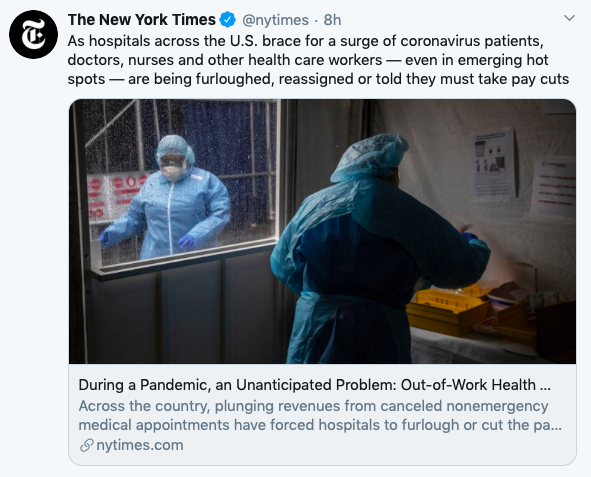
Nonprofit hospital outlook negative as COVID-19 restricts cash flow, Moody’s says

https://www.beckershospitalreview.com/finance/nonprofit-hospital-outlook-negative-as-covid-19-restricts-cash-flow-moody-s-says.html?utm_medium=email

Image result for Nonprofit hospital outlook negative as COVID-19 restricts cash flow, Moody's says

Moody’s Investor Services changed its outlook for nonprofit hospitals from stable to negative because of how the coronavirus outbreak is expected to affect cash flow.

Four things to know:

1. While Moody’s previously expected 2-3 percent growth in cash flow for 2020, this is no longer the case. Moody’s said the coronavirus situation is changing too quickly to estimate a specific range for this year, but nonprofit hospitals will likely see lower cash flow compared to 2019.

2. Moody’s said nonprofit hospitals will take a revenue hit as they cancel lucrative elective surgeries and procedures to prepare for a surge in COVID-19 patients. 

3. Revenue declines will be paired with higher expenses as the need for equipment and supplies increases.

4. Moody’s predicts the containment of the outbreak will come in 2020, and the economy will start to gradually recover. Still, analysts note there is a high degree of uncertainty and a risk that the outbreak could last longer than predicted.


BANKS PRESSURE HEALTH CARE FIRMS TO RAISE PRICES ON CRITICAL DRUGS, MEDICAL SUPPLIES FOR CORONAVIRUS

Banks Pressure Health Care Firms to Raise Prices on Critical Drugs, Medical Supplies for Coronavirus

Image result for BANKS PRESSURE HEALTH CARE FIRMS TO RAISE PRICES ON CRITICAL DRUGS, MEDICAL SUPPLIES FOR CORONAVIRUS

IN RECENT WEEKS, investment bankers have pressed health care companies on the front lines of fighting the novel coronavirus, including drug firms developing experimental treatments and medical supply firms, to consider ways that they can profit from the crisis.

The media has mostly focused on individuals who have taken advantage of the market for now-scarce medical and hygiene supplies to hoard masks and hand sanitizer and resell them at higher prices. But the largest voices in the health care industry stand to gain from billions of dollars in emergency spending on the pandemic, as do the bankers and investors who invest in health care companies.

Over the past few weeks, investment bankers have been candid on investor calls and during health care conferences about the opportunity to raise drug prices. In some cases, bankers received sharp rebukes from health care executives; in others, executives joked about using the attention on Covid-19 to dodge public pressure on the opioid crisis.

Gilead Sciences, the company producing remdesivir, the most promising drug to treat Covid-19 symptoms, is one such firm facing investor pressure.

Remdesivir is an antiviral that began development as a treatment for dengue, West Nile virus, and Zika, as well as MERS and SARS. The World Health Organization has said there is “only one drug right now that we think may have real efficacy in treating coronavirus symptoms” — namely, remdesivir.

The drug, though developed in partnership with the University of Alabama through a grant from the federal government’s National Institutes of Health, is patented by Gilead Sciences, a major pharmaceutical company based in California. The firm has faced sharp criticism in the past for its pricing practices. It previously charged $84,000 for a yearlong supply of its hepatitis C treatment, which was also developed with government research support. Remdesivir is estimated to produce a one-time revenue of $2.5 billion.

During an investor conference earlier this month, Phil Nadeau, managing director at investment bank Cowen & Co., quizzed Gilead Science executives over whether the firm had planned for a “commercial strategy for remdesivir” or could “create a business out of remdesivir.”

Johanna Mercier, executive vice president of Gilead, noted that the company is currently donating products and “manufacturing at risk and increasing our capacity” to do its best to find a solution to the pandemic. The company at the moment is focused, she said, primarily on “patient access” and “government access” for remdesivir.

“Commercial opportunity,” Mercier added, “might come if this becomes a seasonal disease or stockpiling comes into play, but that’s much later down the line.”

Steven Valiquette, a managing director at Barclays Investment Bank, last week peppered executives from Cardinal Health, a health care distributor of N95 masks, ventilators and pharmaceuticals, on whether the company would raise prices on a range of supplies.

Valiquette asked repeatedly about potential price increases on a variety of products. Could the company, he asked, “offset some of the risk of volume shortages” on the “pricing side”?

Michael Kaufmann, the chief executive of Cardinal Health, said that “so far, we’ve not seen any material price increases that I would say are related to the coronavirus yet.” Cardinal Health, Kaufman said, would weigh a variety of factors when making these decisions, and added that the company is “always going to fight aggressively to make sure that we’re getting after the lowest cost.”

“Are you able to raise the price on some of this to offset what could be some volume shortages such that it all kind of nets out to be fairly consistent as far as your overall profit matrix?” asked Valiquette.

Kaufman responded that price decisions would depend on contracts with providers, though the firm has greater flexibility over some drug sales. “As you have changes on the cost side, you’re able to make some adjustments,” he noted.

The discussion, over conference call, occurred during the Barclays Global Healthcare Conference on March 10. At one point, Valiquette joked that “one positive” about the coronavirus would be a “silver lining” that Cardinal Health may receive “less questions” about opioid-related lawsuits.

Cardinal Health is one of several firms accused of ignoring warnings and flooding pharmacies known as so-called pill mills with shipments of millions of highly addictive painkillers. Kaufmann noted that negotiations for a settlement are ongoing.

Owens & Minor, a health care logistics company that sources and manufactures surgical gowns, N95 masks, and other medical equipment, presented at the Barclays Global Healthcare Conference the following day.

Valiquette, citing the Covid-19 crisis, asked the company whether it could “increase prices on some of the products where there’s greater demand.” Valiquette then chuckled, adding that doing so “is probably not politically all that great in the sort of dynamic,” but said he was “curious to get some thoughts” on whether the firm would consider hiking prices.

The inquiry was sharply rebuked by Owens & Minor chief executive Edward Pesicka. “I think in a crisis like this, our mission is really around serving the customer. And from an integrity standpoint, we have pricing agreements,” Pesicka said. “So we are not going to go out and leverage this and try to ‘jam up’ customers and raise prices to have short-term benefit.”

AmerisourceBergen, another health care distributor that supplies similar products to Cardinal Health, which is also a defendant in the multistate opioid litigation, faced similar questions from Valiquette at the Barclays event.

Steve Collis, president and chief executive of AmerisourceBergen, noted that his company has been actively involved in efforts to push back against political demands to limit the price of pharmaceutical products.

Collis said that he was recently at a dinner with other pharmaceutical firms involved with developing “vaccines for the coronavirus” and was reminded that the U.S. firms, operating under limited drug price intervention, were among the industry leaders — a claim that has been disputed by experts who note that lack of regulation in the drug industry has led to few investments in viral treatments, which are seen as less lucrative. Leading firms developing a vaccine for Covid-19 are based in Germany, China, and Japan, countries with high levels of government influence in the pharmaceutical industry.

AmerisourceBergen, Collis continued, has been “very active with key stakeholders in D.C., and our priority is to educate policymakers about the impact of policy changes,” with a focus on “rational and responsible discussion about drug pricing.”

Later in the conversation, Valiquette asked AmerisourceBergen about the opioid litigation. The lawsuits could cost as much as $150 billion among the various pharmaceutical and drug distributor defendants. Purdue Pharma, one of the firms targeted with the opioid litigation, has already pursued bankruptcy protection in response to the lawsuit threat.

“We can’t say too much,” Collis responded. But the executive hinted that his company is using its crucial role in responding to the pandemic crisis as leverage in the settlement negotiations. “I would say that this crisis, the coronavirus crisis, actually highlights a lot of what we’ve been saying, how important it is for us to be very strong financial companies and to have strong cash flow ability to invest in our business and to continue to grow our business and our relationship with our customers,” Collis said.

The hope that the coronavirus will benefit firms involved in the opioid crisis has already materialized in some ways. New York Attorney General Letitia James announced last week that her lawsuit against opioid firms and distributors, including Cardinal Health and AmerisourceBergen, set to begin on March 20, would be delayed over coronavirus concerns.

MARKET PRESSURE has encouraged large health care firms to spend billions of dollars on stock buybacks and lobbying, rather than research and development. Barclays declined to comment, and Cowen & Co. did not respond to a request for comment.

The fallout over the coronavirus could pose potential risks for for-profit health care operators. In Spain, the government seized control of private health care providers, including privately run hospitals, to manage the demand for treatment for patients with Covid-19.

But pharmaceutical interests in the U.S. have a large degree of political power. Health and Human Services Secretary Alex Azar previously served as president of the U.S. division of drug giant Eli Lilly and on the board of the Biotechnology Innovation Organization, a drug lobby group.

During a congressional hearing last month, Azar rejected the notion that any vaccine or treatment for Covid-19 should be set at an affordable price. “We would want to ensure that we work to make it affordable, but we can’t control that price because we need the private sector to invest,” said Azar. “The priority is to get vaccines and therapeutics. Price controls won’t get us there.”

The initial $8.3 billion coronavirus spending bill passed in early March to provide financial support for research into vaccines and other drug treatments contained a provision that prevents the government from delaying the introduction of any new pharmaceutical to address the crisis over affordability concerns. The legislative text was shaped, according to reports, by industry lobbyists.

As The Intercept previously reported, Joe Grogan, a key White House domestic policy adviser now serving on Donald Trump’s Coronavirus Task Force, previously served as a lobbyist for Gilead Sciences.

“Notwithstanding the pressure they may feel from the markets, corporate CEOs have large amounts of discretion and in this case, they should be very mindful of price gouging, they’re going to be facing a lot more than reputational hits,” said Robert Weissman, president of public interest watchdog Public Citizen, in an interview with The Intercept.

“There will be a backlash that will both prevent their profiteering, but also may push to more structural limitations on their monopolies and authority moving forward,” Weissman said.

Weissman’s group supports an effort led by Rep. Andy Levin, D-Mich., who has called on the government to invoke the Defense Production Act to scale up domestic manufacturing of health care supplies.

There are other steps the government can take, Weissman added, to prevent price gouging.

“The Gilead product is patent-protected and monopoly-protected, but the government has a big claim over that product because of the investment it’s made,” said Weissman.

“The government has special authority to have generic competition for products it helped fund and prevent nonexclusive licensing for products it helped fund,” Weissman continued. “Even for products that have no connection to government funding, the government has the ability to force licensing for generic competition for its own acquisition and purchases.”

Drug companies often eschew vaccine development because of the limited profit potential for a one-time treatment. Testing kit companies and other medical supply firms have few market incentives for domestic production, especially scaling up an entire factory for short-term use. Instead, Levin and Weissman have argued, the government should take direct control of producing the necessary medical supplies and generic drug production.

Last Friday, Levin circulated a letter signed by other House Democrats that called for the government to take charge in producing ventilators, N95 respirators, and other critical supplies facing shortages.

The once inconceivable policy was endorsed on Wednesday when Trump unveiled a plan to invoke the Defense Production Act to compel private firms to produce needed supplies during the crisis. The law, notably, allows the president to set a price ceiling for critical goods used in an emergency.


To solve the economic crisis, we will have to solve the health-care crisis

https://www.washingtonpost.com/opinions/the-coronavirus-pandemic-is-not-an-economic-crisis-its-a-health-care-crisis/2020/03/19/d7bb64a6-6a1a-11ea-abef-020f086a3fab_story.html?fbclid=IwAR1I–vZ_8aqfRe0mIyIdWSWGKHuTnBjS-tqkK3PcyYM7xVKx9LIVn9ddsY&utm_campaign=wp_main&utm_medium=social&utm_source=facebook

Image result for To solve the economic crisis, we will have to solve the health-care crisis

In Washington, the focus has now turned to the economic response to the coronavirus pandemic, with experts and politicians proposing their preferred policy tools — ranging from tax cuts to corporate bailouts to direct payments of cash. Each is worth debating, but the focus is misplaced. This is not an economic crisis; it is a health-care crisis.

The distinction may sound academic. But understanding it is actually vital to designing the policies that should follow.

In an economic crisis, you could imagine a situation in which people lose their jobs and are unable to spend money. That’s called a demand shock, which is what happened during the global financial crisis of 2008. Or producers could raise prices (for various reasons), making it harder to buy their goods. That’s a supply shock, and it describes the oil crises of 1973 and 1979. But what is happening now cannot be addressed primarily by economic responses, because we are witnessing the suspension of economics itself.

Today, even if you have money, increasingly you cannot go into a shop, restaurant, theater, sports arena or mall because those places are closed. If you own a factory that hasn’t already closed for health reasons, you may still have to shut it down because you can’t get key components from suppliers or you can’t find enough stores open to sell your goods.

In these conditions, cash to consumers cannot jump-start consumption. Relief to producers will not jump-start production. This problem is on a level different and far greater than the recession of 2008 or the aftermath of 9/11. If it were to go on for months, it could look worse than the Great Depression.

This is not an argument against any of the economic measures being proposed. People need to be able to eat, buy medicine and pay their bills. New York Times columnist Andrew Ross Sorkin has canvassed experts and concluded that the best approach would be a zero-interest “bridge loan to all businesses and self-employed people as long as they keep most of their workers on staff. It is probably the right course of action, massively expensive but cheaper than a full-blown Great Depression.

But even that might not work if we do not recognize that first and foremost the United States faces a health crisis. And that crisis is not being solved. China is now reporting no new domestic infections. South Korea, Taiwan and Singapore have also made progress in “flattening the curve” — the phrase of the year — because they have prioritized dealing with the health-care crisis over enacting a grand economic stimulus.

The United States is still dangerously behind the curve. A headline in Thursday’s Wall Street Journal is, “Coronavirus Testing Chaos Across America.” The article details how the country still has “a chaotic patchwork of testing sites,” with testing proceeding “far slower than experts say is necessary, in part due to a slow federal response.” The U.S. testing rate remains shockingly low, well behind the rates of most other rich countries and far behind those of the Asian countries that are handling this crisis best. Across the United States, hospitals are warning of a dire shortage of beds, medical equipment and supplies. And the worst is yet to come. With infections doubling every two to three days, the U.S. health-care system will face what New York Gov. Andrew Cuomo correctly described as a “tsunami.”

The Trump administration is still acting slowly and fitfully. Experts predicted weeks ago that cities would need thousands more hospital beds, and yet the Navy is still performing maintenance on two hospital ships and figuring out staffing. The president says he will invoke “defense production” powers only if necessary. What is he waiting for? He should direct firms to start production of all key medical equipment in short supply. The armed forces should be deployed immediately to set up field testing and hospital sites. Hotels and convention centers should be turned into hospitals. The federal government should announce a Manhattan Project-style public-private partnership to find and produce a vaccine. After decades of attacks on government, federal agencies are understaffed, underfunded and ill-equipped to handle a crisis of this magnitude. They need help, and fast.

And here’s another idea: President Trump could forge an international effort to unite the world against this common threat. If the United States, China and the European Union worked together, prospects for success — on a vaccine, for example — would be greater. China in particular produces most of the supplies and medical ingredients the world needs. Trump should remove all of his self-defeating tariffs so that American consumers don’t have to pay more for these goods and China can ramp up production. This is a war, and in a war you try to find allies rather than create enemies.


Op-Ed: As a doctor, I use telemedicine. With the coronavirus threat, it could revolutionize healthcare

https://www.latimes.com/opinion/story/2020-03-17/op-ed-as-a-doctor-i-use-telemedicine-with-the-coronavirus-threat-it-could-revolutionize-healthcare?fbclid=IwAR1D6sHWYhvei0Hda4dRuqRaydyxO7AVRjWQj-2UTFqwf3gdKaWuVfxa2Hs

Image result for Op-Ed: As a doctor, I use telemedicine. With the coronavirus threat, it could revolutionize healthcare

As a physician, waiting for the worst of coronavirus to hit, I see a lot to fear. It seems increasingly likely that this will be one of the most significant pandemics in modern human history, and that it will change our approach to healthcare going forward. But not all of its legacy will be negative. Here’s one thing I hope will come out of the crisis: an increased reliance on telemedicine, something that should have happened long ago.

A few months ago, when I was between jobs, I took a part-time job in a rural hospital serving a county of more than 150,000 people. On the verge of bankruptcy, the hospital was unable to attract many specialists to join its ranks, and in desperation, had turned to telemedicine to cover many services. So, for example, if a patient was rushed to the emergency room after a stroke, there was unlikely to be a neurologist in the room. Instead, a neurologist would assess the patient on a mobile screen from far away, with local nursing staff and doctors aiding him or her.

I had been skeptical of telemedicine going in. Physical exams are the bedrock of how doctors and nurses assess patients. We look patients and their loved ones in the eye, palpate sore spots with our fingers and offer comfort with a hand on a shoulder. Physical contact, I’d always thought, was at the heart of how doctors and patients communicate.

It was with this skepticism that I found myself next to a young man who been brought to the emergency room after attempting to take his own life. Again. This time, instead of seeing a psychiatrist in person, he saw one on a screen with wheels. The psychiatrist was in some distant location, but she had been in touch with the local doctors and had access to his medical records. Despite her physical remoteness, she connected with him, and he opened up. She knew of all the local resources to refer him to, and at the end of her conversation, she had developed a real rapport with him. After the visit ended and the nurse wheeled the monitor out of the room, I asked the young man what he thought, and to my surprise, he told me he was more comfortable with this than an in-person visit. He wasn’t the only one — many patients say they prefer a virtual doc to one sitting across from them.

Over the past few decades, medical care has been transformed by technology. Whenever a new drug becomes available, or a medical procedure is approved by the FDA, the medical community is quick to deploy it. Yet, when it comes to how we see patients, our current practices haven’t changed much since the time of Hippocrates. If a patient is sick they either have to come see us in clinic, urgent care, the emergency room or the hospital. Despite the internet transforming every aspect of our lives, from how we find love to how we order groceries, the way we deliver medical care has stagnated.

In the United States, not only are doctors often inaccessible for those living in rural areas, hospitals everywhere have huge economic challenges. One healthcare executive jokingly told me his hospital made more money from its parking lots than its clinics.

The response to COVID-19 might help change that.

One of the main reasons China has been able to slow coronavirus transmission has been because of a dramatic increase in virtual visits. In fact, China has moved half of all medical care online, allowing patients to consult with their doctors and get prescriptions from the comfort of their homes. Hospitals have been notorious petri dishes for deadly bugs since long before COVID-19, and this pandemic has brought that risk into crystal-clear focus. On Tuesday, Medicare announced that it will greatly expand coverage for telemedicine visits, previously sharply restricted. And at a White House briefing, the government announced it was urging states to similarly expand Medicaid coverage to include telemedicine visits by Skype, Facetime or other platforms. Some insurers have also said they will cover telehealth visits at parity with in-person visits.

These measures are commendable, but policies need to be put in place to ensure that the expansion of telemedicine is not temporary. Of course, in-person visits will still be necessary in many cases. But supporting telemedicine on a par with such visits has the potential to protect patients and healthcare personnel and allow for much more efficiency in the system. That said, physicians and nurses will need high-quality training to provide compassionate and thorough care to a patient from across a computer screen. Technology that allows patients to be “examined” remotely needs to be better studied and made more accessible. And since the backbone of telemedicine is reliable high-speed internet, Congress should consider Elizabeth Warren’s plan to bring broadband internet to the remotest parts of this country, to ensure broad access to these services.

This week my team converted most of our clinic visits from face to face to virtual visits. Some were over the phone, others were over video, often with a family member present as well. While there were some patients that still needed to be seen in person, we were able to minimize the risk of viral transmission not only for patients, but also for valuable members of our clinical team. Even before this crisis, as part of my job at the Veterans Affairs Health System in Boston, I often consulted with patients I had never seen as part of an “E Consult” system. While I was initially nervous when I first started doing this, it allowed me to expand my footprint far beyond what I could manage if I were seeing every patient in person.

At some point, I fervently hope the coronavirus will be a thing of the past. But I hope it leaves behind a legacy. I hope it changes how well we wash our hands, how well we fund public health and how well we protect the healthcare workers caring for our sickest patients. And, most of all, I hope it pushes us to embrace telemedicine.


Coronavirus will radically alter the U.S.

https://www.washingtonpost.com/health/2020/03/19/coronavirus-projections-us/?fbclid=IwAR1pOgBLGSYRzL11KbzXjyZuqHpNPFOnE8wwNzmCrAKX4w3S_VX9cVlo3O8&utm_campaign=wp_main&utm_medium=social&utm_source=facebook

Image result for Coronavirus will radically alter the U.S.

Here’s what may lie ahead based on math models, hospital projections and past pandemics.

When Jason Christie, chief of pulmonary medicine at Penn Medicine, got projections on how many coronavirus patients might soon be flocking to his Philadelphia hospital, he said he felt physically ill.

“My front-line providers — we were speaking about it in the situation report that night, and their voices cracked,” Christie said on Wednesday. They saw how quickly the surge would overwhelm the system, forcing doctors to make impossible choices — which patients would get ventilators and beds, and which would die.

“They were terrified. And that was the best-case scenario.”

Experts around the country have been churning out model after model — marshaling every tool from math, medicine, science and history — to try to predict the coming chaos unleashed by the new coronavirus and to make preparations.

At the heart of their algorithms is a scary but empowering truth: What happens next depends largely on us — our government, politicians, health institutions and, in particular, 327 million inhabitants of this country — all making tiny decisions on an daily basis with outsize consequences for our collective future.

In the worst-case scenario, America is on a trajectory toward 1.1 million deaths. That model envisions the sick pouring into hospitals, overwhelming even makeshift beds in parking lot tents. Doctors would have to make agonizing decisions about who gets scarce resources. Shortages of front-line clinicians would worsen as they get infected, some dying alongside their patients. Trust in government, already tenuous, would erode further.

That grim scenario is by no means a foregone conclusion — as demonstrated by countries like South Korea which has reduced its new cases a day from hundreds to dozens with aggressive steps to bolster their health system.

If Americans embrace drastic restrictions and school closures, for instance, we could see a death toll closer to thousands and a national sigh of relief as we prepare for a grueling but surmountable road ahead.

An alarming new model

Doing that will require Americans to “flatten the curve” — slowing the spread of the contagion so it doesn’t overwhelm a health-care system with finite resources. That phrase has become ubiquitous in our national conversation. But what experts have not always made clear is that by applying all that downward pressure on the curve — by canceling public gatherings, closing schools, quarantining the sick and enforcing social distancing — you elongate the curve, stretching it out over a longer period of time.

Success means a longer — though less catastrophic — fight against the coronavirus. And it is unclear whether Americans — who built this country on ideals of independence and individual rights — would be willing to endure such harsh restrictions on their lives for months, let alone for a year or more.

This month began with U.S. officials recommending actions such as hand-washing and social distancing. By Sunday, the Centers for Disease Control and Prevention was warning against gatherings of 50-plus people. By Monday, President Trump had made an abrupt turn from encouraging Americans to go on with their lives, to urging them to work from home, not meet in groups of more than 10, and calling on local officials to close schools, bars and restaurants. (Getting the public to comply has been alarmingly difficult. Young revelers from Bourbon Street to Miami have ignored those pleas, as have some elderly, who are at highest risk.)

Trump’s sudden shift was driven by an alarming new scientific model, developed by British epidemiologists and shared with the White House. The scientists bluntly stated the coronavirus is the most serious respiratory virus threat since the Spanish Flu of 1918. If no action to limit the viral spread were taken, as many as 2.2 million people in the United States could die over the course of the pandemic, according to epidemiologist Neil Ferguson and others at the Imperial College Covid-19 Response Team.

Adopting some mitigation strategies to slow the pandemic — such as isolating those suspected of being infected and social distancing of the elderly — only cuts the death toll in half to 1.1 million, although it would reduce demand for health services by two-thirds.

Image result for coronavirus suppression scenarios

Only by enacting an entire series of drastic, severe restrictions could America shrink its death toll further, the study found. That strategy would require, at minimum, the nationwide practice of social distancing, home isolation, and school and university closures. Such restrictions would have to be maintained, at least intermittently, until a working vaccine is developed, which could take 12 to 18 months at best.

The report’s conclusion: This is “the only viable strategy.”

What hospital planning tells us

Here is another thing that hasn’t been spelled out in our national conversation about flattening the curve: There will probably be more than one curve.

If we’re lucky, the coming months will probably look more like string of hilly bumps, say epidemiologists. If authorities ease some measures in coming months or if we start letting them slip ourselves, that hill could easily turn right back into the exponential curve that has cratered Italy’s health system and that U.S. officials are desperately trying to avoid replicating.

Climbing this first bump is in many ways the most challenging because it involves persuading people to change their individual behaviors for an abstract larger good — and because no one knows how far we actually are from the peak.

On Tuesday morning, New York Gov. Andrew M. Cuomo (D) said infections in his state are expected to peak in 45 days — at the start of May. The state has roughly 53,000 hospital beds, including 3,000 intensive-care beds — way short of the projected need for as many as twice that number of beds and as many as 11 times the number of ICU beds.

A day earlier, Northwell Health — whose 23 hospitals and 800 outpatient centers make up New York’s largest health system — canceled all elective surgeries in its hospitals to free up staff and space. It has 5,500 beds.

“We’re looking at Italy, which is currently 10 days ahead of us, and what they’ve had to do,” said Maria Carney, Northwell’s chief of geriatrics. Carney was health commissioner for New York’s Nassau County during the 2009 H1N1 outbreak and has worked furiously on Northwell’s plans to prepare for the coming tsunami.

One reason she and others are alarmed: In China, the fatality rate in Wuhan, the raging epicenter, was 5.8 percent. But in all other areas of the country it was 0.7 percent — a signal that most deaths were driven by an overwhelmed health system.

And U.S. hospitals are pinched as it is, with some already running at 95 percent capacity pre-coronavirus, Carney noted. As cases surge, Northwell plans to place multiple beds in single rooms. Its ambulances will also shuttle patients to less crowded satellite sites. Those suffering from ordinary emergencies — strokes, heart attacks, car accidents — may find themselves routed to other facilities away from ERs to avoid transmission.

But it’s unclear if it will be anywhere near enough.

Staffing shortages are already developing: As of Tuesday, 18 Northwell employees had already tested positive for the coronavirus. More than 200 were self-quarantined as a result of potential exposures, foreshadowing what is likely to come.

If the numbers next month get truly crazy, cities may look to convert stadiums into isolation wards, as in Wuhan. Cuomo has talked of turning the six-block-long Javits Convention Center on New York City’s west side into a medical surge facility. Others might take Italy’s approach and split hospitals into those treating coronavirus and those treating all other medical problems, to reduce transmission.

In San Francisco, we may see coronavirus patients put into RVs. In Takoma Park, Md., the old Washington Adventist Hospital site, which shuttered in 2019, could suddenly find its doors reopened.

‘Pandemics aren’t just physical’

As America enters this utterly unfamiliar territory, some experts have turned to history for glimpses of what to expect in the months ahead.

Initially leery of alarming the public, they have increasingly compared this pandemic to the 1918 Spanish flu, the deadliest in modern history. It infected roughly a third of the world’s population and killed at least 50 million people, including at least 675,000 in the United States.

Like the hilly bumps experts foresee in coming months, the 1918 pandemic hit America in three waves — a mild one that spring, the deadliest wave in fall and a final one that winter.

With each wave came a cycle of denial, devastation, community response finally kicking into overdrive — always followed by finger-pointing and blame among leaders and the public.

“Every outbreak is different,” said medical anthropologist Monica Schoch-Spana, who spent months digging through archives to study how Spanish flu played out in Baltimore.

Like coronavirus is likely to do, the 1918 flu overwhelmed hospitals. Unable to get help, desperate families waited outside to beg and try to bribe doctors for treatment. In a three-week period, 2,000 died in Baltimore alone. Mortuaries ran out of caskets. When the bodies finally reached cemeteries, the gravediggers were so ill, no one could bury the dead.

Economic pressure on business owners and workers caused public resistance to adopt — and stick with restrictions. The crisis brought out the best in Baltimoreans — with sewing circles churning out gauze masks and hospital bedding, and neighbors donating food and services.

But it also brought out the worst — xenophobic conspiracy theories that nurses of “German extraction” were deliberately infecting people. African American patients were kept out of most hospitals under Jim Crow-era segregation.

“Pandemics aren’t just physical,” said Schoch-Spana. “They bring with them an almost shadow pandemic of psychological and societal injuries as well.”

The power of the individual

Stanford virologist Karla Kirkegaard said she has tried to stave off dread from the projected U.S. death toll with a case study she teaches in her classes:

Amid a cholera outbreak in mid-19th century London, as panicked residents fled one hard-hit neighborhood, a doctor named John Snow calmly entered the breach. He deduced that the source of hundreds of deaths was a single contaminated water pump and persuaded authorities to remove the pump’s handle — a strategy that ended the outbreak.

Controlling the covid-19 pandemic will take much more than a single water pump, Kirkegaard acknowledged as she sheltered in place at her Bay Area home.

But the story, she said, reminds her how powerful the simple act of one individual can be.