A look at what lies under the (high) deductible

https://mailchi.mp/f3434dd2ba5d/the-weekly-gist-december-20-2019?e=d1e747d2d8


With the continued growth in high deductible health plans (HDHPs) in both employer- and exchange-based insurance markets, a larger number of services are falling “under the deductible”, leaving patients responsible for the full cost of care

The graphic above illustrates the national cost ranges of ten common outpatient services, based on data from a publicly-available commercial claims databaseIt’s not just minor services like lab tests or diagnostic imaging that are falling under the deductible—many consumers are now paying full freight for a growing list of outpatient procedures like cataract or carpal tunnel surgery, or even knee arthroscopy.

Shopping can pay off: for any service, the highest-priced provider can be over three times the lowest-priced, translating into thousands of dollars of savings for patients with high-deductible plans.

Outpatient services now account for over half the revenue of many health systems. As deductibles climb, more and more of the (profitable) health system services are becoming “shoppable” for consumers—creating an imperative for systems to both lower costs and pursue rational pricing as scrutiny becomes more intense.


Christmas comes early for healthcare industry groups

https://mailchi.mp/f3434dd2ba5d/the-weekly-gist-december-20-2019?e=d1e747d2d8

Image result for Christmas comes early for healthcare industry groups

Today, President Trump is set to sign into law a $1.4T spending agreement that keeps the Federal government open and avoids a year-end budget showdown with Congress. The agreement is comprised of two separate spending packages, with a total of 12 budget bills, and includes good news for almost every segment of the healthcare industry.

It repeals the long-debated “Cadillac Tax” on high-cost health plans, which was a key funding mechanism for the ACA and was intended to force employers to encourage their employees to use healthcare services more frugally.

It also repeals the “device tax” on medical device manufacturers, and the separate fee on health insurers, both also part of the ACA.

In sum, those three repeals will reduce tax revenue by about $375B over the next decade and will remove a substantial portion of funding originally earmarked to sustain the 2010 health law.

Meanwhile, notably absent from the budget deal are measures to address surprise billing, which have proven difficult to finalize despite broad bipartisan support, and steps to reduce the cost of prescription drugs, a key legislative priority on both sides of the aisle.

Thanks to intense lobbying by various industry interest groups, and the toxic political environment in Washington, the year is drawing to an end with virtually no progress to show on either front.

As a result, despite a year’s worth of heated rhetoric about the high cost of care, the burden of health spending on individuals, and the need to rein in runaway health spending, 2019 is ending with almost every industry interest—pharmaceutical companies, device manufacturers, insurers, physician groups, and hospitals—largely avoiding accountability in the form of federal legislation. As we head into an election year, we’ll likely have to wait until after next November to see real progress on any of these issues. Merry Christmas.


Obamacare Ruling May Spare Republicans Some Political Pain

Image result for Obamacare Ruling May Spare Republicans Some Political Pain

The practical effect of the decision is likely to be months of delays, pushing the final outcome of the case beyond the 2020 election.

A federal appeals court in New Orleans handed Republicans a Christmas present.

The court had been considering a case with the potential to dismantle the entire Affordable Care Act, an outcome that could have set off waves of chaos and disruption leading up to the November election, and for which there was very little contingency planning.


The court had two main options. It could have agreed with the Trump administration, along with a set of Republican state officials and a district court in Texas, and overturned all of the law. Or it could have upheld Obamacare, undermining the arguments of the White House and its allies.

The court found a third way. In a decision at the close of business Wednesday, two of the three judges signaled their support for a key part of the Republicans’ legal argument. The two agreed with a lower court that Obamacare’s individual mandate had been made unconstitutional by a 2017 law that eliminated the financial penalty for remaining uninsured. But the judges punted on the case’s key question of what that meant for the rest of the health law, asking a lower court to reconsider it. The effect is likely to be months of delays, pushing the final outcome of the case beyond the 2020 election.


Starting in 2017, the Republicans’ failed effort to repeal and replace large portions of the health law was deeply unpopular and became a central campaign theme of the 2018 election, in which Democrats won a House majority. Democrats cast themselves as the protectors of Obamacare’s most popular provisions, especially its protections for Americans with pre-existing health conditions.

While most Democrats would have favored a court ruling that upheld Obamacare, a reprise of those politics could have given them a lift in an election year. Voters tend to trust Democrats more than Republicans on health care, but much of the debate during the primary season has focused on ambitious new expansions of government coverage. Those proposals do not enjoy the widespread support attached to the preservation of Obamacare’s core consumer protections.

Those dynamics have allowed Republicans to focus on arguments that they will protect private insurance and oppose socialism, without forcing them to articulate their own detailed health plans. President Trump has periodically hinted at an imminent Obamacare replacement plan, but he has yet to produce one. Mitch McConnell, the Senate majority leader, has declined to produce or advance a major health care bill in the Senate.


But if a court had ruled that all of Obamacare had to be wiped off the books, it would have been far harder for Republicans to avoid articulating their vision for health care. The public did not like their previous attempts in 2017, and there has been little progress, even behind the scenes, to produce an alternative plan more palatable to the public. Two concepts have emerged since then, one from a group of conservative think tanks, and one from the House Republican Study Committee. Neither has received much public attention by party leaders, and both share the basic structure of an earlier legislative plan that divided Republican legislators so much that it never made it to a vote.

Meanwhile, Democrats could have retreated to safer ground, by promising to reinstate popular Obamacare provisions.


If the court had overturned all of Obamacare, it could have meant major disruptions to the health system. Such a ruling, if upheld by the Supreme Court, would have eliminated consumer protections for people with pre-existing health conditions, and wiped away financial assistance that have helped millions of middle-class Americans buy their own coverage.

It would have erased the Medicaid expansion, which provides health insurance to millions of low-income Americans in three dozen states. It would have reversed Medicare policies that make prescription drugs more affordable for seniors, and Food and Drug Administration rules that have allowed cheaper copies of expensive biologic drugs to enter the market.

It would have undone major experiments in the delivery of care, meant to improve health care quality. It would have rolled back enhanced punishments for Medicare fraud. It would have reduced requirements that workplaces provide space for lactating mothers to pump breast milk, and requirements that chain restaurants post calorie counts for their food.

Around 20 million more Americans would have become uninsured, according to an estimate from the Urban Institute. Experts on Medicare policy said they were not even sure how some of the changes could have been carried out now that they have been enshrined in complex regulations and built on in subsequent laws.


None of those effects would have happened immediately, even if the Fifth Circuit had agreed in full with the lower court; the Supreme Court would have probably weighed in. But the prospect of such huge changes had the potential to reset the political conversation about health care in both parties. By avoiding a decision on the case’s consequences, the Fifth Circuit has effectively postponed that shift.

In a statement Wednesday night, President Trump applauded the court’s ruling that the individual mandate was unconstitutional. But he emphasized that the decision would not result in any meaningful changes to voters’ health care.

“The radical health care changes being proposed by the far left would strip Americans of their current coverage,” he said. “I will not let this happen. Providing affordable, high-quality health care will always be my priority. They are trying to take away your health care, and I am trying to give the American people the best health care in the world.”


Such a statement would have been harder to issue if the court panel had agreed with the arguments made by Mr. Trump’s lawyers and called for the reversal of Obamacare’s coverage expansions.

Democrats’ frustration with the court’s indecision was palpable. Chuck Schumer, the Senate minority leader, described the judges’ move as “cowardly.” The decision is “obviously an attempt to shield Republicans from the massive blowback they would receive from the public if the highest court in the land were to strike down the A.C.A. before the upcoming election,” he said in a statement.

It’s possible, of course, that the case will reach a final disposition sooner anyway. California’s attorney general, Xavier Becerra, announced that he and other Democratic state officials involved in the case would be appealing the decision to the Supreme Court. Even though the appellate court sent the case back to Texas, the country’s highest court could still choose to take it, should four justices wish to. But the most likely path involves months or years of additional litigation, with lingering uncertainty over the fate of Obamacare.


Leading with Honor – Adverse Situation

Lee Ellis FAQ – Lessons Learned?

Leading with Honor Frequently Asked Question –

“During the Vietnam War, after 53 missions in enemy territory, your plane was hit. You managed to parachute to safety but landed in a field of Vietnamese snipers and were captured, subsequently being held prisoner for more than five years.

What lessons did you learn from such an adverse situation?”

Lee’s Answer –

“Because we had a lot of time to reflect and think about things in the POW camps, I really got to know myself. What are my strengths and struggles? What are my fears? Am I authentic, or do I hide behind a persona or façade—I wanted to be real, authentic in every situation.

I learned to be positive and expect a good outcome, even in difficult circumstances. Communication is so important. We had to work hard to communicate, because the enemy tried to keep us from communicating. Another important lesson learned is being resilient and bouncing back. We got knocked down and tortured, and what we learned was resilience.

Our senior POW leaders suffered first and most often and the most torture and hardship. They were committed to doing their duty in spite of the heavy costs. They leaned into their doubts and fears to do the right thing and that was a powerful example. We wanted to be like them, so they raised our level of courage and commitment by their example. My goal became to do the right thing regardless of my fears or the risks associated with the situation.”


PENNSYLVANIA HOSPITALS MADE $136.1B IMPACT IN FY 2018

https://www.healthleadersmedia.com/finance/pennsylvania-hospitals-made-1361b-impact-fy-2018?spMailingID=16742301&spUserID=MTg2ODM1MDE3NTU1S0&spJobID=1781321594&spReportId=MTc4MTMyMTU5NAS2

Image result for PENNSYLVANIA HOSPITALS MADE $136.1B IMPACT IN FY 2018

The Hospital and Healthsystem Association of Pennsylvania report found that hospitals also supported more than one in every 10 jobs.

Hospitals in Pennsylvania made a total economic impact of $136.1 billion in Fiscal Year (FY) 2018, according to a Hospital and Healthsystem Association of Pennsylvania (HAP) report released Tuesday.

Of the total economic impact, $60.5 billion were the result of “direct impact,” such as employee salaries, benefits, as well as goods and services for hospital operations. Another $75.6 billion were the result of “ripple impact,” such as additional economic effects of a hospital in a community.

HHAP also found that hospitals supported more than 650,000 jobs, accounting for more than one in every 10 jobs in the state and providing $32.3 billion in total wages. Nearly 300,000 jobs were directly associated with hospitals while 363,000 jobs were associated with “ripple effects” of health systems.

The study’s findings point to the significant economic impact provider organizations have in the Keystone State and the need to promote policies that foster continued growth, according to Sari Siegel, PhD, vice president of healthcare research at HAP.

“While overall growth projections are strong, some hospitals remain financially stressed. Our work illustrates that hospitals often are the backbones of their communities and closure could cause devastating economic ripples throughout a region,” Siegel said in a statement. “The findings of this report underscore the need for policies that bolster hospitals’ long-term sustainability.”

Pennsylvania hospitals have contributed significantly to the state’s economy in recent years and have also made headlines throughout 2019.

Hahnemann University Hospital, a Pennsylvania-based hospital, filed for bankruptcy and closed over the summer. A group of six Philadelphia-based health systems won the hospital at auction for $55 million in early August. 

The report was also released days after two Pennsylvania-based health systems, Tower Health and Drexel University, finalized a $50 million acquisition of St. Christopher’s Hospital for Children, a 188-bed pediatric medical center in Philadelphia.

There are 253 hospitals in Pennsylvania, according to HAP, with more than 37,600 staffed beds. The report also found that hospitals are among the 10 largest employers in 85% of counties across the state.

The total economic impact of Pennsylvania hospitals in FY 2018 grew by nearly $50 billion over the past decade, according to a HAP analysis of data collected from the Department of Health and Human Services (HHS).

Additionally, Pennsylvania hospitals received nearly $2 billion in research allocations from HHS and Patient-Centered Outcomes Research Institute in FY 2018.


NEW COVENANT HEALTH CFO AIMS TO LEAD ORGANIZATION’S FINANCIAL TURNAROUND

https://www.healthleadersmedia.com/finance/new-covenant-health-cfo-aims-lead-organizations-financial-turnaround
Image result for turnaround


The Tewksbury, Massachusetts–based health system strives to post its first positive balance sheet in more than five years.

Stephen Forney, MBA, CPA, FACHE, excels in fixing “broken” organizations and he has built a track record of achieving financial turnarounds at seven healthcare facilities, he tells HealthLeaders in a recent interview.

Forney has over three decades of experience as a healthcare executive, with a primary focus on problem-solving. He began his career fixing problems in areas such as information technology and supply chain, an approach and skill he has carried over into financial operations in the C-suite.

“In finance, it wound up being the same thing. Pretty much every organization I’ve gone to has been broken in some way, shape, or form,” Forney says. “I’ve developed a specialty doing turnarounds and this will be my eighth.”

Forney speaks about his new CFO role at the Tewksbury, Massachusetts–based Catholic nonprofit health system Covenant Health, which he joined in mid-September, and how driving revenue and reducing expenses must go hand-in-hand to achieve financial balance.

This transcript has been lightly edited for brevity and clarity.

HealthLeaders: Covenant is coming off its fifth straight year of operating losses. What is contributing to those losses and how do you plan to address those financial challenges?

Forney: The thing is, most turnarounds—to a greater or lesser extent—look a lot alike. With organizations that have [financial] issues, there are obviously always unique aspects to every situation, but virtually every healthcare organization that’s not doing well is because of the same relatively small handful of issues.

[For example,] revenue cycle is probably No. 1. Productivity has not been well attended to; expenses haven’t had a lot of discipline around them in a broad sense. That’s not to say that all decisions are bad, but in a systematic fashion, things haven’t been looked at. Frequently, driving volume and growing the business needs a better focus. 

In the case of Covenant … there has been a plan developed to address all those areas and we are addressing them already, even though we will be posting another operating loss in fiscal [year] 2019. But the trajectory is good and some of the things that we’re now looking at are what I would consider to be phase two–type initiatives. How do we accelerate and move them to the next level?

On October 1, we outsourced our revenue cycle. I’m pleased that we were able to get that accomplished. Obviously, it’s early but, at least anecdotally, initial trends look good.

HL: Where do you fall on the dynamic between focusing on expense control measures or revenue generation?

Forney: I always feel like you need to do both. Expense management and working towards expense strategies is easier, quicker, and more straightforward.

[Revenue growth strategies] take time, take effort, and tend to [have] a much higher degree of uncertainty around the volume projection. Those are necessary and they’re things that we need to invest in because, at some point, you can’t cut any more from your organization, you’ve got to grow the top line. To me, it’s sort of like step one is stabilize your revenue cycle and stabilize your expenses. Then while you’re doing that, work on growth that’s going to take place 12 to 18 months down the road.

HL: Are you optimistic about the federal government’s efforts to move the industry toward value-based care?

Forney: Going back about a decade, I thought the ACE program, which was [the federal government’s] bundled payment program, was a solid step in the right direction. It gave organizations a chance to collaborate in compliant fashion with physicians to bend the cost curve and have beneficiaries participate in the bending of the cost curve as well. I was with one of the pilot health systems that [participated], and it was a remarkable success.

Everybody got to win; CMS, patients, physicians, and systems won by creating value. Yes, I think that the government has a good role to play in [value-based care] because they have such a large group of patients that they’re willing to experiment like that. [The federal government] can come up with potentially novel ways to get people to buy into this.

HL: What is it like to be at the helm of a Catholic nonprofit system and how does it affect your leadership style?

Forney: From a philosophical standpoint, the principle of creating shareholder wealth and good stewardship are not significantly different. You’ve got an end goal in mind, which is, you’re taking care of the patients and a community. In one case, whatever excess is left goes to a private equity fund or shareholders. In the other case, [the excess] stays in your balance sheet and gets reinvested in the community.

HL: Given your three decades of healthcare experience, do you have advice for your fellow provider CFOs, especially some of the younger ones?

Forney: Focus on being that strategic right-hand person to the CEO. In my experience, that has been one of the things that marks a successful CFO from one that isn’t as successful.

CEOs are going to get ideas from everywhere. They’re outward and inward facing. They deal with the doctors and the community, and they’re going to get all sorts of great ideas.

The CFO needs to be that person [who is] grounded and says, ‘Well, what about this?’ That doesn’t mean saying no. The whole idea is how do you make it [sound] like a yes. To me, the CFO role just grounds all the discussions, from working with physicians to working with the community. 

CFOs over the last couple of decades have been operationally oriented. Now they need to start becoming clinically oriented.

There’s a real benefit in being able to sit down and talk with a physician and understand [what] they’re doing. … It winds up becoming a way to help ground the clinicians in the hospital operations because now you’re having a dialogue with them instead of them just saying, ‘You don’t understand. You’re not a clinician.’ That would be something that I would have a young CFO try to stay focused on, even though it’s dramatically outside the comfort zone for people that typically go into accounting.


Temple will sell Fox Chase Cancer Center

https://www.beckershospitalreview.com/hospital-transactions-and-valuation/temple-will-sell-fox-chase-cancer-center.html?origin=CFOE&utm_source=CFOE&utm_medium=email

Image result for Temple will sell Fox Chase Cancer Center

Philadelphia-based Temple University has signed a binding definitive agreement to sell the Fox Chase Cancer Center and its bone marrow transplant program to Thomas Jefferson University in Philadelphia.

The announcement comes after nearly a year of negotiations. Temple expects to complete the sale of the cancer center and bone marrow transplant program in the spring of 2020.

Temple also entered into an agreement to sell its membership interest in Health Partners Plan, a Philadelphia-based managed care program, to Jefferson. A closing date for the transaction has not yet been determined.

With the agreements in place, Temple and Jefferson are looking for other ways to collaborate. The two organizations are exploring a broad affiliation that would help them address social determinants of health, enhance education for students at both universities, collaborate on healthcare innovation, and implement a long-term oncology agreement that would expand access to resources for Temple residents, fellows and students.

“Healthcare is on the cusp of a revolution and it will require creative partnerships to have Philadelphia be a center of that transformation,” Stephen Klasko, MD, president of Thomas Jefferson University and CEO of Jefferson Health, said in a news release. “For Jefferson, our relationship with Temple will accelerate our mission of improving lives and reimagining health care and education to create unparalleled value.”


Fifth Circuit Appeals Court Strikes Down the Affordable Care Act’s Individual Mandate

https://www.commonwealthfund.org/blog/2019/fifth-circuit-appeals-court-strikes-down-affordable-care-acts-individual-mandate

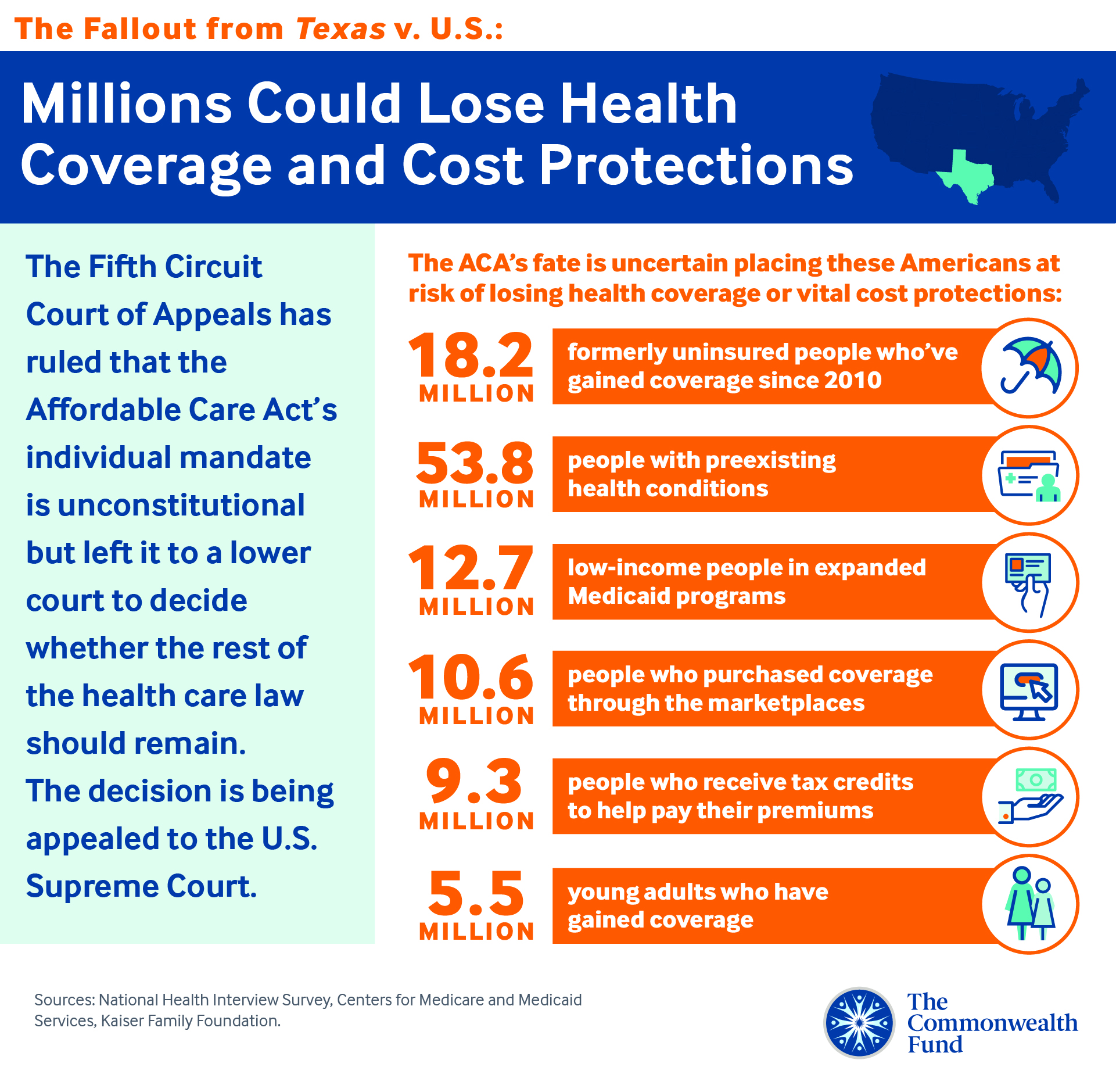
The Fallout from Texas v. U.S.:

Yesterday, a three-judge panel from the Fifth Circuit Court of Appeals struck down the Affordable Care Act (ACA)’s individual mandate. The judges agreed with a lower court decision issued in the case, Texas v. U.S., in December 2018 that the individual mandate is unconstitutional but, unlike the lower court, did not decide that the rest of the ACA is also unconstitutional. Instead, the judges remanded, or sent back, the decision to the same lower court judge to consider. California Attorney General Xavier Becerra, who is leading the 21 Democratic state attorneys general defending the law, along with the U.S. House of Representatives, immediately announced he would appeal the decision to the Supreme Court.

Whether the Supreme Court will decide to take the case now or wait for the decision of Judge O’Connor’s, of the lower court, is uncertain. If the Court decides to take the case now, they could expedite the briefing process and issue a decision in 2020. If it does not take the case now, a ruling will be delayed until after the 2020 presidential election.

No one knows how the Supreme Court will ultimately rule. But we do know that if the Court decides to strike down the ACA, the human toll will be immense and tragic. The law has granted unprecedented health security to millions:

  • 18.2 million formerly uninsured people have gained coverage since 2010
  • 53.8 million Americans with preexisting health conditions are now protected
  • 12.7 million low-income people are insured through expanded Medicaid
  • 10.6 million people have coverage through the ACA marketplaces, 9.3 million of whom receive tax credits to help them pay their premiums
  • 5.5 million young adults have gained coverage, many by staying on their parents’ plans
  • 45 million Medicare beneficiaries have much better drug coverage.

Such a decision will also trigger massive disruption throughout the U.S. health system. The health care industry represents nearly 20 percent of the nation’s economy; the ACA has touched every corner of it. The law restructured the individual and small-group health insurance markets, expanded and streamlined the Medicaid program, improved Medicare benefits, and reformed the way Medicare pays doctors, hospitals, and other providers. It was a catalyst for the movement toward value-based care and established a regulatory pathway for biosimilars — less expensive versions of biologic drugs. States have rewritten laws to incorporate the ACA’s provisions. Insurers, hospitals, physicians, and state and local governments have invested billions of dollars in adjusting to these changes.

The law’s popular preexisting health condition protections have made it possible for people with minor-to-serious health problems to apply for coverage in the same way healthier people have always done. These protections have given the estimated 53.8 million Americans with preexisting health conditions the peace of mind that they will never be denied health insurance because of their health.

More than 150 million people who get coverage through their employers now are eligible for free preventive care, and their children can stay on their policies to age 26.

The wide racial and income inequities in health insurance coverage that have been partly remedied by the ACA would return. Hospitals and providers, especially safety-net institutions, would struggle with mounting uncompensated care burdens and sicker and more costly patients who are not receiving the preventive care they need.

The ACA tore down financial barriers to health care for millions, many of whom were uninsured for most of their lives. It has demonstrably helped people get the health care they need in states across the country. Research indicates that Medicaid expansion has led to improved health status and lower mortality risk.

To date, neither the Trump administration, which has sided with the plaintiffs in the case, nor its Republican colleagues in Congress have offered a replacement plan in the event the law is struck down. The historic progress made by Americans, particularly those with middle and lower incomes and people of color, could unravel. Voters are already telling policymakers they are worried about their ability to afford health care. Yesterday’s decision and the uncertain path forward to the Supreme Court is certain to escalate those worries. With the nation entering the 2020 presidential election year, the Supreme Court may decide to take up the case this term.