


Importance of Character

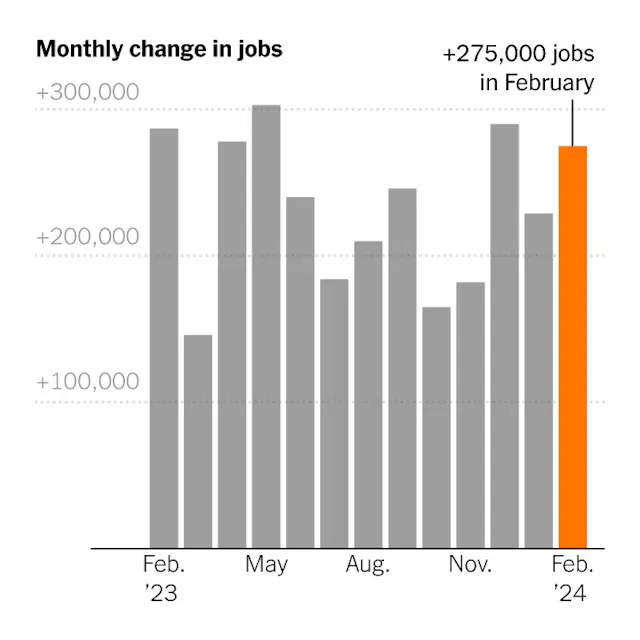
The labor market showed resiliency in February, adding 275,000 jobs, a sign that economic growth is still solid.
If the economy is slowing down, nobody told the labor market.
Employers added 275,000 jobs in February, the Labor Department reported Friday, in another month that exceeded expectations.
It was the third straight month of gains above 200,000, and the 38th consecutive month of growth — fresh evidence that after surging back from the pandemic shutdowns, America’s jobs engine still has plenty of steam.
“We’ve been expecting a slowdown in the labor market, a more material loosening in conditions, but we’re just not seeing that,” said Rubeela Farooqi, chief economist at High Frequency Economics.
The previous two months, December and January, were revised down by a combined 167,000 jobs, reflecting the higher degree of statistical volatility in the winter months. That does not disrupt a picture of consistent robust increases, which now looks slightly smoother..
At the same time, the unemployment rate, based on a survey of households, increased to a two-year high of 3.9 percent, from 3.7 percent in January. A more expansive measure of slack labor market conditions, which includes people working part time who would rather work full time, has been steadily rising and now stands at 7.3 percent.
The unemployment rate was driven by people losing or leaving jobs as well as those entering the labor force to look for work. The labor force participation rate for people in their prime working years — ages 25 to 54 — jumped back up to 83.5 percent, matching a level from last year that was the highest since the early 2000s.
Average hourly earnings rose by 4.3 percent over the year, although the pace of increases has been fading.
“We’ve recently seen gains in real wages, and that’s encouraged people to re-enter the labor market, and that’s a good development for workers,” said Kory Kantenga, a senior economist at the job search website LinkedIn. As wage growth slows, he said, the likelihood that more people will start looking for work falls.
As late as last fall, economists were predicting much more modest employment increases, with hiring concentrated in a few industries. But while some pandemic-inflated industries have shed jobs, expected downturns in sectors like construction haven’t materialized. Rising wages, attractive benefits and more flexible work schedules have drawn millions of workers off the sidelines.
Elevated levels of immigration have also added to the labor supply. According to an analysis by the Brookings Institution, the influx has approximately doubled the number of jobs that the economy could add per month in 2024 without putting upward pressure on inflation, to between 160,000 and 200,000.
Health care and government again led the payroll gains in February, while construction continued its steady increase. Retail and transportation and warehousing, which have been flat to negative in recent months, picked up.
No major industries lost a substantial number of jobs. Credit intermediation continued its downward slide — that sector, which mostly includes commercial banking, has lost about 123,000 jobs since early 2021.
That doesn’t mean the employment landscape looks rosy to everyone. Employee confidence, as measured by the company rating website Glassdoor, has been falling steadily as layoffs by tech and media companies have grabbed headlines. That’s especially true in white-collar professions like human resources and consulting, while those in professions that require working in person — such as health care, construction and manufacturing — are more upbeat.
“It is a two-track labor market,” said Aaron Terrazas, Glassdoor’s chief economist, noting that job searches are taking longer for people with graduate degrees. “For skilled workers in risk-intensive industries, anyone who’s been laid off is having a hard time finding new jobs, whereas if you’re a blue-collar or frontline service worker, it’s still competitive.”
The last few months have been studded with strong economic data, leading analysts surveyed by the National Association for Business Economics to raise their forecasts for gross domestic product and lower their expectations for the trajectory of unemployment. It’s occurred even as inflation has eased, leading the Federal Reserve to telegraph its plans for interest rate cuts sometime this year, which has raised growth expectations further.
Mervin Jebaraj, director of the Center for Business and Economic Research at the University of Arkansas, helped tabulate the survey responses. He said the mood was buoyed partly by fading trepidation over federal government shutdowns and draconian budget cuts, after several close calls since the fall. And he sees no obvious reason for the recovery to end soon.
“Once it starts going, it keeps going,” Mr. Jebaraj said. “You had this external stimulus with all the trillions of dollars of government spending, Now it’s sort of self-sustaining, even though the money’s gone.”



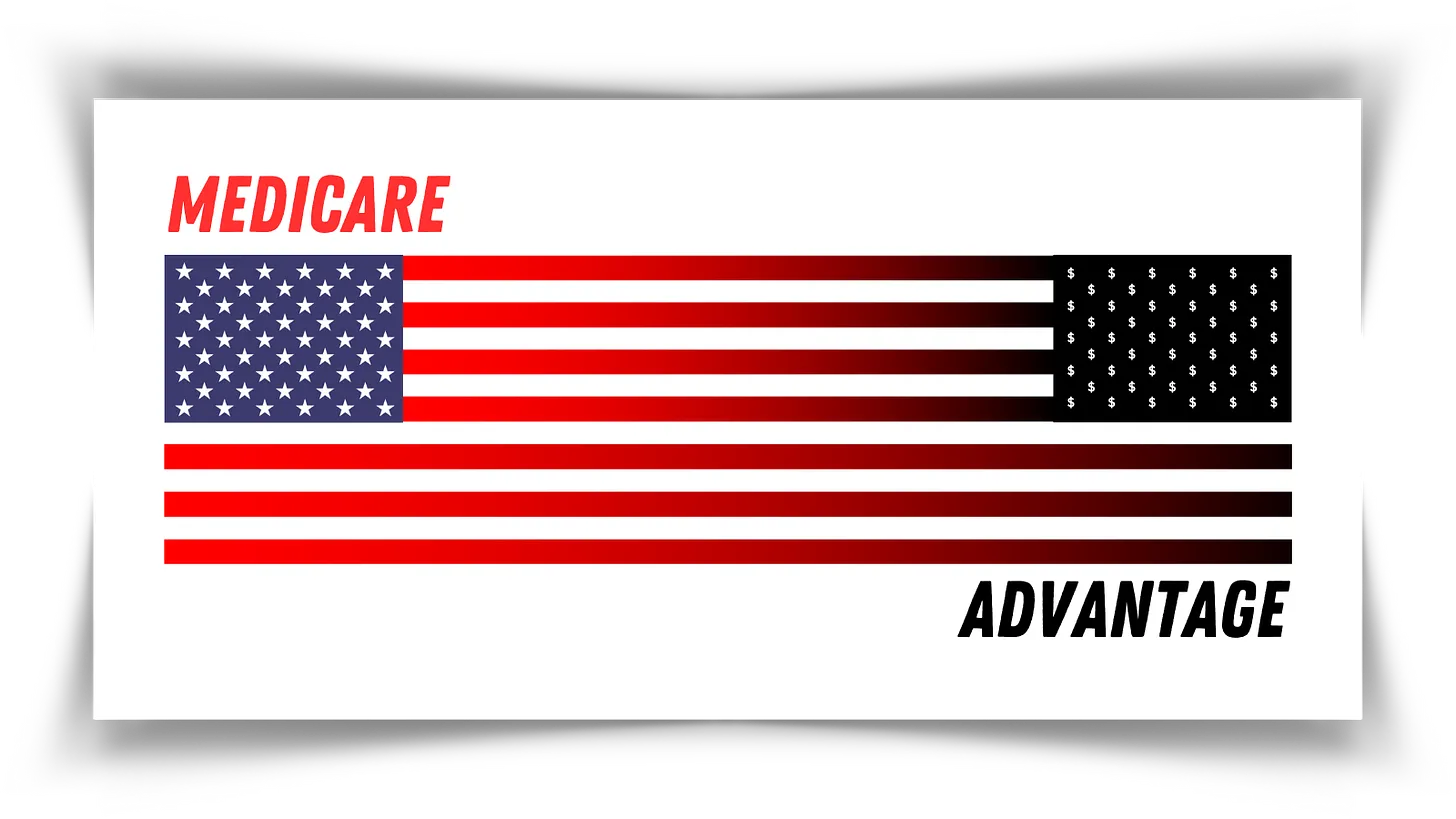
A story in Rolling Stone last month offered an ominous prediction about our nation’s health care. “The right-wing policy agenda written for a new Donald Trump presidency would ‘greatly accelerate’ efforts to privatize Medicare,” Andrew Perez wrote.
That story should be seen by the millions of seniors who might not read Rolling Stone but who have traditional Medicare coverage with a supplemental policy that pays for virtually every medical bill when they get sick. Those are the people who have not yet been enticed into Medicare Advantage plans with promises of groceries and gym memberships but with little or no notice about the delays in care and the up-front, out-of-pocket costs common in many plans.
As I pointed out in an earlier story, there are roadblocks to care that have been reported by hospitals that were no longer accepting Medicare Advantage plans from some companies.
The CEO of the Brookings Hospital System in Brookings, South Dakota, was candid: MA plans “pay less, don’t follow medical policy, coverage, billing, and payment rules and procedures, and they are always trying to figure out how to deny payment for services,” he said.
Yet, in his piece titled “Republicans Are Planning to Totally Privatize Medicare – And Fast,” Perez warns that privatizing Medicare is a goal conservative and right-wing interests have promoted since the 1990s, when former House Speaker Newt Gingrich, no fan of Medicare, predicted that the program would “wither on the vine because we think people are voluntarily going to leave it.”
Indeed, tens of millions of seniors have enrolled in or been forced by their former employers into Medicare Advantage plans, and even the 30 million or so seniors who still prefer to be in traditional Medicare, with its no-strings-attached coverage, may one day be forced to join the ranks of the MA crowd.
It’s time to once again sound the alarm, as Perez has done, that the government program that has brought millions of beneficiaries health insurance and security for more than five decades could eventually disappear.
Perez points out that one item buried in the 887-page Heritage Foundation blueprint written to inform a potential new Trump administration has attracted little attention so far. It is a scheme to “make Medicare Advantage the default enrollment option” for people who are newly eligible for Medicare, he wrote.
David Lipschutz, associate director of the Center for Medicare Advocacy, says the Heritage plan would hasten privatization. “Upon becoming eligible for Medicare now everyone starts with traditional Medicare as the default but can opt out of that program and later choose an Advantage plan,” Lipschutz says. The Heritage proposal, however, would have people start with Medicare Advantage plans, apparently with the opportunity to opt-out. With this arrangement, you can see how easy it would be for Medicare, as we know it, to ‘wither on the vine’ since many people new to Medicare are not well versed in the difference between the two options and instead are swayed by the TV advertising beckoning them to Medicare Advantage plans.
Making those privately operated plans the default “would hasten the end of the traditional Medicare program as well as its foundational premise: that seniors can go to any doctor or provider they choose,” Perez writes, noting that such a change also “would be a boon for private health insurers that generate massive profits and growing portions of their revenues from Medicare Advantage plans.”
Lipschutz agreed the plan would “greatly accelerate” Medicare privatization, noting that the Heritage Foundation’s selling points are “internally inconsistent.” The proposal says a Republican-led federal government would “give beneficiaries direct control of how they spend Medicare dollars,”
but Lipschutz pointed out that with a Medicare Advantage plan, a private insurer tells beneficiaries what procedures they can or cannot have by deciding which ones they will approve for payment. “That is the opposite of putting beneficiaries in control of how they spend their dollars,” Lipschutz says.
Stories in Stat by Bob Herman and Casey Ross have carefully dissected what patients with Medicare Advantage plans have had to endure to get needed care. As I pointed out in a post about their work, patients often struggle to get the care they need.
In one story about UnitedHealthcare, the largest Medicare Advantage company, the reporters noted that the insurer’s stunning financial success was driven by “brazen behavior,” such as cutting off payments for seriously ill patients and “denying rehabilitation care for older and disabled Americans as profits soared.”
UnitedHealth is far from alone in using such tactics to boost profits. Herman and Ross told of the struggle of a sick, 80-year-old North Carolina woman whose plan with Humana, the second largest Medicare Advantage company, would pay only for cheaper care in a nursing home instead of in a long-term acute-care facility.
The insurance industry’s mighty public relations machine makes it hard for ordinary Americans to understand their options when they turn 65. When a TV pitchman or woman is urging viewers to call right away and sign up for free groceries, the deck is stacked against traditional Medicare and supplemental coverage.
Meet the insurance industry’s “Better Medicare Alliance”
How many would-be beneficiaries know about the Better Medicare Alliance, an advocacy group promoting Medicare Advantage plans that swings into action at the slightest hint that lawmakers and regulators might curb the lucrative Medicare Advantage program? The organization’s website offered a sample letter for beneficiaries to send to their Congressional representatives urging them to “protect Medicare Advantage.”
Sixty-one members of Congress also made their preferences clear in a letter to Chiquita Brooks-LaSure, who heads the Center for Medicare and Medicaid Services, writing, “We are committed to our more than 32 million constituents across the United States who choose Medicare Advantage.” The letter was signed by prominent Democrats including Chuck Schumer, Senate Majority leader from New York; Sen. Amy Klobuchar of Minnesota; and Bob Casey of Pennsylvania, who chairs the Senate aging committee. With such high-powered supporters of Medicare Advantage, it’s easy to see why it’s difficult to put the program on an even playing field with traditional Medicare and supplemental insurance coverage.
Not long ago I received an email from David Marans, an 81-year-old Floridian who wanted to tell me about his experiences with Medicare and the supplemental Medigap insurance he had purchased at age 65. It covers Parts A and B deductibles, excess charges that doctors can impose if their state allows them to collect more than what Medicare has agreed to pay, and emergency room care that he told me “ has saved considerable medical expenses, avoided delays, allayed worries, and allowed peace of mind regarding medical treatment.” He said he just shows his card at any hospital or doctor’s office, no questions asked, and the “Medigap provider then handles all the rest.”
The older you get, Marans said, the harder it is to recover from illness; the added stress of finding the means of paying the medical bills and the stresses of Medicare Advantage restrictions and denials can prolong illness. Marans said a Medigap plan alleviates that stress. “In a subtle way, in part, Medigap helps pay for itself.”
Marans’ advice? “Force yourself to get a Medigap plan on your 65th birthday when you enroll in Medicare, and don’t lose it…
Seniors have to understand car insurance is for what might happen. Health insurance is for what very probably will happen.”

