Obamacare Ruling May Spare Republicans Some Political Pain

Image result for Obamacare Ruling May Spare Republicans Some Political Pain

The practical effect of the decision is likely to be months of delays, pushing the final outcome of the case beyond the 2020 election.

A federal appeals court in New Orleans handed Republicans a Christmas present.

The court had been considering a case with the potential to dismantle the entire Affordable Care Act, an outcome that could have set off waves of chaos and disruption leading up to the November election, and for which there was very little contingency planning.


The court had two main options. It could have agreed with the Trump administration, along with a set of Republican state officials and a district court in Texas, and overturned all of the law. Or it could have upheld Obamacare, undermining the arguments of the White House and its allies.

The court found a third way. In a decision at the close of business Wednesday, two of the three judges signaled their support for a key part of the Republicans’ legal argument. The two agreed with a lower court that Obamacare’s individual mandate had been made unconstitutional by a 2017 law that eliminated the financial penalty for remaining uninsured. But the judges punted on the case’s key question of what that meant for the rest of the health law, asking a lower court to reconsider it. The effect is likely to be months of delays, pushing the final outcome of the case beyond the 2020 election.


Starting in 2017, the Republicans’ failed effort to repeal and replace large portions of the health law was deeply unpopular and became a central campaign theme of the 2018 election, in which Democrats won a House majority. Democrats cast themselves as the protectors of Obamacare’s most popular provisions, especially its protections for Americans with pre-existing health conditions.

While most Democrats would have favored a court ruling that upheld Obamacare, a reprise of those politics could have given them a lift in an election year. Voters tend to trust Democrats more than Republicans on health care, but much of the debate during the primary season has focused on ambitious new expansions of government coverage. Those proposals do not enjoy the widespread support attached to the preservation of Obamacare’s core consumer protections.

Those dynamics have allowed Republicans to focus on arguments that they will protect private insurance and oppose socialism, without forcing them to articulate their own detailed health plans. President Trump has periodically hinted at an imminent Obamacare replacement plan, but he has yet to produce one. Mitch McConnell, the Senate majority leader, has declined to produce or advance a major health care bill in the Senate.


But if a court had ruled that all of Obamacare had to be wiped off the books, it would have been far harder for Republicans to avoid articulating their vision for health care. The public did not like their previous attempts in 2017, and there has been little progress, even behind the scenes, to produce an alternative plan more palatable to the public. Two concepts have emerged since then, one from a group of conservative think tanks, and one from the House Republican Study Committee. Neither has received much public attention by party leaders, and both share the basic structure of an earlier legislative plan that divided Republican legislators so much that it never made it to a vote.

Meanwhile, Democrats could have retreated to safer ground, by promising to reinstate popular Obamacare provisions.


If the court had overturned all of Obamacare, it could have meant major disruptions to the health system. Such a ruling, if upheld by the Supreme Court, would have eliminated consumer protections for people with pre-existing health conditions, and wiped away financial assistance that have helped millions of middle-class Americans buy their own coverage.

It would have erased the Medicaid expansion, which provides health insurance to millions of low-income Americans in three dozen states. It would have reversed Medicare policies that make prescription drugs more affordable for seniors, and Food and Drug Administration rules that have allowed cheaper copies of expensive biologic drugs to enter the market.

It would have undone major experiments in the delivery of care, meant to improve health care quality. It would have rolled back enhanced punishments for Medicare fraud. It would have reduced requirements that workplaces provide space for lactating mothers to pump breast milk, and requirements that chain restaurants post calorie counts for their food.

Around 20 million more Americans would have become uninsured, according to an estimate from the Urban Institute. Experts on Medicare policy said they were not even sure how some of the changes could have been carried out now that they have been enshrined in complex regulations and built on in subsequent laws.


None of those effects would have happened immediately, even if the Fifth Circuit had agreed in full with the lower court; the Supreme Court would have probably weighed in. But the prospect of such huge changes had the potential to reset the political conversation about health care in both parties. By avoiding a decision on the case’s consequences, the Fifth Circuit has effectively postponed that shift.

In a statement Wednesday night, President Trump applauded the court’s ruling that the individual mandate was unconstitutional. But he emphasized that the decision would not result in any meaningful changes to voters’ health care.

“The radical health care changes being proposed by the far left would strip Americans of their current coverage,” he said. “I will not let this happen. Providing affordable, high-quality health care will always be my priority. They are trying to take away your health care, and I am trying to give the American people the best health care in the world.”


Such a statement would have been harder to issue if the court panel had agreed with the arguments made by Mr. Trump’s lawyers and called for the reversal of Obamacare’s coverage expansions.

Democrats’ frustration with the court’s indecision was palpable. Chuck Schumer, the Senate minority leader, described the judges’ move as “cowardly.” The decision is “obviously an attempt to shield Republicans from the massive blowback they would receive from the public if the highest court in the land were to strike down the A.C.A. before the upcoming election,” he said in a statement.

It’s possible, of course, that the case will reach a final disposition sooner anyway. California’s attorney general, Xavier Becerra, announced that he and other Democratic state officials involved in the case would be appealing the decision to the Supreme Court. Even though the appellate court sent the case back to Texas, the country’s highest court could still choose to take it, should four justices wish to. But the most likely path involves months or years of additional litigation, with lingering uncertainty over the fate of Obamacare.


Fifth Circuit Appeals Court Strikes Down the Affordable Care Act’s Individual Mandate

https://www.commonwealthfund.org/blog/2019/fifth-circuit-appeals-court-strikes-down-affordable-care-acts-individual-mandate

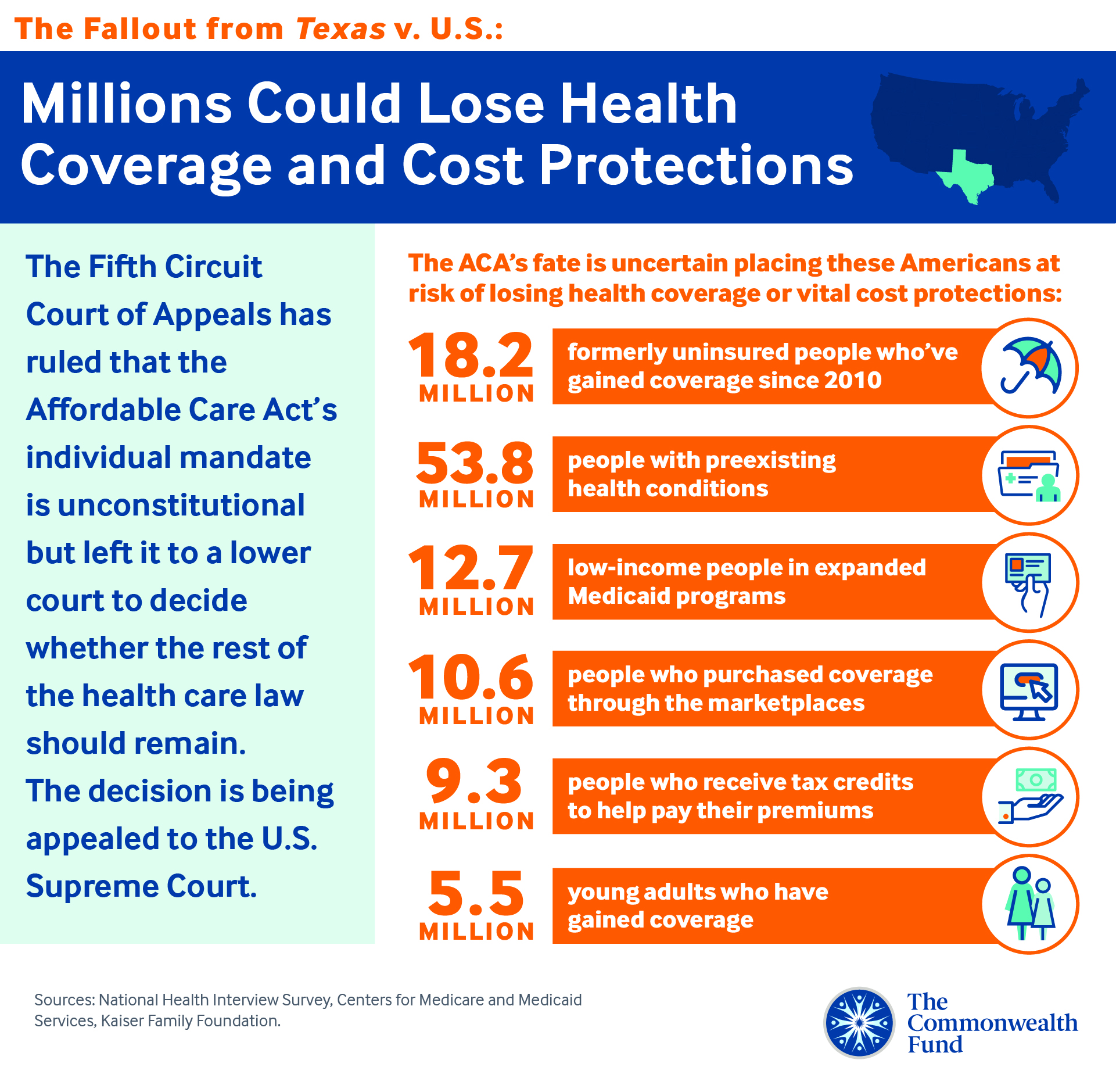
The Fallout from Texas v. U.S.:

Yesterday, a three-judge panel from the Fifth Circuit Court of Appeals struck down the Affordable Care Act (ACA)’s individual mandate. The judges agreed with a lower court decision issued in the case, Texas v. U.S., in December 2018 that the individual mandate is unconstitutional but, unlike the lower court, did not decide that the rest of the ACA is also unconstitutional. Instead, the judges remanded, or sent back, the decision to the same lower court judge to consider. California Attorney General Xavier Becerra, who is leading the 21 Democratic state attorneys general defending the law, along with the U.S. House of Representatives, immediately announced he would appeal the decision to the Supreme Court.

Whether the Supreme Court will decide to take the case now or wait for the decision of Judge O’Connor’s, of the lower court, is uncertain. If the Court decides to take the case now, they could expedite the briefing process and issue a decision in 2020. If it does not take the case now, a ruling will be delayed until after the 2020 presidential election.

No one knows how the Supreme Court will ultimately rule. But we do know that if the Court decides to strike down the ACA, the human toll will be immense and tragic. The law has granted unprecedented health security to millions:

  • 18.2 million formerly uninsured people have gained coverage since 2010
  • 53.8 million Americans with preexisting health conditions are now protected
  • 12.7 million low-income people are insured through expanded Medicaid
  • 10.6 million people have coverage through the ACA marketplaces, 9.3 million of whom receive tax credits to help them pay their premiums
  • 5.5 million young adults have gained coverage, many by staying on their parents’ plans
  • 45 million Medicare beneficiaries have much better drug coverage.

Such a decision will also trigger massive disruption throughout the U.S. health system. The health care industry represents nearly 20 percent of the nation’s economy; the ACA has touched every corner of it. The law restructured the individual and small-group health insurance markets, expanded and streamlined the Medicaid program, improved Medicare benefits, and reformed the way Medicare pays doctors, hospitals, and other providers. It was a catalyst for the movement toward value-based care and established a regulatory pathway for biosimilars — less expensive versions of biologic drugs. States have rewritten laws to incorporate the ACA’s provisions. Insurers, hospitals, physicians, and state and local governments have invested billions of dollars in adjusting to these changes.

The law’s popular preexisting health condition protections have made it possible for people with minor-to-serious health problems to apply for coverage in the same way healthier people have always done. These protections have given the estimated 53.8 million Americans with preexisting health conditions the peace of mind that they will never be denied health insurance because of their health.

More than 150 million people who get coverage through their employers now are eligible for free preventive care, and their children can stay on their policies to age 26.

The wide racial and income inequities in health insurance coverage that have been partly remedied by the ACA would return. Hospitals and providers, especially safety-net institutions, would struggle with mounting uncompensated care burdens and sicker and more costly patients who are not receiving the preventive care they need.

The ACA tore down financial barriers to health care for millions, many of whom were uninsured for most of their lives. It has demonstrably helped people get the health care they need in states across the country. Research indicates that Medicaid expansion has led to improved health status and lower mortality risk.

To date, neither the Trump administration, which has sided with the plaintiffs in the case, nor its Republican colleagues in Congress have offered a replacement plan in the event the law is struck down. The historic progress made by Americans, particularly those with middle and lower incomes and people of color, could unravel. Voters are already telling policymakers they are worried about their ability to afford health care. Yesterday’s decision and the uncertain path forward to the Supreme Court is certain to escalate those worries. With the nation entering the 2020 presidential election year, the Supreme Court may decide to take up the case this term.


South Carolina is the next battleground for Medicaid work requirements

https://www.axios.com/south-carolina-medicaid-work-requirements-f8c52243-d1de-47bf-bf47-5ea82326cea4.html

Image result for Medicaid work requirements

The Trump administration is losing the legal battle over Medicaid work requirements — one of its most impactful and controversial health care policies — but it is leaning into that fight even more aggressively.

Driving the news: The Centers for Medicare & Medicaid Services formally signed off yesterday on South Carolina’s work requirements. Medicaid recipients in the state will have to perform 80 hours per month of work or community service, unless they receive an exemption.

Why it matters: Other states have primarily sought work requirements as a condition of their Medicaid expansions, but South Carolina will impose its new rules without expanding.

Where it stands: A federal judge has already ruled against work requirements in Arkansas, Kentucky and New Hampshire, arguing that they’re inconsistent with Medicaid’s statutory goals.

  • Judge James Boasberg has leaned heavily on the fact that work requirements would cause thousands of people to lose their Medicaid coverage.
  • That will also happen in South Carolina, and those coverage losses will be a factor in the inevitable lawsuits over these rules.

Yes, but: Those rulings are working their way through the appeals process, and rather than change course or slow down in the face of legal setbacks, the administration is getting work requirements on the books wherever it can and hoping for an eventual win in the courts.


Government funding bill deal will repeal key ACA taxes

https://www.axios.com/government-funding-bill-affordable-care-act-taxes-ce13c0af-15d8-4e54-8210-296afa68e9b0.html

U.S. Capitol building

Congress is expected to soon announce a deal to repeal the Affordable Care Act’s health insurance, medical device and “Cadillac” employer health plan taxes — and to raise the smoking age to 21, according to a senior House Democratic aide familiar with talks.

Why it matters: The decision is a colossal win for the health care industry.

  • If this wasn’t good enough news for the industry, the deal won’t address surprise medical bills — and it avoids prescription drug prices except for the CREATES Act, which helps generics get to market faster.
  • The taxes have been repeatedly delayed. And while the industry has pushed for their repeal for years, it hasn’t yet been successful.

Between the lines: Voters are decidedly not asking Washington to lift industry taxes while avoiding dealing with two of the most popular health care issues, but if that’s how this plays out, it’s a great indicator that the industry’s lobbying strength is as good as ever.

  • It’s also a good sign that cost control — the intention of the Cadillac tax, a 40% excise tax on the most generous employer plans — is still not very popular with lawmakers, even as health care costs continue to rise.
  • The tax was expected to raise $200 billion over 10 years.

The other side: The industry says that the ACA taxes end up getting passed along to patients.


Americans Still Favor Private Healthcare System

https://news.gallup.com/poll/268985/americans-favor-private-healthcare-system.aspx

Americans Still Favor Private Healthcare System

STORY HIGHLIGHTS

  • 54% prefer private system; 42% support government-run system
  • Two-thirds of Democrats favor a government-run system
  • Majority continue to see government responsibility for ensuring coverage

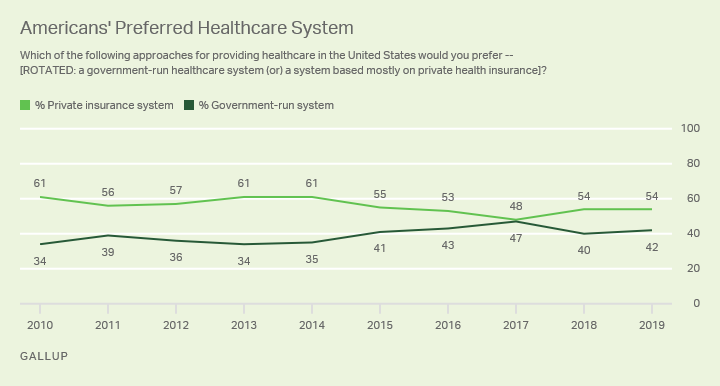
Americans continue to prefer a healthcare system based on private insurance (54%) over a government-run healthcare system (42%). Support for a government-run system averaged 36% from 2010 to 2014 but has been 40% or higher each of the past five years.

Line graph. Americans prefer a healthcare system based on private insurance to a government system by 54% to 42%.

These results are based on Gallup’s annual Health and Healthcare poll, conducted Nov. 1-14. Although more Americans have warmed to the idea of a greater government role in paying for healthcare, it remains the minority view in the U.S. This could create a challenge in a general election campaign for a Democratic presidential nominee advocating a “Medicare for All” or other healthcare plan that would greatly expand the government’s role in the healthcare system.

Democratic candidates’ plans for greater government involvement in healthcare are, however, consistent with the views of their party’s base. Since 2015, after most of the Affordable Care Act’s provisions had gone into effect, an average of 65% of Democrats have favored a government-run system.

Over the same period, Republicans have been overwhelmingly opposed to a government-run system, with an average of 13% preferring that approach while 84% have wanted to retain a private system.

Independents have been closely divided in recent years, but in 2019 tilt more toward a private (50%) than a government-run (45%) system.

Compared with the five-year period spanning the ACA’s passage and implementation from 2010 to 2014, support for a government-run system has increased among all party groups, with larger increases among independents (10 percentage points) and Democrats (seven points) than among Republicans (four points).


Changes in Preferences for Private vs. Government-Run Healthcare System, by Political Party
Figures are the average percentage holding each view in the five-year period
2010-2014 2015-2019
% %
Democrats
System based on private insurance 36 31
Government-run system 58 65
Independents
System based on private insurance 58 49
Government-run system 36 46
Republicans
System based on private insurance 88 84
Government-run system 9 13
GALLUP

Majority in U.S. Say Government Has Responsibility to Ensure Healthcare

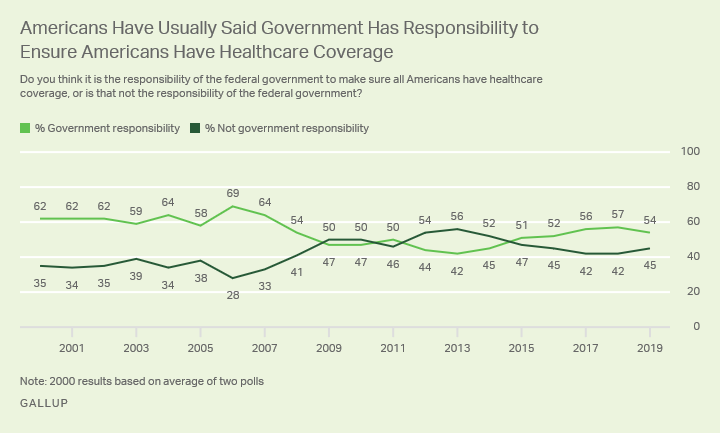
While Americans tend not to favor government-run healthcare, they do believe the federal government has a responsibility to ensure that all Americans have healthcare coverage. In the current survey, 54% hold this view, while 45% say it is not the government’s responsibility.

Recent support for the government having responsibility for ensuring healthcare coverage is not as high as it was from 2001 to 2007, when more than six in 10 Americans commonly expressed that opinion.

By contrast, from 2009 to 2014 — when the Obama administration and congressional Democrats developed, passed and implemented the Affordable Care Act — fewer Americans thought the government should ensure everyone has healthcare coverage. During that period, between 42% and 50% thought the government had that responsibility, the lowest measures in Gallup’s trend.

Line graph. Americans believe the federal government has a responsibility to ensure all in the U.S. have healthcare coverage.

Between 2009 and 2014, the percentages of Republicans and independents who thought the government should be responsible for ensuring healthcare coverage dropped at least 20 points, with a smaller eight-point drop among Democrats.

Democrats’ views are now back to where they were before 2009, while independents and especially Republicans have yet to return to prior levels, though independents are back above the majority level.

Changes in Belief That the Federal Government Has a Responsibility to Ensure All Americans Have Healthcare Coverage, by Political Party
Figures are the average percentage in each period
2001-2008 2009-2014 2015-2019
% % %
Democrats 80 72 80
Independents 64 44 56
Republicans 38 16 21
U.S. adults 62 46 54
GALLUP

Bottom Line

Americans have complex views on healthcare, with a majority saying the government should make sure everyone has coverage — but not necessarily pay for it through a government-run system. The Affordable Care Act was essentially an attempt to bridge these preferences by making coverage available to all through government-backed health insurance exchanges, but allowing those with insurance through an employer or other means to keep it.

Still, the law itself has been controversial, and Americans are currently as likely to disapprove of it as to approve. As such, it is fair to question to what extent Americans would embrace Democratic attempts to move to a healthcare system that goes further than the ACA does, or to support further Republican attempts to dismantle the law.

Healthcare is an issue that directly affects all Americans. Republican and Democratic political leaders have very different ideas about what healthcare policy should be. Additionally, the Democratic presidential campaign has revealed that even candidates in the same party can disagree on the best ways to address the U.S. healthcare system. With little consensus on the best way to approach healthcare policy, it promises to remain a key issue in U.S. politics and elections for the foreseeable future.


43% of U.S. Households Report Preexisting Conditions

https://news.gallup.com/poll/269003/households-report-preexisting-conditions.aspx

43% of U.S. Households Report Preexisting Conditions

STORY HIGHLIGHTS

  • 15% say they themselves have a preexisting health condition
  • 9% say they and someone else in their household have preexisting conditions
  • 19% say a family member has a preexisting condition

About one in four Americans (24%) report that they personally (15%) or they and a member of their household (9%) “have a long-term medical condition, illness or disease that would be considered a ‘preexisting’ condition by a health insurance company.” Factoring in the additional 19% who say another family member has such an illness or disease, the total percentage of U.S. households in which at least one member reports having a preexisting condition is 43%.

Americans’ Reports of Preexisting Medical Conditions in Their Household, 2018-2019
Do you, personally, or does another member of your family living with you, have a long-term medical condition, illness or disease that would be considered a “pre-existing condition” by a health insurance company?
Nov 1-11, 2018 Nov 1-14, 2019
% %
Respondent 16 15
Respondent and a family member 11 9
Family member 17 19
No one in family 54 57
GALLUP

These data are from Gallup’s annual Health and Healthcare survey, conducted Nov. 1-14, and are based on respondents’ self-reports. The survey does not probe about the nature of a respondent’s preexisting condition. Definitions of such conditions vary because individual insurance companies primarily determine what qualifies as a preexisting condition and what does not. They can include cancer or heart disease, but also asthma, high blood pressure or obesity.

Protecting individuals with preexisting conditions from being denied coverage by their insurers was a key tenet in Democrats’ campaign for and passage of the Affordable Care Act in 2010. It became a powerful election-year issue in the 2018 midterms for Democrats after President Donald Trump and Republicans in Congress tried to repeal the law. Gallup has found that Americans who report having a preexisting condition are somewhat more approving of the ACA than are those who do not report having such a condition.

Age Is the Biggest Differentiator in Reported Preexisting Conditions

Across key demographic groups, age stands out as the biggest factor in self-reports of preexisting conditions; the older individual Americans are, the more likely they are to report having one. About one in three adults aged 65 and older (33%) and 50 to 64 (31%) report having a preexisting condition — a rate about twice as high as what young adults aged 18 to 29 report (16%).

Aggregated data from Gallup’s 2018 and 2019 measures reveal other key differences across subgroups:

  • About a third of U.S. adults who are overweight report having a preexisting condition (32%) — much higher than the 21% among those whose self-reported weight is normal or underweight.
  • U.S. whites (29%) are more likely to report having such an illness or disease than are nonwhites (20%).
  • Women (29%) report having a preexisting condition at a higher rate than do men (21%).
  • U.S. adults living in low- (26%) and middle-income households (29%) are more likely to report having a preexisting condition than are those in upper-income households (21%).
Incidence of Preexisting Medical Conditions, Based on Self-Reported Data, by Subgroup
Do you, personally, or does another member of your family living with you, have a long-term medical condition, illness or disease that would be considered a “pre-existing condition” by a health insurance company?
Respondent personally Respondent or family member
% %
65+ years old 33 50
Overweight 32 50
50-64 years old 31 49
Democrat 31 50
Women 29 49
White 29 46
Middle household income ($40,000-$99,999/year) 29 45
Lower household income (less than $40,000/year) 26 43
Independent 24 42
30-49 years old 23 40
Republican 22 40
Men 21 38
Upper household income ($100,000 or more/year) 21 45
Normal weight/Underweight 21 39
Nonwhite 20 38
18-29 years old 16 38
Data aggregated from 2018 and 2019 polls
GALLUP

Across political party groups, Democrats (31%) are more likely to report having a preexisting condition than are independents (24%) and Republicans (22%). A Gallup analysis finds that across age and weight groups, Democrats are more likely than Republicans to report having a preexisting condition. This might suggest that some respondents are answering the question through a political lens — with Democrats more sensitive to the issue of preexisting conditions and therefore more likely to report having one, and Republicans more inclined to downplay the issue and less likely to report having such a condition themselves.

Bottom Line

As many Americans shop for healthcare plans in the current ACA open enrollment period, a sizable percentage of them will need to navigate a market that includes plans that may not provide them with coverage for preexisting conditions. The Trump administration is encouraging consumers currently on the ACA individual market to seek out short-term private plans that in many cases do not protect those with preexisting conditions. These new, non-ACA plans are now available during the ACA’s seventh annual open enrollment period after the administration loosened restrictions on them last year in an effort to offer more affordable alternatives to ACA plans.

The ACA’s provision on preexisting conditions has survived many challenges. Public officials of both major political parties have expressed commitment to the issue and have offered various plans to protect Americans with preexisting conditions from being denied coverage. But Americans have been lukewarm about the law that made the largest breakthrough on the issue — though it is a bit more popular among those who report having a preexisting condition themselves.


Health insurance is as big as Big Tech

https://www.axios.com/health-insurers-pbms-revenue-big-tech-9bc7b8fd-5577-4ebe-a818-42f4f7fd2d36.html?utm_source=newsletter&utm_medium=email&utm_campaign=newsletter_axiosvitals&stream=top

Image result for Health insurance is as big as Big Tech

The 5 largest conglomerates combining health insurance and pharmacy benefits are on track this year to be bigger than the 5 preeminent tech companies.

The big picture: Anthem, Cigna, CVS Health, Humana and UnitedHealth Group cumulatively expect to collect almost $787 billion in 2019, compared with $783 billion of projected revenue for Facebook, Amazon, Apple, Netflix and Google.

Yes, but: The tech companies cumulatively were 5 times more profitable than the health care companies in 2018 and are projected to be 3.5 times more profitable this year.

  • There’s more money to be made selling smartphones and online ads than acting as a health care middleman.
  • Health insurers and pharmacy benefit managers pay out a vast majority of their revenues to hospitals, doctors and drug companies.
  • But insurers and PBMs are still turning large overall profits. And a delay in an Affordable Care Act tax is expected to create a big windfall for the insurance industry this year. Companies are working behind the scenes to get that tax delayed again for 2020 or permanently repealed.

It’s also worth remembering that health insurance giants today do a lot more than just pay out claims for medical care and prescriptions.

  • UnitedHealth owns surgery centers, doctors’ offices, consulting shops and data-analyzing services.
  • CVS, which just bought Aetna, brings in a lot of money through its retail pharmacies and in-store clinics.


Centene quietly lobbying Congress to let states partially expand Medicaid

https://www.healthcaredive.com/news/centene-quietly-lobbying-congress-to-let-states-partially-expand-medicaid/568742/

Centene, the nation’s largest Medicaid managed care provider, wants Congress to change the eligibility requirements around Medicaid, the government-sponsored safety net program that covers one in five low-income Americans.

Its proposal would ultimately push more people onto the Affordable Care Act exchanges by allowing states to adopt a partial Medicaid expansion, an idea typically embraced by red states.

CEO Michael Neidorff told Healthcare Dive the company has been quietly talking to lawmakers on both sides of the aisle on Capitol Hill about the plan, though he emphasized nothing of substance will happen until after the 2020 election.  

Centene says its proposal is an attempt to strengthen the ACA markets by increasing the pool of people while enticing holdout states to partially expand their Medicaid programs.

“I think there’s a way to get it done,” Neidorff told Healthcare Dive. “We have a very powerful Washington office and they’ve been working with leadership and their staff.”

Centene filed lobbying forms totaling about $2 million in spending in the congressional lobbying database for 2019, as of Dec. 11. ​In 2018, the payer reported spending roughly $2.5 million. 

However, policy experts caution that it would result in increased spending for the federal government and fewer protections for those enrolled in Medicaid who are then pushed into the exchanges.

It’s unclear how receptive Congress will be, but experts were skeptical of any consensus on the polarizing health law.

“It would be a very major change. I certainly don’t see that happening. It’s opening up the ACA and as we know from past history, it’s a battle royale when you go into the ACA,” Joan Alker, executive director and co-founder of the Center for Children and Families at Georgetown University, told Healthcare Dive.

Centene’s proposal

Under the ACA, states can expand their Medicaid programs to cover all adults whose annual incomes does not exceed 138% of the federal poverty level, or $17,236 for an individual.

Centene’s proposal calls for lowering that income ceiling from 138% to 100%, or $12,490 for an individual.

That would shrink the pool of who is eligible for Medicaid and push those people into the exchanges. Neidorff said the move would grow the exchange pool and ultimately drive down prices. High costs have attracted criticism as they play a role in forcing those who are not subsidized to leave the market.

Credit: Samantha Liss/Healthcare Dive

For Centene, it would be a notable shift because its core business has long been in Medicaid. The insurance exchanges only became a viable business beginning in 2013 with the advent of the ACA. It’s a nod to how important the exchange business has become for the payer.

Centene arguably stands to benefit the most as the nation’s largest insurer on the exchanges in terms of enrollment, plus the exchanges generate higher profit margins than its Medicaid book of business.

“You move those lives into exchange and your profitability is higher,” David Windley, an analyst with Jefferies, told Healthcare Dive.​

In the states that have not expanded Medicaid, there are about 2 million people with incomes between 100% and 138% of the federal poverty level, according to the Kaiser Family Foundation.

Hospitals and providers are likely to favor the proposal because Medicaid plans tend to pay less than commercial ones. The idea could garner support from states with tight budgets as some, even Massachusetts, have already expressed a desire to adopt a partial expansion. (Both the Trump and Obama’s administrations have denied providing the enhanced match rate for states seeking partial expansions).

Who benefits the most?

Still, there are potential drawbacks, according to analysts and policy experts. For example, the plan could potentially cost taxpayers more if there is a greater shift to the exchanges away from Medicaid coverage.

“Medicaid is broadly accepted as the cheapest coverage vehicle in the country,” Windley said, noting that the exchanges are typically a more expensive insurance product than Medicaid coverage.

Plus, because of the way the ACA was written, the federal government would be forced to pick up the entire tab of the subsidies for those between 100% and 138% of FPL. 

“As a result, the states save money for every beneficiary whom they can move from Medicaid into their exchanges,” according to a previous paper in the New England Journal of Medicine.

However, policy experts warn the proposal may not be in the best interest of Medicaid members who would migrate to the exchanges.

These members are better off with Medicaid, Alker said.

“From a beneficiary perspective it’s problematic because there are no premiums in Medicaid for that group, 100-138 [FPL]. The cost sharing is very limited,” she said.

Plus, there are benefits in Medicaid members would no longer have access to if they move to the exchanges, Adrianna McIntyre, a health policy researcher at Harvard University, told Healthcare Dive, including non-emergency transportation and retroactive eligibility.

Centene argues many states have avoided expanding Medicaid because of cost concerns, which then leaves some residents without access to affordable care, particularly those in the coverage gap, or those with incomes below 100% of FPL.

If a partial option convinces some holdout states to expand “that’s a tradeoff some may be willing to make,” McIntyre said.

Some states that did expand are looking for ways to curb costs and have decided to implement work requirements, Neidorff noted. He believes the proposal is the answer to both these problems for states.

Centene’s plan comes as a slate of Democratic presidential contenders are calling for “Medicare for All,” a single-payer or public-option healthcare system.

Not surprisingly as such a plan would at a minimum sideline private plans and at the extreme eliminate private payers, Neidorff dismissed the idea.

He estimates his plan would cost $6 billion a year, which he characterized as “very affordable” when compared to a Medicare for All plan, which some studies estimate could cost as much as $32 trillion over 10 years.

Still, some policy experts say the change being proposed by Centene is a tall order.

Though the changes may seem small, the consequences of adopting a partial expansion are large, researchers wrote in a NEJM report: “The damage to Medicaid beneficiaries, the exchange population, and the federal budget could be serious.”


Nonprofit hospitals get bump in Moody’s ratings for 2020

https://www.healthcaredive.com/news/nonprofit-hospitals-get-bump-in-moodys-ratings-for-2020/568739/

UPDATE: Dec. 11, 2019: Fitch Ratings also changed its sector outlook for the U.S. nonprofit health systems market to stable from negative for 2020 in a report released Tuesday.

Dive Brief:

  • Next year should be kinder to nonprofit hospitals and health systems, with Moody’s Investors Service forecasting a 2% to 3% growth in operating cash flow next year, driven by stronger provider revenue due to Medicare and commercial reimbursement raises and growth in patient volumes.
  • Moody’s revised its 2020 outlook for the not-for-profit provider sector from negative to stable as a result, and expects to see increased consolidation as hospitals bid to gain “negotiating leverage with commercial insurers, achieve savings through economies of scale, and ensure a foothold in emerging offerings such as urgent care and telemedicine,” analysts wrote.​
  • That’s not to say health systems won’t continue to contend with sharp industry headwinds like rising labor costs and the aging population, along with uncertainty from up-in-the-air legislation, regulation and lawsuits.

Dive Insight:

High Medicare reimbursement rates should, along with slightly more favorable commercial reimbursements, drive sector revenue to jump 4% to 5%, Moody’s predicts. Medicare payment rates in 2020 are the most industry-friendly in a while, analysts say, at 3.1% for overall inpatient rates and 2.6% for outpatient.

Fitch Ratings, which also revised its sector outlook from negative to stable, noted balance sheet measures for the providers are now at levels not seen since before the Great Recession in 2007.

Expense management is also forecast to improve cash flow, though provider shortages will cause labor costs to grow.

A growth in the number of uninsured is projected to curb some of the gains expected under this positive forecast, however. The uninsured rate reached 13.7% at the end of 2018, ticking up from 12.2% in 2017 and a low of 10.6% in 2016, according to Gallup. Policy experts blame the elimination of the Affordable Care Act’s individual mandate, along with other Trump administration policies destabilizing the market.

Other regulatory waves could also impact hospital margins next year.

Cuts to Medicaid disproportionate share payments are likely to be postponed until late 2020 at least, which will help hospitals serving a large number of low-income patients. The $4 billion payment reduction was supposed to go into effect in 2014, but lawmakers have delayed the unpopular cuts annually since.

On Nov. 21, the Senate approved a continuing resolution to fund the federal government through Dec. 20. The CR once again pushed back the trims to the Medicaid payments.

Trump administration policy requiring payers and providers to post secret negotiated rates online could help some hospitals and hurt others, with some health experts arguing it would stimulate competition through transparency and others warning it could cause prices across the board to rise.

Hospital lobbies filed a lawsuit Dec. 4 to stop the rule, arguing it violates the First Amendment and would put overly onerous administrative burdens on providers.

Cuts to the 340B Drug Discount program, meant to prop up hospitals with a large amount of uncompensated care, could also hurt the sector. The program generated an average savings of almost $12 million across all U.S. hospitals last year.

In May, a federal judge struck down planned HHS cuts to 340B, arguing the change was outside of the agency’s authority. However, CMS has said it plans to go through with the payment reductions in the final outpatient rule for 2020.

On the legislative side, the Republican state-led initiative to find the Affordable Care Act unconstitutional would shear an estimated 20 million Americans from coverage and raise premiums on millions more, hitting both hospitals and the consumer hard. ​

“The fate of the ACA will likely again rest with the Supreme Court,” Moody’s analysts said. “An adverse ruling there would have painful implications for hospitals if millions of individuals lose insurance,” and “coverage gains from Medicaid expansion would likely be lost.”


The Health 202: Here’s what doctors, drugmakers and politicians are thankful for

https://www.washingtonpost.com/news/powerpost/paloma/the-health-202/2019/11/27/the-health-202-here-s-what-doctors-drugmakers-and-politicians-are-thankful-for/5ddd69ec88e0fa652bbbda64/

A turkey pardoned by President Trump yesterday. REUTERS/Tom Brenner

It’s Thanksgiving Eve. Which for Health 202 begs this question: What is everyone thankful for this year when it comes to health policy?

We suspect that maybe – just maybe –you’d get vastly different answers from doctors versus insurers versus drugmakers versus consumers versus any other stakeholder in the $3.6 trillion U.S. health-care industry complex. Everyone has competing interests, which is a prime reason why the country’s besetting problems of ever-rising costs and subpar medical outcomes never quite seem to get solved.

So before you tune out the news cycle for Turkey Day, here’s our best guess at what’s giving each health-care stakeholder an attitude of gratitude.

—The White House and Republicans: Democrats are fixated on Medicare-for-all.

The GOP could hardly be more eager to focus on Medicare-for-all proposals from the Democratic presidential candidates. They view it as a way to veer the political conversation away from their own, unpopular actions on health-care policy and to depict Democrats as out-of-touch with voters.

President Trump and his top health officials have repeatedly decried Medicare-for-all, including during an October speech where the president announced an executive order boosting the role of private plans in the Medicare program.

“Every major Democrat in Washington has backed a massive government health care takeover that would totally obliterate Medicare,” the president said during that address. “These Democratic policy proposals … may go by different names, whether it’s single payer or the so-called public option, but they’re all based on the totally same terrible idea: They want to raid Medicare to fund a thing called socialism.”

—Democrats: The Trump administration is refusing to defend the Affordable Care Act.

Democrats are well aware that the refusal by Trump’s Justice Department to defend the Affordable Care Act from a challenge by GOP-led states is a political gift. They spent the 2018 election castigating the administration for not standing by the health-care law’s protections for patients with preexisting conditions – and it helped them win the House majority.

They plan to hammer that message again in 2020, as they seek the White House.

—The Department of Health and Human Services: Obamacare hasn’t been struck down (yet).

A federal appeals court is expected to rule any time now on the challenge to the ACA, which was upheld by a lower court last year. As The Health 202 has written, the decision against defending the law was a deeply controversial one inside the administration.

HHS Secretary Alex Azar and Seema Verma, administrator of the Centers for Medicare and Medicaid Services, tried to persuade the White House to defend the law. If the courts ultimately strike down the ACA, the administration will be on the hook to propose a replacement that would preserve health coverage for millions of Americans who gained it under the health-care law.

—Health-care advocates: Marketplace premiums are somewhat more affordable.

After several rough years for the ACA’s individual marketplaces, they got some good news this year. Average premiums for mid-level “silver” plans fell four percent for 2020 – a marked shift from the double-digit increases shoppers have typically seen.

That doesn’t mean plans are suddenly affordable for consumers ineligible for government subsidies. But it does mean insurers have found a sustainable way to keep participating in the marketplaces – and the marketplaces are here to stay for people without access to employer-sponsored coverage.

—Drugmakers: Chances for a major, bipartisan drug pricing deal this year are fading.

One of the pharmaceutical industry’s biggest fears is that Congress passes legislation allowing the federal government to directly negotiate lower prices in the Medicare program – a move the industry describes as government “price-fixing.”

Trump used to support allowing direct negotiations, and his staff was even in discussions with House Speaker Nancy Pelosi’s (D-Calif.) office earlier this fall over the potential for a bipartisan effort along these lines.

But the president and his aides have increasingly distanced themselves from Pelosi’s bill to allow direct negotiations. Now it looks like House Democrats will pass that measure as a messaging tactic, only to see it blocked in the GOP-led Senate. A bipartisan Senate bill capping how much drugmakers can annually raise prices has somewhat better prospects, but even that measure has made many Republicans suspicious.

In the end, only minor and less-controversial drug pricing measures may end up being attached to a longer-term spending bill.

—Doctors and hospitals: Any legislation protecting patients from “surprise” medical bills will almost certainly include arbitration – an approach that means higher payments for them.

Virtually every member of Congress agrees American patients should be protected from the surprise bills that can result when they visit an emergency department outside their health plan’s provider network or get care from an out-of-network provider at an in-network hospital.

But how to solve that has turned into an insurers-versus-doctors food fight.

Insurers and the Trump administration want to use a benchmarking approach to resolve out-of-network bills, in which the payments are tied to average prices in the same geographic area. That approach would save the government money, the Congressional Budget Office has said.

But doctors – and some dark-money groups that represent their interests – have been spending millions of dollars to push Congress toward adopting an approach called arbitration. In arbitration, which CBO has said would cost the government more money, the medical provider and the insurer each submit a bid to a third party arbiter, who then make a final decision.

Doctors believe arbitration would translate to beefier payments for them – and outcomes from New York’s arbitration system supports that notion. So if Congress passes surprise billing legislation, it will likely include some element of arbitration given the heavy influence by the doctor lobby.

—Regular Americans: Not much.

We hate to say it, readers, but there’s little for you to be thankful for this year when it comes to health-care policy. Costs for employer-sponsored coverage are going up and coverage plans are getting less generous. Congress appears unable to pass major reforms on the biggest consumer concerns. And the next election is likely to result in a government severely split over how to improve health-care – making it likely the status quo will prevail for some time.

But Happy Thanksgiving, anyway!