The pandemic broke America

https://www.axios.com/coronavirus-america-broken-2baa69e4-60e6-49a5-932a-5d118441ae20.html

The coronavirus pandemic broke America - Axios

Eight weeks into this nation’s greatest crisis since World War II, we seem no closer to a national strategy to reopen the nation, rebuild the economy and defeat the coronavirus.

Why it matters: America’s ongoing cultural wars over everything have weakened our ability to respond to this pandemic. We may be our worst enemy.

  • The response is being hobbled by the same trends that have impacted so much of our lives: growing income inequality, the rise of misinformation, lack of trust in institutions, the rural/urban divide and hyper-partisanship.
  • We’re not even seeing the same threat from the virus. Democrats are far more likely than Republicans to be worried about getting seriously ill, while Republicans — including the president — are more likely to think the death counts are too high.

Without even a basic agreement on the danger of the pandemic and its toll, here’s how we see the national response unfold:

  • The Centers for Disease Control and Prevention, the crown jewel of the globe’s public health infrastructure, has been sidelined, its recommendations dismissed by the White House.
  • President Trump declares the U.S. has “prevailed on testing” at a time when health experts say we still need far more daily tests before the country can reopen safely.
  • Distribution of the promising coronavirus drug remdesivir was initially botched because of miscommunication between government agencies.
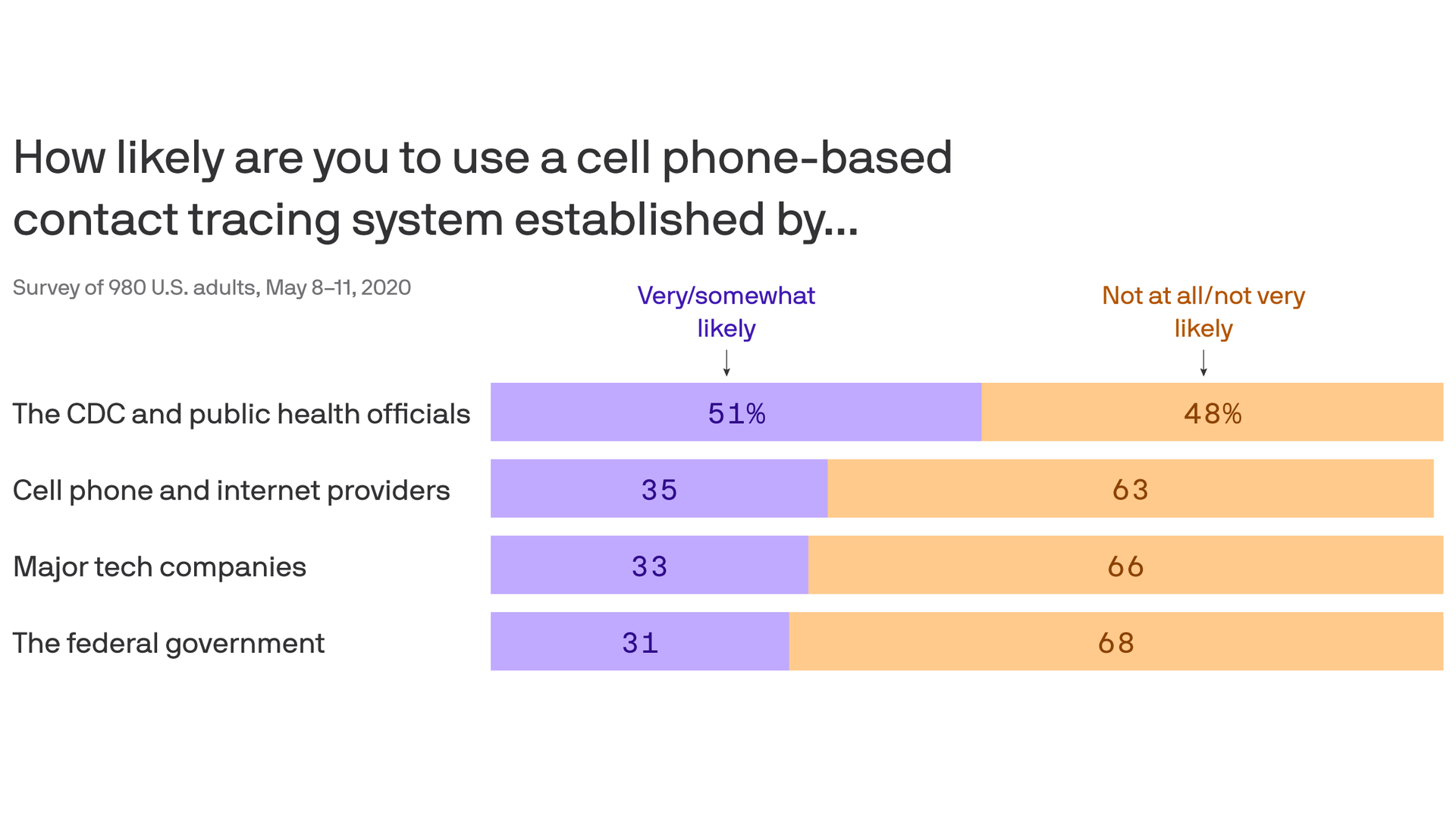
  • More than two thirds of Americans say it’s unlikely they would use a cell phone-based contact tracing program established by the federal government, a key component of a testing regime to control the virus.
  • The second phase of a program to aid small businesses isn’t fully allocated because firms are either concerned about its changing rules, confused about how to access it, or find the structure won’t help them stay in business.
  • With the unemployment rate at a post-Depression record last month, and expected to go higher, there is no meaningful discussion between the parties in Congress on aid to the out-of-work.
  • States and local governments are facing billions in losses without a strategy for assistance.
  • The virus is literally inside the White House. Aides have tested positive for coronavirus, leading to quarantines for some of the nation’s top public health officials and a new daily testing regime for White House staff and reporters who enter the West Wing.
  • The No. 1 book on Amazon for a time was a book by an anti-vaxxer whose conspiracy-minded video about the pandemic spread widely across social media, leading to takedowns by platforms like YouTube and Facebook.

The other side: There’s better news at the state level. “Governors collectively have been winning widespread praise from the public for their handling of the coronavirus outbreak,” the Washington Post reports.

Between the lines: Nationwide, 71% of Americans approve of the job their governor is doing, according to the Post. For Trump, the figure is 43%.

  • And former presidents we often expect to help rally the nation in trying times are scarce.
  • George W. Bush released a video, in which his face barely appeared, calling for unity in the fight against the virus. Barack Obama was recorded in leaked remarks to former staffers calling Trump’s coronavirus response “an absolute chaotic disaster.” Trump attacked both of them on Twitter.

The bottom line: An existential threat — like war or natural disaster — usually brings people together to set a course of action in response. Somehow, we’ve let this one drive us apart.




The latest in the U.S.

https://www.axios.com/newsletters/axios-vitals-72173ec6-3383-4391-afbb-a5ed682e5d7a.html?utm_source=newsletter&utm_medium=email&utm_campaign=newsletter_axiosvitals&stream=top

COVID-19 in the U.S.

As of May 12, 2020, 11pm EDT

Deaths       Confirmed Cases

82,376           1,369,574

Trump and some top aides question accuracy of coronavirus death ...


The U.S. will “without a doubt” have more coronavirus infections and deaths in the fall and winter if effective testing, contact tracing and social distancing measures are not scaled up to adequate levels, NIAID director Anthony Fauci testified on Tuesday.

  • He also said that the “consequences could be really serious” for states and cities that reopen without meeting federal guidelines.

Sen. Mitt Romney (R-Utah) criticized the Trump administration’s coronavirus testing coordinator Adm. Brett Giroir at a Senate hearing Tuesday, accusing him of framing U.S. testing data in a politically positive light: “I find our testing record nothing to celebrate whatsoever.”

Millions of Americans are risking their lives to feed us and bring meals, toiletries and new clothes to our doorsteps — but their pay, benefits and working conditions do not reflect the dangers they face at work, Axios’ Erica Pandey reports.

House Democrats released Tuesday their phase 4 $3 trillion coronavirus relief proposal that would provide billions of additional aid to state and local governments, hospitals and other Democratic priorities.

The American Federation of Teachers launched several capstone lesson plans Tuesday to help K-12 teachers measure student progress during school closures and overcome the challenges of a remote learning setting.

Grocery staples in the U.S. cost more in the last month than in almost 50 years, according to new data out Tuesday from the U.S. Bureau of Labor Statistics.

A new study by economists at the University of Illinois, Harvard Business School, Harvard University and the University of Chicago projects that more than 100,000 small businesses have permanently closed since the coronavirus pandemic was declared in March, the Washington Post reports.


New urgency surrounding children and coronavirus

https://www.axios.com/newsletters/axios-vitals-72173ec6-3383-4391-afbb-a5ed682e5d7a.html?utm_source=newsletter&utm_medium=email&utm_campaign=newsletter_axiosvitals&stream=top

CDC adds 6 new possible coronavirus symptoms - Axios

Solving the mystery of how the coronavirus impacts children has gained sudden steam, as doctors try to determine if there’s a link between COVID-19 and kids with a severe inflammatory illness, and researchers try to pin down their contagiousness before schools reopen.

Driving the news: New York state’s health department is investigating 100 cases of the illness in children, Gov. Andrew Cuomo said at a Tuesday press briefing, Axios’ Orion Rummler reports.

  • Three children in the state have died: an 18-year-old girl, a 5-year-old boy, and a 7-year-old boy. The state’s hospitals had previously reported 85 cases on Sunday.

Doctors have described children “screaming from stomach pain” while hospitalized for shock, Jane Newburger of Boston Children’s Hospital told the Washington Post.

  • In some, arteries in their hearts swelled, similar to Kawasaki disease, a rare condition most often seen in infants and small children that causes blood vessel inflammation, she said.
  • Researchers remain uncertain if this is being caused by COVID-19, but most children appear to have a link. Some affected children have tested positive for coronavirus antibodies, suggesting that the inflammation is “delayed,” Nancy Fliesler of Boston Children’s Hospital wrote on Friday.

What’s next: The CDC is funding a $2.1 million study of 800 children who have been hospitalized after testing positive for the coronavirus through Boston Children’s Hospital. The study aims to understand why some children are more vulnerable to the disease.


Fauci’s warning about reopening may have more influence over Americans than governors

https://www.washingtonpost.com/politics/2020/05/12/faucis-warning-about-reopening-may-have-more-influence-over-americans-than-governors/?fbclid=IwAR0eDoGHpOUI1Ty2RdCoKcxSzwne2NscJfoVGQXnEH8ud2s5MEKIunzXuRA

White House coronavirus expert Dr Anthony Fauci says world may ...

It’s one of those moments that, even as it occurs, seems definitive. The country’s leading infectious-disease expert, Anthony S. Fauci, offering testimony before a Senate committee about a virus that’s infected more than a million Americans — but doing so remotely, because of his own contact with an infected individual. Speaking from quarantine, Fauci will offer a grim warning: Attempting to return economic activity to normal levels too quickly will “result in needless suffering and death” and itself result in negative effects for the economy.

Fauci’s warning stands in obvious contrast to the assertions of his boss, President Trump. As he has so often over the course of the pandemic, Trump waves away questions about whether states are ready to resume normal economic activity, insisting that many places are ready to gear back up. His White House released a set of recommendations for doing so, recommendations to which Fauci will refer. But even as those recommendations were introduced, Trump undercut them. He quickly embraced anti-social-distancing protests in states with blue governors — states where things were not yet ready to return to normal.

The recommendations espoused by Fauci (and, ostensibly, Trump) set an initial baseline of data that states should meet before taking even introductory steps toward reopening their economies. They’re centered on three categories benchmarks: coronavirus symptoms, actual cases and hospital capacity. The initial presentation from the White House explained how those benchmarks could be met:

For the first two, we have publicly available data that allows us to evaluate how states are doing. In the case of demonstrated symptoms, the data are somewhat old, with the most recent metrics reflecting the week of May 2. What’s more, data on the number of people showing up to emergency rooms with symptoms reflecting possible covid-19 cases (the disease caused by the coronavirus) are compiled only by region. Nonetheless, we can get a sense for how many people in each place are showing symptoms as well as up-to-date information on the number of cases and positive tests in each state.

By now, many states appear to meet the benchmarks on these two conditions. (Again, given the limits on the symptomatic data, it’s tricky to say how each fares in the moment.) A number of states that have already begun to reopen, though, don’t. In Texas, for example, the number of new cases is up and the percent of positive tests is flat. In Georgia, the number of new cases is flat and the rate of positive tests has been variable. Both states are nonetheless reopening.

Georgia’s been in the process of reopening for about three weeks, despite missing the basic benchmarks even when that process began. Gov. Brian Kemp (R) made a blanket determination that things could get back to normal, ignoring the sort of regionalized shifts that Trump himself has advocated.

New York, the state hit hardest by the virus, has implemented a deliberate, region-by-region plan for reopening. Gov. Andrew M. Cuomo (D) has outlined seven different criteria in each region of the state before it can resume some normal economic activity (though not all). (Among those? A program sufficient to trace the contacts of individuals with newly confirmed infections.) As of Monday, only three regions met the seven conditions. New York City hit four of the seven.

This is presumably how states are encouraged to reopen to avoid Fauci’s most dire predictions. It’s no guarantee that outbreaks won’t emerge, but New York’s plan is predicated on safety over normalcy while Georgia’s appears to be the opposite.

That’s the important context for Fauci’s testimony. His warnings about moving slowly are not new — though, in the past, they’ve mostly been tempered by the looming physical presence of a president who’s not very interested in diluting his optimistic economic assumptions. Fauci’s language about the ramifications is strong, but the message is consistent.

It also comes a bit too late for states such as Georgia — at least at the official level. One effect of the effort to get the state back to normal is that many Georgians aren’t ready to do so. Economic data shows that, despite businesses being open, they’re often not seeing many customers. The state’s residents are skeptical about getting back to normal. A new Post-Ipsos poll suggests that they are also skeptical of their governor.

Those participating in protests against social distancing are a small minority. Most Americans understand the thrust of Fauci’s concerns and are willing to support continued social distancing measures. While governors are occasionally skipping over the guidelines offered by Fauci and his team, the consumers who can return the economy to normal are still wary — and may be the best audience for Fauci’s warnings.


Americans hate contact tracing

https://www.axios.com/axios-ipsos-coronavirus-week-9-contact-tracing-bd747eaa-8fa1-4822-89bc-4e214c44a44d.html?utm_source=newsletter&utm_medium=email&utm_campaign=newsletter_axiosvitals&stream=top

Video: Transportation's looming overhaul - Axios

In a best-case scenario, just half of Americans would participate in a voluntary coronavirus “contact tracing” program tracked with cell phones, according to the latest installment of the Axios-Ipsos Coronavirus Index.

Why it matters: A strong contact tracing program — identifying people who have the virus and isolating those who have come into contact with them — is the key to letting other people get back to their lives, according to public health experts.

  • The findings underscore deep resistance to turning over sensitive health information, and mistrust about how it could be used.
  • The only way to get even half of Americans to participate would be for public health officials to run the program, not the White House or tech or phone companies.

What they’re saying: “The whole concept of American democracy is about local control and civil liberties, individual liberties,” said Cliff Young, president of Ipsos U.S. Public Affairs.

  • “At the end of the day, I think there will be an American solution to contact tracing,” but if the survey results are any guide, “it’s not going to be a centralized authority saying, ‘And now we’re going to have contact tracing.'”
  • These findings come as tech companies develop software to try to halt the spread, and public health officials train thousands to conduct the tracing.

The big picture: Even as the death toll rises and infections breach the White House firewall, Week 9 of our national survey also finds more people itching to return to work as they used to know it — and bending guidelines to see family and friends.

  • 64% say returning to their pre-coronavirus lives would be a large or moderate risk. Just 30% say that’s worth the risk right now.
  • But four in 10 say they think returning to their normal place of employment would post only a small risk, or no risk.
  • 63% consider airplane travel or mass transit to be a large risk, down from 73% a month ago.
  • Nine in 10 say they’re still practicing social distancing, but just 36% say they’re self quarantining, down from a peak of 55% in Week 4.
  • 32% say they’ve visited family or friends in the past week, the highest share in seven weeks.

These shifts in behavior come even as growing shares of Americans know people in their own communities who have tested positive and the number of confirmed cases in the U.S. has topped 1.3 million, with roughly 80,000 deaths.

  • About a third know someone who has tested positive — and of those, nearly half say they know a person in their own community who has tested positive.
  • “People are getting antsy,” Young said. “They know there’s this risk, but … people’s mental health and social health are challenged and they’re just feeling restless.”
  • “You can only keep cooped up for so long.”

Between the lines: Most don’t see the virus as an immediate existential threat to themselves. This week, we asked whether people had prepared or updated their wills or living wills since the pandemic began. More than nine in 10 said no.

For contact tracing involving cell phone tracking, Democrats surveyed are more open than Republicans to the notion of opt-in reporting.

  • 68% of Democrats say they’d participate if the Centers for Disease Control and Prevention (CDC) was in charge, compared with 58% of independents and 32% of Republicans.
  • Those numbers plunged if the federal government more broadly were in charge, but Democrats remained the most likely to participate — 39% compared with 34% of independents and 23% of Republicans.
  • That’s despite the fact that Democrats are less trusting than others of the Trump administration to protect their families.
  • Men are slightly more likely than women to trust tech companies with the information.

Be smart: Some reporting initiatives may need to be mandatory or person-to-person to get high enough levels of participation to be worthwhile.


Administration contradicts health officials on who can get a coronavirus test

https://www.axios.com/trump-coronavirus-testing-giroir-d83b4703-6d23-47ac-974e-972a8fc85702.html

Trump officials emphasize that coronavirus 'Made in China'

President Trump claimed at a press briefing Monday that any American who “wants” a coronavirus test can get one — contradicting his testing coordinator Adm. Brett Giroir, who just moments earlier said that tests are mostly reserved for people who “need” one because they present symptoms or are participating in contact tracing.

Why it matters: Trump used the briefing largely to celebrate the country’s success in ramping up testing capacity, at one point boasting that “we have met the moment and we have prevailed” in regards to testing. But questions still remain about how Americans will be able to safely return to work if asymptomatic people don’t have access to testing.

Between the lines: The White House, meanwhile, has proven to be a microcosm of what a country with high-quality testing, surveillance and isolation capability can look like.

  • Giroir explained that people who are in close contact with the president are tested regularly using the 15-minute Abbotts lab device, even if they’re asymptomatic.
  • This is how the White House was able to diagnose Pence press secretary Katie Miller and isolate officials like Anthony Fauci who came into contact with her.

What they’re saying: “Right now in America, anybody who needs a test gets a test in America, with the numbers we have,” Giroir said. “If you’re symptomatic with a respiratory illness, that is an indication for a test and you can get a test. If you need to be contact traced, you can get a test.”

  • “And we hope — not hope — we are starting to have asymptomatic surveillance, which is very important. Again, that’s over 3 million tests per week. That is sufficient for everyone who needs a test — symptomatic, contact tracing and, to our best projections, the asymptomatic surveillance we need.”
  • “I think we have been clear all along that we believe and the data indicate we have enough testing to do the phase one gradual reopening that has been supported in the president’s plan and the task force’s plan. It has to be a phased reopening.”

Earlier in the briefing, when asked when Americans can get tested every day like White House senior staff can, Trump responded: “Very soon.”

  • He later said: “If people want to get tested, they get tested. We have the greatest capacity in the world, not even close. If people want to get tested they get tested, but for the most part, they shouldn’t want to get tested.”
  • “There is no reason. They feel good. They don’t have sniffles. They don’t have sore throats. They don’t have any problem.”

The bottom line: Trump and Giroir’s statements blurred the line between two different concepts, as The Daily Beast’s Sam Stein points out. People who “need” a test because they have symptoms or were in contact with an infected person can get one, but the number of tests “needed” to safely reopen the country is not yet sufficient.


The coronavirus is a moving target

https://www.axios.com/coronavirus-research-treatment-vaccines-aedfbf2c-cf09-4a36-ac99-2afb04298e5d.html

The coronavirus is a moving target for efforts to tackle it - Axios

Solutions for COVID-19 are being developed at the same time as knowledge about the disease evolves, a serious challenge for doctors treating patients and for researchers trying to create vaccines and treatments.

Why it matters: What was first thought of as a respiratory infection now appears much more complex, making efforts to tackle the disease more complicated.

“We’re laying the track as the train is moving and the train is coming very fast,” says Mark Poznansky, director of the Vaccine & Immunotherapy Center at Massachusetts General Hospital. “That is an extraordinary place to be at the global level.”

What’s happening: When the world first encountered COVID-19 four months ago, it was deemed a respiratory infection that hammers the lungs. That’s still the case but in recent weeks, clinicians have been reporting wide-ranging manifestations of the disease in some people.

  • Some of this could be that, with enough cases, there are outliers and anomalies. But that underscores that doctors and researchers are learning as they go.

Details: Renal failure, sepsis, damaged blood vessels, skin lesions, stroke, gastrointestinal problems and blood clots in the lungs and kidneys are being seen in some COVID-19 patients.

  • 20% of hospitalized patients in one study in Wuhan, China had heart damage.
  • 31% of people with the disease studied in a Danish ICU had blood clots.

“It comes across more as a systemic disease exhibited initially as a respiratory disease,” says Poznansky. It’s unclear whether the cause is the virus itself, the immune system’s response to it, or the treatment received.

That has implications for developing vaccines. The goal is to prevent infection but not exacerbate the immune effects in response to the virus.

  • “Is [a vaccine] protective or not in a context where we don’t know what exactly defines a protective immune response to COVID-19?” asks Poznansky.
  • The evolving understanding underscores the need to have multiple vaccines in development. (The current count is 123, per the Milken Institute’s tracker.)

What to watch: The changing percent of the disease will feature in regulatory discussions.

  • “This is the question companies will be discussing with regulators: which surrogate endpoints are acceptable as a proxy for going all the way to the worst possible outcomes in a patient?” says Phyllis Arthur, vice president of infectious diseases and diagnostics policy at biotech trade organization BIO.

The bottom line: Pandemics bring a potent mix of uncertainty and urgency to science that experts say requires both nimbleness and rigor to navigate.

  • “This is what a pandemic is like. It’s uncomfortable,” says Arthur. “You need to move swiftly and do good, solid, evidence-based, risk-benefit ratio assessments and understand what you know and don’t know, and make evidence based policy decisions knowing you don’t have perfect information.”


Doctors keep discovering new ways the coronavirus attacks the body

https://www.washingtonpost.com/health/2020/05/10/coronavirus-attacks-body-symptoms/?arc404=true&utm_campaign=29774&utm_medium=email&utm_source=

Coronavirus Causes Damage to Organs Other Than the Lungs, Doctors ...

Damage to the kidneys, heart, brain — even ‘covid toes’ — prompts reassessment of the disease and how to treat it

Deborah Coughlin was neither short of breath nor coughing. In those first days after she became infected by the novel coronavirus, her fever never spiked above 100 degrees. It was vomiting and diarrhea that brought her to a Hartford, Conn., emergency room on May 1.

“You would have thought it was a stomach virus,” said her daughter, Catherina Coleman. “She was talking and walking and completely coherent.”

But even as Coughlin, 67, chatted with her daughters on her cellphone, the oxygen level in her blood dropped so low that most patients would be near death. She is on a ventilator and in critical condition at St. Francis Hospital, one more patient with a strange constellation of symptoms that physicians are racing to recognize, explain and treat.

“At the beginning, we didn’t know what we were dealing with,” said Valentin Fuster, physician-in-chief at Mount Sinai Hospital in New York City, the epicenter of the U.S. outbreak. “We were seeing patients dying in front of us. It was all of a sudden, you’re in a different ballgame, and you don’t know why.”

Today, there is widespread recognition the novel coronavirus is far more unpredictable than a simple respiratory virus. Often it attacks the lungs, but it can also strike anywhere from the brain to the toes. Many doctors are focused on treating the inflammatory reactions it triggers and its capacity to cause blood clots, even as they struggle to help patients breathe.

Learning about a new disease on the fly, with more than 78,000 U.S. deaths attributed to the pandemic, they have little solid research to guide them. The World Health Organization’s database already lists more than 14,600 papers on covid-19. Even the world’s premier public health agencies, including the Centers for Disease Control and Prevention, have constantly altered their advice to keep pace with new developments.

“We don’t know why there are so many disease presentations,” said Angela Rasmussen, a virologist at the Center for Infection and Immunity at Columbia University’s Mailman School of Public Health. “Bottom line, this is just so new that there’s a lot we don’t know.”

More than four months of clinical experience across Asia, Europe and North America has shown the pathogen does much more than invade the lungs. “No one was expecting a disease that would not fit the pattern of pneumonia and respiratory illness,” said David Reich, a cardiac anesthesiologist and president of Mount Sinai Hospital in New York City.

It attacks the heart, weakening its muscles and disrupting its critical rhythm. It savages kidneys so badly some hospitals have run short of dialysis equipment. It crawls along the nervous system, destroying taste and smell and occasionally reaching the brain. It creates blood clots that can kill with sudden efficiency and inflames blood vessels throughout the body.

It can begin with a few symptoms or none at all, then days later, squeeze the air out of the lungs without warning. It picks on the elderlypeople weakened by previous disease, and, disproportionately, the obese. It harms men more than women, but there are also signs it complicates pregnancies.


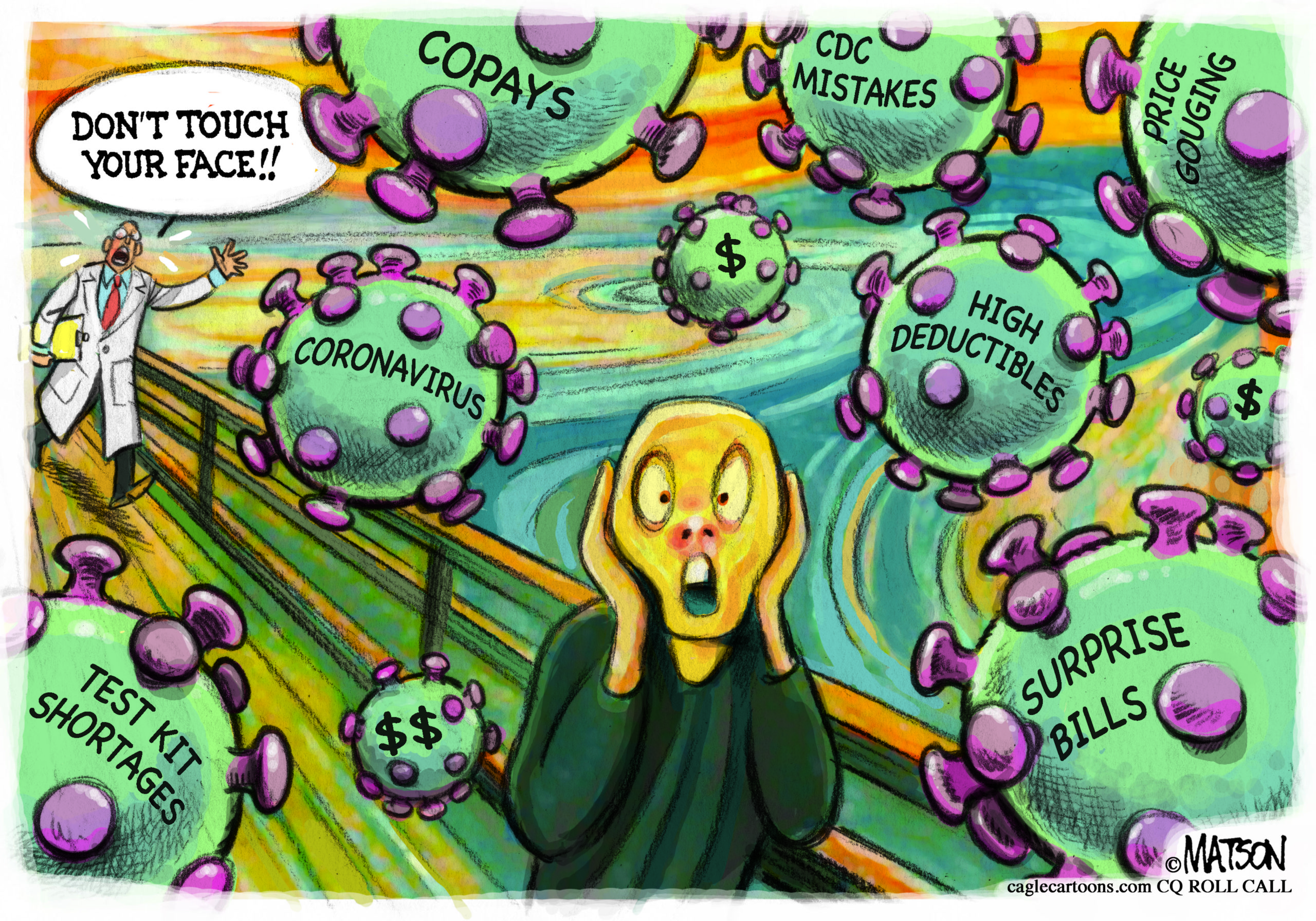
Cartoon – Sign of Coronavirus Times

The Coronavirus Scream - Truthdig: Expert Reporting, Current News ...

See Which States Are Reopening and Which Are Still Shut Down

See Which States Are Reopening and Which Are Still Shut Down - The ...

In Georgia, barbers are giving haircuts armed with face masks and latex gloves. In Texas, movie theaters are filling with customers, who crunch on popcorn several seats away from the nearest stranger. People are sweating at gyms again in Tennessee.

America’s reopening has begun in force, just weeks after the coronavirus put most of the country on lockdown.

More than half the states have started to reopen their economies in some meaningful way or have plans to do so soon, raising concerns among public health experts about a possible surge in new infections and deaths. Many states that are reopening failed to meet criteria recommended by the Trump administration before loosening restrictions on businesses and social activities.

The New York Times is tracking when orders to stay at home are lifted in each state, as well as when broad reopenings are allowed in public spaces, such as restaurants, retail stores, salons, gyms and houses of worship. In some cases, stay-at-home orders are lifting separately from restrictions on businesses. This page will be updated regularly.

Businesses are almost universally reopening under restrictions, such as allowing fewer customers, requiring workers and customers to wear masks, and enforcing social distancing. Even as governors lift orders, stricter local orders may remain in place by city or county.