Trump said more Covid-19 testing ‘creates more cases.’ We did the math

Trump said more Covid-19 testing ‘creates more cases.’ We did the math

Testing silhouette

The counter-narrative began almost instantly. After the U.S. count of Covid-19 cases began an inexorable rise in June, the White House sought to assure Americans that the increase was, basically, an illusion, created by an increase in testing for the novel coronavirus.

In a June 15 tweet, President Trump said testing “makes us look bad.” At his campaign rally in Tulsa five days later, he said he had asked his “people” to “slow the testing down, please.” At a White House press conference last week, he told reporters, “When you test, you create cases.”

And in an interview with Fox News that aired Sunday, Trump could not have been clearer: “Cases are up because we have the best testing in the world and we have the most testing.” Basically, the president was arguing that the U.S. had just as many new cases in June and July as it did in May but, with fewer tests being done in May, they weren’t being detected; with more testing now, they are.

A new STAT analysis of testing data for all 50 states and the District of Columbia, however, shows with simple-to-understand numbers why Trump’s claim is wrong. In only seven states was the rise in reported cases from mid-May to mid-July driven primarily by increased testing. In the other 26 states — among the 33 that saw cases increase during that period — the case count rose because there was actually more disease.

May had brought signs of hope that the U.S. had gotten its Covid-19 outbreak under control, with about 20,000 new cases reported per day after April highs closer to 30,000. But by late June, the daily count climbed to about 40,000, and now it’s at about 70,000. The STAT analysis shows that spread of the virus, far more than testing, explains that increase.

Epidemiologists and infectious disease experts have disputed the White House claims for weeks, citing rising hospitalization numbers and deaths. It’s hard to argue that extremely sick people, let alone dead people, had been obscured by low levels of testing but suddenly revealed by higher levels.

Without a doubt, many cases of Covid-19 in March, April, and May weren’t picked up. In late June, Centers for Disease Control and Prevention Director Robert Redfield told reporters that as many as 90% of cases had been missed; that is, although there were 2.3 million confirmed cases in the U.S. then, some 20 million people had probably been infected. But that reasoning applies today, too: Despite months of government claims to the contrary, not everyone who wants, or should have, a test is getting one.

Simple math belies the “it’s just because of more testing” claim — with some fascinating exceptions.

Using data from Covid Tracking, STAT looked at the number of people tested and the number who tested positive for the disease (cases) in every state and Washington, D.C. We did that for three dates: in mid-May, mid-June, and mid-July. (Due to reporting anomalies, the dates selected sometimes differed by a day or two between states.)

For each date, we calculated the number of cases found per 1,000 tests — a measure of the disease’s prevalence. For example, in Florida on May 13, that rate was 32. On June 13 it was 75. On July 13 it was 193. On May 13, Florida tested 15,159 people; on July 13, it tested 65,567. So indeed, the number of tests has increased.

But the number of cases per thousand, which is independent of the number of tests, has skyrocketed. On May 13, Florida recorded 479 cases; on July 13, it found 12,624. If the prevalence of Covid-19 were the same in July as in May, Florida would have found only 2,098 cases. In other words, 10,526 of the July 13 cases are not due to increased testing, but, instead, to the increased prevalence of disease.

Florida Gov. Ron DeSantis, however, echoes Trump’s explanation, telling a Saturday press briefing that his state’s soaring caseload is largely the result of more testing of people with no or minimal symptoms. “We’re now capturing a lot of those folks,” he said.

In fact, Florida has seen a sevenfold increase in cases in the past month, said Youyang Gu, who developed a well-respected, machine-learning-based model of Covid-19 whose projections have been quite accurate. “In the same time span, the number of tests only increased by a factor of two,” he said. “Obviously, if you double the testing but the number of cases increased sevenfold, then the virus is clearly spreading.”

Testing/cases graphic

The complete data for all 50 states can be found here.


Other states with soaring cases tell the same story as Florida.

In Arizona, the case-finding rate rose from 90 in May to 140 in June to 208 in July. Of its 2,537 cases on July 12, 1,441 were due to increased prevalence.

South Carolina has also experienced a steep rise in prevalence as its case count quintupled: Of the 2,280 cases on July 9, 1,869 were due to rising prevalence, not more testing. Texas and Georgia are similar: rising case counts well beyond increases in testing. In all, 26 states that did more testing in July than in May found more cases because Covid-19 was more prevalent. In 15 of them, the number of cases per 1,000 people tested had more than doubled.

Seven states (Colorado, Indiana, Michigan, Missouri, North Carolina, Ohio, and Wisconsin) meet the three criteria needed to support Trump’s claim that we’re seeing more cases only, or mostly, because we’re doing more testing. The criteria are doing more tests in July than in May, finding more cases on a typical day in July than May, but seeing the number of cases per 1,000 tests decline or remain unchanged from May to July.

Take Missouri. It’s reporting more cases, but not because the virus is exploding there (despite those crowded holiday scenes at Lake of the Ozarks). Its case finding rate has been pretty stable or even declining, from 48 in mid-May to 44 in mid-July. By tripling its number of daily tests, Missouri is finding roughly triple the number of cases.

California comes close to meeting the three criteria, but doesn’t quite. Its number of daily tests more than quadrupled from May to July, from roughly 32,000 to 137,000. But the rate of cases being found has risen, though only about 10%, from 55 to 61 per 1,000 tests. So a big reason — but not the main reason, as in Missouri — more cases are being found is that more testing is being done. Washington is similar: more testing, more cases, but also slightly greater prevalence of disease in mid-July compared to mid-May; its worsening situation is real.

New York tells the opposite story: more testing found fewer cases. The state nearly doubled its daily tests from May 13 (33,794) to July 12 (62,418). But its cases fell from 2,176 to 557. If the case rate had not dropped (by 86 %), New York’s expanded testing would have found 3,995 cases on July 12.

In fact, 16 states plus the District of Columbia are like New York. They tested much more, but found fewer cases in July than May — in most, not only “fewer” in the sense of fewer cases per 1,000 but fewer in absolute terms. New Jersey reported 10,246 tests and 1,144 cases on May 14, and 20,846 tests with a mere 393 new cases on July 14. Again, the virus hasn’t disappeared, but the expansion of testing, far from “creating” cases, has brought good news: In these states, it’s much less prevalent than it was two months ago.


Axios-Ipsos poll: The skeptics are growing

https://www.axios.com/axios-ipsos-poll-gop-skeptics-growing-deaths-e6ad6be5-c78f-43bb-9230-c39a20c8beb5.html

Axios-Ipsos poll: The skeptics are growing - Axios

A rising number of Americans — now nearly one in three — don’t believe the virus’ death toll is as high as the official count, despite surging new infections and hospitalizations, per this week’s installment of the Axios-Ipsos Coronavirus Index.

Between the lines: Republicans, Fox News watchers and people who say they have no main source of news are driving this trend.

Why it matters: It shows President Trump’s enduring influence on his base, even as Americans overall say they are increasingly dissatisfied with his handling of the virus and political support is shifting toward Joe Biden.

What they’re saying: “We live in highly tribal and partisan times, and people are more likely to believe cues and signals from their political leaders than the scientists or the experts,” says Cliff Young, president of Ipsos U.S. Public Affairs.

  • And that’s just the purest form of populism, the demonization of experts to further political ends. But to what end? Fantasy is meeting reality head-on right now.”
  • “People can see the world around them, they know it’s different, but they still can think that the media and politicos are using it to go after Trump.”

By the numbers: Overall, 31% of Americans say they believe the number of Americans dying is lower than the number reported, up sizably from 23% when we asked the same question in May.

Here’s what’s driving the shift in Week 17 of our national survey:

  • Republicans who say the death count is overinflated rose from 40% to 59%.
  • Among independents, that share rose from 24% to 32%.
  • The small share of Democrats with that view was effectively flat, ticking up from 7% to 9%.
  • Most Americans still believe the actual number of deaths is either higher (37%) or on par with (31%) the official count.

Where you get your news has a strong correlation to your faith in the numbers.

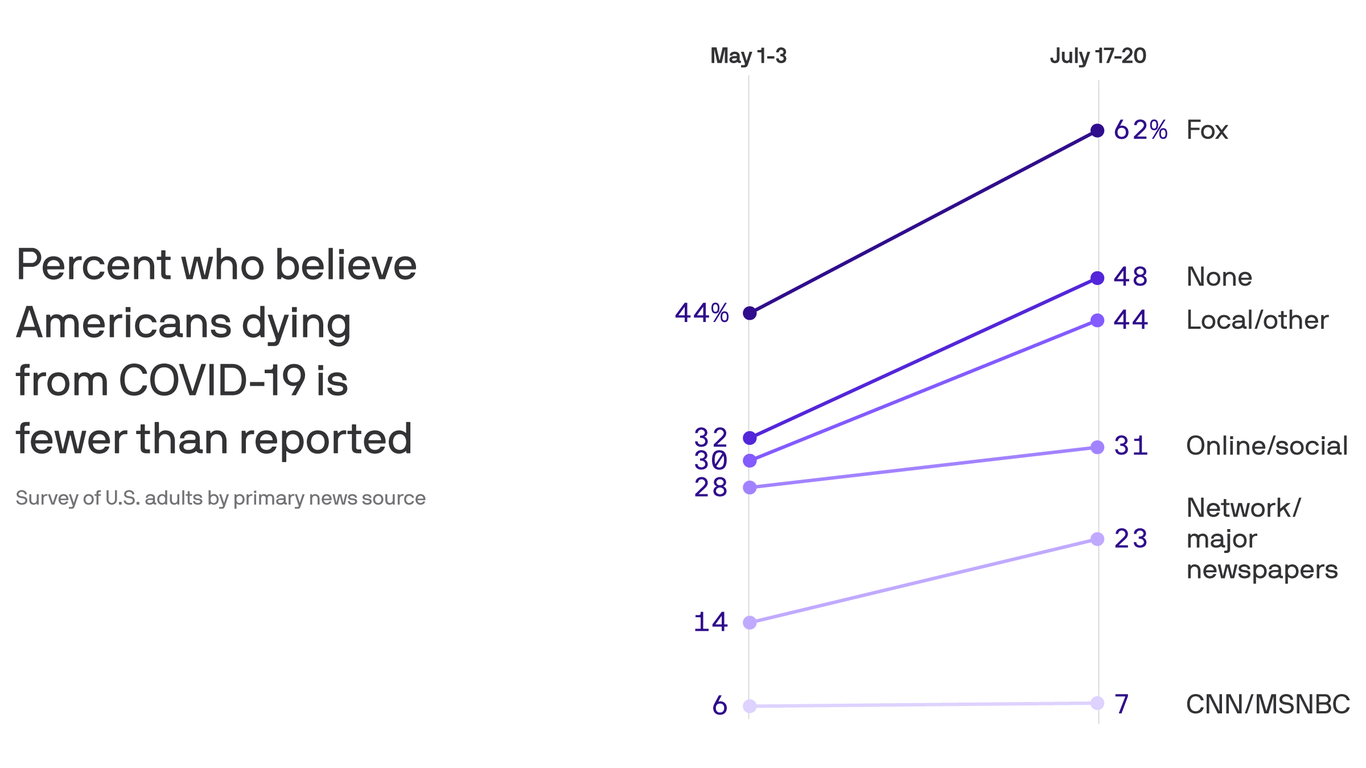
  • Fox News watchers who say deaths are being over-counted shot up from 44% to 62%, even higher than Republicans overall.
  • Other big gains came from those who say they have no primary news source, from 32% to 48%; and those whose primary sources include local news, from 30% to 44%.
  • There was a smaller increase among people whose primary news source is one of the networks or major U.S. newspapers, while views of those who primarily watch CNN and MSNBC remained about the same.

The big picture: The survey shows most Americans are digging in for a long fight against the virus, even if they have conflicting views about what to believe.

  • 72% say they’re prepared to maintain social distancing or self-quarantining for as long as it takes — up from 49% in May — as people realize the end is more than a couple of months off.

This survey finds the highest overall use of face masks since the pandemic began — with 99% of Democrats and 75% of Republicans now saying they’re wearing a mask sometimes or all of the time when they go out.

  • But there’s enough inconsistency in people’s precautions to undercut much of the gains.
  • Only 40% say they wore masks sometimes or all the time when visiting family and friends. And parents are less likely to make their children wear masks outside the home than to do so themselves.

1 big finger wag: Most Americans blame someone other than themselves for the crisis.

  • Three-fourths of respondents say most other Americans are behaving in ways that are making the country’s recovery from the COVID-19 pandemic worse, while one-fourth said they’re making it better.
  • Democrats were more likely (83%) than other groups to say others are making things worse.


Mask resistance during a pandemic isn’t new – in 1918 many Americans were ‘slackers

https://theconversation.com/mask-resistance-during-a-pandemic-isnt-new-in-1918-many-americans-were-slackers-141687?utm_medium=email&utm_campaign=The%20Weekend%20Conversation%20-%201680716207&utm_content=The%20Weekend%20Conversation%20-%201680716207+Version+A+CID_c211e1b0b6c4b69b3a29a9d1624a2ab6&utm_source=campaign_monitor_us&utm_term=Mask%20resistance%20during%20a%20pandemic%20isnt%20new%20%20in%201918%20many%20Americans%20were%20slackers

Mask resistance during a pandemic isn't new – in 1918 many ...

We have all seen the alarming headlines: Coronavirus cases are surging in 40 states, with new cases and hospitalization rates climbing at an alarming rate. Health officials have warned that the U.S. must act quickly to halt the spread – or we risk losing control over the pandemic.

There’s a clear consensus that Americans should wear masks in public and continue to practice proper social distancing. While a majority of Americans support wearing masks, widespread and consistent compliance has proven difficult to maintain in communities across the country. Demonstrators gathered outside city halls in Scottsdale, ArizonaAustin, Texas; and other cities to protest local mask mandates. Several Washington state and North Carolina sheriffs have announced they will not enforce their state’s mask order.

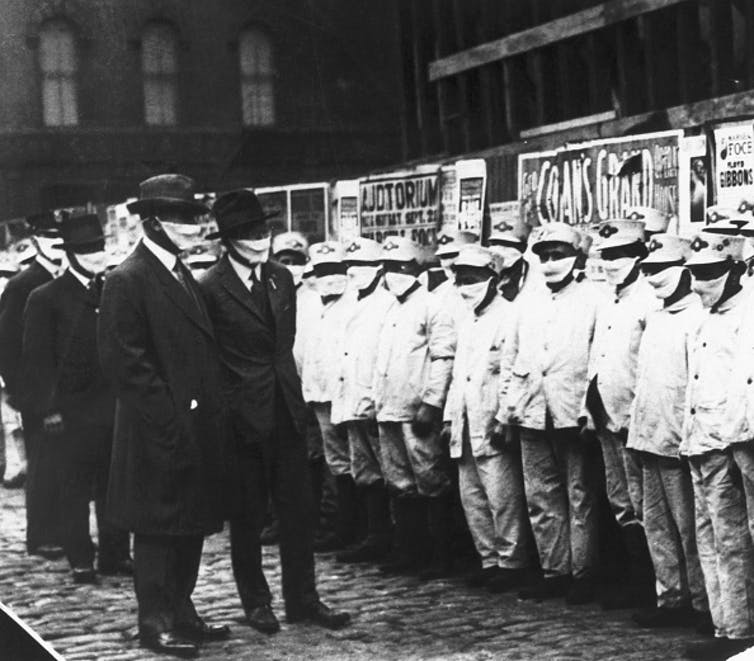
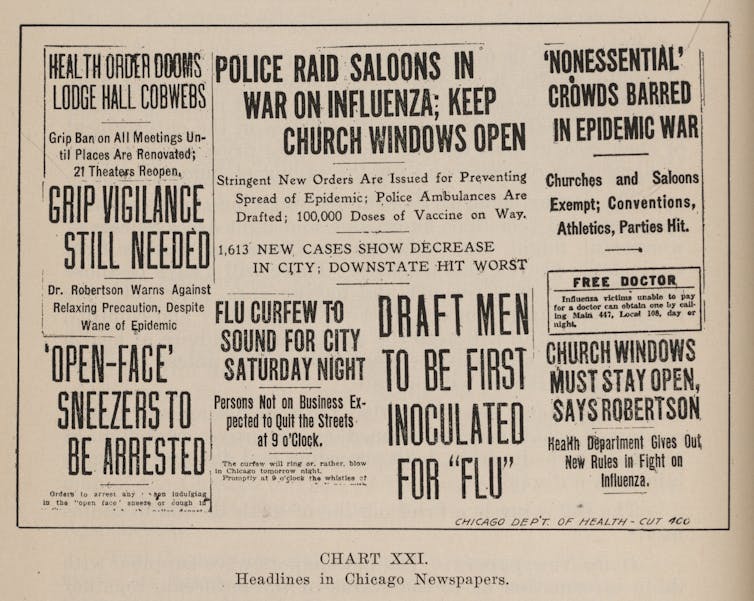
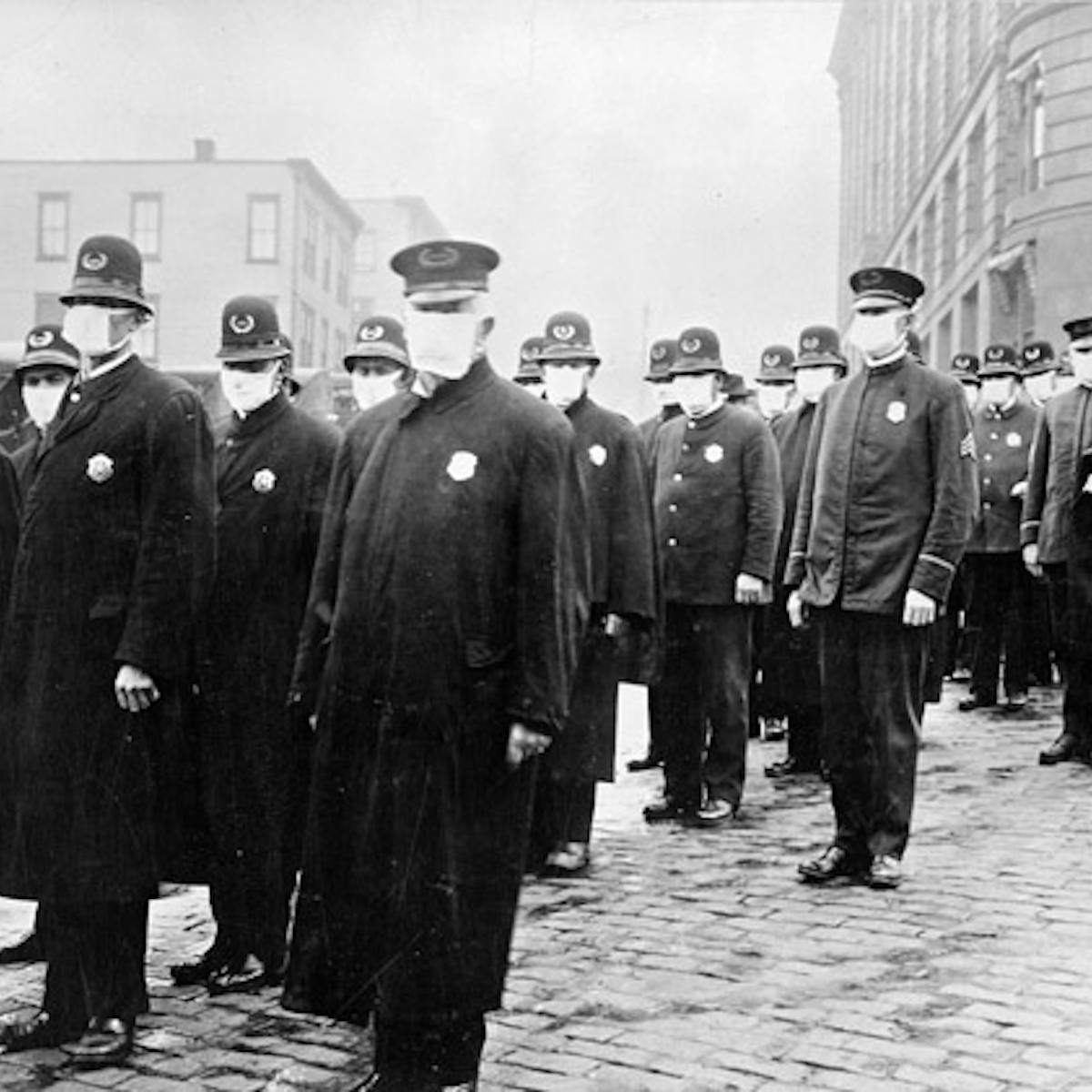
I’ve researched the history of the 1918 pandemic extensively. At that time, with no effective vaccine or drug therapies, communities across the country instituted a host of public health measures to slow the spread of a deadly influenza epidemic: They closed schools and businesses, banned public gatherings and isolated and quarantined those who were infected. Many communities recommended or required that citizens wear face masks in public – and this, not the onerous lockdowns, drew the most ire.

Mask resistance during a pandemic isn't new – in 1918 many ...

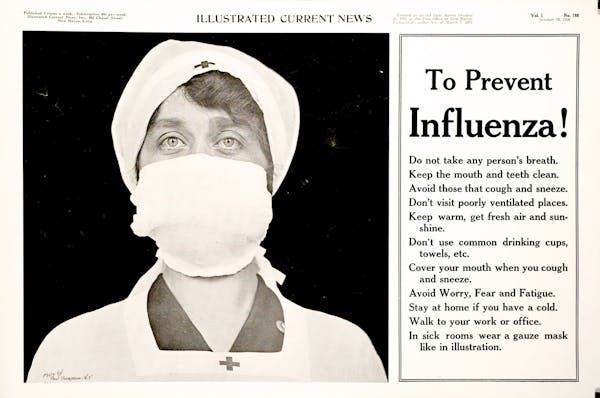
In mid-October of 1918, amidst a raging epidemic in the Northeast and rapidly growing outbreaks nationwide, the United States Public Health Service circulated leaflets recommending that all citizens wear a mask. The Red Cross took out newspaper ads encouraging their use and offered instructions on how to construct masks at home using gauze and cotton string. Some state health departments launched their own initiatives, most notably California, Utah and Washington.

Nationwide, posters presented mask-wearing as a civic duty – social responsibility had been embedded into the social fabric by a massive wartime federal propaganda campaign launched in early 1917 when the U.S. entered the Great War. San Francisco Mayor James Rolph announced that “conscience, patriotism and self-protection demand immediate and rigid compliance” with mask wearing. In nearby Oakland, Mayor John Davie stated that “it is sensible and patriotic, no matter what our personal beliefs may be, to safeguard our fellow citizens by joining in this practice” of wearing a mask.

Health officials understood that radically changing public behavior was a difficult undertaking, especially since many found masks uncomfortable to wear. Appeals to patriotism could go only so far. As one Sacramento official noted, people “must be forced to do the things that are for their best interests.” The Red Cross bluntly stated that “the man or woman or child who will not wear a mask now is a dangerous slacker.” Numerous communities, particularly across the West, imposed mandatory ordinances. Some sentenced scofflaws to short jail terms, and fines ranged from US$5 to $200.

Mask resistance during a pandemic isn't new – in 1918 many ...

Passing these ordinances was frequently a contentious affair. For example, it took several attempts for Sacramento’s health officer to convince city officials to enact the order. In Los Angeles, it was scuttled. A draft resolution in Portland, Oregon led to heated city council debate, with one official declaring the measure “autocratic and unconstitutional,” adding that “under no circumstances will I be muzzled like a hydrophobic dog.” It was voted down.

Utah’s board of health considered issuing a mandatory statewide mask order but decided against it, arguing that citizens would take false security in the effectiveness of masks and relax their vigilance. As the epidemic resurged, Oakland tabled its debate over a second mask order after the mayor angrily recounted his arrest in Sacramento for not wearing a mask.prominent physician in attendance commented that “if a cave man should appear…he would think the masked citizens all lunatics.”

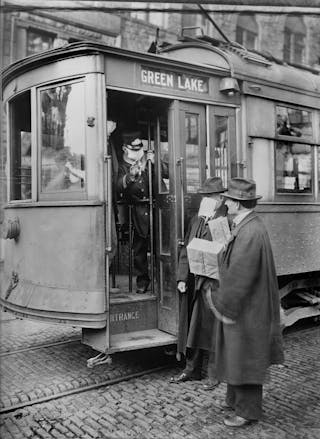
In places where mask orders were successfully implemented, noncompliance and outright defiance quickly became a problem. Many businesses, unwilling to turn away shoppers, wouldn’t bar unmasked customers from their stores. Workers complained that masks were too uncomfortable to wear all day. One Denver salesperson refused because she said her “nose went to sleep” every time she put one on. Another said she believed that “an authority higher than the Denver Department of Health was looking after her well-being.” As one local newspaper put it, the order to wear masks “was almost totally ignored by the people; in fact, the order was cause of mirth.” The rule was amended to apply only to streetcar conductors – who then threatened to strike. A walkout was averted when the city watered down the order yet again. Denver endured the remainder of the epidemic without any measures protecting public health.

Mask resistance during a pandemic isn't new – in 1918 many ...

In Seattle, streetcar conductors refused to turn away unmasked passengers. Noncompliance was so widespread in Oakland that officials deputized 300 War Service civilian volunteers to secure the names and addresses of violators so they could be charged. When a mask order went into effect in Sacramento, the police chief instructed officers to “Go out on the streets, and whenever you see a man without a mask, bring him in or send for the wagon.” Within 20 minutes, police stations were flooded with offenders. In San Francisco, there were so many arrests that the police chief warned city officials he was running out of jail cells. Judges and officers were forced to work late nights and weekends to clear the backlog of cases.

Many who were caught without masks thought they might get away with running an errand or commuting to work without being nabbed. In San Francisco, however, initial noncompliance turned to large-scale defiance when the city enacted a second mask ordinance in January 1919 as the epidemic spiked anew.

Many decried what they viewed as an unconstitutional infringement of their civil liberties. On January 25, 1919, approximately 2,000 members of the “Anti-Mask League” packed the city’s old Dreamland Rink for a rally denouncing the mask ordinance and proposing ways to defeat it. Attendees included several prominent physicians and a member of the San Francisco Board of Supervisors.

It is difficult to ascertain the effectiveness of the masks used in 1918. Today, we have a growing body of evidence that well-constructed cloth face coverings are an effective tool in slowing the spread of COVID-19. It remains to be seen, however, whether Americans will maintain the widespread use of face masks as our current pandemic continues to unfold.

Deeply entrenched ideals of individual freedom, the lack of cohesive messaging and leadership on mask wearing, and pervasive misinformation have proven to be major hindrances thus far, precisely when the crisis demands consensus and widespread compliance.

This was certainly the case in many communities during the fall of 1918. That pandemic ultimately killed about 675,000 people in the U.S. Hopefully, history is not in the process of repeating itself today.


How the coronavirus pandemic became Florida’s perfect storm

https://theconversation.com/how-the-coronavirus-pandemic-became-floridas-perfect-storm-142333

How the coronavirus pandemic became Florida's perfect storm

If there’s one state in the U.S. where you don’t want a pandemic, it’s Florida. Florida is an international crossroads, a magnet for tourists and retirees, and its population is older, sicker and more likely to be exposed to COVID-19 on the job than the country as a whole.

When the coronavirus struck, the conditions there made it a perfect storm.

Florida set a single-day record for new COVID-19 cases in early July, passing 15,000 and rivaling New York’s worst day at the height of the pandemic there. The state has become an epicenter for the spread, with over 300,000 confirmed cases. Its hospital capacity is under stress, and the death toll has been rising.

Despite these strains, Disney World reopened two theme parks on July 11, and Florida Gov. Ron DeSantis announced schools would reopen in August. The governor had shut down alcohol sales in bars in late June as case numbers skyrocketed, but he hasn’t made face masks mandatory or moved to shut down other businesses where the virus can easily spread.

As public health researchers, we have been studying how states respond to the pandemic. Florida stands out, both for its absence of statewide policies that could have stemmed the spread of COVID-19 and for some unique challenges that make those policies both more necessary and more difficult to implement than in many other states.

The challenges of economic pressures

Florida is one of nine states with no income tax on wages, so its tax base relies heavily on tourism and property in its high-density coastal areas. That puts more pressure on the government to keep businesses and social venues open longer and reopen them faster after shutdowns.

If you look closely at Florida’s economy, its vulnerabilities to the pandemic become evident.

The state depends on international trade, tourism and agriculture – sectors that rely heavily on lower-wage, often seasonal, workers. These workers can’t do their jobs from home, and they face financial barriers to getting tested, unless it’s provided through their employer or government testing sites. They also struggle with health care – Florida has a higher-than-average rate of people without health insurance, and it chose not to expand Medicaid.

In the tourism industry, even young, healthy employees typically at lower risk from COVID-19 can unknowingly spread the virus to visitors or vice versa. The tourism industry also encourages crowded bar and club scenes, where the governor has blamed young people for spreading the coronavirus.

The past few weeks have been emblematic of the economic battles facing a state that depends on tourism for both jobs and state revenues.

Even as the public health risks were quickly rising, businesses continued to open their doors. Major cruise lines planned to resume their itineraries in the fall. A note on the Universal Studios website read: “Exposure to COVID-19 is an inherent risk in any public location where people are present; we cannot guarantee you will not be exposed during your visit.”

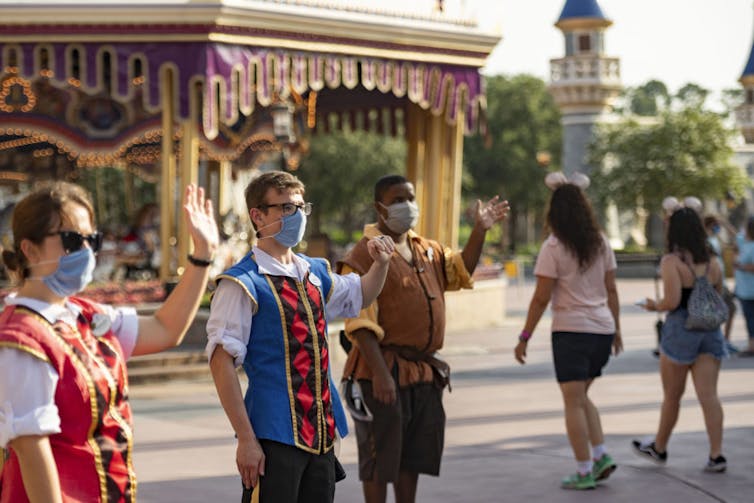
Disney World reopened on July 11 with face mask requirements. Matt Stroshane via Disney

Reopening guidance has been largely ignored

The Governor’s Re-open Florida Taskforce issued guidelines in late April meant to lower the state’s coronavirus risk, but those guidelines have been largely ignored in practice.

No county in Florida has reduced cases or maintained the health care resources recommended by the task force. The data needed to fully assess progress are also questionable, given a recent scandal regarding the state data’s accuracy, availability and transparency.

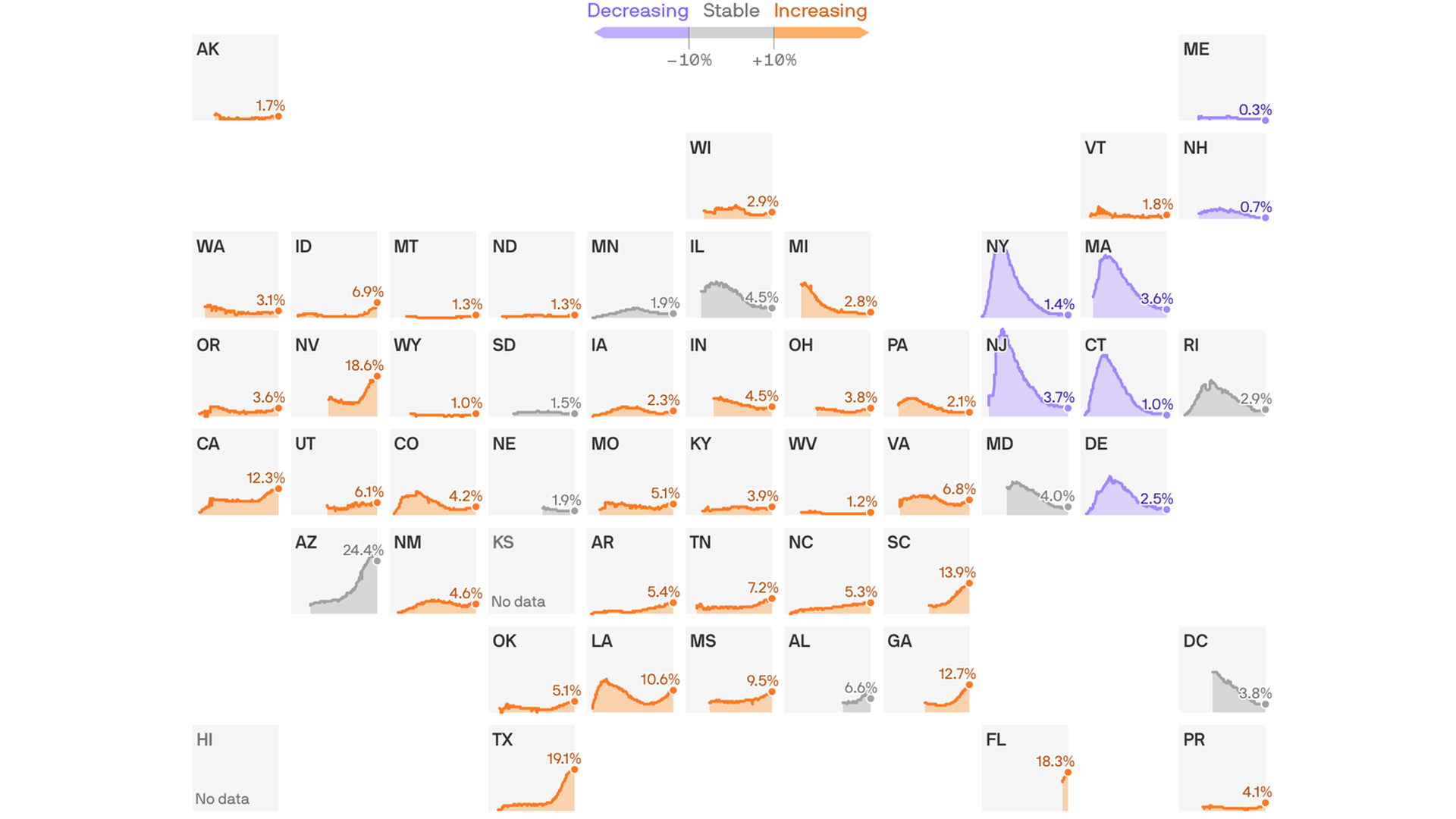
Still, the coronavirus’s rapid surge in Florida is evident in the state-reported casesTesting lines are long, and almost 1 in 5 tests have been positive for COVID-19, suggesting the prevalence of infections is still increasing.

Florida’s patchwork of local rules also makes it hard to contain the virus’s spread.

With no statewide mask rules or plans to reverse reopeningother than for bars, communities and businesses have taken their own actions to implement public health precautions. The result is varying mask ordinances and restrictions on large gatherings in some cities but not those surrounding them. Though the Florida Department of Health has issued an advisory recommending face coverings, some local areas have voted down mask mandates.

More warning signs ahead

Late summer and fall will bring new challenges for Florida in terms of the virus’s spread and the state’s response to it.

That’s when Florida’s risk of hurricanes grows, and while Floridians are well-versed in hurricane preparedness, storm shelters aren’t designed for social distancing and will need careful plans for protecting nursing home residents. Storm cleanup could mean lots of people working in close proximity while protective gear is in short supply.

If Florida’s schools reopen fully, the risk of the virus rapidly spreading to teachers, parents and children who are more vulnerable is a real concern being weighed against the costs of keeping schools closed.

Colleges that reopen to classes and sporting events also raise the risk of spreading the virus in Florida communities. And the possible return of retirees who spend their winters in Florida would increase the high-risk population by late fall. One in five Florida residents is over age 65, giving the state one of the nation’s oldest populations – a risk factor, along with chronic illnesses, for severe symptoms with COVID-19.

Florida is also a battleground state for the upcoming presidential election, and that’s likely to mean campaign rallies and more close contact. The Republican National Convention was moved to Jacksonville after President Donald Trump complained that North Carolina might not let the GOP fill a Charlotte arena to capacity due to coronavirus restrictions. Florida organizers recently said they were considering holding parts of the convention outdoors.

The high number of cases being reported in Florida will lead to even more hospitalizations and fatalities in coming weeks and months. Without clear public health messages and precautions implemented and enforced across the state, the coronavirus forecast for the Sunshine State will remain stormy.


Modeling the ominous impact of testing delays

https://mailchi.mp/da2dd0911f99/the-weekly-gist-july-17-2020?e=d1e747d2d8

Sponsors Delay Trials and Shift Toward Using Remote Procedures ...

With delays in getting test results growing in many areas of the country, a new analysis in the Lancet shows just how destructive increased turnaround times for COVID tests can be.

Researchers modeled the impact of the timeliness and completeness of contact tracing, finding that minimizing testing delay—shortening the time between symptom onset and a positive test result—had the greatest impact on reducing future spread of the disease.

Digging into the details, if infected individuals who develop symptoms are isolated within one day of symptom onset, the R0 (“R-naught”) can be reduced to 1—each existing infection seeds one new case—stabilizing the level of infection in a population. With contact tracing, the R0 can be reduced to 0.8, meaning the disease will decline.

And researchers found with a testing delay of three days or more, even the most efficient isolation and contact tracing is essentially futile, powerless to bend the curve of transmission rates.

Ominous findings for many states, where average test turnaround times are again approaching one week, showing just how far we are from being able to implement the basic public health strategy of “test, trace and isolate”, which has proven effective for so many countries around the world.


Europe’s lessons on reopening schools

https://www.axios.com/europe-lessons-reopening-schools-b713801e-26d6-4ba1-bb9e-c0b0b5809a11.html

Europe's lessons for the U.S. on reopening schools - Axios

American parents and policymakers hoping for a safe return to schools in the fall have been looking to Europe, where several countries reopened as early as April without a subsequent spike in cases.

Why it matters: There’s a growing body of evidence suggesting that schools can operate safely, at least under certain circumstances. But no country that closed schools has attempted to reopen them with outbreaks still raging as they are across much of America.

  • The first countries to bring students back, as Denmark did in April, didn’t detect much spread in schools — but the virus was also under control in the broader communities.
  • Harder-hit countries, like France or Belgium, contained the spread through lockdowns before bringing students back — something the U.S. has largely failed to do.
  • America’s unenviable position as a global epicenter complicates matters, but the challenge is similar: adapting schools to our pandemic reality.

Social distancing: Danish class sizes were initially limited to around 12, and arrival times were staggered to avoid crowding.

  • As they plan for the fall, though, countries like Belgium are dropping distancing mandates for younger students, while France is trimming its spacing requirements from 4 meters (about 12 feet) to 1 (3 feet), per the Washington Post.
  • That’s due to space limitations and the difficulties of keeping children apart, as well as indications that young students are unlikely to spread the virus to one another.

Masks: Similarly, countries including Austria initially required masks but loosened those restrictions over time.

  • Masks are optional for both students and teachers in Denmark, Norway, the U.K. and Sweden, per Science. Some German schools force students to wear them in the hallway, but not in class.
  • Masks are required for both students and teachers in several Asian countries, including China. Some experts argue that mask requirements would make reopening safer, particularly for teachers and older students.

“Bubbles”: When the U.K. fully reopens schools in September, smaller subsets of students will spend classes, lunch and recess together — an approach several other countries have experimented with.

  • If a student gets the virus, the logic goes, there are only so many people they could give it to, or who would need to self-isolate.
  • Italy is asking schools to open on Saturdays to allow for lower daily attendance, and schools are encouraged to hold classes outdoors or in larger venues like cinemas, per The Local. Funding has been allocated to update schools and hire more teachers.

Hybrid learning: Several countries have resumed in-person schooling on a more limited basis, supplemented by online education. School districts across the U.S. are designing such approaches now.

  • Belgian students over 12 will attend school four days a week in the fall, with an additional half-day online. If cases increase, so will the proportion of online education.

What to watch: It remains unclear how susceptible children are to the virus, though findings from a hard-hit town in France — which are consistent with other evidence — suggest it spreads significantly less easily among teens than adults, and hardly at all among young children.

The bottom line: The risks to schools remain uncertain, but will almost certainly depend on what’s happening outside their walls.


U.S. Coronavirus Pandemic Status: It’s about to get a lot worse

https://www.axios.com/coronavirus-pain-getting-worse-cd329f4c-9962-4f40-b401-7a7ac1a393cf.html

The pain of the coronavirus is about to get a lot worse - Axios

For months now, American workers, families and small businesses have been saying they can’t keep up their socially distanced lives for much longer. We’ve now arrived at “much longer” — and the pandemic isn’t going away anytime soon.

The big picture: The relief policies and stopgap measures that we cobbled together to get us through the toughest weeks worked for a while, but they’re starting to crumble just as cases are spiking in the majority of states.

Next week, the extra $600 per week in expanded unemployment benefits will expire. And there’s no indication that Congress has reached a consensus on extending this assistance or providing anything in its place.

  • But nearly half of the U.S. population is still jobless, and millions will remain jobless for the foreseeable future. There are 14 million more unemployed people than there are jobs, per the Economic Policy Institute.
  • Nearly a third of Americans missed a housing payment in July — and that was with the additional $600. Plus, most Americans have already spent the stimulus checks they received at the beginning of the pandemic.
  • “We should be very concerned about what’s going to happen in August and beyond” — starting with a spike in evictions, Mathieu Despard, who leads the Social Policy Institute at the Washington University in St. Louis, tells Axios.

Expect more furloughs and layoffs as more small businesses are pushed off the pandemic cliff.

  • By economists’ estimates, more than 100,000 small businesses have permanently closed since the pandemic began.
  • For those that are hanging on, loans from the Paycheck Protection Program (PPP) have not been enough, and the back and forth between re-opening and then closing again as states deal with new case waves has been devastating. In fact, rates of closure have started increasing, the New York Times reports, citing Yelp data.
  • The big firms aren’t immune either. Just last week, behemoths like United Airlines, Wells Fargo, Walgreens and Levi’s either cut jobs or told workers their jobs were at risk, Axios’ Dion Rabouin writes.

And the question of whether schools will reopen looms.

  • Since schools sent kids home in March, and most summer camps didn’t open their doors for the summer, working parents have been dealing with a child care crisis — attempting to do their jobs, care for their kids and homeschool all at once — and hoping that the stress will be temporary.
  • The situation is more dire for low-income families with kids who rely on school lunches or for single parents who are juggling work and parenting without any help.
  • Now the public heath crisis hasn’t abated, and school districts are running out of time to figure out what the fall will look like. Some, starting with Los Angeles, have already decided to go online.

The bottom line: “It’s the uncertainty that is anxiety-inducing,” says Despard. “If you give people a time horizon and say, ‘Look you have to get through these next 8 weeks of extreme shutdown,’ they’ll do it. Now it’s like, ‘How much longer?'”


U.S. Coronavirus Response: We blew it

https://www.axios.com/coronavirus-america-blew-it-b3d84ea3-78b3-4fe0-8dce-1c4ed0ec0a4c.html

We blew it: Why America still hasn't gotten the coronavirus under ...

America spent the spring building a bridge to August, spending trillions and shutting down major parts of society. The expanse was to be a bent coronavirus curve, and the other side some semblance of normal, where kids would go to school and their parents to work.

The bottom line: We blew it, building a pier instead.

There will be books written about America’s lost five months of 2020, but here’s what we know:

We blew testing. President Trump regularly brags and complains about the number of COVID-19 tests conducted in the U.S., but America hasn’t built the infrastructure necessary to process and trace the results.

  • Quest Diagnostics says its average turnaround time for a COVID-19 test has lengthened to “seven or more days” — thus decreasing the chance that asymptomatic or mildly symptomatic carriers will self-quarantine.
  • The testing delays also make it harder for public health officials to understand current conditions, let alone implement effective contact tracing.
  • Speaking of contact tracing, it remains a haphazard and uncoordinated process in many parts of the country.

We blew schools. Congress allocated $150 billion for state and local governments as part of the CARES Act, but that was aimed at maintaining status quo services in the face of plummeting tax revenue.

There was no money earmarked for schools to buy new safety equipment, nor to hire additional teachers who might be needed to staff smaller class sizes and hybrid learning days.

  • U.S. Education Secretary Betsy DeVos was not among the 27 officials included in the White House Coronavirus Task Force.
  • The administration insists that schools should reopen this fall because kids are less likely to get very sick from the virus, but it has not yet offered detailed plans to protect older teachers, at-risk family members, or students with pre-existing respiratory or immune conditions.
  • Silicon Valley provided some free services to schools, but there was no coordinated effort to create a streamlined virtual learning platform. There also continue to be millions of schoolkids without access to broadband and/or Internet-connected devices.

We blew economics. The CARES Act was bold and bipartisan, a massive stimulus to meet the moment.

  • It’s running out, without an extension plan not yet in place.
  • Expanded unemployment benefits expire in days. Many small businesses have already exhausted their Paycheck Protection Program loans, including some that reopened but have been forced to close again.
  • There has been no national effort to pause residential or commercial evictions, nor to give landlords breathing room on their mortgage payments.

We blew public health. There’s obviously a lot here, but just stick with face masks. Had we all been directed to wear them in March — and done so, even makeshift ones while manufacturing ramped up — you might not be reading this post.

We blew goodwill. Millions of Americans sheltered in place, pausing their social lives for the common good.

  • But many millions of other Americans didn’t. Some were essential workers. Some were deemed essential workers but really weren’t. Some just didn’t care, or didn’t believe the threat. Some ultimately decided that protesting centuries of racial injustice was a worthy trade-off.
  • All of this was complicated by mixed messages from federal and state leaders. Top of that list was President Trump, who claimed to adopt a wartime footing without clearly asking Americans to make sacrifices necessary to defeat the enemy.
  • Five months later, many of those who followed the “rules” are furious at what they perceive to be the selfishness of others.

The bottom line: America has gotten many things right since March, including the development of more effective hospital treatments for COVID-19 patients.

  • But we’re hitting daily infection records, daily deaths hover around 900, and many ICUs reports more patients than beds. It didn’t have to be this way.


The surge in coronavirus hospitalizations is severe

https://www.axios.com/newsletters/axios-vitals-b0ebd340-d76f-49c3-8f02-cb2896ae2e8d.html?utm_source=newsletter&utm_medium=email&utm_campaign=newsletter_axiosvitals&stream=top

Share of hospital beds occupied
by COVID-19 hospitalizations

States shown from first date of reported data, from March 17 to July 19, 2020

  • In the last two weeks hospitalizations are:

The coronavirus surge is real, and it's everywhere - Axios


Coronavirus hospitalizations are skyrocketing, even beyond the high-profile hotspots of Arizona, Florida and Texas, Axios’ Bob Herman and Andrew Witherspoon report.

Why it matters: The U.S. made it through the spring without realizing one of experts’ worst fears — overwhelming hospitals’ capacity to treat infected people. But that fear is re-emerging as the virus spreads rapidly throughout almost every region of the country.

Where things stand: Arizona remains in the worst shape; 27.1% of all hospital beds in the state are occupied by COVID-19 patients as of July 15, according to an analysis combining data from the COVID Tracking Project and the Harvard Global Health Institute. Texas is second at 18.8%.

  • Nevada is the next worst, with COVID-19 patients taking up 18.7% of all hospital beds. That’s up significantly from 11.2% at the start of July.
  • Florida just started tallying current hospitalization data, showing more than 16% of all hospital beds occupied.

It gets worse: Many other states are showing significant upticks in coronavirus hospitalizations during the first half of July, including Alabama, California, Louisiana, Mississippi, South Carolina and Tennessee.

  • Many of these states, which reopened a lot of their economies in May, do not have mask mandates.

Between the lines: Intensive-care unit beds, reserved for the sickest patients, are completely full in parts of ArizonaFloridaMississippi and Texas.

  • Hospitals can convert other areas into ICUs, but that’s not all that useful if hospitals don’t have enough staff and supplies.

The bottom line: Cases have soared over the past 45 days, and hospitalizations naturally follow many of those cases.

  • Rising hospitalizations mean the outbreaks in many areas are not close to being controlled, and some percentage of those hospitalizations will end as deaths.


Coronavirus updates: U.S. infections top 76,000 in a day as virus’s spread continues unabated

https://www.washingtonpost.com/nation/2020/07/18/coronavirus-updates-us-infections-top-76000-day-virus-spread-continues-unabated/?utm_campaign=wp_main&utm_medium=social&utm_source=facebook&fbclid=IwAR3cnVHnhbmPw7a_og-oZc1Ocgfs-A_y4Qr6Ht8OKDkxpiWv7E7ydb67EqA

Coronavirus in the U.S.: Latest Map and Case Count - The New York ...

The United States on Friday set another record for daily coronavirus infections, with states reporting a combined 76,403 new confirmed cases — more than double the amount the country was reporting daily during the initial surge of cases in the spring.

Coronavirus-related deaths are rising, too, after declining nationally throughout May and June. The country reported 963 fatalities from the virus Friday, the most in a single day since June 3.

Here are some other significant developments:

  • A federal appeals court blocked a lower-court ruling that would have allowed the Republican Party of Texas to proceed with its planned in-person convention in downtown Houston. Mayor Sylvester Turner (D) said the event poses too great a health risk with infections in the area spiraling out of control. “In the middle of a pandemic, the doors remain locked,” Sylvester said of the appeals court’s decision.
  • The nine largest brick-and-mortar retail companies — including Walmart, Lowe’s and CVS — have adopted new policies requiring customers to wear masks inside U.S. stores.
  • President Trump affirmed in a Fox News interview he does not favor requiring face coverings nationwide. “I want people to have a certain freedom,” Trump told Chris Wallace in an interview set to air in full on Sunday.
  • California Gov. Gavin Newsom (D) on Friday announced new guidelines that will bar schools in 32 hotspot counties from reopening in the fall unless they meet strict standards for preventing the spread of the coronavirus. Iowa Gov. Kim Reynolds (R) said Friday the state’s schools must resume in-person instruction.

Infections and deaths are rising in states around the country, led by Texas, California, Florida, Georgia and Arizona. Texas on Friday reported a record 14,916 new cases and 174 new deaths related to the virus. Other states, including Ohio, Utah and the Carolinas, have reported single-day records in the past week.

The sharp increases have prompted many states to adopt new public health measures to prevent the virus spread. California ordered most of its schools to conduct remote instruction in the new academic year unless counties can meet strict benchmarks for reducing community transmission. More than half of all U.S. states have instituted some form of statewide mask requirements, including Alabama and Arkansas, where governors previously balked at mask mandates.