June’s cautious economic recovery is based in part-time work and vulnerable industries

https://www.washingtonpost.com/business/2020/07/02/junes-cautious-economic-recovery-is-based-part-time-work-vulnerable-industries/?fbclid=IwAR290sM5RZgwuxNMBDi1chv_i1ulzy4zY2KF4f1cDUMCsiTTpME2wkGVM6s&utm_campaign=wp_main&utm_medium=social&utm_source=facebook


The June unemployment rate of 11.1 percent, down from a peak of 14.7 percent in April, reflects a continuing, cautious economic recovery. What those numbers don’t show is an increase in employment driven disproportionately by part-time work and industries that are vulnerable to another shutdown.

The unemployment rate is a blunt tool. It takes into account anyone who works, even if they work for only one hour a week. And part-time employment has recovered much more quickly from April’s catastrophic losses than full-time employment. While full-time employment is still 12 percent lower than it was in February, part-time employment is back to pre-pandemic levels.

According to the Labor Department’s survey of American households, many of those workers would work full-time if they could and are working part-time only because of poor economic conditions. The number of people pushed into part-time work has more than doubled since February. Meanwhile, the number of people who work part-time by choice is still down by 23 percent.


The unemployment rate isn’t wrong: Part-time work is still work. However, those jobs have already proved to be vulnerable to a slowing economy. Anyone pushed into part-time work by the coronavirus’s initial shock to the economy may be even more vulnerable in the case of future shutdowns. And part-time workers may not have access to benefits such as health insurance that are available to full-time workers.

The industries that bounced back in May and June are also at the mercy of future shutdowns as coronavirus cases surge across the Sun Belt. For instance, unemployment in leisure and hospitality is still very high but dropped by 10 percentage points from April’s staggering 40 percent. Retail and wholesale unemployment dropped by a third. In contrast, finance, government and professional services have had a slow start to recovery. Unemployment in the information industry actually increased from May to June.


If the greatest gains in employment are in industries that suffered most in the early stages of the pandemic, those gains are vulnerable to future waves of shutdowns. Meanwhile, less-volatile industries may continue to be slow to bounce back. A Congressional Budget Office report predicted that the unemployment rate is expected to stay above its pre-pandemic levels through the end of 2030.


Ability to Reduce Your Chances of Getting Covid by 5x

Image may contain: text that says 'INEQUALITY MEDIA IMAGINE IF THERE WAS A MEDICATION THAT REDUCED YOUR CHANCES OF GETTING COVID BY 5X. EVERYONE WOULD WANT THAT MEDICATION. WELL, THAT'S WEARING A MASK. @JasmynBeKnowing'

12 hospitals laying off workers in response to COVID-19

https://www.beckershospitalreview.com/finance/12-hospitals-laying-off-workers-in-response-to-covid-19.html?utm_medium=email

Facing a financial squeeze, hospitals nationwide are cutting jobs

To address the financial fallout from the COVID-19 pandemic, hospitals across the nation are looking to cut costs by implementing furloughs, layoffs or pay cuts. 

U.S. hospitals are expected to lose $323.1 billion this year due to the pandemic, according to a recent report from the American Hospital Association. The total includes $120.5 billion in financial losses that hospitals are projected to see from July through December, as well as $202.6 billion in losses that were projected between March and June. The losses were largely due to a lower patient volume after canceling elective procedures. 

Although Congress allocated $175 billion to help hospitals offset some of the revenue losses and expense increases to prepare for the pandemic, hospitals have said it is not enough.

Nearly 270 hospitals and health systems have furloughed workers in response to the pandemic and several others have implemented layoffs. 

Below are 12 hospitals and health systems that have announced layoffs since June 1:

1. Trinity Health furloughs, lays off another 1,000 workers
Trinity Health, a 92-hospital system based in Livonia, Mich., will lay off and reduce work schedules of 1,000 employees.

2. Ohio children’s hospital cuts jobs
Dayton (Ohio) Children’s Hospital said it has cut jobs to help offset financial losses due to the COVID-19 pandemic.

3. Munson Healthcare to cut 25 leadership positions
Traverse City, Mich.-based Munson Healthcare cut 25 leadership positions to help offset financial losses amid the COVID-19 pandemic.

4. Erlanger lays off 93 nonclinical employees
Chattanooga, Tenn.-based Erlanger Health System has cut 93 nonclinical positions to help offset financial damage from the COVID-19 pandemic. The layoffs come after the health system cut 11 leadership positions June 12, including the CEO of Erlanger Western Carolina Hospital in Murphy, N.C., and made staff and pay cuts in March.

5. Michigan Medicine to lay off 738 employees by end of June
Ann Arbor-based Michigan Medicine planned to eliminate 738 positions by the end of June amid financial challenges from the COVID-19 pandemic.

6. Pennsylvania health system cuts 10% of workforce amid pandemic losses
As part of a restructuring effort to cut pandemic-related losses, State College, Pa.-based Mount Nittany Health System plans to lay off 10 percent of its workforce, or about 250 employees.

7. TriHealth eliminates 440 positions to cut costs
Cincinnati-based TriHealth cut 440 positions as part of a plan to trim at least $140 million in expenditures this year.

8. Layoffs hit U of Kansas Health System
The University of Kansas Health System St. Francis Campus in Topeka laid off employees after previously implementing furloughs.

9. Tower Health to cut 1,000 jobs
Citing a $212 million loss in revenue through May due to the COVID-19 pandemic, West Reading, Pa.-based Tower Health plans to cut 1,000 jobs.

10. Colorado hospital cuts 22 positions
Parkview Medical Center in Pueblo, Colo., eliminated 22 positions in response to the COVID-19 pandemic.

11. Arkansas Children’s cuts 42 positions
Little Rock-based Arkansas Children’s Hospital said it is eliminating 42 jobs as part of cost-savings measures in response to the COVID-19 pandemic.

12. North Carolina health system cuts 10% of workforce, closes clinics
Citing a financial hit from the COVID-19 pandemic, Lumberton, N.C.-based Southeastern Health will permanently close several clinics, cut 10 percent of its workforce and reduce executive pay.


Flu vs. Covid-19 Death Rate, by age

No photo description available.


Hospitals in new COVID-19 hot spots face delicate balancing act with elective surgeries

https://www.fiercehealthcare.com/hospitals/hospitals-new-covid-19-hotspots-face-delicate-balancing-act-elective-surgeries?mkt_tok=eyJpIjoiT1RJMlpqWTNPREJtTmpGaSIsInQiOiJ0enNDdXU5R0ZEdUJmSE1GcXl5UHd4VjdcL1FQcWE3ckN2YmhLVUhnazNFNlhUOEdLQndTcnRnXC9TbWNzWDhZMW5KWEhtMUxJRDRFdG1uXC84NGVhTHZ5QklGK0Fyc2dadXVcL0phNWFaVGY1SGlVVzN6NFRxVlRLOE9mRmdHR2VmdDgifQ%3D%3D&mrkid=959610

Hospitals in new COVID-19 hot spots face delicate balancing act ...

Some hospital systems located in states that are seeing huge spikes of COVID-19 are continuing to perform elective procedures and developing strategies to avoid a total shutdown.

The experiences of hospitals in states such as Florida and Arizona could inform how systems will handle new surges of COVID-19 cases, especially if a second surge of the virus arrives in the fall. Hospitals have been reticent to shut down surgical procedures, which are pivotal to their bottom line and also impact patient care.

“We are not turning it all the way off,” said Marjorie Bessel, M.D., chief clinical officer for Banner Health, referring to elective procedures. “Our surgeries are needed and medically necessary and people need to have those surgeries done.”

The 28-hospital system has a large footprint in Arizona, which is experiencing a major spike in cases. Bessel said 45% of Arizona COVID-19 patients are in a Banner Health facility.

Like many states, Arizona’s governor required hospitals to shutter elective procedures to ensure there is enough capacity and personal protective equipment (PPE) for COVID-19 patients. The governor lifted the shutdown May 1, and Banner has slowly ramped up delayed or canceled elective procedures.

“We attempted to reduce the backlog of people who had been waiting or wait-listed,” Bessel told Fierce Healthcare. “We didn’t quite get back to full normal operations, but we got close.”

That progress has been hindered now as COVID-19 cases soar in the state.

But instead of doing a full shutdown, Banner is implementing a tiered and step-wise approach to surgeries.

“One of the things that we are going to try is to do surgeries for patients that don’t need an inpatient stay,” Bessel said. “We are gonna try that and see how that works for us.”

The system is also tightly monitoring the patients that need an intensive care unit stay after their surgery. Banner can transfer patients to other facilities to ensure it has enough capacity.

“We look at our [patient] census almost hourly throughout the day and the night and make these adjustments to best meet the needs of those in the community,” she said.

Tampa General Hospital in Florida resumed elective procedures back in early May and is still performing surgeries as COVID-19 cases rise. The hospital told Fierce Healthcare that it treats COVID-19 patients in a “negative-pressure unit that is separate from other areas of the hospital.”

The hospital has 81 of these rooms and 100 hospitals and has a surge plan to adjust capacity when necessary.

Another important factor for hospitals is to communicate with patients about what is going on. Tampa General, for instance, issued a release on when it is appropriate to go to the emergency room and outlined the procedures for screening patients of COVID-19 to assuage fears.

Hospitals’ own internal processes have also gotten better amid the COVID-19 pandemic.

“In the operating area, COVID-19 has made us more efficient,” said Michael Zinner, M.D., CEO of the Miami Cancer Institute, which is part of 11-hospital system Baptist Health South Florida. “It has taught us how to move things out of the general operating room into ambulatory and more efficient in the turnovers. It has taught us how to adapt.”

Some states could decide to shut down elective procedures again, which is a move Texas has decided to make in four counties in the state.

Getting and keeping enough PPE

One of the key reasons that states ordered hospitals to shut down surgeries was to preserve enough PPE for COVID-19 care.

But hospital systems say they are in a better place now in terms of PPE than they were at the onset of the pandemic, when a buying spree caused hospitals to fight among each other to get supplies.

“We are a heck of a lot better than we were two months ago,” Zinner said.

He added that Baptist Health even bought a stake in a domestic PPE manufacturer, a move Banner Health made as well.

“Besides the current spike, we were preparing for what we think will be a surge in the fall,” Zinner added.

Another important development for hospitals now is there are guidelines for how to reprocess PPE.

“We have found ways to reprocess some PPE safely so you can reuse it without losing efficacy and take it through a decontamination procedure,” said Michael Calderwood, M.D., an epidemiologist at Dartmouth-Hitchcock Medical Center in New Hampshire.

He pointed to using ultraviolet light and hydrogen peroxide as among methods facilities can use to reprocess their supplies.

The type of PPE that is used in surgeries is also sometimes different than the equipment used to treat COVID-19 patients, Bessel said.

“They use a procedural mask for most of the cases, while the masks in shortage has been the N-95 respirators,” she said.


U.S. coronavirus cases rise by nearly 50,000 in biggest one-day spike of pandemic

https://www.yahoo.com/news/u-coronavirus-cases-rise-nearly-013221004.html

Dr Fauci warns US could see 100,000 new coronavirus cases PER DAY ...

New U.S. COVID-19 cases rose by nearly 50,000 on Wednesday, according to a Reuters tally, marking the biggest one-day spike since the start of the pandemic.

The record follows a warning by the government’s top infectious diseases expert that the number could soon double to 100,000 cases a day if Americans do not come together to take steps necessary to halt the virus’ resurgent spread, such as wearing masks when unable to practice social distancing.

In the first week of June, the United States added about 22,000 new coronavirus cases each day. But as the month progressed, hotspots began to emerge across the Sun Belt. In the last seven days of June, daily new infections almost doubled to 42,000 nationally.

Brazil is the only other country to report more than 50,000 new cases in one day. The United States reported at least 49,286 cases on Tuesday.

More than half of new U.S. cases each day come from Arizona, California, Florida and Texas, home to 30% of the country’s population. All four states plus 10 others saw new cases more than double in June.

The daily increase in new cases could reach 100,000 unless a nationwide push was made to tamp down the fast-spreading virus, Dr. Anthony Fauci, head of the National Institute of Allergy and Infectious Diseases, told a U.S. Senate committee on Tuesday.

“We can’t just focus on those areas that are having the surge. It puts the entire country at risk,” Fauci said.

The rise in cases is not just the result of more testing. Hospitalizations are also skyrocketing.

Nationally, 7% of coronavirus diagnostic tests came back positive last week, up from 5% the prior week, according to a Reuters analysis. Arizona’s positivity test rate was 24% last week, Florida’s was 16%. Nevada, South Carolina and Texas were all 15%, according to the analysis.

(Open https://tmsnrt.rs/2WTOZDR in an external browser for a Reuters interactive)

Some of the recent increase traces back to Memorial Day holiday celebrations in late May. Health experts are worried about Independence Day celebrations this weekend, when Americans traditionally flock to beaches and campgrounds to watch fireworks displays.


Quick Visual Summary of Covid-19 in the United States

No photo description available.

Coronavirus autopsies: A story of 38 brains, 87 lungs and 42 hearts

https://www.washingtonpost.com/health/2020/07/01/coronavirus-autopsies-findings/?fbclid=IwAR2UIzjRRkEDq-1e-NEe9pC2Mf7AIVKc5mPwwOLc8hlymiFKFe7QKM0bLVg

Coronavirus autopsies: A story of 38 brains, 87 lungs and 42 ...

What we’ve learned from the dead that could help the living.

When pathologist Amy Rapkiewicz began the grim process of opening up the coronavirus dead to learn how their bodies went awry, she found damage to the lungs, kidneys and liver consistent with what doctors had reported for months.

But something was off.

Rapkiewicz, who directs autopsies at NYU Langone Health, noticed that some organs had far too many of a special cell rarely found in those places. She had never seen that before, yet it seemed vaguely familiar. She raced to her history books and — in a eureka moment — found a reference to 1960′s report on a patient with dengue fever.

In dengue, a mosquito-borne tropical disease, she learned, the virus appeared to destroy these cells, which produce platelets, leading to uncontrolled bleeding. The novel coronavirus seemed to amplify their effect, causing dangerous clotting.

She was struck by the parallels: “Covid-19 and dengue sound really different, but the cells that are involved are similar.”

Autopsies have long been a source of breakthroughs in understanding new diseases, from HIV/AIDS and Ebola to Lassa fever — and the medical community is counting on them to do the same for covid-19, the disease caused by the coronavirus. With a vaccine probably many months away in even the most optimistic scenarios, autopsies are becoming a critical source of information for research into possible treatments.

When the pandemic hit the United States in late March, many hospital systems were too overwhelmed trying to save lives to spend too much time delving into the secrets of the dead. But by late May and June, the first large batch of reports — from patients who died at a half-dozen institutions — were published in quick succession. The investigations have confirmed some of our early hunches of the disease, refuted others — and opened up new mysteries about the pathogen that has killed more than 500,000 people worldwide.

Among the most important findings, consistent across several studies, is confirmation the virus appears to attack the lungs the most ferociously. They also found the pathogen in parts of the brain, kidneys, liver, gastrointestinal tract and spleen and in the endothelial cells that line blood vessels, as some had previously suspected. Researchers also found widespread clotting in many organs.

But the brain and heart yielded surprises.

“It’s about what we are not seeing,” said Mary Fowkes, an associate professor of pathology who is part of a team at Mount Sinai Health that has performed autopsies on 67 covid-19 patients.

Given widespread reports about neurological symptoms related to the coronavirus, Fowkes said, she expected to find virus or inflammation — or both — in the brain. But there was very little. When it comes to the heart, many physicians warned for months about a cardiac complication they suspected was myocarditis, an inflammation or hardening of the heart muscle walls — but autopsy investigators were stunned that they could find no evidence of the condition.

Another unexpected finding, pathologists said, is that oxygen deprivation of the brain and the formation of blood clots may start early in the disease process. That could have major implications for how people with covid-19 are treated at home, even if they never need to be hospitalized.

The early findings come as new U.S. infections have overtaken even the catastrophic days of April, amid what some critics say is a premature easing of social distancing restrictions in some states, mainly in the South and West. A new modeling study has estimated that about 22 percent of the population — or 1.7 billion people worldwide, including 72 million in the United States — may be vulnerable to severe illness if infected with the virus. According to the analysis published this month in Lancet Global Health, about 4 percent of those people would require hospitalization — underscoring the stakes as autopsy investigators continue their hunt for clues.

Microclots in lungs

At their best, autopsies can reconstruct the natural course of the disease, but the process for a new and highly infectious disease is tedious and requires meticulous work. To protect pathologists and avoid sending virus into the air, they must use special tools to harvest organs and then dunk them in a disinfecting solution for several weeks before they are studied. They must then section each organ and collect small bits of tissue for study under different types of microscopes.

One of the first American investigations to be made public, on April 10, was out of New Orleans. The patient was a 44-year-old man who had been treated at LSU Health. Richard Vander Heide remembers cutting the lung and discovering what was probably hundreds or thousands of microclots.

“I will never forget the day,” recalled Vander Heide, who has been performing autopsies since 1994. “I said to the resident, ‘This is very unusual.’ I had never seen something like this.”

But as he moved onto the next patient and the next, Vander Heide saw the same pattern. He was so alarmed, he said, that he shared the paper online before submitting it to a journal so the information could be used immediately by doctors. The findings caused a stir at many hospitals and influenced some doctors to start giving blood thinners to all covid-19 patients. It is now common practice. The final, peer-reviewed version involving 10 patients was subsequently published in the Lancet in May.

Other lung autopsies — including those described in papers from Italy of 38 patients, a Mount Sinai Health study on 25 patients, a collaboration between Harvard Medical School and German researchers on seven and an NYU Langone Health study on seven — have reported similar findings of clotting.

Most recently, a study out this month in the Lancet’s eClinicalMedicine, found abnormal clotting in the heart, kidney and liver, as well as the lungs of seven patients, leading the authors to suggest this may be a major cause of the multiple-organ failure in covid-19 patients.

Heart cells

The next organ studied up close was the heart. One of the most frightening early reports about the coronavirus from China was that a significant percentage of hospitalized patients — up to 20 to 30 percent — appeared to have a heart problem known as myocarditis that could lead to sudden death. It involves the thickening of the muscle of the heart so that it can no longer pump efficiently.

Classic myocarditis is typically easy to identify in autopsies, pathologists say. The condition occurs when the body perceives the tissue to be foreign and attacks it. In that situation, there would be large dead zones in the heart, and the muscle cells known as myocytes would be surrounded by infection-fighting cells known as lymphocytes. But in the autopsy samples taken so far, the dead myocytes were not surrounded by lymphocytes — leaving researchers scratching their heads.

Fowkes, from Mount Sinai, and her colleague, Clare Bryce, whose work on 25 hearts has been published online but not yet peer reviewed, said they saw some “very mild” inflammation of the surface of the heart but nothing that looked like myocarditis.

NYU Langone’s Rapkiewicz, who studied seven hearts, was struck by the abundance of a rare cell called megakaryocytes in the heart. Megakaryocytes, which produce platelets that control clotting, typically exist only in the bone marrow and lungs. When she went back to the lung samples from the coronavirus patients, she discovered those cells were too plentiful there, too.

“I could not remember a case before where we saw that,” she said. “It was remarkable they were in the heart.”

Vander Heide, from LSU, who reported preliminary findings on 10 patients in April and has a more in-depth paper with more case studies under review at a journal, explained that “when you look at a covid heart, you don’t see what you’d expect.”

He said a couple of patients he performed autopsies on had gone into cardiac arrest in the hospital, but when he examined them, the primary damage was in the lungs — not the heart.

Brain grid

Of all the coronavirus’s manifestations, its impact on the brain has been among the most vexing. Patients have reported a host of neurological impairments, including reduced ability to smell or taste, altered mental status, stroke, seizures — even delirium.

An early study from China, published in the BMJ, formerly the British Medical Journal, in March, found 22 percent of the 113 patients had experienced neurological issues ranging from excessive sleepiness to coma — conditions typically grouped together as disorders of consciousness. In June, researchers in France reported that 84 percent of patients in intensive care had neurological problems, and a third were confused or disoriented at discharge. Also this month, those in the United Kingdom found that 57 of 125 coronavirus patients with a new neurological or psychiatric diagnosis had had a stroke due to a blood clot in the brain, and 39 had an altered mental state.

Based on such data and anecdotal reports, Isaac Solomon, a neuropathologist at Brigham and Women’s Hospital in Boston, set out to systematically investigate where the virus might be embedding itself in the brain. He conducted autopsies of 18 consecutive deaths, taking slices of key areas: the cerebral cortex (the gray matter responsible for information processing), thalamus (modulates sensory inputs), basal ganglia (responsible for motor control) and others. Each was divided into a three-dimensional grid. Ten sections were taken from each and studied.

He found snippets of virus in only some areas, and it was unclear whether they were dead remnants or active virus when the patient died. There were only small pockets of inflammation. But there were large swaths of damage due to oxygen deprivation. Whether the deceased were longtime intensive care patients or people who died suddenly, Solomon said, the pattern was eerily similar.

“We were very surprised,” he said.

When the brain does not get enough oxygen, individual neurons die, and that death is permanent. To a certain extent, people’s brains can compensate, but at some point, the damage is so extensive that different functions start to degrade.

On a practical level, Solomon said, if the virus is not getting into the brain in large amounts, that helps with drug development because treatment becomes trickier when it is pervasive, for instance, in some patients with West Nile or HIV. Another takeaway is that the findings underscore the importance of getting people on supplementary oxygen quickly to prevent irreversible damage.

Solomon, whose work was published as a June 12 letter in the New England Journal of Medicine, said the findings suggest the damage had been happening over a longer period of time, which makes him wonder about the virus’s effect on people who are less ill. “The big lingering question is what happens to people who survive covid,” he said. “Is there a lingering effect on the brain?”

The team from Mount Sinai Health, which took tissue findings from 20 brains, was also perplexed not to find a lot of virus or inflammation. However, the group noted in a paper that the widespread presence of tiny clots was “striking.”

“If you have one blood clot in the brain, we see that all the time. But what we’re seeing is, some patients are having multiple strokes in blood vessels that are in two or even three different territories,” Fowkes said.

Rapkiewicz said it is too early to know whether the newest batch of autopsy findings can be translated into treatment changes, but the information has opened new avenues to explore. One of her first calls after noticing the unusual platelet-producing cells was to Jeffrey Berger, a cardiac specialist at NYU who runs a National Institutes of Health-funded lab that focuses on platelets.

Berger said the autopsies suggest anti-platelet medications, in addition to blood thinners, may be helpful to stem the effects of covid-19. He has pivoted a major clinical trial looking at optimal doses of 38 to examine that question as well.

“It’s only one piece of a very big puzzle, and we have a lot more to learn,” he said. “But if we can prevent significant complications and if more patients can survive the infection, that changes everything.”


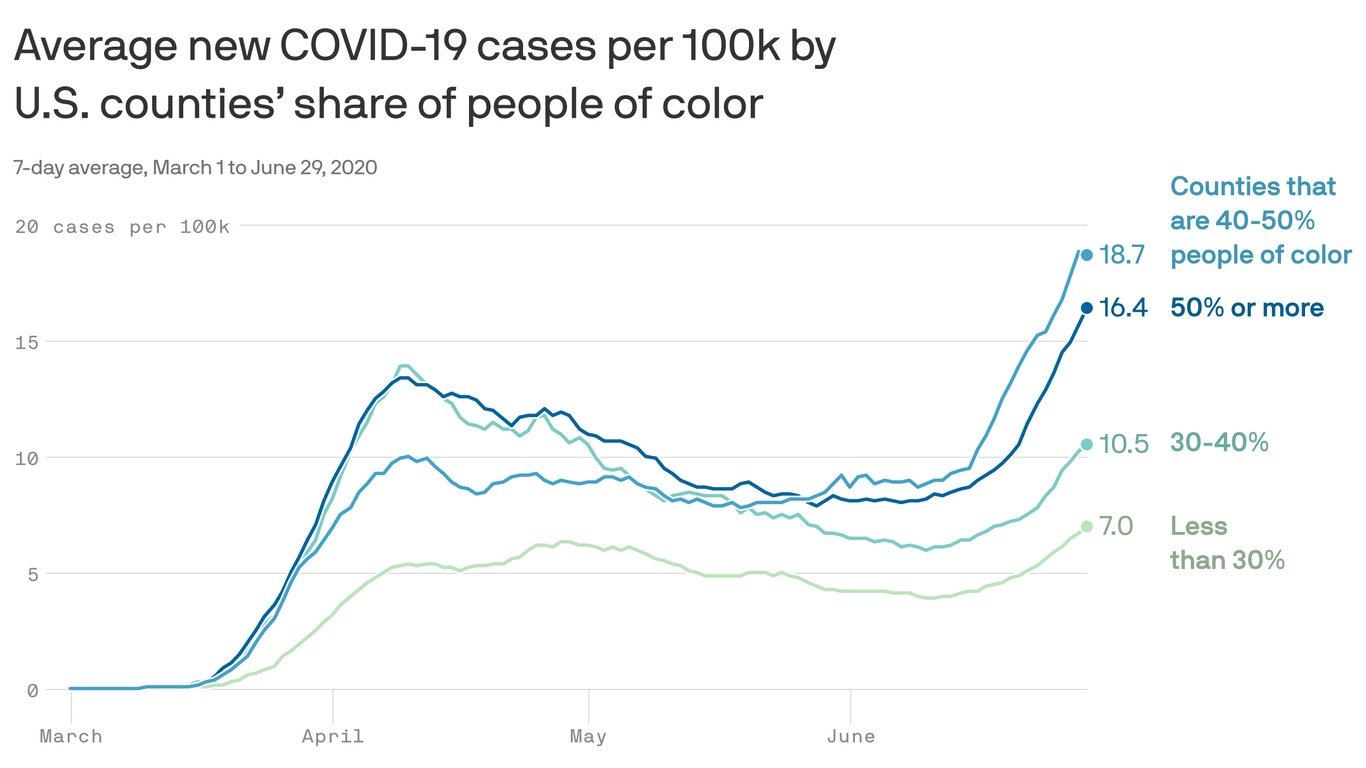
Cases skyrocketing among communities of color

https://www.axios.com/newsletters/axios-vitals-e9aa531d-4ef5-46ec-aedb-56f2bc9a77c9.html?utm_source=newsletter&utm_medium=email&utm_campaign=newsletter_axiosvitals&stream=top

Coronavirus cases skyrocketing among communities of color - Axios

Counties populated by larger numbers of people of color tend to have more coronavirus cases than those with higher shares of white people.

What we’re watching: As the outbreak worsens throughout the South and the West, caseloads are growing fastest in counties with large communities of color.

The big picture: The southern and southwestern parts of the U.S. — the new epicenters of the outbreak — have higher Black and Latino or Hispanic populations to begin with.

  • People of color have seen disproportionate rates of infection, hospitalization and death throughout the pandemic.

Between the lines: These inequities stem from pre-existing racial disparities throughout society, and have been exacerbated by the U.S. coronavirus response.

  • Black and Hispanic or Latino communities have had less access to diagnostic testing, and people of color are also more likely to be essential workers. That means the virus is able to enter and spread throughout a community without adequate detection, often with disastrous results.

The bottom line: Until we plug the huge holes in the American coronavirus response — like inadequate testing and contact tracing and a lack of protection for essential workers — people of color will continue to bear the brunt of the pandemic.

Go deeper: People of color have less access to coronavirus testing