California Hospitals Face Surge With Proven Fixes And Some Hail Marys

https://khn.org/news/california-hospitals-face-surge-with-proven-fixes-and-some-hail-marys/

California Hospitals Face Surge With Proven Fixes And Some Hail ...

California’s hospitals thought they were ready for the next big disaster.

They’ve retrofitted their buildings to withstand a major earthquake and  whisked patients out of danger during deadly wildfires. They’ve kept patients alive with backup generators amid sweeping power shutoffs and trained their staff to thwart would-be shooters.

But nothing has prepared them for a crisis of the magnitude facing hospitals today.

“We’re in a battle with an unseen enemy, and we have to be fully mobilized in a way that’s never been seen in our careers,” said Dr. Stephen Parodi, an infectious disease expert for Kaiser Permanente in California. (Kaiser Health News, which produces California Healthline, is not affiliated with Kaiser Permanente.)

As California enters the most critical period in the state’s battle against COVID-19, the state’s 416 hospitals — big and small, public and private — are scrambling to build the capacity needed for an onslaught of critically ill patients.

Hospitals from Los Angeles to San Jose are already seeing a steady increase in patients infected by the virus, and so far, hospital officials say they have enough space to treat them. But they also issued a dire warning: What happens over the next four to six weeks will determine whether the experience of California overall looks more like that of New York, which has seen an explosion of hospitalizations and deaths, or like that of the San Francisco Bay Area, which has so far managed to prevent a major spike in new infections, hospitalizations and death.

Some of their preparations share common themes: Postpone elective surgeries. Make greater use of telemedicine to limit face-to-face contact. Erect tents outside to care for less critical patients. Add beds — hospital by hospital, a few dozen at a time — to spaces like cafeterias, operating rooms and decommissioned wings.

But by necessity — because of shortages of testing, ventilators, personal protective equipment and even doctors and nurses — they’re also trying creative and sometimes untried strategies to bolster their readiness and increase their capacity.

In San Diego, hospitals may use college dormitories as alternative care sites. A large public hospital in Los Angeles is turning to 3D printing to manufacture ventilator parts. And in hard-hit Santa Clara County, with a population of nearly 2 million, public and private hospitals have joined forces to alleviate pressure on local hospitals by caring for patients at the Santa Clara Convention Center.

Yet some hospitals acknowledge that, despite their efforts, they may end up having to park patients in hallways.

“The need in this pandemic is so different and so extraordinary and so big that a hospital’s typical surge plan will be insufficient for what we’re dealing with in this state and across the nation,” said Carmela Coyle, president and CEO of the California Hospital Association.

Across the U.S., more than 213,000 cases of COVID-19 have been confirmed, and at least 4,750 people have died. California accounts for more than 9,400 cases and at least 199 deaths.

Health officials and hospital administrators are singling out April as the most consequential month in California’s effort to combat a steep increase in new infections. State Health and Human Services Secretary Mark Ghaly said Wednesday that the number of hospitalizations is expected to peak in mid-May.

Gov. Gavin Newsom said there were 1,855 COVID-19 cases in hospitals Wednesday, a number that had tripled in six days, and 774 patients in critical care. By mid-May, the number of critical care patients is expected to climb to 27,000, he said.

Newsom said the state needs nearly 70,000 more hospital beds, bringing its overall capacity to more than 140,000 — both inside hospitals and also at alternative care sites like convention centers. The state also needs 10,000 more ventilators than it normally has to aid the crush of patients needing help to breathe, he said, and so far has acquired fewer than half.

Newsom and state health officials worked with the Trump administration to bring a naval hospital ship to the Port of Los Angeles, where it is already treating patients not infected with the novel coronavirus. The state is working with the Army Corps of Engineers to deploy eight mobile field hospitals, including one in Santa Clara County. And it is bringing hospitals back online that were shuttered or slated to close, including one each in Daly City, Los Angeles, Long Beach and Costa Mesa.

The governor is also drafting a plan to make greater use of hotels and motels and nursing homes to house patients, if needed.

But the size of the surge that hits hospitals depends on how well the public follows social distancing and stay-at-home orders, said Newsom and hospital administrators. “This is not just about health care providers caring for the sick,” said Dr. Steve Lockhart, the chief medical officer of Sutter Health, which has 22 hospitals across Northern California.

While hospitals welcomed the state assistance, they’re also undertaking dramatic measures to prepare on their own.

“I’m genuinely very worried, and it scares me that so many people are still out there doing business as usual,” said Chris Van Gorder, CEO of Scripps Health, a system with five major hospitals in San Diego County. “It wouldn’t take a lot to overwhelm us.”

Internal projections show the hospital system could need 8,000 beds by June, he said. It has 1,200.

In addition to taking precautions to protect its health care workers — such as using baby monitors to observe patients without risking infection — it is working with area colleges to use dorm rooms as hospital rooms for patients with mild cases of COVID-19, among other efforts, he said.

“Honestly, I think we should have been better prepared than we are,” Van Gorder said. “But hospitals cannot take on this burden themselves.”

Van Gorder and other hospital administrators say a continued shortage of COVID-19 tests has hampered their response — because they still don’t know exactly which patients have the virus — as has the chronic underfunding of public health infrastructure.

Kaiser Permanente wants to double the capacity of its 36 California hospitals, Parodi said. It is also working with the garment industry to manufacture face masks, and eyeing hotel rooms for less critical patients.

Harbor-UCLA Medical Center, a 425-bed safety-net hospital in Los Angeles, is working to increase its capacity by 200%, said Dr. Anish Mahajan, the hospital’s chief medical officer.

Harbor-UCLA is using 3D printers to produce ventilator piping equipped to serve two patients per machine. And in March it transformed a new emergency wing into an intensive care unit for COVID-19 patients.

“This was a shocking thing to do,” Mahajan said of the unprecedented move to create extra space.

He said some measures are untested, but hospitals across the state are facing extreme pressure to do whatever they can to meet their greatest needs.

In March, Stanford Hospital in the San Francisco Bay Area launched a massive telemedicine overhaul of its emergency department to reduce the number of employees who interact with patients in person. This is the first time the hospital has used telemedicine like this, said Dr. Ryan Ribeira, an emergency physician who spearheaded the project.

Stanford also did some soul-searching, thinking about which of its staff might be at highest risk if they catch COVID-19, and has assigned them to parts of the hospital with no coronavirus patients or areas dedicated to telemedicine. “These are people that we might have otherwise had to drop off the schedule,” Ribeira said.

Nearby, several San Francisco hospitals that were previously competitors have joined forces to create a dedicated COVID-19 floor at Saint Francis Memorial Hospital with four dozen critical care beds.

The city currently has 1,300 beds, including 200 ICU beds. If the number of patients surges as it has in New York, officials anticipate needing 5,000 additional beds.

But the San Francisco Bay Area hasn’t yet seen the expected surge. UCSF Health had 15 inpatients with COVID-19 Tuesday. Zuckerberg San Francisco General Hospital and Trauma Center had 18 inpatients with the disease Wednesday.

While hospital officials are cautiously optimistic that local and state stay-at-home orders have worked to slow the spread of the virus, they are still preparing for what could be a major increase in admissions.

“The next two weeks is when we’re really going to see the surge,” said San Francisco General CEO Susan Ehrlich. “We’re preparing for the worst but hoping for the best.”


Already Taxed Health Care Workers Not ‘Immune’ From Layoffs And Less Pay

https://khn.org/news/already-taxed-health-care-workers-not-immune-from-layoffs-and-less-pay/

Already Taxed Health Care Workers Not 'Immune' From Layoffs And ...

Just three weeks ago, Dr. Kathryn Davis worried about the coronavirus, but not about how it might affect her group of five OB-GYNs who practice at a suburban hospital outside Boston.

“In medicine we think we’re relatively immune from the economy,” Davis said. “People are always going to get sick; people are always going to need doctors.”

Then, two weeks ago, she watched her practice revenue drop 50% almost overnight after Massachusetts officials told doctors and hospitals to stop performing elective tests and procedures. For Davis, that meant no more non-urgent gynecological visits and screenings.

Late last week, as Davis and her partners absorbed the stunning turn of events, they devised a stopgap plan. The 35 nurses, medical assistants and secretaries they employ would have two options: move from full-time to part-time status or start collecting unemployment. Doctors in the practice would take a substantial pay cut. Davis said she’s hearing from colleagues who may have to permanently close their offices if the focus on crisis-level care continues for months.

“It’s shocking,” she said. “Everyone has been blindsided.”

Atrius Health, the largest independent physician group in Massachusetts, said patient volume is down 75% since mid-March. It is temporarily closing offices, placing many nonclinical employees on furlough and withholding pay for those who remain. The average withholding is 20%, and the company pledges that pay withheld will be returned. The lowest-paid workers, those earning up to $55,000, are exempt.

“What we’re trying to do is piece together a solution to get through the crisis and keep employed as many people as we can,” said Dr. Steven Strongwater, Atrius Health’s CEO.

Atrius cares for 745,000 patients in clinics that often include primary care, specialists, radiology and a pharmacy under one roof.

Strongwater said physician groups must be included when the federal government distributes $100 billion to hospitals from the $2 trillion stimulus package.

It’s not clear if that money will stop the tide of layoffs and lost pay at hospitals as well as in doctor’s offices. A Harvard Medical School physician group will suspend retirement contributions starting April 1.

Beth Israel Lahey Health, the second-largest hospital network in Massachusetts, announced executive pay cuts Monday.

“The suspension of elective procedures and decline in visits to our primary care practices and urgent care centers have resulted in financial challenges,” wrote CEO Dr. Kevin Tabb in an email to employees. Tabb said he would take a 50% salary cut. Other executives and hospital presidents in the system will forgo 20% of their salaries for the next three months.

“Although executive leadership compensation is being reduced, we will never compromise on doing the things that are essential to protect your safety and the safety of our patients,” Tabb told staff.

Dallas-based Steward Health Care has told hospital employees in Massachusetts and eight other states where it operates to expect furloughs focused on nonclinical staff. In a statement, Steward Health Care said it prepared for the pandemic but is experiencing a “seismic financial shock.”

“Elective surgeries are the cornerstone of our hospital system’s operating model — and the negative impact due to the cancellations of these procedures cannot be overstated. In addition, patients are understandably cautious and choosing to defer any nonemergency treatments or routine visits until this crisis has passed.”

Dr. Kaarkuzhali Babu Krishnamurthy, an assistant professor of neurology at Harvard Medical School who studies medical ethics, said employers need to think more carefully about the ethics of asking doctors and nurses to live on less when many are working longer hours and putting the health of their families at risk.

“At a time when health care systems are calling on doctors and nurses to do more, this is not the time to be making it more difficult to do that,” said Krishnamurthy.

There’s talk of redeploying laid-off health care workers to new COVID-19 units opening in shuttered hospitals or to patient overflow sites. Tim Foley, executive vice president for the largest health care union in Massachusetts, 1199SEIU, is promoting the development of a staff registry.

“It is more important, now more than ever, to explore all options to maintain the level of urgent care needed across the state and we look forward to working with all stakeholders to do just that,” Foley said in an email.


Anthony Fauci’s security is stepped up as doctor and face of U.S. coronavirus response receives threats

https://www.washingtonpost.com/politics/anthony-faucis-security-is-stepped-up-as-doctor-and-face-of-us-coronavirus-response-receives-threats/2020/04/01/ff861a16-744d-11ea-85cb-8670579b863d_story.html?utm_campaign=wp_news_alert_revere&utm_medium=email&utm_source=alert&wpisrc=al_news__alert-hse–alert-national&wpmk=1

Nation's top coronavirus expert Dr. Anthony Fauci forced to beef ...

Anthony S. Fauci, the nation’s top infectious-diseases expert and the face of the U.S. response to the novel coronavirus pandemic, is facing growing threats to his personal safety, prompting the government to step up his security, according to people familiar with the matter.

The concerns include threats as well as unwelcome communications from fervent admirers, according to people with knowledge of deliberations inside the Department of Health and Human Services and the Department of Justice.

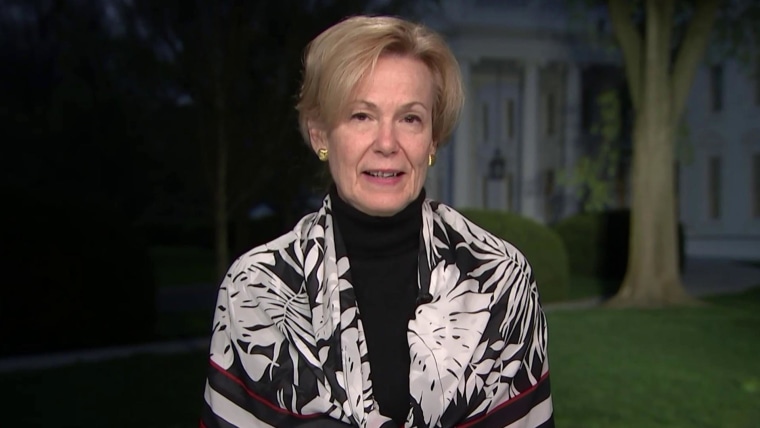
Fauci, 79, is the most outspoken member of the administration in favor of sweeping public health guidelines and is among the few officials willing to correct President Trump’s misstatements. Along with Deborah Birx, the coordinator for the White House’s task force, Fauci has encouraged the president to extend the timeline for social-distancing guidelines, presenting him with grim models about the possible toll of the pandemic.

“Now is the time, whenever you’re having an effect, not to take your foot off the accelerator and on the brake, but to just press it down on the accelerator,” he said Tuesday as the White House’s task force made some of those models public, warning of 100,000 to 240,000 deaths in the United States.

The exact nature of the threats against him was not clear. Greater exposure has led to more praise for the doctor but also more criticism.

Fauci has become a public target for some right-wing commentators and bloggers, who exercise influence over parts of the president’s base. As they press for the president to ease restrictions to reinvigorate economic activity, some of these figures have assailed Fauci and questioned his expertise.

Last month, an article depicting him as an agent of the “deep state” gained nearly 25,000 interactions on Facebook — meaning likes, comments and shares — as it was posted to large pro-Trump groups with titles such as “Trump Strong” and “Tampa Bay Trump Club.”

Alex Azar, the HHS secretary, recently grew concerned about Fauci’s safety as his profile rose and he endured more vitriolic criticism online, according to people familiar with the situation. In recent weeks, admirers have also approached Fauci, asking to him sign baseballs, along with other acts of adulation. It was determined that Fauci should have a security detail. Azar also has a security detail because he is in the presidential line of succession.

Asked Wednesday whether he was receiving security protection, Fauci told reporters, “I would have to refer you to HHS [inspector general] on that. I wouldn’t comment.”

The president interjected, saying, “He doesn’t need security. Everybody loves him.”

HHS asked the U.S. Marshals Service to deputize a group of agents in the office of the HHS inspector general to provide protective services for the doctor, according to an official with knowledge of the request.

The U.S. Marshals Service conveyed the request to the deputy attorney general, who has authority over deputations for the purpose of providing protective services, with the recommendation that it be approved, according to the official, who spoke on the condition of anonymity to reveal sensitive plans that the person was not authorized to discuss.

A Justice Department official signed paperwork Tuesday authorizing HHS to provide its own security detail to Fauci, according to an administration official.

An HHS spokesperson declined to discuss details of the doctor’s security but said: “Dr. Fauci is an integral part of the U.S. Government’s response against covid-19. Among other efforts, he is leading the development of a covid-19 vaccine and he regularly appears at White House press briefings and media interviews.”

At the briefings, Fauci, who has advised presidents of both parties as director of the National Institute of Allergy and Infectious Diseases, has spoken authoritatively about the spread of the coronavirus and the sacrifices involved in mitigating its effects.

He has at times corrected the president, in particular when prompted by reporters. After Trump said a covid-19 vaccine would be available in a couple of months, Fauci said it would in fact be available in about a year to a year and a half, at best.

His role has turned him into a hero for some. When he was absent from a briefing last month, followers who had grown accustomed to his frank assessments of the outbreak were alarmed that he might have been sidelined for his forthrightness. Many took to Twitter to ask, “Where is Dr. Fauci?” causing the question to trend on the platform.

He gained viral attention two days later when he placed his hand in front of his face in a gesture of apparent disbelief as Trump referred to the State Department as the “deep state department” from the White House briefing room.

Fauci has also given several interviews in which he has tempered praise for the president with doubts about his pronouncements, including about the viability of anti-malarial drugs as a treatment for the novel coronavirus. Most notably, he told the journal Science that he attempts to guide Trump’s statements but “can’t jump in front of the microphone and push him down.”

These moves have inspired fandom. But they have also drawn scorn from some of the president’s most vocal supporters, even as both men have sought to tamp down the appearance of tension.

“The president was right, and frankly Fauci was wrong,” Lou Dobbs said last week on his show on the Fox Business Network, referring to the use of experimental medicine.

Right-wing news and opinion sites have gone further, launching baseless smears against the doctor that have gained significant traction within pro-Trump communities online.

Outlets such as the Gateway Pundit and American Thinker seized on a 2013 email — released by WikiLeaks as part of a cache of communications hacked by Russian operatives — in which Fauci praised Hillary Clinton’s “stamina and capability” during her testimony as secretary of state before the congressional committee investigating the attacks in Benghazi, Libya.

The headline in the American Thinker referred to Fauci as a “Deep-State ­Hillary Clinton-loving stooge.” The author, Peter Barry Chowka, didn’t respond to requests for comment. When asked about the relevance of Fauci’s emails to his role in advising the White House’s coronavirus response, Jim Hoft, the editor of the Gateway Pundit, said, “I don’t have a problem with more information being shared about the doctor.”

The outlet has continued to criticize Fauci in recent days, saying that by offering new predictions about the possible death toll, Fauci and others were “going to destroy the U.S. economy based on total guesses and hysterical predictions.”

Several senior administration officials said that Trump respects Fauci and that the two generally have a good working relationship. Trump heeded the guidance of Fauci and Birx this week when he announced his administration would extend social-distancing guidelines for another 30 days. Last week, many health officials and experts grew worried when Trump said he hoped to reopen the country by Easter, even as coronavirus cases in the United States continue to rapidly climb.

The immunologist, who graduated first in his class from Cornell’s medical school, has been the director of the National Institute of Allergy and Infectious Diseases since 1984. Between 1983 and 2002, he was the 13th-most-cited scientist among the 2.5 million to 3 million authors worldwide and across all disciplines publishing in scientific journals, according to the Institute for Scientific Information.


Jobless claims spike to another weekly record amid coronavirus crisis

https://www.axios.com/jobless-claims-unemployment-coronavirus-e54561c2-ed25-4f1e-8e32-7fbec81a9a24.html?stream=top&utm_source=alert&utm_medium=email&utm_campaign=alerts_all

Jobless claims spike to 6.6 million, another weekly record amid ...

6.6 million people filed for unemployment last week, a staggering number that eclipses the record set just days ago amid the coronavirus pandemic, according to government data released Thursday.

Why it matters: Efforts to contain the outbreak are continuing to create a jobs crisis, causing the sharpest spikes in unemployment filings in American history.

  • The colossal number of unemployment filings is worse than most Wall Street banks were expecting.

The big picture: Nearly 10 million Americans have filed for unemployment claims in recent weeks, as businesses around the country shut down in response to the pandemic.

  • But the data lags by a week, so it’s almost certain labor departments around the country are still processing claims and people are still applying.


$40M sale of 2 California hospitals includes commitment to COVID-19 patient care

https://www.beckershospitalreview.com/hospital-transactions-and-valuation/40m-sale-of-2-california-hospitals-includes-commitment-to-covid-19-patient-care.html?utm_medium=email

Verity Health gets $610 million offer for four hospitals

Verity Health Gets $610M Offer to Buy St. Vincent, St. Francis and ...

El Segundo, Calif.-based Verity Health has agreed to sell two California hospitals to AHMC Healthcare and is seeking an expedited review of the transaction, according to Bloomberg Law.

Verity, which entered Chapter 11 bankruptcy in 2018, filed a motion with the bankruptcy court March 29, seeking approval for the sale. Under the proposed transaction, Verity would sell Seton Medical Center in Daly City, Calif., and Seton Coastside in Moss Beach, Calif., to AHMC for $40 million. The agreement also includes a commitment by AHMC to continue to support the state’s efforts to address the COVID-19 pandemic.

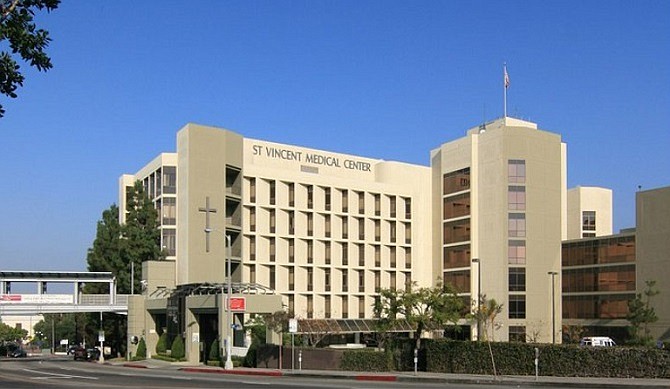
The proposed deal comes after California Gov. Gavin Newson announced March 21 that the state will use $30 million in emergency funding to lease Seton Medical Center and St. Vincent Medical Center in Los Angeles, which Verity closed in January. The state is leasing the hospitals for three months to expand capacity for COVID-19 patients.


The outbreak won’t peak in every state at once

https://www.axios.com/newsletters/axios-vitals-838f492a-6bf5-4aab-b5e4-c291464cd538.html?utm_source=newsletter&utm_medium=email&utm_campaign=newsletter_axiosvitals&stream=top

USA Projected date of peak hospital
resource demand due to COVID-19

The coronavirus projected peak date in each state - Axios


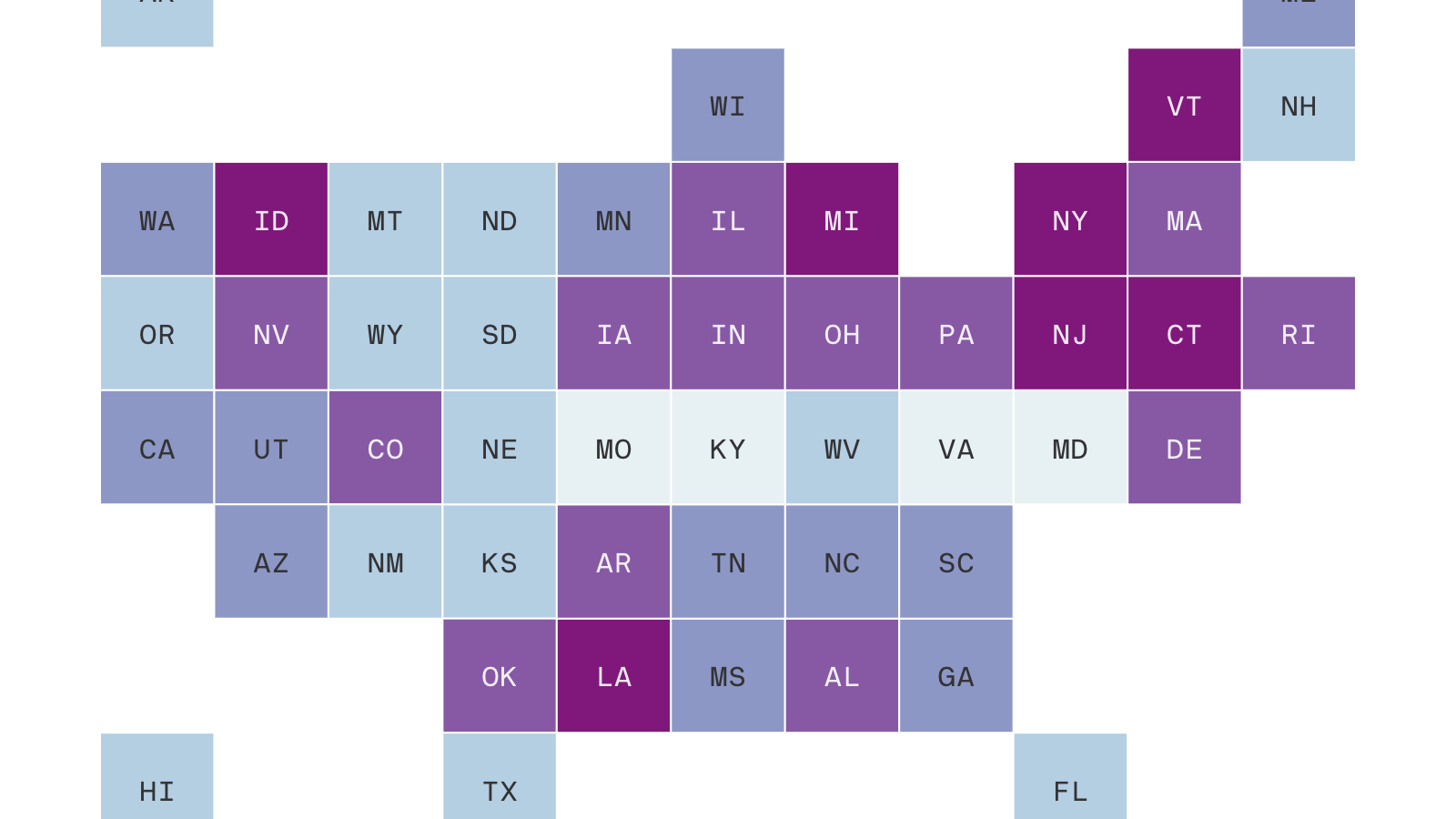
Although the coronavirus is expected to peak in the U.S. in two weeks, many states will see their individual peaks well after that, according to a model by the University of Washington’s Institute for Health Metrics and Evaluation.

Why it matters: States like Virginia and Maryland have more time to prepare for their systems to be maximally strained — if they make good use of that time.

States’ coronavirus peaks are defined as the point at which there is the most demand for resources, namely hospital beds and ventilators.

  • This is also the point at which the most health care workers will be needed to care for coronavirus patients.

Some experts warn that states expected to face the hardest hit later in the year aren’t using their lead time well.

  • “The states that are going to be affected last need to start husbanding resources now, because the feds could get tapped out … by some of these early states, particularly New York, which has absorbed a lot of federal resources,” former Food and Drug Administration commissioner Scott Gottlieb told me.
  • Even though they may not be seeing a huge number of cases now, states like Texas and Florida should stop doing elective surgeries now in order to preserve personal protective equipment — like masks, gowns and gloves — for their health care workers, Gottlieb added.

The bottom line: Coronavirus outbreaks, both globally and in the U.S., have seemed manageable until it’s too late. For states that so far aren’t hit hard, there’s no such thing as over-preparing.


An explosion of coronavirus cases cripples a federal prison in Louisiana

https://www.washingtonpost.com/national/an-explosion-of-coronavirus-cases-cripples-a-federal-prison-in-louisiana/2020/03/29/75a465c0-71d5-11ea-85cb-8670579b863d_story.html?fbclid=IwAR2rjY1fk7FF2H1vhUxaeZ4c8F3_Vi1HUJhCUkhP-bjFdc_tbuHV8KrKN80&utm_campaign=wp_main&utm_medium=social&utm_source=facebook

Federal prison in Louisiana crippled by coronavirus cases as ...

A federal prison in Louisiana has, within days, exploded with coronavirus cases, leading to the death of one inmate on Saturday, the admission of a guard into a hospital intensive care unit, and positive test results for another 30 inmates and staff.

Patrick Jones, 49, was the first inmate in the Federal Bureau of Prisons diagnosed with the novel coronavirus, which causes covid-19, and the first to die.

At least 60 inmates at the Oakdale prison are in quarantine and an unknown number of staff are self-quarantining at home, said Corey Trammel, a union representative for correctional officers at the 1,700-inmate facility about 110 miles northwest of Baton Rouge.

“It’s been simultaneous, just people getting sick back to back to back to back,” Trammel said. “We don’t know how to protect ourselves. Staff are working 36-hour shifts — there’s no way we can keep going on like this.”

The prison bureau is not releasing the names of other infected inmates or staff, citing medical and privacy concerns. Jones complained of a “persistent cough” on March 19, the prison bureau said, and was transported to a hospital where he was diagnosed and placed on a ventilator.

The prison bureau also said Jones had “long-term, preexisting medical conditions” that increased his risk of developing the disease. Jones was convicted in 2017 of possession with intent to distribute crack cocaine within 1,000 feet of a junior college. He was serving a 27-year sentence.

Louisiana ranks 10th highest among states for reported coronavirus cases, with more than 3,300 people who have tested positive and another 137 who have died, government reports show. A week before the Oakdale prison had its first positive case, Gov. John Bel Edwards (D) issued a stay-at-home order and closed all public schools.

Trammel said the prison bureau has been slow to respond to the crisis across the country. The bureau last week banned family and friends from visiting inmates, but the officers’ union had lobbied the federal prison system to take this action for weeks to keep the disease from infiltrating the prison walls.

The Bureau of Prisons updates confirmed coronavirus cases most afternoons on its website, but there has been a lag between cases reported by the officers’ union and prison officials. As of Sunday afternoon, the prison system had only confirmed 14 inmates and 13 staff have tested positive.

At Oakdale, Trammel said staff also asked prison officials — weeks before the first coronavirus case — to shut down a prison labor program within the facility, where more than 100 prisoners make inmate clothing. The program, Trammel said, was not shut down until after the first inmate tested positive.

The Bureau of Prisons — which operates 122 prisons with more than 175,000 inmates — did not immediately respond Sunday to a request for comment. Oakdale Warden Rod Myers could also not be reached for comment.

Trammel said he asked the prison bureau on Saturday to send specialized medical teams to the facility to help with staffing shortages. He’s also asking for hazard pay, which would increase their salaries by 25 percent as they respond to the crisis. And he’s asking for more robust protective gear, including masks with respirators and perhaps face shields.

“We are bringing inmates to the hospitals and are staying right beside them around the clock,” Trammel said. “All we have is these itty bitty masks — a piece of towel over our faces — and nurses are coming into the room for a few minutes and they are all suited up.”

He also said he believes all Oakdale prison staff have now been exposed to the virus. Days ago, he interacted with an inmate who had a fever and still doesn’t know if the prisoner has received a test.

“We should all be in quarantine,” Trammel said. “We should not be going in to spread this monster of a virus.”

Prison reform advocates, who have been pushing for the early release of elderly and severely ill inmates due to covid-19, said the death of a federal inmate illustrates why government officials need to be doing a better job of protecting people like Jones.

“The conditions and reality of incarceration make prisons and jails tinderboxes for the spread of disease,” said Udi Ofer, director of the American Civil Liberties Union’s Justice Division. “A prison sentence should not become a death sentence. Our leaders must immediately take steps to release those identified by the CDC as most vulnerable to covid-19. With every hour of inaction that passes, the greater the human tragedy.”


Dr. Birx predicts up to 200,000 coronavirus deaths ‘if we do things almost perfectly’

https://www.yahoo.com/news/dr-birx-predicts-200-000-115800421.html

Dr. Birx predicts up to 200,000 U.S. coronavirus deaths 'if we do ...

The White House coronavirus response coordinator said Monday that she is “very worried about every city in the United States” and projects 100,000 to 200,000 American deaths as a best case scenario.

In an interview on “TODAY,” Dr. Deborah Birx painted a grim message about the expected fatalities, echoing that they could hit more than 2 million without any measures, as coronavirus cases continue to climb throughout the country.

“I think everyone understands now that you can go from five to 50 to 500 to 5,000 cases very quickly,” Birx said.

“I think in some of the metro areas we were late in getting people to follow the 15-day guidelines,” she added.

Birx said the projections by Dr. Anthony Fauci that U.S. deaths could range from 1.6 million to 2.2 million is a worst case scenario if the country did “nothing” to contain the outbreak, but said even “if we do things almost perfectly,” she still predicts up to 200,000 U.S. deaths.

Fauci, the director of the National Institute of Allergy and Infectious Diseases, reiterated Monday on CNN that “I don’t want to see it, I’d like to avoid it, but I wouldn’t be surprised if we saw 100,000 deaths.”

Politics

Birx said the best case scenario would be for “100 percent of Americans doing precisely what is required, but we’re not sure that all of America is responding in a uniform way to protect one another,” referencing images circulating online of people still congregating in big groups and ignoring guidelines from the Centers for Disease Control and Prevention.

Birx was also on “Meet the Press” on Sunday warning that “no state, no metro area will be spared,” a message she repeated Monday. Even if metro or rural areas don’t see the virus in the community now, by the time it does appear, the outbreak will be significant, she added.

How long Americans will be expected to comply with measures, including socially distancing and sheltering in place, remains unclear in this growing pandemic after several states and larger cities began implementing measures over the past couple of weeks.

President Trump announced Sunday that the administration’s guidelines on social distancing have been extended until April 30. Trump said last week that he wanted to see much of the country return to normal by Easter, April 12, despite warnings from top health experts that easing guidelines early could cause mass deaths. Now, Trump said he expects “great things to be happening” by June 1.

Birx said on Sunday that the choice to extend the guidelines had not been made lightly.

“We know it’s a huge sacrifice for everyone,” she added.


Nurse dies in New York hospital where workers are reduced to using trash bags as protective medical gear

https://www.businessinsider.com/kious-kelly-hospital-nurse-dies-trash-bags-2020-3?utmSource=twitter&utmContent=referral&utmTerm=topbar&referrer=twitter&fbclid=IwAR3BPkAbdFrHQBM1UiV3o23sIqDsBxkhLBNJ7kV9sCmqU3zpKndGKHc0gY8

Nurse dies in New York hospital where workers are reduced to using ...

A nurse at Mount Sinai Hospital in New York died from COVID-19 after learning he was infected by the novel coronavirus almost two weeks ago. Protective medical gowns are in such short supply in the Mount Sinai system that some nurses have started to use Hefty-brand garbage bags instead, according to photos on social media.

The New York Post reported that Kious Kelly, an assistant nursing manager at Mount Sinai Hospital in Manhattan, died Tuesday. He was 48 years old.

His sister confirmed his death to the Post, saying that she was told he had been in the intensive-care unit but that he did not think it was serious. The Post did not specify how he contracted the virus.

“We are deeply saddened by the passing of a beloved member of our nursing staff,” Renatt Brodsky, a representative for the Mount Sinai Health System, told Business Insider in a statement. Brodsky did not provide any further details.

New York state has become the epicenter for the US’s coronavirus outbreak, with more than 33,000 infections and more than 360 deaths. In New York and other areas in the US with large outbreaks, healthcare workers are reporting shortages of personal protective equipment like masks, gowns, face shields, and gloves.

At Mount Sinai West, in the same hospital system where Kelly worked, nurses published a photo on social media showing them fashioning plastic trash bags into protective outfits, according to the Post.

“NO MORE GOWNS IN THE WHOLE HOSPITAL,” they wrote on Facebook. “NO MORE MASKS AND REUSING THE DISPOSABLE ONES … NURSES FIGURING IT OUT DURING COVID-19 CRISIS.” One nurse is seen holding a box of Hefty Strong 33-gallon bags, more commonly used for lining household trash cans.