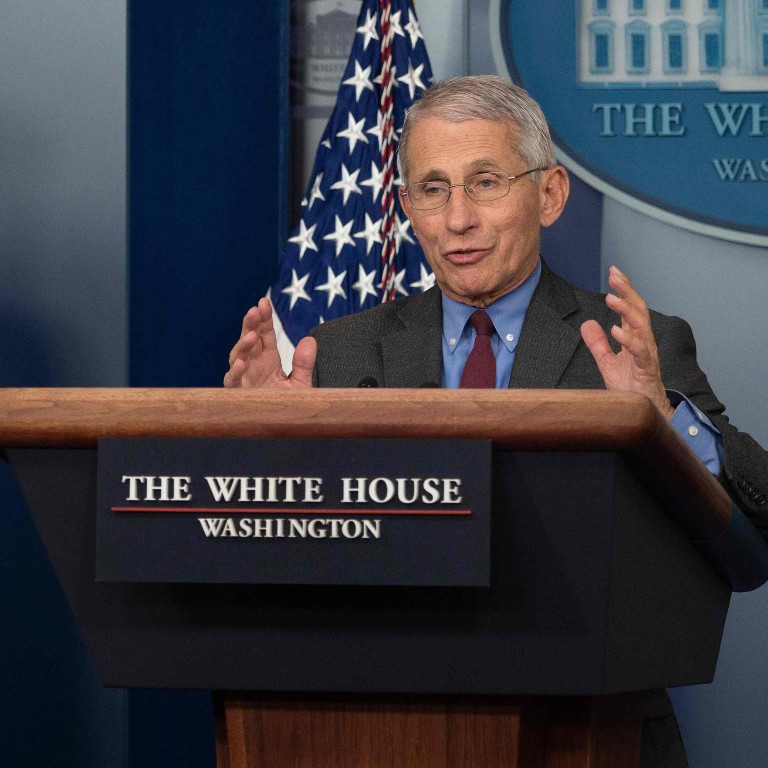
Fauci at center of conservative storm

Fauci at center of conservative storm

Health Official condemns Senator Ron Johnson's false equivalency ...

Criticism of Anthony Fauci from the right has picked up in recent days, with some conservatives calling for Trump to dump the infectious disease expert after he made comments about how imposing social distancing rules earlier could have slowed the spread of the novel coronavirus in the United States.

Fauci has become a national name with his regular presence at the daily coronavirus task force briefings and in other media appearances, and poll numbers show he’s trusted by a majority of Americans. It would set off a political storm if Trump were to sideline him in the middle of a pandemic.

Yet the criticism of Fauci by two conservative lawmakers in a Saturday op-ed and Trump’s own retweet of a conservative’s call to “#FireFauci” were unmistakable signs that the public health official is coming under pressure from some on the right to be loyal to the president. 

Tensions between Fauci and Trump have been evident at times in recent weeks. The doctor put his head in his hand at one March briefing where the president quipped about the “Deep State Department,” and Trump stepped in at a briefing this month before Fauci could give his opinion on hydroxychloroquine.

The president had publicly praised Fauci as “extraordinary” and dismissed speculation about a rift between the two, joking on Friday that Fauci is so popular he could run against Rep. Alexandria Ocasio-Cortez (D-N.Y.) and “win easily.” For the most part Fauci has seemed to successfully walk the line between contradicting Trump without outright criticizing him. 

But Trump’s tweet on Sunday marked a shift and coincided with a fresh groundswell of conservative push-back toward the doctor as Trump comes under intense criticism for his slow response to the virus.

Some of the more pointed criticism of Fauci came after he said on CNN Sunday that more lives could have been saved if stay-at-home measures were implemented earlier than mid-March.

The comments irked Trump allies who viewed them as revisionist history given how Fauci’s own public statements evolved throughout January and February as scientists learned more about the virus and it spread through the U.S.

Jason Miller, a former Trump adviser who now hosts a radio show focused on the pandemic, said Fauci must be careful with how he talks about the crisis, but also described “finger pointing” as media chatter seeking to pull the administration apart.

“This talk of potential removal from the team is unnecessary media chatter trying to draw a divide where one doesn’t exist,” Miller said.

“I think what this is about is about the accuracy with which Dr. Fauci is communicating with both the president and the American people,” he added. “It’s critical as the lead scientist and health expert advising the president on the coronavirus pandemic that he be spot on with his details. I think the recent finger pointing and revisionist history whether intentional or accidental doesn’t help anybody.”

One source close to the administration said, while some inside would like to see Fauci gone, most recognize there is more value to keeping him on.

“I don’t sense there’s a monolithic view,” the person said. “There are some who dislike him and want him out of the [administration] but I think most recognize it’s better for him to be in the tent than outside of it.” 

Fauci’s CNN remarks followed a New York Times article detailing how Trump ignored early warnings about the virus and initially resisted recommendations to implement social distancing recommendations, reporting that Trump has dismissed as “fake.”

One of Trump’s many tweets Sunday night defending his response quoted a former GOP congressional candidate who said it was “time to #FireFauci,” citing his Feb. 29 comments that there was not yet a need for Americans to alter their day-to-day lives.

Fauci has been clear that his realm of expertise is public health, and he has suggested at times that social distancing guidelines will be needed for weeks or months to limit the spread of the virus.

Others inside and outside the administration are advocating that it take steps to open up the economy soon, and emphasizing that health experts can’t be the only voices involved in the decision.

“Anthony Fauci should be deferring to the President when answering questions about timing of economic reopening,” Fox News host Laura Ingraham tweeted on Sunday.

Reps. Andy Biggs (R-Ariz.) and Ken Buck (R-Colo.) penned an op-ed in the Washington Examiner over the weekend arguing that Fauci should not be a primary voice speaking on the coronavirus outbreak after the public health official late last month described social distancing as an “inconvenient” from societal and economic standpoint.

The criticism of Fauci comes amid a concerted effort among Trump and his supporters to shift blame away from the White House for its handling of the coronavirus, which has infected more than 557,000 people in the U.S. and killed more than 22,000 in the country. The president has at various points blamed governors for failing to prepare for the pandemic, deflected criticism toward the World Health Organization (WHO) and accused Democrats of using impeachment as a distraction.

Fauci, director of the National Institute of Allergy and Infectious Diseases since 1984, has been a ubiquitous presence during the coronavirus outbreak, appearing on political talk shows, sports podcasts and Instagram live chats.

He has emerged as something of a beacon for liberals in particular for his willingness to gently correct Trump on matters like a timetable for a vaccine and the efficacy of hydroxychloroquine, an anti-malaria drug the president has touted as a potential treatment for the coronavirus.

But his prominence has made him a target of criticism, so much so that he was given added security at the end of March.

One feature of Trump’s presidency has been his distrust of long-time government officials, particularly those who have served in previous administrations. Another has been Trump’s tendency to tire of aides and advisers who garner more of a spotlight than he does, putting Fauci in a precarious position even at a time when his expertise is most relevant.

Trump would have difficulty firing Fauci, who is not a political appointee, without cause. Attempting to do so would cause a firestorm among even some Republicans who have urged the president to listen to his health experts.

But one former administration official suggested Fauci could see his influence reduced. The official likened it to the way Health and Human Services (HHS) Secretary Alex Azar has been diminished after he warned Trump in January and February about the threat of a pandemic but was dismissed as too alarmist.

“What happens when somebody repeatedly tells the president something he doesn’t want to hear?” said the former administration official, who requested anonymity to speak candidly. “He won’t fire [Fauci], but he’ll just sideline him.”

But doing so could risk damaging public confidence in the administration’s response to the virus. 

Monmouth University poll released last week found that 35 percent of Americans named Fauci when asked who they trust the most among public officials who discuss the outbreak on television, whereas 20 percent named Trump. 

“Regardless of the issue, [Trump is] not always his most disciplined messenger,” said GOP strategist Doug Heye. “The more that he’s able to rely on the expertise of scientists, the more credibility that it gives him in this entire process.”


Trump reportedly squandered 3 crucial weeks to mitigate the coronavirus outbreak after a CDC official’s blunt warnings spooked the stock market

https://www.businessinsider.com/trump-wasted-3-weeks-coronavirus-mitigation-time-february-march-nyt-2020-4

Dow closes with decline of 950 points as coronavirus continues to ...

  • President Donald Trump’s administration wasted three key weeks between February and March that could have been spent enacting mitigatory measures against COVID-19, The New York Times reported on Saturday.
  • By the end of February, top officials knew that time was running out to stem the virus spread, and wanted to present Trump with a plan to enact aggressive social distancing and stay-at-home measures.
  • But on February 26, a top CDC official issued stark warnings about the virus’ spread right before the stock market plummeted, which angered Trump for being, in his view, too alarmist. 
  • The Times reported that the entire episode killed off the efforts to persuade Trump to take aggressive, action to mitigate the virus’ spread. In the end, Trump didn’t issue stay-at-home guidance until March 16. 

President Donald Trump’s administration stalled three key weeks in February that could have been spent enacting mitigatory measures against COVID-19 after Trump was angered by a public health official issuing a dire warning about the virus, The New York Times reported on Saturday.

On Saturday,The Times published a lengthy investigation of all the instances Trump brushed aside warnings of the severity of the coronavirus crisis, failed to act, and was delayed by significant infighting and mixed messages from the White House over what action to take and when. 

The Times wrote: “These final days of February, perhaps more than any other moment during his tenure in the White House, illustrated Mr. Trump’s inability or unwillingness to absorb warnings coming at him.”

The Times conducted dozens of interviews with current and former officials and obtained 80 pages of emails from a number of public health experts both within and outside of the federal government who sounded the alarm about the severity of the crisis on an email chain they called “Red Dawn.”

One of the members of the email group, Health & Human Service disaster preparedness official Dr. Robert Kadlec, became particularly concerned about how rapidly the virus could spread when Dr. Eva Lee, a Georgia Tech researcher, shared a study with the group about a 20-year-old woman in China who spread the virus to five of her family members despite showing no symptoms.

“Eva is this true?! If so we have a huge [hole] on our screening and quarantine effort,” he replied on February 23. 

At that point, researchers and top officials in the federal government determined that since it was way too late to try to keep the virus out of the United States, the best course of action was to introduce mitigatory, non-pharmaceutical interventions (NPIs) like social distancing and prohibiting large gatherings.

As officials sounded the alarm that they didn’t have any time to waste before enacting aggressive measures to contain the virus, top public health officials including Dr. Robert Kadlec concluded that it was time to present Trump with a plan to curb the virus called “Four Steps to Mitigation.”

The plan, according to The Times, included canceling large gatherings, concerts, and sporting events, closing down schools, and both governments and private businesses alike ordering employees to work from home and stay at home as much as possible, in addition to quarantine and isolating the sick.

But their entire plan was derailed by a series of events that ended up delaying the White House’s response by several weeks, wasting precious time in the process.

Trump was on a state visit to India when Dr. Kadlec and other experts wanted to present him with the plan, so they decided to wait until he came back.

But less than a day later, Dr. Nancy Messonnier, the director of the National Center for Immunization and Respiratory Diseases at the CDC, publicly sounded the alarm about the severity of the coronavirus outbreak in a February 26 press conference, warning that the outbreak would soon become a pandemic.

“It’s not so much a question of if this will happen anymore but rather more a question of exactly when this will happen and how many people in this country will have severe illness,” Messonnier said, bluntly warning that community transmission of the virus would be inevitable.

The Times reported that Trump spent the plane ride stewing in anger both over Messonnier’s comments and the resulting plummet of the stock market they caused, calling Secretary of Health & Human Services Alex Azar “raging that Dr. Messonnier had scared people unnecessarily,” The Times said. 

The Times reported that the entire episode effectively killed off any efforts to persuade Trump to take aggressive, decisive action to mitigate the virus’ spread and led to Azar being sidelined, writing, ” With Mr. Pence and his staff in charge, the focus was clear: no more alarmist messages.” 

In the end, Dr. Kadlec’s team never made their presentation. Trump did not issue nationwide social distancing and stay-at-home guidelines until March 16, three weeks after Messonnier warned that the US had limited time to mitigate community transmission of the virus, and several weeks after top experts started calling for US officials to implement such measures.

In those nearly three weeks between February 26 and March 16, the number of confirmed COVID-19 cases rose from just 15 to 4,226, The Times said. As of April 12, there are over half a million confirmed cases in the United States with over 21,000 deaths.


Trump retweeted a threat to fire Fauci after he said the US’s slow response to COVID-19 has cost lives

https://www.businessinsider.com/trump-retweets-threat-fire-fauci-2020-4

Coronavirus: Trump retweets call to fire Dr Fauci who said US ...

  • On Sunday, President Trump retweeted a call to fire Dr. Anthony Fauci to his 76.8 million followers.
  • Earlier in the day, Fauci had told CNN that “no one is going to deny” that lives could’ve been saved if the US had implemented containment measures earlier in the novel coronavirus outbreak.
  • A week ago, at a White House briefing, Trump stopped Fauci from weighing in on using hydroxychloroquine, a malaria drug, for people with COVID-19, the illness caused by the coronavirus.
  • It’s unclear whether his retweet was more than a vague threat, but Trump has fired several government officials over the past few weeks.

President Donald Trump on Sunday retweeted a call to fire Dr. Anthony Fauci, the US government’s top infectious-disease expert who has so far lasted six presidential administrations, to his 76.8 million followers.

The Trump administration has been in damage-control mode over the slow response to dealing with the coronavirus outbreak. Fauci, who has been the director of the National Institute of Allergy and Infectious Diseases since 1984, helping to tackle AIDS, Zika, and Ebola outbreaks, is one of the top experts on the White House’s coronavirus task force.

The tweet, written by DeAnna Lorraine, a Republican who ran for Congress in California, said: “Fauci is now saying that had Trump listened to the medical experts earlier he could’ve saved more lives. Fauci was telling people on February 29th that there was nothing to worry about and it posed no threat to the US public at large. Time to #FireFauci.”

It’s been about two months since the US’s first coronavirus case was reported. According to data from Johns Hopkins University, as of Sunday night more than 22,000 people had died from the virus in the US and more than 555,300 had been infected.

A week ago, during a White House briefing, Trump stopped Fauci from telling reporters what he thought about using hydroxychloroquine, a antimalaria drug, for people with COVID-19, the illness caused by the virus. Trump has been vocal about his support for the drug — though it is not approved for treating COVID-19 — repeatedly saying, “What do you have to lose?”

It’s unclear whether Trump’s retweet was more than a vague threat, but he has fired several government officials in the past few weeks.

Five days ago, he got rid of Glenn Fine, the acting inspector general at the Department of Defense, who had been tasked with overseeing the implementation of the $2 trillion coronavirus stimulus package. On April 3, he fired Michael Atkinson, the intelligence community inspector general who alerted Congress about the whistleblower complaint that accused Trump of soliciting election interference from Ukraine.

Fauci had spoken to CNN earlier on Sunday, and he was quoted in a New York Times report on Saturday that outlined recommendations he backed on February 21.

The Times reported that — in stark contrast to Lorraine’s tweet — Fauci, along with the Trump administration’s other top public-health experts, said on February 21 that the administration needed to announce aggressive social-distancing policies, even at the cost of disrupting normal life and the US economy.

On Sunday, Fauci said on CNN’s “State of the Union” that “no one is going to deny” that lives could have been saved if the US had implemented containment measures earlier in the novel coronavirus outbreak.

Fauci suggested that fewer people would have died if the Trump administration had announced isolation measures in February instead of in mid-March after warnings from public-health officials.

“As I’ve said many times, we look at it from a pure health standpoint,” he said. “We make a recommendation. Often, the recommendation is taken. Sometimes it’s not. But it is what it is. We are where we are right now.”


The US just became the first country in the world to record more than 2,000 coronavirus deaths in 24 hours

https://www.yahoo.com/news/us-just-became-first-country-092209704.html

US becomes first country to record 2,000 coronavirus deaths in 1 ...

The US has become the first country in the world to record more than 2,000 coronavirus deaths in a single day.

2,108 people lost their lives on Friday, according to data collated by researchers at Johns Hopkins University.

The US also surpassed half a million infections at the end of what has been a devastating week.

More Americans died between Monday and Saturday (8,800) than died from the wars in Afghanistan and Iraq combined. 

The US death toll, 18,693, as of Saturday morning, is expected to surpass that in Italy, 18,849, by Sunday, but the overall picture indicates that while deaths continue to rise, the speed of the outbreak looks to be slowing.

“We’re starting to see the leveling off and the coming down,”Dr Anthony Fauci, the US top epidemiologist advising the White House, said on Friday.

But other officials were keen to play down any thoughts of an end to the crisis.

“As encouraging as they are, we have not reached the peak,” Dr Deborah Birx, White House coronavirus response director, said of the easing of new cases on Friday.

While the US as a whole may look better, New York state is still in a dire situation, and remains the country’s worst affected region. 777 new fatalities were reported on Friday, according to The Associated Press.


Timeline: How the U.S. fell behind on the coronavirus

https://www.axios.com/coronavirus-timeline-trump-administration-testing-c0858c03-5679-410b-baa4-dba048956bbf.html

Behind the Curve | Netflix

Early missteps allowed the new coronavirus to spread throughout the U.S for weeks before state and local officials implemented strict lockdowns designed to keep the pandemic from spinning further out of control.

Why it matters: The U.S. missed the boat on the kind of swift, early response that would have been most effective, and has been scrambling to catch up ever since. This timeline, compiled from official sources as well as media reports, shows how that all-important time was lost.

Dec. 31, 2019: China reports the novel coronavirus to the World Health Organization.

Jan. 6: The Centers for Disease Control and Prevention issued a travel notice for Wuhan, China.

Jan. 15: The first U.S. case is confirmed, in a man who traveled from Wuhan.

Jan. 17: The World Health Organization publishes a protocol for manufacturing coronavirus tests.

  • The Centers for Disease Control and Prevention opts to develop its own test instead of using the WHO’s.

Jan. 30: The WHO declares global health emergency.

Jan. 31: The Trump Administration suspended entry into the U.S. for most foreign nationals who had traveled to China in the past 14 days.

Feb. 5: The CDC begins shipping its diagnostic tests to state and local health agencies.

Feb. 8: Labs report problems with the CDC’s tests.

Feb. 24: President Trump tweets: “The Coronavirus is very much under control in the USA. We are in contact with everyone and all relevant countries. CDC & World Health have been working hard and very smart. Stock Market starting to look very good to me!”

Feb. 29: Washington state reports the first COVID-19 death in the U.S.

  • The Food and Drug Administration allows academic labs to develop and begin testing coronavirus testing kits while reviewing pending applications.
  • The WHO reports 86,604 coronavirus cases worldwide.

March 5: LabCorp and Quest Diagnostics launch coronavirus test for commercial use.

March 9: Trump tweets: “So last year 37,000 Americans died from the common Flu. It averages between 27,000 and 70,000 per year. Nothing is shut down, life & the economy go on. At this moment there are 546 confirmed cases of CoronaVirus, with 22 deaths. Think about that!”

  • The WHO reports 114,381 coronavirus cases worldwide.

March 13: Trump declares a national emergency, freeing up $50 billion in federal funds for states and territories.

March 15: 33 states and the District of Columbia closed public schools, according to Education Week. This included the New York City school system, the largest in the country.

March 16: Trump advises Americans to self-isolate for 15 days.

March 19: Trump signed into law an emergency coronavirus relief package for paid sick leave and free testing.

March 23: 9 states had stay-at-home orders.

  • Washington, Oregon, California, Louisiana, Illinois, Ohio, New York, Massachusetts and New Jersey.

March 26: The U.S. now leads world in coronavirus cases.

  • 12 more states issue stay-at-home orders, totaling 21: Idaho, Colorado, New Mexico, Michigan, Wisconsin, Kentucky, Indiana, West Virginia, Hawaii, Connecticut, Vermont and Delaware

March 29: Trump extends social distancing measures to April 30.

March 30: Nine more states issue stay-at-home orders, bringing the total to 30.

  • Governors say testing is still lacking in many states.

March 31: Trump warns of the potential for 100,000 to 240,000 deaths.

April 6: Twelve more states issue stay-at-home orders, bringing the total to 42.


South Korea is winning the fight against covid-19. The U.S. is failing.

https://www.washingtonpost.com/outlook/2020/04/10/south-korea-is-winning-fight-against-covid-19-us-is-failing/?fbclid=IwAR0Fizr7BiOZgPxJVjHpHcuetAnn_UcamZDfmY16V4_RG3xV52rOXryIepk&utm_campaign=wp_main&utm_medium=social&utm_source=facebook

Confucianism Isn't Helping South Korea Beat the Coronavirus

South Korea’s blueprint for victory.

As the coronavirus spreads rapidly around the world, killing thousands and leaving governments scrambling to deal with the fallout, one country has repeatedly drawn praise for its efficiency in dealing with it: South Korea. After the first cases appeared, the South Korean government ramped up testing at a speed almost unimaginable in the United States. Its swift response slowed the spread of the virus and saved thousands of lives. As of April 8, South Korea had suffered 200 deaths due to the virus (4 per 1 million of population) and the number of new cases has slowed, while the United States had suffered 13,000 deaths (39 per 1 million population) with new cases continuing to grow quickly.

How did this happen? For many it is baffling that a relatively small Asian country could succeed where much of the rest of the world tragically failed. Was it South Korea’s experience dealing with another respiratory epidemic illness, Middle East respiratory syndrome, in 2015? Its excellent and affordable health-care system? Its cultural values? Mask-wearing? Some of these factors doubtless accelerated South Korea’s rapid deployment of testing stations and its subsequent efforts to identify and treat patients.

But the efficient South Korean response also hinged on two historically rooted factors: the close cooperation between the state and the private sector, and the South Korean public’s willing and almost enthusiastic embrace of a large-scale medical intervention. The origins of both of these phenomena lie in the South Korean experience of rapid industrialization and nation-building during the Cold War.

After the first cases of covid-19 were reported in South Korea on Jan. 20, the government recognized the need for prompt and comprehensive action. According to Reuters, South Korean Health Ministry officials called a meeting with representatives from medical companies in January when only four cases of the virus had been confirmed. The health officials told the executives that the country needed to have tests ready in short order, and they promised rapid approval by the Korea Centers for Disease Control and Prevention. In scarcely one week, the government had approved a test kit developed by Kogene Biotech and would soon fast-track the approval of test kits developed by several other companies.

The endeavor was so successful that by March, 47 countries were seeking to import South Korean test kits. Compared with President Trump, who has squabbled with 3M and General Motors over the production of masks and ventilators, the government and private sector worked together seamlessly in South Korea. Companies responded quickly to the state’s demands while receiving strong government support.

The private companies’ swift response to an urgent government fiat followed a pattern of state-private sector partnership in the service of the nation that was pioneered by South Korea’s authoritarian ruler Park Chung Hee during the 1960s. When Park seized power in a military coup in 1961, South Korea was among the poorest countries in the world and, from the perspective of many U.S. officials who often called it a “rat hole,” it was hopeless. But Park was driven by an all-consuming determination to achieve double-digit economic growth rates and raise living standards in his impoverished country.

Although Park received much advice from the United States during his 19 years in power, the model of development he came up with did not emulate the American style of free-market capitalism at all. It bound South Korean conglomerates closely to the state, offering them special incentives if they followed state guidance and performed. During the 1960s, Park recognized that to achieve an economic takeoff, he needed to dramatically increase exports. His government made low-interest loans available to companies that were willing to test their mettle exporting textiles, wigs and other light-manufactured goods abroad. Those that succeeded were rewarded with even greater largesse from the state.

This development model had a dark side, of course. The cozy ties between the state and businesses facilitated corruption, strengthened Park’s grip on power and heightened repression. But from a purely economic standpoint, it worked. Exports increased, Korean firms captured a growing share of international markets, and per capita income rose.

Park never strayed far from his military roots. The managerial techniques and soldierly discipline he had learned in his years as an officer informed his approach to development. American aid officials were impressed by how his presentations seemed to come “straight out of the U.S. military briefing manuals.” South Korea’s rapid response to the coronavirus has contained echoes of this military ethos, although the country shifted to more democratic governance in the 1980s and 1990s. “We acted like an army,” one infectious-disease specialist in Korea told Reuters.

Cold War nation-building in South Korea brought not only state-led economic development, but also new kinds of government-led medical interventionsAs historian John P. DiMoia has explained, during the 1950s, many South Koreans were still unfamiliar with Western medicine and did not initially welcome official health programs. This began to change under Park Chung Hee’s rule. The South Korean leader launched public health campaigns that fundamentally changed both the medical profession and the public’s attitude toward it. New professional standards were demanded of doctors and their support staff, while the public was encouraged — and at times coerced — to participate in family planning and other state-organized health interventions.

The swift rollout of coronavirus testing was not South Korea’s first large-scale effort to combat an infectious organism. During the 1960s, according to DiMoia, one of the biggest medical problems plaguing South Korea was parasite infestation. The Park government made a concerted effort to eradicate parasites through a national testing program that targeted elementary school students. For nearly two decades, collecting of stool samples for analysis was a routine part of life for South Korean children. The children that learned — at times grudgingly — to accept government testing for parasites during the 1970s and 1980s are now the adults who willingly line up to be tested for the coronavirus.

Today, the Moon Jae-in government’s response to the virus has not been without flaws and criticism. The South Korean media has blamed him for not moving quickly enough to ban Chinese tourists when the virus began spreading rapidly. Others have criticized the high degree of state surveillance that accompanied the rollout of testing. The government would have had far more difficulty carrying out contact tracing if it could not have closely followed the movement of its citizens through their smartphones and credit cards.

Here, too, there are faint echoes of South Korea’s authoritarian past, which was too often marked by the close monitoring of students, intellectuals and other dissidents by military regimes.

But Moon, who was imprisoned during the 1970s for protesting Park Chung Hee’s authoritarian rule, has been careful to keep his policies within the confines of democratic accountability. Conservative U.S. commentators who claim South Korea has succeeded because it is not a democracy have it wrong. In fact, South Korea has avoided the draconian lockdowns and travel restrictions imposed by the Communist Party of China. Through the use of technology and data, South Korean has been able to keep businesses open to a greater extent than most parts of the United States.

South Korea’s impressive management of the coronavirus only strengthens its rapidly growing cultural influence around the world, which is abundantly clear in the widespread popularity of K-pop and the unprecedented success of the Korean film “Parasite” at the Academy Awards.

The Moon government’s deft handling of a global pandemic that has taken on nightmarish proportions elsewhere has drawn praise from health experts and policymakers worldwide, with many citing it as a model. “Let’s not follow Italy, let’s follow South Korea,” Sen. Mitt Romney (R-Utah) said recently when talking about how the United States should deal with its own swiftly escalating crisis.

Unfortunately, it is too late for the United States to emulate South Korea and avert thousands of deaths. But we could learn from its example, by encouraging better public-private partnerships in manufacturing needed medical equipment and protective gear and by encouraging Americans to embrace public health initiatives, including widespread testing, to save lives.


The U.S. was beset by denial and dysfunction as the coronavirus raged

https://www.washingtonpost.com/national-security/2020/04/04/coronavirus-government-dysfunction/?arc404=true

America Wasn't a Democracy, Until Black Americans Made It One ...

From the Oval Office to the CDC, political and institutional failures cascaded through the system and opportunities to mitigate the pandemic were lost.

By the time Donald Trump proclaimed himself a wartime president — and the coronavirus the enemy — the United States was already on course to see more of its people die than in the wars of Korea, Vietnam, Afghanistan and Iraq combined.

The country has adopted an array of wartime measures never employed collectively in U.S. history — banning incoming travelers from two continents, bringing commerce to a near-halt, enlisting industry to make emergency medical gear, and confining 230 million Americans to their homes in a desperate bid to survive an attack by an unseen adversary.

Despite these and other extreme steps, the United States will likely go down as the country that was supposedly best prepared to fight a pandemic but ended up catastrophically overmatched by the novel coronavirus, sustaining heavier casualties than any other nation.

It did not have to happen this way. Though not perfectly prepared, the United States had more expertise, resources, plans and epidemiological experience than dozens of countries that ultimately fared far better in fending off the virus.

The failure has echoes of the period leading up to 9/11: Warnings were sounded, including at the highest levels of government, but the president was deaf to them until the enemy had already struck.

The Trump administration received its first formal notification of the outbreak of the coronavirus in China on Jan. 3. Within days, U.S. spy agencies were signaling the seriousness of the threat to Trump by including a warning about the coronavirus — the first of many — in the President’s Daily Brief.

And yet, it took 70 days from that initial notification for Trump to treat the coronavirus not as a distant threat or harmless flu strain well under control, but as a lethal force that had outflanked America’s defenses and was poised to kill tens of thousands of citizens. That more-than-two-month stretch now stands as critical time that was squandered.

Trump’s baseless assertions in those weeks, including his claim that it would all just “miraculously” go away, sowed significant public confusion and contradicted the urgent messages of public health experts.

“While the media would rather speculate about outrageous claims of palace intrigue, President Trump and this Administration remain completely focused on the health and safety of the American people with around the clock work to slow the spread of the virus, expand testing, and expedite vaccine development,” said Judd Deere, a spokesman for the president. “Because of the President’s leadership we will emerge from this challenge healthy, stronger, and with a prosperous and growing economy.”

The president’s behavior and combative statements were merely a visible layer on top of deeper levels of dysfunction.

The most consequential failure involved a breakdown in efforts to develop a diagnostic test that could be mass produced and distributed across the United States, enabling agencies to map early outbreaks of the disease, and impose quarantine measure to contain them. At one point, a Food and Drug Administration official tore into lab officials at the Centers for Disease Control and Prevention, telling them their lapses in protocol, including concerns that the lab did not meet the criteria for sterile conditions, were so serious that the FDA would “shut you down” if the CDC were a commercial, rather than government, entity.

Other failures cascaded through the system. The administration often seemed weeks behind the curve in reacting to the viral spread, closing doors that were already contaminated. Protracted arguments between the White House and public health agencies over funding, combined with a meager existing stockpile of emergency supplies, left vast stretches of the country’s health-care system without protective gear until the outbreak had become a pandemic. Infighting, turf wars and abrupt leadership changes hobbled the work of the coronavirus task force.

It may never be known how many thousands of deaths, or millions of infections, might have been prevented with a response that was more coherent, urgent and effective. But even now, there are many indications that the administration’s handling of the crisis had potentially devastating consequences.

Even the president’s base has begun to confront this reality. In mid-March, as Trump was rebranding himself a wartime president and belatedly urging the public to help slow the spread of the virus, Republican leaders were poring over grim polling data that suggested Trump was lulling his followers into a false sense of security in the face of a lethal threat.

The poll showed that far more Republicans than Democrats were being influenced by Trump’s dismissive depictions of the virus and the comparably scornful coverage on Fox News and other conservative networks. As a result, Republicans were in distressingly large numbers refusing to change travel plans, follow “social distancing” guidelines, stock up on supplies or otherwise take the coronavirus threat seriously.

“Denial is not likely to be a successful strategy for survival,” GOP pollster Neil Newhouse concluded in a document that was shared with GOP leaders on Capitol Hill and discussed widely at the White House. Trump’s most ardent supporters, it said, were “putting themselves and their loved ones in danger.”

Trump’s message was changing as the report swept through the GOP’s senior ranks. In recent days, Trump has bristled at reminders that he had once claimed the caseload would soon be “down to zero.”

More than 7,000 people have died of the coronavirus in the United States so far, with about 240,000 cases reported. But Trump has acknowledged that new models suggest that the eventual national death toll could be between 100,000 and 240,000.

Beyond the suffering in store for thousands of victims and their families, the outcome has altered the international standing of the United States, damaging and diminishing its reputation as a global leader in times of extraordinary adversity.

“This has been a real blow to the sense that America was competent,” said Gregory F. Treverton, a former chairman of the National Intelligence Council, the government’s senior-most provider of intelligence analysis. He stepped down from the NIC in January 2017 and now teaches at the University of Southern California. “That was part of our global role. Traditional friends and allies looked to us because they thought we could be competently called upon to work with them in a crisis. This has been the opposite of that.”

This article, which retraces the failures over the first 70 days of the coronavirus crisis, is based on 47 interviews with administration officials, public health experts, intelligence officers and others involved in fighting the pandemic. Many spoke on the condition of anonymity to discuss sensitive information and decisions.

Scanning the horizon

Public health authorities are part of a special breed of public servant — along with counterterrorism officials, military planners, aviation authorities and others — whose careers are consumed with contemplating worst-case scenarios.

The arsenal they wield against viral invaders is powerful, capable of smothering a new pathogen while scrambling for a cure, but easily overwhelmed if not mobilized in time. As a result, officials at the Department of Health and Human Services, the CDC and other agencies spend their days scanning the horizon for emerging dangers.

The CDC learned of a cluster of cases in China on Dec. 31 and began developing reports for HHS on Jan. 1. But the most unambiguous warning that U.S. officials received about the coronavirus came Jan. 3, when Robert Redfield, the CDC director, received a call from a counterpart in China. The official told Redfield that a mysterious respiratory illness was spreading in Wuhan, a congested commercial city of 11 million people in the communist country’s interior.

Redfield quickly relayed the disturbing news to Alex Azar, the secretary of HHS, the agency that oversees the CDC and other public health entities. Azar, in turn, ensured that the White House was notified, instructing his chief of staff to share the Chinese report with the National Security Council.

From that moment, the administration and the virus were locked in a race against a ticking clock, a competition for the upper hand between pathogen and prevention that would dictate the scale of the outbreak when it reached American shores, and determine how many would get sick or die.

The initial response was promising, but officials also immediately encountered obstacles.

On Jan. 6, Redfield sent a letter to the Chinese offering to send help, including a team of CDC scientists. China rebuffed the offer for weeks, turning away assistance and depriving U.S. authorities of an early chance to get a sample of the virus, critical for developing diagnostic tests and any potential vaccine.

China impeded the U.S. response in other ways, including by withholding accurate information about the outbreak. Beijing had a long track record of downplaying illnesses that emerged within its borders, an impulse that U.S. officials attribute to a desire by the country’s leaders to avoid embarrassment and accountability with China’s 1.3 billion people and other countries that find themselves in the pathogen’s path.

China stuck to this costly script in the case of the coronavirus, reporting Jan. 14 that it had seen “no clear evidence of human-to-human transmission.” U.S. officials treated the claim with skepticism that intensified when the first case surfaced outside China with a reported infection in Thailand.

A week earlier, senior officials at HHS had begun convening an intra-agency task force including Redfield, Azar and Anthony S. Fauci, director of the National Institute of Allergy and Infectious Diseases. The following week, there were also scattered meetings at the White House with officials from the National Security Council and State Department, focused mainly on when and whether to bring back government employees in China.

U.S. officials began taking preliminary steps to counter a potential outbreak. By mid-January, Robert Kadlec, an Air Force officer and physician who serves as assistant secretary for preparedness and response at HHS, had instructed subordinates to draw up contingency plans for enforcing the Defense Production Act, a measure that enables the government to compel private companies to produce equipment or devices critical to the country’s security. Aides were bitterly divided over whether to implement the act, and nothing happened for many weeks.

On Jan. 14, Kadlec scribbled a single word in a notebook he carries: “Coronavirus!!!”

Despite the flurry of activity at lower levels of his administration, Trump was not substantially briefed by health officials about the coronavirus until Jan.18, when, while spending the weekend at Mar-a-Lago, he took a call from Azar.

Even before the heath secretary could get a word in about the virus, Trump cut him off and began criticizing Azar for his handling of an aborted federal ban on vaping products, a matter that vexed the president.

At the time, Trump was in the throes of an impeachment battle over his alleged attempt to coerce political favors from the leader of Ukraine. Acquittal seemed certain by the GOP-controlled Senate, but Trump was preoccupied with the trial, calling lawmakers late at night to rant, and making lists of perceived enemies he would seek to punish when the case against him concluded.

In hindsight, officials said, Azar could have been more forceful in urging Trump to turn at least some of his attention to a threat that would soon pose an even graver test to his presidency, a crisis that would cost American lives and consume the final year of Trump’s first term.

But the secretary, who had a strained relationship with Trump and many others in the administration, assured the president that those responsible were working on and monitoring the issue. Azar told several associates that the president believed he was “alarmist” and Azar struggled to get Trump’s attention to focus on the issue, even asking one confidant for advice.

Within days, there were new causes for alarm.

On Jan. 21, a Seattle man who had recently traveled to Wuhan tested positive for the coronavirus, becoming the first known infection on U.S. soil. Then, two days later, Chinese authorities took the drastic step of shutting down Wuhan, turning the teeming metropolis into a ghost city of empty highways and shuttered skyscrapers, with millions of people marooned in their homes.

“That was like, whoa,” said a senior U.S. official involved in White House meetings on the crisis. “That was when the Richter scale hit 8.”

It was also when U.S. officials began to confront the failings of their own efforts to respond.

Azar, who had served in senior positions at HHS through crises including the 9/11 terrorist attacks and the outbreak of bird flu in 2005, was intimately familiar with the playbook for crisis management.

He instructed subordinates to move rapidly to establish a nationwide surveillance system to track the spread of the coronavirus — a stepped-up version of what the CDC does every year to monitor new strains of the ordinary flu.

But doing so would require assets that would elude U.S. officials for months — a diagnostic test that could accurately identify those infected with the new virus and be produced on a mass scale for rapid deployment across the United States, and money to implement the system.

Azar’s team also hit another obstacle. The Chinese were still refusing to share the viral samples they had collected and were using to develop their own tests. In frustration, U.S. officials looked for other possible routes.

A biocontainment lab at the University of Texas medical branch in Galveston had a research partnership with the Wuhan Institute of Virology.

Kadlec, who knew the Galveston lab director, hoped scientists could arrange a transaction on their own without government interference. At first, the lab in Wuhan agreed, but officials in Beijing intervened Jan. 24 and blocked any lab-to-lab transfer.

There is no indication that officials sought to escalate the matter or enlist Trump to intervene. In fact, Trump has consistently praised Chinese President Xi Jinping despite warnings from U.S. intelligence and health officials that Beijing was concealing the true scale of the outbreak and impeding cooperation on key fronts.

The CDC had issued its first public alert about the coronavirus Jan. 8, and by the 17th was monitoring major airports in Los Angeles, San Francisco and New York, where large numbers of passengers arrived each day from China.

In other ways, though, the situation was already spinning out of control, with multiplying cases in Seattle, intransigence by the Chinese, mounting questions from the public, and nothing in place to stop infected travelers from arriving from abroad.

Trump was out of the country for this critical stretch, taking part in the annual global economic forum in Davos, Switzerland. He was accompanied by a contingent of top officials including national security adviser Robert O’Brien, who took an anxious trans-Atlantic call from Azar.

Azar told O’Brien that it was “mayhem” at the White House, with HHS officials being pressed to provide nearly identical briefings to three audiences on the same day.

Azar urged O’Brien to have the NSC assert control over a matter with potential implications for air travel, immigration authorities, the State Department and the Pentagon. O’Brien seemed to grasp the urgency, and put his deputy, Matthew Pottinger, who had worked in China as a journalist for the Wall Street Journal, in charge of coordinating the still-nascent U.S. response.

But the rising anxiety within the administration appeared not to register with the president. On Jan. 22, Trump received his first question about the coronavirus in an interview on CNBC while in Davos. Asked whether he was worried about a potential pandemic, Trump said, “No. Not at all. And we have it totally under control. It’s one person coming in from China. . . . It’s going to be just fine.”

Spreading uncontrollably

The move by the NSC to seize control of the response marked an opportunity to reorient U.S. strategy around containing the virus where possible and procuring resources that hospitals would need in any U.S. outbreak, including such basic equipment as protective masks and ventilators.

But instead of mobilizing for what was coming, U.S. officials seemed more preoccupied with logistical problems, including how to evacuate Americans from China.

In Washington, then-acting chief of staff Mick Mulvaney and Pottinger began convening meetings at the White House with senior officials from HHS, the CDC and the State Department.

The group, which included Azar, Pottinger and Fauci, as well as nine others across the administration, formed the core of what would become the administration’s coronavirus task force. But it primarily focused on efforts to keep infected people in China from traveling to the United States even while evacuating thousands of U.S. citizens. The meetings did not seriously focus on testing or supplies, which have since become the administration’s most challenging problems.

The task force was formally announced on Jan. 29.

“The genesis of this group was around border control and repatriation,” said a senior official involved in the meetings. “It wasn’t a comprehensive, whole-of-government group to run everything.”

The State Department agenda dominated those early discussions, according to participants. Officials began making plans to charter aircraft to evacuate 6,000 Americans stranded in Wuhan. They also debated language for travel advisories that State could issue to discourage other travel in and out of China.

On Jan. 29, Mulvaney chaired a meeting in the White House Situation Room in which officials debated moving travel restrictions to “Level 4,” meaning a “do not travel” advisory from the State Department. Then, the next day, China took the draconian step of locking down the entire Hubei province, which encompasses Wuhan.

That move by Beijing finally prompted a commensurate action by the Trump administration. On Jan. 31, Azar announced restrictions barring any non-U.S. citizen who had been in China during the preceding two weeks from entering the United States.

Trump has, with some justification, pointed to the China-related restriction as evidence that he had responded aggressively and early to the outbreak. It was among the few intervention options throughout the crisis that played to the instincts of the president, who often seems fixated on erecting borders and keeping foreigners out of the country.

But by that point, 300,000 people had come into the United States from China over the previous month. There were only 7,818 confirmed cases around the world at the end of January, according to figures released by the World Health Organization — but it is now clear that the virus was spreading uncontrollably.

Pottinger was by then pushing for another travel ban, this time restricting the flow of travelers from Italy and other nations in the European Union that were rapidly emerging as major new nodes of the outbreak. Pottinger’s proposal was endorsed by key health-care officials, including Fauci, who argued that it was critical to close off any path the virus might take into the country.

This time, the plan met with resistance from Treasury Secretary Steven Mnuchin and others who worried about the impact on the U.S. economy. It was an early sign of tension in an area that would split the administration, pitting those who prioritized public health against those determined to avoid any disruption in an election year to the run of expansion and employment growth.

Those backing the economy prevailed with the president. And it was more than a month before the administration issued a belated and confusing ban on flights into the United States from Europe. Hundreds of thousands of people crossed the Atlantic during that interval.

A wall of resistance

While fights over air travel played out in the White House, public health officials began to panic over a startling shortage of critical medical equipment including protective masks for doctors and nurses, as well as a rapidly shrinking pool of money needed to pay for such things.

By early February, the administration was quickly draining a $105 million congressional fund to respond to infectious disease outbreaks. The coronavirus threat to the United States still seemed distant if not entirely hypothetical to much of the public. But to health officials charged with stockpiling supplies for worst-case-scenarios, disaster appeared increasingly inevitable.

A national stockpile of N95 protective masks, gowns, gloves and other supplies was already woefully inadequate after years of underfunding. The prospects for replenishing that store were suddenly threatened by the unfolding crisis in China, which disrupted offshore supply chains.

Much of the manufacturing of such equipment had long since migrated to China, where factories were now shuttered because workers were on order to stay in their households. At the same time, China was buying up masks and other gear to gird for its own coronavirus outbreak, driving up costs and monopolizing supplies.

In late January and early February, leaders at HHS sent two letters to the White House Office of Management and Budget asking to use its transfer authority to shift $136 million of department funds into pools that could be tapped for combating the coronavirus. Azar and his aides also began raising the need for a multibillion-dollar supplemental budget request to send to Congress.

Yet White House budget hawks argued that appropriating too much money at once when there were only a few U.S. cases would be viewed as alarmist.

Joe Grogan, head of the Domestic Policy Council, clashed with health officials over preparedness. He mistrusted how the money would be used and questioned how health officials had used previous preparedness funds.

Azar then spoke to Russell Vought, the acting director of the White House Office of Management and Budget, during Trump’s State of the Union speech on Feb. 4. Vought seemed amenable, and told Azar to submit a proposal.

Azar did so the next day, drafting a supplemental request for more than $4 billion, a sum that OMB officials and others at the White House greeted as an outrage. Azar arrived at the White House that day for a tense meeting in the Situation Room that erupted in a shouting match, according to three people familiar with the incident.

A deputy in the budget office accused Azar of preemptively lobbying Congress for a gigantic sum that White House officials had no interest in granting. Azar bristled at the criticism and defended the need for an emergency infusion. But his standing with White House officials, already shaky before the coronavirus crisis began, was damaged further.

White House officials relented to a degree weeks later as the feared coronavirus surge in the United States began to materialize. The OMB team whittled Azar’s demands down to $2.5 billion, money that would be available only in the current fiscal year. Congress ignored that figure, approving an $8 billion supplemental bill that Trump signed into law March 7.

But again, delays proved costly. The disputes meant that the United States missed a narrow window to stockpile ventilators, masks and other protective gear before the administration was bidding against many other desperate nations, and state officials fed up with federal failures began scouring for supplies themselves.

In late March, the administration ordered 10,000 ventilators — far short of what public health officials and governors said was needed. And many will not arrive until the summer or fall, when models expect the pandemic to be receding.

“It’s actually kind of a joke,” said one administration official involved in deliberations about the belated purchase.

Inconclusive tests

Although viruses travel unseen, public health officials have developed elaborate ways of mapping and tracking their movements. Stemming an outbreak or slowing a pandemic in many ways comes down to the ability to quickly divide the population into those who are infected and those who are not.

Doing so, however, hinges on having an accurate test to diagnose patients and deploy it rapidly to labs across the country. The time it took to accomplish that in the United States may have been more costly to American efforts than any other failing.

“If you had the testing, you could say, ‘Oh my god, there’s circulating virus in Seattle, let’s jump on it. There’s circulating virus in Chicago, let’s jump on it,’ ” said a senior administration official involved in battling the outbreak. “We didn’t have that visibility.”

The first setback came when China refused to share samples of the virus, depriving U.S. researchers of supplies to bombard with drugs and therapies in a search for ways to defeat it. But even when samples had been procured, the U.S. effort was hampered by systemic problems and institutional hubris.

Among the costliest errors was a misplaced assessment by top health officials that the outbreak would probably be limited in scale inside the United States — as had been the case with every other infection for decades — and that the CDC could be trusted on its own to develop a coronavirus diagnostic test.

The CDC, launched in the 1940s to contain an outbreak of malaria in the southern United States, had taken the lead on the development of diagnostic tests in major outbreaks including Ebola, zika and H1N1. But the CDC was not built to mass-produce tests.

The CDC’s success had fostered an institutional arrogance, a sense that even in the face of a potential crisis there was no pressing need to involve private labs, academic institutions, hospitals and global health organizations also capable of developing tests.

Yet some were concerned that the CDC test would not be enough. Stephen Hahn, the FDA commissioner, sought authority in early February to begin calling private diagnostic and pharmaceutical companies to enlist their help.

But when senior FDA officials consulted leaders at HHS, Hahn, who had led the agency for about two months, was told to stand down. There were concerns about him personally contacting companies regulated by his agency.

At that point, Azar, the HHS secretary, seemed committed to a plan he was pursuing that would keep his agency at the center of the response effort: securing a test from the CDC and then building a national coronavirus surveillance system by relying on an existing network of labs used to track the ordinary flu.

In task force meetings, Azar and Redfield pushed for $100 million to fund the plan, but were shot down because of the cost, according to a document outlining the testing strategy obtained by The Washington Post.

Relying so heavily on the CDC would have been problematic even if it had succeeded in quickly developing an effective test that could be distributed across the country. The scale of the epidemic, and the need for mass testing far beyond the capabilities of the flu network, would have overwhelmed Azar’s plan, which didn’t envision engaging commercial lab companies for up to six months.

The effort collapsed when the CDC failed its basic assignment to create a working test and the task force rejected Azar’s plan.

On Feb. 6, when the World Health Organization reported that it was shipping 250,000 test kits to labs around the world, the CDC began distributing 90 kits to a smattering of state-run health labs.

Almost immediately, the state facilities encountered problems. The results were inconclusive in trial runs at more than half the labs, meaning they couldn’t be relied upon to diagnose actual patients. The CDC issued a stopgap measure, instructing labs to send tests to its headquarters in Atlanta, a practice that would delay results for days.

The scarcity of effective tests led officials to impose constraints on when and how to use them, and delayed surveillance testing. Initial guidelines were so restrictive that states were discouraged from testing patients exhibiting symptoms unless they had traveled to China and come into contact with a confirmed case, when the pathogen had by that point almost certainly spread more broadly into the general population.

The limits left top officials largely blind to the true dimensions of the outbreak.

In a meeting in the Situation Room in mid-February, Fauci and Redfield told White House officials that there was no evidence yet of worrisome person-to-person transmission in the United States. In hindsight, it appears almost certain that the virus was taking hold in communities at that point. But even the country’s top experts had little meaningful data about the domestic dimensions of the threat. Fauci later conceded that as they learned more their views changed.

At the same time, the president’s subordinates were growing increasingly alarmed, Trump continued to exhibit little concern. On Feb. 10, he held a political rally in New Hampshire attended by thousands where he declared that “by April, you know, in theory, when it gets a little warmer, it miraculously goes away.”

The New Hampshire rally was one of eight that Trump held after he had been told by Azar about the coronavirus, a period when he also went to his golf courses six times.

A day earlier, on Feb. 9, a group of governors in town for a black-tie gala at the White House secured a private meeting with Fauci and Redfield. The briefing rattled many of the governors, bearing little resemblance to the words of the president. “The doctors and the scientists, they were telling us then exactly what they are saying now,” Maryland Gov. Larry Hogan (R) said.

That month, federal medical and public health officials were emailing increasingly dire forecasts among themselves, with one Veterans Affairs medical adviser warning, ‘We are flying blind,’” according to emails obtained by the watchdog group American Oversight.

Later in February, U.S. officials discovered indications that the CDC laboratory was failing to meet basic quality-control standards. On a Feb. 27 conference call with a range of health officials, a senior FDA official lashed out at the CDC for its repeated lapses.

Jeffrey Shuren, the FDA’s director for devices and radiological health, told the CDC that if it were subjected to the same scrutiny as a privately run lab, “I would shut you down.”

On Feb. 29, a Washington state man became the first American to die of a coronavirus infection. That same day, the FDA released guidance, signaling that private labs were free to proceed in developing their own diagnostics.

Another four-week stretch had been squandered.

Life and death

One week later, on March 6, Trump toured the facilities at the CDC wearing a red “Keep America Great” hat. He boasted that the CDC tests were nearly perfect and that “anybody who wants a test will get a test,” a promise that nearly a month later remains unmet.

He also professed to have a keen medical mind. “I like this stuff. I really get it,” he said. “People here are surprised that I understand it. Every one of these doctors said, ‘How do you know so much about this?’ ”

In reality, many of the failures to stem the coronavirus outbreak in the United States were either a result of, or exacerbated by, his leadership.

For weeks, he had barely uttered a word about the crisis that didn’t downplay its severity or propagate demonstrably false information. He dismissed the warnings of intelligence officials and top public health officials in his administration.

At times, he voiced far more authentic concern about the trajectory of the stock market than the spread of the virus in the United States, railing at the chairman of the Federal Reserve and others with an intensity that he never seemed to exhibit about the possible human toll of the outbreak.

In March, as state after state imposed sweeping new restrictions on their citizens’ daily lives to protect them — triggering severe shudders in the economy — Trump second-guessed the lockdowns.

The common flu kills tens of thousands each year and “nothing is shut down, life & the economy go on,” he tweeted March 9. A day later, he pledged that the virus would “go away. Just stay calm.”

Two days later, Trump finally ordered the halt to incoming travel from Europe that his deputy national security adviser had been advocating for weeks. But Trump botched the Oval Office announcement so badly that White House officials spent days trying to correct erroneous statements that triggered a stampede by U.S. citizens overseas to get home.

“There was some coming to grips with the problem and the true nature of it — the 13th of March is when I saw him really turn the corner. It took a while to realize you’re at war,” Sen. Lindsey O. Graham (R-S.C.) said. “That’s when he took decisive action that set in motion some real payoffs.”

Trump spent many weeks shuffling responsibility for leading his administration’s response to the crisis, putting Azar in charge of the task force at first, relying on Pottinger, the deputy national security adviser, for brief periods, before finally putting Vice President Pence in the role toward the end of February.

Other officials have emerged during the crisis to help right the United States’ course, and at times, the statements of the president. But even as Fauci, Azar and others sought to assert themselves, Trump was behind the scenes turning to others with no credentials, experience or discernible insight in navigating a pandemic.

Foremost among them was his adviser and son-in-law, Jared Kushner. A team reporting to Kushner commandeered space on the seventh floor of the HHS building to pursue a series of inchoate initiatives.

One plan involved having Google create a website to direct those with symptoms to testing facilities that were supposed to spring up in Walmart parking lots across the country, but which never materialized. Another centered an idea advanced by Oracle chairman Larry Ellison to use software to monitor the unproven use of anti-malaria drugs against the coronavirus pathogen.

So far, the plans have failed to come close to delivering on the promises made when they were touted in White House news conferences. The Kushner initiatives have, however, often interrupted the work of those under immense pressure to manage the U.S. response.

Current and former officials said that Kadlec, Fauci, Redfield and others have repeatedly had to divert their attentions from core operations to contend with ill-conceived requests from the White House they don’t believe they can ignore. And Azar, who once ran the response, has since been sidelined, with his agency disempowered in decision-making and his performance pilloried by a range of White House officials, including Kushner.

“Right now Fauci is trying to roll out the most ambitious clinical trial ever implemented” to hasten the development of a vaccine, said a former senior administration official in frequent touch with former colleagues. And yet, the nation’s top health officials “are getting calls from the White House or Jared’s team asking, ‘Wouldn’t it be nice to do this with Oracle?’ ”

If the coronavirus has exposed the country’s misplaced confidence in its ability to handle a crisis, it also has cast harsh light on the limits of Trump’s approach to the presidency — his disdain for facts, science and experience.

He has survived other challenges to his presidency — including the Russia investigation and impeachment — by fiercely contesting the facts arrayed against him and trying to control the public’s understanding of events with streams of falsehoods.

The coronavirus may be the first crisis Trump has faced in office where the facts — the thousands of mounting deaths and infections — are so devastatingly evident that they defy these tactics.

After months of dismissing the severity of the coronavirus, resisting calls for austere measures to contain it, and recasting himself as a wartime president, Trump seemed finally to succumb to the coronavirus reality. In a meeting with a Republican ally in the Oval Office last month, the president said his campaign no longer mattered because his reelection would hinge on his coronavirus response.

“It’s absolutely critical for the American people to follow the guidelines for the next 30 days,” he said at his March 31 news conference. “It’s a matter of life and death.”


The Memo: Scale of economic crisis sends shudders through nation

The Memo: Scale of economic crisis sends shudders through nation

Pandemic derails resilient US economy | TheHill

New data released Thursday revealed the scale of the economic devastation wrought by the coronavirus crisis — and experts say there is no end in sight.

More than 6.6 million new unemployment claims were filed during the week ending March 28, according to the Department of Labor. The figure was double that of the previous week, which had itself been by far the highest since records began.

The stark reality is that roughly 10 million people have been dumped from their jobs in two weeks. A previously robust economy has been scythed down by the virus. A nation that had been enjoying its lowest unemployment rate for decades is now virtually certain to see jobless totals surpass those of the Great Recession a decade ago.

“The present economic situation is awful,” said Jason Furman, a Harvard University professor who served as chairman of President Obama’s Council of Economic Advisers. “The data is just telling us what we can see with our own eyes — there is very little business happening.”

Economists who had already been deeply worried about the immediate outlook are now wondering if their earlier projections were in fact too rosy.

“In our earlier scenario, we had expected 6.5 million job losses by May,” said Beth Ann Bovino, the chief U.S. economist at Standard & Poor’s. That figure will be exceeded, she now believes, given that there were “more lockdowns, more business closures and more businesses just trying to keep themselves alive” by laying off workers.

Heidi Shierholz, senior economist and director of policy at the Economic Policy Institute, said that even the 10 million figure for new unemployment claims was “likely a massive undercount” of actual losses because, during that period, self-employed people and workers in the so-called “gig economy” were generally not eligible to apply. This is changing as a consequence of the package recently passed by Congress that extends eligibility for unemployment benefits, as well as providing other aid for businesses and individuals.

“Our estimate is that by the end of June, 20 million people will have lost their jobs — and I am wondering if even that is optimistic,” Shierholz said.

The political ramifications of such a huge economic shock are unknowable.

President Trump had been looking forward to using the economy as his strongest card as he seeks a second term in November. That card has been shredded.

Trump has promised repeatedly during his White House briefings on the crisis that the nation can bounce back very fast once the public health dangers have receded.

Trump’s approval ratings have also ticked up modestly since the crisis began in many polls. He may be benefitting from the traditional “rallying around the flag” effect that has occurred in previous moments of crisis.

President George W. Bush, for example, hit 90 percent approval in a Gallup poll — the highest result for any president in the polling organization’s history — right after the terrorist attacks of Sept. 11, 2001.

In a statement on Thursday, probable Democratic nominee Joe Biden hit Trump for “failing to prepare our nation” for the ramifications of the coronavirus crisis. Biden called on Trump to allow open enrollment in the Affordable Care Act and also jabbed at Treasury Secretary Steven Mnuchin for having referred to previous unemployment figures as “not relevant.”

In response, Trump campaign communications director Tim Murtaugh blasted back at Biden for “ineffectively sniping from the sidelines, stumbling through television interviews, and hoping for relevance and political gain.”

Economic experts caution that Trump’s promises of a v-shaped recovery, in which the nation jolts itself back into strong economic shape quickly, are almost certainly unrealistic. It will not be a matter of the nation simply rolling the shutters back up and returning to business as usual.

“The economy is not symmetrical,” said Furman. “It is easier to separate someone from a job than to connect someone to a job. In recessions, the unemployment rate can go up very quickly and it comes down very slowly. The worry is that this will be like that.”

Several economic experts who spoke with The Hill made similar points, unprompted, as to the ways the federal government could ease the crisis.

One refrain was that huge assistance needs to be made available to states. States are generally required to balance their budgets. In a situation like the current one, where their tax revenue is cratering, this means they are obligated to severely cut spending — something that most economists believe would deepen and prolong the recession.

Another theme was the need to tie together financial assistance for businesses and the retention of employees.

The recently passed stimulus package makes some effort to do that, particularly in the case of small businesses. The Paycheck Protection Program extends loans to small businesses based upon eight weeks of payroll costs plus an additional 25 percent of the total.

The payroll portion of the loans would be forgiven — rendering them in effect a grant, not a loan — so long as the workforce was maintained at existing levels.

Economic experts praise the principle but worry that the total amount of money in the pot for these loans — $349 billion — may not be enough. 

“The small business subsidies will be critical,” said Steven Hamilton, an assistant professor of economics at The George Washington University. “The government needs to get the word out on those, and Congress will likely need to pass an expansion both to adequately fund the existing scheme and to make the scheme more generous to businesses to keep them from laying off workers.”

The public seems to share the view that the aid package, which also includes checks of up to $1,200 for individuals, is a move in the right direction — but unlikely to suffice.

A CBS News poll released late Thursday afternoon indicated 81 percent of Americans support the recent legislation but 57 percent also say it likely won’t be enough.

The same trepidation is shared by the experts, given the unprecedented nature of the coronavirus and the economic crisis it has created.

“It’s like nothing we have ever seen before,” said Shierholz.


Federal pandemic money fell for years. Trump’s budgets didn’t help

https://www.politifact.com/article/2020/mar/30/federal-pandemic-money-fell-years-trumps-budgets-d/?fbclid=IwAR3Z3CZ-bU6n4Q5IxIVgsFey0ELs2F6uplsqCHpkLlHN61m5-yQ637SKqeM

PolitiFact (@PolitiFact) | Twitter

IF YOUR TIME IS SHORT

  • Federal support to build state and local capacity to manage a new viral crisis fell by 50% after 2003.
  • The decline in federal aid spans three presidencies and many sessions of Congress.
  • President Donald Trump sought $100 million in cuts that would have made the situation harder.

President Donald Trump’s critics have charged that he undermined efforts that could have helped the nation respond faster and better to the coronavirus. He’s been criticized for downgrading the focus on pandemic threats on the National Security Council and chastised for seeking budget cuts at the Centers for Disease Control and Prevention.

That isn’t the full story of U.S. pandemic preparedness.

The broader picture is that money to prepare for this day has steadily dwindled over the past 15 years — across three presidents and many sessions of Congress.

The funds for pandemics remained about the same under Trump (and would have been lower if his budgets were enacted). But compared with where funding stood in 2003, support to build state and local capacity has fallen by half.

As hospitals and public health agencies aimed for leaner, more efficient operations, the combination of fewer federal dollars and market pressures left them with little cushion to meet the explosive demands of the novel coronavirus.

Over the years, Washington put more emphasis on fighting predictable problems, like the seasonal flu, and outright aggression in the form of chemical, biological and radiological terrorism.

Sandro Galea, dean of Boston University’s School of Public Health, said people like him have been hamstrung in the debate.

“Public health has been on the defensive,” Galea said. “There’s been no space except for talk of bioterrorism. The discussion about investing in the public health system has been utterly sidelined.”

The long-term decline

Frontline readiness for a pandemic depends on many factors.

There have to be enough people with the right skills; enough beds, equipment and materials to treat patients; and the right practices to coordinate efforts across a region. Federal money helps support all of that.

The Centers for Disease Control and Prevention distributes grants to state and local public health agencies, labs and hospitals. In nominal dollars, the funding for the CDC’s Public Health Emergency Preparedness grants went from $939 million in 2003 to $675 million in 2020.

Private health providers get money through a hospital preparedness program within the Health and Human Services Department. It helps local coalitions of hospitals, public health agencies and emergency managers plan and get ready for a sudden health threat. That money went from $515 million to $275 million in the same 17-year period.

Corrected for inflation, combined spending went from over $2 billion in 2003 to a bit under $1 billion in 2020.

These programs came to the fore after the Sept. 11 attacks when concern over bioterrorism spiked. For lawmakers, the concern was personal — letters tainted with anthrax reached Capitol Hill.

But the money gradually faded, and the capacity of state and local public health departments and labs did not keep pace with the likelihood of a viral disease like COVID-19.

“Health departments can’t retain workforce or modernize their disease surveillance and laboratory capacity without adequate, long-term funding,” said Dara Lieberman, director of government relations with Trust for America’s Health, a public health advocacy group. “Today, we’re paying the price.”

Local health systems needed to do their part, but the federal government was uniquely positioned to help.

“The purchasing power of the federal government is second to none, and it has failed to stockpile or otherwise negotiate pipelines to get access to the personal protective gear and medical equipment that it has known with certainty would be needed in a respiratory pandemic,” said Ellen Carlin at Georgetown University’s Center for Global Health Science and Security.

But the news hasn’t been all bad. 

After the Ebola scare in 2014, Washington and the states showed renewed interest in preparing for a naturally occurring viral threat.

Congress provided a bit of extra money, and according to a Health and Human Services study the improvement was striking: In 2014, about 70% of hospital administrators said they were unprepared for an emerging infectious disease like Ebola. Three years later, only 14% said they weren’t ready.

But hospital leaders also warned that it was hard for them to maintain that level “given competing priorities for hospital resources and staff time.”

Local hospitals and public health agencies have come a long way since 2003, said Crystal Watson, assistant professor, at the Johns Hopkins Center for Health Security and former staffer at the Homeland Security Department.

But she said they faced multiple pressures. In addition to falling federal support, Watson said the demand to maintain a healthy bottom line helped shape the situation today.

“Hospitals are under pressure to be efficient,” Watson said. “They don’t stockpile tons of equipment and materials and they don’t have tons of empty beds because that is not profitable. When you need more supplies, and more personnel, that’s when you learn what you lack.”

Today, Watson said, the lesson is clear.

“In retrospect, none of this has been funded at the level it should have been,” she said.

A thinly stocked stockpile

This crisis has also revealed the cracks in the Strategic National Stockpile, the current go-to source for ventilators, masks and other essential needs. States have clamored for supplies, and so far, deliveries have lagged far behind demand.

During her time with Homeland Security, Watson contributed to an assessment of the Strategic National Stockpile. Watson said the stockpile was designed with a long list of threats in mind, from chemical and biological terrorism to natural disasters. Something like COVID-19 would be just one threat among many.

“It’s primary purpose, and where it had more of a focus, was on bioterrorism,” Watson said. “That’s understandable. Who else but the government is going to buy a vaccine to protect the population against smallpox?”

The most recent strategic plan for the stockpile reflects the competing demands.

It mentions emerging infectious disease 15 times. Preparing for anthrax shows up nearly 50 times.

Criticisms of Trump need context

As the first cases emerged in the United States, Democrats criticized Trump’s preparedness on two fronts: He eliminated a key office in the National Security Council, and he tried to cut the CDC’s budget. 

The budget claims have merit. The complaints about the National Security Council  are reasonable, but could be more organizational streamlining than a loss of capability.

Until the spring of 2018, the National Security Council had an office that focused on global health and biodefense. When John Bolton took the lead on the council, he crafted an overall organizational reshuffle.

The functions of the global health division were absorbed into the council’s division that dealt with weapons of mass destruction and biodefense. The White House established a Biodefense Steering Committee headed by the Health and Human Services secretary, and issued a National Biodefense Strategy.

At the time, the Center for Strategic and International Studies think tank said the White House should name a senior-level leader to oversee the policy. The White House did not follow that advice.

The Trump campaign pointed to arguments from Bolton and the former senior director of the council, Tim Morrison, rejecting the idea that they lost their focus on this kind of threat.

On the budget, Trump unsuccessfully pressed for cuts in programs that relate directly to the current crisis. In his 2018 budget, he proposed cutting over $100 million from programs aimed specifically at strengthening public hospitals and labs — a 17% reduction. For fiscal year 2020, he wanted to cut $100 million, again about 17%, from programs that target emerging and zoonotic infectious diseases.

Congress ignored the president’s budget plans and largely kept the flow of dollars steady, even increasing them slightly. 

In 2018, Congress created a new Infectious Diseases Rapid Response Reserve Fund to provide quick money between the time when a crisis strikes and Congress delivers aid with real heft. The fund held $135 million when HHS secretary Alex Azar declared a health emergency in early February, which freed up that money.

That doesn’t mean the Trump administration’s preferences had no effect, said Tony Mazzaschi, with the Association of Schools and Programs of Public Health, a group that lobbies Congress on behalf of public health schools. The threat of cuts made the status quo seem like a win when it wasn’t.

“One of the perverse things that happens is the public health community has to play defense and can’t argue for increases,” Mazzaschi said.


California Hospitals Face Surge With Proven Fixes And Some Hail Marys

https://khn.org/news/california-hospitals-face-surge-with-proven-fixes-and-some-hail-marys/

California Hospitals Face Surge With Proven Fixes And Some Hail ...

California’s hospitals thought they were ready for the next big disaster.

They’ve retrofitted their buildings to withstand a major earthquake and  whisked patients out of danger during deadly wildfires. They’ve kept patients alive with backup generators amid sweeping power shutoffs and trained their staff to thwart would-be shooters.

But nothing has prepared them for a crisis of the magnitude facing hospitals today.

“We’re in a battle with an unseen enemy, and we have to be fully mobilized in a way that’s never been seen in our careers,” said Dr. Stephen Parodi, an infectious disease expert for Kaiser Permanente in California. (Kaiser Health News, which produces California Healthline, is not affiliated with Kaiser Permanente.)

As California enters the most critical period in the state’s battle against COVID-19, the state’s 416 hospitals — big and small, public and private — are scrambling to build the capacity needed for an onslaught of critically ill patients.

Hospitals from Los Angeles to San Jose are already seeing a steady increase in patients infected by the virus, and so far, hospital officials say they have enough space to treat them. But they also issued a dire warning: What happens over the next four to six weeks will determine whether the experience of California overall looks more like that of New York, which has seen an explosion of hospitalizations and deaths, or like that of the San Francisco Bay Area, which has so far managed to prevent a major spike in new infections, hospitalizations and death.

Some of their preparations share common themes: Postpone elective surgeries. Make greater use of telemedicine to limit face-to-face contact. Erect tents outside to care for less critical patients. Add beds — hospital by hospital, a few dozen at a time — to spaces like cafeterias, operating rooms and decommissioned wings.

But by necessity — because of shortages of testing, ventilators, personal protective equipment and even doctors and nurses — they’re also trying creative and sometimes untried strategies to bolster their readiness and increase their capacity.

In San Diego, hospitals may use college dormitories as alternative care sites. A large public hospital in Los Angeles is turning to 3D printing to manufacture ventilator parts. And in hard-hit Santa Clara County, with a population of nearly 2 million, public and private hospitals have joined forces to alleviate pressure on local hospitals by caring for patients at the Santa Clara Convention Center.

Yet some hospitals acknowledge that, despite their efforts, they may end up having to park patients in hallways.

“The need in this pandemic is so different and so extraordinary and so big that a hospital’s typical surge plan will be insufficient for what we’re dealing with in this state and across the nation,” said Carmela Coyle, president and CEO of the California Hospital Association.

Across the U.S., more than 213,000 cases of COVID-19 have been confirmed, and at least 4,750 people have died. California accounts for more than 9,400 cases and at least 199 deaths.

Health officials and hospital administrators are singling out April as the most consequential month in California’s effort to combat a steep increase in new infections. State Health and Human Services Secretary Mark Ghaly said Wednesday that the number of hospitalizations is expected to peak in mid-May.

Gov. Gavin Newsom said there were 1,855 COVID-19 cases in hospitals Wednesday, a number that had tripled in six days, and 774 patients in critical care. By mid-May, the number of critical care patients is expected to climb to 27,000, he said.

Newsom said the state needs nearly 70,000 more hospital beds, bringing its overall capacity to more than 140,000 — both inside hospitals and also at alternative care sites like convention centers. The state also needs 10,000 more ventilators than it normally has to aid the crush of patients needing help to breathe, he said, and so far has acquired fewer than half.

Newsom and state health officials worked with the Trump administration to bring a naval hospital ship to the Port of Los Angeles, where it is already treating patients not infected with the novel coronavirus. The state is working with the Army Corps of Engineers to deploy eight mobile field hospitals, including one in Santa Clara County. And it is bringing hospitals back online that were shuttered or slated to close, including one each in Daly City, Los Angeles, Long Beach and Costa Mesa.

The governor is also drafting a plan to make greater use of hotels and motels and nursing homes to house patients, if needed.

But the size of the surge that hits hospitals depends on how well the public follows social distancing and stay-at-home orders, said Newsom and hospital administrators. “This is not just about health care providers caring for the sick,” said Dr. Steve Lockhart, the chief medical officer of Sutter Health, which has 22 hospitals across Northern California.

While hospitals welcomed the state assistance, they’re also undertaking dramatic measures to prepare on their own.

“I’m genuinely very worried, and it scares me that so many people are still out there doing business as usual,” said Chris Van Gorder, CEO of Scripps Health, a system with five major hospitals in San Diego County. “It wouldn’t take a lot to overwhelm us.”

Internal projections show the hospital system could need 8,000 beds by June, he said. It has 1,200.

In addition to taking precautions to protect its health care workers — such as using baby monitors to observe patients without risking infection — it is working with area colleges to use dorm rooms as hospital rooms for patients with mild cases of COVID-19, among other efforts, he said.

“Honestly, I think we should have been better prepared than we are,” Van Gorder said. “But hospitals cannot take on this burden themselves.”

Van Gorder and other hospital administrators say a continued shortage of COVID-19 tests has hampered their response — because they still don’t know exactly which patients have the virus — as has the chronic underfunding of public health infrastructure.

Kaiser Permanente wants to double the capacity of its 36 California hospitals, Parodi said. It is also working with the garment industry to manufacture face masks, and eyeing hotel rooms for less critical patients.

Harbor-UCLA Medical Center, a 425-bed safety-net hospital in Los Angeles, is working to increase its capacity by 200%, said Dr. Anish Mahajan, the hospital’s chief medical officer.

Harbor-UCLA is using 3D printers to produce ventilator piping equipped to serve two patients per machine. And in March it transformed a new emergency wing into an intensive care unit for COVID-19 patients.

“This was a shocking thing to do,” Mahajan said of the unprecedented move to create extra space.

He said some measures are untested, but hospitals across the state are facing extreme pressure to do whatever they can to meet their greatest needs.

In March, Stanford Hospital in the San Francisco Bay Area launched a massive telemedicine overhaul of its emergency department to reduce the number of employees who interact with patients in person. This is the first time the hospital has used telemedicine like this, said Dr. Ryan Ribeira, an emergency physician who spearheaded the project.

Stanford also did some soul-searching, thinking about which of its staff might be at highest risk if they catch COVID-19, and has assigned them to parts of the hospital with no coronavirus patients or areas dedicated to telemedicine. “These are people that we might have otherwise had to drop off the schedule,” Ribeira said.

Nearby, several San Francisco hospitals that were previously competitors have joined forces to create a dedicated COVID-19 floor at Saint Francis Memorial Hospital with four dozen critical care beds.

The city currently has 1,300 beds, including 200 ICU beds. If the number of patients surges as it has in New York, officials anticipate needing 5,000 additional beds.

But the San Francisco Bay Area hasn’t yet seen the expected surge. UCSF Health had 15 inpatients with COVID-19 Tuesday. Zuckerberg San Francisco General Hospital and Trauma Center had 18 inpatients with the disease Wednesday.

While hospital officials are cautiously optimistic that local and state stay-at-home orders have worked to slow the spread of the virus, they are still preparing for what could be a major increase in admissions.

“The next two weeks is when we’re really going to see the surge,” said San Francisco General CEO Susan Ehrlich. “We’re preparing for the worst but hoping for the best.”