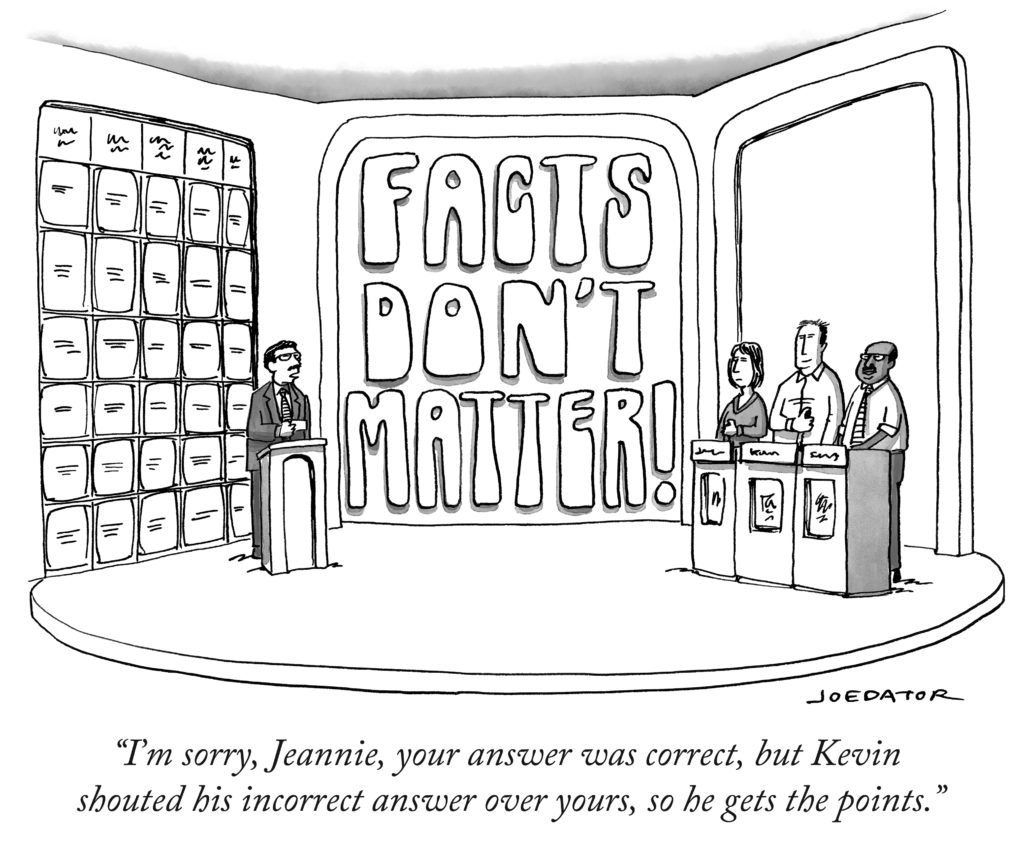
Cartoon – Covid Facts Don’t Matter

Facts Don't Matter (cncartoons033663-514) | Speak Up For Success

Florida Hits 10,000 Coronavirus Deaths—The Fifth State To Reach That Mark

https://www.forbes.com/sites/nicholasreimann/2020/08/20/florida-hits-10000-coronavirus-deaths-the-fifth-state-to-reach-that-mark/#29e05eb438f3

Florida Hits 10,000 Coronavirus Deaths—The Fifth State To Reach ...

TOPLINE

Over 10,000 Floridians have now died of coronavirus, marking a grim milestone that comes weeks after the state led the record U.S. coronavirus case surge earlier this summer.


KEY FACTS

10,049 Florida residents have died of coronavirus, according to the state, reaching that mark after adding 117 deaths Thursday.

Florida is the fifth state in the U.S. to record over 10,000 deaths, joining New York and New Jersey, where most deaths happened during the spring coronavirus surge, along with California and Texas, where most deaths occurred during the summer.

Florida has been the nation’s recent coronavirus epicenter, but the pandemic’s spread seems to have slowed there over the past few weeks, even as deaths, which lag behind other statistics, have been at record highs in the state.

New cases have recently reached their lowest daily increases in two months, and hospitalizations have trended downward since late July.

The testing positivity rate, seen as one of the first indicators of increased coronavirus spread, dropped below 10% Thursday—the first time the state has been below that threshold since June 21, and less than half the 20.71% positivity rate the state had at its highest point on July 8.


BIG NUMBER

23.8%. Gov. Ron DeSantis said that’s what the positivity rate was Thursday for antibody testing at state-run drive-through sites. That number suggests a massive amount of Floridians, much higher than the record-setting confirmed case counts, were infected with coronavirus this summer.


SURPRISING FACT

There are five U.S. states that have over 10,000 deaths. That’s a number that only 14 countries around the world have hit, according to Johns Hopkins University. The U.S. continues to have by far the most coronavirus deaths of any country and could reach 175,000 deaths before the weekend.


KEY BACKGROUND

The U.S. as a whole is on a downward trend when it comes to coronavirus metrics, which seems to be influenced by large states, like Florida, having a reduction in coronavirus spread.

States like California, Texas and Florida, the nation’s three most populated, were all setting records when the U.S. had its highest confirmed coronavirus spike earlier this summer. They now seem to be pushing the country in the other direction.


New unemployment claims top 1 million. Again.

https://www.washingtonpost.com/business/2020/08/20/august-unemployment-claims/?wpmk=1&wpisrc=al_business__alert-economy&utm_source=alert&utm_medium=email&utm_campaign=wp_news_alert_revere&location=alert&pwapi_token=eyJ0eXAiOiJKV1QiLCJhbGciOiJIUzI1NiJ9.eyJjb29raWVuYW1lIjoid3BfY3J0aWQiLCJpc3MiOiJDYXJ0YSIsImNvb2tpZXZhbHVlIjoiNWI2M2EzNDJhZGU0ZTI3Nzk1NTBjYTFiIiwidGFnIjoid3BfbmV3c19hbGVydF9yZXZlcmUiLCJ1cmwiOiJodHRwczovL3d3dy53YXNoaW5ndG9ucG9zdC5jb20vYnVzaW5lc3MvMjAyMC8wOC8yMC9hdWd1c3QtdW5lbXBsb3ltZW50LWNsYWltcy8_d3Btaz0xJndwaXNyYz1hbF9idXNpbmVzc19fYWxlcnQtZWNvbm9teSZ1dG1fc291cmNlPWFsZXJ0JnV0bV9tZWRpdW09ZW1haWwmdXRtX2NhbXBhaWduPXdwX25ld3NfYWxlcnRfcmV2ZXJlJmxvY2F0aW9uPWFsZXJ0In0.ns8VggWJk95qb-c_2926acWIaHxyFIBXSRn76O7Lrf0

The number of people applying for the first time for unemployment insurance ticked up last week to 1.1 million, from 970,000 the week before, a sign that job losses continue to plague the labor market five months into the coronavirus pandemic.

The weekly jobless claims had sunk slowly in recent months but have remained well above historical highs, averaging about 1.18 million a week for the last four weeks. Economists had predicted last week’s figure to approach the numbers from the previous week, which had fallen below 1 million for the first time in about five months.

Instead, the initial claims and new claims for Pandemic Unemployment Assistance, the program available to gig and self-employed workers, both went up. About 543,000 new claims were filed for PUA for the week that ended on Aug. 15, up from 488,000 the week before.

“The fact that the claims are so high this far into the crisis is concerning,” said AnnElizabeth Konkel, an economist at the job site Indeed. “Yet the depths of the damage remain to be seen. I would definitely call it a canary raising alarms in the economic coal mine.”

Data shows the number of job postings slowly recovering in recent weeks, compared with postings from the year prior. However, last week, postings took a turn for the worse. They had been running about 18 percent below normal and fell to 20.3 percent below normal last week.

“The longer we go into this crisis, the longer people that have been temporarily laid off may not get called back,” Konkel said. “Businesses can only ride out this crisis for so long.”

More than 28 million people were receiving some form of unemployment benefits as of Aug. 1, the most recent week for that statistic, about equal to the previous week.

Job loss from the pandemic remains a singular crisis, without comparison in modern times. The country’s unemployment rate, last calculated in July, was 10.2 percent, and economists have warned that it could go up in August as the virus continues to alter life around the country.

The extra $600 in unemployment benefits that many workers credit with keeping them afloat expired at the end of July. And funds from the $660 billion PPP program, which gave grants and loans to companies to keep workers on payroll, have been running out for many recipients.

Companies announcing layoffs in recent days include Wieland Copper Products, in North Carolina, a Mohegan Sun casino in Wilkes-Barre, Pa., Amsterdam Printing & Litho, a printing company in Upstate, N.Y., and Ohio sales and marketing company Maritz. School districts and local governments are also beginning to experience deep cuts: New York Mayor Bill de Blasio (D) warned last week that as many as 22,000 city workers faced possible layoffs in the fall.


Notre Dame cancels in-person classes after surge of COVID-19 cases

https://www.axios.com/notre-dame-cancels-classes-coronavirus-a7bd3249-f757-44a9-baf8-fb4de0bbefa3.html?stream=health-care&utm_source=alert&utm_medium=email&utm_campaign=alerts_healthcare

The University of Notre Dame announced Tuesday that it is canceling in-person classes for at least two weeks following a spike in coronavirus cases.

Why it matters: Notre Dame is the second prominent university to announce this week that it would revert back to remote learning, following the the University of North Carolina at Chapel Hill on Tuesday. The reversals underscore the challenges facing colleges and universities as more students are set return to campus.

Between the lines: As was the case with UNC, most of the COVID-19 infections at Notre Dame have been linked to off-campus parties.

  • The nearly 12,000 students that returned to Notre Dame were all tested before arriving on campus on Aug. 10, and just 33 tested positive, according to the Journal.
  • Through Monday, 147 of the 927 students who had shown symptoms tested positive for the virus — a sharp uptick in the positivity rate.

What they’re saying: Our contact-tracing analysis indicates that most infections are coming from off-campus gatherings,” said University of Notre Dame President Rev. John Jenkins. “Students infected at those gathering passed it on to others, who in turn have passed the virus on to others, resulting in the positive cases we have seen.”

  • “For your sake and the sake of our community and for continuing our semester on campus, please observe health protocols and avoid behavior that puts yourself or others at risk,” Jenkins added.


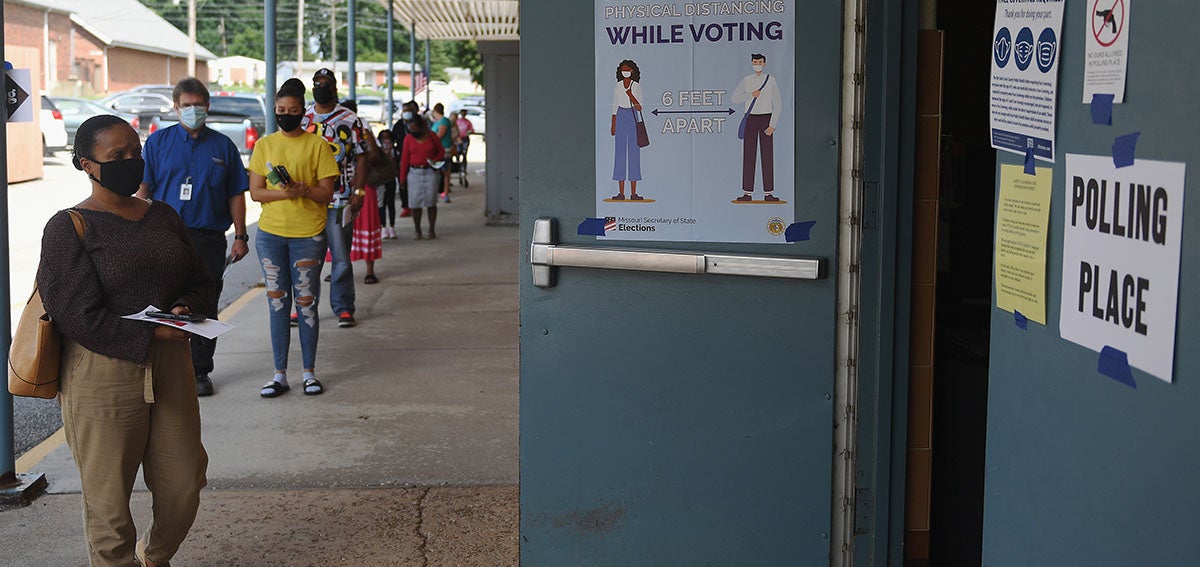
Medicaid Is Essential for Workers

Medicaid Is Essential for Workers as COVID-19 Spreads

Earlier this year, when public schools in Kansas City, Missouri, shut down in-person instruction because of the COVID-19 pandemic, Nika Cotton quit her job in social work to start her own business. She has two young children — ages 8 and 10 — and no one to watch them if she were to continue working a traditional job.

It was a big decision, made weightier by the loss of her employer-sponsored health insurance. But on August 5, Cotton awoke to the news that Missouri voters had narrowly approved the expansion of the state’s Medicaid program via ballot initiative, making it the second politically right-leaning state to do so during the pandemic. The expansion opens Medicaid eligibility to individuals and families with incomes up to 138% of the federal poverty guidelines, which are $12,760 for an individual and $21,720 for a family of three, allowing Cotton’s family of three to qualify.

“It takes a lot of stress off of my shoulders with having to think about how I’m going to take care of myself, how I’m going to be able to go and see a doctor and get the health care I need while I’m starting my business,” she told Alex Smith of KCUR, the NPR affiliate in Kansas City.

Nearly 1,264,000 voters weighed in on the measure, with 53% voting for it and 47% against it. Missouri’s Republican governor Mike Parson opposed it, arguing that the state could not afford the coverage expansion — even though the federal government pays 90% of the costs and a fiscal analysis (PDF) by the Center for Health Economics and Policy at Washington University estimated that the state would save $39 million if it implemented Medicaid expansion in 2020.

The ballot measure requires the state to expand Medicaid by July 2021, and an estimated 230,000 residents with low incomes will become eligible for affordable health coverage.

Voters Signal Support

In late June, Oklahoma voters also approved Medicaid expansion by ballot measure, eking out a victory by less than one percentage point.

“It is difficult to ignore that these ballot initiatives passed in right-leaning states in the middle of the coronavirus pandemic, when millions of Americans have lost their jobs and, with them, their employer-sponsored health insurance,” Dylan Scott wrote in Vox. “This is partly a coincidence — the signatures were collected to put the Medicaid expansion questions on the ballot long before COVID-19 ever arrived in the US — but the relatively narrow margins made me wonder if the pandemic and its economic and medical consequences proved decisive.”

Earlier this year, Scott spoke to Cynthia Cox, MPH, director of the Peterson-Kaiser Health System Tracker, about the potential impact of the pandemic on health care politics. “Many of the biggest coverage expansions both in the US and in similar countries happened in the context of wars and social upheavals, as well as financial crises,” Cox said. “One theory is that those circumstances redefine social solidarity, thus expanding views of the role of government.”

Between February and May, Missouri’s Medicaid program saw enrollment rise nearly 9%, one of the largest increases nationwide during the pandemic, Rachel Roubein reported in Politico. During that same period, Oklahoma’s Medicaid program saw enrollment increase by about 6%.

States that implemented Medicaid expansion are better positioned to respond to COVID-19, according to a report by the Center on Budget and Policy Priorities (CBPP). These states entered the health crisis and resulting economic downturn with lower uninsured rates, which is important for public health “because people who are uninsured may forgo testing or treatment for COVID-19 due to concerns that they cannot afford it, endangering their health while slowing detection of the virus’ spread,” the authors wrote.

CBPP and KFF estimate that 3.6 to 4.4 million uninsured adults would become eligible for Medicaid coverage if the 12 states that have not yet expanded the program did so. Those states are Alabama, Florida, Georgia, Kansas, Mississippi, North Carolina, South Carolina, South Dakota, Tennessee, Texas, Wisconsin, and Wyoming.

Coverage for Frontline Essential Workers

Medicaid is particularly important for frontline essential workers — such as those working in grocery stores, meat processing plants, and nursing homes — during the pandemic. Their jobs require them to report in person, increasing their risk of getting sick with the coronavirus as they interact with coworkers and, in many cases, with customers and patients. Essential workers are often paid low wages and not offered employer-sponsored health insurance or can’t afford the premiums for it.

About 5 million essential workers nationwide get health coverage through Medicaid, “including nearly 1.8 million people working in frontline health care services and 1.6 million in other frontline essential services including transportation, waste management, and child care,” Matt Broaddus, senior research analyst at CBPP, wrote on the center’s blog.

In California, over 950,000 essential workers are enrolled in Medi-Cal, the state’s Medicaid program. People of color are overrepresented in many categories of essential jobs. According to a UC Berkeley Labor Center analysis of the 15 largest frontline essential occupations, Latinx workers are overrepresented in agriculture, construction, and food preparation, among other occupations. Asian workers are overrepresented among registered nurses and personal care aides; and Black workers are overrepresented among personal care aides, laborers and material movers, and office clerks.

In addition to low-wage workers, Medi-Cal continues to bridge the coverage gap for other key populations amid the COVID-19 crisis, which is magnifying historical health inequities. (Medi-Cal covers nearly 40% of the state’s children, half of Californians with disabilities, and over one million seniors. For a refresher on the program, see CHCF’s Medi-Cal Explained series.)

Medicaid Saves Lives

Research has shown time and time again the varied benefits of Medicaid expansion: lower mortality rates among older adults with low incomes, declines in infant mortality, reductions in racial disparities in the care of cancer patients, and fewer personal bankruptcies, just to name a few.

Even though Missouri’s Medicaid expansion won’t take effect for another year, Nika Cotton remains excited. “It’s better late than never,” she said. “The fact that it’s coming is better than nothing” — perhaps a takeaway for the remaining 12 states.


Cartoon – What does your mask say about you?

Jim Morrissey: What does your coronavirus mask say about you ...

U.S. doing a lot less coronavirus testing

https://www.axios.com/newsletters/axios-vitals-32689a40-e409-4547-8468-b03dc589c082.html

The two sides of America's coronavirus response - Axios

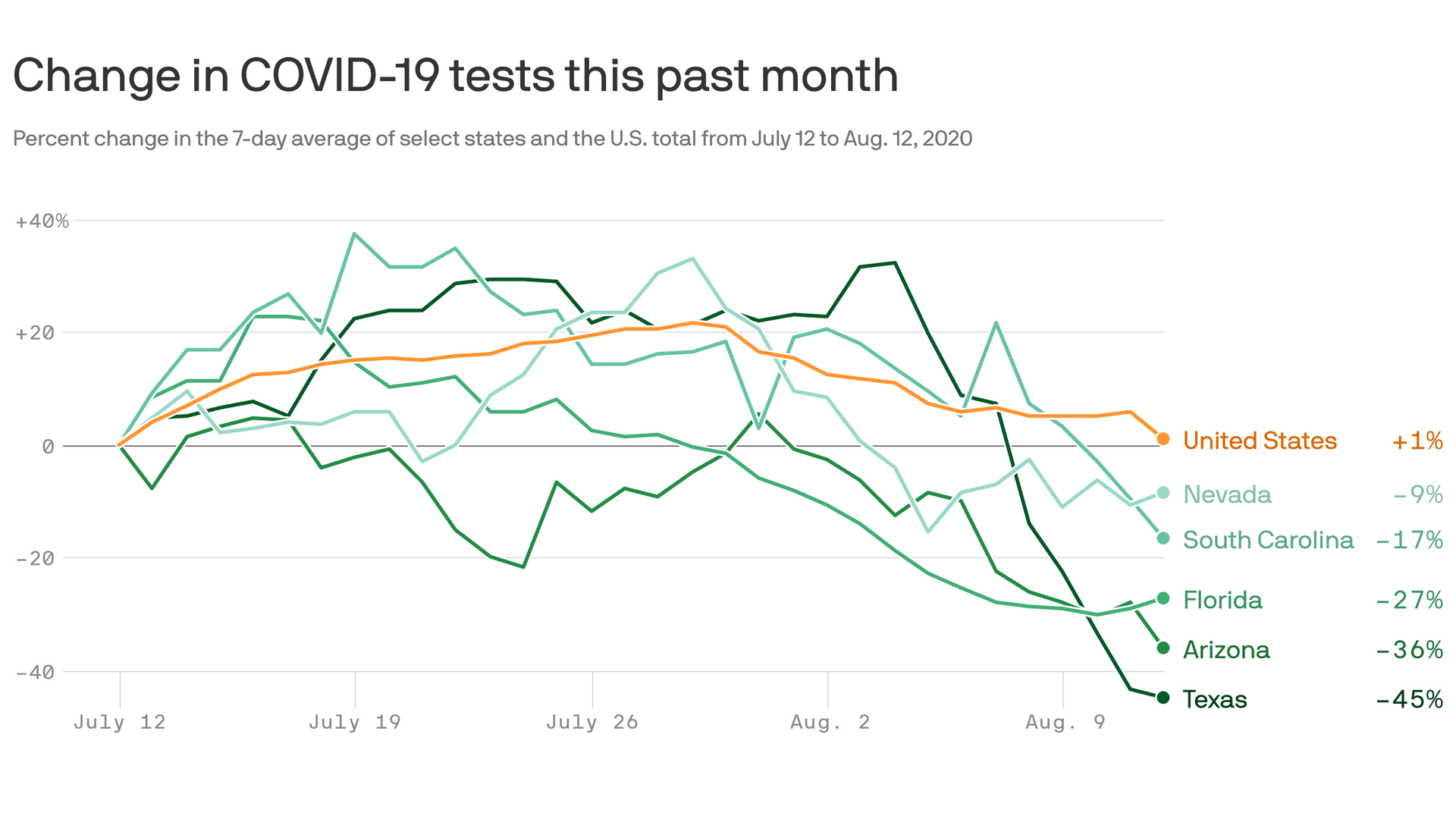
The U.S. is cutting back on coronavirus testing. Nationally, the number of tests performed each day is about 17% lower than it was at the end of July, and testing is also declining in hard-hit states.

Why it matters: This big reduction in testing has helped clear away delays that undermined the response to the pandemic. But doing fewer tests can also undermine the response to the pandemic.

By the numbers: At the end of July, America was doing more than 800,000 tests a day. This week, it’s hovered around 715,000.

  • Even as states with particularly bad outbreaks pull back on their testing, the proportion of tests coming back positive is still high — which would normally be an indication that they need to be doing more tests.
  • In Texas, 19% of tests are coming back positive, according to Nephron Research. In Florida, the rate of positive tests is 18%, and in Nevada, 17%.

Yes, but: Experts have said reducing the demand for testing may be the best way to alleviate long delays, which made tests all but useless. And that appears to be working.

Driving the news: The Department of Health and Human Services estimated this week that nearly 90% of all tests are being completed within three days — a big improvement from turnaround times that had been stretching well over a week.

  • Quest Diagnostics says its expected turnaround time is now 2–3 days, and less for priority patients. LabCorp announced a similar turnaround time last week.

The bottom line: The U.S. is averaging 50,000 new cases a day, and that high caseload is ultimately why the demand for testing is more than the system can handle.

  • We can’t get our caseload under control without fast, widespread testing, but we can’t achieve fast, widespread testing with such a high caseload.


Rely on the science and avoid the politics, Fauci says

https://www.cnn.com/2020/08/12/health/us-coronavirus-wednesday/index.html?utm_source=nl&utm_brand=wired&utm_mailing=WIR_Science_081220&utm_campaign=aud-dev&utm_medium=email&utm_term=WIR_Science&bxid=5db707423f92a422eaeaf234&cndid=54318659&esrc=bounceX&source=EDT_WIR_NEWSLETTER_0_SCIENCE_ZZ

Science Day

Although practices like wearing face coverings have been politicized, Dr. Anthony Fauci said Tuesday he has learned that in order to be a good public health leader in a crisis, you have to divorce yourself from politics, rely on science and be as transparent as possible.

“Completely divorce yourself from the kind of political undertones that sometimes go into an important outbreak like this,” Fauci, director of the National Institute of Allergy and Infectious Diseases, said as he was honored with a 2020 Citizen Leadership Award on Tuesday night by the Aspen Institute.
“You’ve got to stay away from that, lead by example, be perfectly honest and don’t be afraid to say you don’t know something when you don’t know it. I find that to be a very good formula when you’re dealing in a crisis.”
Even with the polarization, every state in the US passed at least one physical distancing measure in March to slow the spread, researchers from Harvard University and University College London said. Those measures worked, a new study found.
Physical distancing resulted in a reduction of more than 600,000 cases within just three weeks, according to the study, published Tuesday in the journal PLOS. Had there not been preventative interventions, the models suggest up to 80% of Americans would have been infected with Covid-19.
“In short, these measures work, and policy makers should use them as an arrow in their quivers to get on top of local epidemics where they are not responding to containment measures,” said the study’s co-author Dr. Mark J. Siedner in a news release.


‘A Smoking Gun’: Infectious Coronavirus Retrieved From Hospital Air

A Smoking Gun': Infectious Coronavirus Retrieved From Hospital Air ...

Airborne virus plays a significant role in community transmission, many experts believe. A new study fills in the missing piece: Floating virus can infect cells.

Skeptics of the notion that the coronavirus spreads through the air — including many expert advisers to the World Health Organization — have held out for one missing piece of evidence: proof that floating respiratory droplets called aerosols contain live virus, and not just fragments of genetic material.

Now a team of virologists and aerosol scientists has produced exactly that: confirmation of infectious virus in the air.

“This is what people have been clamoring for,” said Linsey Marr, an expert in airborne spread of viruses who was not involved in the work. “It’s unambiguous evidence that there is infectious virus in aerosols.”

A research team at the University of Florida succeeded in isolating live virus from aerosols collected at a distance of seven to 16 feet from patients hospitalized with Covid-19 — farther than the six feet recommended in social distancing guidelines.

The findings, posted online last week, have not yet been vetted by peer review, but have already caused something of a stir among scientists. “If this isn’t a smoking gun, then I don’t know what is,” Dr. Marr tweeted last week.

But some experts said it still was not clear that the amount of virus recovered was sufficient to cause infection.

The research was exacting. Aerosols are minute by definition, measuring only up to five micrometers across; evaporation can make them even smaller. Attempts to capture these delicate droplets usually damage the virus they contain.

“It’s very hard to sample biological material from the air and have it be viable,” said Shelly Miller, an environmental engineer at the University of Colorado Boulder who studies air quality and airborne diseases.

“We have to be clever about sampling biological material so that it is more similar to how you might inhale it.”

Previous attempts were stymied at one step or another in the process. For example, one team tried using a rotating drum to suspend aerosols, and showed that the virus remained infectious for up to three hours. But critics argued that those conditions were experimental and unrealistic.

Other scientists used gelatin filters or plastic or glass tubes to collect aerosols over time. But the force of the air shrank the aerosols and sheared the virus. Another group succeeded in isolating live virus, but did not show that the isolated virus could infect cells.

In the new study, researchers devised a sampler that uses pure water vapor to enlarge the aerosols enough that they can be collected easily from the air. Rather than leave these aerosols sitting, the equipment immediately transfers them into a liquid rich with salts, sugar and protein, which preserves the pathogen.

“I’m impressed,” said Robyn Schofield, an atmospheric chemist at Melbourne University in Australia, who measures aerosols over the ocean. “It’s a very clever measurement technique.”

As editor of the journal Atmospheric Measurement Techniques, Dr. Schofield is familiar with the options available, but said she had not seen any that could match the new one.

The researchers had previously used this method to sample air from hospital rooms. But in those attempts, other floating respiratory viruses grew faster, making it difficult to isolate the coronavirus.

This time, the team collected air samples from a room in a ward dedicated to Covid-19 patients at the University of Florida Health Shands Hospital. Neither patient in the room was subject to medical procedures known to generate aerosols, which the W.H.O. and others have contended are the primary source of airborne virus in a hospital setting.

The team used two samplers, one about seven feet from the patients and the other about 16 feet from them. The scientists were able to collect virus at both distances and then to show that the virus they had plucked from the air could infect cells in a lab dish.

The genome sequence of the isolated virus was identical to that from a swab of a newly admitted symptomatic patient in the room.

The room had six air changes per hour and was fitted with efficient filters, ultraviolet irradiation and other safety measures to inactivate the virus before the air was reintroduced into the room.

That may explain why the researchers found only 74 virus particles per liter of air, said John Lednicky, the team’s lead virologist at the University of Florida. Indoor spaces without good ventilation — such as schools — might accumulate much more airborne virus, he said.

But other experts said it was difficult to extrapolate from the findings to estimate an individual’s infection risk.

“I’m just not sure that these numbers are high enough to cause an infection in somebody,” said Angela Rasmussen, a virologist at Columbia University in New York.

“The only conclusion I can take from this paper is you can culture viable virus out of the air,” she said. “But that’s not a small thing.”

Several experts noted that the distance at which the team found virus is much farther than the six feet recommended for physical distancing.

“We know that indoors, those distance rules don’t matter anymore,” Dr. Schofield said. It takes about five minutes for small aerosols to traverse the room even in still air, she added.

The six-foot minimum is “misleading, because people think they are protected indoors and they’re really not,” she said.

That recommendation was based on the notion that “large ballistic cannonball-type droplets” were the only vehicles for the virus, Dr. Marr said. The more distance people can maintain, the better, she added.

The findings should also push people to heed precautions for airborne transmission like improved ventilation, said Seema Lakdawala, a respiratory virus expert at the University of Pittsburgh.

“We all know that this virus can transmit by all these modes, but we’re only focusing on a small subset,” Dr. Lakdawala said.

She and other experts noted one strange aspect of the new study. The team reported finding just as much viral RNA as they did infectious virus, but other methods generally found about 100-fold more genetic matter.

“When you do nasal swabs or clinical samples, there is a lot more RNA than infectious virus,” Dr. Lakdawala said.

Dr. Lednicky has received emails and phone calls from researchers worldwide asking about that finding. He said he would check his numbers again to be sure.

But ultimately, he added, the exact figures may not matter. “We can grow the virus from air — I think that should be the important take-home lesson,” he said.


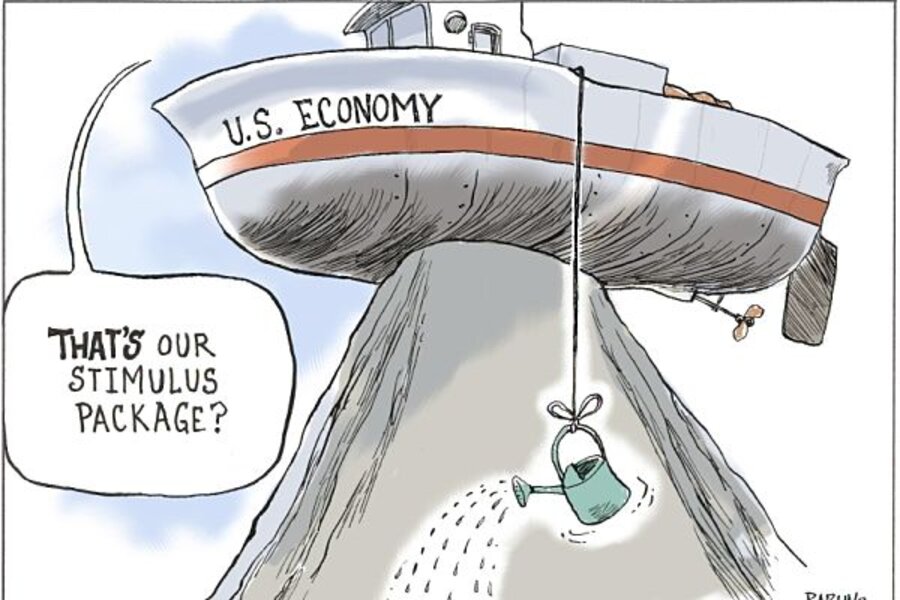
Cartoon – New Economic Stimulus Package

Obama's stimulus did NOT raise government spending - CSMonitor.com