AdventHealth, a 48-hospital system based in Altamonte Springs, Fla., recorded a $417.72 net loss in the first quarter of 2022, driven by both investment and operating losses, according to recently released financial results.
In the quarter ended March 31, AdventHealth saw its revenue increase to $3.67 billion, up nearly 8 percent from the same period last year.
Although revenue was up, so were AdventHealth’s expenses. In the first quarter of 2022, AdventHealth saw its expenses grow to $3.72 billion, up from $3.23 billion recorded in the same period in 2021.
“The increased expense is primarily a result of elevated premium and contract labor costs and wage inflation resulting from workforce shortages,” AdventHealth stated in its financial report. “The system continues to implement workforce stabilization plans to reduce turnover and temporary labor utilization.”
AdventHealth ended the first quarter of 2022 with an operating loss of $46.75 million. In the same quarter of 2021, AdventHealth recorded an operating income of $179.11 million.
After factoring in nonoperating items, including a $372.16 million investment loss, AdventHealth ended the first quarter of 2022 with a net loss of $417.72 million. In the first quarter of 2021, AdventHealth recorded a $94.78 million net income.
From delayed check-ups to postponed elective procedures, missed or deferred care during the pandemic will continue to strain the healthcare delivery system for the foreseeable future. The graphic above shows the impact on cancer care: both cancer screenings and new diagnoses are still down from pre-COVID levels.
Screenings for breast, colon, and cervical cancers were significantly lower in 2020, and patients missed about 10M total screenings in the pandemic’s first year alone. While cancer screenings rebounded somewhat in 2021, they were still below pre-pandemic levels. Unsurprisingly, the downstream impact has been a similar decline in new cancer diagnoses.
The negative effects of care delays have become increasingly obvious: there has been an increase in the number of patients presenting with later-stage cancers. There was a six percent increase in Stage 4 breast cancer diagnoses, and a 16 percent increase in Stage 2 and 3 cancer diagnoses in 2021, compared to 2019.
With no reason to believe that either cancer incidence or acuity has actually changed, oncology providers must increase their screening capacity and double down on reaching out to patients who are overdue for screenings. But as providers continue to work through the backlog of missed exams, they must prepare to treat more complex, higher-acuity cancer patients than ever before.
The combined health system will become the sixth largest nationwide, with $27B in revenue and 67 hospitals across six Midwest and Southeast states. The system will be based in Charlotte, and known as Advocate Health, though Atrium will continue to use its name in its markets.
Atrium CEO Gene Woods is slated to ultimately lead the combined entity, after an 18-month co-CEO arrangement with Advocate Aurora CEO Jim Skogsbergh. While the cross-market merger is unlikely to create antitrust concerns about increased pricing leverage, the Biden administration has been making noises about applying stricter scrutiny to the impact of health system consolidation on labor market competition.
The Gist: Earlier this year, Utah-based Intermountain Healthcare and Colorado-based SCL Health combined to create a 33-hospital, $14B health system, which became the 11th largest nationwide. While these mega-mergers of regional systems can realize cost savings from back-office synergies, there is a significant opportunity to create larger “platforms” of care to win consumer loyalty, deploy digital capabilities, attract talent, and become more desirable partners for nontraditional players like Amazon, Walmart, and One Medical.
It will be critical to watch whether the governance and cultural challenges that often hinder health system mergers come into play here. Advocate Aurora has had two prospective mergers fall apart in recent years, the first with Chicago-based NorthShore University HealthSystem, and the second with Michigan-based Beaumont Health (who subsequently finalized a merger with Spectrum Health earlier this year).
But the combination with Atrium is structured as a joint operating agreement, essentially creating a new superstructure atop the two legacy systems. This may allow the combined entity more flexibility in local decision-making, but the ultimate question will be how the combined entity will create value for consumers. Time will tell.
Seeking stronger workplace protections, physician residents and fellows at both Stanford Health Care and the University of Southern California’s (USC) Keck School of Medicine have voted to join the Committee of Interns and Residents, a chapter of the Service Employees International Union (SEIU).
Despite being frontline healthcare workers, most Stanford residents were excluded from the first round of the health system’s COVID vaccine rollout in December 2020. The system ultimately revised its plan to include residents, but the delay damaged Stanford’s relationship with residents, adding momentum to the unionization movement. Meanwhile, Keck’s residents unanimously voted in favor of joining the union, aiming for higher compensation and greater workplace representation.
The Gist: While nurses and other healthcare workers in California, as in many other parts of the country, have been increasingly banding together for higher pay and better working conditions, physician residents and fellows contemplating unionization is a newer trend.
Physicians-in-training have historically accepted long work hours and low pay as a rite of passage, and have shied away from organizing. But pandemic working conditions, the growing trend of physician employment, and generational shifts in the physician workforce have changed the profession in a multitude of ways.
Health systems and training programs must actively engage in understanding and supporting the needs of younger doctors, who will soon comprise a majority of the physician workforce.
Due to global shortages of iohexol and iodixanol, contrast media products injected into patients during CT scans and other commonly used diagnostic imaging studies, some providers are having to postpone non-emergency imaging.
GE Healthcare, one of two major suppliers of contrast media in the US, has experienced manufacturing disruptions at its Shanghai facility amid China’s COVID lockdowns, and the company estimates the shortages could last through June. It is increasing production at an Ireland factory, and shipping via air cargo to the US, to speed up delivery.
The Gist: This shortage will have wider ranging impacts than just delayed imaging procedures, as so many treatment decisions rely on the results of imaging tests. Contrast fluids are also used for vascular imaging, heart catheterization, and spinal interventions. A prolonged shortage could have far-reaching implications, limiting doctors’ ability to plan surgeries, monitor cancer progression, and perform imaging-guided treatments.
Like so many recent supply shortages, this latest one shines a spotlight on providers’ “just-in-time” supply chain, and their over-reliance on single-source vendors.
Hospitals’ labor costs rose by more than a third from pre-pandemic levels by March 2022, according to a report out Wednesday from Kaufman Hall.
Heightened temporary and traveling labor costs were a main contributor, with contract labor accounting for 11% of hospitals’ total labor expenses in 2022 compared to 2% in 2019, the report found.
Contract nurses’ median hourly wages rose 106% over the period, from $64 an hour to $132 an hour, while employed nurse wages increased 11%, from $35 an hour to $39 an hour, the report found.
Dive Insight:
The new data from Kaufman Hall supports concerns hospital executives expressed while releasing first quarter earnings results, as higher-than expected labor costs spurred some operators, like HCA, to lower their financial full-year guidance.
The ongoing use of contract labor amid shortages driven by heightened turnover was a key factor executives cited for higher costs, and follows the findings from Kaufman Hall’s latest report.
More than a third of nurses surveyed by staffing firm Incredible Health said they plan to leave their current jobs by the end of this year, according to a March report. While burnout is driving them to leave, higher salaries are the top motivating factor for taking other positions, that report found.
Kaufman Hall’s report, which analyzes data from more than 900 hospitals across the country, found hospitals spent $5,494 in labor expenses per adjusted discharge in March compared to $4,009 roughly three years ago.
Costs rose for hospitals in every region, though the South and West experienced the largest increases from pre-pandemic levels as those expenses rose 43% and 42%, respectively.
The West and Northeast/Mid-Atlantic regions saw the highest expenses consistently from 2019 to 2022, according to the report.
“The pandemic made longstanding labor challenges in the healthcare sector much worse, making it far more expensive to care for hospitalized patients over the past two years,” said Erik Swanson, senior vice president of data and analytics at Kaufman Hall.
“Hospitals now face a number of pressures to attract and retain affordable clinical staff, maintain patient safety, deliver quality services and increase their efficiency,” Swanson said.
The report also notes that hospitals are competing with non-hospital employers also pursuing hourly staff, though those companies can pass along wage increases to consumers through higher prices “in a way healthcare organizations cannot,” the report said.
Some hospitals, like HCA Healthcare and Universal Health Services, are looking to raise prices for health plans amid rising nurse salaries, according to reporting from The Wall Street Journal.
Another recent report from group purchasing organization Premier found the CMS underestimated hospital labor spending when making payment adjustments for the 2022 fiscal year, resulting in hospitals receiving only a 2.4% rate increase compared to a 6.5% increase in hospital labor rates.
To match the rates hospitals are now paying staff, an adequate inpatient payment update for fiscal 2023 is needed, that report said.
The CMS proposed its IPPS rule for FY 2023 on April 18 that includes a 3.2% hike to inpatient hospital payments, which provider groups like the American Hospital Association rebuked as “simply unacceptable” considering inflation and rising hospital labor costs.
St. Louis-based Ascension reported higher expenses in the three months ended March 31 and ended the quarter with a loss, according to financial documents filed April 29.
The 143-hospital system reported operating revenue of $6.69 billion in the first three months of this year, up from $6.56 billion in the same period of 2021.
Ascension’s operating expenses climbed to $7.34 billion in the first three months of 2022, up from $6.59 billion in the same period a year earlier. The increase was attributed to several factors, including higher salaries, wages and supply expenses.
Looking at the first nine months of the current fiscal year, Ascension’s operating expenses increased 8.7 percent year over year. Staffing challenges, increased use of contract labor and overtime spend pushed Ascension’s total salaries, wages and benefits up 10.1 percent year over year in the nine months ended March 31.
Ascension ended the most recent quarter with an operating loss of $671.14 million, compared to an operating loss of $16.71 million in the same period last year.
After factoring in nonoperating items, Ascension reported a net loss of $884.74 million for the three months ended March 31. A year earlier, the health system posted net income of $957.32 million. For the first nine months ended March 31, Ascension reported net income of $145.21 million, compared to $4.77 billion in the same period a year earlier.
As of March 31, Ascension had 295 days cash on hand, compared to 336 days as of June 30, 2021.
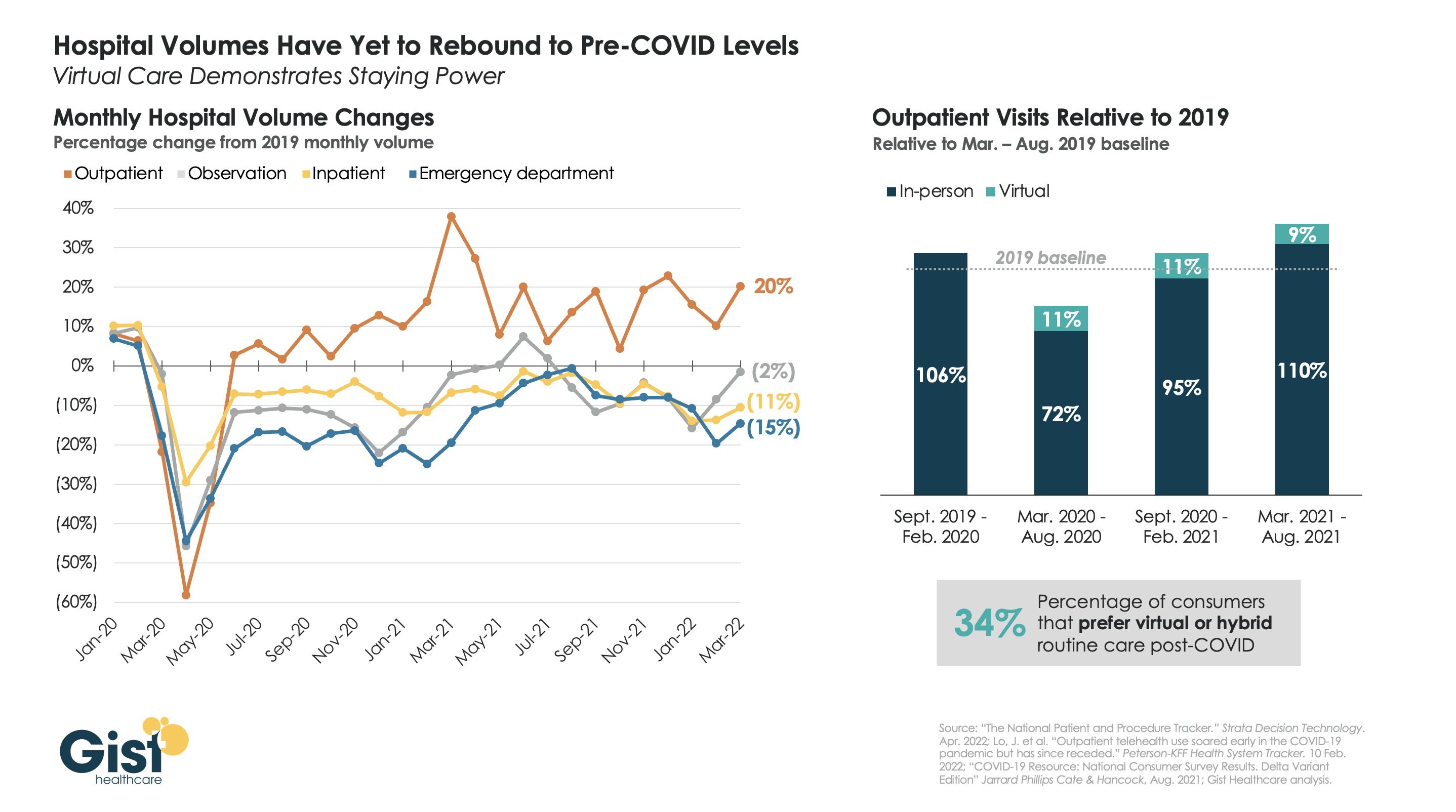
More than two years after the pandemic’s onset, some types of hospital volume still haven’t returned to pre-pandemic levels. The graphic above uses recent data from analytics firm Strata Decision Technology to track monthly hospital volume across various care settings.
While outpatient volume continues to exceed pre-COVID levels, inpatient, emergency department (ED), and observation volume is still below the 2019 baseline.The unpredictability of volume trends is likely to continue, as COVID continues to ebb and flow regionally, and care continues to shift outpatient.
By contrast, the volume of virtual care visits has remained consistent, even as consumers return to in-person outpatient visits, driving up the overall level above the pre-pandemic baseline. Some of this increase in outpatient visit volume has been driven by consumers turning to urgent care clinics or doctors’ offices—either in-person or virtually—for their lower-acuity care needs.
While temporary reimbursement and licensing policies for telehealth have been the main stumbling blocks for many organizations’ longer-term planning for virtual visits, about half of states have now implemented permanent payment parity for telemedicine. As such, provider organizations that are still taking a “wait and see approach” must develop an economically sustainable virtual care model to reduce costs and meet evolving consumer demands.
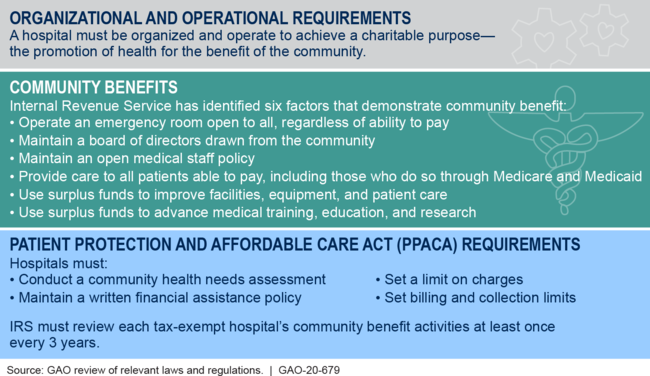
A report from The Lown Institute, a Boston-based think tank, finds that many health systems—227 of the 275 evaluated—spend less on providing “community benefit” than the value of their tax exemptions. The American Hospital Association (AHA) criticized the report’s methodology, claiming it “cherry-picks categories of community investment.” This report builds on previous analyses that have found that, taken together, nonprofit hospitals spend less on charity care than government or for-profit hospitals.
The Gist:Policymakers and academics, prompted by massive capital projects, high executive salaries, and—especially—aggressive pricing and billing strategies, are increasingly questioning whether nonprofit health systems provide sufficient community benefit to retain their tax-exempt status. A recent piece in Health Affairs suggests updating the community benefit standard, which the Internal Revenue Service (IRS) uses to evaluate nonprofit status, to focus on social determinants of health and measurable health outcomes.
We’d expect tougher scrutiny on this topic in the future, especially if state budgets come under pressure from a deterioration in the broader economy.
Organizations should prepare themselves for a continuation of quits as a new culture of quitting becomes the norm as the annual quit rate stands to jump up nearly 20 percent from annual pre pandemic levels, according to Gartner.
The pre pandemic average for quits stood at 31.9 million, but that figure could rise to 37.4 million this year, said executive consultancy Gartner in an April 28 news release.
“An individual organization with a turnover rate of 20 percent before the pandemic could face a turnover rate as high as 24 percent in 2022 and the years to come,” Piers Hudson, senior director in the Gartner HR practice said in the news release. “For example, a workforce of 25,000 employees would need to prepare for an additional 1,000 voluntary departures.”
The reason for the likely increase in quits is new flexibility in work arrangements and employees’ higher expectations, according to Gartner. A misalignment between leaders and workers is also contributing to the attrition.
“Organizations must look forward, not backward, and design a post-pandemic employee experience that meets employees’ changing expectations and leverages the advantages of hybrid work,” said Mr. Hudson.










 HENRY KOTULA