Updated COVID-19 projections are out: The new peak dates in each state

https://www.beckershospitalreview.com/patient-flow/updated-covid-19-projections-are-out-the-new-peak-dates-in-each-state.html?utm_medium=email

COVID-19 state-by-state forecast | WCHS

Peak demand for hospital resources due to COVID-19 is expected this week in the U.S., according to updated projections from the University of Washington’s Institute for Health Metrics and Evaluation in Seattle. 

The model, first released in late March, presents estimates of predicted health service utilization and deaths due to COVID-19 for each state in the U.S. if social distancing measures are maintained through May. Researchers used state-level hospital capacity data, data on confirmed COVID-19 deaths from the World Health Organization, and observed COVID-19 utilization from select locations.

When IHME first released its model, the only place where the number of daily deaths had already peaked was Wuhan, China. The data from Wuhan formed the basis for IHME’s estimation of the time from implementation of social distancing policies to the peak day of deaths. That estimation is now based on data from Wuhan and seven locations in Spain and Italy where the number of daily deaths appears to be peaking or to have peaked. The model has also been updated to use three different weighting schemes to better approximate the variation in potential policy impact across social distancing mandates.

Projections for peak demand for resources, namely hospital beds and ventilators, also changed after IHME incorporated new data sources into its model and made changes to its analytical framework. Access more information about the changes here.

According to the most recent projections, which use data updated April 8, peak demand for hospital resources will occur at the national level on April 11. However, this varies by state. Below is the projected date of peak demand for hospital beds, ICU beds and ventilators in each state according to the IHME model. 

April 1
Vermont

April 2
Washington

April 4
Louisiana

April 7
Michigan

April 8
Colorado
New York
Ohio

April 9
Delaware
District of Columbia

April 11
Illinois
New Jersey

April 12
Hawaii

April 13
California
Pennsylvania
Wisconsin

April 14
Idaho
Indiana

April 15
North Carolina
West Virginia

April 16
Mississippi
New Hampshire

April 17
Alaska
Maine
Maryland
Nevada
Tennessee

April 20
Alabama
Georgia
Kansas
Massachusetts
Montana
Virginia

April 21
Connecticut
Florida
Kentucky
Missouri
New Mexico
North Dakota

April 22
Arizona
Oregon
Texas

April 23
Minnesota
Oklahoma

April 24
South Carolina

April 25
Arkansas
Rhode Island
Utah

April 26
Nebraska

April 27
Iowa
South Dakota

April 29
Wyoming


Pay Cuts, Furloughs, Redeployment for Doctors and Hospital Staff

https://www.medpagetoday.com/infectiousdisease/covid19/85827?xid=nl_mpt_investigative2020-04-08&eun=g885344d0r&utm_source=Sailthru&utm_medium=email&utm_campaign=InvestigativeMD_040820&utm_term=NL_Gen_Int_InvestigateMD_Active

Pay Cuts, Furloughs, Redeployment for Doctors and Hospital Staff ...

— Health systems see massive disruption from COVID-19

In Michigan, Trinity Health is furloughing 2,500 of its 24,000 employees. In Florida, Sarasota Memorial Health Care is taking “immediate steps to reduce costs, including temporary furloughs and reduced hours” for workers.

In less than 1 month, COVID-19 has made swift, deep cuts in hospital billings. Despite high volumes in the first 2 weeks, March revenue plunged by $16 million at Sarasota Memorial. Surgery cases fell by more than 50%, and volumes dropped by 45% at two emergency care centers and by 66% at seven urgent care centers.

Squeezed by plummeting income and climbing COVID-19 expenses, hospitals and health systems are bracing themselves for system-wide disruption by announcing temporary layoffs, reassignments, and pay cuts.

Many changes, like Trinity’s furloughs in Michigan, affect mainly non-clinical workers. Some alter compensation or duties for doctors, nurses, and other healthcare providers.

“In all parts of the country, physicians are being asked to sign agreements or acknowledgments for pay cuts ranging from 20% to 75%, depending on what their specialty is, where they are, and what the institutions are doing,” said Scott Weavil, JD, a California lawyer who counsels physicians nationwide about employment contracts.

“Many of these providers are not on the front lines of COVID, but they are still working,” Weavil noted. “Babies are being born. People are having accidents and visiting emergency departments. Urgent surgeries are happening. Physicians are at work or on call and ready to help if needed. And in most of these environments, there are patients who have tested positive for COVID-19,” he told MedPage Today.

“Ob/gyns aren’t doing a lot of elective procedures like hysterectomies, but they are delivering babies for COVID-positive patients, wearing donated cloth masks that may or may not be effective,” Weavil added.

In some cases, doctors have been sidelined and face the prospect of dwindling income as patient volumes fall. “We have 2,600 physicians and advanced-practice providers,” said Mark Briesacher, MD, senior vice president and chief physician executive of Intermountain Healthcare in Salt Lake City. “About 800 of them are on a patient volume-related type of contract, similar to what you would have in private practice.”

Because non-urgent and elective procedures are being delayed, some of these clinicians now see 30% to 50% fewer patients and could face big income drops, Briesacher told MedPage Today. “But we’ve put a floor in place,” he said: these providers will receive their usual pay until May 30, then 85% of that amount until normal patient volumes resume.

Redeployment can help practitioners make up lost income, Briesacher added. “A general surgeon often has critical care training,” he noted. “When this increase in patient care needs due to COVID-19 does come to Utah, we can deploy that surgeon to work in our ICUs with a critical care doctor, and if they’re working fulltime, they’ll get paid the same as they were before.”

Reassignment does not stop with doctors at Intermountain: hospital nurses can be deployed to screening desks, drive-through testing sites, or telehealth centers and will keep their current rate of pay, spokesperson Daron Crowley said.

“I recently reviewed a COVID-19 compensation plan of a health system in Florida that would give physicians their base or draw, or a midpoint between their 2019 base and their 2019 overall compensation,” noted Weavil, the attorney. “That seemed pretty good, but it came at a cost: the physicians had to agree to practice outside of their normal setting, as long as they were credentialed for the work.”

“At first blush, the credentialing requirement sounded like a protection; if you are a psychiatrist, you’d think ‘they’re not going to send me to the ICU,’ and normally, that’s correct,” Weavil continued.

But hospitals are adopting emergency credentialing provisions during COVID-19 and “doctors can be forced to practice pretty far afield of their specialty,” he said. In some ways, the situation resembles residency, he pointed out: “You have an attending physician who knows what she’s doing directing fish-out-of-water physicians who have been conscripted into service beyond their specialties.”

The list of hospital systems announcing major changes — including pay cuts for hospital executives, as Trinity Health in Michigan has done — grows each day. Boston Medical Center Health System has furloughed 700 employees; Cincinnati-based Bon Secours Mercy Health has announced it will do the same. Kentucky’s Appalachian Regional Healthcare will furlough about 500 staff members. South Carolina’s Prisma Health will lay off an undisclosed number of clinical, corporate, and administrative workers. Tenet Healthcare in Dallas has furloughed 500 fulltime positions.

Furloughing staff “was an extremely difficult decision, and one that we did not make lightly,” Sarasota Memorial CEO David Verinder wrote in a letter to employees.

“Staff have gone above and beyond to care for our patients throughout this crisis, even as they have been anxious about the health and well-being of themselves and their families,” he continued. “But as the health care safety net for the region, we must do all we can to continue fulfilling that critical role in the weeks ahead and for the long-term.”


$100B federal hospital aid won’t fully compensate lost revenue, Moody’s says

https://www.beckershospitalreview.com/finance/100b-federal-hospital-aid-won-t-fully-compensate-lost-revenue-moody-s-says.html?utm_medium=email

Moodys | HENRY KOTULA

The $2 trillion federal coronavirus aid package signed into law that includes $100 billion for nonprofit hospitals won’t completely cover the revenue hospitals will lose as a result of the pandemic, Moody’s Investors Service wrote in an April 3 note.

While the aid package includes several provisions like compensation for lost revenue, increased Medicare reimbursement and advances on future Medicare reimbursement, cash flow at nonprofit hospitals will still likely be materially lower for the next several months. Postponed services alone are likely to reduce hospital revenue by 25 percent to 40 percent a month on average, Moody’s said, a reduction that is affecting even hospitals that aren’t treating large COVID-19 case loads.

“The $100 billion aid package provides some relief to hospitals by supporting their operations and providing access to critical supplies,” Dan Steingart, vice president at Moody’s, said. “However, it is unlikely to fully compensate the sector for the two main financial challenges facing providers as a result of the coronavirus outbreak. The first is a material decline in revenue and cash flow as profitable elective surgeries, procedures and other services are postponed to preserve resources and avoid spreading the virus. The second is difficulty curbing expenses as surge preparation costs offset any expense reductions from postponed or canceled services.”

Moody’s maintained its negative outlook on nonprofit hospitals. 


Resilience, dedication, conviction: Hospital CEOs write thank-you notes to staff

https://www.beckershospitalreview.com/hospital-management-administration/resilience-dedication-conviction-hospital-ceos-write-thank-you-notes-to-staff.html?utm_medium=email

Words of appreciation: Thank-you notes from 15 health system CEOs ...

Healthcare workers have been on the front lines of the COVID-19 pandemic, providing care to ill patients and battling the public health crisis from various angles. In honor of these workers, Becker’s asked hospital and health system CEOs to share notes to their staff and team members.

Michael Apkon, MD, PhD
President and CEO
Tufts Medical Center & Floating Hospital for Children (Boston)

At Tufts Medical Center, we see some of the sickest people in Boston. Our teams routinely surround each of these patients with the extraordinary care and services they need to get well.

This pandemic is unprecedented.  I know our staff are balancing the concerns that we all have for our families and friends, our own health, as well as the changes to our lives outside of work at the same time they do everything they can to provide the level of care people have come to trust from our organization. I can tell you that over my 30 years in this industry, I have not seen more dedication, innovation and willingness to help than I have during these past few months, as we fight a largely unknown enemy.

I could not be more proud of our doctors, nurses, technologists, transporters, housekeepers, cooks, public safety officers and all others who have been vital to the care of all of our patients, including those with a COVID-19 diagnosis. I know that people are coming together across our industry in nearly every city and town. Many thanks to each of our team members and to the healthcare workers around our country as well as to their families, who have had to worry day after day about their loved one on the front lines. Please know your partners, mothers, fathers, sister, brother, sons or daughters have played a critical role in saving lives, and we are doing everything we can to keep them safe.

Marna Borgstrom
CEO Yale New Haven (Conn.) Health

During these unprecedented times I welcome the opportunity to reflect on all that our staff at Yale New Haven Health are doing for each other and for our communities. We have a team of more than 27,000 hardworking and talented people to care for communities in Connecticut, New York and Rhode Island. I am truly humbled and honored to work alongside these amazing individuals.

Our staff, like healthcare workers everywhere, are being tasked in seemingly conflicting ways during this pandemic. Not only are they continuing to do their jobs by caring for the sickest patients, but they are also managing extremely challenging issues at home. Children of all ages are home from school, some need to be home-schooled. Businesses are closed, impacting many spouses and other family members. Staff worry that they may not have an adequate amount of protective equipment and supplies while at work.

But Yale New Haven Health staff are strong, they are resilient and most of all they are caring. As we do everything in our power to keep our staff safe, they are doing everything in their power to care for very ill patients in a world where new information is coming in real time and changing rapidly. We all hope and pray that this pandemic will end soon, but until it does, we are all in this together. I have never been more proud to work with this this wonderful Yale New Haven Health team.

Audrey Gregory, PhD, RN
CEO of the Detroit Medical Center

We know that the current situation around COVID-19 is unnerving, and as things continue to change rapidly every day, it can also be overwhelming.

I want to take this opportunity to thank all the front-line staff at every level in our organization and at healthcare facilities all across the country.

I also would like to say thank you to all of the providers, including residents, fellows and advanced practice providers. I recognize the commitment that you have to provide care to our patients. Not only do I want to acknowledge that, I never want to take that for granted. As healthcare workers, this is the time that we courageously stay on the front lines.

Please be safe and do your part to protect each other. If you have any flu-like symptoms such as fever, cough, sore throat, body aches or shortness of breath, please stay home. I know that as healthcare workers we have a tendency to ignore symptoms, and work through them, so that we do not let the team down. This is the time that I implore you not to do so.

Thank you for your commitment and dedication to the patients and families that depend on us during this challenging time.

R. Guy Hudson, MD
CEO of Swedish Health Services (Seattle)

As we come together to fight this unprecedented pandemic, I am continually impressed by the resilience, professionalism and dedication of our community’s healthcare workers, first responders and other providers of essential services. Without their selfless commitment to serving others, we would not be able to weather this crisis.

Though we have yet to see the full costs that COVID-19 will exact on our region, I am confident that our community will continue to come together, support each other and manage through this situation with resolve.

I am grateful to the community’s outpouring of support for healthcare providers on the front lines, including the 13,000 dedicated caregivers at Swedish. It is often in times of crisis that our humanity, resilience and compassion shine brightest.

The pandemic poses the greatest risk to the most vulnerable members of our community. There are hundreds of nonprofits and other organizations that are doing heroic work to help our neighbors who struggle with mental illness, housing instability, food insecurity and other challenges. Their efforts are more critical than ever and need our support.

In this unchartered territory, I find strength in the dedication and conviction of the caregivers I have the privilege to work alongside. Providing care to our community in a time like this is exactly why we chose careers in healthcare. In the face of this pandemic, we will continue to serve the needs of our community, and we will not waver in our commitment to our patients.

To all our Swedish caregivers: I am proud to work with you.

Alan Kaplan, MD
CEO of UW Health (Madison, Wis.)

We find ourselves in an unprecedented time. We are preparing for a global pandemic, an insidious virus, that is already at our doorstep. To do this, the physicians and staff at UW Health are adjusting every aspect of our standard service to care for those who need us now, to prevent the spread of COVID-19 and to save as many lives as possible.

Despite these dire circumstances, I remain optimistic and proud. The faculty and staff at UW Health, from our diligent technicians to our expert physicians and nurses, are all working incredibly hard to ensure we are doing everything in our power to care for the communities we serve. Your early actions and quick flexibility gave our health system the best chance to manage this crisis. I am especially impressed by the ongoing collaboration, because it shows how much we are capable of accomplishing together. This work is highly valued and deeply appreciated, both within our walls and beyond.

I know this is a trying time for everyone in our organization and so many others around the world. Much of our specialty care has been put on hold, clinics have closed, and regular schedules are nonexistent. I appreciate the long hours and commitment it takes to serve patients and the public good in a time like this. For those on the frontlines of COVID-19, know that our entire organization and our community are proud of the work you are doing.

Finally, I hope you all do what you can to stay healthy, refresh and take time for yourself and to be with loved ones however possible during this new and challenging time. Thank you for everything you do. You are a daily inspiration.

Sarah Krevans
President and CEO of Sutter Health (Sacramento, Calif.)

The healthcare profession attracts those who want to make a difference in the lives of others. They all have a higher calling and always rise to the challenges in front of them. This happens every day, but it’s very apparent during this time in our history. There is no part of our organization that is untouched by this public health emergency. And yet, our teams stand tall. They don’t back down. From front-line health workers, to food and nutrition services staff, to information services personnel — they are committed to keeping our communities safe. Words will never be able to adequately thank them for their dedication, their perseverance and their heart, but all of us across our organization are forever grateful.

Jody Lomeo
President and CEO of Kaleida Health (Buffalo, N.Y.)

As we face these historic and challenging times, it is vitally important that we come together and stick together as a community. It’s just as important that we remain unified as the Kaleida Health family.

That said, let me thank everyone for their incredible dedication and teamwork this past week.

This is an unprecedented issue for healthcare providers to have to deal with; yet the response by the organization as a whole is what we have come to expect: nothing short of remarkable and solely focused on taking care of our community.

On behalf of a grateful community, the board of directors and the Kaleida Health leadership team, we thank you all for your incredible dedication these past few weeks. I have said it numerous times this week: You are the true heroes of this pandemic. And while our way of life has been forever changed, one constant that remains the same: the outstanding work that is done by the Kaleida Health team!

A special note of gratitude goes out to all of those who have volunteered to care for COVID-19 patients within their respective hospitals and across the Kaleida Health system. We could not do this without you!

In closing, thanks again. Stay healthy, stay safe.

We remain #KaleidaStrong.

Elizabeth Nabel, MD
President of Brigham Health (Boston)

We face an unprecedented challenge — possibly the greatest we will ever experience in our careers, maybe even our lifetimes. I am inspired by the indomitable dedication, courage and innovative spirit of our medical and scientific community as we navigate through these most trying events. From providers working on the front lines of patient care to investigators racing to discover an effective treatment for COVID-19, we are surrounded by countless demonstrations of commitment, collaboration and compassion. We will get through this together and come out on the other side stronger than ever.


‘We are not immune’: Henry Ford Health says 734 employees positive for COVID-19

https://www.beckershospitalreview.com/workforce/we-are-not-immune-henry-ford-health-says-734-employees-positive-for-covid-19.html?utm_medium=email

Detroit hospital: More than 600 employees tested positive for ...

More than 700 employees of Detroit-based Henry Ford Health System have tested positive for COVID-19, the health system confirmed to Becker’s.

Adnan Munkarah, MD, executive vice president and chief clinical officer, said Henry Ford has tested nearly 2,500 employees since tracking began March 12, and the majority have tested negative. However, as of April 6, 734 employees, or 2.1 percent of the health system’s workforce, have tested positive. Positive cases include employees not working directly on the front lines or those who contracted the virus in the community.

In announcing the update, Dr. Munkarah pointed to the health system’s strict adherence to the use of personal protective equipment during the pandemic, as well as other measures that have been put in place to protect employees and patients. Those measures include a universal mask policy for employees and visitors and the prioritization of testing for employees exhibiting even mild symptoms.

“As a health system caring for a large majority of our region’s COVID-19 patients, we know we are not immune to potential exposure and we remain grateful for the courage and dedication of our entire team,” said Dr. Munkarah.

Michigan is one of the states hardest hit by the pandemic. As of 7:25 a.m. CDT April 7, there were 17,221 confirmed cases of COVID-19 in the state.  


TED Esther Choo. Emergency physician and public health advocate. Life on the medical front lines of the pandemic

https://www.ted.com/about/programs-initiatives/ted-connects-community-hope

Doctors give OHSU's Esther Choo a standing ovation for gender bias ...

Esther Choo is an emergency physician and associate professor at the Oregon Health & Science University. She is a popular science communicator who has used social media to talk about racism and sexism in healthcare. She was the president of the Academy of Women in Academic Emergency Medicine and is a member of the American Association of Women Emergency Physicians.

As the coronavirus pandemic sweeps the globe, it’s hard to know where to turn or what to think. TED Connects is a free, live, daily conversation series featuring experts whose ideas can help us reflect and work through this uncertain time with a sense of responsibility, compassion and wisdom.


During a Pandemic, an Unanticipated Problem: Out-of-Work Health Workers

https://www.yahoo.com/news/during-pandemic-unanticipated-problem-health-150355070.html
Jordan Schachtel on Twitter: "The people at The New York Times are ...

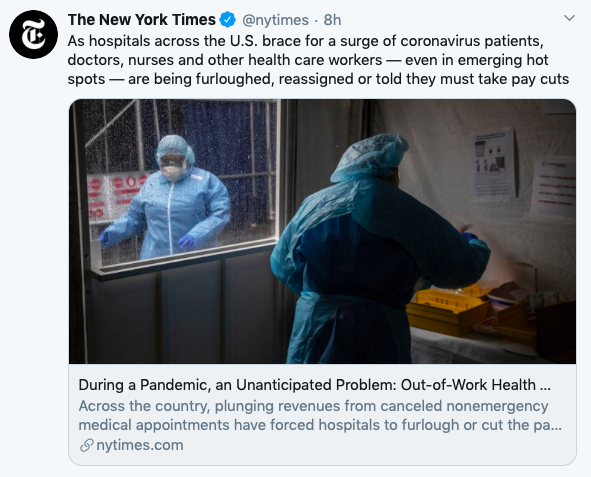
As hospitals across the country brace for an onslaught of coronavirus patients, doctors, nurses and other health care workers — even in emerging hot spots — are being furloughed, reassigned or told they must take pay cuts.

The job cuts, which stretch from Massachusetts to Nevada, are a new and possibly urgent problem for a business-oriented health care system whose hospitals must earn revenue even in a national crisis. Hospitals large and small have canceled many elective services — often under state government orders — as they prepare for the virus, sending revenues plummeting.

That has left trained health care workers sidelined, even in areas around Detroit and Washington, where infection rates are climbing, and even as hard-hit hospitals are pleading for help.

“I’m 46. I’ve never been on unemployment in my life,” said Casey Cox, who three weeks ago worked two jobs, one conducting sleep research at the University of Michigan and another as a technician at the St. Joseph Mercy Chelsea Hospital near Ann Arbor, Michigan. Within a week, he had lost both.

Mayor Bill de Blasio of New York has begged doctors and other medical workers from around the country to come to the city to help in areas where the coronavirus is overwhelming hospitals.

“Unless there is a national effort to enlist doctors, nurses, hospital workers of all kinds and get them where they are needed most in the country in time, I don’t see, honestly, how we’re going to have the professionals we need to get through this crisis,” de Blasio said Friday morning on MSNBC.

And the Department of Veterans Affairs is scrambling to hire health care workers for its government-run hospitals, especially in hard-hit New Orleans and Detroit, where many staff members have fallen ill. The department moved to get a federal waiver to hire retired medical workers to beef up staff levels.

But even as some hospitals are straining to handle the influx of coronavirus patients, empty hospital beds elsewhere carry their own burden.

“We’re in trouble,” said Gene Morreale, the chief executive of Oneida Health Hospital in upstate New York, which has not yet seen a surge in coronavirus patients.

Governors in dozens of states have delivered executive orders or guidelines directing hospitals to stop nonurgent procedures and surgeries to various degrees. Last month, the U.S. surgeon general, Dr. Jerome M. Adams, also implored hospitals to halt elective procedures.

That has left many health systems struggling to survive.

Next week, Morreale said, Oneida will announce that it is putting 25% to 30% of its employees on involuntary furlough. They will have access to their health insurance through June. Physicians and senior staff at the hospital have taken a 20% pay cut.

“We’ve been here 121 years, and I’m hoping we’re still there on the other side of this,” Morreale said.

Appalachian Regional Healthcare, a 13-hospital system in eastern Kentucky and southern West Virginia, has seen a 30% decrease in its overall business because of a decline in patient volume and services related to the pandemic. Last week, the hospital system announced it would furlough about 8% of its workforce — around 500 employees.

Hospital executives across the country are cutting pay while also trying to repurpose employees for other jobs.

At Intermountain Healthcare, which operates 215 clinics and 24 hospitals in Utah, Idaho and Nevada, about 600 of the 2,600 physicians, physicians assistants and registered nurses who are compensated based on volume will see their pay dip by about 15%, said Daron Cowley, a company spokesman.

Those reductions are tied to the drop in procedures, which has fallen significantly for some specialties, he said. The organization is working to preserve employment as much as possible, in part by trying to deploy 3,000 staff members into new roles.

“You have an endoscopy tech right now that may be deployed to be at hospital entrances” where they would take the temperatures of people coming in, Cowley explained.

In Boston, a spokesman for Partners HealthCare, with 12 hospitals, including Massachusetts General and Brigham and Women’s, said staff members whose work has decreased are being deployed to other areas or will be paid for up to eight weeks if no work is available.

But redeployment is not always an option. Janet Conway, a spokeswoman for Cape Fear Valley Health System in Fayetteville, North Carolina, said many of the company’s operating room nurses trained in specialized procedures have been furloughed because their training did not translate to other roles.

“Those OR nurses, many have never worked as a floor nurse,” she said.

Conway said nearly 300 furloughed staff members have the option to use their paid time off, but beyond that, the furlough would be unpaid. Most employees are afforded 25 days per year.

Some furloughed hospital workers are likely to be asked to return as the number of coronavirus cases rise in their communities. But the unpredictable virus has offered little clarity and left hospitals, like much of the economy, in a free fall.

Many health systems are making direct cuts to their payrolls, eliminating or shrinking performance bonuses and prorating paychecks to mirror reduced workload until operations stabilize.

Scott Weavil, a lawyer in California who counsels physicians and other health care workers on employment contracts, said he was hearing from doctors across the country who were being asked to take pay cuts of 20% to 70%.

The requests are coming from hospital administrators or private physician groups hired by the hospitals, he said, and are essentially new contracts that doctors are being asked to sign.

Many of the contracts do not say when the cuts might end, and are mostly affecting doctors who are not treating coronavirus patients on the front lines, such as urologists, rheumatologists, bariatric surgeons, obstetricians and gynecologists.

Such doctors are still being asked to work — often in a decreased capacity — yet may be risking their health going into hospitals and clinics.

“It’s just not sitting well,” Weavil said, noting that he tells doctors they unfortunately have few options if they want to work for their institution long term.

“If you fight this pay cut, administration could write your name down and remember that forever,” he said he tells them.

In other cases, physicians are continuing to find opportunities to practice in a more limited capacity, like telemedicine appointments. But that has not eliminated steep pay cuts.

“Physicians are only paid in our clinic based on their productivity in the work they do,” said Dr. Pam Cutler, the president of Western Montana Clinic in Missoula. “So they’re automatically taking a very significant — usually greater than 50% or 25% — pay cut just because they don’t have any work.”

In some areas, layoffs have left behind health care workers who worry that they will not be able to find new roles or redeploy their skills.

Cox in Michigan said he was briefly reassigned at his hospital, helping screen and process patients coming in with coronavirus symptoms, but eventually the people seeking reassignments outgrew the number of roles.

He also expressed concern that inevitable changes in the health care industry after the pandemic — paired with the possibility of a lengthy period of unemployment — could make it difficult to get his job back.

“I’m just concerned that the job I got laid off from may not be there when this is over,” Cox said. “The longer you’re away, the more you worry, ‘Am I going to be able to come back?’ So there’s a lot of anxiety about it.”

Even as many of the largest hospital networks grapple with sudden financial uncertainty, much smaller practices and clinics face a more immediate threat.

According to a statistical model produced by HealthLandscape and the American Academy of Family Physicians, by the end of April, nearly 20,000 family physicians could be fully out of work, underemployed or reassigned elsewhere, particularly as cities like New York consider large-scale, emergency reassignments of physicians.

“Many of these smaller practices were living on a financial edge to start with, so they’re not entering into this in a good position at all,” said Dr. Gary Price, the president of the Physicians Foundation. “Their margins are narrower, their patients don’t want to come in, and many of them shouldn’t anyway, so their cash flow has been severely impacted and their overhead really hasn’t.”


Nonprofit hospitals vulnerable to coronavirus-related market fallout, Fitch says

https://www.beckershospitalreview.com/finance/nonprofit-hospitals-vulnerable-to-coronavirus-related-market-fallout-fitch-says.html

I Like Boats Dump- Especially Boats Crashing Into Waves - Album on ...

Continued market losses prompted by the COVID-19 pandemic will likely weaken key liquidity metrics and pressure the ratings of some nonprofit hospitals, according to a new Fitch Ratings report. 

About half of Fitch’s rated nonprofit hospitals have 10 percent to 40 percent of their portfolios invested in equities, but other nonprofit hospitals exceed this range by a wide margin, Fitch noted.

Throughout the last month, the stock market suffered historic losses, which caused hospitals with more aggressive asset allocation to underperform their more conservative counterparts by 10 percent to 25 percent, Fitch said. 

Fitch said that hospitals in the last few weeks have seen a median loss of about 30 days of cash on hand. It noted this metric is not “an immediate concern yet, given the ample liquidity these hospitals have.”

But Fitch said most hospitals have cash on hand to fund about 200 days of operations.

The ratings agency said the market likely will remain volatile, and “time will tell if and how the stock market declines eat into a hospital’s reserves.”


How hospital capacity varies dramatically across the country

https://www.healthcaredive.com/news/how-hospital-capacity-varies-dramatically-across-the-country/574892/

POPULATION                                    BED COUNT 

20M                      10M people                            0                          0                         25k beds                     50k

LUMEDX (@Lumedx) | Twitter

Healthcare Dive analyzed data to paint a picture of hospital capacity, pinpointing areas with a higher ratio of people to beds and signaling where there is a risk for capacity issues.

Fewer hospital beds in select regions make them especially vulnerable to the novel coronavirus as it’s expected to spread from big city hot spots to other areas of the country.

As the U.S. has become the next epicenter of the outbreak, hospitals are preparing for the worst. The pathogen threatens to overwhelm their facilities and resources, especially if mitigation efforts fail to blunt a surge of COVID-19 patients.

The latest figures from the Johns Hopkins Coronavirus Resource Center report more than 143,000 confirmed cases in the U.S. and more than 2,500 deaths as of Monday.

The New York City metro area has the most beds compared to the rest of the country. Still, that is not enough capacity to meet the crushing demand.

To illustrate hospital capacity across the country, Healthcare Dive sought to compare bed counts to population, and found population size isn’t always indicative of the number of beds available.

Population size is not always indicative of bed capacity in the top 20 metro areas

Below are the 20 most populated metro areas in the U.S., sorted by population. As you move down the chart, population size decreases, but bed counts do not always. Areas like D.C. and Seattle have fewer beds relative to population size, while Miami and Philadelphia have more beds relative to population.

Some areas like Washington, D.C., have relatively fewer beds compared to their population, while others like Miami, Philadelphia and St. Louis have more beds relative to the number of people in the region.

Some hospitals are turning to hotels and tents, and Vice President Mike Pence has said he’s working with the Department of Defense to get field hospitals and other options online.

Still, researchers cautioned there is a long way to go to meet projected demands. If America’s healthcare system was able to free up half of its beds by discharging patients, the country would still need three times as many beds, Ashish Jha, director of the Harvard Global Health Institute, told reporters during a call on Tuesday. That projection assumes 40% of Americans get infected over the next six months.

“What we know right now is that capacity to manage patients varies dramatically from community to community,” Jha said.

Areas with the highest ratio of people per bed

To paint a picture of hospital capacity across the country, Healthcare Dive used CMS cost reports and population data to calculate the ratio of people per bed in metropolitan areas and regions. In other words, how many residents are there for a single bed? It’s a way to pinpoint areas with a higher ratio of people to beds, signaling areas potentially at risk for capacity issues.

HOW HEALTHCARE DIVE ANALYZED HOSPITAL BED COUNTS

Hospitals certified by Medicare are required to submit annual cost reports to CMS, which include a vast array of information from bed counts to financials. Hospital beds analyzed in this report do not include all the beds a hospital may have reported to CMS.

Healthcare Dive excluded nursery, labor and delivery beds and psychiatric hospitals. In addition, due to the inconsistent reporting in ICU beds, Healthcare Dive did not highlight areas with higher ratios of people per ICU bed. It’s also important to note that some hospitals may have opened or closed since these latest CMS cost reports were published.

Healthcare Dive analyzed specific geographic areas, in this case metropolitan CBSAs, or core-based statistical areas, which are geographic areas that consist of an urban center of 50,000 people or more.

In the U.S., about 42% of the more than 143,000 cases are concentrated in New York, overwhelming available resources. Still, case counts are swelling in areas outside of New York including Chicago, Detroit and New Orleans. Indicating the outbreak is likely to be widespread in America.

Healthcare Dive found the Bloomsburg-Berwick, Pennsylvania, area has the lowest ratio in the nation with 86 people for each bed. Most areas have much higher ratios, the median being around 400 people per bed when comparing CBSAs. The metro area of New York City sits in the middle with 405 people per bed.

The Greeley, Colorado area has the nation’s highest ratio of people per bed, according to the data. About 60 miles northeast of Denver and with a population of more than 314,000, there are 1,397 people for every one hospital bed in the Greeley area.

The CMS data shows a total of 225 hospital beds in the Greeley area, operated by Banner Health’s North Colorado Medical Center.

However, a new 50-bed hospital opened recently and was not included in the most recent cost reports. It is operated by UCHealth.

Still, while those numbers may seem grim, Colorado’s hospital leaders cautioned that the state can and is working to tap into additional resources, citing freestanding emergency rooms and ambulatory surgical centers.

It’s imperative to look beyond just one locale or one hospital and consider the resources of the state as a whole, Colorado’s hospital leaders told Healthcare Dive.

Colorado has a total of 10,293 hospital beds (12,558 licensed beds) and at least 973 ICU beds, the Colorado Hospital Association said.

“It’s going to take the whole system for us to get through this,” Julie Lonborg, senior vice president at the Colorado Hospital Association, told Healthcare Dive.

There are only one or two hospitals in almost all of the 10 regions with the highest ratio of people per bed. Rounding out the top 10 areas with the highest ratio of people per bed following Greeley, include Albany, Oregon; Gettysburg, Pennsylvania; Merced, California; California-Lexington Park, Maryland; Bremerton-Silverdale, Washington; Lawrence, Kansas; Monroe, Michigan; Provo-Orem, Utah; and Ogden-Clearfield, Utah.

The data shows the total bed capacity in a region, but does not take into account the patients currently occupying those beds. However, in an effort to free up existing beds, many hospitals have halted elective surgeries, including in Greeley to free up resources and staff to be able to respond to a potential surge.

“UCHealth Greeley Hospital is caring for a large number of patients at this time, and by working together as a large system, UCHealth is able to redirect patients and admissions to other facilities to help even out our capacities at this and other hospitals,” Kelly Tracer, a spokesperson for the hospital, told Healthcare Dive.

In fact, many hospitals plan to lean on the larger systems they’re a part of to shuffle resources to respond to the pandemic.

In Gettysburg, Pennsylvania, there are 76 hospital beds and 1,353 people per hospital bed. WellSpan Health, which operates Gettysburg Hospital, said it plans to coordinate its response by using its eight other hospitals in different areas and some 200 locations.

“We are taking a comprehensive approach to this issue, developing a network of more than 10 outdoor testing locations across our five-county region and temporarily repurposing several of our outpatient medical practices to care locations dedicated solely for the treatment of patients who are suspected or confirmed to have COVID-19 and have non-emergency medical needs,” according to a statement WellSpan Health provided Healthcare Dive.

Other locations with the highest people per bed ratio are converting existing space into dedicated areas to treat COVID-19 patients to prepare for a crush of patients, including in Lawrence, Kansas, with 893 people for every bed.

Lawrence Memorial Hospital in Lawrence, Kansas, about 40 miles west of Kansas City, is prepared to up its capacity to 205, LMH said in a statement. The hospital reported 136 beds to CMS but said it is licensed for 174.

“At any given time we have upwards of 100 patients,” Traci Hoopingarner, vice president of clinical care and chief nursing officer for LMH Health, said in a statement.

As New York continues to grapple with mounting cases, leaders are issuing dire warnings to the rest of the country.

“New York is the canary in the coal mine. What happens to New York is going to wind up happening in California and Washington state and Illinois. It’s just a matter of time,” New York Gov. Andrew Cuomo said.

Below is an interactive table of hospital bed availability in different metros across the country. Search for your metro area to find the corresponding hospital capacity.


Federal pandemic money fell for years. Trump’s budgets didn’t help

https://www.politifact.com/article/2020/mar/30/federal-pandemic-money-fell-years-trumps-budgets-d/?fbclid=IwAR3Z3CZ-bU6n4Q5IxIVgsFey0ELs2F6uplsqCHpkLlHN61m5-yQ637SKqeM

PolitiFact (@PolitiFact) | Twitter

IF YOUR TIME IS SHORT

  • Federal support to build state and local capacity to manage a new viral crisis fell by 50% after 2003.
  • The decline in federal aid spans three presidencies and many sessions of Congress.
  • President Donald Trump sought $100 million in cuts that would have made the situation harder.

President Donald Trump’s critics have charged that he undermined efforts that could have helped the nation respond faster and better to the coronavirus. He’s been criticized for downgrading the focus on pandemic threats on the National Security Council and chastised for seeking budget cuts at the Centers for Disease Control and Prevention.

That isn’t the full story of U.S. pandemic preparedness.

The broader picture is that money to prepare for this day has steadily dwindled over the past 15 years — across three presidents and many sessions of Congress.

The funds for pandemics remained about the same under Trump (and would have been lower if his budgets were enacted). But compared with where funding stood in 2003, support to build state and local capacity has fallen by half.

As hospitals and public health agencies aimed for leaner, more efficient operations, the combination of fewer federal dollars and market pressures left them with little cushion to meet the explosive demands of the novel coronavirus.

Over the years, Washington put more emphasis on fighting predictable problems, like the seasonal flu, and outright aggression in the form of chemical, biological and radiological terrorism.

Sandro Galea, dean of Boston University’s School of Public Health, said people like him have been hamstrung in the debate.

“Public health has been on the defensive,” Galea said. “There’s been no space except for talk of bioterrorism. The discussion about investing in the public health system has been utterly sidelined.”

The long-term decline

Frontline readiness for a pandemic depends on many factors.

There have to be enough people with the right skills; enough beds, equipment and materials to treat patients; and the right practices to coordinate efforts across a region. Federal money helps support all of that.

The Centers for Disease Control and Prevention distributes grants to state and local public health agencies, labs and hospitals. In nominal dollars, the funding for the CDC’s Public Health Emergency Preparedness grants went from $939 million in 2003 to $675 million in 2020.

Private health providers get money through a hospital preparedness program within the Health and Human Services Department. It helps local coalitions of hospitals, public health agencies and emergency managers plan and get ready for a sudden health threat. That money went from $515 million to $275 million in the same 17-year period.

Corrected for inflation, combined spending went from over $2 billion in 2003 to a bit under $1 billion in 2020.

These programs came to the fore after the Sept. 11 attacks when concern over bioterrorism spiked. For lawmakers, the concern was personal — letters tainted with anthrax reached Capitol Hill.

But the money gradually faded, and the capacity of state and local public health departments and labs did not keep pace with the likelihood of a viral disease like COVID-19.

“Health departments can’t retain workforce or modernize their disease surveillance and laboratory capacity without adequate, long-term funding,” said Dara Lieberman, director of government relations with Trust for America’s Health, a public health advocacy group. “Today, we’re paying the price.”

Local health systems needed to do their part, but the federal government was uniquely positioned to help.

“The purchasing power of the federal government is second to none, and it has failed to stockpile or otherwise negotiate pipelines to get access to the personal protective gear and medical equipment that it has known with certainty would be needed in a respiratory pandemic,” said Ellen Carlin at Georgetown University’s Center for Global Health Science and Security.

But the news hasn’t been all bad. 

After the Ebola scare in 2014, Washington and the states showed renewed interest in preparing for a naturally occurring viral threat.

Congress provided a bit of extra money, and according to a Health and Human Services study the improvement was striking: In 2014, about 70% of hospital administrators said they were unprepared for an emerging infectious disease like Ebola. Three years later, only 14% said they weren’t ready.

But hospital leaders also warned that it was hard for them to maintain that level “given competing priorities for hospital resources and staff time.”

Local hospitals and public health agencies have come a long way since 2003, said Crystal Watson, assistant professor, at the Johns Hopkins Center for Health Security and former staffer at the Homeland Security Department.

But she said they faced multiple pressures. In addition to falling federal support, Watson said the demand to maintain a healthy bottom line helped shape the situation today.

“Hospitals are under pressure to be efficient,” Watson said. “They don’t stockpile tons of equipment and materials and they don’t have tons of empty beds because that is not profitable. When you need more supplies, and more personnel, that’s when you learn what you lack.”

Today, Watson said, the lesson is clear.

“In retrospect, none of this has been funded at the level it should have been,” she said.

A thinly stocked stockpile

This crisis has also revealed the cracks in the Strategic National Stockpile, the current go-to source for ventilators, masks and other essential needs. States have clamored for supplies, and so far, deliveries have lagged far behind demand.

During her time with Homeland Security, Watson contributed to an assessment of the Strategic National Stockpile. Watson said the stockpile was designed with a long list of threats in mind, from chemical and biological terrorism to natural disasters. Something like COVID-19 would be just one threat among many.

“It’s primary purpose, and where it had more of a focus, was on bioterrorism,” Watson said. “That’s understandable. Who else but the government is going to buy a vaccine to protect the population against smallpox?”

The most recent strategic plan for the stockpile reflects the competing demands.

It mentions emerging infectious disease 15 times. Preparing for anthrax shows up nearly 50 times.

Criticisms of Trump need context

As the first cases emerged in the United States, Democrats criticized Trump’s preparedness on two fronts: He eliminated a key office in the National Security Council, and he tried to cut the CDC’s budget. 

The budget claims have merit. The complaints about the National Security Council  are reasonable, but could be more organizational streamlining than a loss of capability.

Until the spring of 2018, the National Security Council had an office that focused on global health and biodefense. When John Bolton took the lead on the council, he crafted an overall organizational reshuffle.

The functions of the global health division were absorbed into the council’s division that dealt with weapons of mass destruction and biodefense. The White House established a Biodefense Steering Committee headed by the Health and Human Services secretary, and issued a National Biodefense Strategy.

At the time, the Center for Strategic and International Studies think tank said the White House should name a senior-level leader to oversee the policy. The White House did not follow that advice.

The Trump campaign pointed to arguments from Bolton and the former senior director of the council, Tim Morrison, rejecting the idea that they lost their focus on this kind of threat.

On the budget, Trump unsuccessfully pressed for cuts in programs that relate directly to the current crisis. In his 2018 budget, he proposed cutting over $100 million from programs aimed specifically at strengthening public hospitals and labs — a 17% reduction. For fiscal year 2020, he wanted to cut $100 million, again about 17%, from programs that target emerging and zoonotic infectious diseases.

Congress ignored the president’s budget plans and largely kept the flow of dollars steady, even increasing them slightly. 

In 2018, Congress created a new Infectious Diseases Rapid Response Reserve Fund to provide quick money between the time when a crisis strikes and Congress delivers aid with real heft. The fund held $135 million when HHS secretary Alex Azar declared a health emergency in early February, which freed up that money.

That doesn’t mean the Trump administration’s preferences had no effect, said Tony Mazzaschi, with the Association of Schools and Programs of Public Health, a group that lobbies Congress on behalf of public health schools. The threat of cuts made the status quo seem like a win when it wasn’t.

“One of the perverse things that happens is the public health community has to play defense and can’t argue for increases,” Mazzaschi said.