Healthcare jobs grew by 75K in August as industry recovers from job losses due to COVID-19

https://www.fiercehealthcare.com/hospitals/healthcare-jobs-grew-by-75k-august-as-industry-recovers-from-job-losses-due-to-covid-19

The healthcare industry added 75,000 jobs last month, a decline compared with the 126,000 that were added in July, the latest federal jobs report shows.

But there are some bright spots for the industry that is still recovering from major unemployment earlier this year sparked by job losses due to the COVID-19 pandemic.

The Bureau of Labor Statistics’ jobs report released Friday showed that hospitals continue to add more jobs after several major subsystems furloughed and laid off workers at the onset of the pandemic in March.

Hospitals added 14,000 jobs in August, which was below the 27,000 jobs the industry added in July.

The industry shed 26,000 jobs in May as hospitals took massive revenue hits from the cancellation of elective procedures and lower patient volume due to COVID-19.

Job numbers continue to recover robustly for other sectors of the healthcare industry.

Physician offices added 27,000 jobs and dentists another 22,000 in August. Home healthcare agencies added 12,000 positions in August.

But things continue to get worse for nursing homes.

Nursing homes and residential care facilities lost 14,000 jobs. But it was the lowest number of job losses the industry has faced in months.

In July the sector lost 28,000 jobs. In June, 20,000 positions were shed.

While several parts of the healthcare industry are adding jobs, the overall picture has been bleak. The federal government reported last month that healthcare employment has been down by nearly 800,000 jobs since February.

Things could continue to get worse for both hospitals and physician offices. Experts predict that hospital volumes, which have rebounded since major drops in March and April, are still below pre-pandemic levels for some facilities.


Unemployment Claims Are ‘Stubbornly High’ as Layoffs Persist

Rise in Unemployment Claims Signals an Economic Reversal - The New York  Times

Just over one million Americans filed new claims for state jobless benefits last week, the latest sign that the economy is losing momentum just as federal aid to the unemployed has been pulled away.

Weekly claims briefly dipped below the one million mark early this month, offering a glimmer of hope in an otherwise gloomy job market. But filings jumped to 1.1 million the next week, and stayed above one million last week, the Labor Department said Thursday.

“It’s devastating how stubbornly high initial claims are,” said Julia Pollak, a labor economist at the employment site ZipRecruiter. “There are still huge numbers of layoffs taking place.”

Another 608,000 people filed for benefits under the federal Pandemic Unemployment Assistance program, which offers aid to independent contractors, self-employed workers and others not covered by regular state programs. That number, unlike the figures for state claims, is not seasonally adjusted.

Other recent indicators also suggest that the recovery is faltering. Job growth slowed in July, and real-time data from private-sector sources suggests that hiring has slumped further in August. On Tuesday, American Airlines said it will furlough 19,000 workers on Oct. 1, the latest in a string of such announcements from major corporations.

“It is worrying because it does signal that these large companies are pessimistic about the state of the recovery and don’t think that we are going to be returning to normal anytime soon,” said Daniel Zhao, senior economist at the career site Glassdoor.

Unemployment filings have fallen sharply since early April, when 6.6 million applied for benefits in a single week. But even after that decline, weekly filings far exceed any previous period. Close to 30 million Americans are receiving benefits under various state and federal programs.

The rate of job losses remains high as government support for the unemployed is waning. A $600-a-week federal supplement to state unemployment benefits expired at the end of July, and efforts to replace it have stalled in Congress. President Trump announced this month that he was using his executive authority to give jobless workers an additional $300 or $400 a week, but few states have begun paying out the new benefit.

Economists warn that the loss of federal support could act as a brake on the recovery. Nancy Vanden Houten, lead economist for the forecasting firm Oxford Economics, estimated that the lapse in extra unemployment benefits would reduce household income by $45 billion in August. That could lead to a drop in consumer spending and further layoffs, she said.

The benefit initiated by Mr. Trump would use federal emergency funds to provide $300 a week in extra payments to most unemployed workers. (States can choose to chip in an additional $100 a week, but few are doing so.) As of Wednesday, 34 states had been approved for grants under the program, known as Lost Wages Assistance.

Arizona, the first state to turn the grants into payments, sent $252.6 million to about 400,000 recipients last week, a sum that included retroactive payments for the first two weeks of August. Texas this week has paid out $424 million and expects to deliver nearly $1 billion more to cover the first three weeks of benefits. A handful of other states are paying benefits or expect to begin doing so within days.

Most, however, said it could take until mid-September or later.

Once the money starts flowing, it may not last long. Mr. Trump’s order authorized spending up to $44 billion, which federal officials said last week would cover four or five weeks of payments. That means jobless workers in many states may receive a lump sum covering several weeks of retroactive benefits, but nothing more without congressional action.

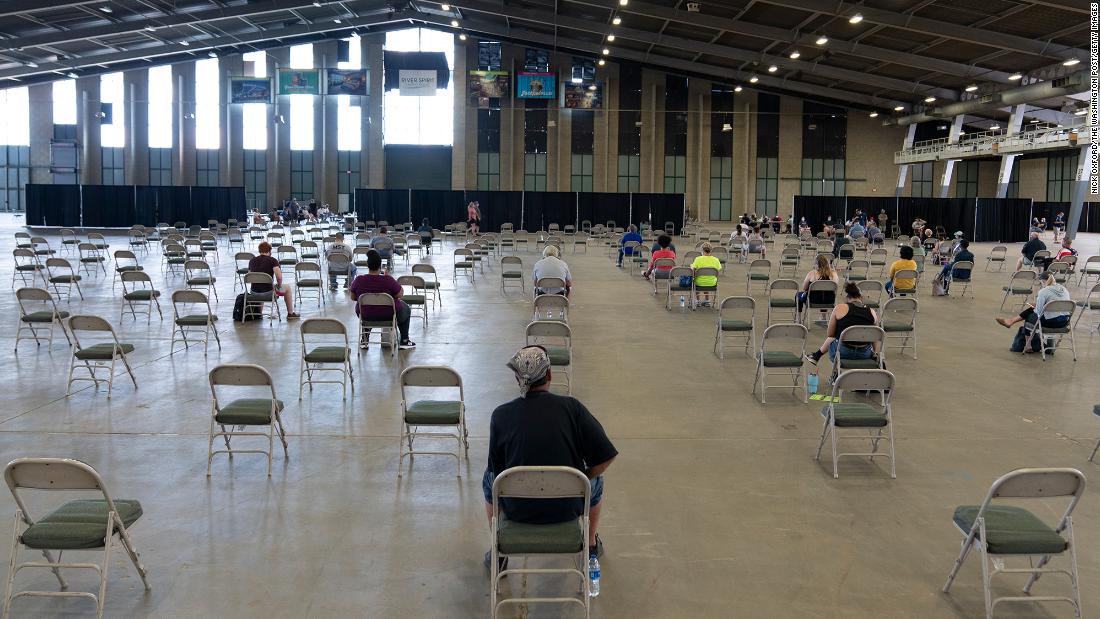
A crowd thronged a temporary unemployment office in Kentucky in June. Adapting computer systems to new benefits has been a crucial factor in processing claims.

On the surface, the new lost wages program looks like the earlier $600-a-week federal supplement, just cut in half. But there are subtle differences: The program has a different funding source (the Federal Emergency Management Agency instead of the Labor Department) and new restrictions (people receiving less than $100 a week in regular benefits don’t qualify).

Those kinds of adjustments would be trivial on a modern computer system. But many state unemployment systems are running on computers that are anything but modern.

In Oklahoma, for example, the unemployment system uses a 40-year-old mainframe computer that turns even minor adjustments into a major programming task. As a result, even though the state was among the first to apply for the $300 benefit this month, it doesn’t expect to begin paying the new benefit until late September.

“The fact that I’m working with a mainframe from 1978 to process claims is just crippling to the agency,” said Shelley Zumwalt, interim executive director of the agency that oversees Oklahoma’s unemployment system. “We are just holding that system together with masking tape and chewing gum.”

When the pandemic hit, Arizona, too, was stuck with archaic computer systems. It built a new system virtually from scratch to begin paying out federally funded emergency benefits, and it was among the last states to do so.

But the approach left Arizona better able to handle curveballs like the new $300 benefit.

“Through that chaos, we created a pandemic unemployment system,” said Michael Wisehart, director of the Arizona Department of Economic Security.

Christy Miller says there are three things that shape her identity: making people laugh, making people strong and lifting heavy objects. She can’t do any of those right now, and she isn’t sure when she will be able to again.

Ms. Miller, 49, is a standup comedian in New York, where comedy clubs have been closed since March. She is also a personal trainer and an amateur power lifter — activities she has had to give up because gyms, too, remain closed in the city.

The $600-a-week supplement to her unemployment pay didn’t just allow her to pay rent and buy food. It also freed up the time and mental energy for her to learn video production, podcasting and other skills to help her survive the pandemic-driven shutdown of her industry.

“I would give up the $600 a week any day for this coronavirus to go away and get back to work,” she said. “But the $600 has allowed me not to be homeless, to learn more computer stuff that I never would have learned or had the time to learn.”

None of those ventures are producing much income yet, though. She saved as much of her unemployment benefits as she could, and has enough to cover rent through the end of the year. But other bills are another matter. And there is little guarantee that her business will bounce back before her savings run out.

“If they don’t fix this pandemic thing, I may have to leave New York because I can’t afford to stay here,” she said.

Kris Fusco is finally back at work. That doesn’t mean her coronavirus worries are behind her.

When Ms. Fusco’s employer — a small, family-owned business in Massachusetts that rents musical instruments to students — laid her off in March, she expected to be out of work for a couple of weeks. That got extended to April, then to June. Eventually one of the owners called her to tell her they didn’t know when they could reopen.

“I said, ‘You do what you need to do to keep your business afloat, and I’m just going to hold on as long as I can,’” she said. Fortunately, her employer called her back shortly after the $600 supplement expired. She returned to work last week, and, despite some nervousness about going into the office with the virus still spreading, she said she was grateful for the paycheck.

But Ms. Fusco, 50, doesn’t know how long her good fortune will last. With many schools still teaching remotely or canceling activities like band, she worries that her company’s business will suffer. Already, she has noticed a large number of instruments being returned.

“It’s very worrisome for me because I can see the snowball effect from Covid-19 all around me,” she said. “It’s always lurking right behind my eyeballs that in six months I might be out of a job again.”


Millions of U.S. jobs to be lost for years, IRS projections show

https://www.accountingtoday.com/articles/millions-of-u-s-jobs-to-be-lost-for-years-irs-projections-show?utm_source=Sailthru&utm_medium=email&utm_campaign=Issue:%202020-08-21%20CFO%20Dive%20%5Bissue:29224%5D&utm_term=CFO%20Dive

Millions of US Jobs to Be Lost for Years After Covid, IRS ...

The Internal Revenue Service projects that lower levels of employment in the U.S. could persist for years, showcasing the economic fallout of the coronavirus pandemic.

The IRS forecasts there will be about 229.4 million employee-classified jobs in 2021 — about 37.2 million fewer than it had estimated last year, before the virus hit, according to updated data released Thursday. The statistics are an estimate of how many of the W-2 tax forms that are used to track employee wages and withholding the agency will receive.

Lower rates of W-2 filings are seen persisting through at least 2027, with about 15.9 million fewer forms filed that year compared with prior estimates. That’s the last year for which the agency has published figures comparing assumptions prior to the pandemic and incorporating the virus’s effects.

W-2s are an imperfect measure for employment, because they don’t track the actual number of people employed. A single worker with several jobs would be required to fill out a form for each position. Still, the data suggest that it could take years for the U.S. economy to make up for the contraction suffered because of COVID-19.

The revised projections also show fewer filings of 1099-INT forms through 2027. That’s the paperwork used to report interest income — and serves as a sign that low interest rates could persist.

There’s one category that is expected to rise: The IRS sees about 1.6 million more tax forms for gig workers next year compared with pre-pandemic estimates.

That boost “likely reflects assumptions with the shift to ‘work from home,’ which may be gig workers, or may just be that businesses are more willing to outsource work — or have the status of their workers be independent contractors — now that they work from home,” Mike Englund, the chief economist for Action Economics said.


New unemployment claims top 1 million. Again.

https://www.washingtonpost.com/business/2020/08/20/august-unemployment-claims/?wpmk=1&wpisrc=al_business__alert-economy&utm_source=alert&utm_medium=email&utm_campaign=wp_news_alert_revere&location=alert&pwapi_token=eyJ0eXAiOiJKV1QiLCJhbGciOiJIUzI1NiJ9.eyJjb29raWVuYW1lIjoid3BfY3J0aWQiLCJpc3MiOiJDYXJ0YSIsImNvb2tpZXZhbHVlIjoiNWI2M2EzNDJhZGU0ZTI3Nzk1NTBjYTFiIiwidGFnIjoid3BfbmV3c19hbGVydF9yZXZlcmUiLCJ1cmwiOiJodHRwczovL3d3dy53YXNoaW5ndG9ucG9zdC5jb20vYnVzaW5lc3MvMjAyMC8wOC8yMC9hdWd1c3QtdW5lbXBsb3ltZW50LWNsYWltcy8_d3Btaz0xJndwaXNyYz1hbF9idXNpbmVzc19fYWxlcnQtZWNvbm9teSZ1dG1fc291cmNlPWFsZXJ0JnV0bV9tZWRpdW09ZW1haWwmdXRtX2NhbXBhaWduPXdwX25ld3NfYWxlcnRfcmV2ZXJlJmxvY2F0aW9uPWFsZXJ0In0.ns8VggWJk95qb-c_2926acWIaHxyFIBXSRn76O7Lrf0

The number of people applying for the first time for unemployment insurance ticked up last week to 1.1 million, from 970,000 the week before, a sign that job losses continue to plague the labor market five months into the coronavirus pandemic.

The weekly jobless claims had sunk slowly in recent months but have remained well above historical highs, averaging about 1.18 million a week for the last four weeks. Economists had predicted last week’s figure to approach the numbers from the previous week, which had fallen below 1 million for the first time in about five months.

Instead, the initial claims and new claims for Pandemic Unemployment Assistance, the program available to gig and self-employed workers, both went up. About 543,000 new claims were filed for PUA for the week that ended on Aug. 15, up from 488,000 the week before.

“The fact that the claims are so high this far into the crisis is concerning,” said AnnElizabeth Konkel, an economist at the job site Indeed. “Yet the depths of the damage remain to be seen. I would definitely call it a canary raising alarms in the economic coal mine.”

Data shows the number of job postings slowly recovering in recent weeks, compared with postings from the year prior. However, last week, postings took a turn for the worse. They had been running about 18 percent below normal and fell to 20.3 percent below normal last week.

“The longer we go into this crisis, the longer people that have been temporarily laid off may not get called back,” Konkel said. “Businesses can only ride out this crisis for so long.”

More than 28 million people were receiving some form of unemployment benefits as of Aug. 1, the most recent week for that statistic, about equal to the previous week.

Job loss from the pandemic remains a singular crisis, without comparison in modern times. The country’s unemployment rate, last calculated in July, was 10.2 percent, and economists have warned that it could go up in August as the virus continues to alter life around the country.

The extra $600 in unemployment benefits that many workers credit with keeping them afloat expired at the end of July. And funds from the $660 billion PPP program, which gave grants and loans to companies to keep workers on payroll, have been running out for many recipients.

Companies announcing layoffs in recent days include Wieland Copper Products, in North Carolina, a Mohegan Sun casino in Wilkes-Barre, Pa., Amsterdam Printing & Litho, a printing company in Upstate, N.Y., and Ohio sales and marketing company Maritz. School districts and local governments are also beginning to experience deep cuts: New York Mayor Bill de Blasio (D) warned last week that as many as 22,000 city workers faced possible layoffs in the fall.


Prosecuting the case against the COVID response

https://mailchi.mp/647832f9aa9e/the-weekly-gist-august-14-2020?e=d1e747d2d8

Bruce Plante Cartoon: Corona virus denial

This week, in her debut as running mate to presidential candidate Joe Biden, California Sen. Kamala Harris gave a preview of one of the Democratic ticket’s key arguments for the fall campaign, making a full-throated, prosecutorial case against the Trump administration’s handling of the coronavirus pandemic.

“The virus has impacted almost every country,” Harris said, “but there’s a reason it has hit America worse than any other advanced nation. It’s because of Trump’s failure to take it seriously from the start.

After receiving a briefing from public health experts on Thursday, Biden and Harris argued for a more comprehensive, aggressive national strategy to battle the virus, including major federal investment in contact tracing, a national mask mandate, and guaranteed free access to a COVID vaccine when it becomes available.

The remarks came as the US experienced the deadliest day of the summer so far, with nearly 1,500 COVID fatalities on Wednesday, and a seven-day rolling average of over 1,000 deaths per day for the last 17 days. Meanwhile, a new analysis by the New York Times, using data from the Centers for Disease Control and Prevention (CDC), indicated that the true US death toll from COVID may be as much as 35 percent higher than the reported total of 167K—a finding based on “excess deaths” above normal levels since March.

As President Trump continued to urge schools to reopen for in-person instruction nationwide, the White House released new guidance for ensuring students’ safe return to school. The guidance encouraged social distancing, frequent handwashing, better ventilation of school facilities, and the use of outdoor settings wherever possible.

Despite the President’s claim last week that children are “virtually immune” from the virus, a new analysis from the American Academy of Pediatrics and the Children’s Hospital Association showed that 97,000 children tested positive for COVID in the last two weeks of July alone, a 40 percent increase in the total number of known cases over that period.

About 340,000 children have tested positive so far, representing about 9 percent of all US cases. As schools face pressure to reopen, those numbers are likely to mount, and early-opening school districts in Georgia, Tennessee, Indiana, and Mississippi are already struggling to keep schools open amid rising cases.

Federal assistance to help schools deal with what seems like inevitable rounds of positive cases and closures is not forthcoming, however: after failing to reach a deal on another round of COVID relief, lawmakers have left Washington until September.

US coronavirus update: 5.2M cases; 167K deaths; 64.6M tests conducted.


Cartoon – I can’t remember the last time the Cupboards were so bare!

Year in Economy Cartoons - Slideshows and Picture Stories ...

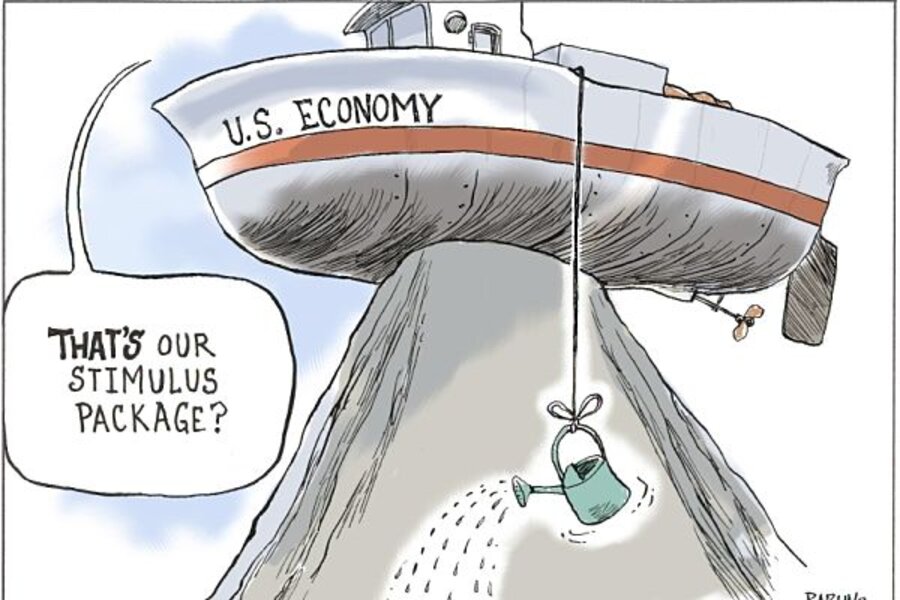
Cartoon – New Economic Stimulus Package

Obama's stimulus did NOT raise government spending - CSMonitor.com

THE BIG DEAL—Five takeaways from the July jobs report

https://thehill.com/policy/finance/510987-july-jobs-report-unemployment-economy-coronavirus

July U.S. Job Gains Top Expectations

The Friday release of the July jobs report gave a clearer view into a labor market clouded by mixed signals from real-time data and concerns about rising coronavirus cases across the country. The U.S. recovered another 1.8 million jobs last month—a bit above economists’ expectations, but well below the gains of May and June — and pushed the unemployment rate down to 10.2 percent.

While the U.S. economy is continuing to recover from the shock of pandemic, the report is a bit more complicated than the headline numbers indicate. Here are five key points to make sense of the July jobs report.


The recovery is still going, but slowing: The story of the coronavirus recession is a story of declines of record-breaking size and speed. Between March and April, the U.S. lost roughly 10 years of job gains and followed it up with a 32-percent annualized decline in economic growth in the second quarter.

The U.S. made solid progress recovering part of the more than 20 million jobs lost to the pandemic with gains of 2.7 million in May and 4.8 million in June. But the 1.8 million jobs gained in July marks a notable slowdown in the pace of recovery.

Economists have warned since coronavirus cases began spiking in mid-June that the resurgence would hinder the pace of growth, even if states don’t reimpose business closures. Those warnings bore out in the July jobs report, reinforcing the need to control the virus before the economy can fully recover.


The report gives both sides ammo in stimulus talks: The state of the economy rarely fits into a neat political narrative and the July jobs report is no exception.

Democrats can point to the slowing pace of job growth and the long road to recovery to support their calls for another $3 trillion in stimulus.

“The latest jobs report shows that the economic recovery spurred by the investments Congress has passed is losing steam and more investments are still urgently needed to protect the lives and livelihoods of the American people,” said House Speaker Nancy Pelosi (D-Calif.) and Senate Minority Leader Charles Schumer (D-N.Y.) in a Friday statement.

But the White House and Republican lawmakers are seizing on the expectations-beating job gain and lack of increase in permanent layoffs to make the case behind a pared down bill focused on reopening the economy.

“The most responsible thing we can do is to take proactive measures to allow people to return to work safely, instead of continuing to lock down the economy,” said Rep. Kevin Brady (R-Texas), ranking member of the House Ways and Means Committee.


The job market is still a long way from recovery: Despite three months of seven-figure job gains, the U.S. economy is still in a deeply damaged state. The July unemployment rate of 10.2 percent is roughly even with the peak of joblessness during the Great Recession of 10 percent in October 2009. And the true level of U.S. unemployment may be higher given how the pandemic has made it harder to define and track who is truly in the labor force.

It took a decade of steady economic recovery— the longest in modern U.S. history — for unemployment to drop to a 50-year low of 3.5 percent in February, so the nation remains a long way from where it was before the pandemic.

“At the current pace, it would take well into 2021 to recoup the 12.9 million jobs lost since February,” wrote Diane Swonk, chief economist at Grant Thornton, in a Friday analysis of the jobs report.


The increase in government jobs is likely misleading: Employment in government — which includes public schools — rose by 301,000 in July.

At first glance, that’s a welcome sign of resilience as state and local governments face severe budget crunches driven by falling tax revenues and staggering unemployment claims. But economists warn that the rise is likely the result of a seasonal adjustment designed to account for the large numbers of teachers and school employees that roll off of payrolls during the summer before coming back to work in the fall.

Elise Gould, senior economist at the left-leaning Economic Policy Institute, noted that public sector employment is still 1 million jobs below its February level after loads of layoffs during the beginning of the pandemic.

“We’ve seen large reductions in state and local public sector employment — a sector which disproportionately employs women and Black workers — over the last few months,” Gould wrote.

“I’d warn data watchers to consider those gains with a grain of salt, and to look at the overall changes from February (pre-COVID-19) to July.”

Aid to state and local governments is one of the biggest obstacles to gathering GOP support behind another stimulus bill, so this rise could factor into the rhetoric around the negotiations.


The report poses hard questions for negotiators: Every monthly jobs report has about two weeks of lag between the time the data was compiled — around the 12th of that month — and the report’s release.

While economic conditions don’t typically change drastically in that time, July was an exception. The $600 weekly boost to jobless benefits and the federal eviction and foreclosure ban enacted in March both lapsed in between the jobs report survey period and release, and much of the money lent through the Paycheck Protection Program had been spent by the end of the month. That means lawmakers are looking at a glimpse of the economy with much more fiscal support than it currently has, posing tough choices about how much more is needed to keep the economy afloat.

Even so, economists are urging  lawmakers not to rest on their laurels as the U.S. faces a difficult road ahead.

“Any notion that the improvement in the top line provides a convenient excuse for policymakers to avoid hard decisions around a fifth round of fiscal aid aimed at the unemployed should be summarily dismissed,” wrote Joe Brusuelas, chief economist at tax and audit firm RSM, in a Friday analysis.

Talks on a new coronavirus relief package were going poorly before the report and collapsed hours after it was released. 


LEADING THE DAY

Trump embraces jobs report signaling slowdown: The White House is trying to capitalize on the latest jobs numbers, arguing they point to a strong economic recovery under President Trump even as millions remain out of work and states grapple with increases in coronavirus infections.

But the data nevertheless point to an economic slowdown, challenging the White House’s bullish predictions for a speedy V-shaped recovery. The figures also come amid collapsed talks between the Trump administration and Democratic leaders on a coronavirus relief package, which economists say is desperately needed to prevent a deeper recession.

“This is not a rocket ship,” said Martha Gimbel, senior manager of economic research at Schmidt Futures. “It’s really unclear if the economy is going to achieve escape velocity before the lack of government spending crashes down or before … we have to shut down again, which is a total possibility.”

The Hill’s Morgan Chalfant and I explain why here.

The White House view: White House economic adviser Larry Kudlow, who did the rounds on cable news Friday morning, declared that the numbers evidenced a “self-sustaining recovery” and predicted that the United States would see unemployment head into the single digits in the fall months.

“The worries that some partial shutdowns or some pausing shutdowns would wreck the jobs numbers did not pan out. I think that shows signs of strength,” Kudlow said on Fox Business.

The economists’ take: Economic analysts say that despite the jobs report, there remains a need for additional fiscal stimulus. Many point to an extension of the expanded unemployment benefits and additional aid to states as necessary steps to shepherd the economy through recovery until there is a vaccine for the coronavirus.

“This jobs number doesn’t change the undeniable need for additional federal support,” said Isaac Boltansky, director of policy research at investment bank Compass Point Research & Trading.


Cartoon – Unemployment Insurance vs. Raising the Minimum Wage

If you make less than $600 week, you’re underpaid. Period.

No photo description available.

US economy added 1.8 million jobs in July but still down nearly 13 million jobs during the pandemic

https://edition.cnn.com/2020/08/07/economy/july-2020-jobs-report/index.html?fbclid=IwAR2ZKuCxrp3mzH_GizAoLlCe3ZRAleJbzjCSYYmxiJ6Efiq_qfbU9eq2N2o

July jobs report 2020: US economy added 1.8 million jobs in July ...

The US economy added another 1.8 million jobs in July, a sharp slowdown from June and a small step for an economy that’s still down 12.9 million jobs during the pandemic.

It was the third-straight month of improvement after the spring lockdown that decimated the labor market, and the July job gain exceeded economists’ expectations. Even so, it was far fewer than the 4.8 million jobs added in June.
The unemployment rate fell to 10.2%, the Bureau of Labor Statistics reported Friday, but remains above the Great Recession high of 10% that was reached in October 2009.
Friday’s report had good and bad parts, and economists are still trying to come to grips with how the labor market is behaving in this unparalleled situation.
For example, the number of people working part-time rose by 803,000 to 24 million in total in July. The government defines part-time work as anything under 35 hours per week.
“We added more jobs than most people expected, but the gains really were disproportionately part-time workers,” said Kate Bahn, economist and director of labor market policy at the Washington Center for Equitable Growth. “To me that means even if workers are coming back it’s to jobs that pay less, and families will be worse off.”
Meanwhile, the unemployment rate fell in all demographic groups. The rate remains by far the highest for Black workers at 14.6%, which is concerning, Bahn said.
“Research from previous downturns suggests that Black workers are the most likely to be displaced,” she added.
Then there are seasonal adjustments, which are based on historical trends in the job market — but because the pandemic is unlike any other moment in history, they’re distorting the data at the moment. Without seasonal adjustments, only 591,000 jobs were added in July.
That said, one positive sign in this jobs report is the number of permanent job losses: it was more or less flat from June at 2.9 million. This might not sound exciting, but it would have been very bad news for the recovery had the number gone up.
“Granted still more than double from before the crisis, but we’ll take the one-month reprieve,” said Daniel Zhao, senior economist at Glassdoor.
Since the pandemic hit, the government has struggled to count the enormous number of people who are out of work. That’s in part because it has been increasingly difficult for workers themselves to discern whether they have been temporarily laid off or employed but not at work.
The share of misclassified responses was smaller in June and July than in the months before, the BLS said. Including the misclassified workers, the July unemployment rate would have been about one percentage point higher than reported.
The reopening of the economy and a resurgence in Covid-19 infections in some states, paired with business and individuals running out of federal aid, has created a unique set of conditions for the jobs market.
survey from Cornell University showed that 31% of workers who were recently rehired have lost their jobs for a second time during the pandemic. Another 26% have been told that they might get laid off again.
Meanwhile, the Federal Reserve Bank of St. Louis said states with more Covid cases since June also registered the weakest employment recovery. This was most notably true for Arizona, Florida and Texas.

Head-butting in Washington

Friday’s jobs report comes during tense times in Washington, as Republicans and Democrats are butting heads over the next stimulus bill. One point of contention is the government’s boost of unemployment benefits. The CARES act provided a weekly boost of $600 to regular jobless aid. But this provision ran out on July 31.
Now Congress is arguing about how to proceed: Democrats want to keep the $600 weekly supplement for the rest of the year, while Republicans want to cut it to $400 a week.
For millions of Americans, the benefit expansion contributes a large portion of their income at the moment — so cutting it could hamper the recovery. At the same time, some economists believe that too much unemployment aid actually keeps people from returning to work. The question is what is too much aid during an economic crisis of unprecedented proportions.
“The primary reasoning behind the reducing those benefits it that it would push more Americans back into the labor force. But there doesn’t seem to be a lot of evidence for the need to push people back, because the jobs aren’t’ there,” said Zhao, the Glassdoor economist.
This could mean workers who are forced back to work by the lower benefits may have to take part-time or riskier jobs than they would otherwise choose.