


Thought of the Day – I want this
https://finance.yahoo.com/news/colleges-students-liability-waivers-112753572.html
Schools that are choosing to reopen amid the coronavirus pandemic are attempting to protect themselves against possible legal blowback with legal liability waivers.
From universities to K-12 districts, some schools are sending forms with titles such as “Assumption of Risk” and “Waiver of Liability” to fend off any lawsuits should students contract coronavirus on campus or in the classroom.
“Institutions are basically trying to have it both ways,” Kevin McClure, associate professor of higher education at the University of North Carolina Wilmington, told Yahoo Finance. “They’re trying to say: ‘We are opening in the midst of significant risk, and at the same time we want you — as students or faculty or staff — to assume that risk and to not hold us responsible for the decisions that we’ve made.’”
Generally, the waiver forms note two things: That there is a risk of contracting the coronavirus if a student appears on campus and that the decision to come back cannot be held against the school.
“I know the challenge these circumstances present, but I also know our students’ ability to take responsibility both for themselves and each other,” Damon Sims, vice president for Student Affairs at Penn State, said in a press release. “If ever there was a time for them to do so, now is that time. We will do all we can to encourage that outcome, and we expect them to do all they can to make it so. We are in this together.”
Students returning to Penn State’s University Park campus, which usually houses more that 45,000 undergraduate students, are required to fill out the following “coronavirus compact” prior to their arrival on Penn State’s campus
Saint Anselm College in New Hampshire is another college asking its students to sign a waiver.
The liberal arts school is planning to conduct its fall semester primarily in-person, an option 30% of schools have chosen. Classes start for 2,000 students on August 19, university spokesperson Paul Pronovost told Yahoo Finance.
Aside from the usual safety measures — from reducing density in housing, classroom, and common spaces, restricting visitors, implementing distancing — the school is also going to administer two coronavirus tests on students upon their arrival: A rapid test and a fuller test. Saint Anselm is also planning to do surveillance testing throughout the semester.
Beyond social distancing, testing, and contact tracing, the university wants students and parents to “accept” the unique schooling situation.
There’s “simply no way for the College – or any College or institution, for that matter – to guarantee that our campus will not see cases of COVID-19,” Pronovost said in an email. “We believe it is important for students and families to understand and accept that this is the reality of the current situation.”
The liability waiver notes that students “forever release and waive my right to bring suit against Saint Anselm College, its Board of Trustees, officers, directors, managers, officials, agents, employees, or other representatives in connection with exposure, infection, and/or spread of COVID-19 related to taking classes, living or participating in activities on the Saint Anselm College Campus.”
The possibility of lawsuits worried colleges enough to lobby Congress for protections from liability.
Nearly 80 education groups sent a letter to congressional leaders back in May, stating that reopening schools involves not just “enormous uncertainty about COVID-19-related standards of care” but also the “corresponding fears of huge transactional costs associated with defending against COVID-19 spread lawsuits.”
Rutgers Law Professor Adam Scales argued that we may see an uptick in litigation, at least “until Congress or the courts firmly signal that COVID is not going to be ‘the new asbestos,’” adding that courts will not likely impose severe liability on public entities like schools.
“Just because a student can get into court does not mean the student can win,” Michael Duff, a law professor at the University of Wyoming, told Yahoo Finance. “So even if the waiver does not ‘work,’ and the student can get into court, there is no guarantee that a lawyer would take the case because the case may be weak.”
There is also the issue of proof.
“The idea that liability — whether caused by negligence or gross negligence — is easy to prove is a myth,” Duff said. “The student would first have to prove that the college did not act ‘reasonably’ in the COVID-19 context.”
Given that the definition of acting “reasonably” would not necessarily involve a college being perfect with its coronavirus mitigation, Duff added, gross negligence would be “a very hard thing to prove.”
At the same time, Scales added, a liability waiver could not serve as a “get-out-of-jail-free card” a school taken to court in a coronavirus-related case brought by a student.
At the end of the day, McClure noted, colleges need students to return to campus and pay tuition to survive as institutions of higher education.
“I do genuinely believe that many institutions and the people running them want to do what’s right and keep people healthy,” McClure said. “On the other hand, there are the financial realities of attempting to keep an organization up and running, and an organization whose revenue is often very much tied to people coming to campus.”
Schools are thus faced with “a stark dilemma,” McClure added, of either bringing students and faculty back to campus or “make significant cuts because we are not able to pay our bills.”
That said, given that students are paying a lot more today than previous generations in terms of tuition and fees, there is a sentiment that “institutions actually have a greater duty of care to their students.”
That idea is being put to the test amid the coronavirus pandemic, McClure said, and the liability waivers — which essentially abandon the “duty of care” that these institutions should take — fly in the face of this “consumerist moment” in higher education.
“Anytime that you’ve got people that are forking over large amounts of money and making a significant investment,” McClure said, “you can expect that they’re going to want a certain level of service and are going to be unhappy when a company or an organization isn’t delivering their end of the deal.”


Prison officials have been reluctant to do widespread virus testing even as infection rates are escalating.
Cases of the coronavirus in prisons and jails across the United States have soared in recent weeks, even as the overall daily infection rate in the nation has remained relatively flat.
The number of prison inmates known to be infected has doubled during the past month to more than 68,000. Prison deaths tied to the coronavirus have also risen, by 73 percent since mid-May. By now, the five largest known clusters of the virus in the United States are not at nursing homes or meatpacking plants, but inside correction institutions, according to data The New York Times has been collecting about confirmed coronavirus cases since the pandemic reached American shores.
And the risk of more cases appears imminent: The swift growth in virus cases behind bars comes as demonstrators arrested as part of large police brutality protests across the nation have often been placed in crowded holding cells in local jails.
A muddled, uneven response by corrections officials to testing and care for inmates and workers is complicating the spread of the coronavirus. In interviews, prison and jail officials acknowledged that their approach has largely been based on trial and error, and that an effective, consistent response for U.S. correctional facilities remains elusive.
“If there was clearly a right strategy, we all would have done it,” said Dr. Owen Murray, a University of Texas Medical Branch physician who oversees correctional health care at dozens of Texas prisons. “There is no clear-cut right strategy here. There are a lot of different choices that one could make that are going to be in-the-moment decisions.”
The inconsistent response to the spread of the coronavirus in correctional facilities is in contrast with efforts to halt its spread in other known incubators of the virus: Much of the cruise ship industry has been closed down. Staff members and residents of nursing homes in several states now face compulsory testing. Many meat processing plants have been shuttered for extensive cleaning.
As the toll in prisons has increased, so has fear among inmates who say the authorities have done too little to protect them. There have been riots and hunger strikes in correctional facilities from Washington State to New York. And even the known case numbers are likely a significant undercount because testing has been extremely limited inside prisons and because some places that test do not release the results to the public.
“It’s like a sword hanging over my head,” said Fred Roehler, 77, an inmate at a California prison who has chronic inflammatory lung disease and other respiratory ailments. “Any officer can bring it in.”
Public officials have long warned that the nation’s correctional facilities would likely become vectors in the pandemic because they are often overcrowded, unsanitary places where social distancing is impractical, bathrooms and day rooms are shared by hundreds of inmates, and access to cleaning supplies is tightly controlled. Many inmates are 60 or older, and many suffer from respiratory illnesses or heart conditions.
In response, local jails have discharged thousands of inmates since February, many of whom had been awaiting trials to have charges heard or serving time for nonviolent crimes. State prison systems, where people convicted of more serious crimes are housed, have been more reluctant to release inmates.
Testing for the virus within the nation’s penal institutions varies widely, and has become a matter of significant debate.
Republican-led states like Texas, Tennessee and Arkansas — which generally spend less on prisoners than the national average — have found themselves at the forefront of testing inmates.
In Texas, the number of prisoners and staff members known to be infected has more than quadrupled to 7,900 during the past three weeks after the state began to test every inmate.
Yet states that typically spend far more on prisons have carried out significantly less testing.
California, which spends $12 billion annually on its prison system, has tested fewer than 7 percent of inmates in several of its largest, most crowded facilities, according to the state’s data. Other Democratic-led states that also spend heavily on prisons, including New York, Oregon and Colorado, have also conducted limited testing despite large outbreaks in their facilities.
New York has tested about 3 percent of its 40,000 prison inmates; more than 40 percent of those tested were infected.
Critics say that the dearth of testing in some facilities has meant that prison and public health officials have only vague notions about the spread of the virus, which has allowed some elected officials to suggest that it is not present at all.
“We have really no true idea of how bad the problem is because most places are not yet testing the way they should,” said Dr. Homer Venters, who served as chief medical officer for the New York City jail system and now works for a group called Community Oriented Correctional Health Services, which works to improve health care services in local jails. “I think a lot of times some of the operational challenges of either not having adequate quarantine policies or adequate medical isolation policies are so vexing that places simply decide that they can just throw up their hands.”
Most state prison systems have conducted few tests. Systems in Illinois, Mississippi and Alabama have tested fewer than 2.5 percent of inmates. And in Louisiana, officials had tested several dozen of its 31,000 inmates in March when the warden and medical director at one of the state’s largest prisons died of the coronavirus. The state has since announced plans to test every inmate.
Prison officials in states where only a limited number of inmates have been tested say they are following federal guidelines. The Centers for Disease Control and Prevention recommend that only prisoners with symptoms be tested.
Prisons that have conducted mass testing have found that about one in seven tests of inmates have come back positive, the Times database shows. The vast majority of inmates who have tested positive have been asymptomatic.
Public health officials say that indicates the virus has been present in prison populations for far longer than had previously been understood.
“If you don’t do testing, you’re flying blind,” said Carlos Franco-Paredes, an infectious-disease specialist at the University of Colorado School of Medicine.
But in California, there continues to be reluctance to test each of the state’s 114,000 inmates, despite growing criticism to take a more aggressive approach. One in six inmates in the state’s prisons have been tested, and the state has released some inmates who were later found to have the virus, raising fears that prison systems could seed new infections outside penal institutions.
“Nothing significant had been done to protect those most vulnerable to the virus,” said Marie Waldron, the Republican minority leader of the California State Assembly.
But J. Clark Kelso, who oversees prison health care in California, said that mass testing would provide only a snapshot of the virus’s spread.
“Testing’s not a complete solution,” Mr. Kelso said. “It gives you better information, but you don’t want to get a false sense of security.”
California’s health department has recommended that a facility’s prison inmates and staff members be given priority for testing once an infection has been identified there.
But the state prison system has conducted mass testing at only a handful of institutions where infections have been found, according to state data. In one of those facilities, the California Institution for Men in Chino, nearly 875 people have tested positive and 13 inmates have died.
Instead, California has employed surveillance testing, which involves testing a limited number of inmates at each state prison regardless of the known infection rate.
That method, Mr. Kelso said, had led officials to conclude that the vast majority of its prisons are free of the virus.
“We’re not 100 percent confident because we’re not testing everyone,” he said. “As we learn every single day from what we’re doing, we may suddenly decide, ‘No, we actually have to test all of them.’ We’re not at that point yet.”
In interviews, California prison inmates say prison staff have sometimes refused to test them, even after they complained about symptoms similar to the coronavirus. Several prisoners said they had been too weak to move for weeks at a time, but were never permitted to see a nurse and had never been tested.
“I had chest pains. I couldn’t breathe,” said Althea Housley, 43, an inmate at Folsom State Prison, where no inmates have tested positive, according to state data. “They told us it was the flu going around, but I ain’t never had a flu like that.”
Mr. Kelso did not dispute the prisoners’ accounts.
In Texas, mass testing has found that nearly 8,000 inmates and guards have been infected. Sixty-two people have died, including some who had not exhibited symptoms.
Dr. Murray, the physician who oversees much of Texas’ prison health care system, said the disparate approaches taken by prison authorities might actually be beneficial as officials compare notes.
“I’m glad we’ve got 50 states and everyone is trying to do something a little different — whether that’s by intent or not — because it’s really the only basis that we’re going to have for comparison later on,” he said.
But Baleegh Brown, 31, an inmate at a California prison, said he was displeased about being part of what he considered a science experiment. His prison has had more than 170 infections.
He said that he and his cellmate are confined to a 6-by-9-foot space for about 22 hours each day as the prison tries to prevent the virus from spreading further. Mr. Brown said he had a weakened immune system after a case of non-Hodgkin’s lymphoma, making him particularly vulnerable to illness.
“We need more testing here so everyone knows for sure,” he said. “And for me, my body has been compromised, so I don’t know how it is going to react. That makes all you don’t know even scarier.”

After days of protests across the world against police brutality toward minorities sparked by the killing of George Floyd in Minneapolis, healthcare groups are speaking out against the impact of “systemic racism” on public health.
“These ongoing protests give voice to deep-seated frustration and hurt and the very real need for systemic change. The killings of George Floyd last week, and Ahmaud Arbery and Breonna Taylor earlier this year, among others, are tragic reminders to all Americans of the inequities in our nation,” Rick Pollack, president and CEO of the American Hospital Association (AHA), said in a statement.
“As places of healing, hospitals have an important role to play in the wellbeing of their communities. As we’ve seen in the pandemic, communities of color have been disproportionately affected, both in infection rates and economic impact,” Pollack said. “The AHA’s vision is of a society of healthy communities, where all individuals reach their highest potential for health … to achieve that vision, we must address racial, ethnic and cultural inequities, including those in health care, that are everyday realities for far too many individuals. While progress has been made, we have so much more work to do.”
The Society for Healthcare Epidemiology of America (SHEA) also decried the public health inequality highlighted by the dual crises.
“The violent interactions between law enforcement officers and the public, particularly people of color, combined with the disproportionate impact of COVID-19 on these same communities, puts in perspective the overall public health consequences of these actions and overall health inequity in the U.S.,” SHEA said in a statement. Association of American Medical Colleges (AAMC) executives called for health organizations to do more to address inequities.
“Over the past three months, the coronavirus pandemic has laid bare the racial health inequities harming our black communities, exposing the structures, systems, and policies that create social and economic conditions that lead to health disparities, poor health outcomes, and lower life expectancy,” said David Skorton, M.D., AAMC president and CEO, and David Acosta, M.D., AAMC chief diversity and inclusion officer, in a statement.
“Now, the brutal and shocking deaths of George Floyd, Breonna Taylor, and Ahmaud Arbery have shaken our nation to its core and once again tragically demonstrated the everyday danger of being black in America,” they said. “Police brutality is a striking demonstration of the legacy racism has had in our society over decades.”
They called on health system leaders, faculty researchers and other healthcare staff to take a stronger role in speaking out against forms of racism, discrimination and bias. They also called for health leaders to educate themselves, partner with local agencies to dismantle structural racism and employ anti-racist training.

AMY GOODMAN: I certainly look forward to the day you’re sitting here in the studio right next to me, but right now the numbers are grim. The number of confirmed U.S. coronavirus cases has officially topped 2 million in the United States, the highest number in the world by far, but public health officials say the true number of infections is certain to be many times greater. Officially, the U.S. death toll is nearing 113,000, but that number is expected to be way higher, as well.
This comes as President Trump has announced plans to hold campaign rallies in several states that are battling new surges of infections, including Florida, Texas, North Carolina and Arizona — which saw cases rise from nearly 200 a day last month to more than 1,400 a day this week.
On Tuesday, the country’s top infectious disease expert, Dr. Anthony Fauci, called the coronavirus his worst nightmare.
DR. ANTHONY FAUCI: Now we have something that indeed turned out to be my worst nightmare: something that’s highly transmissible, and in a period — if you just think about it — in a period of four months, it has devastated the world. … And it isn’t over yet.
AMY GOODMAN: This comes as Vice President Mike Pence tweeted — then deleted — a photo of himself on Wednesday greeting scores of Trump 2020 campaign staffers, all of whom were packed tightly together, indoors, wearing no masks, in contravention of CDC guidelines to stop the spread of the coronavirus.
Well, for more, we’re going directly to Dr. Craig Spencer, director of global health in emergency medicine at Columbia University Medical Center. His recent piece in The Washington Post is headlined “The strange new quiet in New York emergency rooms.”
Dr. Spencer, welcome back to Democracy Now! It’s great to have you with this, though this day is a very painful one. Cases in the United States have just topped 2 million, though that number is expected to be far higher, with the number of deaths at well over 113,000, we believe, Harvard University predicting that that number could almost double by the end of September. Dr. Craig Spencer, your thoughts on the reopening of this country and what these numbers mean?
DR. CRAIG SPENCER: That’s a really good question. So, when you think about those numbers, remember that very early on, in March, in April, when I was seeing this huge surge in New York City emergency departments, we weren’t testing. We were testing people that were only being admitted to the hospital, so we were knowingly sending home, all across the epicenter, people that were undoubtedly infected with coronavirus, that are not included in that case total. So you’re right: The likely number is much, much higher, maybe 5, 10 times higher than that.
In addition, we know that that’s true for the death count, as well. This has become this political flashpoint, talking about how many people have died. We know that it’s an incredible and incalculable toll, over 100,000. Within the next few days, we’ll have more people that have died from COVID than died during World War I here in the United States. So that’s absolutely incredible.
We know that, also, just because New York City was bad, other places across the country might not get as bad, but that doesn’t mean that they’re not bad. So, we had this huge surge, of a bunch of deaths in New York City, you know, over 200,000 cases, tens of thousands of deaths. What we’re seeing now is we’re seeing this virus continue to roll across this country, causing these localized outbreaks.
And this is, I think, going to be our reality, until we take this serious, until we actually take the actions necessary to stop this virus from spreading. Opening up, like we’ve seen in Arizona and many other places, is exactly counter to what we need to be doing to keep this virus under control. So, yeah, I worry that what we’ve seen so far is an undercount and what we’re seeing now is really just the beginning of another wave of infections spreading across the country.
NERMEEN SHAIKH: Well, Dr. Spencer, I want to ask — it’s not just in the U.S. that cases have hit this dreadful milestone. Worldwide, cases have now topped 7 million, although, like the U.S., the number is likely to be much higher because of inadequate testing all over the world. But I’d like to focus on the racial dimension of the impact of coronavirus, not just in the U.S., but also worldwide. Just as one example, in Brazil — and this is a really stunning statistic — that in Rio’s favelas, more people have died than in 15 states in Brazil combined. So, could you talk about this, both in the context of the U.S., and explain whether that is still the case, and what you expect in terms of this racial differential, how it will play out as this virus spreads?
DR. CRAIG SPENCER: Absolutely. What we’re seeing, not just in the United States, but all over the world, is coronavirus is amplifying these racial and ethnic inequities. It is impacting disproportionately vulnerable and already marginalized populations.
Starting here in the U.S., if you think about the fact, in New York City, the likelihood of dying from coronavirus was double if you’re Black or African American or Latino or Hispanic, double than what it was for white or Asian New Yorkers, so we already know that this disproportionate impact on already marginalized and vulnerable communities exists here in the United States, in the financial capital of the world. It’s the same throughout the U.S. A lot of the data that we’re seeing over the past few days, as we’re getting this disaggregated data by race and ethnic background, is that it is hitting these communities much harder than it is hitting white and other communities in the United States.
The statistics that you give for Brazil are being played out all over the world. We know that communities that already lack access to good healthcare or don’t have the same economic ability to stay home and participate in social distancing are being disproportionately impacted.
That is why we need to focus on and think about, in our public health messaging and in our public health efforts, to think about those communities that are already on the margins, that are already vulnerable, that are already suffering from chronic health conditions that may make them more likely to get infected with and die from this disease. We need to think about that as part of our response, not just in New York, not just in the U.S., but in Brazil, in Peru, in Ecuador, in South Africa, in many other countries, where we’re seeing the disproportionate number of cases coming from now.
We’re seeing — you know, I think it was just pointed out that three-quarters of all the new cases, the record-high cases, over 136,000 this past weekend on one day, three-quarters of those are coming from just 10 countries. And we know that that will continue, and it will burn through those countries and will continue through many more.
As of right now, we haven’t seen huge numbers in places like West Africa and East Africa, sub-Saharan Africa, where many people were concerned about initially. Part of that is because they have in place a lot of the tools from previous outbreaks, especially in West Africa around Ebola. But it may be that we need more testing. It may be that we’re still waiting to see the big increase in cases that may eventually hit there, as well.
NERMEEN SHAIKH: Dr. Spencer, you mentioned that on Sunday — it was Sunday where there were 136,000 new infections, which was a first. It was the highest number since the virus began. But even as the virus is spreading, much like states opening in the U.S., countries are also starting to reopen around the world, including countries that have now among the highest outbreaks. Brazil is now second only to the U.S. in the number of infections, and Russia is third, and these countries are opening, along with India and so on. So, could you — I mean, there are various reasons that countries are opening. A lot of them are not able — large numbers of people are not able to survive as long as the country is closed, like, in fact, Brazil and India. So what are the steps that countries can take to reopen safely? What is necessary to arrest the spread of the virus and allow people at the same time to be out?
DR. CRAIG SPENCER: It’s tough, because we know that this virus cannot infect you if this virus does not find you. If there’s going to be people in close proximity, whether it’s in India or Illinois, this virus will pass and will infect you. I have a lot of concern, much as you pointed out, places like India, 1.3 billion people, where they’re starting to open up after a longer period of being locked down, and case numbers are steadily increasing.
You’re right that a lot of people around the world don’t have access to multitrillion-dollar stimulus plans like we do in the United States, the ability to provide at least some sustenance during this time that people are being forced at home. Many people, if they don’t go outside, don’t eat. If they don’t work, you know, their families can’t pay rent or really just can’t live.
What do we do? We rely on the exact same tools that we should be relying on here, which is good public health principles. You need to be able to locate those people who are sick, isolate them, remove them from the community, and try to do contact tracing to see who they potentially have exposed. Otherwise, we’re going to continue to have people circulating with this virus that can continue to infect other people.
It’s much harder in places where people may not have access to a phone or may not have an address or may not have the same infrastructure that we have here in the United States. But it’s absolutely possible. We’ve done this with smallpox eradication decades ago. We need to be doing this good, simple, bread-and-butter, basic public health work all around the world. But that takes a lot of commitment, it takes a lot of money, and it takes a lot of time.
AMY GOODMAN: It looks like President Trump is reading the rules and just doing the opposite — I mean, everything from pulling out of the World Health Organization, which — and if you could talk about the significance of this? You’re a world health expert. You yourself survived Ebola after working in Africa around that disease. And also here at home, I mean, pulling out of Charlotte, the Republican convention, because the governor wouldn’t agree to no social distancing, and he didn’t want those that came to the convention to wear masks. If you can talk about the significance, what might seem trite to some people, but what exactly masks do? And also, in this country, the states we see that have relaxed so much — he might move, announce tomorrow, the convention to Florida. There’s surges there. There’s surges in Arizona, extremely desperate question of whether a lockdown will be reimposed there. What has to happen? What exactly, when we say testing, should be available? And do you have enough masks even where you work?
DR. CRAIG SPENCER: Great. Yes. So, let me answer each of those. I think, first, on the World Health Organization, and really the rhetoric that is coming from the White House, it needs to be one of global solidarity right now. We are not going to beat this alone. I think that that’s been proven. This idea of American exceptionalism now is only true in that we have the most cases of anywhere in the world. We are not going to beat this alone. No country is going to beat this alone. As Dr. Fauci said, this is his worst nightmare. It’s my worst nightmare, as well. This is a virus that was first discovered just months ago, and has now really taken over the world. We need organizations like the World Health Organization, even if it isn’t perfect. And I’ve had qualms with it in the past. I’ve written about it, I’ve spoken about it, about the response as part of the West Africa Ebola outbreak that I witnessed firsthand. But at the end of the day, they do really, really good work, and they do the work that other organizations, including the United States, are not doing around the world, and that protects us. So, we absolutely, despite their imperfections, need to further invest and support them.
In terms of masks, masks may be, in addition to social distancing, one of the few things that really, really helps us and has proven to decrease transmission. We know that if a significant proportion of society — you know, 60, 70, 80% of people — are wearing masks, that will significantly decrease the amount of transmission and can prevent this virus from spreading very rapidly. Everyone should be wearing masks. I think, in the United States right now, we should consider the whole country as a hot zone. And the risk of transmission being very high, regardless of whether you’re in New York or North Dakota, people should be wearing a mask when they’re going outside and when they’re interacting with others that they generally don’t interact with.
We know the science is good. I will say that from a public health perspective, there was some initial reluctance and, really, I guess, some confusion early on about whether people should be using masks. We didn’t have a lot of the science to know whether it would help. We do now. And thankfully, we’re changing our recommendations.
We also were concerned about the availability of masks early on. As you mentioned, there was questions around availability of personal protective equipment, whether we had enough in hospitals to provide care while keeping providers safe. It’s better now, but there are still a lot of people who are saying that they’re reusing masks, that we still need more personal protective equipment. So, for the moment, everyone should be wearing a mask.
AMY GOODMAN: And for the protests outside?
DR. CRAIG SPENCER: Absolutely. Yeah, of course. Just because I think we have personal passions around public health crises, that doesn’t prevent us from being infected. From a public health perspective, of course I have concerns that people who are close and are yelling and are being tear-gassed and are not wearing masks, if that’s all the case, it’s certainly an environment where the coronavirus could spread.
So, what I’ve been telling everyone that’s protesting is exercise your right to protest — I think that’s great — but be safe. We are in a pandemic. We’re in a public health emergency. Wear a mask. Socially distance as much as you possibly can. Wash your hands.
AMY GOODMAN: And are you telling the authorities to stop tear-gassing and pepper-spraying the protesters?
DR. CRAIG SPENCER: I mean, well, one, it’s illegal. You should definitely stop tear-gassing. We know that what happens when people get tear-gassed is they cough, and it increases the secretions, which increases the risk. It increases the transmissibility of this virus.
In addition to that, you know, holding people and arresting them and putting them into small cells with others without masks is also, as we’ve seen from this huge number of cases in places like meatpacking plants or in jails, in prisons, the number of cases have been extremely high in those places. Putting people into holding cells for a prolonged period of time is not going to help; it’s definitely going to increase the transmissibility of this virus.
So, yes, everyone should be wearing a mask. I think everyone should have a mask on when you’re anywhere that your interacting with others can potentially spread this.
I think your other question was around testing. We know that right now testing has significantly increased in the U.S. Is it adequate? No, I don’t think so. I know I hear from a lot of people who say they still have to drive two to three hours to get a test. We still have questions around the reliability of some of serology tests, or the antibody tests. Those are the tests that will tell you whether or not you’ve been previously exposed and now have antibodies to the disease. Some of the more readily available tests just aren’t that great. And so, we can’t use them yet to make really widespread decisions on who might have antibodies, who might have protection and who can maybe more safely go back into society without the fear of being infected.
NERMEEN SHAIKH: Dr. Spencer, we just have 30 seconds. Very quickly, there are 135 vaccines in development. What’s your prognosis? When will there be a vaccine or a drug treatment?
DR. CRAIG SPENCER: We have one drug that shortens the time that people are sick. We don’t know about the impact on mortality. There are other treatments that are in process now. Hopefully some of them work.
In terms of vaccines, we will have a vaccine, very likely, that we know is effective, probably at some time later this year. The bigger process is going to be how do we scale it up to make hundreds of millions of doses; how do we do it in a way that we can get it to all of the people that deserve it, not just the people that can pay for it. I think these are going to be some of the bigger questions and bigger problems that we’re going to face, going forward. But I’m optimistic that we’ll have a vaccine or many vaccines, hopefully, in the next year.
AMY GOODMAN: Dr. Craig Spencer, we want to thank you so much for being with us, director of global health in emergency medicine at Columbia University Medical Center. And thank you so much for your work as an essential worker. Dr. Spencer’s recent piece, we’ll link to at democracynow.org. It’s in The Washington Post, headlined “The strange new quiet in New York emergency rooms.”
When we come back, George Floyd’s brother testifies before Congress, a day after he laid his brother to rest. Stay with us.
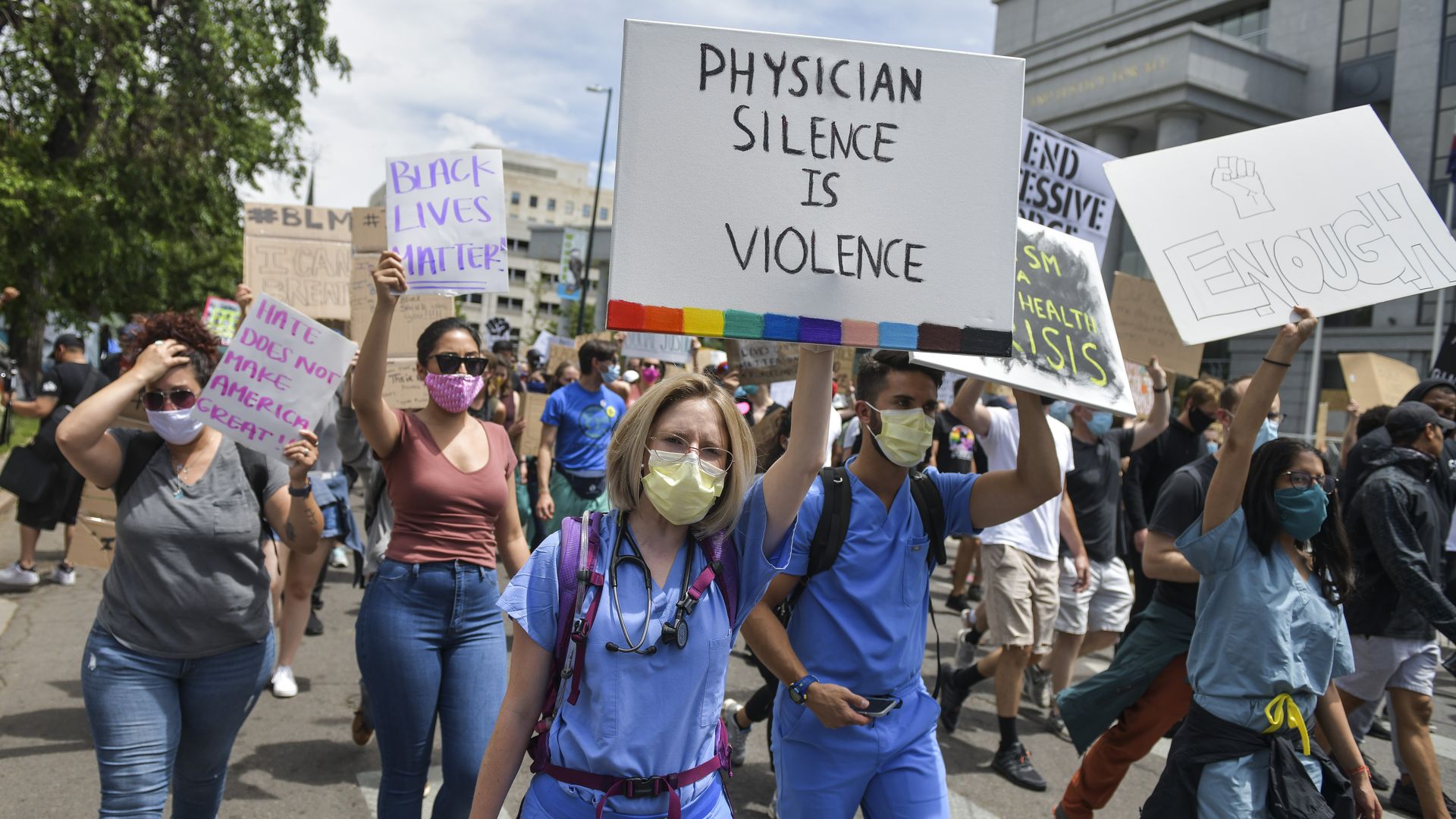
When protests broke out against the coronavirus lockdown, many public health experts were quick to warn about spreading the virus. When protests broke out after George Floyd’s death, some of the same experts embraced the protests. That’s led to charges of double standards among scientists.
Why it matters: Scientists who are seen as changing recommendations based on political and social priorities, however important, risk losing public trust. That could cause people to disregard their advice should the pandemic require stricter lockdown policies.
What’s happening: Many public health experts came out against public gatherings of almost any sort this spring — including protests over lockdown policies and large religious gatherings.
Yes, but: Spending time in a large group, even outdoors and wearing masks — as many of the protesters are — does raise the risk of coronavirus transmission, says Michael Osterholm, director of the Center for Infectious Disease Research and Policy at the University of Minnesota.
The difference in tone between how some public health experts are viewing the current protests and earlier ones focused on the lockdowns themselves was seized upon by a number of critics, as well as the Trump campaign.
The current debate underscores a larger question: What role should scientists play in policymaking?
The big picture: The debate risks exacerbating a partisan divide among Americans in their reported trust in scientists.
What to watch: If there is a rise in new cases in the coming weeks, there will be pressure to trace them — to protests, rallies and the reopening of states. How experts weigh in could affect how their recommendations will be viewed in the future — and whether the public, whatever their political leanings, will follow them again.


 HENRY KOTULA