3 Months Of Hell: U.S. Economy Drops 32.9% In Worst GDP Report Ever

https://www.npr.org/sections/coronavirus-live-updates/2020/07/30/896714437/3-months-of-hell-u-s-economys-worst-quarter-ever?utm_campaign=storyshare&utm_source=facebook.com&utm_medium=social&fbclid=IwAR1L_YW1uYovd5bpjtU6xV7HI_DgGsYPgmdEs3fz0RbOn8XukrKhafRsljE

Economy Shrank At 32.9% Rate In 2nd Quarter

Percent change from the preceding period, seasonally adjusted annual rate

3 Months Of Hell: U.S. Economy Drops 32.9% In Worst GDP Report ...

The coronavirus pandemic triggered the sharpest economic contraction in modern American history, the Commerce Department reported Thursday.

Gross domestic product — the broadest measure of economic activity — shrank at an annual rate of 32.9% in the second quarter as restaurants and retailers closed their doors in a desperate effort to slow the spread of the virus, which has killed more than 150,000 people in the U.S.

The economic shock in April, May and June was more than three times as sharp as the previous record — 10% in 1958 — and nearly four times the worst quarter during the Great Recession.

“Horrific,” said Nariman Behravesh, chief economist at IHS Markit. “We’ve never seen anything quite like it.”

Another 1.43 million people filed for state unemployment last week, an increase of 12,000, the Labor Department reported Thursday. It was the second week in a row of increased unemployment filings and shows that the economic picture continues to remain grim.

GDP swings are typically reported at an annual rate — as if they were to continue for a full year — which can be misleading in a volatile period like this. The overall economy in the second quarter was 9.5% smaller than during the same period a year ago.

After a sharp drop in March and April, economic activity began to rebound in May and June, although that recovery remains halting and could be jeopardized by a new surge of infections.

“As soon as the virus started to take off again in key states like Texas, California, Arizona, Florida, it’s fading very rapidly,” Behravesh said.

Restaurant owner Cameron Mitchell likens the pandemic to a hurricane. What appeared to be a business rebound in June turned out to be merely the eye of the storm, and he’s now being buffeted by gale-force winds again.

“Our associates are more scared to work today and guests are more afraid to go out, so sales have dropped,” Mitchell said.

Business at his restaurants in Florida had nearly recovered to pre-pandemic levels in June but has since fallen sharply.

Other industries have enjoyed a more durable recovery, though few are back to where they were in February.

Dentists’ offices are ordinarily one of the more stable parts of the economy, but they closed for all but emergency services during much of the spring. Dental hygienist Alexis Bailey was out of work for 10 weeks before her office in Lansing, Mich., reopened at the end of May.

At first, she was reluctant to go back to work while the virus was still circulating.

“I was terrified,” Bailey said. “I was not happy to be back. But I have a job to do and I like to do it and I want to help people. We talk about how essential we are, so that’s what we’ve had to do.”

Within an hour of returning to work, Bailey said, she began to feel comfortable, particularly with the additional protective gear and other safety precautions her office has adopted.

“I tell my patients all the time I wouldn’t be here if I didn’t feel safe,” she said.

Nationwide, dental offices added more than a quarter-million jobs in May and another 190,000 in June. And there has been no shortage of patients.

She thought no one would want to come. “But we’re booked,” Bailey said. “People miss getting their teeth cleaned. They want to catch up. Every time they come in, they say, ‘This has been nice to get out of the house and feel safe and talk to somebody.’ ”

Factory production has also begun to rebound, along with construction. But airlines and amusement parks are still struggling.

“It’s very much a sort of two-tiered economy right now,” Behravesh said.

The unemployment rate approached 15% in April, and in June it was still higher — at 11.1% — than during any previous postwar recession.

While the drop in GDP was largely driven by a decline in consumer spending, the economic fallout was cushioned somewhat by an unprecedented level of federal relief.

Wages and salaries fell sharply in April, but that was more than offset by the $1,200 relief payments that the government sent to most adults and by supplemental unemployment benefits of $600 per week.

Those government payments helped prevent an even steeper drop in consumer spending — the lifeblood of the U.S. economy — and allowed struggling families to buy groceries and pay rent.

Federal Reserve Chair Jerome Powell said Wednesday that the money “has been well spent. It has kept people in their homes. It has kept businesses in business. So that’s all a good thing.”

Those extra unemployment benefits are expiring this week, though. With coronavirus infections still threatening the recovery, additional federal support is likely to be necessary.

“Until we get the virus under control, we’re going to need more help,” Behravesh said. “Our view is that we’re not going to get to the pre-pandemic levels of economic activity until some time in 2022.”

Restaurant owner Mitchell says his business lost $700,000 in June alone. He predicts a wave of restaurant bankruptcies unless the federal government provides more relief.

“No one is looking for a handout here,” he said. “We’re looking to survive.”

He’s watching news of vaccine trials closely in hopes that eventually diners will feel comfortable eating out again in large numbers.

“I don’t think it’s the next couple of weeks,” he said. “But I tell our team, ‘Every day that goes by, it’s one day closer to the end of this thing.’ ”


Cartoon – All Lives Matter

Cartoons: U.S. 'underestimated' COVID-19 spread; Disney reopens

US coronavirus data will now go straight to the White House. Here’s what this means for the world

https://theconversation.com/us-coronavirus-data-will-now-go-straight-to-the-white-house-heres-what-this-means-for-the-world-142814?utm_medium=email&utm_campaign=Latest%20from%20The%20Conversation%20for%20July%2028%202020%20-%201689316298&utm_content=Latest%20from%20The%20Conversation%20for%20July%2028%202020%20-%201689316298+Version+A+CID_abf5f3d50179e225ba3e81ad0fbb430c&utm_source=campaign_monitor_us&utm_term=US%20coronavirus%20data%20will%20now%20go%20straight%20to%20the%20White%20House%20Heres%20what%20this%20means%20for%20the%20world

US coronavirus data will now go straight to the White House ...

Led by physicians, scientists and epidemiologists, the US Centers for Disease Control and Prevention (CDC) is one of the most reliable sources of knowledge during disease outbreaks. But now, with the world in desperate need of authoritative information, one of the foremost agencies for fighting infectious disease has gone conspicuously silent.

For the first time since 1946, when the CDC came to life in a cramped Atlanta office to fight malaria, the agency is not at the front line of a public health emergency.

On April 22, CDC director Robert Redfield stood at the White House briefing room lectern and conceded that the coronavirus pandemic had “overwhelmed” the United States. Following Redfield at the podium, President Donald Trump said the CDC director had been “totally misquoted” in his warning that COVID-19 would continue to pose serious difficulties as the US moved into its winter ‘flu season in late 2020.

Invited to clarify, Redfield confirmed he had been quoted correctly in giving his opinion that there were potentially “difficult and complicated” times ahead.

Trump tried a different tack. “You may not even have corona coming back,” the president said, once again contradicting the career virologist. “Just so you understand.”

The exchange was interpreted by some pundits as confirmation that the CDC’s venerated expertise had been sidelined as the coronavirus continued to ravage the US.

In the latest development, the New York Times reported this week the CDC has even been bypassed in its data collection, with the Trump administration ordering hospitals to send COVID-19 data directly to the White House.

Diminished role

When facing previous public health emergencies the CDC was a hive of activity, holding regular press briefings and developing guidance that was followed by governments around the world. But during the greatest public health emergency in a century, it appears the CDC has been almost entirely erased by the White House as the public face of the COVID-19 pandemic response.

This diminished role is obvious to former leaders of the CDC, who say their scientific advice has never before been politicised to this extent.

As the COVID-19 crisis was unfolding, several CDC officials issued warnings, only to promptly disappear from public view. Nancy Messonnier, director of the CDC’s National Center for Immunization and Respiratory Diseases, predicted on February 25 that the virus was not contained and would grow into a pandemic.

The stock market plunged and Messonnier was removed from future White House press briefings. Between March 9 and June 12 there was no CDC presence at White House press briefings on COVID-19.

The CDC has erred during the pandemic, most significantly in its initial efforts to develop a test for COVID-19. The testing kits proved to be faulty – a problem compounded by sluggish efforts to rectify the situation – and then by severe delays in distributing enough tests to the public.

But many public health specialists are nevertheless baffled by the CDC’s low profile as the pandemic continues to sweep the globe.

“They have been sidelined,” said Howard Koh, former US assistant secretary for health. “We need their scientific leadership right now.”

What does it mean for the world?

The CDC being bypassed in the collection of COVID-19 data is another body blow to the agency’s standing.

Hospitals have instead been ordered to send all COVID-19 patient information to a central database in Washington DC.

This will have a range of likely knock-on effects. For starters, the new database will not be available to the public, prompting inevitable questions over the accuracy and transparency of data which will now be interpreted and shared by the White House.

The Department of Health and Human Services, which issued the new order, says the change will help the White House’s coronavirus task force allocate resources. But epidemiologists and public health experts around the world fear the new system will make it harder for people outside the White House to track the pandemic or access information.

This affects all nations, because one of the CDC’s roles is to provide sound, independent public health guidance on issues such as infectious diseases, healthy living, travel health, emergency and disaster preparedness, and drug efficacy. Other jurisdictions can then adapt this information to their local context — expertise that has become even more essential during a pandemic, when uncertainty is the norm.

It is difficult to recall a previous public health emergency when political pressure led to a change in the interpretation of scientific evidence.

What happens next?

Despite the inevitable challenges that come with tackling a pandemic in real time, the CDC remains the best-positioned agency – not just in the US but the entire world – to help us manage this crisis as safely as possible.

In the absence of US leadership, nations should start thinking about developing their own national centres for disease control. In Australia’s case, these discussions have been ongoing since the 1990s, stymied by cost and lack of political will.

COVID-19, and the current sidelining of the CDC, may be the impetus needed to finally dust off those plans and make them a reality.


Cartoon – Masks are for the Weak!!!

Gun Control and Gun Rights Cartoons | US News

Cartoon – Under Control

Coronavirus | The Manchester Journal | Manchester Breaking News ...

America has to be ready for mail voting to avert an election crisis

America has to be ready for mail voting to avert an election crisis

States Should Embrace Vote by Mail and Early Voting To Protect ...

Valid concerns have been raised about mail voting. In New York, the local election boards have taken weeks to count primary ballots received in the mail as a result of the coronavirus, leaving several races for Congress still unresolved. The problems have been blamed on the late decision to send out the absentee ballot applications, outdated ballot counting machines, and the sheer number of mail ballots. The New York case raises a serious alarm with the 2020 election approaching and many states considering more reliance on mail voting in the midst of the pandemic.

Adding to this sense of urgency, President Trump has declared, without evidence, that mail voting is an open invitation to fraud and will be used unfairly against him this fall. He has tweeted that mail voting would make this the “most rigged” election in history. Setting aside the fact that states have relied on absentee and mail voting to hold secure elections for many years, the stumbles in New York and the irresponsible fear mongering by Trump raise the potential of a very real crisis come this fall.

Consider the national disruption surrounding the 2000 election, which was decided for George Bush after a recount in Florida, a month of legal battles, and a controversial split Supreme Court decision. After you add the factor of a second wave of coronavirus cases in the fall and a sitting president shouting “rigged!” to the rafters, and you can understand why some analysts worry that the period following the 2020 election may be one of the most disruptive contests in our modern history.

A crisis foretold, however, can be a crisis averted. Instead of wringing our hands over the recent problems with mail voting in New York, we have to learn from them and from the multiple states that have implemented mail voting systems without problems or fraud. Then states can make common sense preparations to ensure the process goes as quickly and smoothly as possible to prevent a potential election crisis in November.

The fact that election boards were overwhelmed by an influx of absentee ballots in New York must be the rallying cry for dedicating more resources to efficiently implement mail voting systems. Reducing funds available for mail voting initiatives, as some Trump supporters have advocated, in this era when many people have to rely on these ballots or literally risk death, will only serve to suppress voting, which may be the point.

Consider the case of Ohio for a glimpse of what a proactive mail voting initiative looks like. At the urging of Governor Mike DeWine, Republican and Democratic lawmakers unanimously approved their all mail voting primary that was successfully concluded in April. Governors and state legislatures across the country have to learn from Ohio, and additional federal funds have to be made available to assist the efforts.

All those claims that mail ballots are subject to rampant tampering is not evidence that they are, and it suggests the need to educate voters on the issue. Members of the Armed Forces have relied on absentee voting with mail ballots since the Civil War. Trump himself has voted absentee by mail. Meanwhile, three states allow ounties to conduct elections completely by mail if they choose, five other states conduct elections almost entirely by mail, and more than two dozen other states permit their residents to cast absentee ballots by mail without having to provide a reason.

Over 250 million votes have been cast using mailed ballots since 2000, according to the Vote at Home Institute, and yet exhaustive analysis has identified only a tiny fraction of cases of fraud. None of those states that hold their elections almost entirely by mail has seen voter fraud scandals. The bipartisan group Vote Safe, chaired by former Governor Tom Ridge of Pennsylvania and former Governor Jennifer Granholm of Michigan, notes that several studies have consistently proven that mail ballots are secure and do not advantage one political party over the other. The team rightly emphasizes that the goal of ensuring the safety of voters as they exercise their rights during a raging pandemic is not a partisan issue.

Whether we improve our voting systems or defund them, the use of mail ballots will inevitably be much greater in the 2020 election than in years past. We can prepare for this eventuality and find innovative ways to deal with the challenges that arise, or we can shift our gaze from another crisis foretold and suffer the major consequences come November.

Winston Churchill Quotes About Democracy. QuotesGram

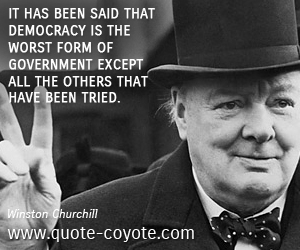
Winston Churchill noted that democracy is the worst form of government, except for all other forms that have been tried. In the midst of a pandemic across the country that has already claimed the lives of tens of thousands of Americans, exercising our right to vote by mail instead of in person may also seem like the worst solution, except for all other options.


The Constitution doesn’t have a problem with mask mandates

https://theconversation.com/the-constitution-doesnt-have-a-problem-with-mask-mandates-142335?utm_medium=email&utm_campaign=Latest%20from%20The%20Conversation%20for%20July%2022%202020%20-%201684316250&utm_content=Latest%20from%20The%20Conversation%20for%20July%2022%202020%20-%201684316250+Version+A+CID_3a4842bdc1542ab5ad1725fad090f099&utm_source=campaign_monitor_us&utm_term=The%20Constitution%20doesnt%20have%20a%20problem%20with%20mask%20mandates

The Constitution doesn't have a problem with mask mandates

Many public health professionals and politicians are urging or requiring citizens to wear face masks to help slow the spread of the COVID-19 virus.

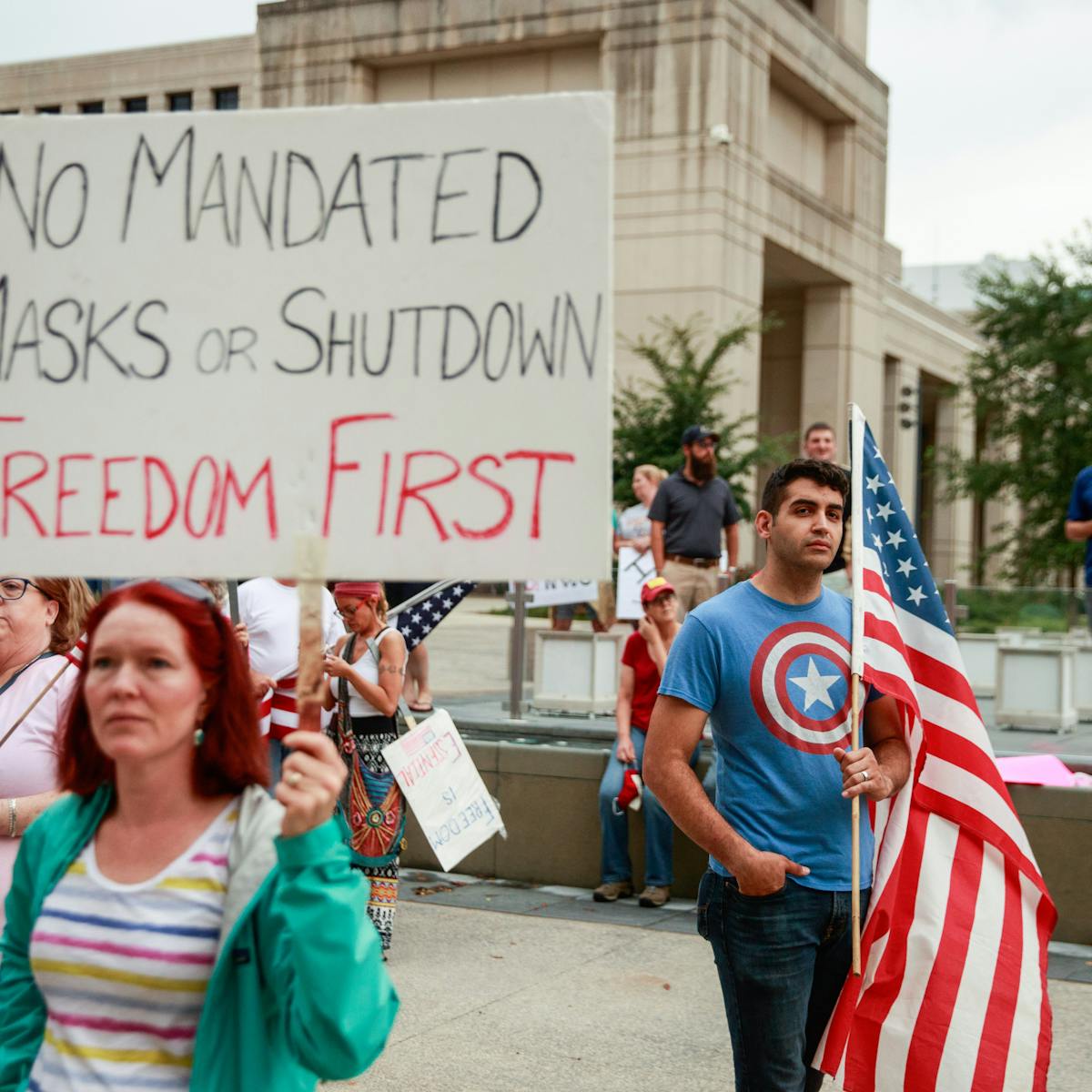
Some Americans have refused, wrongly claiming mask decrees violate the Constitution. An internet search turns up dozens of examples.

“Costco Karen,” for instance, staged a sit-in in a Costco entrance in Hillsboro, Oregon after she refused to wear a mask, yelling “I am an American … I have rights.”

A group called Health Freedom Idaho organized a protest against a Boise, Idaho, mask mandate. One protester said, “I’m afraid where this country is headed if we just all roll over and abide by control that goes against our constitutional rights.”

As one protester said, “The coronavirus doesn’t override the Constitution.”

Speaking as a constitutional law scholar, these objections are nonsense.

The objections

It is not always clear why anti-maskers think government orders requiring face coverings in public spaces or those put in place by private businesses violate their constitutional rights, much less what they think those rights are. But most of the mistaken objections fall into two categories:

Mandatory masks violate the First Amendment right to speech, assembly, and especially association and mandatory masks violate a person’s constitutional right to liberty and to make decisions about how to their own health and bodily integrity.

They’re not mutually exclusive claims:lawsuit filed by four Florida residents against Palm Beach County, for example, argues that mask mandates “interfere with … personal liberty and constitutional rights,” such as freedom of speech, right to privacy, due process, and the “constitutionally protected right to enjoy and defend life and liberty.” The lawsuit asks the court to issue a permanent injunction against the county’s mask mandate.

Responding to a reporter who asked why President Donald Trump appeared unconcerned about the absence of masks and social distancing at a campaign rally in Tulsa, Vice President Mike Pence said: “I want to remind you again freedom of speech and the right to peaceably assemble is in the Constitution of the U.S. Even in a health crisis, the American people don’t forfeit our constitutional rights.”

What the First Amendment does – and doesn’t – do

The First Amendment protects freedom of speech, press, petition, assembly and religion.

There are two reasons why mask mandates don’t violate the First Amendment.

First, a mask doesn’t keep you from expressing yourself. At most, it limits where and how you can speak. Constitutional law scholars and judges call these “time, place, and manner” restrictions. If they do not discriminate on the basis of the content of the speech, such restrictions do not violate the First Amendment. An example of a valid time, place and manner restriction would be a law that limits political campaigning within a certain distance of a voting booth.

Additionally, the First Amendment, like all liberties ensured by the Constitution, is not absolute.

All constitutional rights are subject to the goverment’s authority to protect the health, safety and welfare of the community. This authority is called the “police power.” The Supreme Court has long held that protecting public health is sufficient reason to institute measures that might otherwise violate the First Amendment or other provisions in the Bill of Rights. In 1944, in the case of Prince v. Massachusetts, for example, the Supreme Court upheld a law that prohibited parents from using their children to distribute religious pamphlets on public streets.

The right to liberty

Some anti-maskers object that masks violate the right to liberty.

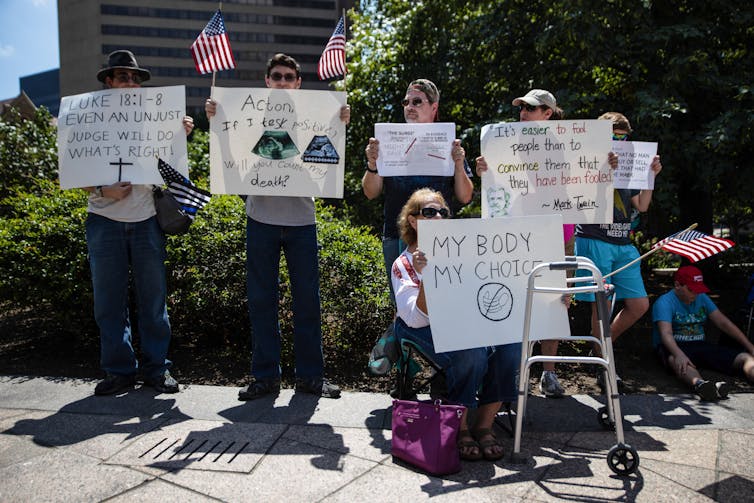
The right to liberty, including the right to make choices about one’s health and body, is essentially a constitutional principle of individual autonomy, neatly summarized as “My body, my choice.”

The 1905 case of Jacobsen v. Massachusetts shows why mask mandates don’t violate any constitutional right to privacy or health or bodily integrity. In that case, the Supreme Court upheld a smallpox vaccination requirement in Cambridge, Massachusetts.

The court said that the vaccination requirement did not violate Jacobsen’s right to liberty or “the inherent right of every freeman to care for his own body and health in such way as to him seems best.”

As the court wrote, “There are manifold restraints to which every person is necessarily subject for the common good. On any other basis, organized society could not exist with safety to its members.” In a 1995 New York case, a state court held that an individual with active tuberculosis could be forcibly detained in a hospital for appropriate medical treatment.

Even if you assume that mask mandates infringe upon what the Supreme Court calls “fundamental rights,” or rights that the court has called the “very essence of a scheme of ordered liberty,” it has consistently ruled states can act if the restrictions advance a compelling state interest and do so in the least restrictive manner.

Rights are conditional

As the Jacobsen ruling and the doctrine of time, place and manner make clear, the protection of all constitutional liberties rides upon certain necessary – but rarely examined – assumptions about communal and public life.

One is that is constitutional rights – whether to liberty, speech, assembly, freedom of movement or autonomy – are held on several conditions. The most basic and important of these conditions is that our exercise of rights must not endanger others (and in so doing violate their rights) or the public welfare. This is simply another version of the police power doctrine.

Unfortunately, a global pandemic in which a serious and deadly communicable disease can be transmitted by asymptomatic carriers upsets that background and justifies a wide range of reasonable restrictions on our liberties. Believing otherwise makes the Constitution a suicide pact – and not just metaphorically.


Tracking Our COVID-19 Response. Each state’s progress towards a new normal.

https://www.covidexitstrategy.org/

July 10 – Updated Color Scale
As a country we’ve reached a record number of cases. We’ve added a new color to the scale: “Bruised Red”. There were extremes that were not captured in our original scale. Our scale also has been adjusted to put more weight on “new cases per million” and “positivity”.
July 15 – ICU and Bed Occupancy – Not Publicly Reported by CDC Anymore
Unfortunately our data source for ICUs and beds has been removed by the CDC. Our hope is this loss of critical public health information is temporary. HHS is instituting a new process for collecting information from hospitals. The aggregate data from that system should be made public.


Covid-19 data is a public good. The US government must start treating it like one.

https://www.technologyreview.com/2020/07/17/1005391/covid-coronavirus-hospitalizations-data-access-cdc/

Data for the public good - O'Reilly Radar

The US has failed to prioritize a highly effective and economical intervention—providing quick and easy access to coronavirus data.

Earlier this week as a pandemic raged across the United States, residents were cut off from the only publicly available source of aggregated data on the nation’s intensive care and hospital bed capacity. When the Trump administration stripped the Centers for Disease Control and Prevention (CDC) of control over coronavirus data, it also took that information away from the public.


I run a nonpartisan project called covidexitstrategy.org, which tracks how well states are fighting this virus. Our team is made up of public health and crisis experts with previous experience in the Trump and Obama administrations. We grade states on such critical measures as disease spread, hospital load, and the robustness of their testing. 


Why does this work matter? In a crisis, data informs good decision-making. Along with businesses, federal, state, and local public health officials and other agencies rely on us to help them decide which interventions to deploy and when workplaces and public spaces can safely reopen. Almost a million people have used our dashboards, with thousands coming back more than 200 times each.

To create our dashboards, we rely on multiple sources. One is the National Healthcare Safety Network (NHSN), run by the CDC. Prior to July 14, hospitals reported the utilization and availability of intensive care and inpatient beds to the NHSN. This information, updated three times a week, was the only publicly available source of aggregated state-level hospital capacity data in the US.

With 31 states currently reporting increases in the number of hospitalized covid-19 patients, these utilization rates show how well their health systems will handle the surge of cases.


Having this information in real time is essential; the administration said the CDC’s system was insufficiently responsive and data collection needed to be streamlined. The US Department of Health and Human Services (HHS) directed hospitals (pdf) to report their data to a new system called HHS Protect.

Unfortunately, by redirecting hospitals to a new system, it left everyone else in the dark. On July 14, the CDC removed the most recent data from its website. As we made our nightly update, we found it was missing. After significant public pressure, the existing maps and data are back—but the agency has added a disclaimer that the data will not be updated going forward.


This is unacceptable. This critical indicator was being shared multiple times a week, and now updates have been halted. US residents need a federal commitment that this data will continue to be refreshed and shared.

The public is being told that a lot of effort is going into the new system. An HHS spokesman told CNBC that the new database will deliver “more powerful insights” on the coronavirus. But the switch has rightly been criticized because this new data source is not yet available to the public. Our concerns are amplified by the fact that responsibility for the data has shifted from a known entity in the CDC to a new, as-yet-unnamed team within HHS.

I was part of the team that helped fix Healthcare.gov after the failed launch in 2013. One thing I learned was that the people who make their careers in the federal government—and especially those working at the center of a crisis—are almost universally well intentioned. They seek to do the right thing for the public they serve.


In the same spirit, and to build trust with the American people, this is an opportunity for HHS to make the same data it’s sharing with federal and state agencies available to the public. The system that HHS is using helps inform the vital work of the White House Coronavirus Task Force. From leaked documents, we know that reports for the task force are painstakingly detailed. They include county-level maps, indicators on testing robustness, and specific recommendations. All of this information belongs in the public domain.

This is also an opportunity for HHS to make this data machine readable and thereby more accessible to data scientists and data journalists. The Open Government Data Act, signed into law by President Trump, treats data as a strategic asset and makes it open by default. This act builds upon the Open Data Executive Order, which recognized that the data sets collected by the government are paid for by taxpayers and must be made available to them. 

As a country, the United States has lagged behind in so many dimensions of response to this crisis, from the availability of PPE to testing to statewide mask orders. Its treatment of data has lagged as well. On March 7, as this crisis was unfolding, there was no national testing data. Alexis Madrigal, Jeff Hammerbacher, and a group of volunteers started the COVID Tracking Project to aggregate coronavirus information from all 50 state websites into a single Google spreadsheet. For two months, until the CDC began to share data through its own dashboard, this volunteer project was the sole national public source of information on cases and testing.

With more than 150 volunteers contributing to the effort, the COVID Tracking Project sets the bar for how to treat data as an asset. I serve on the advisory board and am awed by what this group has accomplished. With daily updates, an API, and multiple download formats, they’ve made their data extraordinarily useful. Where the CDC’s data is cited 30 times in Google Scholar and approximately 10,000 times in Google search results, the COVID Tracking Project data is cited 299 times in Google Scholar and roughly 2 million times in Google search results.


Sharing reliable data is one of the most economical and effective interventions the United States has to confront this pandemic. With the Coronavirus Task Force daily briefings a thing of the past, it’s more necessary than ever for all covid-related data to be shared with the public. The effort required to defeat the pandemic is not just a federal response. It is a federal, state, local, and community response. Everyone needs to work from the same trusted source of facts about the situation on the ground.

Data is not a partisan affair or a bureaucratic preserve. It is a public trust—and a public resource.


Merkel says pandemic reveals limits of ‘fact-denying populism’

Merkel says pandemic reveals limits of ‘fact-denying populism’

Covid-19 has exposed the limits of 'fact-denying populism', Merkel ...

German Chancellor Angela Merkel told European Union (EU) countries Wednesday that the coronavirus pandemic is showing the limits of “fact-denying populism” as she urged the bloc to reach an agreement on an economic recovery package.

Merkel said that the EU “must show that a return to nationalism means not more, but less control,” according to France 24.

Without naming any specific nations, Merkel said: “We are seeing at the moment that the pandemic can’t be fought with lies and disinformation, and neither can it be with hatred and agitation.”

“Fact-denying populism is being shown its limits,” she added. “In a democracy, facts and transparency are needed. That distinguishes Europe, and Germany will stand up for it during its presidency.”

The pandemic has killed more than 100,000 people in the 27 EU nations and sparked what is expected to be the largest recession the continent has experienced in decades.

On Tuesday the EU released a report predicting the bloc’s economy will contract more than initially expected due to coronavirus-related lockdowns.

Merkel on Wednesday joined EU Economy Commissioner Paolo Gentiloni in urging the commission to quickly reach an agreement on the 750 billion-euro stimulus package proposed earlier this year.

“The depth of the economic decline demands that we hurry,” Merkel told lawmakers, according to The Associated Press. “We must waste no time — only the weakest would suffer from that. I very much hope that we can reach an agreement this summer. That will require a lot of readiness to compromise from all sides — and from you too.