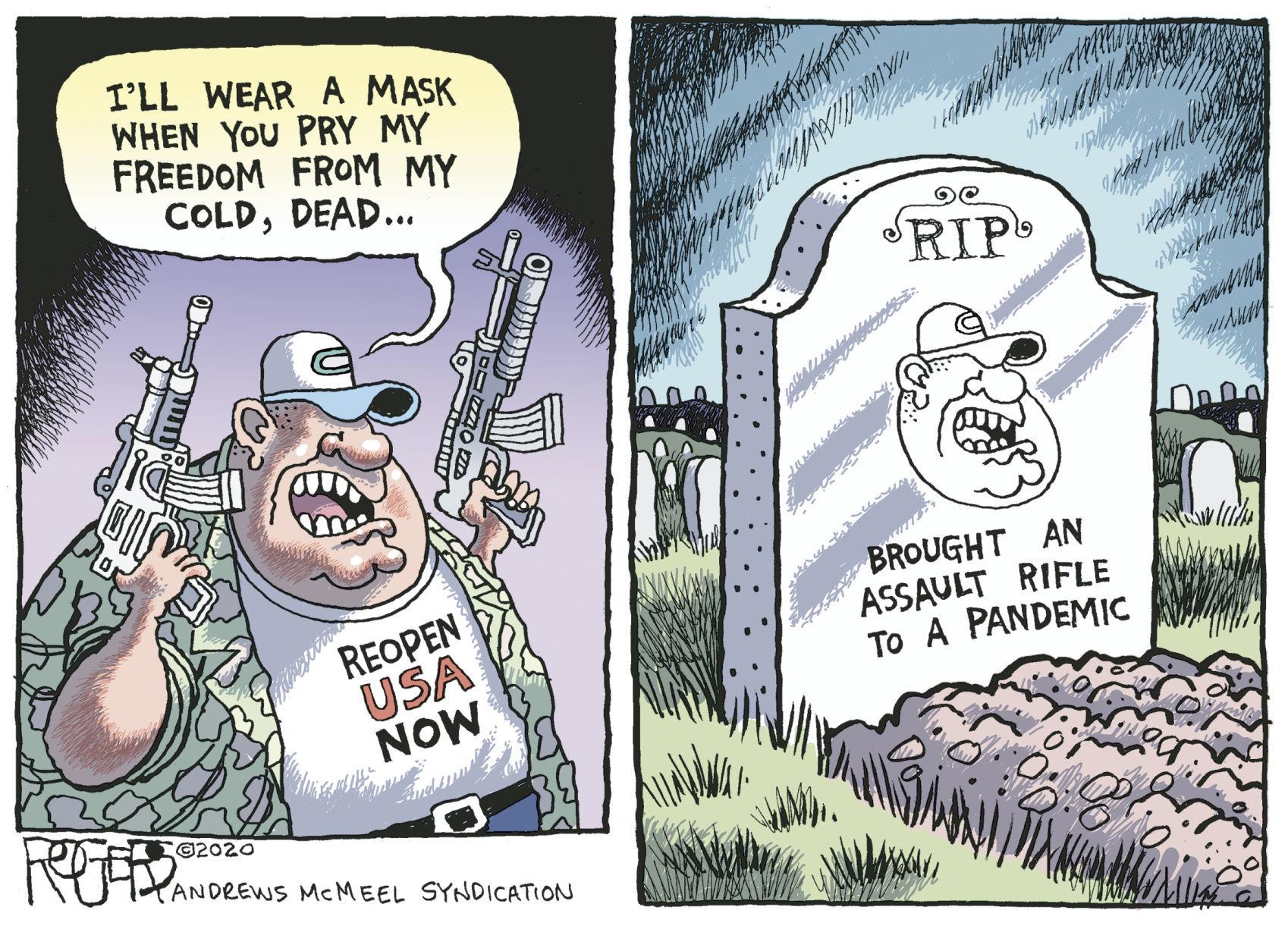
Cartoon – Price of Pandemic Freedom

Editorial cartoon: Rob Rogers (May 16, 2020) | | yakimaherald.com

Cartoon – Yes, We’re Open. Sort of

Today's editorial cartoon - CentralMaine.com

Cartoon – Where Liberty Ends

Coronavirus recovery, Joe Biden and binge-watching: Top columns

Cartoon – To Beach or not to Beach

Cartoons

In the Pandemic Era, Is It Safe to Go to Work?

In the Pandemic Era, Is It Safe to Go to Work?

Waiter serves meal to customers wearing PPE

A waiter wearing a face shield and mask to protect himself and others from the coronavirus serves diners at a restaurant in Santa Monica, California, on June 21, 2020. Photo: David Livingston / Getty Images

Stories that caught our attention.

It’s a scary thing to go back and know you have low immunity.

—Patti Hanks, Virginia furniture store worker

Twelve million adults who are not working live with those higher risks in households with at least one full-time worker, thereby exposing them indirectly to the infection risks of housemates doing customer-facing or other service jobs during a pandemic.

The ability to earn income from home is a privilege, and the “impossible choice between lives and livelihoods falls mainly to lower-wage workers in service industries,” KFF President and CEO Drew Altman wrote in Axios. Here’s what it’s like to work in four jobs that require face-to-face interaction during the worsening COVID-19 crisis.

Patti Hanks, Virginia

Soon after finishing chemotherapy for ovarian cancer, Patti Hanks had to go back to her job processing transactions at a furniture and appliance store in Virginia. She was nervous about returning to work during the pandemic, but she couldn’t afford to lose employer-sponsored health insurance.

“It’s a scary thing to go back and know you have low immunity,” Hanks, 62, told Sarah Kliff in the New York Times. “But when it all boils down to it, I don’t think COVID-19 is going away any time soon. I don’t think you can hide from it.”

Nearly 60% of Americans under 65 have employer health coverage, according to the Peterson-KFF Health System Tracker. For people like Hanks, that makes work and health interdependent. Even without her furniture store job, she likely makes too much income from other sources (rental properties and raising cattle) to qualify for Medicaid.

So Hanks continues reporting to work. She wears a mask in the store, maintains distance from customers, and sanitizes shared objects like chairs and pens frequently. Still, there’s only so much she can control. The store has been busy since Virginia began lifting stay-at-home restrictions in May, and Hanks has assisted at least one customer who appeared to be unwell.

“You can’t crawl into a hole,” she told Kliff. “I think we’ve done everything we can to protect ourselves. . . . So I’ll just keep going.”

David Smith, Michigan

In normal times, David Smith, co-owner of the European-style eatery Café Muse in the Detroit suburb of Royal Oak, has one of his younger employees seat customers for dine-in service. But times are certainly not normal — nor are interactions with customers.

“I’ve been trying to do most of the seating, because it’s just really difficult when you have like an 18- or 19-year-old [employee] at the front having to enforce mask wearing,” he told Brenna Houck for her article in Eater Detroit.

The restaurant has been open for dine-in service for a only few weeks, and Smith has already had to call the police on an irate customer who refused to wear a mask when picking up a to-go order. Smith’s business partner, Greg Reyner, stepped in to ask the customer to wait for his food outside, and when the man refused, Reyner asked him to leave. The customer later called the restaurant and allegedly threatened the staff, leading Smith and Reyner to call the police.

The state of Michigan allowed restaurants and bars to reopen for indoor and outdoor dine-in service on June 8. Governor Gretchen Whitmer mandated that each customer must “wear a face covering over his or her nose and mouth . . . when in any enclosed public space, unless the individual is unable medically to tolerate a face covering.” Additionally, businesses are permitted to deny entry or access to anyone who refuses to comply with the mask rule.

That doesn’t mean it’s easy or pleasant to enforce the rule for the safety of staff and customers. “It is very upsetting,” Smith told Houck. “You’re shaking after having these conversations with people, because you just don’t know. What if someone got killed because they told [a customer] to wear a mask? You worry about it all the time.”

Amanda, Missouri

Nursing homes and assisted living facilities are hot spots for COVID-19 cases. Amanda (who asked that her last name be withheld) is a receptionist at a nursing home in St. Louis, and the last few months have been extremely stressful as she and her colleagues work to keep the facility free of COVID-19.

“I can’t sleep nowadays because I dream about being the cause of people dying,” she told Vox’s Luke Winkie. “That’s a horrifying thought for me. I’ve written up my resignation several times. But I don’t have the heart to do it because they need me there.”

So far, the nursing home has not had any cases, and Amanda attributes this to the facility’s early adoption of safety precautions. In February, the administrators advised staff to use personal protective equipment at work, regularly disinfect surfaces, and shelter in place at home when they weren’t working. The facility stopped admitting visitors, and when families dropped off presents for Mother’s Day, staff put the presents on hold for 24 to 72 hours before giving them to the residents.

[My family and I] never even hugged one another when I went to the emergency department because I don’t want to infect them.

—Marcial Reyes, emergency room nurse

Amanda and her colleagues take precautions not only at work, but also at home. “I won’t let my kids see their friends,” she told Winkie. “A lot of people are letting their kids see other kids, but I nipped that in the bud right away. My colleagues have done the same.”

As states reopen, Amanda is increasingly worried about the health of senior citizens like the ones she cares for. “I believe that our government hasn’t done anything,” she said. “Why don’t we have rapid testing in our facility right now? They should be in every hospital, every nursing home, and they should continue to produce them until they’re in schools and courthouses.”

Marcial Reyes, California

Fourteen years ago, Marcial Reyes emigrated from the Philippines to the US on a work visa to become a nurse. He’s been a US citizen for eight years. He was working as an emergency room nurse in Fontana, California, when the COVID-19 crisis struck, Josie Huang reported in LAist.

Reyes knew he was at high risk of contracting the coronavirus. When he started experiencing shortness of breath, he quarantined himself on the first floor of his house, away from his wife Rowena, who is also a nurse, and their five-year-old son. But the symptoms kept getting worse, and eventually he drove himself to the hospital — to the same emergency room where he usually cares for patients.

His health deteriorated so rapidly over the next few days that his doctors put him in a medically induced coma and hooked him up to a ventilator for 10 days. “[My family and I] never even hugged one another when I went to the emergency department because I don’t want to infect them,” he told Huang.

In California, nearly one in five registered nurses is of Filipino descent, according to a 2016 survey (PDF) by the California Board of Registered Nursing. California hospitals have recruited heavily from the Philippines for more than a century. Filipino nurses have stepped up to work in underserved areas and work on the front lines of health crises like the AIDS epidemic and COVID-19.

“It’s not uncommon for many Filipino families to produce multiple health care workers,” Huang wrote. The Reyes family is just one such example. Rowena Reyes and their son both also tested positive for COVID-19, though they recovered without hospitalization.

Marcial Reyes’ recovery will be much slower and more complicated. He needs to regain strength in his legs, and he still struggles with writing, Huang reported. Still, he is looking forward to the day when he can return to the emergency room as a nurse.


Pre And Post Coronavirus Unemployment Rates By State, Industry, Age Group, And Race

https://www.forbes.com/sites/mikepatton/2020/06/28/pre-and-post-coronavirus-unemployment-rates-by-state-industry-age-group-and-race/#65c42c6555eb

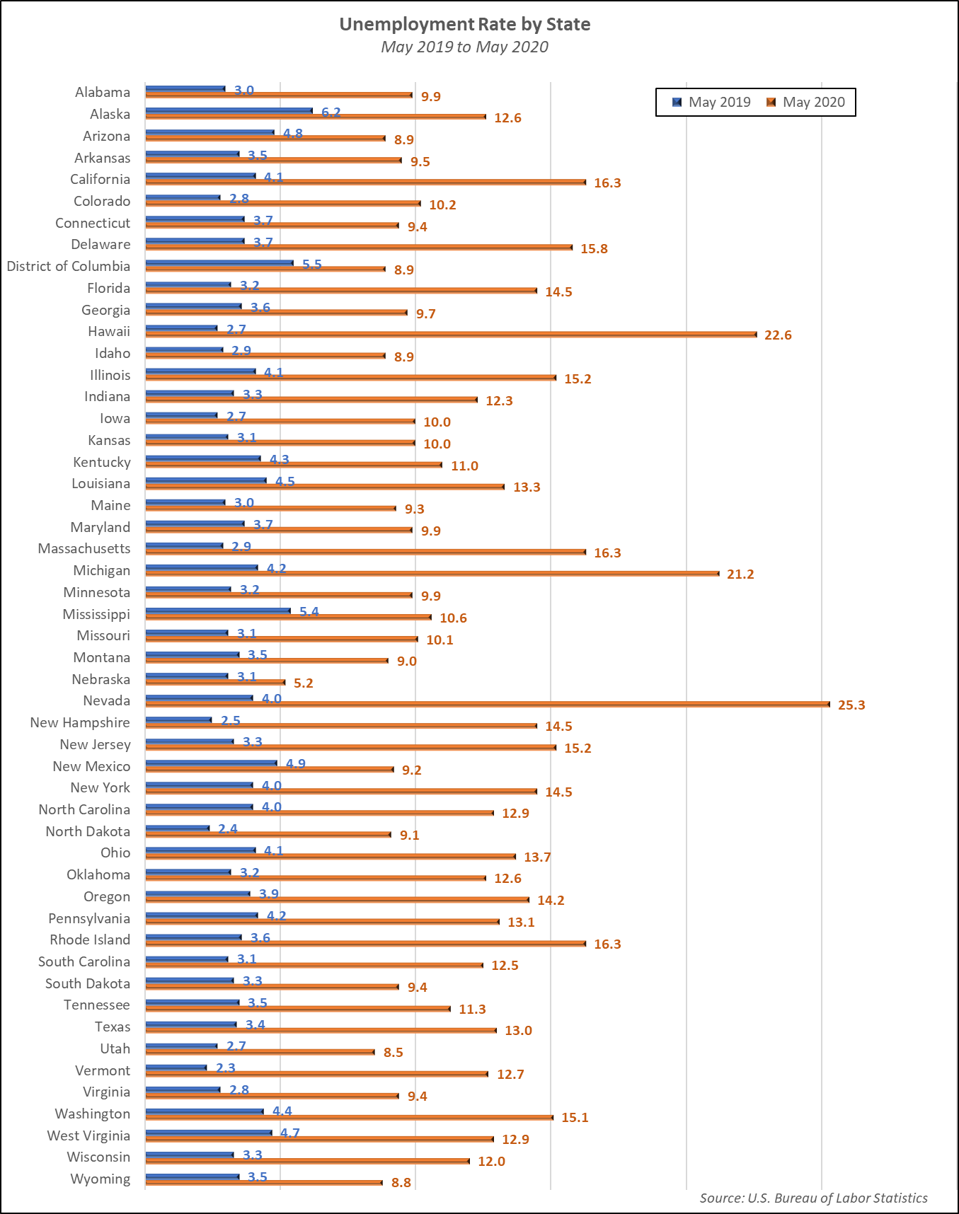
Unemployment by State-May 2019 to May 2020

The coronavirus has decimated the U.S. economy and benched nearly 40 million American workers. In the past several days, the U.S. has logged its highest number of new Covid-19 cases since the pandemic began. These combined with other factors, which we will discuss, is jeopardizing the future employment of millions of workers and the viability of thousands of businesses. Here’s how unemployment has increased for every state, industry, age group, and race, and why.

Unemployment by State

The coronavirus and subsequent stay at home orders hit the labor force especially hard. As states attempted to reopen, a resurgence in the virus is causing many businesses to close again, some by choice, others by government mandate.

Nevada has been hit the hardest as the unemployment rate in the Silver State rose from 4.0% in May 2019 to a whopping 25.3% in May 2020. Nevada’s economy is heavily reliant on leisure and hospitality, which had the brunt of the job losses. Hawaii, the second hardest hit state saw unemployment rise from 2.7% in May 2019 to 22.6% in May 2020. Which is the only other state with unemployment above 20% in May 2020? Michigan, where unemployment rose from 4.2% to 21.2% year over year. What state has fared best? Nebraska, which also has one of the most diverse economies of all states. Deriving nearly 50% of its total GDP from five different industries, unemployment in the Cornhusker State rose from 3.1% to a modest 5.2% from May 2019 to May 2020. Unemployment numbers for all states are shown in the following chart.

Unemployment by Industry

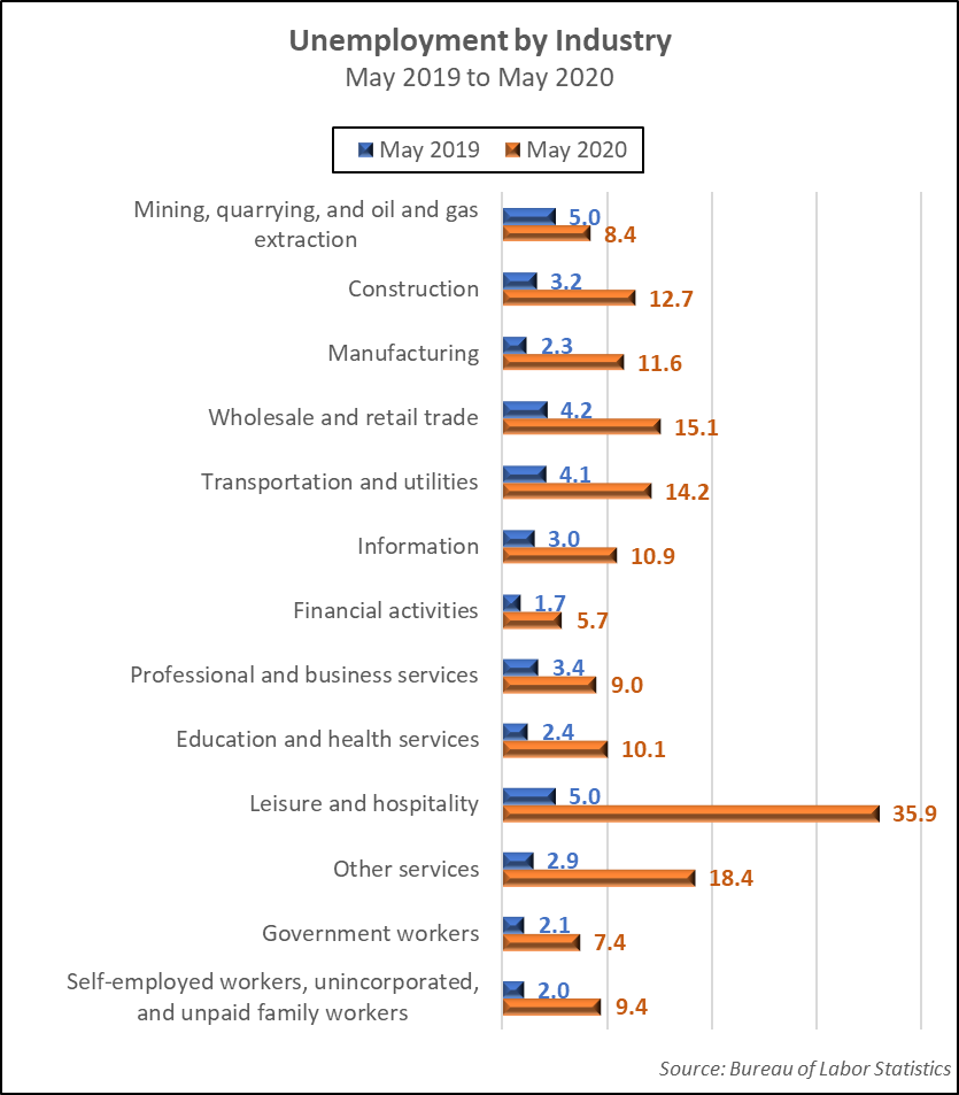
As mentioned in the previous section, the states that have fared best either have a more diverse economy or do not rely heavily on industries that have been hardest hit by the coronavirus. The most negatively affected is the leisure and hospitality industry where unemployment rose 618% from a low of 5.0% in May 2019 to a staggering 35.9% in May 2020. At a distant second, but still reeling, is the wholesale and retail trade industry, which saw unemployment rise from 4.2% to 15.1% during the same period. The rest of the industries are listed in the following chart.

Unemployment by Industry-May 2019 to May 2020

Unemployment by Age Group

Businesses need two things to exist: workers and customers. Without customers, there is no need for workers or the business for that matter. Some businesses require highly skilled workers while others operate well using unskilled labor. It is this unskilled labor group that has been hardest hit.

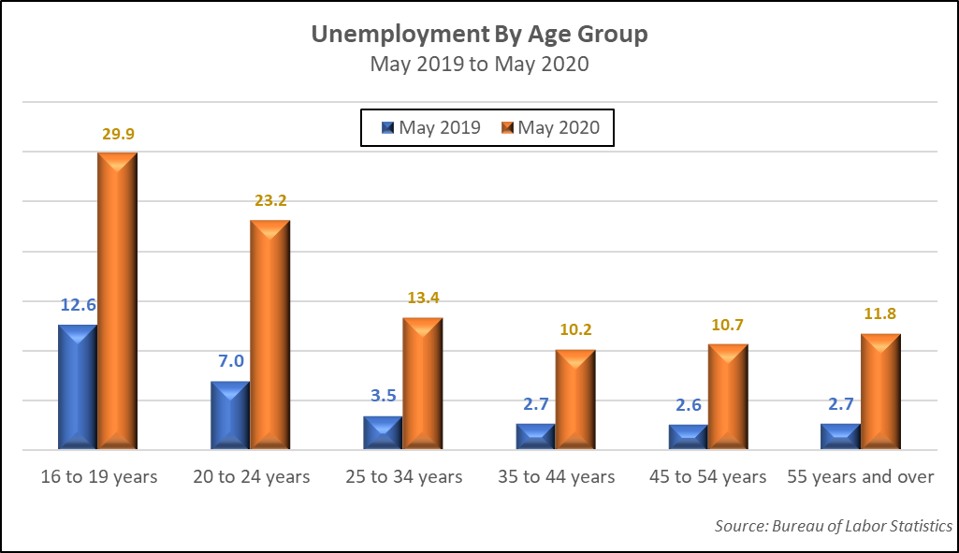
The greatest rise in unemployment is among workers under age 25. This is likely due to three factors. Younger workers typically have fewer marketable skills, less work experience, and less seniority. Many of these workers are in industries that have felt the greatest pain. Unemployment rates by age group are contained in the following chart.

Unemployment by Age Group-May 2019 to May 2020

Unemployment by Race/Ethnicity

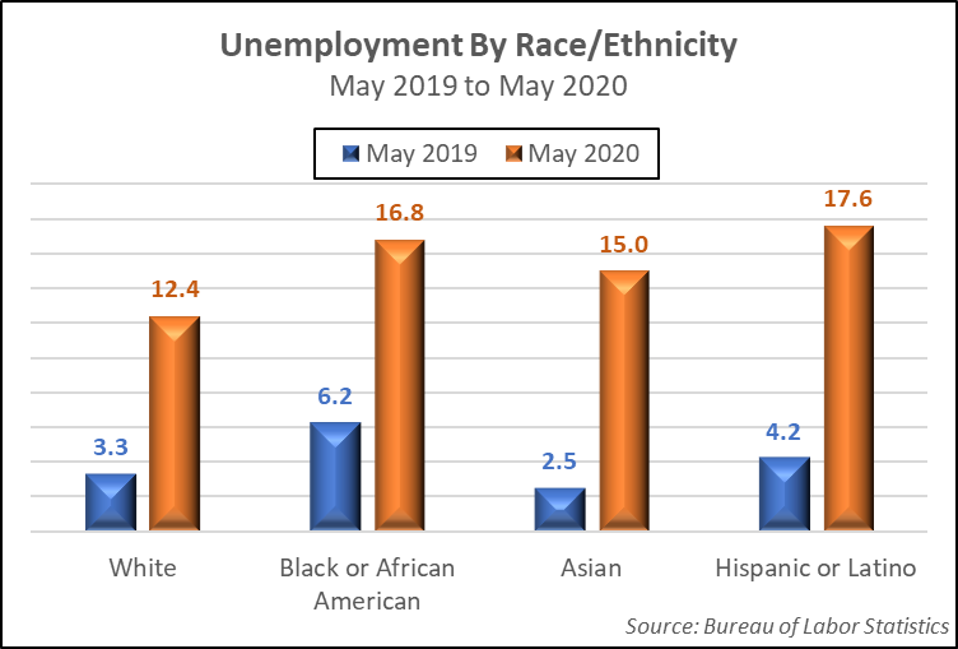
Question: Prior to Covid-19, was unemployment among blacks / African Americans at a record low as President Trump has claimed? Using the available data, which extends back to January 1972, the answer is yes. This new record low was achieved in October and November of 2019 when unemployment among black or African American workers fell to 5.1%. The previous record low was 5.2% in December 1973. The current rate is 16.8%, which is less than the highest rate of 20.7% logged in December 1982. The most recent high in unemployment for this group was 19.3% in March 2010. It has been steadily declining since then. Numbers for White, Asian, and Hispanic or Latino and black or African American workers are listed in the following chart.

Unemployment by Race or Ethnicity-May 2019 to May 2020

Businesses need workers, workers need businesses, and both depend on customers. Since the pandemic began, consumer demand has fallen sharply. With the probability that a vaccine will not be available until early 2021 at the soonest, plus a disregard for recommended safety protocols by many individuals, namely wearing masks and social distancing, it is highly unlikely that the economy will return to normal for several years.

Will the president continue to hold rallies? Will he set an example by wearing a mask? Will the protests and violence continue? Will other large gatherings continue? Unless Americans make a collective and conscious choice to mask up and social distance, we will be forced to live in a depressed economy for longer than necessary. The choice is up to us.


Fauci testifies new coronavirus cases could ‘go up to 100,000 a day if this does not turn around’

https://www.washingtonpost.com/nation/2020/06/30/coronavirus-live-updates-us/?utm_campaign=wp_post_most&utm_medium=email&utm_source=newsletter&wpisrc=nl_most

Coronavirus update: Fauci testifies new U.S. cases could 'go up to ...

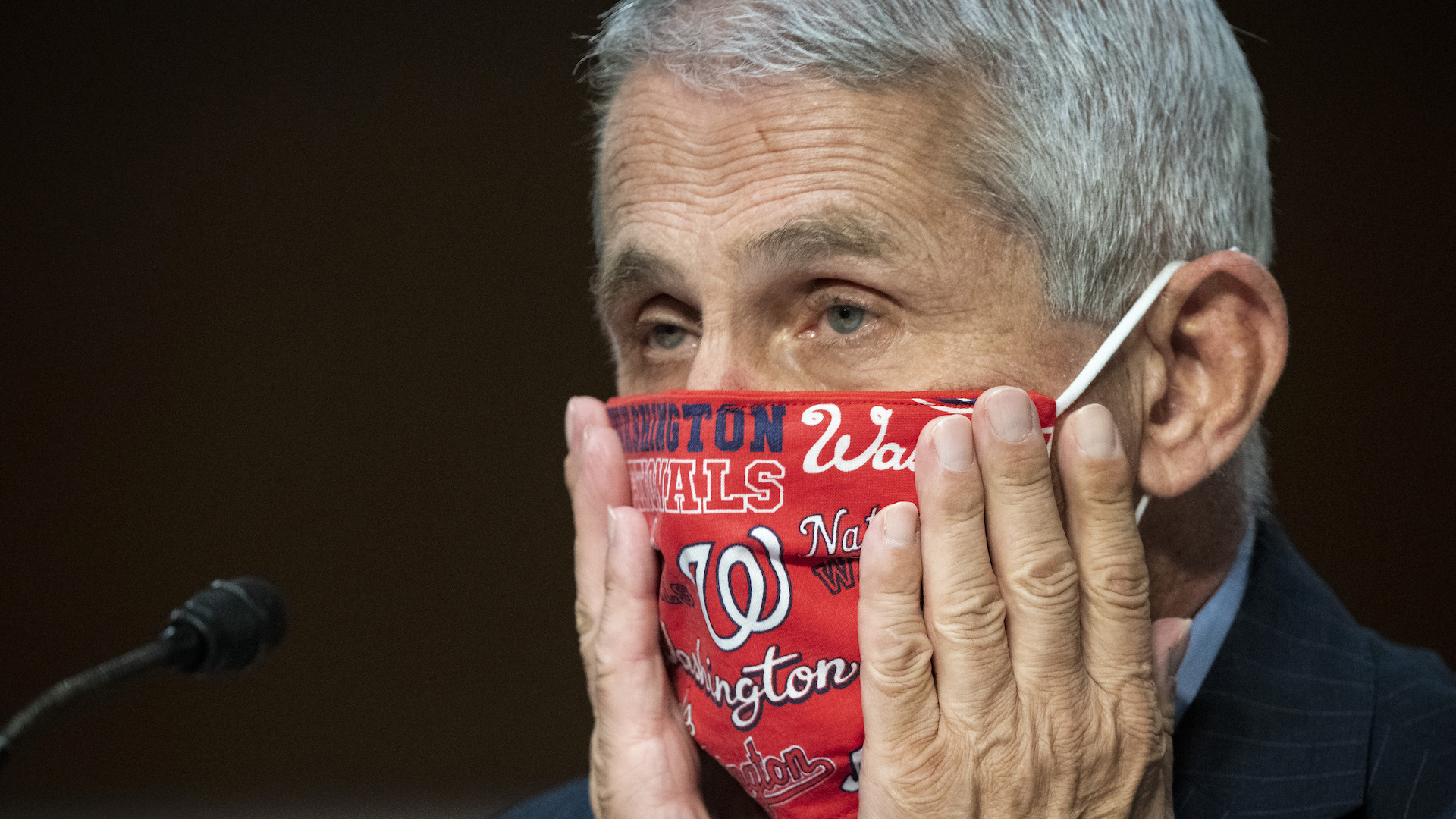
Anthony S. Fauci, the nation’s top infectious-diseases expert, gave a dire warning Tuesday in a Senate committee hearing held as coronavirus infections surge in many parts of the United States.

“We are now having 40-plus thousand new cases a day. I would not be surprised if we go up to 100,000 a day if this does not turn around. And so I am very concerned,” Fauci said in response to questioning from Sen. Elizabeth Warren (D-Mass.) on what the overall U.S. death toll is likely to be.

While the U.S. wrestles with safely reopening, the European Union confirmed Americans will not be allowed to travel to the bloc of 27 countries when it reopens to some foreign travel Wednesday. The United States is leading the world in both officially confirmed infections and fatalities as it continues to see surges in new cases, hospitalizations and deaths in many states.

Nearly 10.3 million coronavirus cases have been detected worldwide, with roughly 2.6 million infections reported in the United States. At least 124,000 people have died of covid-19 in the United States, and the global death count is hovering near 505,000.

Here are some significant developments:

  • Former vice president and presumptive Democratic presidential nominee Joe Biden said during a speech that President Trump ‘failed’ Americans in his response to the coronavirus pandemic. Biden also released a plan to combat the virus: beefed-up testing and contacting tracing, using the Defense Production Act and organizing a global, coordinated approach for treatment and vaccines.
  • More Republican leaders advocated for the use of face masks in public, including House Minority Leader Kevin McCarthy (Calif.) — who encouraged President Trump to don one — and Senate Majority Leader Mitch McConnell. In addition, Health and Human Services Secretary Alex Azar said the rise in cases can be stopped if Americans wear facial coverings in public, along with practicing social distancing and proper personal hygiene.
  • Social distancing will not be enforced July 3 at the Mount Rushmore fireworks display that Trump will attend, South Dakota Gov. Kristi L. Noem (R) said Monday. Noem also said masks will be provided to the 7,500 participants, but they will not be required to wear them.
  • The number of people hospitalized for covid-19 is surging in seven states, according to data tracked by The Washington Post. In Texas, Arizona, Nevada, South Carolina, Montana, Georgia and California, seven-day averages are up at least 25 percent from last week.
  • Chinese researchers announced the discovery of a new strain of swine flu among workers at a slaughterhouse and warned it should be monitored in case human-to-human transmission starts.


Labs warn COVID-19 testing demand will top capacity soon as new hotspots emerge

https://www.healthcaredive.com/news/labs-warn-covid-19-testing-demand-will-top-capacity-hotspots-new-surge/580730/

Dive Brief:

  • With the spike in coronavirus cases in Southern and Western states, commercial laboratories say they do not have the capacity to keep up with growing demand for their testing services and predict longer turnaround times for results over the coming weeks.
  • The American Clinical Laboratory Association, which represents LabCorp, Quest Diagnostics and other labs, said Saturday its members have seen a steady increase in the volume of COVID-19 test orders recently, specifically calling out the fact that critical testing materials are in short supply.
  • Quest on Thursday issued its own warning that despite the rapid expansion of its testing capacity, demand has been growing faster. In particular, the lab giant noted that orders for molecular diagnostic services have increased by about 50% over the past three weeks.

Dive Insight:

U.S. commercial labs had made “significant strides” during the coronavirus pandemic by expanding testing capacity from about 100,000 tests per day in early April to more than 300,000 currently, according to ACLA.

But newly emerging hotspots like Arizona, California and Texas are putting a strain on labs and an already limited supply of testing materials, the group said.

While labs nationwide are trying to increase capacity by purchasing more testing machines and attempting to secure additional test materials from suppliers, ACLA President Julie Khani cautioned, “the reality of this ongoing global pandemic is that testing supplies are limited” and “every country across the globe is in need of essential testing supplies, like pipettes and reagents, and that demand is likely to increase in the coming months.”

Khani said ACLA has been in talks with the Trump administration and supply chain partners about the challenges labs face as they try to increase their level of respective COVID-19 testing abilities to meet the anticipated increase in U.S. demand for tests over the coming weeks.

In the absence of a solution, Khani warned that significant demand “will likely exceed” labs’ testing capacities and “could extend turnaround times for test results.”

For its part, Quest’s statement on Thursday described the U.S. coronavirus outbreak as an “evolving” situation that is putting a “strain” on the company’s COVID-19 testing resources.

“Today, we have the capacity to perform approximately 110,000 of these tests a day (770,000 a week). Despite the rapid expansion of our testing capacity, demand for testing has been growing faster,” according to Quest.

Currently, Quest’s average turnaround time for test results are one day for hospital patients, pre-operative patients in acute care settings, and symptomatic healthcare workers, and two to three days for all other patient populations. However, the company warned that “given increased demand, we expect average turnaround times near term to extend in excess of 3 days.”

Nonetheless, Quest said it is taking actions to try to increase COVID-19 testing scale, with the goal of being able to perform 150,000 tests per day. Toward that end, the company is installing additional testing platforms in its network of U.S. labs and said it is collaborating with independent labs who currently have underused capacity.

Quest’s rival LabCorp was not immediately available for comment on its testing capacity amid reports of demand increasing across the country.


Trinity Health expects $2B revenue plunge as it cuts, furloughs more staff

https://www.healthcaredive.com/news/trinity-health-cutting-cost-cutting-2-billion-revenue-shortfall/580738/

The Dumbest Things You Can Do With Your Money | Work + Money

Dive Brief:

  • Trinity Health, one of the nation’s largest nonprofit health systems, said Monday it will take more measures to cut costs due to the downturn spurred by the novel coronavirus. The restructuring plan includes eliminating positions, extending furloughs, severances and reductions in schedules. The decisions are being “customized” across the system based on factors that include volume projections and the cost and revenue challenges in each market.
  • The Livonia, Michigan-based hospital operator said it continues to treat COVID-19 patients, however, it has “for now seen declining numbers of very sick patients with COVID-19.”
  • The system said it expects revenue to be depressed or “below historical levels” for the remainder of this fiscal year and much of the next. It projects revenue to drop by $2 billion to $17.3 billion for fiscal year 2021, which starts after its June 30 year end.

Dive Insight:

In May, Trinity said it planned to furlough nearly 12% of its workforce — or 15,000 employees out of the 125,000 nationally.  

Trinity, one of the nation’s largest hospital operators with 92 facilities and operations across 22 states, is now broadening that restructuring, extending and adding new furloughs.

In a Monday bond filing, Trinity said its operations were “significantly” impacted by the effects of the pandemic as many operators saw depressed volumes due to shelter-in-place orders, which started in most of Trinity’s markets during the last two weeks of March.

“The effect of COVID-19 on the operating margins and financial results of Trinity Health is adverse and significant and, at this point, the duration of the pandemic and the length of time until Trinity Health returns to normal operations is unknown,” according to Monday’s bond filing.

The system said relief funds provided by the federal government have not been enough to cover its operating losses. Trinity has received $600 million in relief funds that do not have to be repaid and more in loans through the advanced Medicare payment program, according to a previous analysis by Healthcare Dive.

Still, the system said it has drawn on credit facilities totaling $1 billion to provide adequate liquidity during the pandemic. Trinity reported having 178 days cash on hand as of March 30.

Some nonprofits are faring better than Trinity and pulling back on earlier staffing cuts.

Mayo Clinic said last week it will call back its furloughed workers by the end of August and restore pay that had been cut due to the pandemic.

Mayo has some of the most cash on hand in terms of days when comparing other major nonprofit systems. Mayo had 252 days of cash on hand as of March 30, more than the other 20 largest nonprofits except Cleveland Clinic and New York-Presbyterian.


Pandemic Graphic of the Day

Image may contain: text