The analog reality beneath a patina of digital care 

https://mailchi.mp/4b683d764cf3/the-weekly-gist-november-18-2022?e=d1e747d2d8

Telemedicine is supposed to make consumers’ lives easier, right? One of us had the opposite experience when managing a sick kid this week. My 14-year-old has been sick with a bad respiratory illness for over a week. We saw her pediatrician in-person, testing negative for COVID (multiple times), flu, and strep. Over the week, her symptoms worsened, and rather than haul her back to the doctor, we decided to give our health plan’s telemedicine service a try. To the plan’s credit, the video visit was easy to schedule, and we were connected to a doctor within minutes. He agreed that symptoms and timeline warranted an antibiotic, and said he was sending the prescription to our pharmacy as we wrapped up the call. 
 
Here’s where the challenges began. We went to our usual CVS a few hours later, and they had no record of the prescription. (Note to telemedicine users: write down the name of your provider. The pharmacy asked to search for the script by the doctor’s name, which I didn’t remember—and holding up the line of a dozen other customers to fumble with the app seemed like the wrong call.)

We left and contacted the telemedicine service to see if the prescription had been transmitted, and after a half hour on hold, were finally transferred to pharmacy support. It turns out that the telemedicine service transmits their prescriptions via “e-fax”, so it was difficult to confirm if the pharmacy had received it. Not to be confused with e-prescribing, e-fax is literally an emailed image of a prescription, with none of the safeguards and communication capabilities of true electronic prescribing. 

The helpful service representative kindly offered to call the pharmacy and placed us on hold—only to get a message that the pharmacy was closed for lunch and not accepting calls! Several hours later, which included being on hold for 75 minutes (!!!) with our CVS, my daughter finally got her medication. 

Despite the slick app and teleconferencing system, the operations behind the virtual visit still relied on the very analog processes of phone trees and faxes—which created a level of irritation that rivaled trying to land Taylor Swift tickets for the same kid. It was a stark reminder of how far healthcare has to go to deliver a truly digital, consumer-centered experience. 
Amazon launches direct-to-consumer virtual care platform

https://mailchi.mp/4b683d764cf3/the-weekly-gist-november-18-2022?e=d1e747d2d8

On Tuesday, the e-commerce giant unveiled its latest healthcare endeavor, Amazon Clinic, a “virtual health storefront” that can asynchronously connect patients to third-party telemedicine providers. It offers diagnosis and treatment for roughly 20 low-acuity, elective health conditions—including acne, birth control, hair loss, and seasonal allergies—at flat, out-of-pocket rates. (The service does not currently accept insurance.) It also refills prescriptions, which customers can send to any pharmacy, including Amazon’s. At its launch, Amazon Clinic is available in 32 states. 

The Gist: This is exactly the kind of venture at which Amazon excels: creating a marketplace that’s convenient for buyers and sellers (patients and telemedicine providers), pricing it competitively to pursue scale over margins, and upselling customers by pairing care with Amazon’s other products or services (like Amazon Pharmacy). 

Its existing customer base and logistics expertise could position it to replace telemedicine storefront competitors, including Ro and Hims & Hers, as the leading direct-to-consumer healthcare platform, at least among those that don’t take insurance.

It bears watching to see how Amazon builds on this service, including whether it eventually incorporates insurance coverage, partners with health systems (similar to Hims & Hers), or connects Amazon Clinic to Prime in order to attract greater numbers of—generally young, healthy, and relatively wealthy—consumers.

COVID public health emergency (PHE) likely to extend past January

https://mailchi.mp/4b683d764cf3/the-weekly-gist-november-18-2022?e=d1e747d2d8

The Department of Health and Human Services (HHS) appears set to extend the federal COVID PHE past its current expiration date of January 11, 2023, as HHS had promised to give stakeholders at least 60 days’ notice before ending it, and that deadline came and went on November 11th. Days later the Senate voted to end the PHE, a bill which Biden has promised to veto should it reach his desk. Measures set to expire with the PHE, or on a several month delay after it ends, include Medicare telehealth flexibilities, continuous enrollment guarantees in Medicaid, and boosted payments to hospitals treating COVID patients. 

The Gist: Despite growing calls to end the PHE declaration, and even as White House COVID coordinator Dr. Ashish Jha has said another severe COVID surge this winter is unlikely, the White House is likely trying to buy time to resolve the complicated issues tied to the PHE, some of which must be dealt with legislatively. 

And with a divided Congress ahead, it remains to be seen how these issues, especially Medicare telehealth flexibilities—a topic of bipartisan agreement—are sorted out. Meanwhile the continuation of the PHE prevents states from beginning Medicaid re-determinations, allowing millions of Americans to avoid being disenrolled.

Virtual care solidifying its post-COVID role 

https://mailchi.mp/4587dc321337/the-weekly-gist-october-14-2022?e=d1e747d2d8

After COVID restrictions introduced millions of Americans to telehealth, it became an open question whether virtual care would revolutionize healthcare delivery, or turn out to be a flash in the pan. Using commercial claims data from Fair Health, the graphic above reveals that roughly one in twenty commercial medical claims are now for virtual care, a rate that has held fairly steady since dropping from its early pandemic peak. (These use rates likely extend to Medicare, as a Kaiser Family Foundation analysis showed that the virtual share of outpatient visits barely differed between those younger and older than 65.) 

What could be considered a true revolution is virtual care’s impact on behavioral healthcare, which makes up nearly two-thirds of overall virtual care volume. According to Zocdoc, an online marketplace booking both in-person and virtual care services, 85 percent of psychiatric appointments booked in the first half of 2022 were for virtual care, dwarfing the virtual visit levels of the other top specialties.

Meanwhile, consumers have incorporated virtual care into their lives as a useful option, though not as the sole way they access care. A recent survey found that a near-majority of consumers have accessed care both virtually and in-person, far more than the number who rely exclusively on one channel or the other. The pandemic changed consumers’ baseline expectation of what care could be delivered at home. The ability to deliver accessible, efficient virtual visits and connect that care to in-person care delivery will be a competitive advantage in the “hybrid” care environment sought by many consumers.

What shutting down Amazon’s national care delivery service means about its health care ambition

Amazon announced it will shut down Amazon Care—its primary care service sold to employer health plans—by the end of the year. There’s one thing that Amazon’s decision will surely mean: It will continue to be fashionable to mock Amazon.

People may look at this, compare it to Amazon’s Haven misadventure, and say that everyone (including Advisory Board) who speculated that Amazon could succeed in health care is either naïve or delusional.

But there’s more to it.

In looking at what Amazon reportedly said about the challenges facing Amazon Care, we believe that the acquisition of One Medical is the clearest signal yet that Amazon intends to succeed at health care.

The problems with Amazon Care

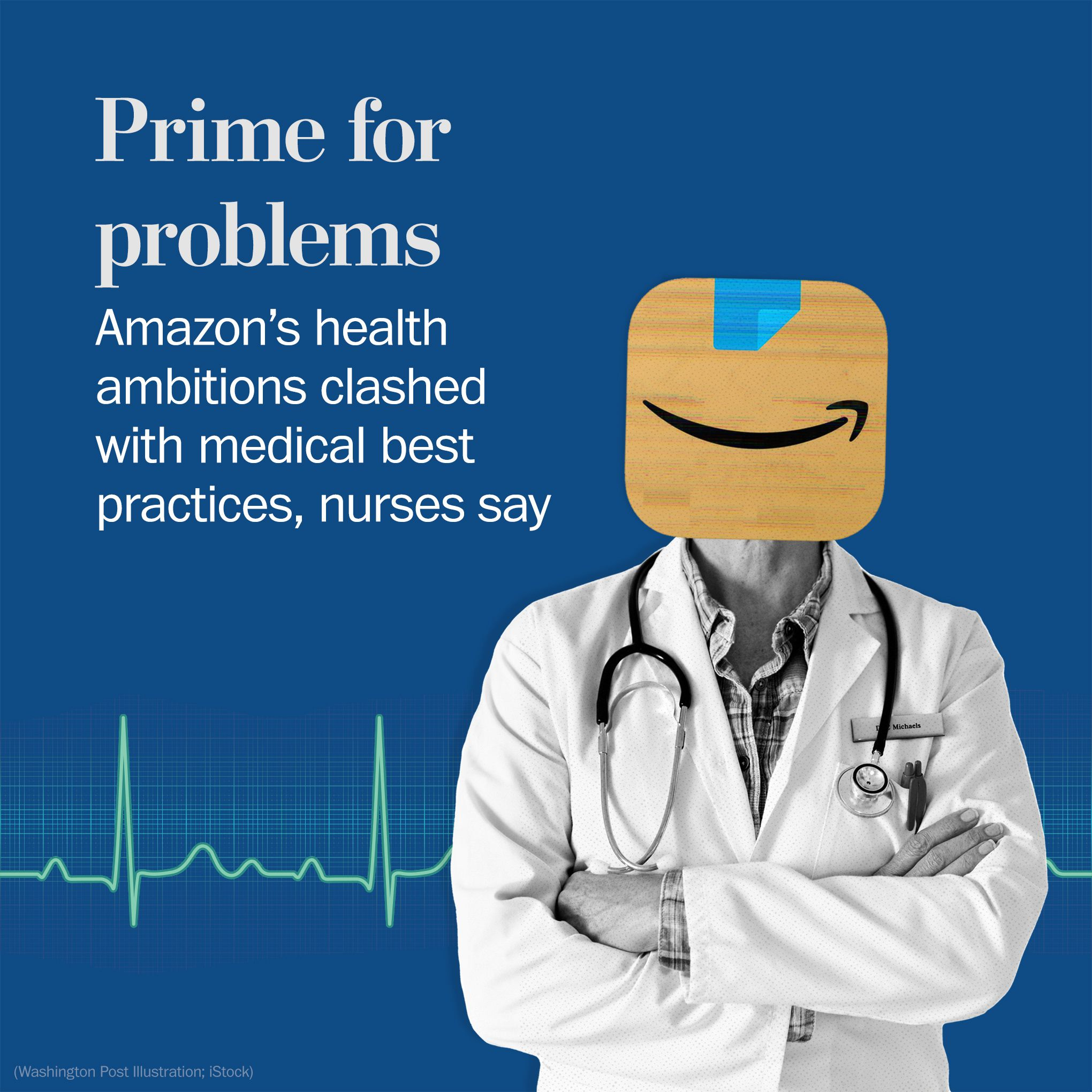
Amazon Care appears to have struggled to understand the nuances and demands of care delivery, as detailed recently in the Washington Post. Clearly, the tension between expectations for growth and quality were real. This raised questions for us: Was Amazon going to truly “iterate” on its health care capabilities? When it came to care delivery, would Amazon get better, or would it do enough to get by?

Amazon concedes that its product was not comprehensive enough for its employer partners. It’s unclear whether that means it simply wasn’t saving them money, even if employees were using it. At the same time, we wonder how hard it was to persuade employees to embrace Amazon-branded health care or to attract employees to a product centered on virtual and home-based care—or some combination of the two.

Remember: Everyone had to try out telehealth in 2020 because, in many cases, they had no choice. There isn’t any similarly powerful and pervasive force pushing anyone to virtual-first care today. People tend to like virtual visits, but that doesn’t mean that they want to receive all adequately satisfy users or keep care from fragmenting with its mosaic of services, channels, and providers.

What shutting down Amazon Care suggests about Amazon’s health care ambition

Amazon’s willingness to jettison its homegrown but underperforming health care business suggests three things.

  1. One Medical is the centerpiece of Amazon’s health care strategy, not simply one component among many. When viewed this way, the details of the acquisition make more sense than they did four weeks ago. Knowing that a virtual and home-based model wasn’t attractive for employers, we can understand more clearly why Amazon wanted a partner with both in-person and digital health capabilities. Knowing that its own product was struggling, we can see why it was willing to pay a huge premium for One Medical.
  2. Amazon is iterating on its health care capabilities, but it is iterating at an enormous scale. “Fail fast” is axiomatic in technology. It’s usually applied to minimum viable products—applications and services that are quickly built, delivered, and assessed for their ability to meet customer demands and gain traction in the market. Products that don’t meet those demands are replaced as quickly as possible. Obviously, Amazon Care was not a minimum viable product. It was rolled out three years ago, and it offered telehealth services in all 50 states and in-home services in seven markets. But when you look at the pivot Amazon seems to be making from virtual and home-based care with Amazon Care to in-person and virtual with One Medical, it’s hard not to reach for the “fail fast” comparison.
  3. Amazon is a different kind of competitor in health care. We can’t think of another organization that would spend years building out a care delivery enterprise, roll it out in 50 states, and then simply shut it down. We also can’t think of another organization whose alternative care delivery plan is to spend nearly $4 billion on another company. It’s not just the scale and the money—it’s the willingness to throw around those assets that makes Amazon a potentially potent competitor.

There are still enormous execution challenges for Amazon and One Medical. Massive disruption of the industry is not a given, no matter how much money is spent or how many companies are bought and/or fail.

It seems likely that the impact of Amazon on the market will be centered, at least for the immediate future, on the same direct-to-consumer approach that One Medical has taken and at which Amazon is expert in its other lines of business.

That does not mean Amazon can be dismissed as a dilettante or a dabbler in health care. Its mere presence in the market already seems to have sparked a bidding war for Signify Health. Amazon’s continued iteration of its approach to health care demands ongoing attention.

Walmart partners with UnitedHealth Group (UHG) in its continued push into healthcare

https://mailchi.mp/6a3812741768/the-weekly-gist-september-9-2022?e=d1e747d2d8

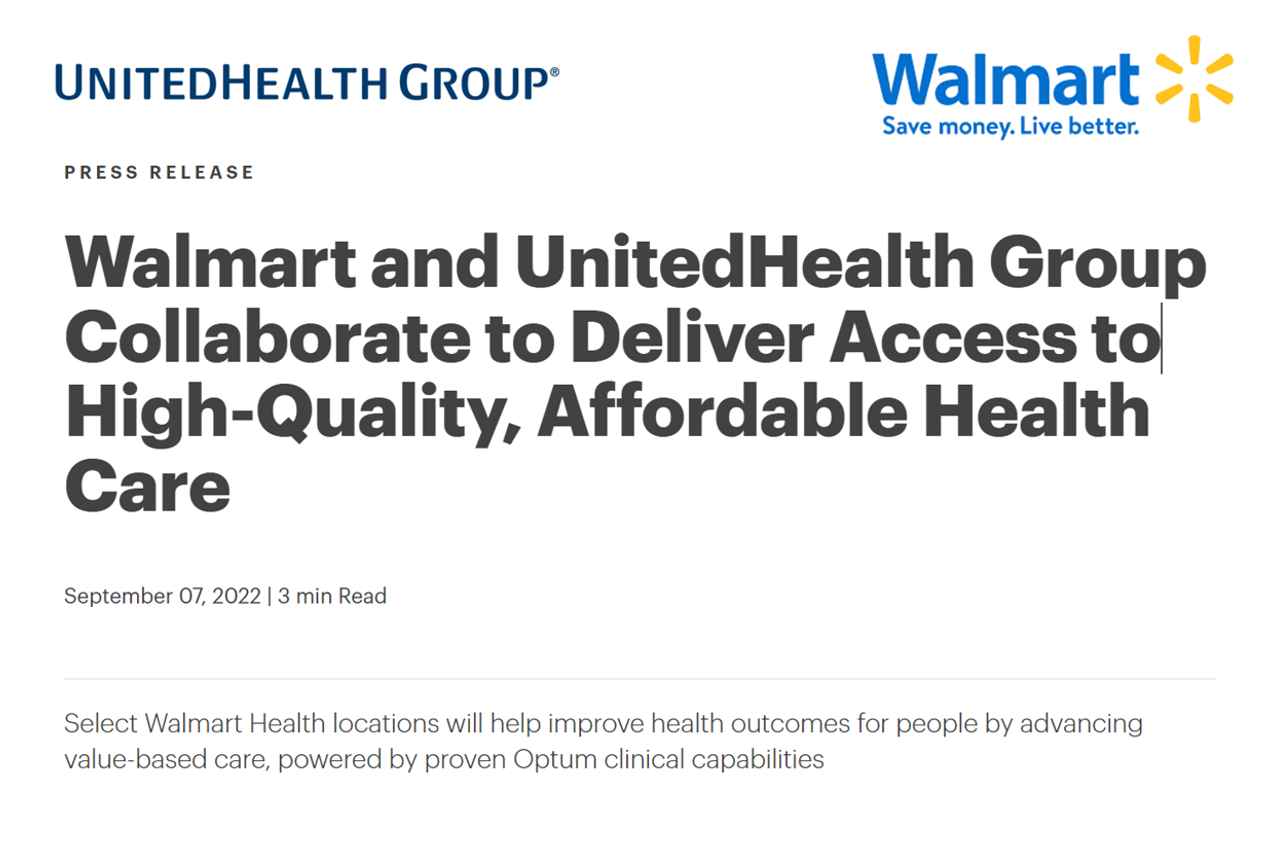
The nation’s largest retailer and its largest insurer announced a 10-year partnership to bring together the collective expertise of both companies to provide affordable healthcare to potentially millions of Americans. Set to start next year with 15 Walmart Health locations in Georgia and Florida, the collaboration will initially focus on seniors and Medicare Advantage (MA) beneficiaries, and will include a co-branded MA plan in Georgia. Walmart Health Virtual Care will also be in-network for some UnitedHealthcare beneficiaries. Plans for future years involve expanding the collaboration across commercial and Medicaid plans, as well as including pharmacy, dental, and vision services. 

The Gist: We have long wondered if this powerhouse pairing was in the works, as this kind of partnership makes a lot of sense for both parties. While Walmart has reportedly been considering an insurance company acquisition for years, and more recently been dabbling in its own insurance efforts, partnering with UHG provides the retailer with a share of the upside potential of getting into the insurance market without having to fully commit to entering that complex business. And given that 90 percent of Americans live within 10 miles of a Walmart store, and more than half of Americans visit a store every week, Walmart provides UHG with low-cost healthcare access points all over the country, especially important in markets where United’s own Optum physician network is not (yet) present.

Amazon Care is shutting down at the end of 2022. Here’s why

https://www.fiercehealthcare.com/health-tech/amazon-care-shutting-down-end-2022-tech-giant-said-virtual-primary-care-business-wasnt

Three years after it began piloting a primary care service for its employees that blended telehealth and in-person medical services, Amazon plans to cease operations of its Amazon Care service.

Amazon announced Wednesday afternoon that it would end Amazon Care operations after December 31. In an email to Amazon Health Services employees, Neil Lindsay, senior vice president of Amazon Health Services, said Amazon Care wasn’t a sustainable, long-term solution for its enterprise customers.

Amazon provided a copy of the email to Fierce Healthcare.

The decision only impacts Amazon Care and Care Medical teams and not Amazon’s other healthcare services. 

While operating Amazon Care, the company “gathered and listened to extensive feedback” from its enterprise customers and their employees and evolved the service to continuously improve the experience for customers.

“However, despite these efforts, we’ve determined that Amazon Care isn’t the right long-term solution for our enterprise customers, and have decided that we will no longer offer Amazon Care after December 31, 2022,” Lindsay wrote.

“This decision wasn’t made lightly and only became clear after many months of careful consideration. Although our enrolled members have loved many aspects of Amazon Care, it is not a complete enough offering for the large enterprise customers we have been targeting, and wasn’t going to work long-term,” he said.

The online retail company piloted virtual urgent care and primary care service with its employees and their families in the Seattle region in 2019.

Amazon Care has since expanded rapidly with telehealth services available in all 50 states and in-person services in at least seven cities, including Dallas, D.C. and Baltimore. As part of its ambitions in healthcare, Amazon then focused on ramping up partnerships with employers and signed on other companies as clients including Silicon Labs, TrueBlue, Whole Foods Market, Precor—a Washington-based fitness equipment company that was acquired by Peloton—and Hilton.

Some industry insiders have said that Amazon Care struggled to gain a foothold with employer clients.

The company was on track to rapidly expand its hybrid care model to more than 20 additional cities in 2022, including major metropolitan areas like San Francisco, Miami, Chicago and New York City.

CEO Andy Jassy has made health care a priority, naming Amazon Care as an example of “iterative innovation” in his first letter to shareholders earlier this year. In July, the company announced plans to buy concierge primary care provider One Medical in a deal valued at approximately $3.9 billion.

If the One Medical deal goes through, it would significantly expand Amazon’s foothold in the nearly $4 trillion healthcare market, specifically in the competitive primary care market.

One Medical markets itself as a membership-based, tech-integrated, consumer-focused primary care platform. The company operates 188 offices in 29 markets. At the end of March, One Medical had 767,000 members.

The deal also gives Amazon rapid access to the lucrative employer market as One Medical works with 8,000 companies.

The One Medical acquisition has not yet closed.

Lindsay said the company’s work building Amazon Care has deepened its understanding of “what’s needed long-term to deliver meaningful health care solutions for enterprise and individual customers.

“I believe the health care space is ripe for reinvention, and our efforts to help improve the health care experience can have an immensely positive impact on our quality of life and health outcomes. However, none of these reasons make this decision any easier for the teams that have helped to build Amazon Care, or for the customers our Care team serves,” he wrote.

The decision to cease Amazon Care’s operations will likely mean some employees will be laid off. Lindsay said in his email to employees that many Amazon Care employees will have an opportunity to join other parts of the Health Services organization or other teams at Amazon. “Well also support employees looking for roles outside of the company,” he said.

Emergency visits are down, so why does the ED feel so busy?

https://mailchi.mp/efa24453feeb/the-weekly-gist-july-22-2022?e=d1e747d2d8

We’ve been noticing a disconnect recently in our conversations with health system executives. When we share national data that shows that emergency department visits are still down substantially from pre-COVID levels, the reaction is often one of surprise.

As one CEO recently put it to us, “We’re seeing exactly the opposite. Our ED feels busier than ever.” It appears that, upon further examination, what’s going on is a shift in the mix of patients who are visiting the ED. The lower-acuity, urgent-care level cases do seem to have shifted away from traditional hospital settings toward virtual visits and urgent care centers. That’s good news from an overall cost of care perspective, but it means that hospital EDs are increasingly filled with sicker, more acute patients.

One sure sign the mix has shifted: many systems are now telling us that the percentage of ED visitors who end up getting admitted is rising. But staffing-driven capacity constraints mean that it’s taking longer to find an inpatient bed for those patients, or to discharge them from the ED to other settings (or back home)—so the average length of stay in the ED is going up.

On top of that, many EDs are now seeing an increase in psych patients, who stay longer and require greater staff attention. All of that, along with staff who are completely exhausted and demoralized after the pandemic, has combined to make many EDs feel swamped these days—despite what the national data are showing. 

Amazon to acquire One Medical in $3.9B deal

Amazon plans to acquire virtual and in-person primary care company One Medical, the online retailer said July 21.  

In a cash deal valued at $3.9 billion, the aim is to combine One Medical’s technology and team with Amazon, it said in a news release. The goal of the acquisition, according to the two companies, is to offer more convenient and affordable healthcare in-person and virtually.

“The opportunity to transform healthcare and improve outcomes by combining One Medical’s human-centered and technology-powered model and exceptional team with Amazon’s customer obsession, history of invention and willingness to invest in the long-term is so exciting,” said Amir Dan Rubin, CEO of One Medical, in a company news release. “There is an immense opportunity to make the healthcare experience more accessible, affordable, and even enjoyable, for patients, providers and payers. We look forward to innovating and expanding access to quality healthcare services together.”

Amazon will acquire One Medical for $18 per share.

Completion of the transaction is subject to customary closing conditions, including approval by One Medical’s shareholders and regulatory approval. 

If the acquisition is approved, Mr. Rubin will remain CEO of One Medical. 

Setting the post-COVID agenda for health systems

https://mailchi.mp/9e0c56723d09/the-weekly-gist-july-8-2022?e=d1e747d2d8

As the economic situation has worsened over the past few months, we’ve been working with several health systems to recalibrate strategy. For many, the anticipated “post-COVID recovery” period has turned into a struggle to reverse declining (often negative) margins, while still scrambling to address mounting workforce shortages. All this amid continued pressure from disruptive competitors and ever-rising consumer expectations.

In the graphic above, we’ve pulled together some of the most important changes we believe health systems need to make. These range from improvements to the operating model (shifting to a team-based approach to staffing, greater use of automation where appropriate, and moving to asset-light capital strategies) to transformations of the clinical model (moving care into lower-cost outpatient and community settings, integrating virtual care into clinical delivery, and creating tighter alignment with key physicians).

In general, the goal is to deliver lower-cost care in less expensive settings, using less expensive staff. 

But those cost-saving strategies will need to be coupled with a new go-to-market approach, including new payment models that reward systems for shifting away from high-cost (and highly reimbursed) care models. 

Employers and consumers will expect more solution-based offerings, which integrate care across the continuum into coherent bundles of service. This will require a more deliberate focus on service line strategies, moving away from a fragmented, inpatient-centric model.

Contracting approaches must align payment with this shift, changing incentives to reward coordinated, cost-effective, outcomes-driven care. 

A key insight from our discussions with health system leaders: short-term cost-cutting initiatives to “stop the bleed” won’t suffice—instead, more permanent solutions will be required that address not only the core operating model, but also the approach to revenue generation. 

The post-COVID environment is turning out to be a lot tougher than many had expected, to say the least.