https://www.washingtonpost.com/health/2020/11/02/deborah-birx-covid-trump/

“This is not about lockdowns. … It’s about an aggressive balanced approach that is not being implemented,” says internal White House report that challenges many of Trump’s pronouncements.
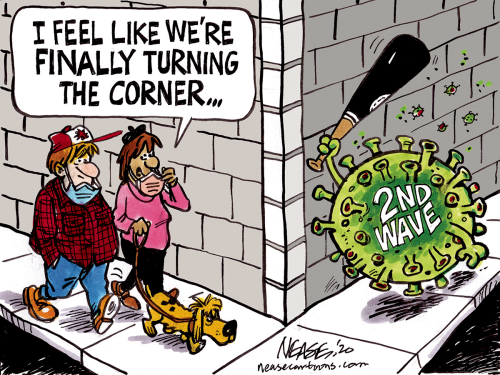
A top White House coronavirus adviser sounded alarms Monday about a new and deadly phase in the health crisis, pleading with top administration officials for “much more aggressive action,” even as President Trump continues to assure rallygoers that the nation is “rounding the turn” on the pandemic.
“We are entering the most concerning and most deadly phase of this pandemic … leading to increasing mortality,” said the Nov. 2 report from Deborah Birx, coordinator of the White House coronavirus task force. “This is not about lockdowns — it hasn’t been about lockdowns since March or April. It’s about an aggressive balanced approach that is not being implemented.”
Birx’s internal report, shared with top White House and agency officials, contradicts Trump on numerous points: While the president holds large campaign events with hundreds of attendees, most without masks, she explicitly warns against them. While the president blames rising cases on more testing, she says testing is “flat or declining” in many areas where cases are rising. And while Trump says the country is “rounding the turn,” Birx notes that the country is entering its most dangerous period yet and will see more than 100,000 new cases a day this week.
Through a spokesperson, Birx did not respond to a request for comment.
Other health experts, including Anthony S. Fauci, director of the National Institute of Allergy and Infectious Diseases, have warned of record surges in cases and hospitalizations as the United States records more than 9 million cases and 230,000 deaths.
“We’re in for a whole lot of hurt,” Fauci told The Washington Post late Friday, predicting a long and potentially deadly winter unless there’s an “abrupt change” — prompting Trump to suggest that he planned to fire the scientist after the election.
But Birx’s daily missives go further, revealing how much the administration’s internal reports are in direct conflict with Trump’s public pronouncements that downplay the seriousness of the threat and erroneously suggest that few people are dying. They also speak to the increasing desperation of health officials to spotlight the risks of a pandemic that is forecast to take thousands more lives as the weather worsens unless people change their behaviors. Some officials are also concerned about recouping their reputations in a post-Trump era.
The increasingly dire tone of Birx’s reports has gotten little traction, according to an administration official who works with her and spoke on the condition of anonymity to share sensitive information. “She feels like she’s being ignored,” the official said.
Birx’s message “has been urgent for weeks,” said another administration official, “as has the plea for the administration to ask the American people to use masks, avoid gatherings and socially distance, basically since it became apparent that we were heading into a third surge.”
The report hits hard on the worsening situation: “Cases are rapidly rising in nearly 30 percent of all USA counties, the highest number of county hotspots we have seen with this pandemic,” it said. “Half of the United States is in the red or orange zone for cases despite flat or declining testing.”
Sounding a similar theme to past reports, it calls for “much more aggressive action from messaging, to testing, to surging personnel around the country before the crisis point.”
What is “essential at this time point,” the report said, is “consistent messaging about uniform use of masks, physical distancing and hand washing with profound limitation on indoor gatherings especially with family and friends.”
It adds: “This is about empowerment Americans with the knowledge and data for decision-making to prevent community spread and save lives.”
The president appears unpersuaded by such messages, convinced by new medical adviser Scott Atlas, a neuroradiologist with no infectious-disease experience, that allowing healthy people to return to daily activities without restrictions will hasten herd immunity and bolster the economy, say some advisers who spoke on the condition of anonymity because they were not authorized to speak publicly.
Trump plans to hold a large indoor gathering for 300 to 400 guests at the White House on Tuesday to watch the election returns, only a few weeks after a White House event to announce his Supreme Court nominee Amy Coney Barrett became a superspreader event.
White House communications director Alyssa Farah disputed the report’s suggestion that the administration’s response has been inadequate to the crisis. She said the White House has “significantly increased” the U.S. national stockpile to ensure the country has sufficient personal protective equipment; bought 150 million coronavirus tests and distributed them to the most vulnerable populations, including nursing homes, assisted-living facilities and Native American tribal areas; and sent special teams to states and nursing homes with the most cases.
In addition, she said, the administration continues to work to “safely rush therapeutics” to the sick and develop vaccines. “We are working around-the-clock to safely treat the virus and ultimately defeat it,” Farah said.
Birx’s report goes to pains to dispute Trump’s false claims that coronavirus cases are increasing only because of increases in testing. Monday’s report notes that although testing is flat, a rising number of tests are positive, suggesting “community spread is much worse than is evident by current [measurements].”
An earlier, Oct. 17 report sounded the same theme: It cited increasing daily hospital admissions, rising fatalities and emergency room visits, and bluntly stated, “this is not due to increased testing but broad and ever-increasing community spread.”
That report added these words highlighted in bold: “There is an absolute necessity of the Administration to use this moment to ask the American people to wear masks, physical distance and avoid gatherings in both public and private spaces.” On that day, Trump held two large rallies, according to his public schedule, one in Michigan and one in Wisconsin.
Birx’s report goes to pains to dispute Trump’s false claims that coronavirus cases are increasing only because of increases in testing. Monday’s report notes that although testing is flat, a rising number of tests are positive, suggesting “community spread is much worse than is evident by current [measurements].”
An earlier, Oct. 17 report sounded the same theme: It cited increasing daily hospital admissions, rising fatalities and emergency room visits, and bluntly stated, “this is not due to increased testing but broad and ever-increasing community spread.”
That report added these words highlighted in bold: “There is an absolute necessity of the Administration to use this moment to ask the American people to wear masks, physical distance and avoid gatherings in both public and private spaces.” On that day, Trump held two large rallies, according to his public schedule, one in Michigan and one in Wisconsin.
Officials describe Birx as frustrated with Atlas’s growing influence. She has challenged his views in task force meetings, suggesting that reopening society without any restrictions would lead to thousands of deaths.
In recent weeks, Birx has crisscrossed the country, traveling to dozens of virus hot spots, where she has urged state and local officials to mandate masks, close bars and restaurants and encourage distancing.
Birx is said to be close to Vice President Pence, but he’s been on the road campaigning in recent weeks, taking his attention away from the coronavirus, according to a senior administration official who spoke on the condition of anonymity to share internal discussions.
Unlike Fauci, a highly regarded civil servant who Trump has criticized as a “Democrat,” Birx was chosen by the administration to helm the response and has been lavishly praised in the past by Trump.
Fauci said in his interview Friday that he and Birx lost the president’s ear as Trump worried increasingly about a sputtering economy and his reelection prospects.
“They needed to have a medical message that was essentially consistent with what they were saying, and one of the ways to say: ‘The outbreak is over. [Mitigation strategies are] really irrelevant because it doesn’t make any difference. All you need to do is prevent people from dying and protect people in places like the nursing homes,’ ” Fauci said.