Starting next month, the federal government will stop reimbursing hospitals and other providers for the vaccination, testing, and treatment of uninsured COVID-19 patients. So far, about 50K providers have submitted a total of $20B of claims for COVID-related care for the uninsured.
Congress has yet to authorize more funding for this and other COVID relief programs, after stripping $15.6B from the latest government spending package. Though the White House is asking Congress to authorize $22.5B for further COVID aid and surge preparedness, it’s not clear how much of any new funding would go toward reimbursing care for the uninsured.
The Gist: This news comes as US officials expect a rise in cases driven by the Omicron BA.2 subvariant. Hospitals, already struggling with high labor and supply expenses, will face further margin pressures if a future COVID surge brings increased hospitalizations.
This will be especially true for safety net hospitals, and for those in states which haven’t expanded Medicaid. At the same time, 15M Americans are also at risk of losing Medicaid coverage when the federal government ends the public health emergency. Lower-income patients and the hospitals that treat them have already shouldered COVID’s worst effects, and the funding stalemate risks further worsening their situation.
The expected green light for a second coronavirus booster shot poses a challenge to the Biden administration, which will need to work overtime to convince a public that has largely decided to move on from the COVID-19 pandemic.
Both Pfizer and Moderna have filed for emergency use authorization with the Food and Drug Administration for a fourth dose of their respective vaccines, citing evidence that protection from the third shot has decreased enough to warrant a fourth dose.
Yet the nation’s vaccination and booster rates have dropped to record lows, just as experts and officials are bracing for the possibility of another wave of infections from the BA.2 subvariant of omicron.
The BA.2 version of omicron is much more transmissible than the original variant. Combined with relaxed precautions like indoor masking and waning immunity among those who have not received a vaccine booster, cases have risen sharply in Europe in the past few weeks, and the U.S. could follow shortly.
The omicron subvariant is responsible for about 35 percent of all cases in the country. In some regions though, like the northeast, it is responsible for the majority of infections.
Federal health officials are reportedly poised to authorize a fourth dose of coronavirus vaccine for adults age 50 and older as soon as this week. A fourth shot is already authorized for the immunocompromised.
But the issues that plagued the administration during the first booster campaign loom large, and officials are likely eager to avoid the same pitfalls.
Chaotic and at times disparate messages from administration health officials culminated in a complicated set of recommendations about who should be getting booster shots, and why, which experts said helped depress enthusiasm.
“I think that some of the low uptake of boosters, especially amongst people who would benefit, the high risk population, is because that message has been diluted,” said Amesh Adalja, a senior scholar at the Johns Hopkins Center for Health Security.
But the underlying disagreement about the goal of booster shots has not changed. While there’s widespread agreement that older Americans are much more at risk for severe outcomes, it’s still not clear if younger people will benefit from an additional dose.
Much of the debate has centered on whether the goal is to prevent people from being hospitalized with COVID-19 or whether the goal is to prevent them from getting sick at all, even if it is milder.
Anthony Fauci, White House chief medical advisor and the nation’s top infectious disease doctor, said regulators are trying to determine how low protection against hospitalization needs to drop before a booster is warranted.
“So the real open question that we don’t know definitively the answer to, is how long is the durability of protection against severe disease going to last even when the protection against infection diminishes substantially,” Fauci said during a Washington Post event last week.
“For example, we know that when you get down to a rather low level 30, 40 or so percent of protection against infection, you still have, when you look at hospitalization, a high degree [of protection],” Fauci said.
President Biden last summer promised widespread boosters for all Americans by the end of September, well before the FDA and the Centers for Disease Control and Prevention (CDC) had examined the evidence.
While officials were careful to say the booster program was contingent on the FDA and CDC giving the green light, scientists inside and outside the government argued there wasn’t enough evidence showing protection against severe illness and hospitalization dropped to levels that warranted a booster.
The CDC initially decided against recommending broad authorization, and instead recommended a booster shot for people over the age of 65, as well as anyone who was at “high risk” of exposure to the virus in the workplace.
The agency eventually decided to make everyone eligible, but by then much of the damage had been done. Vaccinated Americans have largely shown they are not interested in getting a booster.
According to current CDC data, less than 45 percent of all adults have received a booster shot, but the number rises to about 67 percent of adults age 65 and older.
Adalja said it makes sense to be proactive and have a plan to get additional booster shots to the older group. But he said the decisions should be left to the scientists, and the health agencies should make decisions independent of the White House.
“Keep the politicians out of it,” Adalja said. “The miscommunications occurred because they made boosters a political issue, not a scientific issue.”
But even if there is a targeted recommendation, a stalled funding request in Congress further complicates matters. The U.S government does not have enough doses on hand to vaccinate everyone who would be eligible for another booster.
The White House says it needs tens of billions of dollars in COVID response funding, which is tied up due to political disagreements. Administration officials say they don’t have enough doses on hand to cover anyone other than the immunocompromised and people aged 65 and older.
But an independent analysis from the Kaiser Family Foundation found the government only has enough vaccine supplies to cover 70 percent of the 65 and older group.
Cases of COVID-19 have increased during the last 14 days in 10 states and Washington, D.C., with the latest additions of the district and Illinois.
Nationwide, COVID-19 cases decreased 15 percent over the past 14 days, according to HHS data collected by The New York Times. But as the more contagious omicron subvariant BA.2 continues to spread, cases are ticking upward in 10 states and D.C. as of March 25. Cases were moving upward in nine states as of March 24, with D.C. and Illinois reporting increases a day later.
Here are the 14-day changes for cases in each state reporting an increase, according to HHS data collected by The New York Times:
New York: 44 percent
Kentucky: 35 percent
Arkansas: 23 percent
Colorado: 21 percent
Connecticut: 18 percent
Texas: 17 percent
Massachusetts: 15 percent
Vermont: 13 percent
Rhode Island: 11 percent
Washington, D.C.: 5 percent
Illinois: 1 percent
The latest variant proportion estimates from the CDC show the omicron subvariant BA.2 accounts for more than one-third of COVID-19 cases nationwide and more than half of cases in the Northeast. Rhode Island has the highest proportion of BA.2 cases of all states, according to the latest ranking of states by the subvariant’s prevalence.
“If we maintain our preparedness, an increase in cases does not need to be a cause for alarm like it once was,” Jeff Zients, White House COVID-19 response coordinator, said in a March 23 media briefing. “We know what tools we need to fight the virus. Unfortunately, because of congressional action, we’re at risk of not having these tools readily available.”
President Joe Biden signed into law March 15 a sweeping $1.5 trillion bill that funds the government through September. The legislation did not include COVID-19 funding the White House had requested from Congress due to partisan disagreement about offsetting the funding.
There is no clear path to approval of more COVID-19 funding.
The lack of funding is affecting resources for COVID-19 testing and treatment. The Health Resources and Services Administration stopped accepting providers’ claims for COVID-19 testing and treatment of the uninsured March 22 due to a lack of sufficient funds. The federal government is also cutting back shipments of monoclonal antibody treatments to states by 30 percent, and the U.S. supply of those treatments could run out as soon as May.
The high-profile children’s hospital uses donor money to engage in long and costly legal battles over wills. Here’s how St. Jude has created one of the most lucrative charitable bequest programs in the country.
Most Americans know St. Jude Children’s Research Hospital through television advertisements featuring Hollywood celebrities asking for contributions or the millions of fundraising appeals that regularly arrive in mailboxes across the country.
But a select group of potential donors is targeted in a more intimate way. Representatives of the hospital’s fundraising arm visit their homes; dine with them at local restaurants; send them personal notes and birthday cards; and schedule them for “love calls.”
What makes these potential donors so special? They told St. Jude they were considering leaving the hospital a substantial amount in their wills. Once the suggestion was made, specialized fundraisers set a singular goal: build relationships with the donors to make sure the money flows to the hospital after their deaths.
The intense cultivation of these donors is part of a strategy that has helped St. Jude establish what may be the most successful charitable bequest program in the country. In the most recent five-year period of reported financial results, bequests constituted $1.5 billion, or 20%, of the $7.5 billion St. Jude raised in those years. That amount, both in terms of dollars and as a percentage of fundraising, far outpaces that raised by other leading children’s hospitals and charities generally.
While a financial boon to St. Jude, the hospital’s pursuit has led to fraught disputes with donors’ family members and allegations that it goes too far in its quest for bequests.
St. Jude is a major research center with a 73-bed hospital in Memphis, Tennessee, that primarily treats kids from the Mid-South. Its bequest operation has a broad reach, with fundraisers based across the nation and a willingness to challenge families in court over the assets their loved ones leave behind. These battles can sometimes be lengthy and costly, spending donor money on litigation and diminishing inheritances. Family attorneys who specialize in such fights say that St. Jude can be especially aggressive, often pursuing cases all the way to state supreme courts.
“At the end of it, there is very little to hold on to feel good about,” said Vance Lanier, of Lafayette, Louisiana, who won a yearslong legal battle with St. Jude over his father’s estate but not before both sides spent heavily on the case.
“Think of all the fees for lawyers that didn’t go to St. Jude, not one child, not one cancer patient,” Lanier said. “Where is the sanity in all this?”
The nonprofit even courts those who aid in estate planning and drawing up wills, sponsoring conferences where attorneys, financial advisers and estate professionals gather. On at least one occasion it offered attendees a chance to win a golf trip.
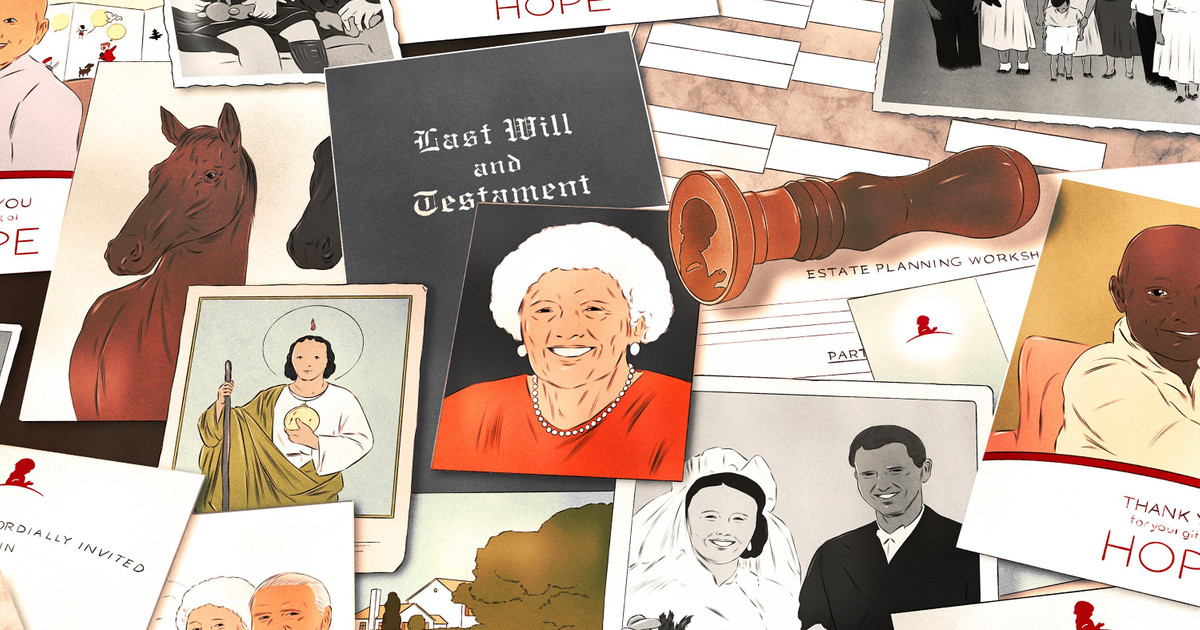
The prospective donors wooed by St. Jude are often people like Nona Harris: elderly, childless women with substantial wealth. Harris notified the charity in 1996 that she was considering leaving it a bequest. St. Jude spent the next two decades cultivating Harris. An internal database, built to collect information on donors, tracked nearly 100 calls and other contacts between Harris and the charity’s fundraisers during that time — an average of almost once every two months. It also noted information Harris shared with fundraisers.
By the time she died in 2015, the charity knew just about everything there was to know about her. It knew about the health problems of her husband, J.D., from the medicines that he took to the heart defibrillator that needed to be replaced. St. Jude knew that J.D.’s mother died when he was 13 and that one of Nona’s relatives had a rare tongue cancer. It knew the couple owned a condominium in Tulsa, Oklahoma, and a ranch with cattle and horses in Kansas.
Most importantly, the charity knew the couple planned to leave their nearly $6 million estate to St. Jude. But Nona died before J.D., and after he changed his estate plan — reducing St. Jude’s payout by about $2.5 million — the charity went to court, triggering an expensive, drawn-out legal battle that pitted the hospital against several of J.D.’s family members.
A log maintained by fundraisers for St. Jude Children’s Research Hospital collected personal information about Nona Harris and her family.
Estate matters can be contentious, and many nonprofit organizations, including ProPublica, seek donations in people’s wills.
But St. Jude’s pursuit of such donations stands out. Bequests to St. Jude, as a percentage of total contributions, are more than double the national average of 9% as calculated by Giving USA.
And it receives more than other children’s hospitals that list bequest donations. Boston Children’s Hospital reported that estate and trust donations ranged from 3% to 6.5% annually during the three-year period of 2014 through 2016. Donations from estates to Children’s Hospital Colorado Foundation represents 3.5% of total giving at that hospital, according to its website. Nationwide Children’s Hospital in Columbus, Ohio, said its bequest giving was aligned with national benchmarks such as the 9% figure from Giving USA.
For such organizations, any decision about waging legal fights with family members often comes down to a public relations decision.
“A legal fight could mar the reputation of a charity,” said Elizabeth Carter, a law professor at Louisiana State University who specializes in estate planning. “A lot of charities decide it is just not worth it; we don’t need that bad press. Occasionally you will see them fighting it, but not often because of the bad PR that comes from it.”
In a statement issued through its fundraising arm, the American Lebanese Syrian Associated Charities, or ALSAC, St. Jude said its bequest program “operates with the highest ethical standards and with bequest program best practices like other large charities.”
But it declined to answer specific questions about its bequest program, including how many cases are in litigation, or to respond in detail to questions about individual cases in which it has contested wills.
In 2017, Fred Jones, the ALSAC lawyer who oversees bequest matters, told an Oklahoma court that the charity was involved in more than 100 legal fights over disputed estates. Jones said many of those involved other parties challenging an estate in which St. Jude had an interest, but that it did pursue legal action on its own in some cases. Jones said St. Jude received about 2,000 new bequests in the fiscal year ending June 30, 2017. In a statement, ALSAC said it litigates less than less than 1% of the thousands of estate donations that it receives.
Jones told the court that neither St. Jude nor ALSAC “is in the business of trying cases,” in part because such efforts are funded with donations for the treatment of sick children. As a result, Jones said, St. Jude only initiates cases in which due diligence reveals substantial evidence to support a claim. “In effect, we’re using donor dollars — which we very carefully protect — in those cases where we believe that there has been a curtailment of the donor’s actual intent,” he said. Jones did not respond to a request for comment. St. Jude declined to provide further details on the use of donor funds to pay legal costs. In some jurisdictions, courts allow winning parties in a case to seek legal fees from the losing side and legal costs are sometimes reimbursed as part of settlement agreements.
To make the case that estate proceeds should go to St. Jude, the charity sometimes argues that relatives are not entitled to any proceeds from their family’s estates.
“Where I think the line is crossed is when they promote the disinheritance of children or families,” said Cary Colt Payne, a Las Vegas attorney representing a son who is battling St. Jude over his father’s estate.
In its statement, ALSAC said ProPublica’s reporting on bequests was “highly selective and flawed as it focused on a small handful of contested cases over several years out of the many types of these donations received each year. These contested estate matters often cover complex and sensitive family matters, include multiple charities, and involve local lawyers advising ALSAC/St. Jude.”
St. Jude’s responsibility, according to the statement, is “to carry out the clear written intent of a donor, typically stated in a written will or trust drafted by an independent lawyer, most often witnessed and notarized. These are beautiful legacy gifts with enduring impact, enabling us to remain focused on our mission: Finding cures. Saving children.”
“Love Calls”
St. Jude, founded by the entertainer Danny Thomas, makes a unique promise as part of its fundraising: “Families never receive a bill from St. Jude for treatment, travel, housing or food — because all a family should worry about is helping their child live.”
That pledge, and the ubiquitous appeals for donations that accompany it, has helped St. Jude become the country’s largest health care charity. Recent years have seen record-breaking fundraising gains. The hospital raises so much money that between 2016 and 2020, it annually steered an average of $400 million into a growing reserve fund that totaled $5.2 billion as of June 30, 2020 — the most recent figures publicly available.
To raise money, St. Jude depends on the related nonprofit ALSAC, which conducts the hospital’s fundraising and awareness campaigns.
ALSAC’s interactions with Nona Harris provide a window into the techniques used by the charity to encourage bequests and cultivate those who express an interest in making them.
In January 1996, Nona called St. Jude to let the hospital know she was considering making a large bequest, which at that time she said could be up to $500,000.
Phone calls from potential donors like Harris are just one of the ways ALSAC learns of potential bequests. Other times, the hospital is alerted by a financial planner or estate lawyer of plans by clients to leave money to St. Jude. Most times, proceeds from bequests just show up with no prior notice after a person has died. The charity also solicits them in fundraising materials, encouraging anyone open to considering St. Jude in their will to notify it using an enclosed information card and envelope.
Harris, after notifying St. Jude of the potential bequest, then asked that no one contact her. That request was apparently ignored as an ALSAC staffer was tasked with getting in touch with Nona a few months after her call, according to a printout of a computerized log of interactions with Nona filed in court.
ALSAC bequest specialists maintain a “portfolio” of estate donors who are ranked by importance, according to current and former ALSAC employees. The size and range of the ALSAC bequest operation gives it the advantage of being able to meet in person with donors anywhere in the country.
ALSAC sent Nona handwritten birthday and holiday cards, and in one case, just a note to say, “I thought of you today.” The cards were often followed by phone calls around the holidays to check in with her.
On four occasions — in 2000, twice in 2001 and in 2005 — Nona was listed for what were described in the log as “love calls.” St. Jude declined to provide details on what such calls entailed.
Call logs between St. Jude and Nona Harris show several “love calls” placed between 2000 and 2001.
The ALSAC staff invited the Harrises to special events, including a 50th anniversary gala party in Los Angeles, as well as asking them repeatedly to come to Memphis and visit the hospital. “I will be sure to be at the front door waiting for your arrival,” a staffer wrote in 2007. Family members do not believe the Harrises ever visited.
One hint in the notes of why Nona chose St. Jude as a beneficiary of her estate was a comment she made in 2004 that she “was thrilled to do it since St. Jude is her patron saint.” Although the hospital is named after the saint, it does not have any religious affiliations. J.D. also had a fondness for the children’s hospital, according to family members, and would occasionally wear a St. Jude baseball cap sent to the couple by fundraisers.
The Harrises were different from other large bequest donors in one significant way. It doesn’t appear anyone from ALSAC ever visited them at their home.
Former ALSAC employees who worked on bequests said they would visit some donors dozens of times. They said some of those were older donors who were lonely and enjoyed the companionship. Internally, the jobs came to be known as “the tea and cookie positions” since that’s what many visits to donors involved. One staffer said he became so close to one donor that he attended holiday dinners at the family’s home.
An ALSAC employee based in Rhode Island said she would meet in person with 150 to 200 people a year throughout New England and upstate New York who indicated they planned to leave money to St. Jude or were considering it, according to testimony she gave in 2015 in a New Hampshire estate dispute.
The employee, Maureen Mallon, was an estate lawyer in private practice for 20 years before joining ALSAC as a philanthropic adviser in 2010.
“Part of my role is to connect them, to build a relationship with them, to give them more information about the hospital,” she said of visiting potential donors.
Mallon testified about her relationship with one donor, whom she visited at her home in person five times, usually for an hour or more. The woman — who was elderly, widowed and did not have children — would have lunch ready for the two of them and always sent Mallon home with baked goods. One time she called to make sure Mallon made it home safely. Mallon said the woman discussed details of her estate and shared family histories and relationships. She confided that certain relatives would be unhappy if they learned she planned to leave her home to the Memphis hospital. The visits and notes about what was discussed were recorded in a database, according to the testimony. Attempts to contact Mallon were unsuccessful.
The Harrises were private people who had retired to their ranch in Kansas following years of traveling the world as part of J.D.’s work in the oil industry. They used their Tulsa condo when they came for medical care in the city.
On the ranch, J.D. would rise early each day to drive the foreman around the 320-acre property to feed the scores of cattle and horses. He typically dressed in blue jeans, black cowboy boots with his initials on them, a cowboy hat and a white oxford shirt with two pockets that he used to carry a small notebook, a pencil and his checkbook.
J.D. was plainspoken and frank, friends recalled, while Nona was described as a generous person who was always impeccably dressed.
After Nona died on the day after Thanksgiving in 2015, J.D. became closer with his remaining family members, including two nieces and a nephew, according to court testimony.
J.D. was particularly fond of his great-nephew Brent Neitzke, who lived in Indiana and visited him at the ranch on a regular basis after Nona’s death. Most Sunday nights, J.D. and Neitzke would talk for hours on the phone. Neitzke said they discussed politicians, happenings in the world and J.D.’s travels. He said J.D. also talked about his estate and his plans to split it.
J.D. told his accountant that the estate plan he formed after Nona’s death was something of a compromise. He would still be honoring Nona’s wish to help St. Jude while at the same time taking care of his family.
When J.D. called ALSAC two months after Nona died to share the news that his wife had passed away, he told the staffer who was the main contact for Nona that he wanted “to talk to me at length about his codicile (sic) to their will,” according to court records. A codicil modifies or revokes parts of a will.
Call logs show J.D. Harris wanted to discuss his will after the 2015 death of his wife, Nona.
Later, the ALSAC staffer tried to set up a meeting with J.D. at his home, but J.D. said that it was too soon for a visit and that he wanted to speak to his attorney first, according to notes of the conversation recorded by ALSAC.
For ALSAC, the next step was the courtroom.
Court Battles
That’s where Vance Lanier found himself when St. Jude fought him over the distribution of his father’s estate.
Lanier is a financial planner in Lafayette, Louisiana, who helps clients with estate and trust matters. His father, Eugene, died in December 2015. His will directed that $100,000 from the proceeds of the sale of his home go to St. Jude.
But there was a problem. The elder Lanier did not own his home, according to his son. More than a decade earlier he had placed it in a trust, along with other assets, to benefit his three children.
To Lanier, it was a simple matter. St. Jude was not entitled to any money from the house sale. “He had given away his assets to put into a trust,” Lanier said. “My dad did not own it. He could have changed that while he was alive, but he didn’t.”
Still, recognizing that his father did want to make a donation to St. Jude, and hoping to avoid spending money on legal fees, Lanier said he offered St. Jude $25,000 to settle the matter. The offer was rejected, according to Lanier and his attorney, and St. Jude instead pursued the matter in a yearslong court fight. St. Jude argued that the elder Lanier, through his will, “clearly directed the sale” of the property and that $100,000 of the proceeds should go to the hospital.
A trial court ruled in favor of Vance Lanier. St. Jude appealed that ruling but eventually lost. The charity then asked the state Supreme Court to reverse that ruling, but the request was denied, ending the matter.
Lanier said the legal dispute was expensive for both sides. He spent $50,000 in lawyer fees. Even if St. Jude had won the case, he said, much of the money it would have received from the elder Lanier’s estate would have been wiped out by legal costs. St. Jude did not respond to questions about how much it paid its lawyers.
Lanier said he wrote to the chief executive of St. Jude complaining that the legal fight was a waste of time and the charity’s resources.
Before the estate dispute, Lanier said he and other members of his extended family were supporters of St. Jude and had collectively donated thousands of dollars to the Memphis hospital. That is no longer the case, he said.
“After this and seeing the waste, I don’t want anything to do with them,” he said.
Influence and Attorneys
One sign of the significance of bequests to St. Jude is that it frequently underwrites conferences for estatelawyers and financial planners, who can help clients determine which charities to leave money to in their wills.
In some cases, it is the only charity involved. Typical sponsors are mostly banks, trust companies and consultancies.
St. Jude has been a top-level diamond sponsor for the past several years of the Heckerling Institute on Estate Planning, an annual conference that typically draws more than 3,000 attendees.
The $30,000 cost of a diamond sponsorship allows St. Jude to bring as many as 10 employees to work at its deluxe suite on the exhibit hall floor. St. Jude also gets a list of all attendees and their emails and expanded networking times with conferencegoers.
At the 2017 conference, St. Jude raffled off a free trip to attend a PGA Tour golf event in Memphis.
The winner, estate and tax adviser Jack Meola, of New Jersey, said that in addition to attending the golf event, he and his wife were taken on a tour of St. Jude. “It’s a very emotional experience,” he said.
At the Heckerling conference the next year, ALSAC asked him to give a luncheon talk to attendees about St. Jude, Meola said.
He said he shares his experience of visiting the hospital with his clients when they are considering charities as beneficiaries.
“I always talk to clients and give them the example,” Meola said. “They may not end up choosing St. Jude, but I give them the emotional side.”
St. Jude’s relationship with a Las Vegas estate lawyer ensured it learned about a lucrative estate case in time to fight for the bequest all the way to the state Supreme Court, and it raised ethical questions about whether the lawyer had been fully transparent with her client.
The lawyer, Kristin Tyler, drafted a will in October 2012 for Theodore Scheide Jr. that directed his estate go to St. Jude. But after Scheide died in 2014, the original of that will could not be located. A guardian who served as the administrator of Scheide’s estate concluded that he destroyed it, rendering it null and void, and determined his money should go to his son.
In 2016, just as a court was on the verge of finalizing the passing of Scheide’s $2.6 million estate to his son, Tyler learned of the plans for the money and alerted Jones, the ALSAC attorney. Tyler knew to call Jones because in addition to Scheide she had another client: St. Jude.
Tyler was vague about what prompted her to look into the matter at the last minute, writing in one email at the time that “for some reason I recently thought about Theo Scheide.” She was certain, however, that the money should go to St. Jude and not Scheide’s son. The two were estranged and Tyler said Scheide was adamant about disinheriting his son.
After calling Jones, Tyler then contacted a partner at a prominent Las Vegas law firm that worked with the charity. In an email, she advised the partner that St. Jude would be reaching out to him and “you need to jump on this quick.” She offered to help, writing, “I want to make sure this estate goes 100% to St. Jude and not to Theo’s estranged son.” She wrote that it would be “a shame” for the money to go to the son.
Tyler later testified that she had represented the hospital in at least two, and perhaps three, estate matters. She testified that she was unsure if she was working for St. Jude at the same time she helped Scheide draft his will. In any event, she said that it wouldn’t have been necessary to tell Scheide about her work for St. Jude because the interests of the two parties were not opposed to each other — meaning there was no conflict of interest. St. Jude did not respond to questions about its relationship with Tyler.
Legal experts said the need to disclose the relationship with St. Jude would depend on the nature and extent of Tyler’s dealings with the charity. Tyler declined to comment.
A district court judge, after a hearing, ruled that the estate should go to the son as there were not two independent witnesses who could vouch for the existence and substance of the missing original will. St. Jude appealed that decision to the state Supreme Court, which overturned the lower court in 2020 and ruled in favor of the charity. Appeals in the case continue.
Key to the supreme court ruling were affidavits from Tyler and her assistant testifying to the legitimacy of the missing will, saying that they witnessed Scheide sign it and that, to their knowledge, he had not intentionally destroyed or revoked it.
For Scheide’s son, Chip, the most painful part of the legal fight with St. Jude was not potentially losing out on his father’s estate but the way he was characterized by the charity and years of uncertainty over the potential inheritance. In appealing the case to the state Supreme Court, St. Jude repeatedly referred to Chip as a “disinherited” son and claimed his father had “no interest” in contacting him. He called it “intentionally hurtful.”
Chip acknowledges an estrangement from his father but says it was not rooted in anger or a dispute. Instead, Chip said, it was the result of a decision his father made in the wake of his parents’ divorce to remarry and move from Pittsburgh to Florida when Chip was 11 or 12. After he moved away, Chip only saw his father a few times.
“He made a choice,” Chip said of his father and the distant relationship between the two. Still, he said, the two stayed in touch. They regularly exchanged holiday cards and just a year before he died, Theodore sent Chip a congratulatory card and a check when he married for a second time.
Chip was in Las Vegas about a year before his father died and tried to contact him, without success. Later he learned his father was in the hospital at that time.
Despite the contention of St. Jude that Theodore did not want to contact Chip, Diane Prosser, a case manager for the guardianship service that managed Theodore’s affairs, said in an interview with ProPublica that Theodore talked frequently about his son toward the end of his life.
“I know towards the end, he mentioned his son a lot,” Prosser said. “I remember saying, should we be looking for his son?” Prosser said she discussed the matter with her boss but doesn’t remember any effort by the guardianship service to find Chip before Theodore died on Aug. 17, 2014.
“He Knew Exactly What He Wanted to Do”
J.D. Harris was admitted to the hospital for a heart valve procedure on Dec. 15, 2016, a little over a year after his wife died. During the operation, his kidneys failed, according to court testimony. Doctors told J.D. that if he didn’t begin dialysis he would die within days. J.D., who was 92, told the doctors he wasn’t interested in the treatment.
By this point, J.D. had not yet made the changes to his estate that he talked about during the previous months. On Dec. 19, he called his longtime accountant, Dwight Kealiher, from the hospital and told him he wanted to rework his trust and will.
Attorney Jerry Zimmerman, a well-known Tulsa estate lawyer, met twice with J.D. at the hospital on Dec. 21. Zimmerman questioned J.D. to make sure he was competent, asking him personal questions and inquiring about his assets. He said in court testimony that J.D. was lucid and accurately recalled details of his estate and his existing trust.
Zimmerman said J.D. told him he wanted to change his estate plan to split it between St. Jude and four family members, including Neitzke. J.D. also wanted $100,000 to go to Jim Tibbets, the foreman of his ranch, whom he considered a friend, Zimmerman testified.
Zimmerman returned to the hospital the next day with the reworked estate documents, but J.D. said he wanted Kealiher to be there to review them and didn’t sign. A day later, on Dec. 23, Zimmerman came back with Kealiher, who had just been released from a different hospital.
J.D., however, was in no condition to sign, according to his medical records. A hospital notary said he was “laboring” and might be confused. A nurse, concerned that J.D. was too weak to sign and incoherent, eventually asked everyone to leave the room.
Tibbets slept in J.D.’s room that night and said that J.D. woke up several times asking about the estate documents and requesting that Zimmerman come to the hospital so he could sign them. Tibbets explained it was the middle of the night and that wasn’t possible, court records show.
The next day was Christmas Eve and Zimmerman was not available to come to the hospital, court records show. He gave the papers to be signed to Tibbets. Overnight, Tibbets said J.D. again woke up and asked about the estate documents as well as inquiring about the animals on his ranch.
“He was adamant about it,” Tibbets said in an interview of J.D.’s desire to finalize his estate plans. “His mind was still sharp right until he passed away.”
Tibbets said he put a piece of cardboard underneath the papers and that J.D. meticulously signed each letter of his name, understanding the importance of the moment. When he finished, he told Tibbets he was “glad” it was done. He died later on Christmas Day.
Six months later, St. Jude began the court fight seeking to overturn a district court finding that the restated trust was properly executed and requesting a new trial on the matter.
The hospital said that it didn’t receive proper notice of the nature of the district court hearing on J.D.’s estate and that it was unfairly denied a chance to introduce medical records showing that J.D. was often incoherent, comatose or otherwise incapable of decision-making at the times he was asked to sign the reworked estate plan. The charity did not contest that J.D. signed the documents.
“He talked to his lawyer. He talked to his accountant. He talked to his family. He talked to his ranch hand, who was family to him,” Tulsa District Court Judge Kurt G. Glassco said in a ruling, which found that J.D.’s reworked estate plan was valid. “And he knew exactly what he wanted to do.”
After Glassco denied St. Jude’s request for a new trial, the charity then appealed to the state Supreme Court, which delegated the matter to the Court of Civil Appeals.
As the case dragged on, J.D.’s nephew Doug Holmes, who was one of the family members named as a beneficiary in the restated trust, wrote a letter to the St. Jude board of directors.
“The continued unfounded litigation has caused significant pain to family members, as we repeatedly have to relive the final days of our dear uncle,” he wrote in December 2018. “With each of St. Jude’s legal filings, the attorney fees increase, sapping precious dollars that could go to St. Jude families.”
In December 2019, the appeals court upheld the lower court ruling. In 2020, more than three years after J.D.’s death, his family members finally received their shares of his nearly $6 million estate.
Neitzke said his family remains mystified as to why St. Jude challenged the distribution of J.D.’s trust. The charity was still being granted a generous, multimillion-dollar bequest and J.D. even told the charity to expect a change from what Nona had promised before she died, he said.
Neitzke said he had been a supporter of St. Jude, but the litigation had changed his view.
“I thought this was a waste of time and money,” he said. “I will never give them another dime.”
Wisconsin Governor Tony Evers signed a bill Wednesday that makes it a felony to threaten a healthcare worker in the state, similar to laws covering police officers and other government workers.
The state already has a law making it a felony to commit battery against nurses, emergency care providers or those working in an emergency department.
“With significant workforce challenges in Wisconsin hospitals, we cannot afford to lose providers because they fear threats in the workplace,” Eric Borgerding, president of the state’s hospital association, said in a release. “Today’s new law will send a strong message to the public that threats against health care workers are taken seriously and not tolerated in Wisconsin.”
Dive Insight:
Healthcare workers have long been accustomed to both verbal and physical attacks in the workplace, often coming from distraught patients or family members.
In fact, workers in the healthcare and social service industries experience the highest rates of injuries caused by workplace violence and are five times as likely to get injured at work than workers overall, according to data from the Bureau of Labor Statistics.
A recent survey from staffing firm Incredible Health found nurses believe attacks are on the rise, partially due to ongoing COVID-19 guidelines. Some 65% of nurses said they had been verbally or physically attacked by a patient or patient’s family member in the past year, the survey found.
While 52% attributed that uptick to pandemic restrictions, 47% said it’s a result of longer wait times and other issues caused by a lack of staffing.
Hospitals across the country are grappling with dire staffing shortages as burned out healthcare workers quit, retire or leave for higher-paying traveling nurse positions two years into the COVID-19 pandemic.
A recent report from the Wisconsin Hospital Association found 13 out of the 17 positions it surveyed had higher hospital vacancy rates in 2021 than the year prior, and seven of those positions had vacancy rates exceeding 10%.
“Threats against healthcare workers cause hospital staff to choose between caring for patients in the hospital or leaving the hospital altogether,” Borgerding said.
There are no federal laws that directly address violence against healthcare workers, though the Occupational Safety and Health Administration offers guidance for employers, and a handful of states have rules for employers or laws penalizing offenders.
Last April, the U.S. House of Representatives passed the Workplace Violence Prevention for Health Care and Social Service Workers Act, which would make healthcare employers develop and implement comprehensive workplace violence prevention plans, provide employees with annual training, keep detailed records of violent incidents and submit annual summaries to the federal labor department. The bill has yet to pass the Senate.
Labor unions representing healthcare workers, like National Nurses United, support that legislation and say a consistent and enforceable rule is necessary.
However, NNU opposes laws like Wisconsin’s that criminalize perpetrators of violence against healthcare workers, as those who do so are often vulnerable patients, the union said in an emailed statement.
Economists are curious as to whether baby boomers who accelerated their retirement during the pandemic will return to the workforce, and if so, at what rate.
About 2.6 million older workers retired above ordinary trends since the start of the pandemic two years ago, according to a Bloomberg report citing estimates from the Federal Reserve Bank of St. Louis. Despite this boom, applications for Social Security benefits have remained fairly flat, based on calculations by the Boston College Center for Retirement Research. About 0.1 percent of the U.S. population 55 and older have applied each month, which is in line with pre-pandemic applications.
Pandemic surges in stock and real estate values made this an “opportune time for some workers to step out of the labor force and stay out of the labor force,” Lowell Ricketts, data scientist for the Institute for Economic Equity at the St. Louis Fed, told Bloomberg. “But we’re still expecting a steady, steady trend that some might want to come back,” he noted, citing remote and hybrid work as attractors for seniors eyeing a return to the job market, particularly amid high inflation.
Bureau of Labor Statistics data on labor participation shows that some baby boomers have come back, while many remain on the sidelines. Pre-pandemic, “unretirement” was not uncommon in the United States, due to financial hardship or personal choice. It’s still too soon to say whether the pandemic has challenged this dynamic.
Some “retirees” may have only one foot out the door, too. The Social Security Administration’s Office of the Chief Actuary suggested older people may have “retired” from one job and continued working in another, which explains why they haven’t applied for benefits, Bloomberg reports.
Early retirements have stood to further disrupt the healthcare labor force throughout the pandemic. For instance, census microdata from the Current Population Survey provided by the University of Minnesota shows 14,500 nurses had recently retired as of March 2021, an increase of 140 percent over that figure in March 2019, according to a Pew report. The figure represents people who worked in the profession the past year but said they were now retired and not looking for work.
Ten Texas physicians and a healthcare executive who operates a group of medical practices in Florida agreed to pay a total of $1.68 million to settle kickback allegations, according to a March 22 Justice Department news release.
According to prosecutors, the Texas physicians received thousands of dollars in pay from eight different management service organizations in exchange for ordering laboratory tests from Little River Healthcare, True Health Diagnostics and/or Boston Heart Diagnostics Corp.
Here are the physicians who reached monetary settlements:
Tamar Brionez, MD, agreed to pay $85,006
Gary Goff, MD, and his affiliated practices agreed to pay $454,088
John Hierholzer, MD, agreed to pay $24,850
Bruce Maniet, DO, agreed to pay $175,43
Huy Chi Nguyen, MD, agreed to pay $211,821
Dung Chi Nguyen, MD, agreed to pay $211,721
Rakesh Patel, DO, agreed to pay $174,539
Cuong Trinh, MD, agreed to pay $45,056
Randall Walker, MD, agreed to pay $60,898
Michael Whiteley, DO, agreed to pay $52,015
As part of the settlements, the 10 physicians agreed to cooperate in the investigations against other parties involved in the alleged scheme.
In addition to the physicians, Brett Markowitz, the founder and CEO of Florida Rejuvenation Holdings, which operates medical practices in Tampa, paid $185,000 to resolve allegations of accepting kickbacks from True Health. Prosecutors said True Health paid for each patient that physicians at the medical practices referred for clinical laboratory services.
Obamacare enrollment at a record-high 14.5 million
Congress may not fund premium subsidies in 2023
The Affordable Care Act marks its 12th anniversary Wednesday, and despite a record 14.5 million enrollees, the Biden administration is preparing for the possibility that millions could lose coverage next year.
The $1.9 trillion pandemic stimulus package (Public Law 117-2), signed March 2021, reduced Obamacare premiums to no more than 8.5% of income for eligible households and expanded premium subsidies to households earning more than 400% of the federal poverty level. The rescue plan also provided additional subsidies to help with out-of-pocket costs for low-income people. As a result, 2.8 million more consumers are receiving tax credits in 2022 compared to 2021.
But without congressional action, the subsidies—and the marketplace enrollment spikes they ushered in—could be lost in 2023. A new HHS report released Wednesday, shows an estimated 3.4 million Americans would lose marketplace coverage and become uninsured if the premium tax credits aren’t extended beyond 2022.
In a briefing with reporters Tuesday, Chiquita Brooks-LaSure, administrator for the Centers for Medicare & Medicaid Services, said her agency is “confident that Congress will really understand how important the subsidies were” to enrolling more people this year. The CMS would “pivot quickly,” however, to implement new policies and outreach plans if the subsidies aren’t extended as open enrollment for 2023 begins in November.
“That said, today and tomorrow we are celebrating the Affordable Care Act,” Brooks-LaSure added. “As part of that process, we’ve been reminding ourselves that sometimes it takes some time to pass legislation. And just like the Affordable Care Act took time, we’re confident that Congress is going to address these critical needs for the American people.”
After years of legal and political brawls that turned the landmark legislation into a political football, Obamacare “is at its strongest point ever,” Brooks-LaSure said. The 14.5 million total enrollees—those who extended coverage and those who signed up for the first time—is a 21% increase from last year. The number of new consumers during the 2022 open enrollment period increased by 20% to 3.1 million from 2.5 million in 2021.
This week, the Department of Health and Human Services will highlight the impact of the ACA and the Biden administration’s efforts to strengthen the law. The CMS recently announced a new special enrollment period opportunity for people with household incomes under 150% of the federal poverty level who are eligible for premium tax credits. The new special enrollment period will make it easier for low-income people to enroll in coverage throughout the year.
Troubled times could be around the corner, however, as millions of people with Medicaid coverage could become uninsured after the public health emergency ends. Under the Families First Coronavirus Response Act (Public Law 116-127), signed March 2020, states must maintain existing Medicaid enrollment until the end of the month that the public health emergency is lifted. Once the continuous enrollment mandate ends, states will resume Medicaid redeterminations and disenrollments for people who no longer meet the program’s requirements.
Dan Tsai, deputy administrator and director of the Center for Medicaid and CHIP Services at CMS, said the agency is working with states to make sure people who lose Medicaid coverage can be transferred into low- and no-cost Obamacare coverage.
“A substantial portion of individuals who will no longer be eligible for Medicaid will be eligible for other forms of coverage,” including marketplace coverage, Tsai told reporters Tuesday.
In a statement, President Joe Biden acknowledged the law’s great impact. “This law is the reason we have protections for pre-existing conditions in America. It is why women can no longer be charged more simply because they are women. It reduced prescription drug costs for nearly 12 million seniors. It allows millions of Americans to get free preventive screenings, so they can catch cancer or heart disease early—saving countless lives. And it is the reason why parents can keep children on their insurance plans until they turn 26.”
U.S. jobless claims set a more than 50-year low last week as the red-hot labor market shows few signs of cooling in the near-term.
The Labor Department released its latest weekly jobless claims report Thursday at 8:30 a.m. ET. Here were the main metrics from the print, compared to consensus estimates compiled by Bloomberg:
Initial jobless claims, week ended March 19: 187,000 vs.210,000 expected and a revised 215,000 during prior week
Continuing claims, week ended March 12: 1.350 millionvs.1.400 million expected and a revised 1.417 million during prior week
At 187,000, new jobless claims improved for a back-to-back week and reached the lowest level since September 1969. Continuing claims also fell further to reach 1.35 million — the least since January 1970.
The labor market has remained a point of strength in the U.S. economy, with job openings still elevated but coming down from record levels as more workers rejoin the labor force from the sidelines.
Going forward, however, some economists warned that new cases of the fast-spreading sub-variant of Omicron, known as BA.2, could at least temporarily disrupt mobility and economic activity across the country. As of this week, about one-third of COVID-19 cases in the U.S. have been attributed to the sub-variant, though overall new infections have still been trending down from January’s record high. The impact on the labor market — and on demand in the service sector especially — remains to be seen.
“Right now, U.S. cases are in the sweet spot between the bottom of the initial Omicron wave and the impending explosion in BA.2 cases, but this probably won’t last long,” Ian Shepherdson, chief economist at Pantheon Macroeconomics, wrote in a note this week. “Our bet … is that the coming BA.2 wave will trigger a modest but visible pull-back in the discretionary services sector, thereby dampening consumption in the first month of the second quarter.”
Still, many economists and policymakers have pointed out that the labor market withstood prior disruptions due to the Omicron wave earlier this year. Non-farm payrolls grew more than expected in each of January and February despite the outbreak.
And Federal Reserve Chair Jerome Powell reiterated his assessment of the labor market’s strength earlier this week, just days after calling the current job market “tight to an unhealthy level” in his post-Fed meeting press conference last week.
“The labor market has substantial momentum. Employment growth powered through the difficult Omicron wave, adding 1.75 million jobs over the past three months,” Powell said in a speech Monday. “By many measures, the labor market is extremely tight, significantly tighter than the very strong job market just before the pandemic.”
The tightness of the labor market has also strongly informed the Fed’s decisions in pressing ahead with tightening monetary policy, with the economy showing clear signs of strength and the ability to handle less accommodative financial conditions. Last week, the Fed raised interest rates by 25 basis points in its first rate hike since 2018. And St. Louis Fed President Jim Bullard, the lone dissenter of that decision who had called for a more aggressive 50 basis point rate hike last week, justified his vote in part given the strength of the U.S. labor market even in the face of decades-high rates of inflation.
“U.S. labor markets are today already stronger than they have been in a generation,” Bullard said in a statement.