Cartoon – List of Forbidden Dinner Topics
https://finance.yahoo.com/news/weekly-unemployment-claims-week-ended-dec-18-2021-232812196.html
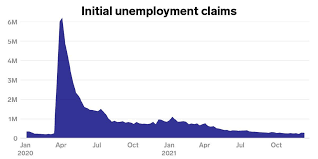
New weekly jobless claims held below pre-pandemic levels last week, further underscoring still-solid demand for labor heading into the new year.
The Labor Department released its latest weekly jobless claims report Thursday at 8:30 a.m. ET. Here were the main metrics from the print, compared to consensus estimates compiled by Bloomberg:
This week’s new jobless claims report coincides with the survey week for the December monthly jobs report from the Labor Department, offering an early indication of the relative strength expected in that print due for release in early January.
At 205,000, initial unemployment claims were expected to come in below even pre-pandemic levels yet again, with jobless claims having averaged around 220,000 per week throughout 2019. Earlier this month, first-time unemployment filings fell sharply to 188,000, or the lowest level since 1969. And based on the latest report, the four-week moving average for new claims was near its lowest in 52 years, ticking up by 2,750 week-over-week to reach 206,250.
Continuing claims have also come down sharply from pandemic-era highs, albeit while remaining slightly above the 2019 average of about 1.7 million. This metric, which counts the total number of individuals claiming benefits across regular state programs, came in below 2 million for a fourth straight week and reached the lowest level since March 2020.
“The claims data indicate strong demand for workers and a reluctance by businesses to lay off workers,” Rubeela Farooqi, chief economist for High Frequency Economics, wrote in a note. “However, disruptions around Omicron and Delta could be a headwind if businesses have to close for health-related reasons.”
“Overall, the direction in the labor market recovery remains positive, with demand still strong,” she added. “Labor shortages are persisting, preventing a stronger recovery, although these appeared to ease somewhat in November.”
And indeed, policymakers have also taken note of the improving labor market situation. In a press conference last week, Federal Reserve Chair Jerome Powell maintained, “Amid improving labor market conditions and very strong demand for workers, the economy has been making rapid progress toward maximum employment.” And at the close of the Federal Open Market Committee’s latest policy-setting meeting, officials decided to speed their rate of asset-purchase tapering, paring back some crisis-era support in the economy as the recovery progressed.
Many Americans have also cited solid labor market conditions, especially as job openings hold at historically high levels. In the Conference Board’s latest Consumer Confidence report for December, 55.1% of consumers surveyed said jobs were “plentiful.” While this rate was down slightly from November’s 55.5%, it still represented a “historically strong reading,” according to the Conference Board.




With coronavirus cases on the rise, at-home testing remains a useful but imperfect way to mitigate risk.
I caught up with Katherine J. Wu, a staff writer who’s been covering this pandemic, to talk about what rapid-test results can—and can’t—tell us. Below you’ll find six takeaways from our conversation.
The conversation that follows has been edited and condensed for clarity.
1. With at-home tests, you trade accuracy for convenience.
“Doctors treating patients very often reach for those really sensitive PCR laboratory tests because they want to know beyond a shadow of a doubt whether the virus is present so the person can get the right treatment. Those tests are so sensitive that people can really trust when they’re negative. With the rapid tests, a negative is a lot less of a certain answer.”
2. At-home tests are most useful when a person has symptoms.
“A lot of the rapid tests we now use at home were initially designed to be taken as diagnostics for people who are feeling sick and want answers quickly. They then got the FDA greenlight to be used as screeners. Generally, right after your symptoms first appear is when they have been shown to be most accurate.”
3. They’re less accurate when used as screeners by people who feel fine.
“Things get a little tricky when you don’t have symptoms and you don’t have a known exposure—for example, if you’re hoping for a negative so that you can clear yourself to, say, go visit a grandparent.
“Rapid tests are not as good as lab tests when it comes to picking up on the virus when it’s present at really low levels. To get around that, experts say to test repeatedly. That way, if you miss the virus on Monday, maybe you’ll catch it Tuesday.”
4. At-home tests might be your only option.
“Let’s certainly not discount the value of rapid tests. With so many cases here and abroad, laboratory-testing infrastructure is going to be crushed. It may not be practical for people to seek out PCR testing as their No. 1 choice right now. If people are able to access rapid tests, they should test themselves daily at this point because we know results can change so quickly.”
5. All tests are mere snapshots of a moment in time.
“Tests cannot predict the future. The minute that swab goes into your nose—that is what the result is going to be giving you information on. We know this virus can replicate super quickly, especially if we’re talking about something like Omicron or Delta. A person can test negative in the morning and have a blazing positive result by the evening.”
6. Omicron is making things even trickier.
“We are still figuring out how quickly this variant spreads both within individual people and between different people. But based on what we know so far, it seems to be moving super fast, and there seems to be some indication that people can go from not contagious to quite contagious very quickly. And if that’s the case, then that means that negative test results actually expire sooner.”

Pregnancy can be a scary time for many reasons, one of which is having so many things feel off-limits for the safety of the fetus. But what about vaccines? Especially the Covid-19 vaccine? To understand the answer to this question you need data about the vaccine in pregnancy, but you also need data about lacking protection from Covid-19 in pregnancy. Fortunately, we discuss both in this episode!

COVID-19 cases are surging across the U.S. ahead of Christmas, sparking the cancellation of sporting events and a growing list of hospitals postponing nonessential surgeries — both a reminder of last year’s holiday surge and a sign that the next several weeks will determine the pandemic’s trajectory for the rest of the winter months.
Nationwide, the daily average for new cases was more than 133,000 on Dec. 18, a 21 percent jump over the last two weeks, according to data compiled by The New York Times.
Health officials have warned the omicron variant — which appears to cause less severe illness, though is more transmissible — could exacerbate the ongoing delta-fueled surge and overwhelm the healthcare system.
“I think we’re really just about to experience a viral blizzard,” Michael Osterholm, PhD, director of the Center for Infectious Disease Research and Policy at the University of Minnesota, told CNN during a Dec. 17 interview. “I think in the next three to eight weeks, we’re going to see millions of Americans are going to be infected with this virus, and that will be overlaid on top of delta, and we’re not yet sure exactly how that’s going to work out.”
New York — where omicron accounts for at least 13 percent of new cases — for two consecutive days set a record for the daily number of new cases reported. Health officials reported more than 21,000 new cases on Dec.17 and 21,908 on Dec. 18. Three Midwestern states and Vermont also set COVID-19 records last week, including Ohio, which reported nearly 12,000 new cases Dec. 16.
While early data suggests omicron is tied to less severe illness than the original strain, health officials have warned against underestimating the virus. The outgoing National Institutes of Health director, Francis Collins, MD, PhD, offered a grim projection during a Dec. 19 interview with NPR.
“Even if it has somewhat lower risk of severity, we could be having a million cases a day if we’re not really attentive to all of those mitigation strategies,” Dr. Collins said.
Anthony Fauci, MD, director of the National Institute of Allergy and Infectious Diseases, said areas with low vaccination coverage will likely be especially hard hit across the coming weeks.
“We are going to see significant stress in some regions of the country on the hospital system, particularly in those areas where you have a low level of vaccination, which is one of the reasons why we continue to stress the importance of getting those unvaccinated people vaccinated,” he told CNN Dec. 19, adding that in some regions of the U.S., omicron accounts for 50 percent of new infections, “which means it’s going to take over.”
“This virus is extraordinary. It has a doubling time of anywhere from two to three days,” Dr. Fauci said.
The daily average for U.S. COVID-19 hospitalizations was more than 69,000 as of Dec. 19, marking a 16 percent rise across the last two weeks; and while omicron may be associated with lower disease severity, a significant surge would inevitably lead to more hospitalizations and deaths, health officials say. Connecticut, Washington, D.C., and Rhode Island have seen the highest percent increase in hospitalization rates over the last two weeks.
As the holidays and planned celebrations near, Dr. Fauci emphasized the importance of booster doses in combating the surge. He urged against holiday gatherings and travel among people who have not been fully vaccinated or received their boosters. Given a rise in breakthrough cases, he also suggested people take a rapid test before attending a gathering.
“If you do these things … I do believe that you can feel quite comfortable with a family setting, the dinners and the gatherings that you have around the holiday season,” Dr. Fauci told ABC News Dec. 19. “Nothing is 100 percent risk-free, but I think if you do the things that I just mentioned, you’d actually mitigate that risk enough to feel comfortable about being able to enjoy the holiday.”
Moderna said Dec. 20 that a booster dose of its vaccine increased antibody levels against omicron 37-fold. Laboratory findings from Pfizer also indicate its booster offers significant protection against the strain.
CDC data showed 61.4 percent of the nation’s population had been fully vaccinated as of Dec. 19. Nearly 30 percent of the fully vaccinated population had received their booster dose.