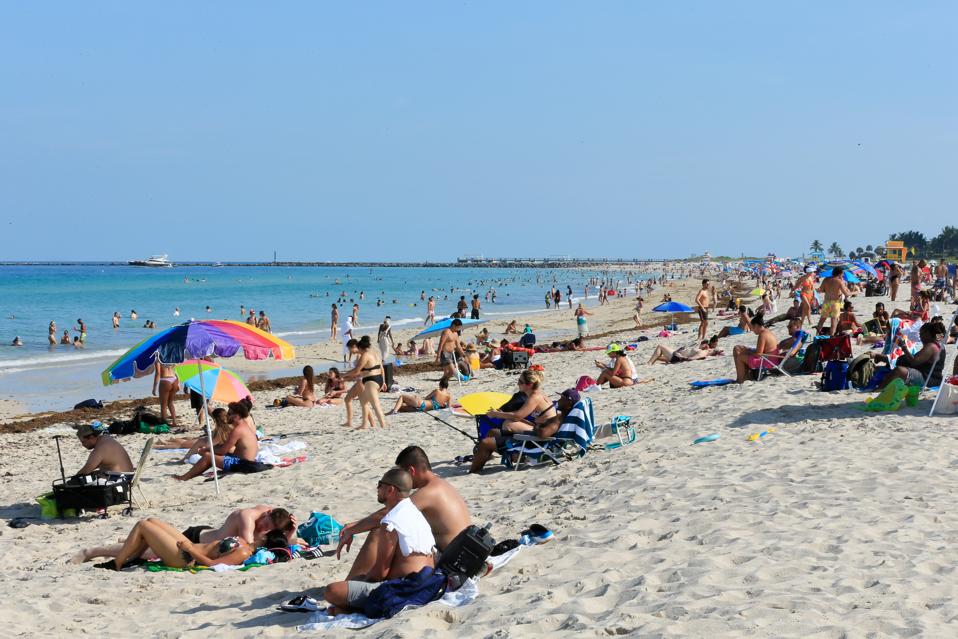
Here Are All The States Where Coronavirus Cases Are Spiking

https://www.forbes.com/sites/sarahhansen/2020/06/13/here-are-all-the-states-where-coronavirus-cases-are-spiking/?utm_source=newsletter&utm_medium=email&utm_campaign=dailydozen&cdlcid=5d2c97df953109375e4d8b68#31fb4d452dd5

Here Are All The States Where Coronavirus Cases Are Spiking

TOPLINE

Some states are seeing a dramatic surge in new coronavirus infections even as reopening measures continue across the country, raising tough questions about whether those reopening efforts were premature and how officials will balance maintaining public safety with preventing more economic damage.  


KEY FACTS

Texas and Florida—two of the first states to reopen—both hit new daily highs last week. 

California also hit a record daily high last week, though one official attributed the spike to increased testing (Florida’s governor has also attributed his state’s spike to more testing).

Arkansas, Alabama, North Carolina, South Carolina, Utah and Alaska have also seen surging case numbers over the last week.

On Friday, the CDC released new forecasts that singled out six states—Arizona, Arkansas, Hawaii, North Carolina, Utah and Vermont—where the coronavirus death toll is likely to rise over the next month. 

Some states and cities have walked back reopening measures in response to surging cases: Oregon’s governor put the reopening process on pause on Friday after the state saw its highest level of new cases since the start of the pandemic; Utah’s governor issued a similar order, as did the mayor of Nashville, Tennessee.

According to data compiled by Johns Hopkins, more than 2 million Americans have contracted Covid-19, the disease caused by the coronavirus, since the beginning of the pandemic, and more than 114,000 have died. 


KEY BACKGROUND

Even though news of states hitting record levels of coronavirus cases day after day might make it seem like the U.S. is headed for a second wave of the virus, the country is still situated very firmly within the “first wave.” New infections peaked around 36,000 cases a day in April, according to New York Times data, and over the last month the number of new daily cases has held relatively steady around 20,000. Cases in former hot spots like New York and New Jersey have fallen dramatically while cases in many areas of the South and West continue to rise. For a true “second wave” of the virus to be possible, the virus would need to subside and then reappear. 


CRUCIAL QUOTE

“We really never quite finished the first wave,” Dr. Ashish Jha, a professor of global health at Harvard University, told NPR. “And it doesn’t look like we are going to anytime soon.”


Fauci Says ‘Real Normality’ Unlikely For A Year As U.S. Continues Pandemic Slog

https://www.forbes.com/sites/lisettevoytko/2020/06/14/fauci-says-real-normality-unlikely-for-a-year-as-us-continues-pandemic-slog/?utm_source=newsletter&utm_medium=email&utm_campaign=dailydozen&cdlcid=5d2c97df953109375e4d8b68#2511f59a1855

Fauci Says 'Real Normality' Unlikely For A Year As U.S. Continues ...

TOPLINE

Dr. Anthony Fauci told a British newspaper Sunday that something resembling normal life in the U.S. would likely return in “a year or so,” with the coronavirus pandemic expected to require social distancing and other mitigation efforts through the fall and winter, although political divisiveness, reopening efforts and the George Floyd protests could add more layers of difficulty to the country’s recovery.

KEY FACTS

“I would hope to get to some degree of real normality within a year or so. But I don’t think it’s this winter or fall,” Fauci, director of the National Institute of Allergy and Infectious Diseases, told The Telegraph Sunday.

Fauci also told the newspaper that the travel ban from the U.K., the European Union, China and Brazil will likely stay in place for “months,” based on “what’s going on with the infection rate.”

Within the U.S., Florida, California and Texas hit all-time daily highs in reported Covid-19 cases, while the Centers for Disease Control predicted six states (Arizona, Arkansas, Hawaii, North Carolina, Utah and Vermont) will see higher death tolls over the next month.

U.S., where states that aren’t making them mandatory, like California, are seeing cases spike while New York, where the protective gear is required, has the country’s lowest spread rate.

“We’re seeing several states, as they try to reopen and get back to normal, starting to see early indications [that] infections are higher than previously,” Fauci said.

BIG NUMBER

Over 2 million. That’s how many confirmed coronavirus cases are in the U.S., which leads the world both in the number of infections and casualties from the disease, according to data from Johns Hopkins University.

WHAT TO WATCH FOR

Despite Fauci’s immediate conservative outlook on when life can return to normal, he’s hopeful that multiple Covid-19 vaccines could be found by the end of 2020. “We have potential vaccines making significant progress. We have maybe four or five,” he told The Telegraph. Although “you can never guarantee success with a vaccine,” Fauci added, from “everything we have seen from early results, it’s conceivable we get two or three vaccines that are successful.”

SURPRISING FACT

The U.S. is not facing a second wave of coronavirus. “We really never quite finished the first wave,” according to Dr. Ashish Jha, a global health professor at Harvard. In an NPR interview, Jha said the first wave is unlikely to be finished “anytime soon.”

KEY BACKGROUND

The World Health Organization designated the coronavirus outbreak as a pandemic on March 11, 2020. As of Sunday, the pandemic is approaching its fifth month, and few countries have had success in beating back their outbreaks. New Zealand has essentially returned to normal life after eliminating coronavirus, while countries like the U.S., the U.K. and Brazil, among others, continue to see new cases and report deaths.

Within the U.S., efforts to reduce cases and deaths, like mask wearing, have become partisan political issues. Desires both from elected officials and some citizens to reopen economies have also impacted the pandemic, as states that reopened earlier, like Florida, are seeing numbers of cases spike. Concerns that recent protests sparked by George Floyd’s killing will also further spread the coronavirus are present, but have not yet been proven, as symptoms can take up to 14 days to develop.


Beijing goes into ‘wartime mode’ as virus emerges at market

https://www.washingtonpost.com/world/beijing-goes-into-wartime-mode-as-virus-emerges-at-market-in-chinese-capital/2020/06/13/65c5aac8-ad40-11ea-868b-93d63cd833b2_story.html?stream=top&utm_campaign=newsletter_axiosvitals&utm_medium=email&utm_source=newsletter

Beijing district in 'wartime emergency mode' after spike in local ...

A district in central Beijing has gone into “wartime mode” after discovering a cluster of coronavirus cases around the biggest meat and vegetable market in the city, raising the prospect of a second wave of infections in the sensitive capital, the seat of the Chinese Communist Party.

The discovery of dozens of infections, both symptomatic and asymptomatic, underscores the perniciousness of the virus and its propensity to spread despite tight social controls.

“We would like to warn everyone not to drop their guard even for a second in epidemic prevention control; we must be prepared for a prolonged fight with the virus,” Xu Hejian, a spokesman for the Beijing municipal government, said at a news conference Saturday.

“We have to stay alert to the risks of imported cases and to the fact that epidemic control in our city is complicated and serious and will be here for a long time,” he said.

Coronavirus surges across the U.S.

https://www.axios.com/newsletters/axios-vitals-64a706e3-e179-4531-82b1-f82e9bb422c3.html?utm_source=newsletter&utm_medium=email&utm_campaign=newsletter_axiosvitals&stream=top

As more Texas businesses open, health experts watch and wait

Coronavirus cases and hospitalizations are reaching alarming levels in some states.

What they’re saying: “Arizona is the new national hotspot for COVID-19 with more than 4,400 new cases in just the last 72 hours. Per capita, Arizona’s infection rate is now more than three times higher than New York state. It’s spreading like wildfire,” Rep. Greg Stanton tweeted last night.

The big picture: Several states have seen record numbers of new cases over the last few days, including Alabama, Alaska, Arizona, Arkansas, California, Florida, North Carolina, Oklahoma and South CarolinaReuters reports.

  • On Saturday, Texas reported 2,242 coronavirus hospitalizations — a record for the state, per the Houston Chronicle. Health officials are becoming concerned about hospital capacity.
  • Arkansas, North Carolina and Utah also had record numbers of patients enter the hospital on Saturday, per Reuters.
  • South Carolina recorded nearly 800 new coronavirus cases on Sunday, setting another single-day record and raising the state’s seven-day average for the 17th day straight,” the Post and Courier reports.

The bottom line: There’s never been any reason to think that states with mild outbreaks in April weren’t at risk of having a crisis in June, especially states that haven’t taken lockdowns or social distancing as seriously.

  • “This is not the second wave of the pandemic in states like Arizona, Texas, Utah, California, and Florida. Unlike in New York, the first wave never ended in these places,” the Kaiser Family Foundation’s Larry Levitt tweeted.


Infectious disease expert says coronavirus won’t slow down until ‘about 60% or 70%’ of American population is infected, points out US is at ‘about 5%’

https://www.insider.com/expert-us-is-in-an-unsure-moment-with-coronavirus-2020-6

Infectious disease expert says coronavirus won't slow down until ...

  • The director of the Center for Infectious Disease Research and Prevention said the US is in an “unsure moment” regarding the effects of states reopening and protests during the novel coronavirus pandemic.
  • Dr. Michael Osterholm told “Fox News Sunday” that it’s too early to tell if protests have been a source of widespread infections, but early data suggests the demonstrations aren’t responsible for rises in 22 states.
  • The Centers for Disease Control and Prevention predicted on June 12 that the US coronavirus death toll could increase to 130,000 by July 4.

Dr. Michael Osterholm, the director of the Center for Infectious Disease Research and Prevention, said Sunday that the US is in an “unsure moment” as states reopen and new cases emerge.

“We have to be humble and say we’re in an unsure moment,” Osterholm said on “Fox News Sunday,” adding that states across the country are in varied stages of the pandemic as 22 have recorded an increase in coronavirus cases, eight in plateaus, and 21 with decreasing cases.

Osterholm was speaking as states have been reopening businesses for weeks, Americans flocked to warm weather, and widespread protests drew people to the streets in cities across the country. The first few weeks of June have seen sharp rises in new cases and hospitalizations.

The US hit a grim milestone two weeks into June as it marked more than 2 million infected and 115,000 dead from the virus. Centers for Disease Control and Prevention predicted on June 12 that the US coronavirus death toll could increase to 130,000 by July 4.

“About 5% of the US population has been infected to date with the virus, this virus is not going to rest until it gets to about 60% or 70%,” Osterholm said. “When I say rest, I mean just slow down, so one way or another we’re going to see a lot of additional cases.”

The expert told host Chris Wallace that the increase cannot only be attributed to increasingly available testing, and it’s too early to tell if protests have been a source of widespread infections, but early data suggests not.

“These next weeks, the two weeks are going to be the telling time, we just don’t know,” he said. “We’re not driving this tiger, we’re riding it.”

“My biggest concern is if cases start to disappear across the country, suggesting we are in a trough” that would lead to a second wave of the virus, Osterholm said.

Dr. Anthony Fauci has recently downplayed concerns that the recent rise in cases of the novel coronavirus in the US doesn’t a “second spike” of infections, and a seasonal resurgence was “not inevitable.”

Though Fauci told CNN on June 12 that indicators like hospitalizations could still spell concern for officials, increased testing and CDC capabilities could counter a possible resurgence in cases.


Public Health Officials Face Wave Of Threats, Pressure Amid Coronavirus Response

Public Health Officials Face Wave Of Threats, Pressure Amid Coronavirus Response
Public health officials face wave of threats, pressure amid ...

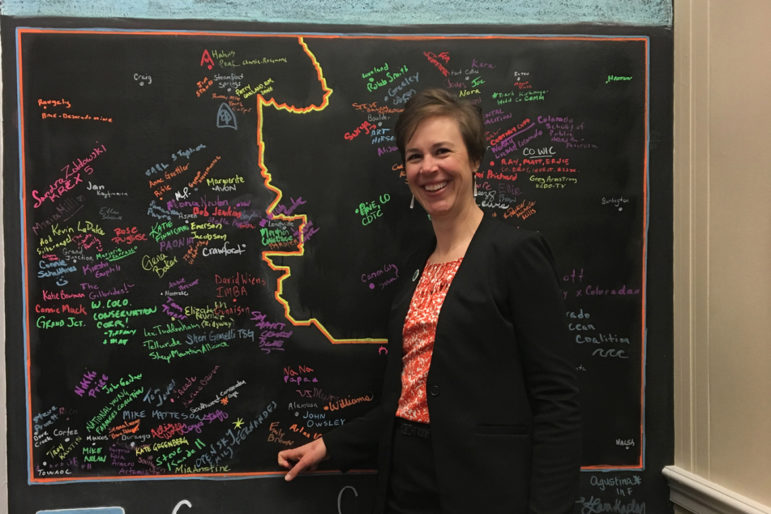
Emily Brown was director of the Rio Grande County Public Health Department in Colorado until May 22, when the county commissioners fired her after battling with her over coronavirus restrictions. “They finally were tired of me not going along the line they wanted me to go along,” she says.

Emily Brown was stretched thin.

As the director of the Rio Grande County Public Health Department in rural Colorado, she was working 12- and 14-hour days, struggling to respond to the pandemic with only five full-time employees for more than 11,000 residents. Case counts were rising.

She was already at odds with county commissioners, who were pushing to loosen public health restrictions in late May, against her advice. She had previously clashed with them over data releases and had haggled over a variance regarding reopening businesses.

But she reasoned that standing up for public health principles was worth it, even if she risked losing the job that allowed her to live close to her hometown and help her parents with their farm.

Then came the Facebook post: a photo of her and other health officials with comments about their weight and references to “armed citizens” and “bodies swinging from trees.”

The commissioners had asked her to meet with them the next day. She intended to ask them for more support. Instead, she was fired.

“They finally were tired of me not going along the line they wanted me to go along,” she said.

In the battle against COVID-19, public health workers spread across states, cities and small towns make up an invisible army on the front lines. But that army, which has suffered neglect for decades, is under assault when it’s needed most.

Officials who usually work behind the scenes managing everything from immunizations to water quality inspections have found themselves center stage. Elected officials and members of the public who are frustrated with the lockdowns and safety restrictions have at times turned public health workers into politicized punching bags, battering them with countless angry calls and even physical threats.

On Thursday, Ohio’s state health director, who had armed protesters come to her house, resigned. The health officer for Orange County, California, quit Monday after weeks of criticism and personal threats from residents and other public officials over an order requiring face coverings in public.

As the pressure and scrutiny rise, many more health officials have chosen to leave or been pushed out of their jobs. A review by KHN and The Associated Press finds at least 27 state and local health leaders have resigned, retired or been fired since April across 13 states.

In California, senior health officials from seven counties, including the Orange County officer, have resigned or retired since March 15. Dr. Charity Dean, the second in command at the state Department of Public Health, submitted her resignation June 4.

These officials have left their posts due to a mix of backlash and stressful, nonstop working conditions, all while dealing with chronic staffing and funding shortages.

Some health officials have not been up to the job during the biggest health crisis in a century. Others previously had plans to leave or cited their own health issues.

But Lori Tremmel Freeman, CEO of the National Association of County and City Health Officials, said the majority of what she calls an “alarming” exodus resulted from increasing pressure as states reopen. Three of those 27 were members of her board and well known in the public health community — Rio Grande County’s Brown; Detroit’s senior public health adviser, Dr. Kanzoni Asabigi; and the head of North Carolina’s Gaston County Department of Health and Human Services, Chris Dobbins.

Asabigi’s sudden retirement, considering his stature in the public health community, shocked Freeman. She also was upset to hear about the departure of Dobbins, who was chosen as health director of the year for North Carolina in 2017. Asabigi and Dobbins did not reply to requests for comment.

“They just don’t leave like that,” Freeman said.

Public health officials are “really getting tired of the ongoing pressures and the blame game,” Freeman said. She warned that more departures could be expected in the coming days and weeks as political pressure trickles down from the federal to the state to the local level.

From the beginning of the coronavirus pandemic, federal public health officials have complained of being sidelined or politicized. The Centers for Disease Control and Prevention has been marginalized; a government whistleblower said he faced retaliation because he opposed a White House directive to allow widespread access to the malaria drug hydroxychloroquine as a COVID-19 treatment.

In Hawaii, U.S. Rep. Tulsi Gabbard called on the governor to fire his top public health officials, saying she believed they were too slow on testing, contact tracing and travel restrictions. In Wisconsin, several Republican lawmakers have repeatedly demanded that the state’s health services secretary resign, and the state’s conservative Supreme Court ruled 4-3 that she had exceeded her authority by extending a stay-at-home order.

With the increased public scrutiny, security details — like those seen on a federal level for Dr. Anthony Fauci, the top infectious disease expert — have been assigned to state health leaders, including Georgia’s Dr. Kathleen Toomey after she was threatened. Ohio’s Dr. Amy Acton, who also had a security detail assigned after armed protesters showed up at her home, resigned Thursday.

In Orange County, in late May, nearly a hundred people attended a county supervisors meeting, waiting hours to speak against an order requiring face coverings. One person suggested that the order might make it necessary to invoke Second Amendment rights to bear arms, while another read aloud the home address of the order’s author — the county’s chief health officer, Dr. Nichole Quick — as well as the name of her boyfriend.

Quick, attending by phone, left the meeting. In a statement, the sheriff’s office later said Quick had expressed concern for her safety following “several threatening statements both in public comment and online.” She was given personal protection by the sheriff.

But Monday, after yet another public meeting that included criticism from members of the board of supervisors, Quick resigned. She could not be reached for comment. Earlier, the county’s deputy director of public health services, David Souleles, retired abruptly.

An official in another California county also has been given a security detail, said Kat DeBurgh, the executive director of the Health Officers Association of California, declining to name the county or official because the threats have not been made public.

DeBurgh is worried about the impact these events will have on recruiting people into public health leadership.

“It’s disheartening to see people who disagree with the order go from attacking the order to attacking the officer to questioning their motivation, expertise and patriotism,” said DeBurgh. “That’s not something that should ever happen.”

Many local health leaders, accustomed to relative anonymity as they work to protect the public’s health, have been shocked by the growing threats, said Theresa Anselmo, the executive director of the Colorado Association of Local Public Health Officials.

After polling local health directors across the state at a meeting last month, Anselmo found about 80% said they or their personal property had been threatened since the pandemic began. About 80% also said they’d encountered threats to pull funding from their department or other forms of political pressure.

To Anselmo, the ugly politics and threats are a result of the politicization of the pandemic from the start. So far in Colorado, six top local health officials have retired, resigned or been fired. A handful of state and local health department staff members have left as well, she said.

“It’s just appalling that in this country that spends as much as we do on health care that we’re facing these really difficult ethical dilemmas: Do I stay in my job and risk threats, or do I leave because it’s not worth it?” Anselmo asked.

Some of the online abuse has been going on for years, said Bill Snook, a spokesperson for the health department in Kansas City, Missouri. He has seen instances in which people took a health inspector’s name and made a meme out of it, or said a health worker should be strung up or killed. He said opponents of vaccinations, known as anti-vaxxers, have called staffers “baby killers.”

The pandemic, though, has brought such behavior to another level.

In Ohio, the Delaware General Health District has had two lockdowns since the pandemic began — one after an angry individual came to the health department. Fortunately, the doors were locked, said Dustin Kent, program manager for the department’s residential services unit.

Angry calls over contact tracing continue to pour in, Kent said.

In Colorado, the Tri-County Health Department, which serves Adams, Arapahoe and Douglas counties near Denver, has also been getting hundreds of calls and emails from frustrated citizens, deputy director Jennifer Ludwig said.

Some have been angry their businesses could not open and blamed the health department for depriving them of their livelihood. Others were furious with neighbors who were not wearing masks outside. It’s a constant wave of “confusion and angst and anxiety and anger,” she said.

Then in April and May, rocks were thrown at one of their office’s windows — three separate times. The office was tagged with obscene graffiti. The department also received an email calling members of the department “tyrants,” adding “you’re about to start a hot-shooting … civil war.”  Health department workers decamped to another office.

Although the police determined there was no imminent threat, Ludwig stressed how proud she was of her staff, who weathered the pressure while working round-the-clock.

“It does wear on you, but at the same time we know what we need to do to keep moving to keep our community safe,” she said. “Despite the complaints, the grievances, the threats, the vandalism — the staff have really excelled and stood up.”

The threats didn’t end there, however: Someone asked on the health department’s Facebook page how many people would like to know the home addresses of the Tri-County Health Department leadership. “You want to make this a war??? No problem,” the poster wrote.

Back in Colorado’s Rio Grande County, some members of the community have rallied in support of Brown with public comments and a letter to the editor of a local paper. Meanwhile, COVID-19 case counts have jumped from 14 to 49 as of Wednesday.

Brown is grappling with what she should do next: dive back into another strenuous public health job in a pandemic, or take a moment to recoup?

When she told her 6-year-old son she no longer had a job, he responded: “Good — now you can spend more time with us.”


Kaiser Permanente: 8 key capabilities for a sustained response to COVID-19

https://www.fiercehealthcare.com/hospitals/kaiser-permanente-8-key-capabilities-for-a-sustained-response-to-covid-19?mkt_tok=eyJpIjoiT1dRNE5UVmhOR014WVRBNSIsInQiOiJMbGJHalA3UVBpNnpFb1dmMlozajNmSmJ1ZFZMYjgxUWJqdER6dmdteENYZnVYVlg0ZFdpRDIwVTh6ZW56MjNVTTVHbm9mWHFtTVlPcllUN1JjbHpiUGw5MFJxVnpHN3JaRFhMdGZSdUdlSHdQRjBqbnY1Ym9pUTErbDdEdThOZSJ9&mrkid=959610

Kaiser Permanente: 8 key capabilities for a sustained response to ...

As the industry braces for the next phase of COVID-19, experts at Kaiser Permanente are sharing several key capabilities that will be critical to prepare for another potential surge.

In an article for NEJM Catalyst, leaders at the healthcare giant highlight eight focus areas health systems must consider as the country reopens and offer a look at how Kaiser Permanente tackled those challenges.

A critical starting point, they write, is a robust testing program that feeds into essential contact tracing and monitoring of any spikes in cases. As of May 18, Kaiser Permanente has performed more than 233,706 diagnostic tests and is also tracking the spread telephonically through its call centers as well as secure emails between patients and doctors.

The Oakland, California-based system is also mulling greater use of patient symptom surveying and harnessing data within electronic health records to further enhance the testing effort, according to the article.

Stephen Parodi, M.D., executive vice president at The Permanente Federation and Kaiser Permanente’s national infectious disease leader, told Fierce Healthcare that the goal of the paper is to spotlight how crucial it is to consider all fronts in preventing the spread of COVID-19.

“I think one of the biggest takeaways here is that we need a complete and comprehensive approach to suppress the virus,” Parodi, one of the report’s lead authors, said.

Bechara Choucair, M.D., senior vice president and chief health officer at Kaiser Permanente, is also one of the paper’s lead authors.

The other capabilities included in the report are:

  • Enhanced contact tracing and isolation efforts
  • Robust community health efforts
  • Home health care options
  • Ability to maintain surge capacity
  • Targeted and safe strategies to reopen
  • Ongoing research on the virus
  • Effective communication with patients

Parodi said two of the biggest challenges Kaiser Permanente faced in working through this checklist of capabilities were a lack of supplies and the need to work alongside other organizations.

He said that didn’t only mean strengthening and reinforcing existing relationships with community groups but also reaching out to other health systems and providers to coordinate plans and work together.

It also required coordination between officials and policymakers at all levels of government, he said.

“Having the leaders at individual medical centers working with the county level folks is really key to making sure that we’re aware of each other’s work and response, then actually syncing them together,” Parodi said.

Parodi also said that Kaiser Permanente went “wholesale” into using telehealth during the initial surge of COVID-19 cases, and now the system and its physicians will be working together to determine where virtual care is most appropriate and effective, as the interest in and growth of those services isn’t going away anytime soon.

He added that moving into the reopening phase poses its own set of challenges, because it’s an “unprecedented” situation to navigate.

Kaiser Permanente is aiming to center shared decision-making and patient education in the response to reopening, he said, while also providing guidance to support providers. That way, decisions are ultimately made by the doctor and patient, but they’re informed and guided decisions, he said.

“There is no set playbook for how to do it right,” Parodi said.


States are wrestling on their own with how to expand testing, with little guidance from the Trump administration

https://www.washingtonpost.com/politics/states-are-wrestling-on-their-own-with-how-to-expand-testing-with-little-guidance-from-the-trump-administration/2020/06/09/d02672f4-9bab-11ea-ad09-8da7ec214672_story.html?utm_campaign=Newsletter%20Weekly%20Roundup%3A%20Healthcare%20Dive%3A%20Daily%20Dive%2006-13-2020&utm_medium=email&utm_source=Sailthru

States are wrestling on their own with how to expand testing, with ...

In Maryland, drive-through coronavirus testing sites are now open to all residents, whether or not they show signs of illness.

In Oregon, by contrast, officials have said that generally only people with symptoms of covid-19, the illness associated with the coronavirus, should be tested — even in the case of front-line health-care workers.

In Rhode Island, officials have proactively tested all of the state’s 7,500 nursing home residents, including those with no symptoms, and are developing plans to test more people in high-risk workplaces, such as restaurants and grocery stores.

The wide range of approaches across the country comes as the federal government has offered little guidance on the best way to test a broad swath of the population, leaving state public health officials to wrestle on their own with difficult questions about how to measure the spread of the virus and make decisions about reopening their economies.

Faced with conflicting advice from experts in the field, states are using different tests that vary in reliability and have adopted a variety of policies about who else should get tested and when — particularly when it comes to asymptomatic people who are considered low-risk for the illness.

“The states are on their own,” said Kelly Wroblewski, director of infectious diseases at the Association of Public Health Laboratories, noting that the kind of guidance the federal government routinely gives in screening for flu and other outbreaks “has been absent” in the covid-19 pandemic. “There has been no coordination.”

That means that while tests are available to anyone who wants them in states such as Kentucky and Georgia and some large cities such as Detroit and Los Angeles, state officials in Idaho and Louisiana continue to recommend that only sick people get tested.

The lack of a unified national strategy has left Americans uncertain about whether and how to be tested and is hampering reopening plans, experts warn.

Many officials now worry that protests in more than 100 U.S. cities in recent days after the death of George Floyd in police custody, which have drawn thousands of people packed closely together, could spark new infections.

So far, about 460,000 Americans are being tested a day — 0.15 percent of the population, and still shy of the 900,000 to 30 million that experts say need to be tested daily to capture the extent of the virus’s spread.

“The case numbers we’re seeing are probably massively undercounted,” said Divya Siddarth, a researcher who helped devise a testing strategy for Harvard University’s Safra Center that emphasizes finding and suppressing the disease in areas with fewer cases. “These [lower prevalence] regions are likely to reopen, and they’ve barely done any tests.”

The lack of clear information is forcing businesses large and small, schools, universities and professional sports organizations to make their own decisions about how much testing they need to be safe.

Some institutions have announced their own plans for universal testing. The National Hockey League, for example, has said it plans to test all players daily as part of a plan to resume play in June. The University of Arizona has developed its own antibody test that’s available to all students and local health-care workers.

Under a law passed earlier this year, the Trump administration is required to develop a national testing strategy. But an 81-page document submitted to Congress by the Department of Health and Human Services late last month was not released publicly and offered few detailed recommendations.

The Washington Post obtained a copy of the plan, which set a goal for states of testing at least 2 percent of their residents in May and June. But how to meet that benchmark and whether to go further was left up to state leaders who were required to submit plans this month to HHS for review.

The Centers for Disease Control and Prevention has recommended universal testing for residents of nursing homes, which have been especially hit hard by the coronavirus. But the HHS document said the CDC was still working on guidelines for other large populations of mostly asymptomatic people — including at universities, prisons and “critical infrastructure worksites” — as well as those for integrating testing into reopening work places.

Mia Palmieri Heck, a spokeswoman for HHS, said the federal government “has provided prescriptive criteria about testing asymptomatic individuals when they affect highly vulnerable populations such as individuals who live in nursing homes, working in or visiting health-care clinics or communal dining spaces.” She added that federal experts have also been advising states on developing plans to more broadly test people without symptoms to determine community spread.

The question of asymptomatic testing is particularly tricky given that the CDC late last month said that its researchers now believe as many as 35 percent of people infected with the coronavirus never show symptoms of disease.

Typifying the kind of conflicting information facing states, a World Health Organization official sparked global confusion on Monday when she said it is “very rare” for people with no symptoms to transmit the disease. After significant pushback from researchers, the official said Tuesday that scientists continue to believe that people without symptoms do in fact spread the virus — but more research is needed to understand by how much.

She noted that some modeling shows as much as 41 percent of transmission may be due to asymptomatic people.

“In some ways, this may be the Achilles’ heel of the entire testing challenge for this virus,” said Ashish Jha, director of the Harvard Global Health Institute, who has advocated for increasing the number of people getting tested.

Local and state health officials worry that the lack of coherent strategy could result in tests becoming widely available for the affluent, while remaining limited for those with fewer resources, including minority communities that have already been disproportionately affected by the virus.

At the University of Arizona, officials plan to reserve molecular swab tests, which determine if a person is currently infected, for symptomatic students and their contacts. Each test is about $50 to $75 dollars; there are 60,000 students, staff and faculty and each would have to be tested repeatedly.

“Maybe the NFL can afford that; we can’t, and I don’t know any university that can,” said Robert C. Robbins, the university’s president.

‘Box the virus in’

When coronavirus cases began to mount in March, a severe shortage of test kits and supplies meant tests were sharply rationed. Even after it was clear that the virus was spreading in the United States, the CDC at first recommend only testing people who had visited China or been in contact with someone who had.

Later, federal officials suggested that younger, healthy people did not necessarily need testing even if they were experiencing coronavirus symptoms, reasoning that the tests should be reserved for hospitalized patients for whom a positive result might make a difference in treatment plan.

As tests have become more available, officials have begun to recommend that anyone who is experiencing signs of illness, even a mild cough or sore throat, get one.

The goal is to identify and quarantine people with the disease, and then use contact tracers to track down people who have interacted with that person and quarantine them as well.

“Testing is just part of a comprehensive strategy,” former CDC director Tom Frieden said. “As you emerge from that sheltering situation, you box the virus in.”

But when it comes to testing people without symptoms, state recommendations vary.

About at least half of states aim to test people identified as contacts of known positive cases, according to a Post tally, as was recommended in new guidance from the CDC this week. But many others tell those people to self-isolate for 14 days.

“Every state is figuring this out on its own, little bit by little bit,” said Philip Chan, medical director for the Rhode Island Department of Health.

Nearly all states have set aside thousands of tests for people in congregate settings — residential settings where large numbers of people live in proximity, especially nursing homes and prisons.

But only a handful of states have so far satisfied the CDC goal to test everyone living in a nursing home, where the age and underlying medical conditions of residents make them especially vulnerable to covid-19 outbreaks.

Some states have also prioritized testing front-line health-care workers and other people working elbow-to-elbow in manufacturing facilities, particularly meatpacking plants, which have been hit hard by the virus.

Even states that have conducted widespread testing in such facilities face difficult questions about whether a single round of testing is sufficient, given that people could easily contract the virus at any time, including after testing negative.

“There’s not a lot of communication between the states and there’s not a lot of specifics, so everybody’s kind of going on their own,” Wroblewski said.

A tricky disease

A number of states and large cities, such as Detroit and Los Angeles, have opened drive-through testing sites like those offered in Maryland, a mode of mass testing used effectively overseas in South Korea and elsewhere.

Experts have warned that drive-through sites often fail to collect enough information from those tested to follow up effectively. They also prioritize people who choose to show up, tending to mean tests go to better educated and informed residents and not necessarily those most likely to have been exposed to the virus.

In Macon, Ga., the Moonhanger Group set up drive-through testing for employees returning to work at their four restaurants. But they did not wait for the results, or for all employees to get tested, before reopening on May 26.

“We were confident, based on the low number of positive results reported in Bibb county, that none of our employees would test positive and we hoped to share that news with the public,” owner Wes Griffith wrote on Facebook. “Unfortunately and surprisingly, we have employees who have tested positive. All of them were a-symptomatic.” Griffith did not respond to a request for comment.

Three of the four restaurants had to quickly close again, pending further testing.

In Georgia, public officials are advertising on radio and social media to encourage anyone to get tested at drive-through sites.

Those tested have included political leaders, who got tested largely to encourage others to do so too, only to find themselves “shocked” when their results came back positive, said Phillip Coule, chief medical officer of the Augusta University Health System, which is partnering with the state on testing.

“It’s a great demonstration of how tricky this disease is,” he said.

Other states have downplayed asymptomatic testing as unreliable or a poor use of resources.

Coule noted that the message, “If you want a test, you can get a test,” puts the onus for deciding who should get tested on individuals, rather than prioritizing the highest-risk or the most vulnerable. One of his patients, he noted, sought a test because he wanted to honeymoon in St. Lucia and needed a negative result to enter the country.

Oregon only opened testing to front-line workers and long-term care residents without symptoms in April and continues not to recommend asymptomatic testing, saying on the state website that it is “not useful” because the false negative rate is high. Viral tests have been estimated to have up to a 20 percent false negative rate.

At a recent news conference, Oregon Health Authority Chief Medical Officer Dana Hargunani said people without symptoms are “unlikely or certainly less likely to cause transmission of the virus.”

‘It’s like a war’

For states looking to figure out who to test and when, advice from national experts has been abundant — but not always consistent.

Proposals from academics and other experts vary widely in their recommendations of the numbers of tests that should be performed each day, and many do not offer guidance about who should be tested.

Some researchers have recommended focusing on parts of the country that have few cases in hopes of stamping out the disease.

“We should quickly get resources to places where the disease can be suppressed, then backfill tests in the places currently overwhelmed,” said Glen Weyl, an economist at Microsoft, who worked on the Harvard University proposal. “It’s like a war — you have to more troops than the enemy in order to win a battle.”

Other researchers have proposed blanketing the country with tests, with a focus on places experiencing clear outbreaks.

Paul Romer, an economist at New York University, said there should be mass testing in hot spots that is quickly expanded to near-universal, constant testing for everyone — 23 million tests a day, noting that the cost of tests have dropped.

“It would be feasible if we just invested and made it happen,” he said.

Other countries have used aggressive and organized testing to help stop the spread of the virus. South Korea — where the first case of the coronavirus was diagnosed on the same day as in the United States — quickly started mass testing at drive-through sites to spot and isolate cases.

The government has also instituted a sophisticated and aggressive effort to trace contacts of any known case, to squelch outbreaks. After several people who visited nightclubs in Seoul tested positive in early May, the government within two weeks tracked down 46,000 people who might have been exposed and tested them all.

In Wuhan, China, the site of the world’s first major coronavirus outbreak, government officials said they tested nearly 10 million of the city’s 11 million residents since mid-May, part of an effort to test universally and ensure the city doesn’t experience a new wave of infections.

Still, many experts agree that completely random asymptomatic testing is not an effective strategy.

A report issued late last month by the Center for Infectious Disease Research and Policy at the University of Minnesota called for ramping up testing nationwide, including in some congregate settings and as part of public health research. But the report found that widespread testing of people without symptoms was not advisable in most workplaces, in schools or in the broader community.

Researchers at the center found such testing could waste precious resources and could cause problems for communities, given that the tests are not fully reliable.

“There’s been far too much of this group think around, ‘test, test, test,’ without understanding what it’s accomplishing,” said Michael Osterholm, the director of the center. “You need the right test, at the right time, for the right reasons.”

The report’s central recommendation: that HHS form a blue-ribbon commission with national experts to formulate advice for states.


Masks now seen as vital tool in coronavirus fight

Masks now seen as vital tool in coronavirus fight

Masks now seen as vital tool in coronavirus fight | TheHill

Evidence is mounting that widespread mask-wearing can significantly slow the spread of coronavirus and help reduce the need for future lockdowns. 

Public health authorities did not initially put an emphasis on masks, but that’s changed and there is now increasing consensus that they play an important role in hindering transmission of the virus at a time when wearing one has become politicized as some states and businesses have made them a requirement for certain activities.

Wearing a mask is also seen by experts as a relatively easy action that could help avoid much costlier responses like stay at home orders and closing businesses.

“It’s a lot less economically disruptive to wear a mask than to shut society, so I can’t understand some of the resistance to mask wearing,” Tom Frieden, the former director of the Centers for Disease Control and Prevention (CDC), said on a call with reporters on Thursday.

Experts say mask-wearing is not the only response needed to slow the spread of the virus. Avoiding crowds and staying six feet apart from others is also important, as is an effective system of testing and contact tracing so people can quarantine and prevent further spread. 

study from University of Cambridge researchers this week found that widespread mask-wearing can help prevent a resurgence of the virus with less reliance on lockdowns that have proven economically devastating.

The modeling in the study found that if 50 percent or more of the population routinely wore masks, each infected person would on average spread the virus to less than one additional person, causing the outbreak to decline, the university said.

“We have little to lose from the widespread adoption of facemasks, but the gains could be significant,” Renata Retkute, one of the authors of the study, said in a statement. 

Scott Gottlieb, the former FDA Commissioner for President Trumppointed to the study on Twitter this week and wrote: “More widespread masking with higher quality masks could help mitigate a second wave.”

It cannot be ruled out that further lockdowns will be needed, but wearing a mask is one part of a strategy to help avoid them, according to Joshua Sharfstein, vice dean at the Johns Hopkins Bloomberg School of Public Health.

“I think it could substantially help open workplaces, but I’d still want to maximize distancing,” he said.

The emphasis on masks has been slow to develop in some places. The World Health Organization did not issue a recommendation for the general public to wear masks until last week, previously only saying people who are sick and those caring for them should use masks.

In the early days of the outbreak in the United States, there was also concern about the general public using up masks that were in short supply for health workers. 

“Seriously people- STOP BUYING MASKS!” Surgeon General Jerome Adams tweeted at the end of February. “They are NOT effective in preventing general public from catching #Coronavirus, but if healthcare providers can’t get them to care for sick patients, it puts them and our communities at risk!”

That has changed, though, and the general public is now recommended to wear a simple cloth covering that could even be homemade, while leaving more advanced N95 masks for health care workers. The CDC now recommends wearing a mask in public when it is hard to stay six feet away from others, such as in grocery stores and pharmacies. Experts add that wearing a mask is mostly to protect others, not oneself.

“I don’t think it was so obvious from the beginning,” Sharfstein said, pushing back on critics who say authorities were slow to issue mask recommendations. “But it’s become more obvious,” he added.

Public health experts are lamenting, though, that mask-wearing has become politicized as opponents call requirements they wear one an infringement on their personal freedoms. 

President Trump did not publicly wear a mask during a May visit to a Ford factory despite the company policy requiring one. He also called it “unusual” that presumptive Democratic presidential nominee Joe Biden wore a mask during a Memorial Day ceremony, though he said he “wasn’t criticizing.”

In Arizona, which has seen a surge in coronavirus cases recently, Gov. Doug Ducey (R) was pressed at a news conference on Thursday by a reporter who asked, “When was the last time you wore a face mask, governor?”

“I’ve got my face masks with me today,” Ducey said, taking some out of his pocket. “And when I’m not physically distancing, I wear them and wash them often.”

Some states, like Massachusetts and New York, have mandated masks when people are in public and cannot stay six feet apart. Asked if he would mandate masks in Arizona, Ducey did not answer directly, but said, “I want people to wear masks when they can’t socially distance.”

Carlos del Rio, a professor of epidemiology at Emory University, compared the situation with mask-wearing to the early days of seatbelts.

“Imagine if today was the ‘60s and we were starting to use seatbelts and you would have some politicians say, ‘Oh, seatbelts don’t make a difference; I like my freedom; I don’t like to be tied down when I’m driving,’” he said. 

But, he added: “Over and over the evidence is showing masks work; masks make a difference.”

“I didn’t jump on masks immediately,” he said. “But after a while, I said, ‘Yeah this is what we all need to be doing,’ but I think it took some time.”


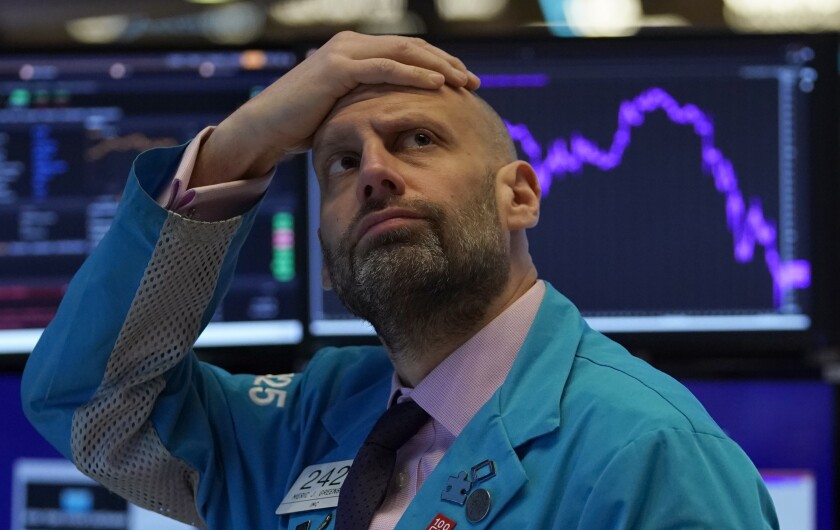
Dow plunges more than 1,800 points as rising COVID-19 cases roil Wall Street

Dow plunges more than 1,800 points as rising COVID-19 cases roil Wall Street

Dow plunges 1,800 as investors turn jittery over new wave of ...

Stocks plummeted Thursday as the emergence of new coronavirus hotspots and a caution from the Federal Reserve chairman shook Wall Street after months of steady gains.

The Dow Jones Industrial Average closed with a loss of 1,861 points, plunging 6.9 percent for its worst day of losses since March. The S&P 500 index closed with a loss of 5.9 percent, and the Nasdaq composite sunk 5.3 percent on the day.

All three major U.S. stock indexes closed with their steepest single-day losses since crashing in March amid the beginning of lockdowns imposed to slow the spread of COVID-19. Thursday’s losses come after more than two months of steady recovery toward the record highs seen before the pandemic derailed the economy.

Despite the loss of more than 21 million jobs and the deaths of more than 110,000 Americans due to the coronavirus, investors had gradually upped their bets on a quick economic recovery through April and May as states began loosening business closures and travel restrictions.

The surprise addition of 2.5 million jobs in May, according to the Labor Department, also fueled hopes for a quicker than expected rebound from a recession of unprecedented scale and speed.

But Thursday’s abrupt reversal comes as states across the U.S. see spiking COVID-19 cases and diminishing hospital capacity to handle a new wave of infections.

Week-over-week case counts are rising in half of all U.S. states, and only 16 states plus the District of Columbia have seen their total case counts decline for two consecutive weeks.

North Carolina, California, Mississippi and Arkansas are all facing record levels of hospitalizations, and the virus appears to be quickly spreading in Houston, Phoenix, South Carolina and Missouri.

Some market experts also attribute Thursday’s losses to Fed Chairman Jerome Powell’s Wednesday prediction of a “long road” to recovery.

During a Wednesday press conference, Powell said that while the U.S. may see significant job growth in coming months as people return to their jobs,” the country is “still going to face, probably, an extended period where it will be difficult for many people to find work.”

“What we’re trying to do is create an environment in which they have the best chance either to go back to their old job or to get a new job,” he continued.

President Trump, who frequently lashes out at the Fed when markets turn south, blasted the Fed for underestimating how quickly the U.S. economy could recover and how soon a COVID-19 vaccine would be available.

“The Federal Reserve is wrong so often. I see the numbers also, and do MUCH better than they do. We will have a very good Third Quarter, a great Fourth Quarter, and one of our best ever years in 2021. We will also soon have a Vaccine & Therapeutics/Cure. That’s my opinion. WATCH!” Trump tweeted.

Trump’s top economic advisor Larry Kudlow also criticized Powell, urging the Fed chief to ease up on the dour forecasts

“I do think Mr. Powell could lighten up a little when he has these press offerings. You know, a smile now and then, a little bit of optimism,” Kudlow said on Fox Business Network.

“I’ll talk with him and we’ll have some media training at some point.