Consumer confidence declines as COVID surges

https://mailchi.mp/86e2f0f0290d/the-weekly-gist-july-10-2020?e=d1e747d2d8


Just as consumer confidence was approaching pre-COVID levels in early June, cases began surging in many parts of the country. The graphic below shares highlights from a recent Morning Consult poll, which found reduced consumer confidence in participating in a range of activities, like dining out or going to a mall.

The poll also showed a significant consumer divide based on political affiliation, with Republicans’ confidence levels for many activities being twice that of Democrats. It remains to be seen whether the current surge will result in consumers pulling back on healthcare utilization the way they are beginning to for other activities.

A coalition of healthcare organizations is urging consumers to continue social distancing but “stop medical distancing”—in hopes that the new surge will not lead patients to avoid needed medical care. While cell tower data at thousands of hospital facilities suggest volumes may be stalling again, we anxiously await the latest national data on outpatient visit and elective procedure volumes.

We’d predict the surge will exacerbate consumer discomfort with “waiting” in healthcare settings—urgent care clinics, emergency departments and the like—though we’d expect the reduction in utilization to be less severe and more regionally varied this time around. 

Let us know what you’re seeing!


Facing another round of elective surgery shutdowns

https://mailchi.mp/86e2f0f0290d/the-weekly-gist-july-10-2020?e=d1e747d2d8

COVID-19: Hospitals brace for elective surgery shut-downs | New ...

With elective surgery shutdowns hitting health systems in Florida and Texas, providers across the country are thinking through the odds of a second round coming to their markets. While shutting down nonemergent cases in areas truly overwhelmed by the virus may be a necessity, we have been struck by how much better prepared systems are to deal with a second surge.

According to one of our member COOs, the enormous amount that hospitals and doctors have learned about COVID across the past six months, and the operational changes they’ve made to ensure safety (which now feel routine) make systems much better equipped to manage elective cases even if COVID admissions begin to rise.

“We created designated non-COVID facilities, supported by rigorous safety procedures. And we now have a few months of evidence that these changes allow us to manage electives without putting patients or staff at risk,” he said. “Just like none of us are wiping down our groceries with bleach anymore, we’ve learned what is and isn’t essential to create a safe environment in a surgery center.”

But he cautioned that, in their market, supply shortages will likely threaten electives before a local surge of COVID cases. The system recently postponed some procedures when the turnaround time for COVID test results suddenly jumped, and they are once again worried about shortages of PPE.

As we look toward fall, when more surges are likely as kids return to school and the flu season sets in, hospitals must have the resources to manage COVID spikes without shutting down the rest of the system. Many patients with ongoing health needs put their care on hold for much of the spring. If much of healthcare is forced into a second months-long shutdown, the toll from untreated conditions could be enormous.


As cases and deaths rise, Americans ponder a return to school

https://mailchi.mp/86e2f0f0290d/the-weekly-gist-july-10-2020?e=d1e747d2d8

Top 10 List of Must Do's for Back to School 2019 ...

The US spent another week headed in the wrong direction, with daily new COVID-19 cases reaching nearly 60,000 on Thursday, the sixth record-setting total in the past ten days.

The spike continued to be most pronounced in states that reopened early, with Texas, South Carolina, Arizona, and Florida hit particularly hard. More worryingly, several states saw daily deaths from COVID rise, with Alabama, Florida, Mississippi, South Dakota and Tennessee hitting one-day death records.

Like the light from some malign star, death numbers are a lagging indicator—a reflection of new case totals from weeks earlier—leading health experts to warn of dark days ahead for the rest of the summer. In his customary understated manner, top White House health advisor Dr. Anthony Fauci said this week, “I don’t think you could say we’re doing great. I mean, we’re just not.”

Responding to concerns about the availability of hospital capacity, Texas Gov. Greg Abbott expanded a ban on elective surgeries to more than 100 counties across the state, and HCA Healthcare delayed inpatient surgeries at more than a dozen of its hospitals in Florida, as did other health systems there.

School reopening emerged as a political flashpoint this week, with President Trump hosting a summit meeting on “Safely Reopening America’s Schools” on Tuesday at the White House. The President criticized reopening guidelines from the Centers for Disease Control (CDC) as being “very tough & expensive”, but on Thursday CDC director Dr. Robert Redfield told CNN that the guidelines, first published in May, would not be revised.

With schools and colleges set to restart in many places next month, the influential American Academy of Pediatrics modified its earlier support for reopening schools, pushing back on the administration’s threatened funding cuts for school districts that do not reopen on time, with in-person classes.

The debate over how to handle school reopening underscores how much time was lost between March and May, when a national reopening plan should have been developed. As the virus surges, with students and teachers set to return in just a few short weeks, and further economic recovery hinging on parents’ ability to send their kids safely to school, the window is rapidly closing on our ability to navigate this critical transition.

US coronavirus update: 3.2M cases; 135K deaths; 38.0M tests conducted.


Coronavirus is spreading in fraternity houses, raising concerns for campuses opening this fall

https://www.washingtonpost.com/national/coronavirus-is-spreading-in-fraternity-houses-raising-concerns-for-campuses-opening-this-fall/2020/07/10/72c986c0-c2f0-11ea-9fdd-b7ac6b051dc8_story.html?fbclid=IwAR290_LVJbF-FPWb4OkSx78MlT9olOI3Q9f3g6ILztueGLkDQSTX85pI2DA&utm_campaign=wp_main&utm_medium=social&utm_source=facebook

Animal House': Where Are They Now? - ABC News

Leaders agonizing about whether, and how, to safely reopen colleges and universities this fall now have another worry: the frat house.

In recent weeks, as students have trickled back onto campus, public health officials have been warning about an alarming rise in coronavirus cases that appears related to fraternity housing and parties that had been a staple of the college experience.

With students often crammed into houses that were hard to police and regulate before the pandemic, public health officials say they think major changes are needed to better protect the health of students and the broader community in college towns from coast to coast.

The concerns center on how easily the virus spreads during social gatherings — particularly indoor events. There is also skepticism about whether students in group housing will follow safety precautions, including forgoing roommates and communal meals, and wearing masks.

“There’s no doubt that this is a massive change, a massive transition for all of us,” said Judson Horras, president and chief executive of the North American Interfraternity Conference, a membership organization representing 6,000 undergraduate fraternity chapters and 250,000 fraternity members. “It won’t look like a normal fall this fall with social events.”

In a sign of the growing concern, the leadership at the University of California at Berkeley sent an urgent appeal Wednesday to students, noting that the number of coronavirus cases on campus had more than doubled in just a week. The majority of cases have been traced back to fraternity or sorority social gatherings, UC-Berkeley University Health Services’ medical director, Anna Harte, and assistant vice chancellor, Guy Nicolette, wrote in a letter to students.

“At the rate we are seeing increases in cases, it’s becoming harder to imagine bringing our community back in the way we are envisioning,” Harte and Nicolette wrote.

The jump in cases at UC-Berkeley comes on the heels of major outbreaks at the University of Washington and University of Mississippi, both of which have been traced to fraternity housing or social functions this summer.

At the University of Washington, in Seattle, at least 155 of the school’s 1,100 fraternity members have tested positive for the coronavirus since an outbreak began about two weeks ago, according to Erik Johnson, the president of the school’s Interfraternity Council.

At the University of Mississippi, in Oxford, health officials said last month that they had traced more than 160 cases back to off-campus fraternity rush parties, which are held to recruit new members. The University of Mississippi has warned fraternities they would be placed on probation if they are found to have hosted parties.

The PolicyLab at Children’s Hospital of Philadelphia raised concerns in a report this week about a growing number of infections in several other college towns, including Auburn, Ala., and Tuscaloosa, Ala., where the University of Alabama is located.

The report did not specifically mention Greek life, but researchers said college towns in general should brace for a sharp increase in cases as students return for the fall semester.

“If these places are having problems with half-empty campuses, we can only assume the fall will take a major toll on these college towns,” the researchers wrote.

In recent days, residents in Kalamazoo, Mich., have been complaining to local news media that parties have continued throughout the summer near fraternity row at Western Michigan University. The complaints follow a message the school’s health center posted July 2 on Twitter warning students to change their social behaviors.

“We answer phone calls everyday from people who were in crowds, at gatherings, and then learned later someone they met was COVID-positive,” the health center wrote. “There is no ‘safe’ party that looks like parties you attended in 2019.”

In a statement, Western Michigan University said college officials are trying to strike a balance by finding ways in which students can “be social and enjoy new and old friendships” while still taking “personal responsibility,” including by staying six feet away from others as much as possible.

“Put more simply, our message is: stay social but stay safe,” said Paula Davis, a university spokeswoman.

Thomas Russo, chief of the division of infectious diseases at the Jacobs School of Medicine and Biomedical Sciences at the University at Buffalo, said fraternities will continue to pose a risk for rampant spread of the virus.

He said many fraternities have characteristics of a bar and indoor restaurant, both of which are said to be locations where the virus spreads efficiently.

“If they are crowded indoors, and they’re in close quarters for a long period of time, it’s just a recipe for getting infected,” Russo said. “And the setting almost guarantees if multiple individuals get infected, you suddenly have scenarios where they can spread it to 10, 20, 30 or 40 other individuals.”

Johnson said that is exactly what happened at the University of Washington this summer. He said the school’s 25 fraternities have not been having parties or large social gatherings since the virus began circulating on the West Coast this spring, which forced the university to shut down.

But as students began moving back into fraternity housing in June, the virus quickly spread among roommates, he said.

“There is not one event, or multiple events, that we can identify as being the repository of this,” said Johnson, who is a senior. “It just spread from people living in a house, or visiting others in a house to hang out, or even just running into someone at a grocery store. . . . It was truly community spread.”

Johnson said most University of Washington cases involved people who were asymptomatic, which Russo said is common for carriers of the virus who are in their late teens or early 20s.

But Russo said colleges and their broader communities should not underestimate the danger facing students and others if an outbreak occurs on campus.

“We think in that age group only a small number will become seriously ill from coronavirus,” Russo said. “But if you have thousands of people infected, unfortunately some of these young adults are still going to have a bad outcome.”

Although the covid-19 death rate among people ages 18 to 29 is very low, Russo said, students are almost certainly going to interact with university staff and faculty who could be more vulnerable, as well as parents and grandparents.

Acknowledging that risk, elected leaders and university administrators are stepping up efforts to draft new guidelines for student housing.

Ohio Gov. Mike DeWine (R) on Thursday called on colleges and universities to step up coronavirus testing while also identifying housing units to “rapidly relocate individuals” should they become sick while living in residence halls or fraternity or sorority houses.

Fraternity members are also vowing to do more to police themselves, including limits on social gatherings.

Penn State’s Interfraternity Council voted Tuesday to halt all social activities indefinitely. The vote came after a 21-year-old student at the university died of coronavirus complications last month shortly after he returned home to eastern Pennsylvania. The student was not a member of a fraternity, but his death was jarring to university officials and student leaders as they prepare to resume classes in the fall.

“It is important to us that the residents of State College are not put at high risk as students return to campus this fall,” the council said in a statement.

At the University of Virginia, where the membership of 61 fraternities and sororities accounts for approximately a third of undergraduates, conversations between the school and Greek student leaders have been underway for months, said Julie Caruccio, an assistant vice president and associate dean of students. The discussions have focused on how to return to school safely.

“Our fraternity and sorority students are abundantly aware that the spotlight is on them,” Caruccio said. “They know, fairly or unfairly, that what they do is going to be watched carefully.”

One aspect of sorority and fraternity life at U-Va. that may be advantageous is that the recruitment of new members — or rush — does not occur until spring. And many of the organizations have said they will recruit new members online rather than through parties or social gatherings.

At the University of Washington, Johnson said the council is calling on fraternities to dramatically limit rental occupancy this year, even if it means chapters may need to lean on alumni or other sources to help pay the bills. Members will be encouraged to wear masks in their fraternity houses, except in their private rooms, Johnson said.

Although Johnson acknowledged that it may be hard to “change behaviors” among some upperclassmen who remember pre-coronavirus college life, he said he expects that abiding by the rules will be fairly easy for younger students.

“We are bringing in a new member class every year,” Johnson said. “Those new members won’t know what the norm was last year.”


We’re losing the war on the coronavirus

https://www.axios.com/coronavirus-losing-war-b36632fb-33b0-4cb0-84b2-14000841d89c.html

We're losing the war on the coronavirus - Axios

By any standard, no matter how you look at it, the U.S. is losing its war against the coronavirus.

Why it matters: The pandemic is not an abstraction, and it is not something that’s simmering in the background. It is an ongoing emergency ravaging nearly the entire country, with a loss of life equivalent to a Sept. 11 every three days — for four months and counting.

The big picture: “The part that really baffles me is the complete lack of interest in doing anything to achieve the goals we all agree on,” said Ashish Jha, the director of the Global Health Institute at Harvard.

  • Everyone wants to be able to safely reopen schools and see their friends and leave the house. To do those things safely, you have to get the virus under control. But much of America is talking and planning like victors at the precise moment we’re in the throes of defeat.

Seven times over the last two weeks, the U.S. has set a new record for the most cases in a single day. Cases are increasing in 33 states, and several of those states are seeing such staggering increases that they may soon overwhelm their hospitals.

  • No, those increases are not just a reflection of better testing. And though testing has dramatically improved, it’s still not enough to meet demand.
  • The peak of the U.S.’ coronavirus vigilance is in the past, but the peak of the virus’ actual spread is happening right now.

Yes, but: Public health experts say they’re optimistic that we’ll get our act together.

  • “It’s certainly within our power to turn things around. Whether or not we will depends on whether our political leaders will commit themselves to it,” said Jennifer Nuzzo, an epidemiologist at Johns Hopkins University. “If they’re able to get on the same page as the evidence, then I think they can avoid shutdowns.”

It’s true — and it’s good — that the percentage of all coronavirus patients who die seems to be falling. And experts hope that will hold, as the pool of infected people is skewing younger.

  • But “I don’t know that I take much comfort in this, knowing that thousands of people are going to die in the coming days and weeks and it was all preventable,” Jha said.
  • The virus has already killed over 130,000 people in the U.S. — roughly the population of Charleston, S.C. And deaths are now beginning to rise in the places experiencing big outbreaks.
  • Patients who don’t die can still experience lasting, painful symptoms, including damage to the lungs, heart, immune system and even the brain, after they leave the hospital.

What’s next: The optimistic view is that the pandemic just had to get worse before it gets better — that people outside of the New York region may not have taken it seriously enough in the early days when it was concentrated there, but that they will now.

The bottom line: “I think there’s a lot we can still do to turn around, and i’m still hopeful we are going to get more leadership to fight this thing,” Jha said. “I think we’re going to have to relearn the lessons of March and April and New York, without the ability to say, ‘Oh that was just New York.’ “It’s going to be a painful summer.”


Florida smashes single-day record for new coronavirus cases

https://www.axios.com/florida-coronavirus-case-record-2991255d-5b29-42e0-9c67-39b26c1e541c.html?stream=health-care&utm_source=alert&utm_medium=email&utm_campaign=alerts_healthcare

Florida reports massive single-day increase of 9,000 coronavirus ...

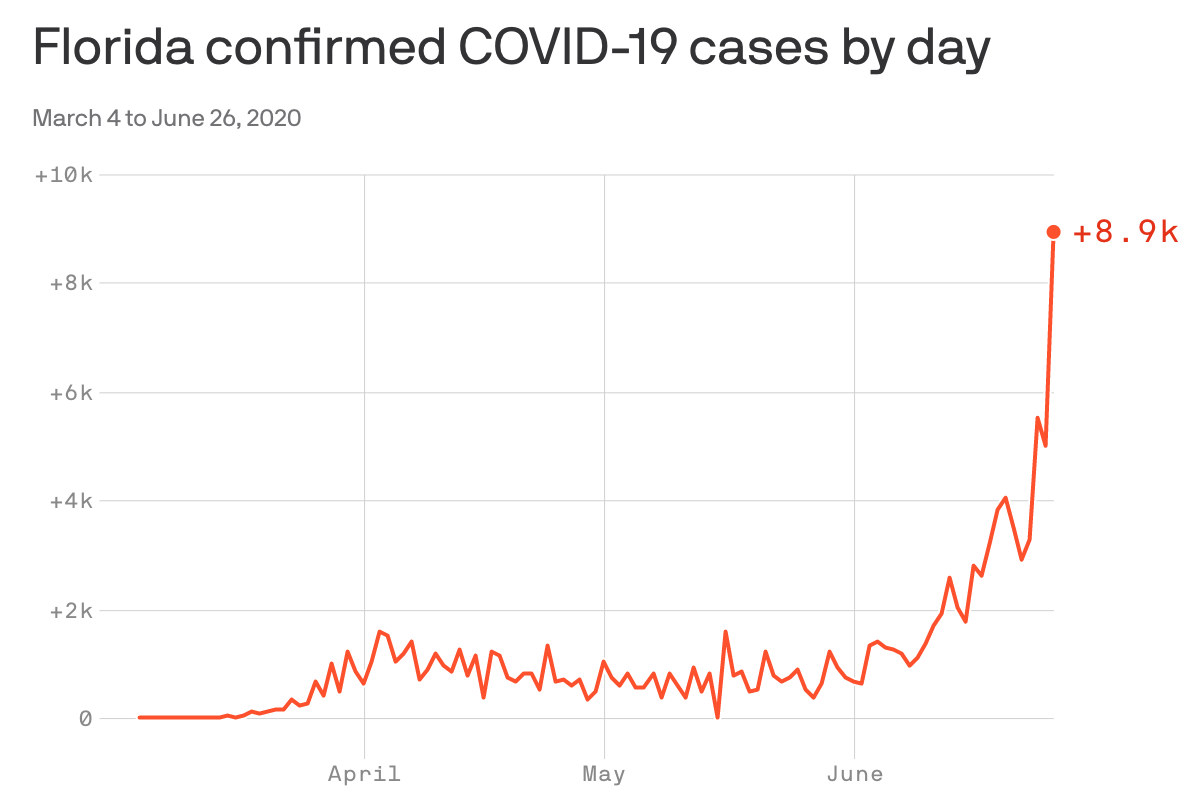
Florida reported 15,299 confirmed coronavirus cases on Sunday — a new single-day record for any state, according to its health department.

The big picture: The figure shatters both Florida’s previous record of 11,458 new cases and the single-state record of 11,694 set by California last week, according to AP. It also surpasses New York’s daily peak of 11,571 new cases in April, and comes just a day after Disney World reopened in Orlando.

Worth noting: More than a dozen states have reported new highs for daily case numbers this week.


Fauci: Surge States Must Pause Reopening

https://www.medpagetoday.com/infectiousdisease/covid19/87527?utm_source=Sailthru&utm_medium=email&utm_campaign=Weekly%20Review%202020-07-12&utm_term=NL_DHE_Weekly_Active

Fauci: Surge States Must Pause Reopening | MedPage Today

NIAID chief pins hopes for long-term containment on vaccine.

States facing COVID-19 surges must hit “pause” on their reopenings and begin to truly follow the CDC guidelines for mitigating its spread, NIAID Director Anthony Fauci, MD, told The Hill during an online webinar hosted by the website on Thursday.

Cases in the U.S. peaked in April but instead of falling to near zero, as happened in many European countries, new daily diagnoses plateaued at about 20,000 per day.

That ended in late May, when new cases began rising again, driven by big increases in California, Texas, Florida, and Arizona. The national rate has been topping 50,000 per day; the widely cited Johns Hopkins University tracker’s count spiked by 113,000 in the 24 hours ending at 8:00 a.m. ET Friday.

“We need to get our arms around that … and we need to do something about it quickly,” Fauci said.

One major challenge is the nature of the virus itself, which is “spectacularly transmissible,” he noted.

But the other problem is that some states ignored public health experts’ advice.

“We went from shutting down to opening up in a way that essentially skipped over all the guideposts,” he said, referring to the benchmarks for each phase of the reopening process. “That’s not the way to go.”

Fauci said he hopes it won’t be necessary for sunbelt states to return to a total shutdown.

“We’ve got to get them to do very fundamental things: closing bars, avoiding congregations of large numbers of people, getting the citizenry in those states to wear masks, maintain six-foot distance, washing hands,” he said. “If we can do that consistently, I will tell you almost certainly you’re going to see a down curve of those infections.”

Fauci also offered his projections for vaccine development.

“We’re really cautiously optimistic that things are moving along quite well with more than one candidate.”

He said the Moderna vaccine, which the NIH helped to develop, “will very likely be going into advanced phase III clinical trials, by the end of this month, July.”

Other “equally promising” vaccine candidates will begin these trials “a little bit later.”

“[W]ith any vaccine development program you never can guarantee success … but the early signs are proving favorable,” he said.

Fauci said he hopes “by the end of this calendar year and the beginning of 2021, that we will have a vaccine that we will be able to begin to deploy to people who need it.”


Has Italy Beaten COVID-19?

https://www.medpagetoday.com/infectiousdisease/covid19/87446?utm_source=Sailthru&utm_medium=email&utm_campaign=Weekly%20Review%202020-07-12&utm_term=NL_DHE_Weekly_Active

Has Italy Beaten COVID-19? | MedPage Today

Nation adapts to “new normal” of masks and distancing; second wave now seen as unlikely.

Three weeks ago, the hospital Policlinico San Donato in Milan, Italy, slowly started to get back to a semblance of “normal.”

In the early days of the coronavirus pandemic, this 500-bed hospital was caring for 600 patients with COVID-19.

Now, the hospital’s chief cardiac surgeon, Lorenzo Menicanti, MD, says his unit is operating at 40% to 50% of its normal volume — which may sound underwhelming, but at one point his entire cardiac ICU was dedicated to the care of COVID-19 patients.

“We are almost out of the nightmare,” Menicanti told MedPage Today, noting that the hospital has seen no new positive cases in the last three weeks.

Once seen as the world’s worst hotspot, Italy has managed to bring the virus to heel, as has much of the rest of Europe. Italy has had more than 34,000 deaths, with nearly half of them in the Lombardy region, of which Milan is the capital.

At one time, experts in the U.S. were worried that it would become “the next Italy” — a prospect that now seems welcome as America has nearly 100,000 more deaths than the European country.

Menicanti attributes Italy’s success to surprisingly high levels of compliance with social distancing measures from the Italian people.

“In the beginning, all of us were shocked by the rules. To be locked in, not being able to travel or meet people, that’s very strange for us. Italians love crowded places,” Menicanti said. “But the population, incredibly, has followed the rules.”

Even today, Italians continue to be frightened into compliance and are “afraid to restart their lives normally,” he said.

“I think the feeling of the U.S. population is not the same,” he said.

Living the Nightmare

Italy’s first case of coronavirus was identified in Codogno, a town of 16,000 people about an hour’s drive from Milan.

Annalisa Malara, MD, an intensivist and anesthesiologist at Codogno Hospital, diagnosed the first patient there on Feb. 20.

Local officials responded swiftly: “I called the chief of the hospital who declared it a crisis situation,” Malara wrote in a narrative for the European Society of Cardiology.” The chief in Lombardy was contacted as were the politicians, and a national emergency was announced. Codogno hospital was put in lockdown and emergencies were sent to Lodi Hospital, which is 30 km away.”

The town locked down immediately and largely averted a major crisis, according to news reports. An Associated Press report from mid-March said most Codogno residents were wearing masks when they went outside, handshakes were forsaken and people kept a social distance as they waited in lines at pharmacies and food stores.

Other towns that didn’t implement such a strict lockdown right away, such as Bergamo and Cremona, were hit harder, and scenes of coffins piling up in churches were burned into the national psyche.

Mario Carminati, a priest in Bergamo, told the BBC that the “sound of ambulance sirens was constant. This was a reminder to be on the lookout, that if you didn’t do as they said, you could be next.”

“We don’t want to forget what happened,” Carminati said. “We want it to be a reminder of how to live in a certain way.”

That fear has produced compliance that made control of the virus possible, Menicanti said. The entire region of Lombardy now only has 41 COVID-19 patients in intensive care, down from a peak of 1,800. Only 277 people in the region are hospitalized with the disease.

“It’s another world, because in other times we had 12,000 patients hospitalized,” Menicanti told MedPage Today.

About 7% of staff at Policlinico San Donato became infected with the virus, a result Menicanti called lower than expected given that testing was limited at the beginning of the outbreak. “The PPE worked very well,” he said. “The incidence of infection in our hospital was low.”

However, more than 150 Italian doctors are said to have died from the virus.

Back to Business

Now in Lombardy, masks must be worn at all times while in public. Schools and universities remain closed. Bars and restaurants are open, but with social distancing rules in place. Some even place glass shields between tables. It’s the “new normal” that many Americans refuse to accept.

“It’s not nice to go to restaurants and see people inside cages, but it was a good way to start again, and people have accepted it,” Menicanti said.

While it was relatively easy to stop normal hospital operations and push all resources to COVID care, it’s “much more complicated to restart,” he said.

The layout of Policlinico San Donato has been changed so that there are new routes for COVID-free patients to enter and be transported through the hospital. All patients who enter the hospital must be screened for COVID and must have two negative swabs to be admitted to the surgical ward. An entire floor is devoted solely to screening.

Staff on the COVID wards are tested more frequently than those assigned to non-COVID areas. Menicanti said he’s tested about once a week.

A third of hospital beds must remain free in case there’s a new wave of infections, but “all the data we have in Italy are against this idea,” Menicanti said. “So probably in another couple of weeks, we will consider occupying all beds for normal operation.”

No Second Wave?

Like much of the rest of Europe, Italians have become so confident in their ability to control the virus that many experts believe there won’t be a massive “second wave” of infections and deaths.

Enrico Bucci, PhD, a molecular biologist and statistician who runs a company aimed at detecting research fraud, wrote in a widely shared Facebook commentary that the probability of having a second wave that produces as much mortality as the first is “pretty low.”

However, “the sooner we abandon spacing, masks, hand hygiene, tracking, isolation and containment measures in hospitals, the more we increase the likelihood of high-intensity epidemic waves,” Bucci noted.

Health officials have gotten better at identifying sources of infection and reacting quickly to contain them, Menicanti said. For instance, as soon as a hot spot at a company in Bologna was identified, it was shut down: “Now we know what to do” to prevent local outbreaks from growing into a large second wave, he said.

While he’s concerned about the winter and a double-whammy of flu and COVID cases, he noted that there’s a large campaign for flu vaccination that may help moderate that burden.

“Of course it’s not over, we know that,” he said. “But the population is very prudent and being very attentive to the rules.”

“Summer will be perfect, we hope,” Menicanti said. “We shall see what happens in October.”


COVID-19 surge pushes US toward deadly cliff

COVID-19 surge pushes US toward deadly cliff

Archive

The coronavirus is spreading at ever-faster rates in a broad array of states, putting the U.S. on the precipice of an explosion of illness that threatens to overwhelm the nation’s health care system.

The painful economic lockdowns imposed in March gave the country time to flatten the epidemiological curve and contain the virus. But that window of opportunity, which came at great economic cost, is quickly slamming shut. Health experts say all signs point to a deadly summer and fall unless government leaders implement a much more robust national strategy.

The breadth of the spread is staggering. Forty-three states have seen the number of cases confirmed on an average day increase in the last two weeks. The number of patients in hospitals has risen over the same period in 29 states. More than 80 percent of intensive care beds are occupied in Alabama, Arizona and Georgia.

The same models that predicted surges in Phoenix, Houston and Miami now show a new and broader round of cities as the likely next epicenters. The number of confirmed cases is likely to rise substantially in places like Atlanta, Kansas City, Mo., Tulsa, Okla., and Greenville, S.C.

The virus also appears to be traveling north along the I-95 corridor. Cities like Philadelphia and Baltimore, which struggled through earlier peaks of viral transmission, are now seeing early signs of a second wave. Transmissions even appear to be rising in New York City.

On the other side of the country, outbreaks in California have grown to unprecedented proportions. The Golden State is now averaging more than 7,900 new cases a day, substantially more than its seven-day average just two weeks ago.

Public health experts warn that the U.S. has only a fleeting window in which to wrestle the virus back under some form of control. Without a stronger national response, including restrictions on large gatherings and requirements that people wear masks in public, the risk of a second peak could bring new lockdowns and more economic harm, derail the beginning of the new school year and even overwhelm local health systems.

“Our projections show that without immediate actions to significantly reduce travel and social distancing nationwide, this virus will not only threaten our ability to reopen schools in the coming weeks, but our capacity to care for the sickest individuals,” said David Rubin, director of PolicyLab at the Children’s Hospital of Philadelphia whose models forecast higher case counts.

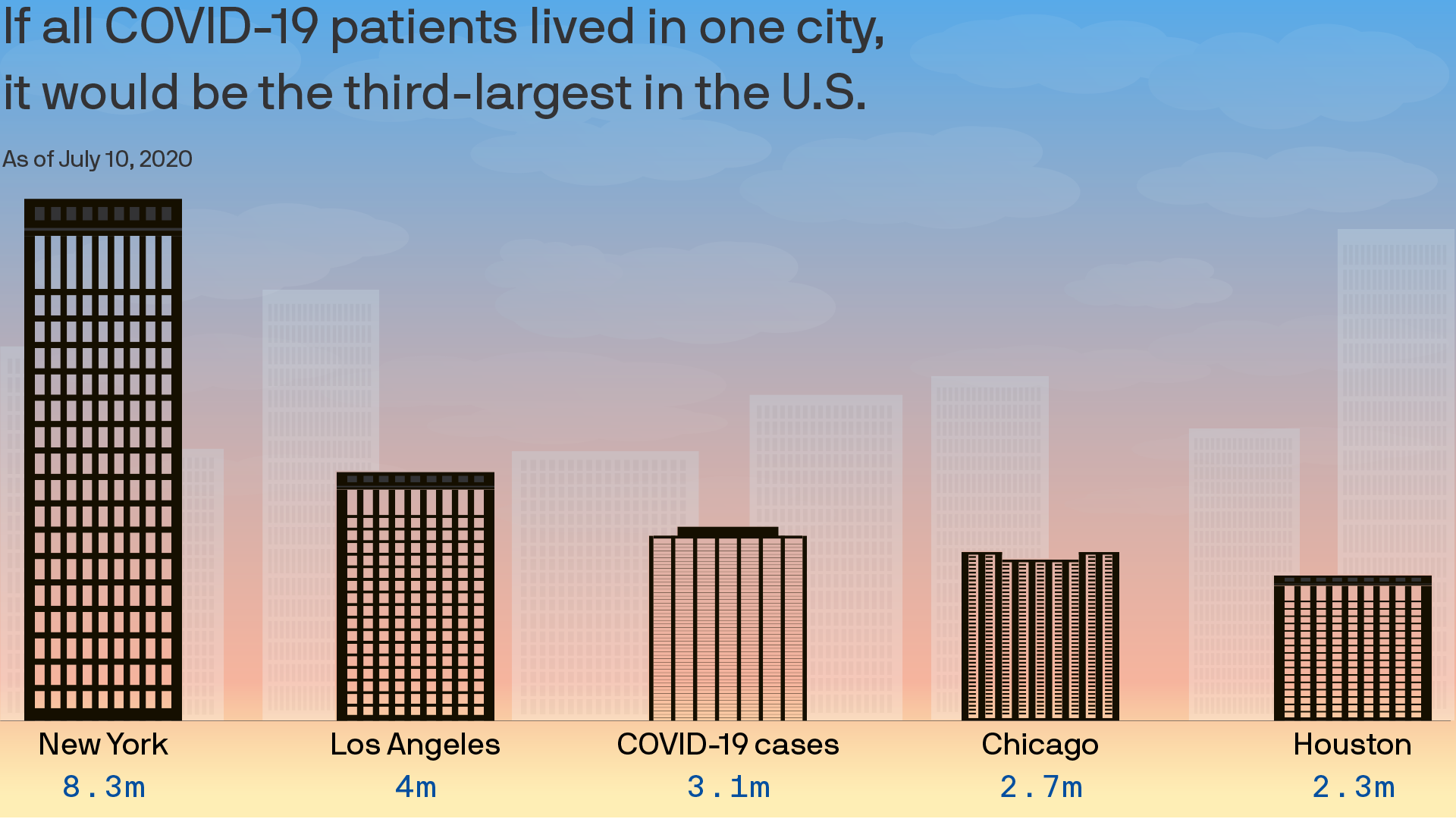
More than 3.1 million Americans have tested positive for the virus, though the Centers for Disease Control and Prevention estimate that as many as 25 million people in the U.S. may have contracted it. More than 133,000 people have died, almost twice as many victims as in Brazil, the second-hardest hit country.

Cities that successfully avoided early explosions of cases are now in the crosshairs after the loosening of restrictions in some states and regions that helped avoid what studies have suggested would have been tens of millions of infections.

“I would be lying if I didn’t say I was concerned,” Kansas City, Mo., Mayor Quintin Lucas said in an interview. “We have looked at the trends out of Texas, Arizona and Florida. Those states kind of reflect the political choices that were made statewide in Missouri, and that does give us concern.”

The Kansas City metropolitan area has confirmed more than 10,000 coronavirus cases. The PolicyLab model shows Jackson County, Mo., is likely to experience more than 200 new cases every day by the beginning of August.

Rubin warned that smaller cities are likely to experience significant outbreaks in the coming weeks, potentially straining health systems that are not as prepared to handle a high volume of patients in need of intensive care. College towns like South Bend, Ind., and Tuscaloosa, Ala., are beginning to see case counts rise even with most students gone.

“We’re starting to see a mild uptick,” said James Mueller, South Bend’s mayor. “We’re in a much better position now than we were for the first increase or the first peak.”

At other levels of government, some who have sought to downplay the severity of the American outbreak have pointed to an increasing number of tests being conducted across the country, which they say will naturally lead to identification of those who have only minor symptoms or asymptomatic cases. But the number of cases is rising faster than would be accounted for by the increase in testing; the share of tests coming back positive is rising in 38 states.

More than a quarter of tests conducted in Arizona are coming back positive, according to state data. More than 15 percent of tests are coming back positive in Alabama, Florida, Mississippi, South Carolina and Texas.

Governors in 23 states have ordered residents to wear masks in public, though President Trump has refused to order a nationwide mask mandate. Trump has instead focused on reopening the economy, insisting that schools operate as normal in the months before he faces voters in November.

But public health experts argue action is needed now to avoid a second peak of tsunami-like proportions.

“We never gave communities a real chance at success as we lacked a national strategy around masking and limiting gathering sizes to act as a buffer as places reopened,” Rubin and his colleagues Gregory Tasian and Jing Huang wrote.

“So, do we admit that we’ve failed and try to salvage the reopening of our schools in fall by quickly enacting a national approach to pause all reopenings and try to get our country back onto stable footing?” he asked. “It may not be what people want to hear, but the situation is that dire that we need to consider this.”


Covid-19 has decimated independent US primary care practices—how should policymakers and payers respond?

Covid-19 has decimated independent US primary care practices—how should policymakers and payers respond? 

9 ways Covid-19 may forever upend the U.S. health care industry - STAT

The coronavirus pandemic has torn through the global economy, suppressing consumer demand and industrial production. As countries look to an eventual recovery, but in a very different environment characterized by continuing distancing measures and loss of public confidence, businesses in many sectors, such as hospitality and retail, are asking how they can adapt to survive these new economic conditions. Yet perhaps surprisingly, those feeling threatened include independent primary care practices in the United States. Despite the USA being one of the most expensive healthcare systems in the world, many primary care practices are now facing financial collapse. Some estimates suggest that primary care practices will lose up to $15 billion during 2020 as a consequence of the coronavirus pandemic.

Covid-19 has highlighted a fundamental weakness in how primary care is paid for in the USA. Many practices are financed by fee-for-service (FFS) reimbursement. Put bluntly, providers make money from office visits, diagnostic tests, and procedures. This has long been criticized for encouraging an expansion of what is considered disease and overtreatment, contributing to the high cost of the American health system. However, it can only work as long as patients keep coming, and they are no longer doing so, at least not in sufficient numbers for many primary care practices to remain viable. The imposition of social distancing policies has seen a severe reduction in office visits, and with it a substantial decline in revenue. The pandemic has taught Americans that the financial model that underpins primary care needs to be reformed. It needs to move from a per-visit reimbursement to a per-patient reimbursement, in other words primary care capitation, as used in many other countries, including the UK.

If the existing reimbursement model is not reformed, the clinical and financial implications for struggling primary care practices, which could play a key role in the continuing coronavirus pandemic, will be far-ranging. From a clinical standpoint, primary care practices that need to lay off staff or close will not be able to respond effectively to an influx of patients who have been delaying care since the pandemic began. Given that primary care is often the entry point into the healthcare system, this could lead to severe reductions in access to routine health care as well as referrals to specialty providers for advanced complaints. From a financial standpoint, many of these independent practices may consider consolidation with larger health systems, something that has been shown to increase prices without improving quality in the long run.

To overcome these issues, insurers and primary care practices could work together to construct capitated payment models. In capitated contracts, providers are paid a risk-adjusted sum for each patient enrolled in the practice. Payment to providers is not reliant on volume of office visits, but rather delivering cost-effective care focused on the health of primary care patients.

As we noted above, this system is already widely used internationally, but there are also good examples in the USA. For example, Iora Health is a venture-backed primary care company that partners with insurers to obtain a flat $150 per-member-per-month (PMPM) fee for taking care of its patients. They also receive bonuses for reducing total cost of care (TCOC). As a result, they have been able to use their dollars for health-related interventions, such as hiring health coaches. They have also demonstrated significant reductions in hospitalizations and health spending along with high patient satisfaction scores. Most importantly, they were able to quickly adapt to the needs of their patient population in the pandemic using alternative models of care, such as online consultations, without the added stress of losing revenue.

There are also many other promising examples of both public and private payers designing capitated contracts for independent primary care practices. In the public sector, the Centers for Medicare and Medicaid Services (CMS) introduced the multi-payer Primary Care First (PCF) Model. Under PCF, primary care practices will receive a risk-adjusted population-based payment for patients as well as a flat fee for any office visits performed. In addition, there are bonuses for practices to limit hospitalizations, an expensive component of delivering care. However, this is still an experimental program that is supposed to begin in 2021, which may be too late for primary care practices that are already facing financial strain from the pandemic.

In the private sector, Blue Cross Blue Shield of North Carolina (BCBS NC) has created the Accelerate to Value program for independent primary care practices. Through this program, BCBS NC is offering independent primary care practices a supplemental stabilization payment, based on the number of members a particular practice serves. In return, it is asking them to remain open for patients and deliver care appropriate to the circumstances created by the pandemic. In the longer term, it also asks them to join an accountable care organization (ACO) and consider accepting capitation for future reimbursement. 

While CMS and BCBS can offer blueprints for a path towards primary care capitation, there will be challenges to implement capitation at scale across the nation’s primary care system. A key defining aspect of the US healthcare system is its multitude of payers, from commercial to Medicaid to Medicare. For primary care capitation to succeed, practices will need to pursue multi-payer contracts that cover a critical mass of the patients they serve. Independent practices will also have to adapt to a fixed budget model where excess healthcare utilization could actually lead to financial losses, unlike in fee-for-service.

Ultimately, it is important to recognize that no payment model will be a panacea for healthcare providers during the pandemic and afterwards. However, the coronavirus pandemic has highlighted clear deficiencies in the American fee for service system that have existed for almost a century. Covid-19 has created an opportunity for policymakers and providers to look anew at a model that is already implemented widely in other countries, and in parts of the US. At some point there will have to be an inquiry into the many failures that have characterized the American response to covid-19. Given the magnitude of the catastrophe that has befallen the US, in stark contrast to the relative successes achieved in many other countries, it will be essential to challenge many things once taken for granted. One must be the fee for service system that has so clearly undermined the resilience of the US health system. Covid-19 has provided an almost unprecedented opportunity to create a healthcare system that rewards providers caring for patients in a coordinated manner, rather than prioritizing expensive and often wasteful healthcare provision.