Trump sparks debate over merits of voting by mail

Trump sparks debate over merits of voting by mail

Trump criticism too late: Swing states already have mail-in voting

President Trump is taking a hard stand against expanding alternatives to in-person voting amid the coronavirus pandemic, arguing that mail-in voting risks “tremendous potential for fraud” and hands an advantage to Democrats.

While voting rights and elections experts say there may be some truth to Trump’s claim that mail-in voting is more susceptible to fraud, they note that electoral fraud of any form is exceedingly rare. And they say there are security measures that can mitigate those risks.

At the same time, experts argued that policymakers should be wary of restricting an already-existing alternative to in-person voting that has the potential to expand the electorate and limit the spread of the coronavirus.

“Perhaps there’s more potential for fraud than in in-person voting, but both can be done safely and securely,” said George Hornedo, the former deputy political director and national delegate director for former South Bend, Ind., Mayor Pete Buttigieg’s presidential campaign. “Election fraud in all instances is extremely rare.”

Hornedo suggested several measures to cut down on the risks of fraud in mail voting, including ballot tracking, pre-paid postage and setting up ballot drop boxes that would “eliminate the need for voters to hand over ballots to third parties.”

Vote-by-mail programs are already extremely common and have been in use for years.

Five states — Colorado, Hawaii, Oregon, Utah and Washington — now conduct their elections almost entirely by mail. And in about two-thirds of states, voters can request a mail-in ballot without providing an “excuse” for not being able to vote in person on Election Day.

Trump acknowledged at a press briefing this week that he voted by mail in Florida’s presidential primary last month, though he said that he was “allowed to” because he lived out of state and wasn’t able to vote in person. In other instances, he said, mail-in voting “is a terrible, terrible thing.”

“There’s a lot of dishonesty going on with mail-in voting, mail-in ballots,” he said at a media briefing.

Myrna Pérez, the director of the Brennan Center’s Voting Rights and Elections Program, said that the idea that mail-in voting is some “brand new thing” is “not consistent with the real world.”

“We are in the middle of an emergency situation, and the appropriate thing to be doing right now is to be looking at all things we know and figuring out how to make those things work for us in this crisis,” she said.

Pérez said that policymakers should look at the experiences of states with robust vote-by-mail programs and use them to guide efforts to expand those programs in other states.

“The challenge our country has to figure out is how to get this up to scale,” Pérez said. “That’s something that’s going to require thinking and resources, but we should not be starting from the premise that this is a brand new untested thing.”

Lonna Atkeson, a political science professor at the University of New Mexico, said there are still risks involved with mail-in voting. Fraud, for instance, becomes harder to detect when people don’t have to show up to vote in person, she said.

“If you show up the polls and you say you’re John Doe and you’re 25, and that John Doe is 50, you know there’s a problem,” Atkeson said. “Those kinds of catches are possible.”

“Where we see fraud, we tend to see it in absentee voting,” she added, pointing to the 2018 election in North Carolina’s 9th congressional district, when a contractor working for Republican candidate Mark Harris was charged with election fraud in connection to an absentee ballot collections scheme.

State officials eventually overturned the results of that race and called a special election for the House seat.

Experts also warn that external threats, such as foreign adversaries, could also pose a greater threat with absentee, or remote voting.

“The manipulation campaigns, Russia, China, Iran, and maybe some unscrupulous domestic operatives could seize this opportunity to actually promote downloads of bogus, basically absentee ballots and direct people’s votes to the wrong place,” said Theresa Payton, CEO of Fortalice Solutions and author of the forthcoming book “Manipulated: Inside the Cyberwar to Hijack Elections and Distort the Truth.”

Payton recommended holding mock elections as a means of working out any potential risk and pitfalls in the process.

“Let’s pretend, we got these ballots in the mail. Let’s scan them. How long does it take to scan a ballot? What is our error defect rate?” Payton said. “How we will audit an all absentee ballot, or maybe as high as 40 percent absentee ballot election because they’re not used to that yet.”

Democrats and election rights advocates are some of the most vocal voices pushing for expanded vote by mail. Democratic lawmakers, led by Sens. Amy Klobuchar (D-Minn.) and Ron Wyden (D-Ore.), are calling on the federal government to send at least $1.6 billion to states as part of the next coronavirus spending package and that Congress impose requirements to ensure states permit vote-by-mail.

However, Republicans have continued to voice skepticism about vote-by-mail measures.

“I don’t think the Republicans are going to embrace any of the language that we’ve seen Senators Klobuchar and Wyden put forward to make the election universally accessible for every American,” said Matt Liebman, of the left-leaning group the Voter Protection Project.

“Republicans are going to take advantage of the situation to suppress voter turnout, and not only try to use that to hold the presidency, the United States Senate, but, you know, some of these critical state legislative races across the country,” he continued.

Trump and Republicans have also pushed the argument that expanding the use of mail-in ballots lends a partisan advantage to Democrats. That line of reasoning hinges on the notion that such programs increase the number of people who cast ballots and that high-turnout elections tend to favor Democrats.

But experts said there’s little evidence that one party or another benefits more from the widespread use of mail-in ballots.

“I have not seen any conclusive data on that and I cannot understand how anyone can pretend to know that,” Pérez said.

However, not all Republicans are opposed to the measures. Maryland’s Republican Gov. Larry Hogan ordered the state’s June 2 primary to be vote-by-mail.

“If one is in a pandemic, and you sit and you say, we’re not going to allow you to keep safe, and vote by mail and exercise your right to vote, that’s outrageous,” said Page Gardner, the founder of the Voter Participation Center.” “It’s a weakening of our democracy. It’s a weakening of our democratic institutions.”



Fauci: US could have ‘saved lives’ if social-distancing restrictions were enforced earlier

https://thehill.com/homenews/administration/492411-fauci-us-could-have-saved-lives-if-social-distancing-restrictions

Top doc Fauci admits lives could have been saved if US had shut ...

Anthony Fauci, the U.S. government’s top infectious disease expert, said Sunday that the U.S. would have saved lives had the country enforced firm social-distancing requirements as early as February, but noted that those recommendations were met with pushback at the time.

Speaking on CNN’s “State of The Union,” Fauci addressed a New York Times report that said he and other health experts concluded on Feb. 21 that the Trump administration would need to issue aggressive mitigation measures in order to slow the spread of COVID-19, the disease caused by the novel coronavirus. 

“As I have said many times, we look at it from a pure health standpoint,” Fauci said. “We make a recommendation. Often, the recommendation is taken. Sometimes, it’s not. It is what it is. We are where we are right now.”

Fauci added that “you could logically say, that if you had a process that was ongoing, and you started mitigation earlier, you could have saved lives.”

“Obviously, no one is going to deny that. But what goes into those kinds of decisions is complicated,” he said. “I mean, obviously, if we had, right from the very beginning, shut everything down, it may have been a little bit different. But there was a lot of pushback about shutting things down back then.”

The National Security Council reportedly received intelligence reports in January warning that the COVID-19 outbreak would spread to the U.S. By the third week of February, Dr. Robert Kadlec, the top disaster response official at the Health and Human Services Department (HHS), convened a meeting on whether officials should lock down the country to prevent an outbreak. The group determined that mitigation measures such as school and business closures were necessary despite the devastating economic implications, The Times noted.

The White House issued social-distancing guidelines, including recommendations against gatherings of more than 10 people, in mid-March. President Trump later that month extended those guidelines through the end of April.

The U.S. has reported more than 530,000 confirmed COVID-19 cases and roughly 20,600 deaths caused by it as of Sunday morning, according to a Johns Hopkins University database. 

Asked whether the statistics were a direct cause of the late start on mitigation measures, Fauci said that “it isn’t as simple as that.” While earlier mitigation efforts would have had an impact, Fauci noted that “where we are right now is the result of a number of factors,” including the size of the country and the heterogeneity of the country.

“I think it’s a little bit unfair to compare us to South Korea, where they had an outbreak in Daegu, and they had the capability of immediately, essentially, shutting it off completely in a way that we may not have been able to do in this country,” he said. “So, obviously it would have been nice if we had a better head start, but I don’t think you could say that we are where we are right now because of one factor.”

The Trump administration has faced continued scrutiny over its handling of the outbreak, as state and federal officials raise alarms over testing and medical equipment shortages.

The president on Feb. 28 predicted that the disease would disappear like a “miracle.” Asked about those comments last week, Trump said that “the cases really didn’t build up for a while” and that he was trying to avoid stirring panic. 


The US just became the first country in the world to record more than 2,000 coronavirus deaths in 24 hours

https://www.yahoo.com/news/us-just-became-first-country-092209704.html

US becomes first country to record 2,000 coronavirus deaths in 1 ...

The US has become the first country in the world to record more than 2,000 coronavirus deaths in a single day.

2,108 people lost their lives on Friday, according to data collated by researchers at Johns Hopkins University.

The US also surpassed half a million infections at the end of what has been a devastating week.

More Americans died between Monday and Saturday (8,800) than died from the wars in Afghanistan and Iraq combined. 

The US death toll, 18,693, as of Saturday morning, is expected to surpass that in Italy, 18,849, by Sunday, but the overall picture indicates that while deaths continue to rise, the speed of the outbreak looks to be slowing.

“We’re starting to see the leveling off and the coming down,”Dr Anthony Fauci, the US top epidemiologist advising the White House, said on Friday.

But other officials were keen to play down any thoughts of an end to the crisis.

“As encouraging as they are, we have not reached the peak,” Dr Deborah Birx, White House coronavirus response director, said of the easing of new cases on Friday.

While the US as a whole may look better, New York state is still in a dire situation, and remains the country’s worst affected region. 777 new fatalities were reported on Friday, according to The Associated Press.


Trump suggests doctors complain about lack of coronavirus equipment in order to get on TV

https://www.yahoo.com/news/trump-suggests-doctors-complain-lack-141500695.html

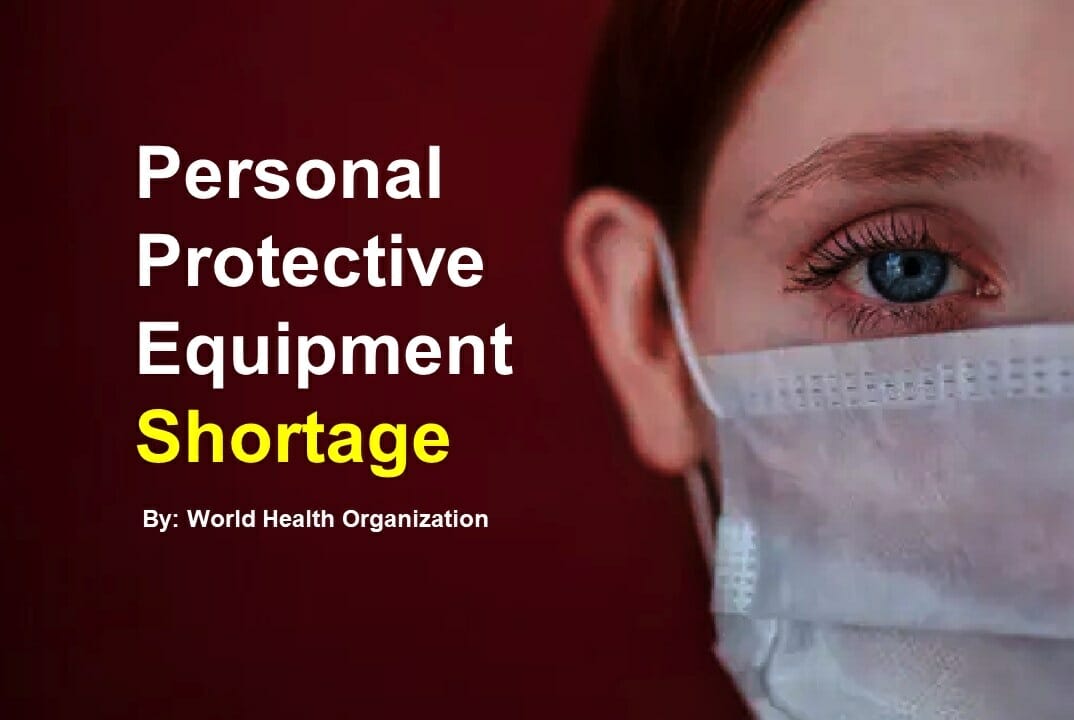
PPE Shortage Endangering Health Workers Worldwide - GineersNow

Donald Trump has implied doctors and elected officials say they do not have enough personal protective equipment (PPE) and other materials to get on television amid the coronavirus crisis.

The US president had a row with Jim Acosta, CNN’s chief White House correspondent, over the shortage of PPE, which includes essential gear such as hand sanitiser, gloves, aprons, and face masks, during his coronavirus press briefing.

Acosta said: “We hear from a lot of people who see these briefings as sort of ‘happy talk’ briefings. And some of the officials don’t paint as rosy a picture of what is happening around the country. If you look at some of these questions – do we have enough masks? No. Do we have enough tests? No. Do we have enough PPE? No.”

Mr Trump interjected: “Why would you say that? The answer is yes. I think the answer is yes.”

Acosta referred to doctors and other medical officials who have vented their frustrations about the dearth of essential equipment on CNN.

The president hit back: “A lot of it is fake news.”

Acosta said: “Doctors and medical officers come on our air and say ‘we don’t have enough tests, we don’t have enough masks’.”

Mr Trump chipped in: “Well yeah, depending on your air they are always going to say that because otherwise, you are not going to put them on.”

The spat comes as doctors and healthcare workers across America are battling against a shortage of face masks which safeguard them against coronavirus – sparking fears doctors will not be able to provide life-saving care if they fall ill.

America has become the first country in the world to record more than 2,000 people dying from coronavirus in one day alone, according to Johns Hopkins University figures.

People who contract coronavirus in the US are at greater risk than those in the UK or Canada due to America not having a national health service.

Americans are at risk of running up bills for coronavirus treatment which force them to fork out tens of thousands of dollars. The situation is exacerbated by the fact many have lost their healthcare insurance due to job losses linked to the pandemic.


When the coronavirus lockdowns end, we will live in a shrunken world

https://www.yahoo.com/news/coronavirus-lockdowns-end-live-shrunken-122800321.html

Flipboard: When the coronavirus lockdowns end, we will live in a ...

  • A projection from the Department of Homeland Security, published by the New York Times, shows coronavirus cases spiking again at the end of summer.
  • It’s a stark reminder that American life after lockdown will still be one of limited human interaction. And that means we’ll have to live with a smaller economy too. 
  • The economy will be packed with uncertainty given the possibility of another shelter-in-place order.
  • Until we can all hang out again with confidence, the US economy is going to be a shell of its former self.

When the US emerges from its various shades of shelter-in-place orders, it will emerge to a shrunken global economy. One that will not easily be inflated living within parameters the coronavirus demands.

Financial transactions are a form of human interaction, and even after strict orders to stay at home are lifted, Americans will need to limit human interaction to mitigate the spread of coronavirus. One projection from the Department of Homeland Security, first reported by the New York Times, imagines a world where schools remain closed, 25% of Americans work from home, and social distancing remains in place through the summer.

And people will still be scared. They will know that there is an deadly virus infecting people who interact with other people.

In this scenario, back to work doesn’t mean back to growth because people won’t be spending money the way they did before. Back to work simply means finding a more sane, stable way to maintain society until we get a vaccine. There will be no V-shaped recovery. This is a marathon, and if we’re lucky, we will limp across the finish line.

As incomplete as it is, China is the best picture we have for understanding what a life after lockdown looks like, and it doesn’t look like a booming economy. 460,000 businesses closed permanently in China during the first quarter.

One Chinese county has gone back into lockdown already. In Beijing — where state media says epidemic prevention and control will “probably” become “long-term normal” — restaurants have been ordered to maintain social distance by cutting seating in half and limiting tables to three people. Customers have been slow to come back anyway.

All of this is to say that even if we’re out of lockdown, this saga isn’t remotely over.

Deflation strikes back

What China’s economy is telling us is that once this weird supply funk brought on by everyone staying home is over, and some people are able to go back to work, we’ll still have a demand crisis. Even though the virus has been contained analysts at Oxford Economics told clients it expects to see “basically no growth” in China this year. With other global economies weakened it will sell fewer exports. 

Zhu Jun, director of the international department of the People’s Bank of China, said that there’s a small chance the world risks another Great Depression. Cheery, I know, but until there’s a vaccine, optimism will be in short supply.

Here in the US, just as in China, people will be broke and businesses will be broken. Money will be scarce. Demand will be depressed not just because of a lack of funds, but because people will have changed their behavior to avoid getting sick. 

Wall Street it seems, hasn’t processed this bad news yet. It’s taking this pandemic day-by-day, not looking at life after lockdown. This week the market rallied on news that all over the US, even New York City, the curve is flattening. It was a silly rally.

It’s silly for the market to declare victory before we’ve even seen how much damage has been done (that will take months at least). It’s silly to expect any kind of stability until we know what kind of demand a post-shelter-in-place, pre-vaccine American economy will have.

Finally, we don’t know how long Washington will be in a giving mood. So far the Federal Reserve has pulled out all the stops, and Congress has approved trillions in aid. But will Washington keep sending checks to unemployed Americans until we have a vaccine? 

US employment by industry who can work from home

We thought we knew uncertainty

I think back to all the times I’ve heard CEOs and Wall Street types talk about uncertainty around regulations, or elections, or literally anything else that has happened in my life time, and I have to laugh. All of it seems silly compared to the uncertainty before us right now.

It is quite possible that sometime this summer scientists will develop a treatment for COVID-19 that makes the symptoms much more mild — something more like a standard, week-long flu. That discovery could make things a lot easier, and really bolster confidence enough to bring the economy back until we have a vaccine. But government officials obviously can’t plan with that in mind. Neither can businesses.

And so, those charged with imagining the worst case scenario must imagine a world where Americans are again forced to shelter-in-place to flatten the curve. Homeland Security’s projections put a resurgence of the virus somewhere around the end of summer to the beginning of fall. It’s not unreasonable to think certain populations may have to go back into shelter-in-place then.

Singapore has a robust system of testing for and tracking the coronavirus and its citizens went back into shelter-in-place this week. Here in the US we don’t have such a system. Last week the White House ended federal funding for its drive-thru testing site program.

On Friday New York Governor Andrew Cuomo urged the President to invoke the Defense Production Act to ramp up production of antibody tests that can show who has been infected with the coronavirus and built up immunity. That would allow people to go back to work, but the federal government will only be able to produce 2,000 a day in the next two weeks. 

As a nation, we need to be doing everything we can to ensure that when this lockdown is over, those who can go out can do so with as much confidence as possible. We need to inject as much certainty into this situation as possible Without testing, that’s not happening.

In an interview with CNBC, Bill Gates — the Microsoft founder and billionaire philanthropist who has dedicated a significant chunk of his charitable efforts to studying pandemics — said the federal government simply doesn’t seem interested in a unified testing system. This is one of the few variables in this pandemic the government can control, and it’s blowing it.

Testing is one of the only things that will make our beleaguered, shrunken coronavirus economy a little bit bigger. It’s one of the only ways we can impact the ugly twist of this economic downturn, behavior.

Even then, though, the possibility of an outbreak in a workplace, city, or state will change the way our economy works in ways that will make money scarce. We need to be ready for that.


Cartoon – Reality Check

Cartoon, April 9 | Cartoons | themountaineer.com

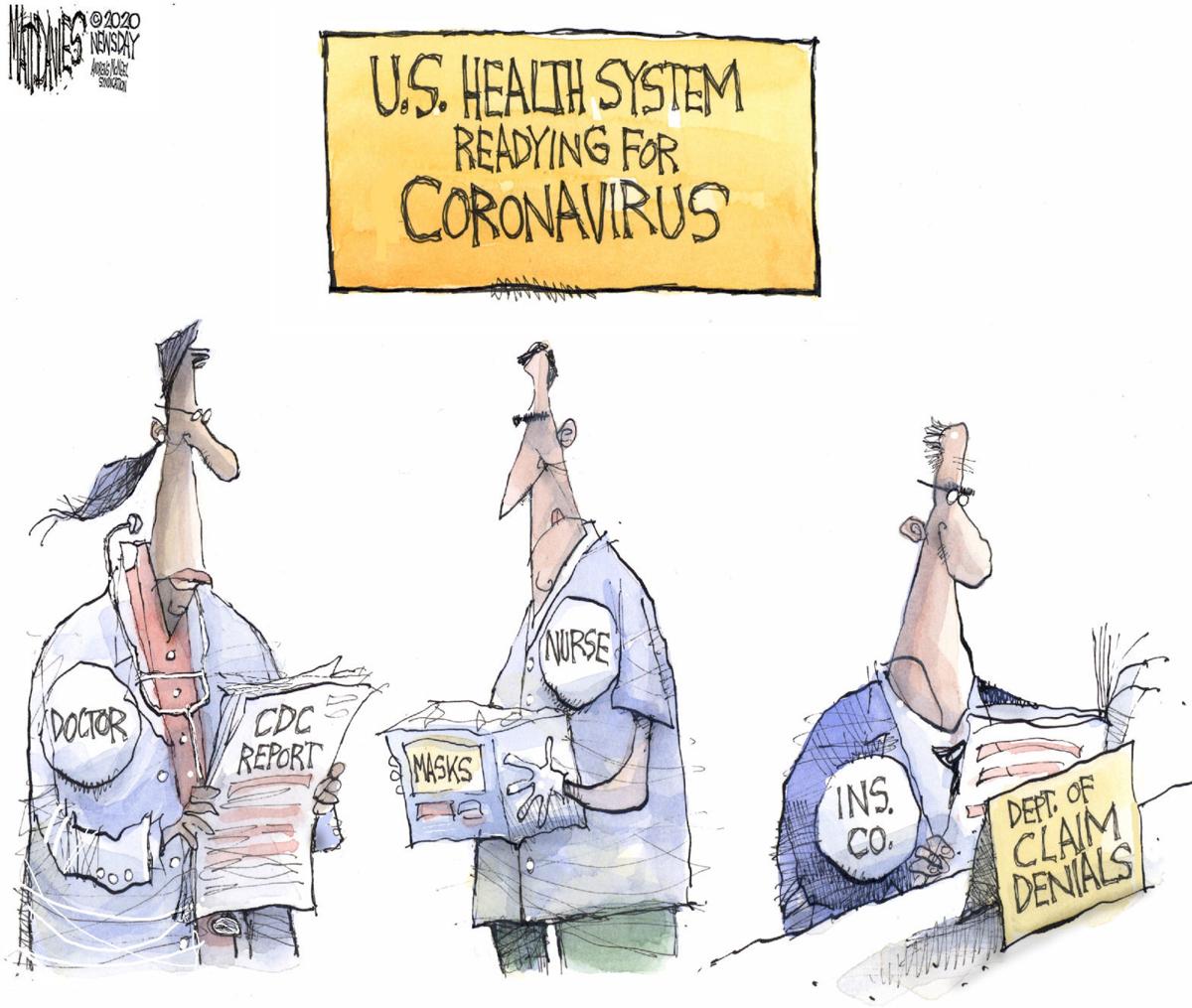
Cartoon – U.S Health System Readying for Coronavirus

Corona response | Cartoons | postregister.com

U.S. coronavirus updates: U.S. passes Italy on reported deaths

https://www.axios.com/coronavirus-west-virginia-first-case-ac32ce6d-5523-4310-a219-7d1d1dcb6b44.html

Trump dodges whether he was briefed on aide's doomsday scenario on ...

The U.S. passed Italy for recorded coronavirus deaths on Saturday, per Johns Hopkins data. 18,860 Americans have died.

Where it stands: Government projections show lifting social distancing restrictions after just 30 days will lead to a dramatic infection spike this summer and death tolls would rival doing nothing, the New York Times reports.

The big picture: The coronavirus has killed more than 1,000 people every day in the U.S. since April 1, and infected over 501,000 others. New York’s death toll sits at 8,627 as of Saturday after 783 people died in 24 hours — a slight uptick from the day prior.

  • Public health officials warned this would be a deadly week for America, even as New York began to see declining trends of hospitalizations and ICU admissions.
  • All but eight states have issued stay-at-home orders.

What’s happening: New York hospitalizations appears to have plateaued as the state flattens the coronavirus curve, Gov. Andrew Cuomo (D) said on Saturday. Intubations are also down, a good sign for fatalities in the state.

  • Surgeon General Jerome Adams disagreed Friday that the federal government’s 30-day campaign will provide enough time for all Americans to resume their work and lifestyles.
  • Smaller airlines receiving bailouts of up to $100 million won’t have to provide the federal government with compensation, the Treasury Department said.
  • This Easter Sunday will be America’s biggest test yet for whether people can social distance long enough to flatten the coronavirus curve.
  • Apple and Google announced a joint effort to notify people via smartphone — on an opt-in basis — if they’ve come into contact with someone with the coronavirus, without having to share users’ location information with government authorities.
  • Roughly 16 million Americans have filed for jobless benefits over the past three weeks due to the pandemic’s growing economic repercussions. Trump is preparing to launch a second coronavirus task force focused on economic recovery.
  • President Trump has been increasingly frustrated with the pandemic’s impact on the economy and pushed for a May 1 reopening.
  • 20 cruise ships at port or anchorage in the U.S. have reported “known or suspected COVID-19 infection” among their crews, the CDC says.
  • The pandemic will likely drop global carbon dioxide emissions more than any prior crisis or war.
  • The U.S. expelled more than 6,000 migrants under new powers invoked by the CDC’s emergency public health order. The number of people coming into the U.S. has plummeted due to coronavirus travel bans.
  • Hospitals, doctors’ offices, suppliers and other health care facilities have now received $51 billion in “advance payments” from Medicare.
  • The federal government is deploying 90% of stockpiled medical equipment to fight the pandemic. These shipments aren’t enough to meet current demands from states.

Between the lines: Data on fatalities generally lag a couple of weeks behind what’s fueling the outbreak, which is mainly the number of new cases and hospitalizations, NIAID Director Dr. Anthony Fauci told Fox News on Wednesday.

  • State officials have stressed that lockdowns must continue even if cities begin to see slight improvements from social distancing.
  • Coronavirus testing capacity is still far enough behind demand that the U.S. continues to only test the sickest patients, which allowed the coronavirus outbreak to spread without detection, almost certainly making it worse than it would have been otherwise.

Go deeper: In photos: Life in the era of coronavirus across the U.S.


Timeline: How the U.S. fell behind on the coronavirus

https://www.axios.com/coronavirus-timeline-trump-administration-testing-c0858c03-5679-410b-baa4-dba048956bbf.html

Behind the Curve | Netflix

Early missteps allowed the new coronavirus to spread throughout the U.S for weeks before state and local officials implemented strict lockdowns designed to keep the pandemic from spinning further out of control.

Why it matters: The U.S. missed the boat on the kind of swift, early response that would have been most effective, and has been scrambling to catch up ever since. This timeline, compiled from official sources as well as media reports, shows how that all-important time was lost.

Dec. 31, 2019: China reports the novel coronavirus to the World Health Organization.

Jan. 6: The Centers for Disease Control and Prevention issued a travel notice for Wuhan, China.

Jan. 15: The first U.S. case is confirmed, in a man who traveled from Wuhan.

Jan. 17: The World Health Organization publishes a protocol for manufacturing coronavirus tests.

  • The Centers for Disease Control and Prevention opts to develop its own test instead of using the WHO’s.

Jan. 30: The WHO declares global health emergency.

Jan. 31: The Trump Administration suspended entry into the U.S. for most foreign nationals who had traveled to China in the past 14 days.

Feb. 5: The CDC begins shipping its diagnostic tests to state and local health agencies.

Feb. 8: Labs report problems with the CDC’s tests.

Feb. 24: President Trump tweets: “The Coronavirus is very much under control in the USA. We are in contact with everyone and all relevant countries. CDC & World Health have been working hard and very smart. Stock Market starting to look very good to me!”

Feb. 29: Washington state reports the first COVID-19 death in the U.S.

  • The Food and Drug Administration allows academic labs to develop and begin testing coronavirus testing kits while reviewing pending applications.
  • The WHO reports 86,604 coronavirus cases worldwide.

March 5: LabCorp and Quest Diagnostics launch coronavirus test for commercial use.

March 9: Trump tweets: “So last year 37,000 Americans died from the common Flu. It averages between 27,000 and 70,000 per year. Nothing is shut down, life & the economy go on. At this moment there are 546 confirmed cases of CoronaVirus, with 22 deaths. Think about that!”

  • The WHO reports 114,381 coronavirus cases worldwide.

March 13: Trump declares a national emergency, freeing up $50 billion in federal funds for states and territories.

March 15: 33 states and the District of Columbia closed public schools, according to Education Week. This included the New York City school system, the largest in the country.

March 16: Trump advises Americans to self-isolate for 15 days.

March 19: Trump signed into law an emergency coronavirus relief package for paid sick leave and free testing.

March 23: 9 states had stay-at-home orders.

  • Washington, Oregon, California, Louisiana, Illinois, Ohio, New York, Massachusetts and New Jersey.

March 26: The U.S. now leads world in coronavirus cases.

  • 12 more states issue stay-at-home orders, totaling 21: Idaho, Colorado, New Mexico, Michigan, Wisconsin, Kentucky, Indiana, West Virginia, Hawaii, Connecticut, Vermont and Delaware

March 29: Trump extends social distancing measures to April 30.

March 30: Nine more states issue stay-at-home orders, bringing the total to 30.

  • Governors say testing is still lacking in many states.

March 31: Trump warns of the potential for 100,000 to 240,000 deaths.

April 6: Twelve more states issue stay-at-home orders, bringing the total to 42.