Decentralized leadership raises questions about Trump coronavirus response

https://thehill.com/homenews/administration/491093-decentralized-leadership-raises-questions-about-trump-coronavirus

The rotating cast of officials appearing behind President Trump to detail the government’s response to the coronavirus are leading to new criticisms that they reflect a scattered approach from the White House that too often leaves states fending for themselves.

Top Trump administration officials say the appearances by a broad range of administration officials shows the “all of government” undertaken to combat the coronavirus.

But some current and former government officials see a disconnected strategy where it can be unclear who’s in charge of what or whether there is a coordinated long-term plan.


Federal pandemic money fell for years. Trump’s budgets didn’t help

https://www.politifact.com/article/2020/mar/30/federal-pandemic-money-fell-years-trumps-budgets-d/?fbclid=IwAR3Z3CZ-bU6n4Q5IxIVgsFey0ELs2F6uplsqCHpkLlHN61m5-yQ637SKqeM

PolitiFact (@PolitiFact) | Twitter

IF YOUR TIME IS SHORT

  • Federal support to build state and local capacity to manage a new viral crisis fell by 50% after 2003.
  • The decline in federal aid spans three presidencies and many sessions of Congress.
  • President Donald Trump sought $100 million in cuts that would have made the situation harder.

President Donald Trump’s critics have charged that he undermined efforts that could have helped the nation respond faster and better to the coronavirus. He’s been criticized for downgrading the focus on pandemic threats on the National Security Council and chastised for seeking budget cuts at the Centers for Disease Control and Prevention.

That isn’t the full story of U.S. pandemic preparedness.

The broader picture is that money to prepare for this day has steadily dwindled over the past 15 years — across three presidents and many sessions of Congress.

The funds for pandemics remained about the same under Trump (and would have been lower if his budgets were enacted). But compared with where funding stood in 2003, support to build state and local capacity has fallen by half.

As hospitals and public health agencies aimed for leaner, more efficient operations, the combination of fewer federal dollars and market pressures left them with little cushion to meet the explosive demands of the novel coronavirus.

Over the years, Washington put more emphasis on fighting predictable problems, like the seasonal flu, and outright aggression in the form of chemical, biological and radiological terrorism.

Sandro Galea, dean of Boston University’s School of Public Health, said people like him have been hamstrung in the debate.

“Public health has been on the defensive,” Galea said. “There’s been no space except for talk of bioterrorism. The discussion about investing in the public health system has been utterly sidelined.”

The long-term decline

Frontline readiness for a pandemic depends on many factors.

There have to be enough people with the right skills; enough beds, equipment and materials to treat patients; and the right practices to coordinate efforts across a region. Federal money helps support all of that.

The Centers for Disease Control and Prevention distributes grants to state and local public health agencies, labs and hospitals. In nominal dollars, the funding for the CDC’s Public Health Emergency Preparedness grants went from $939 million in 2003 to $675 million in 2020.

Private health providers get money through a hospital preparedness program within the Health and Human Services Department. It helps local coalitions of hospitals, public health agencies and emergency managers plan and get ready for a sudden health threat. That money went from $515 million to $275 million in the same 17-year period.

Corrected for inflation, combined spending went from over $2 billion in 2003 to a bit under $1 billion in 2020.

These programs came to the fore after the Sept. 11 attacks when concern over bioterrorism spiked. For lawmakers, the concern was personal — letters tainted with anthrax reached Capitol Hill.

But the money gradually faded, and the capacity of state and local public health departments and labs did not keep pace with the likelihood of a viral disease like COVID-19.

“Health departments can’t retain workforce or modernize their disease surveillance and laboratory capacity without adequate, long-term funding,” said Dara Lieberman, director of government relations with Trust for America’s Health, a public health advocacy group. “Today, we’re paying the price.”

Local health systems needed to do their part, but the federal government was uniquely positioned to help.

“The purchasing power of the federal government is second to none, and it has failed to stockpile or otherwise negotiate pipelines to get access to the personal protective gear and medical equipment that it has known with certainty would be needed in a respiratory pandemic,” said Ellen Carlin at Georgetown University’s Center for Global Health Science and Security.

But the news hasn’t been all bad. 

After the Ebola scare in 2014, Washington and the states showed renewed interest in preparing for a naturally occurring viral threat.

Congress provided a bit of extra money, and according to a Health and Human Services study the improvement was striking: In 2014, about 70% of hospital administrators said they were unprepared for an emerging infectious disease like Ebola. Three years later, only 14% said they weren’t ready.

But hospital leaders also warned that it was hard for them to maintain that level “given competing priorities for hospital resources and staff time.”

Local hospitals and public health agencies have come a long way since 2003, said Crystal Watson, assistant professor, at the Johns Hopkins Center for Health Security and former staffer at the Homeland Security Department.

But she said they faced multiple pressures. In addition to falling federal support, Watson said the demand to maintain a healthy bottom line helped shape the situation today.

“Hospitals are under pressure to be efficient,” Watson said. “They don’t stockpile tons of equipment and materials and they don’t have tons of empty beds because that is not profitable. When you need more supplies, and more personnel, that’s when you learn what you lack.”

Today, Watson said, the lesson is clear.

“In retrospect, none of this has been funded at the level it should have been,” she said.

A thinly stocked stockpile

This crisis has also revealed the cracks in the Strategic National Stockpile, the current go-to source for ventilators, masks and other essential needs. States have clamored for supplies, and so far, deliveries have lagged far behind demand.

During her time with Homeland Security, Watson contributed to an assessment of the Strategic National Stockpile. Watson said the stockpile was designed with a long list of threats in mind, from chemical and biological terrorism to natural disasters. Something like COVID-19 would be just one threat among many.

“It’s primary purpose, and where it had more of a focus, was on bioterrorism,” Watson said. “That’s understandable. Who else but the government is going to buy a vaccine to protect the population against smallpox?”

The most recent strategic plan for the stockpile reflects the competing demands.

It mentions emerging infectious disease 15 times. Preparing for anthrax shows up nearly 50 times.

Criticisms of Trump need context

As the first cases emerged in the United States, Democrats criticized Trump’s preparedness on two fronts: He eliminated a key office in the National Security Council, and he tried to cut the CDC’s budget. 

The budget claims have merit. The complaints about the National Security Council  are reasonable, but could be more organizational streamlining than a loss of capability.

Until the spring of 2018, the National Security Council had an office that focused on global health and biodefense. When John Bolton took the lead on the council, he crafted an overall organizational reshuffle.

The functions of the global health division were absorbed into the council’s division that dealt with weapons of mass destruction and biodefense. The White House established a Biodefense Steering Committee headed by the Health and Human Services secretary, and issued a National Biodefense Strategy.

At the time, the Center for Strategic and International Studies think tank said the White House should name a senior-level leader to oversee the policy. The White House did not follow that advice.

The Trump campaign pointed to arguments from Bolton and the former senior director of the council, Tim Morrison, rejecting the idea that they lost their focus on this kind of threat.

On the budget, Trump unsuccessfully pressed for cuts in programs that relate directly to the current crisis. In his 2018 budget, he proposed cutting over $100 million from programs aimed specifically at strengthening public hospitals and labs — a 17% reduction. For fiscal year 2020, he wanted to cut $100 million, again about 17%, from programs that target emerging and zoonotic infectious diseases.

Congress ignored the president’s budget plans and largely kept the flow of dollars steady, even increasing them slightly. 

In 2018, Congress created a new Infectious Diseases Rapid Response Reserve Fund to provide quick money between the time when a crisis strikes and Congress delivers aid with real heft. The fund held $135 million when HHS secretary Alex Azar declared a health emergency in early February, which freed up that money.

That doesn’t mean the Trump administration’s preferences had no effect, said Tony Mazzaschi, with the Association of Schools and Programs of Public Health, a group that lobbies Congress on behalf of public health schools. The threat of cuts made the status quo seem like a win when it wasn’t.

“One of the perverse things that happens is the public health community has to play defense and can’t argue for increases,” Mazzaschi said.


Anthony Fauci’s security is stepped up as doctor and face of U.S. coronavirus response receives threats

https://www.washingtonpost.com/politics/anthony-faucis-security-is-stepped-up-as-doctor-and-face-of-us-coronavirus-response-receives-threats/2020/04/01/ff861a16-744d-11ea-85cb-8670579b863d_story.html?utm_campaign=wp_news_alert_revere&utm_medium=email&utm_source=alert&wpisrc=al_news__alert-hse–alert-national&wpmk=1

Nation's top coronavirus expert Dr. Anthony Fauci forced to beef ...

Anthony S. Fauci, the nation’s top infectious-diseases expert and the face of the U.S. response to the novel coronavirus pandemic, is facing growing threats to his personal safety, prompting the government to step up his security, according to people familiar with the matter.

The concerns include threats as well as unwelcome communications from fervent admirers, according to people with knowledge of deliberations inside the Department of Health and Human Services and the Department of Justice.

Fauci, 79, is the most outspoken member of the administration in favor of sweeping public health guidelines and is among the few officials willing to correct President Trump’s misstatements. Along with Deborah Birx, the coordinator for the White House’s task force, Fauci has encouraged the president to extend the timeline for social-distancing guidelines, presenting him with grim models about the possible toll of the pandemic.

“Now is the time, whenever you’re having an effect, not to take your foot off the accelerator and on the brake, but to just press it down on the accelerator,” he said Tuesday as the White House’s task force made some of those models public, warning of 100,000 to 240,000 deaths in the United States.

The exact nature of the threats against him was not clear. Greater exposure has led to more praise for the doctor but also more criticism.

Fauci has become a public target for some right-wing commentators and bloggers, who exercise influence over parts of the president’s base. As they press for the president to ease restrictions to reinvigorate economic activity, some of these figures have assailed Fauci and questioned his expertise.

Last month, an article depicting him as an agent of the “deep state” gained nearly 25,000 interactions on Facebook — meaning likes, comments and shares — as it was posted to large pro-Trump groups with titles such as “Trump Strong” and “Tampa Bay Trump Club.”

Alex Azar, the HHS secretary, recently grew concerned about Fauci’s safety as his profile rose and he endured more vitriolic criticism online, according to people familiar with the situation. In recent weeks, admirers have also approached Fauci, asking to him sign baseballs, along with other acts of adulation. It was determined that Fauci should have a security detail. Azar also has a security detail because he is in the presidential line of succession.

Asked Wednesday whether he was receiving security protection, Fauci told reporters, “I would have to refer you to HHS [inspector general] on that. I wouldn’t comment.”

The president interjected, saying, “He doesn’t need security. Everybody loves him.”

HHS asked the U.S. Marshals Service to deputize a group of agents in the office of the HHS inspector general to provide protective services for the doctor, according to an official with knowledge of the request.

The U.S. Marshals Service conveyed the request to the deputy attorney general, who has authority over deputations for the purpose of providing protective services, with the recommendation that it be approved, according to the official, who spoke on the condition of anonymity to reveal sensitive plans that the person was not authorized to discuss.

A Justice Department official signed paperwork Tuesday authorizing HHS to provide its own security detail to Fauci, according to an administration official.

An HHS spokesperson declined to discuss details of the doctor’s security but said: “Dr. Fauci is an integral part of the U.S. Government’s response against covid-19. Among other efforts, he is leading the development of a covid-19 vaccine and he regularly appears at White House press briefings and media interviews.”

At the briefings, Fauci, who has advised presidents of both parties as director of the National Institute of Allergy and Infectious Diseases, has spoken authoritatively about the spread of the coronavirus and the sacrifices involved in mitigating its effects.

He has at times corrected the president, in particular when prompted by reporters. After Trump said a covid-19 vaccine would be available in a couple of months, Fauci said it would in fact be available in about a year to a year and a half, at best.

His role has turned him into a hero for some. When he was absent from a briefing last month, followers who had grown accustomed to his frank assessments of the outbreak were alarmed that he might have been sidelined for his forthrightness. Many took to Twitter to ask, “Where is Dr. Fauci?” causing the question to trend on the platform.

He gained viral attention two days later when he placed his hand in front of his face in a gesture of apparent disbelief as Trump referred to the State Department as the “deep state department” from the White House briefing room.

Fauci has also given several interviews in which he has tempered praise for the president with doubts about his pronouncements, including about the viability of anti-malarial drugs as a treatment for the novel coronavirus. Most notably, he told the journal Science that he attempts to guide Trump’s statements but “can’t jump in front of the microphone and push him down.”

These moves have inspired fandom. But they have also drawn scorn from some of the president’s most vocal supporters, even as both men have sought to tamp down the appearance of tension.

“The president was right, and frankly Fauci was wrong,” Lou Dobbs said last week on his show on the Fox Business Network, referring to the use of experimental medicine.

Right-wing news and opinion sites have gone further, launching baseless smears against the doctor that have gained significant traction within pro-Trump communities online.

Outlets such as the Gateway Pundit and American Thinker seized on a 2013 email — released by WikiLeaks as part of a cache of communications hacked by Russian operatives — in which Fauci praised Hillary Clinton’s “stamina and capability” during her testimony as secretary of state before the congressional committee investigating the attacks in Benghazi, Libya.

The headline in the American Thinker referred to Fauci as a “Deep-State ­Hillary Clinton-loving stooge.” The author, Peter Barry Chowka, didn’t respond to requests for comment. When asked about the relevance of Fauci’s emails to his role in advising the White House’s coronavirus response, Jim Hoft, the editor of the Gateway Pundit, said, “I don’t have a problem with more information being shared about the doctor.”

The outlet has continued to criticize Fauci in recent days, saying that by offering new predictions about the possible death toll, Fauci and others were “going to destroy the U.S. economy based on total guesses and hysterical predictions.”

Several senior administration officials said that Trump respects Fauci and that the two generally have a good working relationship. Trump heeded the guidance of Fauci and Birx this week when he announced his administration would extend social-distancing guidelines for another 30 days. Last week, many health officials and experts grew worried when Trump said he hoped to reopen the country by Easter, even as coronavirus cases in the United States continue to rapidly climb.

The immunologist, who graduated first in his class from Cornell’s medical school, has been the director of the National Institute of Allergy and Infectious Diseases since 1984. Between 1983 and 2002, he was the 13th-most-cited scientist among the 2.5 million to 3 million authors worldwide and across all disciplines publishing in scientific journals, according to the Institute for Scientific Information.


What the U.S. can learn from other countries in the coronavirus fight

https://www.axios.com/coronavirus-lessons-other-countries-24794264-1653-4500-922c-7f1c66efa011.html

Coronavirus lessons that the U.S. can learn from other countries ...

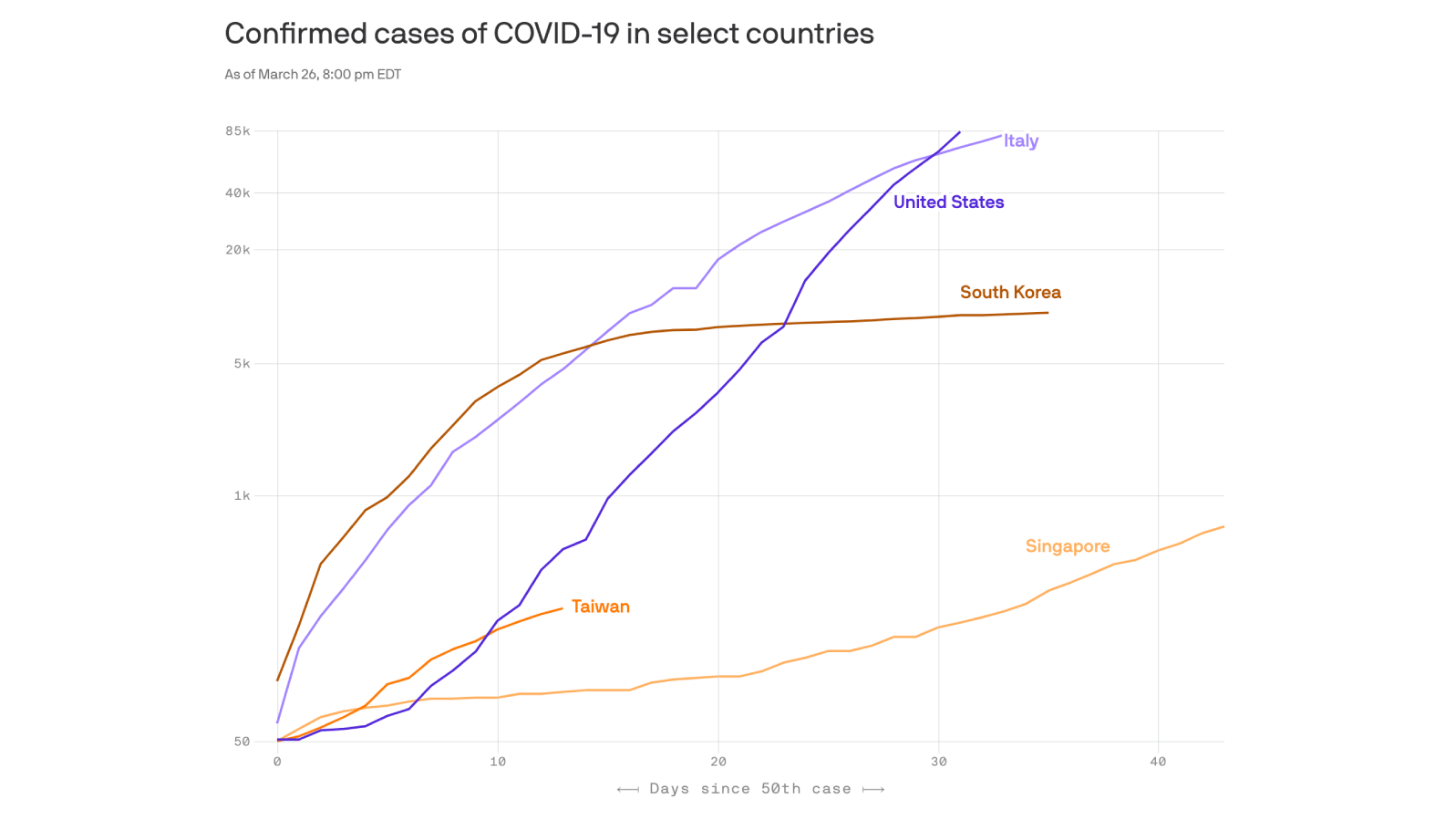
The countries that have most successfully fended off the novel coronavirus have mainly done it with a combination of new technology and old-school principles.

Why it matters: There’s a lot the U.S. can learn from the way other countries have handled this global pandemic — although we may not be able to apply those lessons as quickly as we’d like.

The big picture: A handful of Asian countries, including South Korea, Singapore and Taiwan, have succeeded where the U.S. and Europe have failed.

  • They were able to quickly bring the virus under control, reducing the number of new cases that cropped up each day. And they did it largely without shutting down schools, businesses and public life.

The bad news: It’s too late for the U.S. to simply do what worked in those countries. We’ve already made too many mistakes.

  • But there are still lessons for the U.S. to learn for future outbreaks — and, hopefully, there are some pieces of those countries’ larger strategies that we can adapt to our coronavirus response now.
Lesson 1: The playbook works

As a new infection begins to spread, you want to quickly test the people who might have it, and quarantine the ones who do. Then you want to figure out who else they might have infected, and test those people, and quarantine the ones who are indeed sick. This process gets repeated.

  • “If you don’t know what your population is that you’re supposed to be monitoring, you don’t have a chance,” said Claire Standley, an infectious-disease expert at Georgetown University’s Center for Global Health Science and Security.

This test-and-trace process is nothing new. It’s the standard playbook. South Korea, Singapore and Taiwan just executed it a lot better than the United States.

  • Testing and contact tracing are particularly important with this strain of coronavirus because people can spread it before they start to feel sick — so if you’re only testing the sickest patients, the virus is still spreading unchecked.
  • And it’s important to do this early. It’s a lot easier to stop five people from infecting another 15 than it is to stop 20,000 people from infecting another 60,000.

Next time a mysterious virus starts spreading abroad, better testing and a much faster response will be imperative.

Lesson 2: Technology can help

Singapore has gotten pretty draconian with its track-and-trace process.

  • The government tracks the location of residents’ smartphones, so it knows exactly who had come within a few feet of an infected or potentially infected person.
  • It uses the same location data to help enforce mandatory quarantines.

That might be too Big Brother for the U.S., but a voluntary version of it might work — we already consent to a whole lot of location tracking for much less important ends.

  • And researchers are already using population-level smartphone data to see, for example, which cities are flouting stay-at-home orders. That can help inform local response even without individualized tracking.
  • “I think we’re further along that pathway than maybe people think,” Standley said.

Taiwan, meanwhile, aided its coronavirus response by making better use of data it already had. It quickly merged its immigration and health care databases, giving authorities a real-time view of who was getting sick and where they had traveled.

  • That might be hard to copy in the U.S., though, because the relevant data are scattered across multiple local, state and federal agencies with little to no integration. And we have no centralized health data.
Lesson 3: Messaging matters

Public communication is one of the big things Italy — a leading example of what not to do — got wrong.

  • Some Italian officials downplayed the virus for too long. Leaders often contradicted each other, and sometimes themselves, about piecemeal interventions before finally locking down the entire country as cases skyrocketed.

Singapore, by contrast, came out early with a clear message: This was going to be bad for a while, and people needed to stick together and do their part.

The U.S., so far, looks a lot more like Italy.

  • President Trump has sent similarly mixed messages here, initially downplaying the virus and saying it would go away on its own before changing his tone as cases mounted.
What’s next

The U.S. can’t go back in time to get things right at the beginning. So we can’t match the success of places like South Korea.

  • Our best backup plan is to stick with aggressive social distancing and give our testing capacity more time to ramp up.
  • We don’t seem to be on track to ever achieve the kind of sophisticated track-and-trace programs Asia employed, but hopefully some cruder version can help us find our way out of this if we keep the number of new cases low in the meantime.

The bottom line: “If we had got on top of this thing two months ago, America would look very, very different,” Ashish Jha, director of Harvard’s Global Health Institute, said in a recent interview with the New Yorker.


The U.S. Tried to Build a New Fleet of Ventilators. The Mission Failed.

The U S Tried to Build a New Fleet of Ventilators The Mission ...

As the coronavirus spreads, the collapse of the project helps explain America’s acute shortage.

Thirteen years ago, a group of U.S. public health officials came up with a plan to address what they regarded as one of the medical system’s crucial vulnerabilities: a shortage of ventilators.

The breathing-assistance machines tended to be bulky, expensive and limited in number. The plan was to build a large fleet of inexpensive portable devices to deploy in a flu pandemic or another crisis.

Money was budgeted. A federal contract was signed. Work got underway.

And then things suddenly veered off course. A multibillion-dollar maker of medical devices bought the small California company that had been hired to design the new machines. The project ultimately produced zero ventilators.

That failure delayed the development of an affordable ventilator by at least half a decade, depriving hospitals, states and the federal government of the ability to stock up. The federal government started over with another company in 2014, whose ventilator was approved only last year and whose products have not yet been delivered.

Today, with the coronavirus ravaging America’s health care system, the nation’s emergency-response stockpile is still waiting on its first shipment. The scarcity of ventilators has become an emergency, forcing doctors to make life-or-death decisions about who gets to breathe and who does not.

The stalled efforts to create a new class of cheap, easy-to-use ventilators highlight the perils of outsourcing projects with critical public-health implications to private companies; their focus on maximizing profits is not always consistent with the government’s goal of preparing for a future crisis.

“We definitely saw the problem,” said Dr. Thomas R. Frieden, who ran the Centers for Disease Control and Prevention from 2009 to 2017. “We innovated to try and get a solution. We made really good progress, but it doesn’t appear to have resulted in the volume that we needed.”

The project — code-named Aura — came in the wake of a parade of near-miss pandemics: SARS, MERS, bird flu and swine flu.

Federal officials decided to re-evaluate their strategy for the next public health emergency. They considered vaccines, antiviral drugs, protective gear and ventilators, the last line of defense for patients suffering respiratory failure. The federal government’s Strategic National Stockpile had full-service ventilators in its warehouses, but not in the quantities that would be needed to combat a major pandemic.

In 2006, the Department of Health and Human Services established a new division, the Biomedical Advanced Research and Development Authority, with a mandate to prepare medical responses to chemical, biological and nuclear attacks, as well as infectious diseases.

In its first year in operation, the research agency considered how to expand the number of ventilators. It estimated that an additional 70,000 machines would be required in a moderate influenza pandemic.

The ventilators in the national stockpile were not ideal. In addition to being big and expensive, they required a lot of training to use. The research agency convened a panel of experts in November 2007 to devise a set of requirements for a new generation of mobile, easy-to-use ventilators.

In 2008, the government requested proposals from companies that were interested in designing and building the ventilators.

The goal was for the machines to be approved by regulators for mass development by 2010 or 2011, according to budget documents that the Department of Health and Human Services submitted to Congress in 2008. After that, the government would buy as many as 40,000 new ventilators and add them to the national stockpile.

The ventilators were to cost less than $3,000 each. The lower the price, the more machines the government would be able to buy.

Companies submitted bids for the Project Aura job. The research agency opted not to go with a large, established device maker. Instead it chose Newport Medical Instruments, a small outfit in Costa Mesa, Calif.

Newport, which was owned by a Japanese medical device company, only made ventilators. Being a small, nimble company, Newport executives said, would help it efficiently fulfill the government’s needs.

Ventilators at the time typically went for about $10,000 each, and getting the price down to $3,000 would be tough. But Newport’s executives bet they would be able to make up for any losses by selling the ventilators around the world.

“It would be very prestigious to be recognized as a supplier to the federal government,” said Richard Crawford, who was Newport’s head of research and development at the time. “We thought the international market would be strong, and there is where Newport would have a good profit on the product.”

Federal officials were pleased. In addition to replenishing the national stockpile, “we also thought they’d be so attractive that the commercial market would want to buy them, too,” said Nicole Lurie, who was then the assistant secretary for preparedness and response inside the Department of Health and Human Services. With luck, the new generation of ventilators would become ubiquitous, helping hospitals nationwide better prepare for a crisis.

The contract was officially awarded a few months after the H1N1 outbreak, which the C.D.C. estimated infected 60 million and killed 12,000 in the United States, began to taper off in 2010. The contract called for Newport to receive $6.1 million upfront, with the expectation that the government would pay millions more as it bought thousands of machines to fortify the stockpile.

Project Aura was Newport’s first job for the federal government. Things moved quickly and smoothly, employees and federal officials said in interviews.

Every three months, officials with the biomedical research agency would visit Newport’s headquarters. Mr. Crawford submitted monthly reports detailing the company’s spending and progress.

The federal officials “would check everything,” he said. “If we said we were buying equipment, they would want to know what it was used for. There were scheduled visits, scheduled requirements and deliverables each month.”

In 2011, Newport shipped three working prototypes from the company’s California plant to Washington for federal officials to review.

Dr. Frieden, who ran the C.D.C. at the time, got a demonstration in a small conference room attached to his office. “I got all excited,” he said. “It was a multiyear effort that had resulted in something that was going to be really useful.”

In April 2012, a senior Health and Human Services official testified before Congress that the program was “on schedule to file for market approval in September 2013.” After that, the machines would go into production.

Then everything changed.

The medical device industry was undergoing rapid consolidation, with one company after another merging with or acquiring other makers. Manufacturers wanted to pitch themselves as one-stop shops for hospitals, which were getting bigger, and that meant offering a broader suite of products. In May 2012, Covidien, a large medical device manufacturer, agreed to buy Newport for just over $100 million.

Covidien — a publicly traded company with sales of $12 billion that year — already sold traditional ventilators, but that was only a small part of its multifaceted businesses. In 2012 alone, Covidien bought five other medical device companies, in addition to Newport.

Newport executives and government officials working on the ventilator contract said they immediately noticed a change when Covidien took over. Developing inexpensive portable ventilators no longer seemed like a top priority.

Newport applied in June 2012 for clearance from the Food and Drug Administration to market the device, but two former federal officials said Covidien had demanded additional funding and a higher sales price for the ventilators. The government gave the company an additional $1.4 million, a drop in the bucket for a company Covidien’s size.

Government officials and executives at rival ventilator companies said they suspected that Covidien had acquired Newport to prevent it from building a cheaper product that would undermine Covidien’s profits from its existing ventilator business.

Some Newport executives who worked on the project were reassigned to other roles. Others decided to leave the company.

“Up until the time the company sold, I was really happy and excited about the project,” said Hong-Lin Du, Newport’s president at the time of its sale. “Then I was assigned to a different job.”

In 2014, with no ventilators having been delivered to the government, Covidien executives told officials at the biomedical research agency that they wanted to get out of the contract, according to three former federal officials. The executives complained that it was not sufficiently profitable for the company.

The government agreed to cancel the contract. The world was focused at the time on the Ebola outbreak in West Africa. The research agency started over, awarding a new contract for $13.8 million to the giant Dutch company Philips. In 2015, Covidien was sold for $50 billion to another huge medical device company, Medtronic. Charles J. Dockendorff, Covidien’s former chief financial officer, said he did not know why the contract had fallen apart. “I am not aware of that issue,” he said in a text message.

Robert J. White, president of the minimally invasive therapies group at Medtronic who worked at Covidien during the Newport acquisition, initially said he had no recollection of the Project Aura contract. A Medtronic spokeswoman later said that Mr. White was under the impression that the contract had been winding down before Covidien bought Newport.

In a statement Sunday night, after the article was published, Medtronic said, “The prototype ventilator, developed by Newport Medical, would not have been able to meet the specifications required by the government, nor at the price required.” Medtronic said that one problem was that the machine was not going to be usable with newborns.

It wasn’t until last July that the F.D.A. signed off on the new Philips ventilator, the Trilogy Evo. The government ordered 10,000 units in December, setting a delivery date in mid-2020.

As the extent of the spread of the new coronavirus in the United States became clear, Dr. Anthony S. Fauci, director of the National Institute of Allergy and Infectious Diseases, revealed on March 15 that the stockpile had 12,700 ventilators ready to deploy. The government has since sped up maintenance to increase the number available to 16,660 — still fewer than a quarter of what officials years earlier had estimated would be required in a moderate flu pandemic.

Last week, the Health and Human Services Department contacted ventilator makers to see how soon they could produce thousands of machines. And it began pressing Philips to speed up its planned shipments.

The stockpile is “still awaiting delivery of the Trilogy Evo,” a Health and Human Services spokeswoman said. “We do not currently have any in inventory, though we are expecting them soon.”


Small hospitals’ bailout concerns

https://www.axios.com/newsletters/axios-vitals-61745839-012e-4bd1-8843-24917a73b6e2.html?utm_source=newsletter&utm_medium=email&utm_campaign=newsletter_axiosvitals&stream=top

Country Closures: Rural Communities Adapt As More Hospitals Shut Down

Congress is about to provide $100 billion for hospitals and other health care providers to cope with the fallout from the coronavirus, but small hospitals have no idea how to access those funds — and many need the money immediately, Axios’ Bob Herman reports.

What they’re saying: “A lot of rural hospitals out there need a cash infusion today,” Alan Morgan, CEO of the National Rural Health Association, told Axios. “How is it going to happen? What is the process? There are way more questions than answers.”

Details: The stimulus bill says “the Secretary of Health and Human Services shall, on a rolling basis, review applications and make payments” to hospitals and other providers, out of a $100 billion fund.

  • HHS did not respond to questions about how that process would work.

Between the lines: Many hospitals are part of large, profitable systems that benefit from their area’s demographics. The coronavirus will cause them financial distress, but they are not in danger of going under.

  • Rural and safety net hospitals, which treat disproportionate amounts of older and low-income patients, have a lot less wiggle room to call off elective procedures as they wait for a coronavirus surge.
  • Many small hospitals can’t get new loans from banks and could miss payroll as soon as next week.

The bottom line: Bob asked Morgan how this process was supposed to work. “I don’t know,” he said, “and we are greatly concerned.”


BIG PHARMA PREPARES TO PROFIT FROM THE CORONAVIRUS

Big Pharma Prepares to Profit From the Coronavirus

Image result for BIG PHARMA PREPARES TO PROFIT FROM THE CORONAVIRUS

AS THE NEW CORONAVIRUS spreads illness, death, and catastrophe around the world, virtually no economic sector has been spared from harm. Yet amid the mayhem from the global pandemic, one industry is not only surviving, it is profiting handsomely.

“Pharmaceutical companies view Covid-19 as a once-in-a-lifetime business opportunity,” said Gerald Posner, author of “Pharma: Greed, Lies, and the Poisoning of America.” The world needs pharmaceutical products, of course. For the new coronavirus outbreak, in particular, we need treatments and vaccines and, in the U.S., tests. Dozens of companies are now vying to make them.

“They’re all in that race,” said Posner, who described the potential payoffs for winning the race as huge. The global crisis “will potentially be a blockbuster for the industry in terms of sales and profits,” he said, adding that “the worse the pandemic gets, the higher their eventual profit.”

The ability to make money off of pharmaceuticals is already uniquely large in the U.S., which lacks the basic price controls other countries have, giving drug companies more freedom over setting prices for their products than anywhere else in the world. During the current crisis, pharmaceutical makers may have even more leeway than usual because of language industry lobbyists inserted into an $8.3 billion coronavirus spending package, passed last week, to maximize their profits from the pandemic.

Initially, some lawmakers had tried to ensure that the federal government would limit how much pharmaceutical companies could reap from vaccines and treatments for the new coronavirus that they developed with the use of public funding. In February, Rep. Jan Schakowsky, D-Ill., and other House members wrote to Trump pleading that he “ensure that any vaccine or treatment developed with U.S. taxpayer dollars be accessible, available and affordable,” a goal they said couldn’t be met “if pharmaceutical corporations are given authority to set prices and determine distribution, putting profit-making interests ahead of health priorities.”

When the coronavirus funding was being negotiated, Schakowsky tried again, writing to Health and Human Services Secretary Alex Azar on March 2 that it would be “unacceptable if the rights to produce and market that vaccine were subsequently handed over to a pharmaceutical manufacturer through an exclusive license with no conditions on pricing or access, allowing the company to charge whatever it would like and essentially selling the vaccine back to the public who paid for its development.”

But many Republicans opposed adding language to the bill that would restrict the industry’s ability to profit, arguing that it would stifle research and innovation. And although Azar, who served as the top lobbyist and head of U.S. operations for the pharmaceutical giant Eli Lilly before joining the Trump administration, assured Schakowsky that he shared her concerns, the bill went on to enshrine drug companies’ ability to set potentially exorbitant prices for vaccines and drugs they develop with taxpayer dollars.

The final aid package not only omitted language that would have limited drug makers’ intellectual property rights, it specifically prohibited the federal government from taking any action if it has concerns that the treatments or vaccines developed with public funds are priced too high.

“Those lobbyists deserve a medal from their pharma clients because they killed that intellectual property provision,” said Posner, who added that the language prohibiting the government from responding to price gouging was even worse. “To allow them to have this power during a pandemic is outrageous.”

The truth is that profiting off public investment is also business as usual for the pharmaceutical industry. Since the 1930s, the National Institutes of Health has put some $900 billion into research that drug companies then used to patent brand-name medications, according to Posner’s calculations. Every single drug approved by the Food and Drug Administration between 2010 and 2016 involved science funded with tax dollars through the NIH, according to the advocacy group Patients for Affordable Drugs. Taxpayers spent more than $100 billion on that research.

Among the drugs that were developed with some public funding and went on to be huge earners for private companies are the HIV drug AZT and the cancer treatment Kymriah, which Novartis now sells for $475,000.

In his book “Pharma,” Posner points to another example of private companies making exorbitant profits from drugs produced with public funding. The antiviral drug sofosbuvir, which is used to treat hepatitis C, stemmed from key research funded by the National Institutes of Health. That drug is now owned by Gilead Sciences, which charges $1,000 per pill — more than many people with hepatitis C can afford; Gilead earned $44 billion from the drug during its first three years on the market.

“Wouldn’t it be great to have some of the profits from those drugs go back into public research at the NIH?” asked Posner.

Instead, the profits have funded huge bonuses for drug company executives and aggressive marketing of drugs to consumers. They have also been used to further boost the profitability of the pharmaceutical sector. According to calculations by Axios, drug companies make 63 percent of total health care profits in the U.S. That’s in part because of the success of their lobbying efforts. In 2019, the pharmaceutical industry spent $295 million on lobbying, far more than any other sector in the U.S. That’s almost twice as much as the next biggest spender — the electronics, manufacturing, and equipment sector — and well more than double what oil and gas companies spent on lobbying. The industry also spends lavishly on campaign contributions to both Democratic and Republican lawmakers. Throughout the Democratic primary, Joe Biden has led the pack among recipients of contributions from the health care and pharmaceutical industries.

Big Pharma’s spending has positioned the industry well for the current pandemic. While stock markets have plummeted in reaction to the Trump administration’s bungling of the crisis, more than 20 companies working on a vaccine and other products related to the new SARS-CoV-2 virus have largely been spared. Stock prices for the biotech company Moderna, which began recruiting participants for a clinical trial of its new candidate for a coronavirus vaccine two weeks ago, have shot up during that time.

On Thursday, a day of general carnage in the stock markets, Eli Lilly’s stock also enjoyed a boost after the company announced that it, too, is joining the effort to come up with a therapy for the new coronavirus. And Gilead Sciences, which is at work on a potential treatment as well, is also thriving. Gilead’s stock price was already up since news that its antiviral drug remdesivir, which was created to treat Ebola, was being given to Covid-19 patients. Today, after Wall Street Journal reported that the drug had a positive effect on a small number of infected cruise ship passengers, the price went up further.

Several companies, including Johnson & Johnson, DiaSorin Molecular, and QIAGEN have made it clear that they are receiving funding from the Department of Health and Human Services for efforts related to the pandemic, but it is unclear whether Eli Lilly and Gilead Sciences are using government money for their work on the virus. To date, HHS has not issued a list of grant recipients. And according to Reuters, the Trump administration has told top health officials to treat their coronavirus discussions as classified and excluded staffers without security clearances from discussions about the virus.

Former top lobbyists of both Eli Lilly and Gilead now serve on the White House Coronavirus Task Force. Azar served as director of U.S. operations for Eli Lilly and lobbied for the company, while Joe Grogan, now serving as director of the Domestic Policy Council, was the top lobbyist for Gilead Sciences.


Confronting a national emergency over coronavirus

https://mailchi.mp/325cd862d7a7/the-weekly-gist-march-13-2020?e=d1e747d2d8

Image result for national emergency

President Trump declared a national emergency today, in response to the growing spread of coronavirus across the country. The administration had come under sharp criticism for its sluggish response to the coronavirus crisis, in particular the widespread shortage of tests. Dr. Antony Fauci, director of the National Institute of Health’s infectious disease branch, told Congress on Thursday that the government’s response on testing was “not really geared to what we need right now…That’s a failing. Let’s admit it.”

In response, the administration today announced a series of emergency steps to increase testing capacity, turning to private labs to support the effort. The emergency status frees up $50B in federal emergency funding. Trump also announced that the Health and Human Services (HHS) Secretary will be able to waive regulations around telemedicine licensing, critical access hospital bed requirements and length of stay, and other measures to provide hospitals with added flexibility. House Speaker Nancy Pelosi and Treasury Secretary Steven Mnuchin have negotiated a sweeping aid package that would strengthen safety net programs, and offer sick leave for American workers affected by the virus.

Meanwhile, the American economy likely entered a recession, as consumers continued to pull back on spending on airline travel, entertainment, and other discretionary areas, while financial markets experienced the worst one-day drop in more than 30 years. Many school districts and universities shut down and announced plans to convert to online instruction for the foreseeable future. Employers imposed broad travel restrictions on their employees, moved to teleworking where possible, and even began to lay off workers as demand for services cratered. Shoppers stocked up on staples, cleaning supplies, and (inexplicably) toilet paper, as shelves ran bare in many stores.

Epidemiologists and disease experts urged broad adoption of “social distancing”, restricting large gatherings and reducing the ability of the virus to spread person-to-person. The objective: “flattening the curve” of transmission, so that the healthcare delivery system does not become overwhelmed as the virus spreads exponentially.


Winners and losers of the HHS interoperability final rule

https://www.beckershospitalreview.com/ehrs/winners-and-losers-of-the-hhs-interoperability-final-rule.html?utm_medium=email

Image result for HHS interoperability final rule

HHS released its much-anticipated final rules on EHR interoperability, ruling against “information blocking” tactics by EHR vendors and giving patients more control over their medical records.

The new rule will be applied over the next two years and will make patient records downloadable to smartphones using consumer apps. Overall, members of the healthcare industry applaud these efforts to make patient information more accessible to improve healthcare delivery. However, there are privacy concerns around how patient data can be used once downloaded to third-party consumer apps that weren’t addressed in the final rule.

Here is a brief list of a few potential winners and losers of the new rule.


WINNERS

Patients. Patients now have more control over their medical records and will be able to access them through third-party apps for free, which will make it easier for them to take their medical records to new providers outside of their previous provider’s system. As a result, they will have more choice in where they go for healthcare.

Hospitals and physicians. The lengthy process of trying to convert a patient’s medical records will be unnecessary. Patients will no longer need to have their medical records faxed between healthcare facilities in different networks and the rule will streamline workflow around gathering patient data to provide the best possible care. Hospitals participating in Medicare and Medicaid will also be able to send electronic notifications to other facilities or providers when a patient is admitted, transferred or discharged under its new “Coordination of Participation” rule.

App developers and health IT startups. App developers that allow patients to store their health data and medical information will have access to that data, a virtual gold mine. The federal privacy protections limiting how providers and insurers share medical records do not apply when patients transfer data to consumer apps, according to the New York Times.

Apple and Microsoft. Healthcare providers will be required to send medical data in a format that is compatible on third-party apps including Apple Health Records. Microsoft is also working to sell technology in the health sector, and the new rule will make it easier, according to CNBC.


LOSERS

Patients. While the rule has many benefits to patients, there is also potential for disaster. Patients who download their medical information on consumer apps may find their information shared or sold. There could also be additional security issues if those apps are hacked. Finally, some patients may become confused by their medical records and notes if the information isn’t stated clearly, causing further anxiety around their care.

Hospitals and clinics. Patient leakage may become more common if it’s easier for patients to take their medical records with them. Healthcare organizations will also need to prepare for an influx of patient data and have strong governance procedures in place as they partner with payers and other organizations to incorporate clinical data with patient-gathered data and potentially social determinants of health data.

EHR vendors. EHR companies must now adopt application programming interfaces so their systems can communicate with third-party apps. EHR companies have two years to comply and face up to $1 million per violation for engaging in “information blocking.” The new focus on interoperability may also pave the way for competitors to gain market share over the two most dominant players, Epic and Cerner.

Epic. Epic was a notable opponent to the HHS interoperability rules, citing patient privacy concerns. If forced to collaborate with other companies, Epic could potentially lose its edge over competitors, according to an op-ed written by former HHS Secretary Tommy Thompson in the Wisconsin State Journal. He contended Epic would have to “give its trade secrets away to venture capitalists, Big Tech, Silicon Valley interests and overseas competitors for little or no compensation.” Epic is also the most dominant EHR, holding 28 percent of the acute care hospital market, which could be threatened by greater interoperability. However, in response to the final rule’s release, Epic issued a statement saying that it would focus on “standards-based scope for meaningful interoperability.”


Congress releases $8.3B coronavirus funding package. Here’s what’s in it

https://www.fiercehealthcare.com/hospitals-health-systems/congress-releases-8-3b-coronavirus-funding-package-here-s-what-s-it?mkt_tok=eyJpIjoiWXpZek1tWm1NakprWTJaaSIsInQiOiJFYkFWWlwvYzc5c09JOWNiV1ZmSXlqclZsSU5RYnNBQ1NGd2EyQTdiYUdoa3BpV2ZwMTlyZ0xwcWNSNkthZ0pnbDRxR0IrWGNwZmFrcDhWQ3FjNkdzSUx6YTRKM3RHVWhPaitCXC8wRE5rRHM1a3dSRVBNTFdodnBiY0tkclQxSTVRIn0%3D&mrkid=959610

Image result for Congress releases $8.3B coronavirus funding package. Here's what's in it

Congress is expected to pass a major $8.3 billion spending package to help providers and local governments handle the spread of the coronavirus and to boost the development of vaccines and tests of the virus.

Here are key parts of the spending package released Wednesday:

  • $500 million for an emergency telehealth waiver. The bill would waive certain Medicare restrictions for telehealth, including that a Medicare beneficiary can use telehealth services even if they aren’t in a rural community. “This provision would also allow beneficiaries to receive care from physicians and other practitioners in their homes,” a summary of the package said;
  • $2.2 billion to the Centers for Disease Control and Prevention to help state and local health agencies. The funding would include a provision to reimburse state or local costs for coronavirus response and preparedness activities from Jan. 20 to the end of this supplemental;
  • Nearly $1 billion to buy drugs and medical supplies. This procurement will include $500 million for drugs, masks and personal protective equipment that can be distributed to state and local health agencies in areas that are in shortage. It also includes funding for increasing the supply of biocontainment beds, which are secured areas used for patients with highly contagious diseases; and
  • More than $3 billion to support the research and development of vaccines, diagnostics and other treatments for the coronavirus. Any vaccine or diagnostic developed via taxpayer funds must also “be available for purchase by the federal government at a fair and reasonable price,” the summary said. The bill also enables the Department of Health and Human Services to ensure any vaccine or diagnostic can be affordable in the commercial market, but doesn’t elaborate on how.

The package sailed through the House on Wednesday and could be taken up quickly by the Senate.

Provider groups bracing for a coronavirus outbreak praised the spending package.

“This bill will provide essential assistance to caregivers and communities on the front lines of this battle,” said Chip Kahn, president and CEO of the Federation of American Hospitals, in a statement.