$100B federal hospital aid won’t fully compensate lost revenue, Moody’s says

https://www.beckershospitalreview.com/finance/100b-federal-hospital-aid-won-t-fully-compensate-lost-revenue-moody-s-says.html?utm_medium=email

Moodys | HENRY KOTULA

The $2 trillion federal coronavirus aid package signed into law that includes $100 billion for nonprofit hospitals won’t completely cover the revenue hospitals will lose as a result of the pandemic, Moody’s Investors Service wrote in an April 3 note.

While the aid package includes several provisions like compensation for lost revenue, increased Medicare reimbursement and advances on future Medicare reimbursement, cash flow at nonprofit hospitals will still likely be materially lower for the next several months. Postponed services alone are likely to reduce hospital revenue by 25 percent to 40 percent a month on average, Moody’s said, a reduction that is affecting even hospitals that aren’t treating large COVID-19 case loads.

“The $100 billion aid package provides some relief to hospitals by supporting their operations and providing access to critical supplies,” Dan Steingart, vice president at Moody’s, said. “However, it is unlikely to fully compensate the sector for the two main financial challenges facing providers as a result of the coronavirus outbreak. The first is a material decline in revenue and cash flow as profitable elective surgeries, procedures and other services are postponed to preserve resources and avoid spreading the virus. The second is difficulty curbing expenses as surge preparation costs offset any expense reductions from postponed or canceled services.”

Moody’s maintained its negative outlook on nonprofit hospitals. 


MUSC Health lays off 900 due to COVID-19 financial strain

https://www.beckershospitalreview.com/finance/musc-health-lays-off-900-due-to-covid-19-financial-strain.html?utm_medium=email

The Agenda: MUSC laying off 900 amid financial strain; McMaster's ...

MUSC Health, an eight-hospital system based in Charleston, S.C., is laying off about 900 employees and reducing pay for salaried workers to help offset financial damage caused by the COVID-19 pandemic.

Like many other health systems across the U.S., MUSC Health is facing financial pressure from canceling elective procedures and other nonemergent care. As a result, the health system has experienced a significant decline in surgical volumes, inpatient visits and ambulatory encounters.

MUSC Health announced April 6 that it has taken several steps to diminish continued financial damage caused by the pandemic. Those steps include delaying capital expenditures, reducing contractual services, transitioning 80 percent of outpatient visits to telehealth, reducing employee compensation and layoffs.

MUSC Health is laying off about 900 employees, roughly 5 percent of its more than 17,000-person workforce. The layoffs, which the health system described as “temporary,” were effective April 7, according to The Post and Courier. The layoffs will not affect frontline healthcare workers, MUSC Health CEO Patrick Cawley, MD, said during an April 6 press conference, according to the report.

The health system is also reducing pay for full-time salaried workers and its leadership team by 15 percent and 20 percent, respectively. Salary adjustments take effect next week.

“It is also important to emphasize that at this time, frontline health care team members, who have already seen fewer work hours due to COVID-19 response, will not see any additional pay cuts so that MUSC Health can continue to be prepared to face the public health crisis as it unfolds,” the health system said April 6.

MUSC Health said it is evaluating state and federal COVID-19 aid proposals, but not all of the proposed benefits apply to MUSC Health. “There are no guarantees on the timing or amount of these funds that MUSC Health may receive,” the system said.


During a Pandemic, an Unanticipated Problem: Out-of-Work Health Workers

https://www.yahoo.com/news/during-pandemic-unanticipated-problem-health-150355070.html
Jordan Schachtel on Twitter: "The people at The New York Times are ...

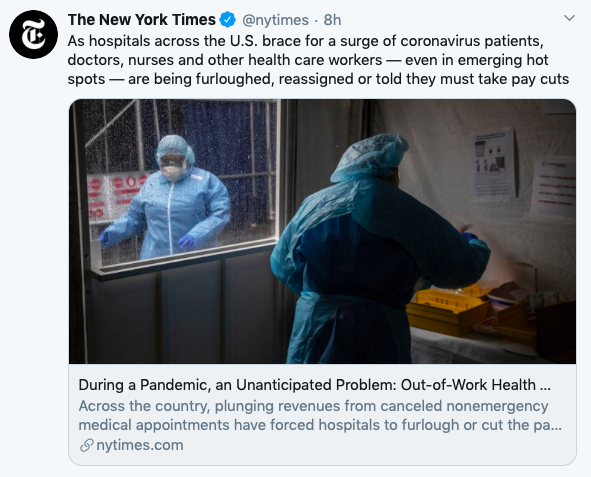
As hospitals across the country brace for an onslaught of coronavirus patients, doctors, nurses and other health care workers — even in emerging hot spots — are being furloughed, reassigned or told they must take pay cuts.

The job cuts, which stretch from Massachusetts to Nevada, are a new and possibly urgent problem for a business-oriented health care system whose hospitals must earn revenue even in a national crisis. Hospitals large and small have canceled many elective services — often under state government orders — as they prepare for the virus, sending revenues plummeting.

That has left trained health care workers sidelined, even in areas around Detroit and Washington, where infection rates are climbing, and even as hard-hit hospitals are pleading for help.

“I’m 46. I’ve never been on unemployment in my life,” said Casey Cox, who three weeks ago worked two jobs, one conducting sleep research at the University of Michigan and another as a technician at the St. Joseph Mercy Chelsea Hospital near Ann Arbor, Michigan. Within a week, he had lost both.

Mayor Bill de Blasio of New York has begged doctors and other medical workers from around the country to come to the city to help in areas where the coronavirus is overwhelming hospitals.

“Unless there is a national effort to enlist doctors, nurses, hospital workers of all kinds and get them where they are needed most in the country in time, I don’t see, honestly, how we’re going to have the professionals we need to get through this crisis,” de Blasio said Friday morning on MSNBC.

And the Department of Veterans Affairs is scrambling to hire health care workers for its government-run hospitals, especially in hard-hit New Orleans and Detroit, where many staff members have fallen ill. The department moved to get a federal waiver to hire retired medical workers to beef up staff levels.

But even as some hospitals are straining to handle the influx of coronavirus patients, empty hospital beds elsewhere carry their own burden.

“We’re in trouble,” said Gene Morreale, the chief executive of Oneida Health Hospital in upstate New York, which has not yet seen a surge in coronavirus patients.

Governors in dozens of states have delivered executive orders or guidelines directing hospitals to stop nonurgent procedures and surgeries to various degrees. Last month, the U.S. surgeon general, Dr. Jerome M. Adams, also implored hospitals to halt elective procedures.

That has left many health systems struggling to survive.

Next week, Morreale said, Oneida will announce that it is putting 25% to 30% of its employees on involuntary furlough. They will have access to their health insurance through June. Physicians and senior staff at the hospital have taken a 20% pay cut.

“We’ve been here 121 years, and I’m hoping we’re still there on the other side of this,” Morreale said.

Appalachian Regional Healthcare, a 13-hospital system in eastern Kentucky and southern West Virginia, has seen a 30% decrease in its overall business because of a decline in patient volume and services related to the pandemic. Last week, the hospital system announced it would furlough about 8% of its workforce — around 500 employees.

Hospital executives across the country are cutting pay while also trying to repurpose employees for other jobs.

At Intermountain Healthcare, which operates 215 clinics and 24 hospitals in Utah, Idaho and Nevada, about 600 of the 2,600 physicians, physicians assistants and registered nurses who are compensated based on volume will see their pay dip by about 15%, said Daron Cowley, a company spokesman.

Those reductions are tied to the drop in procedures, which has fallen significantly for some specialties, he said. The organization is working to preserve employment as much as possible, in part by trying to deploy 3,000 staff members into new roles.

“You have an endoscopy tech right now that may be deployed to be at hospital entrances” where they would take the temperatures of people coming in, Cowley explained.

In Boston, a spokesman for Partners HealthCare, with 12 hospitals, including Massachusetts General and Brigham and Women’s, said staff members whose work has decreased are being deployed to other areas or will be paid for up to eight weeks if no work is available.

But redeployment is not always an option. Janet Conway, a spokeswoman for Cape Fear Valley Health System in Fayetteville, North Carolina, said many of the company’s operating room nurses trained in specialized procedures have been furloughed because their training did not translate to other roles.

“Those OR nurses, many have never worked as a floor nurse,” she said.

Conway said nearly 300 furloughed staff members have the option to use their paid time off, but beyond that, the furlough would be unpaid. Most employees are afforded 25 days per year.

Some furloughed hospital workers are likely to be asked to return as the number of coronavirus cases rise in their communities. But the unpredictable virus has offered little clarity and left hospitals, like much of the economy, in a free fall.

Many health systems are making direct cuts to their payrolls, eliminating or shrinking performance bonuses and prorating paychecks to mirror reduced workload until operations stabilize.

Scott Weavil, a lawyer in California who counsels physicians and other health care workers on employment contracts, said he was hearing from doctors across the country who were being asked to take pay cuts of 20% to 70%.

The requests are coming from hospital administrators or private physician groups hired by the hospitals, he said, and are essentially new contracts that doctors are being asked to sign.

Many of the contracts do not say when the cuts might end, and are mostly affecting doctors who are not treating coronavirus patients on the front lines, such as urologists, rheumatologists, bariatric surgeons, obstetricians and gynecologists.

Such doctors are still being asked to work — often in a decreased capacity — yet may be risking their health going into hospitals and clinics.

“It’s just not sitting well,” Weavil said, noting that he tells doctors they unfortunately have few options if they want to work for their institution long term.

“If you fight this pay cut, administration could write your name down and remember that forever,” he said he tells them.

In other cases, physicians are continuing to find opportunities to practice in a more limited capacity, like telemedicine appointments. But that has not eliminated steep pay cuts.

“Physicians are only paid in our clinic based on their productivity in the work they do,” said Dr. Pam Cutler, the president of Western Montana Clinic in Missoula. “So they’re automatically taking a very significant — usually greater than 50% or 25% — pay cut just because they don’t have any work.”

In some areas, layoffs have left behind health care workers who worry that they will not be able to find new roles or redeploy their skills.

Cox in Michigan said he was briefly reassigned at his hospital, helping screen and process patients coming in with coronavirus symptoms, but eventually the people seeking reassignments outgrew the number of roles.

He also expressed concern that inevitable changes in the health care industry after the pandemic — paired with the possibility of a lengthy period of unemployment — could make it difficult to get his job back.

“I’m just concerned that the job I got laid off from may not be there when this is over,” Cox said. “The longer you’re away, the more you worry, ‘Am I going to be able to come back?’ So there’s a lot of anxiety about it.”

Even as many of the largest hospital networks grapple with sudden financial uncertainty, much smaller practices and clinics face a more immediate threat.

According to a statistical model produced by HealthLandscape and the American Academy of Family Physicians, by the end of April, nearly 20,000 family physicians could be fully out of work, underemployed or reassigned elsewhere, particularly as cities like New York consider large-scale, emergency reassignments of physicians.

“Many of these smaller practices were living on a financial edge to start with, so they’re not entering into this in a good position at all,” said Dr. Gary Price, the president of the Physicians Foundation. “Their margins are narrower, their patients don’t want to come in, and many of them shouldn’t anyway, so their cash flow has been severely impacted and their overhead really hasn’t.”


Quorum says it may have to file for bankruptcy

https://www.healthcaredive.com/news/quorum-10k-delay-bankruptcy-warning/575491/

Dive Brief:

  • For-profit hospital operator Quorum Health said in a recent filing with the Securities and Exchange Commission that it may have to file for Chapter 11 bankruptcy to address current liquidity needs while continuing to care for patients and keep its hospitals operating.
  • The company said it’s in ongoing discussions with certain debt holders concerning a recapitalization or financial reorganization transaction.
  • Quorum also announced in the SEC filing that it will be late to file its annual 10-K report, covering financials for its fiscal year ending December 31, 2019.

Dive Insight:

COVID-19 has upended hospitals’ typical operations, prompting many to halt lucrative elective surgeries and cancel doctors visits to preserve staff and resources. Some worry those patients and revenue may never come back as unemployment claims go up and people lose their employer-sponsored health coverage. 

Tennessee-based Quorum Health, which operates 24 hospitals in 14 states, may have already been more ill-positioned financially than other systems for such a pandemic.

Quorum missed Wall Street earnings expectations in its most recent financials for the third quarter of 2019, posting a net loss of almost $76 million and a revenue decline almost 9% year over year. The company now said it’s delaying its 10K report with its most recent financials due to restructuring talks, but has 15 days to do so.

The for-profit chain went public in May 2016 with 38 hospitals – 14 of which have since shuttered. In 2017 private equity firm KKR took a 5.6% stake in the system for $11.3 million. 

Beyond being Quorum’s largest debt-holder today, KKR also owns about 9% of its public shares. In December, the firm offered to buy Quorum out and take the hospital chain private at $1 a share.

While negotiating with debt holders and weighing its options, Quorum intends to maintain all operations at its hospitals without any interruption in service, CEO Robert Fish said in a statement.

“Our facilities play a critically important role in their communities and the fight against COVID-19,” Fish said. “We are intensely focused on ensuring our employees have the resources they need to provide quality care to the patients and communities they serve, now and well into the future.”


California Hospitals Face Surge With Proven Fixes And Some Hail Marys

https://khn.org/news/california-hospitals-face-surge-with-proven-fixes-and-some-hail-marys/

California Hospitals Face Surge With Proven Fixes And Some Hail ...

California’s hospitals thought they were ready for the next big disaster.

They’ve retrofitted their buildings to withstand a major earthquake and  whisked patients out of danger during deadly wildfires. They’ve kept patients alive with backup generators amid sweeping power shutoffs and trained their staff to thwart would-be shooters.

But nothing has prepared them for a crisis of the magnitude facing hospitals today.

“We’re in a battle with an unseen enemy, and we have to be fully mobilized in a way that’s never been seen in our careers,” said Dr. Stephen Parodi, an infectious disease expert for Kaiser Permanente in California. (Kaiser Health News, which produces California Healthline, is not affiliated with Kaiser Permanente.)

As California enters the most critical period in the state’s battle against COVID-19, the state’s 416 hospitals — big and small, public and private — are scrambling to build the capacity needed for an onslaught of critically ill patients.

Hospitals from Los Angeles to San Jose are already seeing a steady increase in patients infected by the virus, and so far, hospital officials say they have enough space to treat them. But they also issued a dire warning: What happens over the next four to six weeks will determine whether the experience of California overall looks more like that of New York, which has seen an explosion of hospitalizations and deaths, or like that of the San Francisco Bay Area, which has so far managed to prevent a major spike in new infections, hospitalizations and death.

Some of their preparations share common themes: Postpone elective surgeries. Make greater use of telemedicine to limit face-to-face contact. Erect tents outside to care for less critical patients. Add beds — hospital by hospital, a few dozen at a time — to spaces like cafeterias, operating rooms and decommissioned wings.

But by necessity — because of shortages of testing, ventilators, personal protective equipment and even doctors and nurses — they’re also trying creative and sometimes untried strategies to bolster their readiness and increase their capacity.

In San Diego, hospitals may use college dormitories as alternative care sites. A large public hospital in Los Angeles is turning to 3D printing to manufacture ventilator parts. And in hard-hit Santa Clara County, with a population of nearly 2 million, public and private hospitals have joined forces to alleviate pressure on local hospitals by caring for patients at the Santa Clara Convention Center.

Yet some hospitals acknowledge that, despite their efforts, they may end up having to park patients in hallways.

“The need in this pandemic is so different and so extraordinary and so big that a hospital’s typical surge plan will be insufficient for what we’re dealing with in this state and across the nation,” said Carmela Coyle, president and CEO of the California Hospital Association.

Across the U.S., more than 213,000 cases of COVID-19 have been confirmed, and at least 4,750 people have died. California accounts for more than 9,400 cases and at least 199 deaths.

Health officials and hospital administrators are singling out April as the most consequential month in California’s effort to combat a steep increase in new infections. State Health and Human Services Secretary Mark Ghaly said Wednesday that the number of hospitalizations is expected to peak in mid-May.

Gov. Gavin Newsom said there were 1,855 COVID-19 cases in hospitals Wednesday, a number that had tripled in six days, and 774 patients in critical care. By mid-May, the number of critical care patients is expected to climb to 27,000, he said.

Newsom said the state needs nearly 70,000 more hospital beds, bringing its overall capacity to more than 140,000 — both inside hospitals and also at alternative care sites like convention centers. The state also needs 10,000 more ventilators than it normally has to aid the crush of patients needing help to breathe, he said, and so far has acquired fewer than half.

Newsom and state health officials worked with the Trump administration to bring a naval hospital ship to the Port of Los Angeles, where it is already treating patients not infected with the novel coronavirus. The state is working with the Army Corps of Engineers to deploy eight mobile field hospitals, including one in Santa Clara County. And it is bringing hospitals back online that were shuttered or slated to close, including one each in Daly City, Los Angeles, Long Beach and Costa Mesa.

The governor is also drafting a plan to make greater use of hotels and motels and nursing homes to house patients, if needed.

But the size of the surge that hits hospitals depends on how well the public follows social distancing and stay-at-home orders, said Newsom and hospital administrators. “This is not just about health care providers caring for the sick,” said Dr. Steve Lockhart, the chief medical officer of Sutter Health, which has 22 hospitals across Northern California.

While hospitals welcomed the state assistance, they’re also undertaking dramatic measures to prepare on their own.

“I’m genuinely very worried, and it scares me that so many people are still out there doing business as usual,” said Chris Van Gorder, CEO of Scripps Health, a system with five major hospitals in San Diego County. “It wouldn’t take a lot to overwhelm us.”

Internal projections show the hospital system could need 8,000 beds by June, he said. It has 1,200.

In addition to taking precautions to protect its health care workers — such as using baby monitors to observe patients without risking infection — it is working with area colleges to use dorm rooms as hospital rooms for patients with mild cases of COVID-19, among other efforts, he said.

“Honestly, I think we should have been better prepared than we are,” Van Gorder said. “But hospitals cannot take on this burden themselves.”

Van Gorder and other hospital administrators say a continued shortage of COVID-19 tests has hampered their response — because they still don’t know exactly which patients have the virus — as has the chronic underfunding of public health infrastructure.

Kaiser Permanente wants to double the capacity of its 36 California hospitals, Parodi said. It is also working with the garment industry to manufacture face masks, and eyeing hotel rooms for less critical patients.

Harbor-UCLA Medical Center, a 425-bed safety-net hospital in Los Angeles, is working to increase its capacity by 200%, said Dr. Anish Mahajan, the hospital’s chief medical officer.

Harbor-UCLA is using 3D printers to produce ventilator piping equipped to serve two patients per machine. And in March it transformed a new emergency wing into an intensive care unit for COVID-19 patients.

“This was a shocking thing to do,” Mahajan said of the unprecedented move to create extra space.

He said some measures are untested, but hospitals across the state are facing extreme pressure to do whatever they can to meet their greatest needs.

In March, Stanford Hospital in the San Francisco Bay Area launched a massive telemedicine overhaul of its emergency department to reduce the number of employees who interact with patients in person. This is the first time the hospital has used telemedicine like this, said Dr. Ryan Ribeira, an emergency physician who spearheaded the project.

Stanford also did some soul-searching, thinking about which of its staff might be at highest risk if they catch COVID-19, and has assigned them to parts of the hospital with no coronavirus patients or areas dedicated to telemedicine. “These are people that we might have otherwise had to drop off the schedule,” Ribeira said.

Nearby, several San Francisco hospitals that were previously competitors have joined forces to create a dedicated COVID-19 floor at Saint Francis Memorial Hospital with four dozen critical care beds.

The city currently has 1,300 beds, including 200 ICU beds. If the number of patients surges as it has in New York, officials anticipate needing 5,000 additional beds.

But the San Francisco Bay Area hasn’t yet seen the expected surge. UCSF Health had 15 inpatients with COVID-19 Tuesday. Zuckerberg San Francisco General Hospital and Trauma Center had 18 inpatients with the disease Wednesday.

While hospital officials are cautiously optimistic that local and state stay-at-home orders have worked to slow the spread of the virus, they are still preparing for what could be a major increase in admissions.

“The next two weeks is when we’re really going to see the surge,” said San Francisco General CEO Susan Ehrlich. “We’re preparing for the worst but hoping for the best.”


Already Taxed Health Care Workers Not ‘Immune’ From Layoffs And Less Pay

https://khn.org/news/already-taxed-health-care-workers-not-immune-from-layoffs-and-less-pay/

Already Taxed Health Care Workers Not 'Immune' From Layoffs And ...

Just three weeks ago, Dr. Kathryn Davis worried about the coronavirus, but not about how it might affect her group of five OB-GYNs who practice at a suburban hospital outside Boston.

“In medicine we think we’re relatively immune from the economy,” Davis said. “People are always going to get sick; people are always going to need doctors.”

Then, two weeks ago, she watched her practice revenue drop 50% almost overnight after Massachusetts officials told doctors and hospitals to stop performing elective tests and procedures. For Davis, that meant no more non-urgent gynecological visits and screenings.

Late last week, as Davis and her partners absorbed the stunning turn of events, they devised a stopgap plan. The 35 nurses, medical assistants and secretaries they employ would have two options: move from full-time to part-time status or start collecting unemployment. Doctors in the practice would take a substantial pay cut. Davis said she’s hearing from colleagues who may have to permanently close their offices if the focus on crisis-level care continues for months.

“It’s shocking,” she said. “Everyone has been blindsided.”

Atrius Health, the largest independent physician group in Massachusetts, said patient volume is down 75% since mid-March. It is temporarily closing offices, placing many nonclinical employees on furlough and withholding pay for those who remain. The average withholding is 20%, and the company pledges that pay withheld will be returned. The lowest-paid workers, those earning up to $55,000, are exempt.

“What we’re trying to do is piece together a solution to get through the crisis and keep employed as many people as we can,” said Dr. Steven Strongwater, Atrius Health’s CEO.

Atrius cares for 745,000 patients in clinics that often include primary care, specialists, radiology and a pharmacy under one roof.

Strongwater said physician groups must be included when the federal government distributes $100 billion to hospitals from the $2 trillion stimulus package.

It’s not clear if that money will stop the tide of layoffs and lost pay at hospitals as well as in doctor’s offices. A Harvard Medical School physician group will suspend retirement contributions starting April 1.

Beth Israel Lahey Health, the second-largest hospital network in Massachusetts, announced executive pay cuts Monday.

“The suspension of elective procedures and decline in visits to our primary care practices and urgent care centers have resulted in financial challenges,” wrote CEO Dr. Kevin Tabb in an email to employees. Tabb said he would take a 50% salary cut. Other executives and hospital presidents in the system will forgo 20% of their salaries for the next three months.

“Although executive leadership compensation is being reduced, we will never compromise on doing the things that are essential to protect your safety and the safety of our patients,” Tabb told staff.

Dallas-based Steward Health Care has told hospital employees in Massachusetts and eight other states where it operates to expect furloughs focused on nonclinical staff. In a statement, Steward Health Care said it prepared for the pandemic but is experiencing a “seismic financial shock.”

“Elective surgeries are the cornerstone of our hospital system’s operating model — and the negative impact due to the cancellations of these procedures cannot be overstated. In addition, patients are understandably cautious and choosing to defer any nonemergency treatments or routine visits until this crisis has passed.”

Dr. Kaarkuzhali Babu Krishnamurthy, an assistant professor of neurology at Harvard Medical School who studies medical ethics, said employers need to think more carefully about the ethics of asking doctors and nurses to live on less when many are working longer hours and putting the health of their families at risk.

“At a time when health care systems are calling on doctors and nurses to do more, this is not the time to be making it more difficult to do that,” said Krishnamurthy.

There’s talk of redeploying laid-off health care workers to new COVID-19 units opening in shuttered hospitals or to patient overflow sites. Tim Foley, executive vice president for the largest health care union in Massachusetts, 1199SEIU, is promoting the development of a staff registry.

“It is more important, now more than ever, to explore all options to maintain the level of urgent care needed across the state and we look forward to working with all stakeholders to do just that,” Foley said in an email.


Coronavirus will radically alter the U.S.

https://www.washingtonpost.com/health/2020/03/19/coronavirus-projections-us/?fbclid=IwAR1pOgBLGSYRzL11KbzXjyZuqHpNPFOnE8wwNzmCrAKX4w3S_VX9cVlo3O8&utm_campaign=wp_main&utm_medium=social&utm_source=facebook

Image result for Coronavirus will radically alter the U.S.

Here’s what may lie ahead based on math models, hospital projections and past pandemics.

When Jason Christie, chief of pulmonary medicine at Penn Medicine, got projections on how many coronavirus patients might soon be flocking to his Philadelphia hospital, he said he felt physically ill.

“My front-line providers — we were speaking about it in the situation report that night, and their voices cracked,” Christie said on Wednesday. They saw how quickly the surge would overwhelm the system, forcing doctors to make impossible choices — which patients would get ventilators and beds, and which would die.

“They were terrified. And that was the best-case scenario.”

Experts around the country have been churning out model after model — marshaling every tool from math, medicine, science and history — to try to predict the coming chaos unleashed by the new coronavirus and to make preparations.

At the heart of their algorithms is a scary but empowering truth: What happens next depends largely on us — our government, politicians, health institutions and, in particular, 327 million inhabitants of this country — all making tiny decisions on an daily basis with outsize consequences for our collective future.

In the worst-case scenario, America is on a trajectory toward 1.1 million deaths. That model envisions the sick pouring into hospitals, overwhelming even makeshift beds in parking lot tents. Doctors would have to make agonizing decisions about who gets scarce resources. Shortages of front-line clinicians would worsen as they get infected, some dying alongside their patients. Trust in government, already tenuous, would erode further.

That grim scenario is by no means a foregone conclusion — as demonstrated by countries like South Korea which has reduced its new cases a day from hundreds to dozens with aggressive steps to bolster their health system.

If Americans embrace drastic restrictions and school closures, for instance, we could see a death toll closer to thousands and a national sigh of relief as we prepare for a grueling but surmountable road ahead.

An alarming new model

Doing that will require Americans to “flatten the curve” — slowing the spread of the contagion so it doesn’t overwhelm a health-care system with finite resources. That phrase has become ubiquitous in our national conversation. But what experts have not always made clear is that by applying all that downward pressure on the curve — by canceling public gatherings, closing schools, quarantining the sick and enforcing social distancing — you elongate the curve, stretching it out over a longer period of time.

Success means a longer — though less catastrophic — fight against the coronavirus. And it is unclear whether Americans — who built this country on ideals of independence and individual rights — would be willing to endure such harsh restrictions on their lives for months, let alone for a year or more.

This month began with U.S. officials recommending actions such as hand-washing and social distancing. By Sunday, the Centers for Disease Control and Prevention was warning against gatherings of 50-plus people. By Monday, President Trump had made an abrupt turn from encouraging Americans to go on with their lives, to urging them to work from home, not meet in groups of more than 10, and calling on local officials to close schools, bars and restaurants. (Getting the public to comply has been alarmingly difficult. Young revelers from Bourbon Street to Miami have ignored those pleas, as have some elderly, who are at highest risk.)

Trump’s sudden shift was driven by an alarming new scientific model, developed by British epidemiologists and shared with the White House. The scientists bluntly stated the coronavirus is the most serious respiratory virus threat since the Spanish Flu of 1918. If no action to limit the viral spread were taken, as many as 2.2 million people in the United States could die over the course of the pandemic, according to epidemiologist Neil Ferguson and others at the Imperial College Covid-19 Response Team.

Adopting some mitigation strategies to slow the pandemic — such as isolating those suspected of being infected and social distancing of the elderly — only cuts the death toll in half to 1.1 million, although it would reduce demand for health services by two-thirds.

Image result for coronavirus suppression scenarios

Only by enacting an entire series of drastic, severe restrictions could America shrink its death toll further, the study found. That strategy would require, at minimum, the nationwide practice of social distancing, home isolation, and school and university closures. Such restrictions would have to be maintained, at least intermittently, until a working vaccine is developed, which could take 12 to 18 months at best.

The report’s conclusion: This is “the only viable strategy.”

What hospital planning tells us

Here is another thing that hasn’t been spelled out in our national conversation about flattening the curve: There will probably be more than one curve.

If we’re lucky, the coming months will probably look more like string of hilly bumps, say epidemiologists. If authorities ease some measures in coming months or if we start letting them slip ourselves, that hill could easily turn right back into the exponential curve that has cratered Italy’s health system and that U.S. officials are desperately trying to avoid replicating.

Climbing this first bump is in many ways the most challenging because it involves persuading people to change their individual behaviors for an abstract larger good — and because no one knows how far we actually are from the peak.

On Tuesday morning, New York Gov. Andrew M. Cuomo (D) said infections in his state are expected to peak in 45 days — at the start of May. The state has roughly 53,000 hospital beds, including 3,000 intensive-care beds — way short of the projected need for as many as twice that number of beds and as many as 11 times the number of ICU beds.

A day earlier, Northwell Health — whose 23 hospitals and 800 outpatient centers make up New York’s largest health system — canceled all elective surgeries in its hospitals to free up staff and space. It has 5,500 beds.

“We’re looking at Italy, which is currently 10 days ahead of us, and what they’ve had to do,” said Maria Carney, Northwell’s chief of geriatrics. Carney was health commissioner for New York’s Nassau County during the 2009 H1N1 outbreak and has worked furiously on Northwell’s plans to prepare for the coming tsunami.

One reason she and others are alarmed: In China, the fatality rate in Wuhan, the raging epicenter, was 5.8 percent. But in all other areas of the country it was 0.7 percent — a signal that most deaths were driven by an overwhelmed health system.

And U.S. hospitals are pinched as it is, with some already running at 95 percent capacity pre-coronavirus, Carney noted. As cases surge, Northwell plans to place multiple beds in single rooms. Its ambulances will also shuttle patients to less crowded satellite sites. Those suffering from ordinary emergencies — strokes, heart attacks, car accidents — may find themselves routed to other facilities away from ERs to avoid transmission.

But it’s unclear if it will be anywhere near enough.

Staffing shortages are already developing: As of Tuesday, 18 Northwell employees had already tested positive for the coronavirus. More than 200 were self-quarantined as a result of potential exposures, foreshadowing what is likely to come.

If the numbers next month get truly crazy, cities may look to convert stadiums into isolation wards, as in Wuhan. Cuomo has talked of turning the six-block-long Javits Convention Center on New York City’s west side into a medical surge facility. Others might take Italy’s approach and split hospitals into those treating coronavirus and those treating all other medical problems, to reduce transmission.

In San Francisco, we may see coronavirus patients put into RVs. In Takoma Park, Md., the old Washington Adventist Hospital site, which shuttered in 2019, could suddenly find its doors reopened.

‘Pandemics aren’t just physical’

As America enters this utterly unfamiliar territory, some experts have turned to history for glimpses of what to expect in the months ahead.

Initially leery of alarming the public, they have increasingly compared this pandemic to the 1918 Spanish flu, the deadliest in modern history. It infected roughly a third of the world’s population and killed at least 50 million people, including at least 675,000 in the United States.

Like the hilly bumps experts foresee in coming months, the 1918 pandemic hit America in three waves — a mild one that spring, the deadliest wave in fall and a final one that winter.

With each wave came a cycle of denial, devastation, community response finally kicking into overdrive — always followed by finger-pointing and blame among leaders and the public.

“Every outbreak is different,” said medical anthropologist Monica Schoch-Spana, who spent months digging through archives to study how Spanish flu played out in Baltimore.

Like coronavirus is likely to do, the 1918 flu overwhelmed hospitals. Unable to get help, desperate families waited outside to beg and try to bribe doctors for treatment. In a three-week period, 2,000 died in Baltimore alone. Mortuaries ran out of caskets. When the bodies finally reached cemeteries, the gravediggers were so ill, no one could bury the dead.

Economic pressure on business owners and workers caused public resistance to adopt — and stick with restrictions. The crisis brought out the best in Baltimoreans — with sewing circles churning out gauze masks and hospital bedding, and neighbors donating food and services.

But it also brought out the worst — xenophobic conspiracy theories that nurses of “German extraction” were deliberately infecting people. African American patients were kept out of most hospitals under Jim Crow-era segregation.

“Pandemics aren’t just physical,” said Schoch-Spana. “They bring with them an almost shadow pandemic of psychological and societal injuries as well.”

The power of the individual

Stanford virologist Karla Kirkegaard said she has tried to stave off dread from the projected U.S. death toll with a case study she teaches in her classes:

Amid a cholera outbreak in mid-19th century London, as panicked residents fled one hard-hit neighborhood, a doctor named John Snow calmly entered the breach. He deduced that the source of hundreds of deaths was a single contaminated water pump and persuaded authorities to remove the pump’s handle — a strategy that ended the outbreak.

Controlling the covid-19 pandemic will take much more than a single water pump, Kirkegaard acknowledged as she sheltered in place at her Bay Area home.

But the story, she said, reminds her how powerful the simple act of one individual can be.


Health providers seek at least $1B in next coronavirus stimulus bill

https://thehill.com/policy/healthcare/487813-providers-ask-for-at-least-1-billion-for-next-coronavirus-stimulus-bill

Health providers seek at least $1B in next coronavirus stimulus bill

Lawmakers should allocate at least another $1 billion in emergency funding for the coronavirus response, according to a letter from health care provider groups to congressional leaders.

The letter from the American Hospital Association, American Medical Association and American Nurses Association urged lawmakers to ensure that the next economic stimulus package includes funding to ensure that hospitals, health systems, physicians and nurses are “directly supported” for preparedness response.

The groups said the additional funding is needed for specific priorities, including ramping up infection controls, increasing the number of patient beds, building or retrofitting separate areas to screen and treat coronavirus patients and obtaining scarce protection supplies like masks and ventilators.

The groups also said hospitals and nurses need financial support because of the impact of canceling elective surgeries and procedures due to shortages of protective equipment, as well as patient fears.

“Such cancellations could have devastating financial implications for hospitals, physicians and nurses already at financial risk and may limit access to care,” the groups wrote.

The House early Saturday passed legislation aimed at mitigating the economic impact of the coronavirus epidemic, including provisions that would ensure that workers can take paid sick or family leave, bolster unemployment insurance and guarantee that all Americans can get free diagnostic testing for the coronavirus.

The Senate is expected to vote on the bill later this week, as the House still needs to pass “technical” corrections.