Medicaid Is Essential for Workers

Medicaid Is Essential for Workers as COVID-19 Spreads

Earlier this year, when public schools in Kansas City, Missouri, shut down in-person instruction because of the COVID-19 pandemic, Nika Cotton quit her job in social work to start her own business. She has two young children — ages 8 and 10 — and no one to watch them if she were to continue working a traditional job.

It was a big decision, made weightier by the loss of her employer-sponsored health insurance. But on August 5, Cotton awoke to the news that Missouri voters had narrowly approved the expansion of the state’s Medicaid program via ballot initiative, making it the second politically right-leaning state to do so during the pandemic. The expansion opens Medicaid eligibility to individuals and families with incomes up to 138% of the federal poverty guidelines, which are $12,760 for an individual and $21,720 for a family of three, allowing Cotton’s family of three to qualify.

“It takes a lot of stress off of my shoulders with having to think about how I’m going to take care of myself, how I’m going to be able to go and see a doctor and get the health care I need while I’m starting my business,” she told Alex Smith of KCUR, the NPR affiliate in Kansas City.

Nearly 1,264,000 voters weighed in on the measure, with 53% voting for it and 47% against it. Missouri’s Republican governor Mike Parson opposed it, arguing that the state could not afford the coverage expansion — even though the federal government pays 90% of the costs and a fiscal analysis (PDF) by the Center for Health Economics and Policy at Washington University estimated that the state would save $39 million if it implemented Medicaid expansion in 2020.

The ballot measure requires the state to expand Medicaid by July 2021, and an estimated 230,000 residents with low incomes will become eligible for affordable health coverage.

Voters Signal Support

In late June, Oklahoma voters also approved Medicaid expansion by ballot measure, eking out a victory by less than one percentage point.

“It is difficult to ignore that these ballot initiatives passed in right-leaning states in the middle of the coronavirus pandemic, when millions of Americans have lost their jobs and, with them, their employer-sponsored health insurance,” Dylan Scott wrote in Vox. “This is partly a coincidence — the signatures were collected to put the Medicaid expansion questions on the ballot long before COVID-19 ever arrived in the US — but the relatively narrow margins made me wonder if the pandemic and its economic and medical consequences proved decisive.”

Earlier this year, Scott spoke to Cynthia Cox, MPH, director of the Peterson-Kaiser Health System Tracker, about the potential impact of the pandemic on health care politics. “Many of the biggest coverage expansions both in the US and in similar countries happened in the context of wars and social upheavals, as well as financial crises,” Cox said. “One theory is that those circumstances redefine social solidarity, thus expanding views of the role of government.”

Between February and May, Missouri’s Medicaid program saw enrollment rise nearly 9%, one of the largest increases nationwide during the pandemic, Rachel Roubein reported in Politico. During that same period, Oklahoma’s Medicaid program saw enrollment increase by about 6%.

States that implemented Medicaid expansion are better positioned to respond to COVID-19, according to a report by the Center on Budget and Policy Priorities (CBPP). These states entered the health crisis and resulting economic downturn with lower uninsured rates, which is important for public health “because people who are uninsured may forgo testing or treatment for COVID-19 due to concerns that they cannot afford it, endangering their health while slowing detection of the virus’ spread,” the authors wrote.

CBPP and KFF estimate that 3.6 to 4.4 million uninsured adults would become eligible for Medicaid coverage if the 12 states that have not yet expanded the program did so. Those states are Alabama, Florida, Georgia, Kansas, Mississippi, North Carolina, South Carolina, South Dakota, Tennessee, Texas, Wisconsin, and Wyoming.

Coverage for Frontline Essential Workers

Medicaid is particularly important for frontline essential workers — such as those working in grocery stores, meat processing plants, and nursing homes — during the pandemic. Their jobs require them to report in person, increasing their risk of getting sick with the coronavirus as they interact with coworkers and, in many cases, with customers and patients. Essential workers are often paid low wages and not offered employer-sponsored health insurance or can’t afford the premiums for it.

About 5 million essential workers nationwide get health coverage through Medicaid, “including nearly 1.8 million people working in frontline health care services and 1.6 million in other frontline essential services including transportation, waste management, and child care,” Matt Broaddus, senior research analyst at CBPP, wrote on the center’s blog.

In California, over 950,000 essential workers are enrolled in Medi-Cal, the state’s Medicaid program. People of color are overrepresented in many categories of essential jobs. According to a UC Berkeley Labor Center analysis of the 15 largest frontline essential occupations, Latinx workers are overrepresented in agriculture, construction, and food preparation, among other occupations. Asian workers are overrepresented among registered nurses and personal care aides; and Black workers are overrepresented among personal care aides, laborers and material movers, and office clerks.

In addition to low-wage workers, Medi-Cal continues to bridge the coverage gap for other key populations amid the COVID-19 crisis, which is magnifying historical health inequities. (Medi-Cal covers nearly 40% of the state’s children, half of Californians with disabilities, and over one million seniors. For a refresher on the program, see CHCF’s Medi-Cal Explained series.)

Medicaid Saves Lives

Research has shown time and time again the varied benefits of Medicaid expansion: lower mortality rates among older adults with low incomes, declines in infant mortality, reductions in racial disparities in the care of cancer patients, and fewer personal bankruptcies, just to name a few.

Even though Missouri’s Medicaid expansion won’t take effect for another year, Nika Cotton remains excited. “It’s better late than never,” she said. “The fact that it’s coming is better than nothing” — perhaps a takeaway for the remaining 12 states.



Cartoon – What does your mask say about you?

Jim Morrissey: What does your coronavirus mask say about you ...

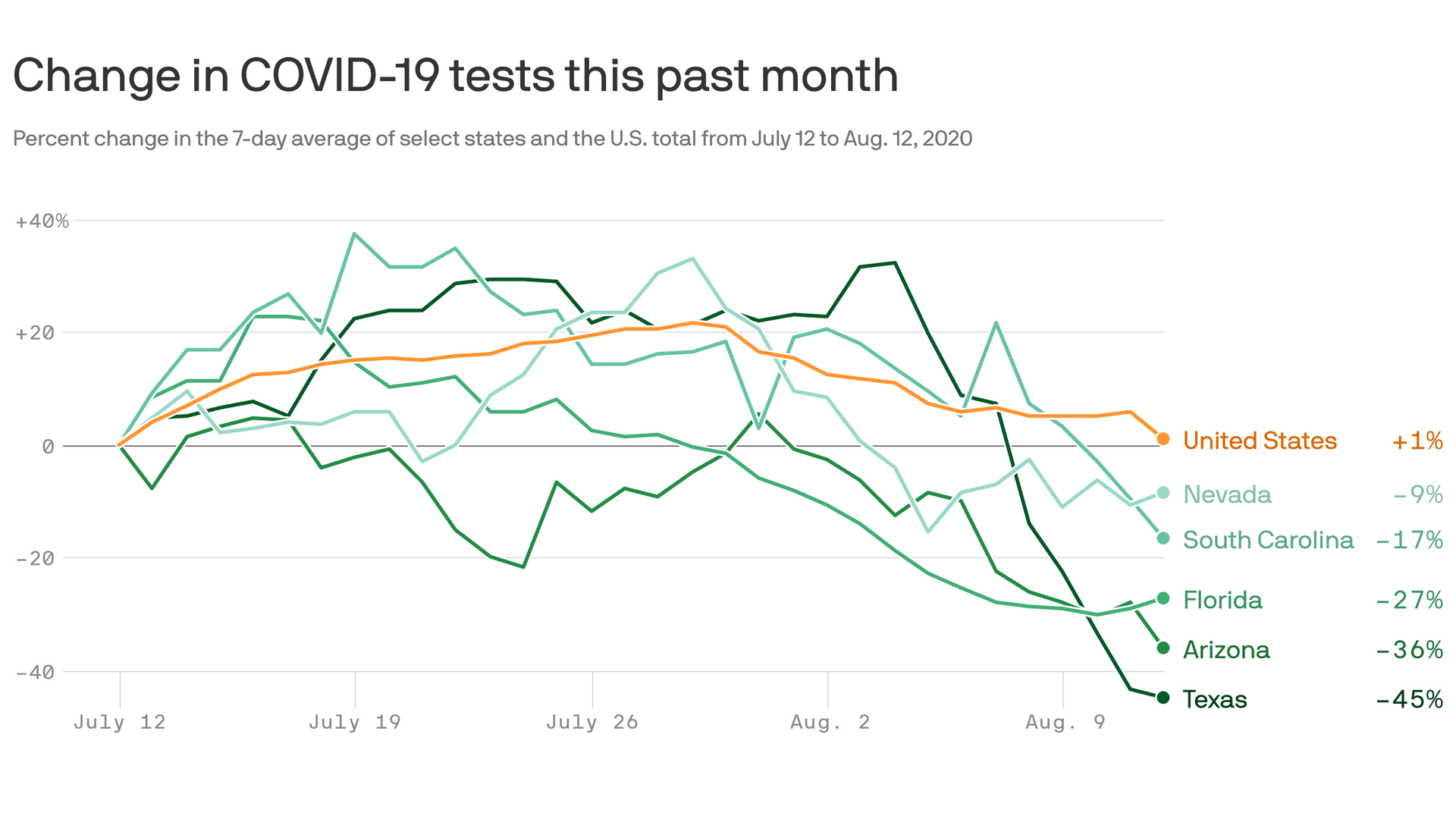
U.S. doing a lot less coronavirus testing

https://www.axios.com/newsletters/axios-vitals-32689a40-e409-4547-8468-b03dc589c082.html

The two sides of America's coronavirus response - Axios

The U.S. is cutting back on coronavirus testing. Nationally, the number of tests performed each day is about 17% lower than it was at the end of July, and testing is also declining in hard-hit states.

Why it matters: This big reduction in testing has helped clear away delays that undermined the response to the pandemic. But doing fewer tests can also undermine the response to the pandemic.

By the numbers: At the end of July, America was doing more than 800,000 tests a day. This week, it’s hovered around 715,000.

  • Even as states with particularly bad outbreaks pull back on their testing, the proportion of tests coming back positive is still high — which would normally be an indication that they need to be doing more tests.
  • In Texas, 19% of tests are coming back positive, according to Nephron Research. In Florida, the rate of positive tests is 18%, and in Nevada, 17%.

Yes, but: Experts have said reducing the demand for testing may be the best way to alleviate long delays, which made tests all but useless. And that appears to be working.

Driving the news: The Department of Health and Human Services estimated this week that nearly 90% of all tests are being completed within three days — a big improvement from turnaround times that had been stretching well over a week.

  • Quest Diagnostics says its expected turnaround time is now 2–3 days, and less for priority patients. LabCorp announced a similar turnaround time last week.

The bottom line: The U.S. is averaging 50,000 new cases a day, and that high caseload is ultimately why the demand for testing is more than the system can handle.

  • We can’t get our caseload under control without fast, widespread testing, but we can’t achieve fast, widespread testing with such a high caseload.


Rely on the science and avoid the politics, Fauci says

https://www.cnn.com/2020/08/12/health/us-coronavirus-wednesday/index.html?utm_source=nl&utm_brand=wired&utm_mailing=WIR_Science_081220&utm_campaign=aud-dev&utm_medium=email&utm_term=WIR_Science&bxid=5db707423f92a422eaeaf234&cndid=54318659&esrc=bounceX&source=EDT_WIR_NEWSLETTER_0_SCIENCE_ZZ

Science Day

Although practices like wearing face coverings have been politicized, Dr. Anthony Fauci said Tuesday he has learned that in order to be a good public health leader in a crisis, you have to divorce yourself from politics, rely on science and be as transparent as possible.

“Completely divorce yourself from the kind of political undertones that sometimes go into an important outbreak like this,” Fauci, director of the National Institute of Allergy and Infectious Diseases, said as he was honored with a 2020 Citizen Leadership Award on Tuesday night by the Aspen Institute.
“You’ve got to stay away from that, lead by example, be perfectly honest and don’t be afraid to say you don’t know something when you don’t know it. I find that to be a very good formula when you’re dealing in a crisis.”
Even with the polarization, every state in the US passed at least one physical distancing measure in March to slow the spread, researchers from Harvard University and University College London said. Those measures worked, a new study found.
Physical distancing resulted in a reduction of more than 600,000 cases within just three weeks, according to the study, published Tuesday in the journal PLOS. Had there not been preventative interventions, the models suggest up to 80% of Americans would have been infected with Covid-19.
“In short, these measures work, and policy makers should use them as an arrow in their quivers to get on top of local epidemics where they are not responding to containment measures,” said the study’s co-author Dr. Mark J. Siedner in a news release.


‘A Smoking Gun’: Infectious Coronavirus Retrieved From Hospital Air

A Smoking Gun': Infectious Coronavirus Retrieved From Hospital Air ...

Airborne virus plays a significant role in community transmission, many experts believe. A new study fills in the missing piece: Floating virus can infect cells.

Skeptics of the notion that the coronavirus spreads through the air — including many expert advisers to the World Health Organization — have held out for one missing piece of evidence: proof that floating respiratory droplets called aerosols contain live virus, and not just fragments of genetic material.

Now a team of virologists and aerosol scientists has produced exactly that: confirmation of infectious virus in the air.

“This is what people have been clamoring for,” said Linsey Marr, an expert in airborne spread of viruses who was not involved in the work. “It’s unambiguous evidence that there is infectious virus in aerosols.”

A research team at the University of Florida succeeded in isolating live virus from aerosols collected at a distance of seven to 16 feet from patients hospitalized with Covid-19 — farther than the six feet recommended in social distancing guidelines.

The findings, posted online last week, have not yet been vetted by peer review, but have already caused something of a stir among scientists. “If this isn’t a smoking gun, then I don’t know what is,” Dr. Marr tweeted last week.

But some experts said it still was not clear that the amount of virus recovered was sufficient to cause infection.

The research was exacting. Aerosols are minute by definition, measuring only up to five micrometers across; evaporation can make them even smaller. Attempts to capture these delicate droplets usually damage the virus they contain.

“It’s very hard to sample biological material from the air and have it be viable,” said Shelly Miller, an environmental engineer at the University of Colorado Boulder who studies air quality and airborne diseases.

“We have to be clever about sampling biological material so that it is more similar to how you might inhale it.”

Previous attempts were stymied at one step or another in the process. For example, one team tried using a rotating drum to suspend aerosols, and showed that the virus remained infectious for up to three hours. But critics argued that those conditions were experimental and unrealistic.

Other scientists used gelatin filters or plastic or glass tubes to collect aerosols over time. But the force of the air shrank the aerosols and sheared the virus. Another group succeeded in isolating live virus, but did not show that the isolated virus could infect cells.

In the new study, researchers devised a sampler that uses pure water vapor to enlarge the aerosols enough that they can be collected easily from the air. Rather than leave these aerosols sitting, the equipment immediately transfers them into a liquid rich with salts, sugar and protein, which preserves the pathogen.

“I’m impressed,” said Robyn Schofield, an atmospheric chemist at Melbourne University in Australia, who measures aerosols over the ocean. “It’s a very clever measurement technique.”

As editor of the journal Atmospheric Measurement Techniques, Dr. Schofield is familiar with the options available, but said she had not seen any that could match the new one.

The researchers had previously used this method to sample air from hospital rooms. But in those attempts, other floating respiratory viruses grew faster, making it difficult to isolate the coronavirus.

This time, the team collected air samples from a room in a ward dedicated to Covid-19 patients at the University of Florida Health Shands Hospital. Neither patient in the room was subject to medical procedures known to generate aerosols, which the W.H.O. and others have contended are the primary source of airborne virus in a hospital setting.

The team used two samplers, one about seven feet from the patients and the other about 16 feet from them. The scientists were able to collect virus at both distances and then to show that the virus they had plucked from the air could infect cells in a lab dish.

The genome sequence of the isolated virus was identical to that from a swab of a newly admitted symptomatic patient in the room.

The room had six air changes per hour and was fitted with efficient filters, ultraviolet irradiation and other safety measures to inactivate the virus before the air was reintroduced into the room.

That may explain why the researchers found only 74 virus particles per liter of air, said John Lednicky, the team’s lead virologist at the University of Florida. Indoor spaces without good ventilation — such as schools — might accumulate much more airborne virus, he said.

But other experts said it was difficult to extrapolate from the findings to estimate an individual’s infection risk.

“I’m just not sure that these numbers are high enough to cause an infection in somebody,” said Angela Rasmussen, a virologist at Columbia University in New York.

“The only conclusion I can take from this paper is you can culture viable virus out of the air,” she said. “But that’s not a small thing.”

Several experts noted that the distance at which the team found virus is much farther than the six feet recommended for physical distancing.

“We know that indoors, those distance rules don’t matter anymore,” Dr. Schofield said. It takes about five minutes for small aerosols to traverse the room even in still air, she added.

The six-foot minimum is “misleading, because people think they are protected indoors and they’re really not,” she said.

That recommendation was based on the notion that “large ballistic cannonball-type droplets” were the only vehicles for the virus, Dr. Marr said. The more distance people can maintain, the better, she added.

The findings should also push people to heed precautions for airborne transmission like improved ventilation, said Seema Lakdawala, a respiratory virus expert at the University of Pittsburgh.

“We all know that this virus can transmit by all these modes, but we’re only focusing on a small subset,” Dr. Lakdawala said.

She and other experts noted one strange aspect of the new study. The team reported finding just as much viral RNA as they did infectious virus, but other methods generally found about 100-fold more genetic matter.

“When you do nasal swabs or clinical samples, there is a lot more RNA than infectious virus,” Dr. Lakdawala said.

Dr. Lednicky has received emails and phone calls from researchers worldwide asking about that finding. He said he would check his numbers again to be sure.

But ultimately, he added, the exact figures may not matter. “We can grow the virus from air — I think that should be the important take-home lesson,” he said.


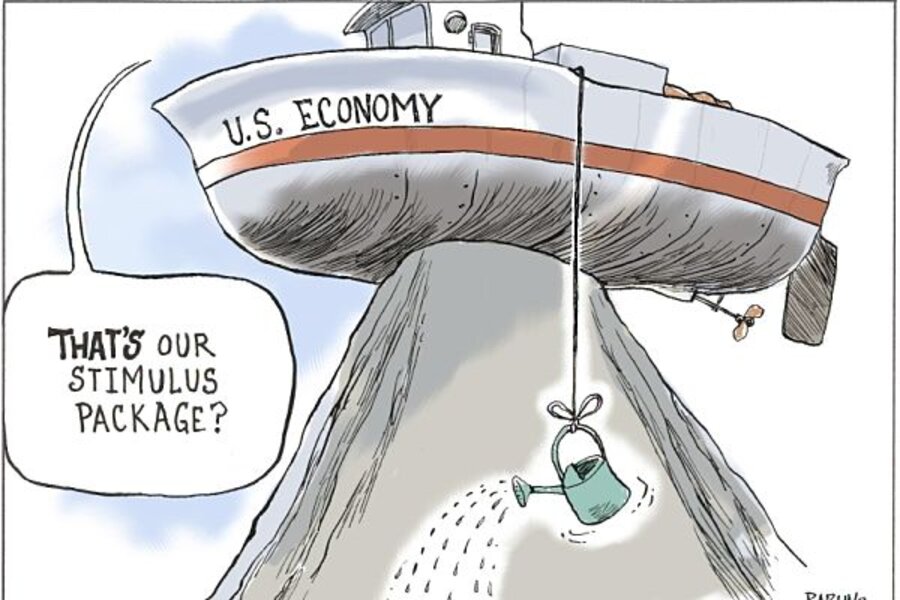
Cartoon – New Economic Stimulus Package

Obama's stimulus did NOT raise government spending - CSMonitor.com

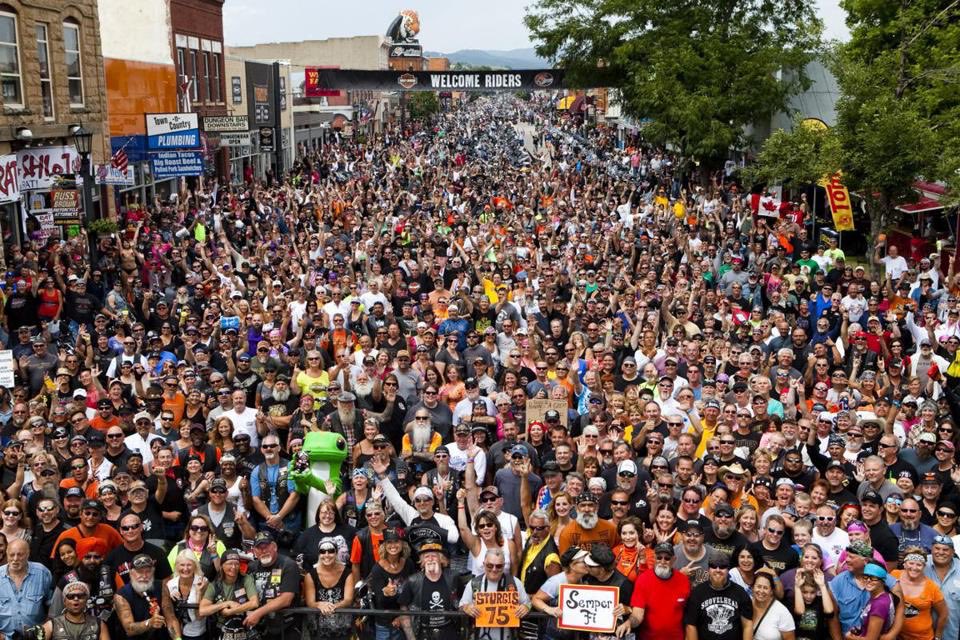
60% of Sturgis residents were against a motorcycle rally that brings in thousands but the city approved it. Here’s why

https://www.cnn.com/2020/08/10/us/sturgis-motorcycle-rally-residents-decision

Steven J. Frisch on Twitter: "I'm fearful of what is to come, as ...

Before deciding on whether to hold the 80th annual motorcycle rally in Sturgis, South Dakota, the local city council turned to its residents to get their take.

“There was a significant amount of discussion that the council had with residents, businesses and state health officials as well as local health officials,” Daniel Ainslie, the city manager, told CNN Sunday.
The city, home to fewer than 7,000, sent a survey to all households asking if they wanted the rally to proceed on its scheduled date. The massive event usually brings in crowds of about 500,000 over 10 days of drag races, contests and concerts. On its 75th anniversary, nearly three quarters of a million people showed.
A little more than 60% of people in the city voted against holding the event this week. But the city council approved it anyway.

https://www.washingtonpost.com/arts-entertainment/2020/08/10/smash-mouth-coronavirus-concert/?utm_campaign=wp_main&utm_medium=social&utm_source=facebook&fbclid=IwAR0EIjLLrhpAEXabcLb11uuVlYYSuluULzd13BPitPSQCW7m-KHfsL7ZNgE


Dr. Anthony Fauci says chance of coronavirus vaccine being highly effective is ‘not great’

https://www.cnbc.com/amp/2020/08/07/coronavirus-vaccine-dr-fauci-says-chances-of-it-being-highly-effective-is-not-great.html?utm_source=&utm_medium=email&utm_campaign=32192

KEY POINTS
  • White House coronavirus advisor Dr. Anthony Fauci that the chances of scientists creating a highly effective vaccine — one that provides 98% or more guaranteed protection — for the virus are slim.
  • Scientists are hoping for a coronavirus vaccine that is at least 75% effective, but 50% or 60% effective would be acceptable, too, he said.
  • The FDA has said it would authorize a coronavirus vaccine so long as it is safe and at least 50% effective.

White House coronavirus advisor Dr. Anthony Fauci said Friday that the chances of scientists creating a highly effective vaccine — one that provides 98% or more guaranteed protection — for the virus are slim.

Scientists are hoping for a coronavirus vaccine that is at least 75% effective, but 50% or 60% effective would be acceptable, too, Fauci, director of the National Institute of Allergy and Infectious Diseases, said during a Q&A with the Brown University School of Public Health. “The chances of it being 98% effective is not great, which means you must never abandon the public health approach.”

“You’ve got to think of the vaccine as a tool to be able to get the pandemic to no longer be a pandemic, but to be something that’s well controlled,” he said.

The Food and Drug Administration has said it would authorize a coronavirus vaccine so long as it is safe and at least 50% effective. Dr. Stephen Hahn, the FDA’s commissioner, said last month that the vaccine or vaccines that end up getting authorized will prove to be more than 50% effective, but it’s possible the U.S. could end up with a vaccine that, on average, reduces a person’s risk of a Covid-19 infection by just 50%.

“We really felt strongly that that had to be the floor,” Hahn said on July 30, adding that it’s “been batted around among medical groups.”

“But for the most part, I think, infectious disease experts have agreed that that’s a reasonable floor, of course hoping that the actual effectiveness will be higher.”

A 50% effective vaccine would be roughly on par with those for influenza, but below the effectiveness of one dose of a measles vaccination, which is about 93% effective, according to the Centers for Disease Control and Prevention.

Public health officials and scientists expect to know whether at least one of the numerous potential Covid-19 vaccines in development worldwide is safe and effective by the end of December or early next year, though there is never a guarantee. Drug companies Pfizer and Moderna both began late-stage trials for their potential vaccines last week and both expect to enroll about 30,000 participants.

Fauci has previously said he worries about the “durability” of a coronavirus vaccine, saying if Covid-19 acts like other coronaviruses, it may not provide long-term protection.

Health officials say there is no returning to “normal” until there is a vaccine. Fauci’s comment came a day after the World Health Organization cautioned about the development of vaccines, reiterating that there may never be a “silver bullet” for the virus, which continues to rapidly spread worldwide. The phase three trials underway do not necessarily mean that a vaccine is almost ready to be deployed to the public, the agency said.

“Phase three doesn’t mean nearly there,” Mike Ryan, executive director of the WHO’s emergencies health program, said during a virtual panel discussion with “NBC Nightly News” Anchor Lester Holt hosted by the Aspen Security Forum. “Phase three means this is the first time this vaccine has been put into the general population into otherwise healthy individuals to see if the vaccine will protect them against natural infection.”

While there is hope scientists will find a safe and effective vaccine, there is never a guarantee, WHO Director-General Tedros Adhanom Ghebreyesus said.

“We cannot say we have vaccines. We may or may not,” he said.

On Friday, Fauci reiterated that he is “cautiously optimistic” scientists will find a safe and effective vaccine. He also reiterated that the coronavirus may never be eliminated, but world leaders can work together to bring the virus down to “low levels.”

Some of Fauci’s comments have been at odds with President Donald Trump, who has repeatedly said the virus would “disappear.”

Trump, who is seeking reelection, said Thursday that it’s possible the United States could have a safe and effective vaccine for the coronavirus before the upcoming presidential election on Nov. 3.


THE BIG DEAL—Five takeaways from the July jobs report

https://thehill.com/policy/finance/510987-july-jobs-report-unemployment-economy-coronavirus

July U.S. Job Gains Top Expectations

The Friday release of the July jobs report gave a clearer view into a labor market clouded by mixed signals from real-time data and concerns about rising coronavirus cases across the country. The U.S. recovered another 1.8 million jobs last month—a bit above economists’ expectations, but well below the gains of May and June — and pushed the unemployment rate down to 10.2 percent.

While the U.S. economy is continuing to recover from the shock of pandemic, the report is a bit more complicated than the headline numbers indicate. Here are five key points to make sense of the July jobs report.


The recovery is still going, but slowing: The story of the coronavirus recession is a story of declines of record-breaking size and speed. Between March and April, the U.S. lost roughly 10 years of job gains and followed it up with a 32-percent annualized decline in economic growth in the second quarter.

The U.S. made solid progress recovering part of the more than 20 million jobs lost to the pandemic with gains of 2.7 million in May and 4.8 million in June. But the 1.8 million jobs gained in July marks a notable slowdown in the pace of recovery.

Economists have warned since coronavirus cases began spiking in mid-June that the resurgence would hinder the pace of growth, even if states don’t reimpose business closures. Those warnings bore out in the July jobs report, reinforcing the need to control the virus before the economy can fully recover.


The report gives both sides ammo in stimulus talks: The state of the economy rarely fits into a neat political narrative and the July jobs report is no exception.

Democrats can point to the slowing pace of job growth and the long road to recovery to support their calls for another $3 trillion in stimulus.

“The latest jobs report shows that the economic recovery spurred by the investments Congress has passed is losing steam and more investments are still urgently needed to protect the lives and livelihoods of the American people,” said House Speaker Nancy Pelosi (D-Calif.) and Senate Minority Leader Charles Schumer (D-N.Y.) in a Friday statement.

But the White House and Republican lawmakers are seizing on the expectations-beating job gain and lack of increase in permanent layoffs to make the case behind a pared down bill focused on reopening the economy.

“The most responsible thing we can do is to take proactive measures to allow people to return to work safely, instead of continuing to lock down the economy,” said Rep. Kevin Brady (R-Texas), ranking member of the House Ways and Means Committee.


The job market is still a long way from recovery: Despite three months of seven-figure job gains, the U.S. economy is still in a deeply damaged state. The July unemployment rate of 10.2 percent is roughly even with the peak of joblessness during the Great Recession of 10 percent in October 2009. And the true level of U.S. unemployment may be higher given how the pandemic has made it harder to define and track who is truly in the labor force.

It took a decade of steady economic recovery— the longest in modern U.S. history — for unemployment to drop to a 50-year low of 3.5 percent in February, so the nation remains a long way from where it was before the pandemic.

“At the current pace, it would take well into 2021 to recoup the 12.9 million jobs lost since February,” wrote Diane Swonk, chief economist at Grant Thornton, in a Friday analysis of the jobs report.


The increase in government jobs is likely misleading: Employment in government — which includes public schools — rose by 301,000 in July.

At first glance, that’s a welcome sign of resilience as state and local governments face severe budget crunches driven by falling tax revenues and staggering unemployment claims. But economists warn that the rise is likely the result of a seasonal adjustment designed to account for the large numbers of teachers and school employees that roll off of payrolls during the summer before coming back to work in the fall.

Elise Gould, senior economist at the left-leaning Economic Policy Institute, noted that public sector employment is still 1 million jobs below its February level after loads of layoffs during the beginning of the pandemic.

“We’ve seen large reductions in state and local public sector employment — a sector which disproportionately employs women and Black workers — over the last few months,” Gould wrote.

“I’d warn data watchers to consider those gains with a grain of salt, and to look at the overall changes from February (pre-COVID-19) to July.”

Aid to state and local governments is one of the biggest obstacles to gathering GOP support behind another stimulus bill, so this rise could factor into the rhetoric around the negotiations.


The report poses hard questions for negotiators: Every monthly jobs report has about two weeks of lag between the time the data was compiled — around the 12th of that month — and the report’s release.

While economic conditions don’t typically change drastically in that time, July was an exception. The $600 weekly boost to jobless benefits and the federal eviction and foreclosure ban enacted in March both lapsed in between the jobs report survey period and release, and much of the money lent through the Paycheck Protection Program had been spent by the end of the month. That means lawmakers are looking at a glimpse of the economy with much more fiscal support than it currently has, posing tough choices about how much more is needed to keep the economy afloat.

Even so, economists are urging  lawmakers not to rest on their laurels as the U.S. faces a difficult road ahead.

“Any notion that the improvement in the top line provides a convenient excuse for policymakers to avoid hard decisions around a fifth round of fiscal aid aimed at the unemployed should be summarily dismissed,” wrote Joe Brusuelas, chief economist at tax and audit firm RSM, in a Friday analysis.

Talks on a new coronavirus relief package were going poorly before the report and collapsed hours after it was released. 


LEADING THE DAY

Trump embraces jobs report signaling slowdown: The White House is trying to capitalize on the latest jobs numbers, arguing they point to a strong economic recovery under President Trump even as millions remain out of work and states grapple with increases in coronavirus infections.

But the data nevertheless point to an economic slowdown, challenging the White House’s bullish predictions for a speedy V-shaped recovery. The figures also come amid collapsed talks between the Trump administration and Democratic leaders on a coronavirus relief package, which economists say is desperately needed to prevent a deeper recession.

“This is not a rocket ship,” said Martha Gimbel, senior manager of economic research at Schmidt Futures. “It’s really unclear if the economy is going to achieve escape velocity before the lack of government spending crashes down or before … we have to shut down again, which is a total possibility.”

The Hill’s Morgan Chalfant and I explain why here.

The White House view: White House economic adviser Larry Kudlow, who did the rounds on cable news Friday morning, declared that the numbers evidenced a “self-sustaining recovery” and predicted that the United States would see unemployment head into the single digits in the fall months.

“The worries that some partial shutdowns or some pausing shutdowns would wreck the jobs numbers did not pan out. I think that shows signs of strength,” Kudlow said on Fox Business.

The economists’ take: Economic analysts say that despite the jobs report, there remains a need for additional fiscal stimulus. Many point to an extension of the expanded unemployment benefits and additional aid to states as necessary steps to shepherd the economy through recovery until there is a vaccine for the coronavirus.

“This jobs number doesn’t change the undeniable need for additional federal support,” said Isaac Boltansky, director of policy research at investment bank Compass Point Research & Trading.


97,000 children reportedly test positive for coronavirus in two weeks as schools gear up for instruction

https://www.cbsnews.com/news/covid-19-kids-school-children-positive-tests-coronavirus-reopening/?utm_source=nl&utm_brand=wired&utm_mailing=WIR_Science_081020&utm_campaign=aud-dev&utm_medium=email&utm_term=WIR_Science&bxid=5db707423f92a422eaeaf234&cndid=&esrc=bounceX&source=EDT_WIR_NEWSLETTER_0_SCIENCE_ZZ

97,000 children reportedly test positive for coronavirus in two ...

Nearly 100,000 children tested positive for the coronavirus in the last two weeks of July, a new report from the American Academy of Pediatrics finds. Just over 97,000 children tested positive for the coronavirus from July 16 to July 30, according to the association.

Out of almost 5 million reported COVID-19 cases in the U.S., CBS News’ Michael George reports that the group found that more than 338,000 were children.

Vanderbilt University’s Dr. Tina Hartert hopes increased testing of children will help determine what role they play in transmission, as school districts around the country return to some form of school. She is leading a government-funded study that saw DIY testing kits sent to some 2,000 families.

“The kits are shipped to the families, they are taught how to collect these samples, and then the samples are sent back by the families to a central repository,” she said.

In New York City, home to the nation’s largest school district, Mayor Bill de Blasio announced a return to in-person schooling in the fall and pledged officials “have worked incessantly to get this right.”

“They’ve looked at examples from all over the world of what will keep the school community safe, and they’ve made a series of choices of how to do things from the health and safety lens first, while also making sure we can educate our kids,” he said in a Friday press conference.

De Blasio gave parents until Friday night to register students for in-person instruction, remote learning or a hybrid.

More than 25 children died of the coronavirus in July alone. Pressure to get kids back into the classroom has left superintendents in more than 13,000 different school districts across the country to figure out how to keep children safe amid a myriad of public health advisories, and handle learning differences.

Niles, Michigan Superintendent Dan Applegate is hoping Plexiglas could be a solution for children with speech impediments to be able to participate in class.

He demonstrated by speaking behind a transparent slate at a press conference.

“As I’m sitting here and I can articulate,” Applegate said. “The student on the other side will be wearing a mask. Then I can put my mask on, and that student can drop their mask and articulate as well.”

Indiana’s Lawrence Township is cleaning school buses with a hospital-grade disinfectant spray for students still needing rides to school.

“You’re going to see a very clean and disinfected bus,” Transportation Director Matt Miles said. “We actually have fogging machines.”

However, they are not expecting many students to get on the bus — 35% of children in the area are expected to learn remotely, while other school districts in the U.S. will not open at all.