


Happy Independence Day


https://www.visualcapitalist.com/wp-content/uploads/2020/09/state-of-democracy.html
View the full-sized interactive version of this infographic by clicking here
From Norway to North Korea, governing systems differ around the world. But has the world become more or less free in the past decade?
This visualization from Preethi Lodha demonstrates how democracy levels of 167 countries have changed since 2006. The original data comes from the Democracy Index, which is compiled annually by the Economist Intelligence Unit.
First, it’s important to understand the classifications made by the Democracy Index.
Based on answers to 60 questions across a nation’s electoral process, civil liberties, government functions, political participation and political culture, countries are assigned a range of scores in the Democracy Index.
Based on these scores, a nation automatically falls into one of the following four types of governance. Here’s which category fits the bill, depending on the range of scores:

One thing that stands out is that many hybrid regimes and flawed democracies are also considered high potential emerging markets, but are held back by their political instability.
In recent times, public demonstrations have been a major cause behind increases in Democracy Index scores and changes in governance classifications.
Algeria moved from authoritarian to hybrid regime in 2019, the only country in the Arab region to do so in the index. This came after sustained protests against the previous president, Abdelaziz Bouteflika—who had served for 20 years.
Chile experienced similar turmoil, for the better. After a spike in the scale of middle class unrest over inequality and unfair policies in late 2019, the political participation moved it up from a flawed to full democracy.
The U.S. has one of the oldest democracies in the world. However, it was downgraded from a full to a flawed democracy as of the 2016 index, a status that had been “teetering” since before then, according to the report that year.
Venezuela dropped into an authoritarian regime in 2017, and it doesn’t seem to be improving anytime soon. The state was found to use the COVID-19 pandemic as an excuse to crack down on any dissent against the government.
All in all, the average global democracy score worldwide emerged at 5.48 in 2019, although it’s clear that certain countries pull this value towards the opposite extremes.
North Korea, an authoritarian regime with a 1.08 score, has remained consistently one of the lowest ranked countries in the index. Meanwhile, its alphabetical successor Norway steadily keeps up its high score streak, with 9.87 being the best example of a full democracy in 2019.
Here’s how many countries made up each system of governance over the years, and the global Democracy Index score for that year.

Authoritarian regimes peaked in 2010 with 57 countries, whereas the full democracy category peaked in 2008 with 28 countries.
Since 2006, the average global score has slid from 5.52 to 5.48, and the total of countries categorized under full democracy decreased from 26 to 22.
Does this signal an increasingly divided world? And will the global pandemic—which is already delaying elections—have a further pronounced effect on backsliding these democracy scores?

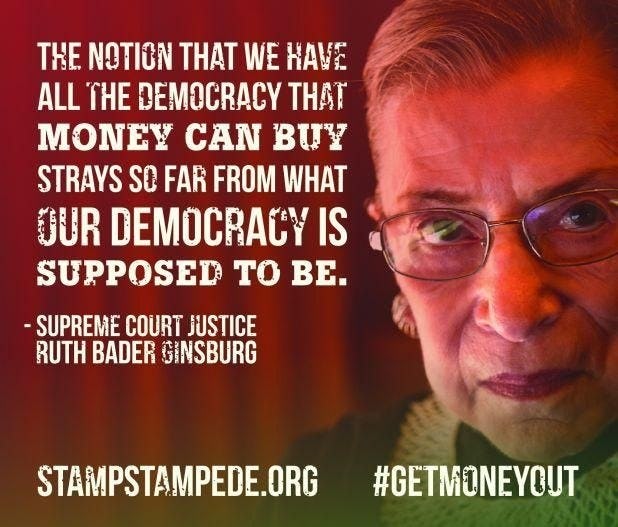

If you’re looking for the right to vote, you won’t find it in the United States Constitution or the Bill of Rights.
The Bill of Rights recognizes the core rights of citizens in a democracy, including freedom of religion, speech, press and assembly. It then recognizes several insurance policies against an abusive government that would attempt to limit these liberties: weapons; the privacy of houses and personal information; protections against false criminal prosecution or repressive civil trials; and limits on excessive punishments by the government.
But the framers of the Constitution never mentioned a right to vote. They didn’t forget – they intentionally left it out. To put it most simply, the founders didn’t trust ordinary citizens to endorse the rights of others.
They were creating a radical experiment in self-government paired with the protection of individual rights that are often resented by the majority. As a result, they did not lay out an inherent right to vote because they feared rule by the masses would mean the destruction of – not better protection for – all the other rights the Constitution and Bill of Rights uphold. Instead, they highlighted other core rights over the vote, creating a tension that remains today.

James Madison of Virginia. White House Historical Association/Wikimedia Commons
Many of the rights the founders enumerated protect small groups from the power of the majority – for instance, those who would say or publish unpopular statements, or practice unpopular religions, or hold more property than others. James Madison, a principal architect of the U.S. Constitution and the drafter of the Bill of Rights, was an intellectual and landowner who saw the two as strongly linked.
At the Constitutional Convention in 1787, Madison expressed the prevailing view that “the freeholders of the country would be the safest depositories of republican liberty,” meaning only people who owned land debt-free, without mortgages, would be able to vote. The Constitution left voting rules to individual states, which had long-standing laws limiting the vote to those freeholders.
In the debates over the ratification of the Constitution, Madison trumpeted a benefit of the new system: the “total exclusion of the people in their collective capacity.” Even as the nation shifted toward broader inclusion in politics, Madison maintained his view that rights were fragile and ordinary people untrustworthy. In his 70s, he opposed the expansion of the franchise to nonlanded citizens when it was considered at Virginia’s Constitutional Convention in 1829, emphasizing that “the great danger is that the majority may not sufficiently respect the rights of the Minority.”
The founders believed that freedoms and rights would require the protection of an educated elite group of citizens, against an intolerant majority. They understood that protected rights and mass voting could be contradictory.
Scholarship in political science backs up many of the founders’ assessments. One of the field’s clear findings is that elites support the protection of minority rights far more than ordinary citizens do. Research has also shown that ordinary Americans are remarkably ignorant of public policies and politicians, lacking even basic political knowledge.
What Americans think of as the right to vote doesn’t reside in the Constitution, but results from broad shifts in American public beliefs during the early 1800s. The new states that entered the union after the original 13 – beginning with Vermont, Kentucky and Tennessee – did not limit voting to property owners. Many of the new state constitutions also explicitly recognized voting rights.
As the nation grew, the idea of universal white male suffrage – championed by the commoner-President Andrew Jackson – became an article of popular faith, if not a constitutional right.
After the Civil War, the 15th Amendment, ratified in 1870, guaranteed that the right to vote would not be denied on account of race: If some white people could vote, so could similarly qualified nonwhite people. But that still didn’t recognize a right to vote – only the right of equal treatment. Similarly, the 19th Amendment, now 100 years old, banned voting discrimination on the basis of sex, but did not recognize an inherent right to vote.

Andrew Jackson of Tennessee. Ralph Eleaser Whiteside Earl/Wikimedia Commons
Today, the country remains engaged in a long-running debate about what counts as voter suppression versus what are legitimate limits or regulations on voting – like requiring voters to provide identification, barring felons from voting or removing infrequent voters from the rolls.
These disputes often invoke an incorrect assumption – that voting is a constitutional right protected from the nation’s birth. The national debate over representation and rights is the product of a long-run movement toward mass voting paired with the longstanding fear of its results.
The nation has evolved from being led by an elitist set of beliefs toward a much more universal and inclusive set of assumptions. But the founders’ fears are still coming true: Levels of support for the rights of opposing parties or people of other religions are strikingly weak in the U.S. as well as around the world.
Many Americans support their own rights to free speech but want to suppress the speech of those with whom they disagree.
Americans may have come to believe in a universal vote, but that value does not come from the Constitution, which saw a different path to the protection of rights.


 HENRY KOTULA
(c).jpg)
