Biden, Sanders, Warren clash over Medicare for All in Houston

Biden, Sanders, Warren clash over Medicare for All in Houston

Image result for Biden, Sanders, Warren clash over Medicare for All in Houston

The battle over health care that has dominated the Democratic race for the White House took center stage in Houston, where for the first time the top three candidates tangled over whether the nation is ready for sweeping reforms.

Former Vice President Joe Biden went back and forth at the opening of Thursday’s debate with the two progressives who are his leading challengers atop the polls, Sens. Bernie Sanders (I-Vt.) and Elizabeth Warren (D-Mass.).

Arguing that the “Medicare for All” proposal championed by Sanders would cost people their insurance, Biden called out the Vermont senator as a socialist and said his proposals would be too costly.

At one point in the debate, Biden said of Warren and Sanders that “nobody’s yet said how much it’s gonna cost for the taxpayer.”

He also pointed to the taxes that would have to increase for middle class people to pay for Medicare for All.

“There will be deductible in your paycheck,” Biden said, referencing the chunk that taxes would take out of people’s pay.

Sanders said most Americans were getting a raw deal in terms of their present health care costs compared with countries that have systems more similar to his Medicare for All approach.

“Let us be clear, Joe, in the United States of America we are spending twice as much per capita on health care as the Canadians or any other major country on earth,” Sanders said. 

“This is America,” Biden retorted. 

“Yeah, but Americans don’t want to pay twice as much as other countries and they guarantee health care to all people,” Sanders responded. 

Health care is a top issue in the race according to polls, and Democrats believe they can win the White House if the general election against President Trump is focused on the issue.

But it is also the issue that divides the Democratic candidates the most, with Biden and other centrists proposing more modest steps, such as reforms to ObamaCare.

The battle over health care is intertwined with the debate Democrats are having over which of their candidates is best positioned to defeat President Trump, with some in the party worried that Warren and Sanders are too liberal to win a general election. Others say their bold ideas are what is needed for the party to defeat Trump.

Biden argues Medicare for All means scrapping former President Obama’s signature achievement, the Affordable Care Act, instead of building on it.

While Sanders touted that everyone would have coverage under his plan and that it would be more generous, with no premiums or deductibles, Biden countered with the cost of the proposal, which estimates put at around $32 trillion over 10 years.

In the debate’s first hour, Biden was already hitting Sanders and Warren over the cost of the plan.

“The senator says she’s for Bernie,” Biden said of Warren’s support for Sanders’s Medicare for All plan. “Well I’m for Barack.”

Warren, pressed by host George Stephanopolous on whether middle class taxes would rise from Medicare for All, did not directly answer, pivoting to argue that overall costs for the middle class would go down once the abolition of premiums and deductibles is taken into account.

“What families have to deal with is cost, total cost,” Warren said, adding: “The richest individuals and the biggest corporations are going to pay more, and middle class families are going to pay less.”

Other candidates were also in the middle of the Medicare for All exchanges.

Sen. Kamala Harris (D-Calif.), who drew flak in the early months of the campaign for seeming to change her position on health care several times, touted the plan she eventually developed, to allow some private insurance to remain under Medicare for All by allowing private companies to administer some plans in a tightly regulated way.

“I want to give credit to Bernie. Take credit, Bernie,” Harris said, while adding, “I wanted to make the plan better, which I did.”

At another point in the debate, Biden dismissed the idea that employers would raise workers’ wages if employers no longer had to provide health insurance under a Medicare for All system. 

“My friend from Vermont thinks the employer’s going to give you back what you’ve negotiated as a union all these years … they’re going to give back that money to the employee?” Biden said.

“As a matter of fact they will,” Sanders interjected.

“Let me tell you something, for a Socialist you’ve got a lot more confidence in corporate America than I do,” Biden responded. 

While all of the Democrats advocate large additional government spending to expand health insurance coverage, the debates over whether private insurance should remain as an option has proven to be a particularly fierce source of debate.

Republicans have sensed an opening on that point as well, eagerly bashing Democrats for wanting to take away employer-sponsored coverage that millions of Americans have. Sanders and Warren counter that Medicare for All coverage would be better insurance, with no deductibles at all, so people would not miss it.

“I’ve actually never met anybody who likes their health insurance company,” Warren said, noting people like their doctors, which they would be able to keep. 

Sen. Amy Klobuchar (D-Minn.), who has staked out a more moderate ground, tore into Sanders, though, over his plan’s elimination of private insurance.

“While Bernie wrote the bill, I read the bill, and on page eight of the bill it says that we will no longer have private insurance as we know it,” Klobuchar said.

“I don’t think that’s a bold idea, I think it’s a bad idea,” she added. 

Amid the division, Harris tried to strike a unifying note.

“I think this discussion is giving the American people a headache,” she said. “What they want to know is that they’re going to have health care and cost will not be a barrier to getting it.” 


Denver Provider Market at ‘Tipping Point,’ Study Finds

https://www.healthleadersmedia.com/finance/denver-provider-market-tipping-point-study-finds?spMailingID=16259324&spUserID=MTg2ODM1MDE3NTU1S0&spJobID=1720747610&spReportId=MTcyMDc0NzYxMAS2

The report expects employers and health plans to exert more influence in demanding market power going forward.

Health systems and physician groups have dominated the Denver healthcare market in recent years, but a new study indicates that employer-purchasers and health plans are poised to disrupt that dynamic. 

Supported by existing legislation, activism from local businesses, and the efforts of Gov. Jared Polis, the Denver market is at a ‘tipping point,’ according to a Catalyst for Payment Reform (CPR) and the Colorado Business Group on Health (CBGH) report released Thursday morning.

The study specifically referenced the RAND report from May which found that payers were paying rates to providers well above Medicare levels, noting that employers have an opportunity to pressure insurers to engage providers in contract arrangements that better align with care rendered.

Researchers believe that payment reform is achievable in Denver, suggesting six policy recommendations to business groups, lawmakers, and insurers, including the expansion of price transparency measures and promotion of benchmarking prices relative to Medicare.

Corralling healthcare prices has been a primary issue in Colorado this year, with the state most recently pursuing a reinsurance program that Polis expects to lower premiums by 18%.

The study found that four major health systems, HCA Holdings, Centura Health, UC Health, and SCL Health, accounted for 85% of patient admissions in 2017. On the Herfindahl-Hirschman Index, this level is considered “moderately concentrated” but the report highlights that it also means the market is “concentrated enough to stifle price competition.”

While providers have concentrated in the market through continuous merger activity, the study found that insurers are governed by strict regulations. The result has been Coloradans facing 13% higher prices compared to the national average and 5% high utilization rates.

Two of the recommendations offered by the study were to align two-sided risk arrangements with Medicaid and the Polis-Primavera “Roadmap to Affordability,” the governor’s strategic initiative to make care more affordable, as well as to implement benefit designs to “encourage consumers seek higher value care.” The study also urges that employer-purchases to pursue value-oriented programs that hold providers accountable to the listed targets.

However, in an interview with HealthLeaders earlier this year, Centura Health CEO Peter Banko said the system was going to “pause on the mad rush” to value-based care models, citing the direction the market was taking on the issue.

As highlighted in the RAND report, CPR and CBGH believe that building on purchaser momentum through a statewide purchase cooperative can be an effective method at changing the market dynamics in Denver.

Similar to the Employers’ Forum of Indiana, an employer-led healthcare coalition which collaborated on the RAND report, the Peak Health Alliance, a Summit County-based purchaser cooperative, has sought to combat rising healthcare prices in the Denver area. The report states that Peak Health, which represents 6,000 covered lives, has already negotiated a “very aggressive” reduction in rates with Centura.

Bob Smith, MBA, executive director of CBGH, said that the report gives employer-purchasers “the tools to make changes” to the Denver healthcare market and stem the tide of rising prices.

“Healthcare costs, primarily driven by high prices and seemingly unwarranted increases, are edging out salary growth and economic development,” Smith said in a statement. “These trends are taking a toll on every employer from school districts to manufacturers and are simply not sustainable.”

Smith urged lawmakers to act on the report’s suggested reforms but also said that employers now have “the responsibility to act.”


The U.S. has fantastic health care, the problem is….

Click to access wf1341834-cmo-campaign-wyatt-decker-article-part1.pdf

Image result for The U.S. has fantastic  health care, the problem is….

In part 1 of an executive interview series, CEO and physician Wyatt Decker discusses his perspectives on today’s challenges and opportunities for reinventing health care.

IMAGINE THIS SCENARIO: there are 200 people in a room and each person has a serious health condition. Cost is not a barrier to each of these people receiving their prescribed treatment. A question is asked — how many of you would book a flight to a different country to get your care? You guessed it. No hands go up.

Dr. Wyatt Decker is chief executive officer of OptumHealth and an emergency medicine physician who brings more than two decades of service within the Mayo Clinic. He held dual roles as chief medical information officer for Mayo Clinic and CEO of Mayo Clinic in Arizona. Dr. Decker often conducts this experiment with audiences to underscore the quality of care delivered in the United States. We often hear about the problems of health care. No doubt, there are deep and serious problems. However, in scenarios like the one above, we understand that the quality of care delivered by our nation’s physicians is among the finest available. So why do we hear so much about what’s wrong?

According to Dr. Decker, the real opportunities for reinventing health care lie in improving system access, increasing affordability and meeting consumer preferences. “ All of these things really require us to think deeply about how health care is delivered and how can we do it better,” he says.  In part 1 of a recent conversation, Dr. Decker shares lessons learned and offers his perspective on where today’s health care executives and clinical leaders should focus.


What is your take on the state of the health care industry today? What challenges are driving the need to rethink health care systems and delivery?


THE CHALLENGE OF HEALTH CARE ACCESS:  “ People want to get to a doctor or a health care team and they can’t. Either because they are underinsured or they don’t have the financial resources. They don’t know where to go or sometimes there just aren’t enough doctors or the right type of doctor, whether it’s primary care or a specialist available in their area to see.”

THE CHALLENGE OF HEALTH CARE AFFORDABILITY:
“ We hear a lot about affordability of health care and outof-pocket cost can be very high, but also the health care system itself is very expensive. So how do we make it more affordable for large employers, individuals, consumers and even the government itself? Can we get on a more sustainable path?”

THE CHALLENGE OF CONSUMER PREFERENCES:  “ Most people who’ve experienced the health care system feel that it isn’t focused around their needs, schedules or preferences. We’re entering an era where in most other industries there’s lots of personalization and consumer focus. Health care has been very slow to evolve. We need to make it an experience where people feel appreciated, valued and respected. Not just that they’re getting great quality care, but also that their preferences and needs are being met.”

“ Our nation’s care providers are deeply committed and among the best-trained in the world. But I also see them in a system that is struggling. Emergency departments are, at times, the last resort for people who lack resources and access to care. I’ve seen patients struggle to manage chronic conditions without the right support and how the absence of good guidance can create confusion.”

Clearly, the need to reinvent in all aspects of health care is top of mind for many. But it can be difficult to figure out where to start. Can you discuss where you think it’s smart for leaders to focus?


“ We should all be thinking about how we drive towards a health care system that really creates and adds value to people’s lives,” says Dr. Decker. Here’s his advice on key areas of focus.


PAYMENT MODELS:  “ Move towards payment models that actually reward the correct behaviors in health care. What do I mean by that? The pay-per-value model — rewarding groups of providers to keep people well and healthy — is far more powerful than the traditional fee-for-service model.”


LOCAL ECOSYSTEMS:  “ Recognize that health care is local. It’s important to create ecosystems that deliver great, connected care for individuals throughout the health spectrum. This means the patient and their health data move seamlessly between specialists, hospitals, ambulatory care centers, and so on. These kinds of networks and interoperability of data is crucial to create a successful health care system.”

SOCIAL DETERMINANTS OF HEALTH:  “ Health care outcomes are driven not only by the quality and capabilities of the health care provider, but also by social determinants of health. Good health care addresses things like access to good nutrition, social connections, transportation and more that can limit the ability for a person to get and stay healthy. For example, in-home health visits to help patients who have difficulty traveling or easily obtained referrals to social and community services can really enable success.”


From your perspective, what could health  care reinvention mean to a patient, provider  or health plan?


TO PATIENTS:  “ It means a health care system where instead of waiting for something to go wrong, there is a team helping you proactively flourish and be healthy. It means a simple phone call or an app or a video chat could advise you on when you might be at risk of developing a serious condition before you develop it. It means a system that  is always there for you, almost like a guardian angel. It helps you navigate the system and your journey towards health and wellness. It means all of this in a health care system that is easy to access, affordable, high-quality  and compassionate.”


TO PROVIDERS:  “ Providers have high rates of frustration and even burnout with their own profession. Reinvention looks to reduce the very heavy clerical burden driving these trends. Doctors today spend about two hours of clerical and non-visit care for every hour of direct patient care that they provide. However, when you talk to doctors, they find the most fulfillment in engaging directly with patients and making a difference in their care. Reinvention means relieving exhausted providers of administrative and clerical duties that don’t bring enjoyment or result in improved care  and outcomes.”


TO HEALTH PLANS:  “ Health plans are frustrated because they pay for a lot of care that evidence shows doesn’t improve outcomes or help patients on their journey to health and wellness. Payers are happy to pay for health care if it’s necessary. But it doesn’t make sense to pay for care that doesn’t add value. Reinvention means reducing this financial waste to bring down the cost of coverage for everyone.”

“ We have an opportunity now to make the health care system work better for everyone. Improve access and affordability for patients, allow doctors to spend more time with patients, and increase efficiencies within health plans. There’s an opportunity to help people connect the dots and get everyone working together.”

You’ve been a practicing physician and a business leader. Tell us the lessons learned from this unique vantage point.
“ I have spent most of my career as a practicing physician in busy, level 1 trauma centers and emergency departments. In that environment, you see health care at its finest and also how the health system can be challenging. I think in amazement of the times I’ve seen teams of people —  multiple physicians, nurses and technicians — come together as one unit to save someone from a major trauma. I also have great admiration for the persistence of doctors who save lives by diagnosing life-threatening conditions through nuanced symptoms.
I’m a deep believer that in health care, we need to place the patient at the center of everything we do. I always remind young doctors and medical students…imagine for a moment that your patient is you or a loved one. You’d want the doctor to listen and explain things in a compassionate and thoughtful manner. You’d want them to be focused. You’d want them to recognize your unique history and what’s important to you. The notion of putting the patient at the center of everything is something that I have carried with me throughout my career. I have also dedicated myself to developing better models of care and systems that allow doctors and care teams to function seamlessly, be high-performing and deliver great outcomes for patients.”

“ I have an appreciation for how powerful it can be when you work to reduce waste, create care that’s efficient and care that is patient-focused. Today I’m focused on an interesting juxtaposition — creating the right mix of scalable innovations that help our whole nation succeed in health care while also improving the personal and individual patient health care experience.”

STAY TUNED FOR PART 2  of this executive interview series to learn more about Dr. Wyatt Decker’s perspectives on the intersection of technology and health care, the human impact of transformation and physician burn-out.


Rhode Island: A Most-Improved State in Health Performance

https://www.commonwealthfund.org/blog/2019/rhode-island-most-improved-state-health-performance

Rhode Island health care improvement

States use the Commonwealth Fund’s 2019 Scorecard on State Health System Performance to identify places where their health care policies are on track and areas that need improvement. Using the Scorecard, states can compare their improvement to others, and see how they stack up. In the most recent edition, released in June, Rhode Island improved on the most health system performance indicators tracked over time, followed by Missouri, Washington, West Virginia, and Arkansas.

Rhode Island particularly made strides in the areas of coverage and behavioral health. The state uninsured rate among adults dropped from 17 percent in 2013 to 7 percent in 2015 and 6 percent in 2017. In addition, the percentage of adults with any mental illness reporting an unmet need dropped from 27 percent in 2010–11 to 18 percent in 2014–16. The state also saw significant reductions in the percentage of children with unmet mental health needs.

These improvements did not happen by chance. What actions did policymakers take to drive progress and what work lies ahead?

Making Progress Through Clear Priorities and State Leadership

In 2014, Governor Gina Raimondo came into office fully committed to the Affordable Care Act, including Rhode Island’s state-based health insurance marketplace and expanded Medicaid eligibility.

Another early administration priority was making sure behavioral health care was as available and affordable as medical care. The opioid epidemic was hitting Rhode Island hard, making access to treatment for mental health and substance use disorder a top concern.

Coverage expansion. The decision to create a state-based marketplace, HealthSource Rhode Island (HSRI), was instrumental in helping the state make gains in coverage and affordability. The state has its own funding for marketing and navigators who help people understand and choose health plans. This has helped shield residents from federal outreach cuts. The state’s commitment also helped when the Trump administration decided to end marketplace cost-sharing-reduction subsidies. The state’s Office of the Health Insurance Commissioner (OHIC) worked with the state marketplace HSRI to protect consumers by building price increases to cover the loss of subsidies into silver-level health plans and keeping premiums lower in the other plans. HSRI plans offered among the lowest state-based marketplace premiums in the country. During last year’s open-enrollment period, HSRI saw a 5 percent increase in new and overall customers.

Access to behavioral health. In 2015, Governor Raimondo issued an executive order to establish the Overdose Prevention and Intervention Task Force, which has guided state reforms. The opioid crisis also has led to more open conversations about mental health and to improved relationships between first responders and communities. To facilitate these relationships, Rhode Island now requires police officers receive training to recognize behavioral health issues and help connect individuals with the care they need.

Rhode Island experienced a decline in overall overdose deaths, from 336 in 2016 to 314 in 2018. Community programs and pharmacies have worked hard to get naloxone, used to counter the effects of opioid overdose, into the hands of people who need it. Rhode Island was also the first state to offer medication-assisted opioid treatment in prison. Community health workers follow up on inmates after release to ensure treatment is continued. Fatal overdoses declined by 60 percent among people leaving detention from 2016 to 2017, and continued to drop in 2018.

OHIC also has prioritized integrating behavioral health into the primary care setting as a cost-effective way of increasing access to such services. Studies have shown that integrated care improves depression and anxiety outcomes, along with quality of life, while reducing the total cost of care.

Additionally, OHIC has been working on encouraging parity between medical and behavioral health in the insurance market by reviewing insurers’ coverage documents. It is focusing on limiting mental health benefit exclusions and ensuring the states’ major carriers are in compliance with the laws related to coverage for mental health and substance use disorder treatment. As a result, the four major insurers have agreed to discontinue prior authorization requirements for certain medication-assisted treatments.

Maintaining Momentum

In 2018 an HSRI/OHIC workgroup was formed to develop policy options to mitigate the potential impact of federal changes on health coverage costs, consumer choice, and access. The group recommended pursuing a Section 1332 waiver to establish a reinsurance program to reduce premium increases in the individual market; implementing a state-level requirement that individuals have health insurance to offset the impact of the federal health insurance mandate penalty repeal; and establishing OHIC’s regulatory authority over short-term limited duration plans. All three recommendations were signed into law on July 5.

In addition, recent state legislation has expanded OHIC’s authority related to establishing behavioral health parity, such as a law giving it authority over health plans and third-party organizations that conduct benefit reviews.

Addressing population health challenges demands a concerted effort. Rhode Island is fortunate to have a culture of collaboration among health care leaders, coupled with strong political commitment to health system improvement.


A Wave of Layoffs Loom for Wall Street

https://www.crainsnewyork.com/markets/wave-layoffs-looms-wall-street?utm_source=breaking-news&utm_medium=email&utm_campaign=20190909&utm_content=hero-readmore


Trends In Public Opinion On US Gun Laws: Majorities Of Gun Owners And Non–Gun Owners Support A Range Of Measures

Trends In Public Opinion On US Gun Laws: Majorities Of Gun Owners And Non–Gun Owners Support A Range Of Measures
By Colleen Barry, Elizabeth Stone, Cassandra Crifasi, Jon Vernick, Daniel Webster, and Emma McGinty

This new study, being released ahead of print, used data from the National Survey of Gun Policy from the years 2013, 2015, 2017, and 2019. The surveys were administered by the Johns Hopkins Center for Gun Policy and Research, which sampled adult gun owners and non–gun owners alike. The findings show that large majorities of both owners and nonowners strongly support a range of measures to strengthen US gun laws. Read More >>

This study will also appear in the October issue of Health Affairs, a theme issue with studies focusing on violence and health.

HA 38/10 Ahead of Print, Barry

https://www.healthaffairs.org/doi/abs/10.1377/hlthaff.2019.00576?utm_source=Newsletter&utm_medium=email&utm_content=Trends+In+Public+Opinion+On+US+Gun+Laws%3B++Opioid+Addiction%3B+Expanding+International+Reference+Pricing&utm_campaign=HAT+9-9-19


Rural Hospital Closures Reduce Access to Emergency Care

https://www.americanprogress.org/issues/healthcare/reports/2019/09/09/474001/rural-hospital-closures-reduce-access-emergency-care/

Rural Hospital Closures Reduce Access to Emergency Care

Introduction and summary

The number of rural hospital closures in the United States has increased over the past decade.1 Since 2010, 113 rural hospitals,2 predominantly in Southern states, have closed. This is a concerning trend, since hospital closures reduce rural communities’ access to inpatient services and emergency care.3 In addition, hospitals that are at risk financially are more likely to serve rural communities with higher proportions of vulnerable populations.4

Understanding the financial pressures facing rural hospitals is imperative to ensuring that America’s 60 million rural residents have access to emergency care.5 Rural hospitals are generally less profitable than urban ones, and those with the lowest operating margins maintain fewer beds and have lower occupancy rates. Low-margin rural hospitals are also more likely to be in states that have not expanded Medicaid under the Affordable Care Act (ACA). According to new analysis by the Center for American Progress, future hospital closures would reduce rural Americans’ proximity to emergency treatment. Among low-margin, rural hospitals—those most likely to close—the majority of those with emergency departments are at least 20 miles away from the next-closest emergency department.

This report first discusses the role that hospitals and emergency care play in rural health care as well as trends in hospital closures. It then uses federal data to examine differences in the financial viability of rural and urban hospitals and the availability of hospital-based emergency care in rural areas. The final section of this report offers policy recommendations to improve health care access and emergency care for rural residents.

Rural hospitals have been closing at an unprecedented rate

From 2013 to 2017, rural hospitals closed at a rate nearly double that of the previous five years.6 (See Figure 1) According to the Government Accountability Office (GAO), recent rural hospital closures have disproportionately occurred among for-profit and Southern hospitals. Southern states accounted for 77 percent of rural hospital closures over that time period but only 38 percent of all rural hospitals in 20137

Hospital closures may deepen existing disparities in access to emergency care. Closures are more likely to affect communities that are rural, low income, and home to more racial/ethnic minority residents.8 Although about half of acute care hospitals are located in rural communities and the other half are located in urban areas,9 rural residents live 10.5 miles from the nearest acute care hospital on average, compared with 4.4 miles for those in urban areas.10 According to a poll by the Pew Research Center, about one-quarter (23 percent) of rural residents said that “access to good doctors and hospitals” is a problem in their community, while only 18 percent of urban residents and 9 percent of suburban residents said it was a problem.11

A variety of factors influence hospitals’ sustainability. Thanks to medical and technological advances, conditions that once required hospitalization can now be treated in an ambulatory care center or a physician’s office. University of Pennsylvania professor and CAP nonresident senior fellow Ezekiel Emanuel has argued that one reason hospitals are closing is that “more complex care can safely and effectively be provided elsewhere, and that’s good news.”12 As a whole, the hospital industry remains highly profitable, and hospital margins are at their highest in decades.13

Evidence on the relationship between hospital closures and health outcomes is mixed. A 2015 study of nearly 200 hospital closures in Health Affairs found no significant changes in hospitalization rates or mortality in the affected communities, whether rural or urban.14 More recent studies have found an association between rural hospital closures and increased mortality. Harvard researcher Caitlin Carroll showed that rural hospital closures led to an overall increase in mortality rates for time-sensitive health conditions,15 and Kritee Gujral and Anirban Basu of the University of Washington found that rural hospital closures in California were followed by increases in mortality for inpatient stays.16

In rural areas, hospitals face additional challenges to their viability, including lower patient volumes; higher rates of uncompensated care; and physician shortages.17 In addition, rural patients tend to be older and lower income.18 Rural hospitals tend to be smaller, serve a higher share of Medicare patients, and have lower occupancy rates than urban hospitals.19 Rural hospitals commonly offer obstetrics, imaging and diagnostic services, emergency departments, as well as hospice and home care,20 but patients needing more complicated treatment are often referred to tertiary or specialized hospitals. In fact, rural patients are more likely to be transferred to another hospital than patients at urban hospitals.21

Most urban hospitals are reimbursed under the prospective payment systems (PPS) for Parts A and B of Medicare. Through both the inpatient and outpatient PPS, the Centers for Medicare and Medicaid Services (CMS) reimburse hospitals at a predetermined amount based on diagnoses, with adjustments—including those for local input costs and patient characteristics.22 However, rural hospitals often face higher costs due to lower occupancy rates and provide care to a higher percentage of patients covered by Medicare, Medicaid, and the Children’s Health Insurance Program (CHIP). Such hospitals may be eligible to receive higher payments from Medicare if they qualify as a Sole Community Hospital (SCH) or Medicare-Dependent Hospital (MDH).23

Another form of financial relief for rural hospitals is obtaining designation as a Critical Access Hospital (CAH), which Medicare reimburses based on cost rather than on the PPS.24 To qualify as a CAH, a hospital must provide 24/7 emergency services; maintain no more than 25 beds; and serve a rural area that is 35 miles from another hospital.25 Medicare reimburses CAHs at 101 percent of reasonable costs, rather than through the inpatient and outpatient PPS structures.26 As of 2018, there were 1,380 CAHs nationwide,27 accounting for about two-thirds of all rural hospitals.28

Even with cost-based reimbursement, however, some CAHs are unable to sustain the costs required to maintain inpatient beds.29 The 25-bed limit for CAHs prevent participating hospitals from eliminating inpatient services and restrict their ability to expand in response to fluctuations in community populations or care volumes. Other challenges facing rural hospitals include lacking sufficient patient volume to maintain high-quality performance for certain procedures and pressure to drop high-value but poorly reimbursed services such as obstetrics while maintaining low-volume, high profit services such as joint replacement procedures. 30

A key way that states can support struggling rural hospitals is by expanding Medicaid under the ACA. Expanding Medicaid increases coverage among low-income adults, 31 which in turn reduces uncompensated care costs for hospitals32 and allows financially vulnerable hospitals to improve their viability.33 Consistent with other recent studies,34 the GAO concluded in a 2018 report on rural hospitals that those “located in states that increased Medicaid eligibility and enrollment experienced fewer closures.”35

Rural hospitals are cutting back on services

Rural hospitals in different states have responded to financial pressures in a variety of ways, trying to balance community needs with financial viability. For many hospitals this has meant cutting inpatient obstetric services, leaving more than half of rural counties without hospital obstetric services.36 For instance, in Wisconsin, falling birth rates led to 12 hospitals in the state closing their obstetric services in the past decade.37 In Grantsburg, Wisconsin, lower birth rates and an older community population led Burnett Medical Center to shut down its obstetrics services.38 In order to offer these services, Burnett Medical Center would have needed to keep a general surgeon on call to perform caesarean sections, and with just 40 deliveries in 2017, the hospital could not justify the expense.39 While the hospital will continue providing prenatal and postnatal care, it will refer patients to a facility in Minnesota for deliveries—a facility is almost 40 minutes away.40

In other communities, hospitals have been replaced by other types of health care facilities. For example, Appalachian Regional Healthcare System closed Blowing Rock Hospital in North Carolina in 2013. Three years later, it opened a 112-bed post-acute care center in Blowing Rock in response to demand for rehabilitation services and the aging population in the surrounding area.41

Financial data shows that rural hospitals are more likely to struggle

To compare the financial situations of rural and urban hospitals and examine how future rural hospital closures could affect the availability of emergency care, CAP analyzed data from the CMS Healthcare Cost Report Information System (HCRIS). The CMS requires all Medicare-certified hospitals to report their financial information annually. CAP used the HCRIS to examine the financial margins and other characteristics of 4,147 acute care hospitals for fiscal year 2017. Of these, 1,954 hospitals (47 percent) were in rural areas, while the remaining were in urban areas. Hospitals self-report their status in the HCRIS as either urban or rural, which the CMS defines as either inside or outside of a metropolitan statistical area, respectively.42 Further information about CAP’s hospital sample can be found in the Methodological appendix.

Hospital operating margins, which measure excess patient-related revenues relative to patient-related expenses, are often used as an indicator of financial health.43 A 2011 study by Harvard researchers Dan Ly, Ashish Jha, and Arnold Epstein found that the lowest 10 percent of hospitals by operating margin were 9.5 times more likely to close within two years compared to all others. 44 The same study concluded that hospitals with low operating margins were also more likely to be acquired or merge.45

In CAP’s hospital sample, the median operating margin was negative 2.6 percent among all hospitals, negative 0.1 percent for urban hospitals, and  negative 4.9 percent for rural hospitals.46 Public hospitals and MDHs in the sample were more likely to have negative operating margins, consistent with what other studies have found.47 To analyze hospitals’ relative financial health across geographic areas, CAP ranked hospitals in the HCRIS sample based on operating margin, splitting them into three groups: the lowest 10 percent, the middle 80 percent, and the highest 10 percent. The range of operating margins for each group is shown in Table 1.

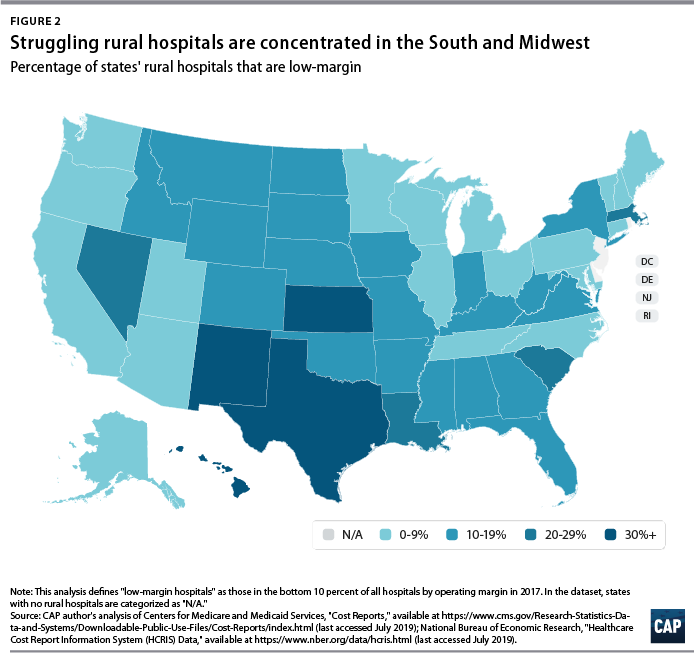
Rural hospitals are less likely to be financially healthy than urban hospitals. In 2017, rural hospitals comprised only 27.9 percent of the hospitals with operating margins in the highest decile but comprised 59.7 percent of the hospitals in the lowest decile. Southern and Midwestern states had the greatest proportion of rural hospitals with low operating margins, mimicking the geographic patterns in hospital closures that the GAO report identified. CAP finds that from 2015 through 2017, rural hospitals were consistently more likely than urban hospitals to fall in the bottom 10 percent of operating margins. CAP’s analysis also confirms that rural hospitals in states that expanded Medicaid had a higher median operating margin (negative 3.4 percent) than those in states that have not expanded Medicaid (negative 5.7 percent).

To examine commonalities among the hospitals most vulnerable to closure, CAP analyzed characteristics of the hospitals with low margins, defined as having an operating margin in the lowest 10 percent among all hospitals. Smaller, low-occupancy rural hospitals were most likely to struggle financially: nearly 1 in 6 (15 percent) of hospitals with 25 or fewer beds had low margins, and nearly one-fifth (17 percent) of hospitals with low-occupancy rates had low margins. (See Figure 3)

Emergency departments are on the front lines for rural health

In some emergency situations, hospital closures can be life-threatening, increasing the time and distance patients travel to receive care. Studies show that the probability of dying from a heart attack increases with distance from emergency care,48 and traumatic injuries are more likely to be fatal for rural residents than for urban ones.49

Rural residents are more likely than urban residents to visit the emergency department.50 A shortage of primary care providers; lack of public transportation infrastructure; shortages in preventive care; higher rates of smoking and obesity; and greater prevalence of chronic disease in rural areas all contribute to the greater utilization of emergency room care.51 As a result, emergency departments often stand in as the main source of care for vulnerable and low-income populations, especially for communities that face a shortage of primary care. 52 Among the dozens of rural hospitals that have closed in recent years, some served as the only emergency department in a community, according to MedPAC53

While freestanding emergency departments have proliferated,54 they are not filling the gap for rural emergency care. MedPAC found that, as of 2016, nearly all the country’s 566 stand-alone emergency departments were in urban areas and tended to be located in more affluent communities.55 Researchers at the North Carolina Rural Health Research Program found that the freestanding emergency department model was generally not viable in rural areas of the state due to low patient volumes, high rates of uninsured patients, and provider shortages.56 One limit on the growth of independent freestanding emergency centers is that they are not recognized in Medicare law and are therefore unable to bill the program, unlike hospital-affiliated off-campus emergency departments. 57

Future rural hospital closures would increase the distances that patients travel for emergencies

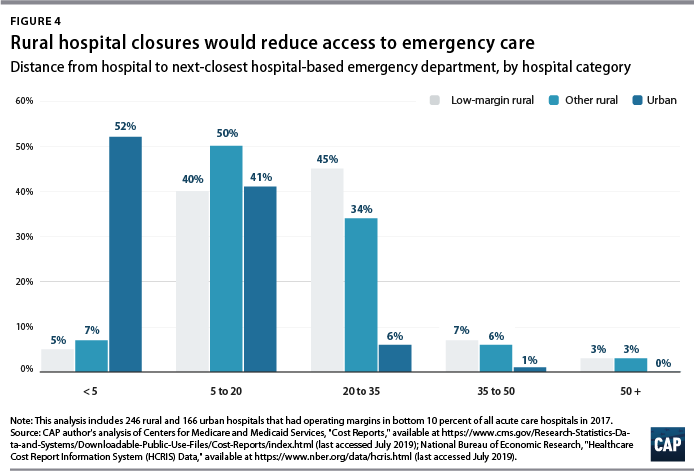
To better understand how future rural hospital closures could affect access to emergency care, CAP calculated hospitals’ distance to the next-closest hospital-based emergency department. CAP restricted its 2017 HCRIS data sample to the 3,616 acute care hospitals that provide 24-hour emergency services.58 Using addresses or coordinates provided in the HCRIS, CAP mapped each low-margin rural hospital to the next-closest hospital emergency department. Mapping strategies are detailed in the Methodological appendix.

Among the 222 low-margin rural hospitals, more than half (55 percent) were more than 20 miles away from the next-closest hospital-based emergency department, and one-tenth were more than 35 miles away. (See Figure 4). The average distance to the next-closest emergency department was 22 miles.

The disappearance of rural, low-margin hospitals would greatly increase patients’ travel distances for emergency care. Without other resources to fill the gap, some patients might forgo care they need and others would be forced to undertake an even longer journey to receive medical attention.

Policies to improve rural emergency and nonemergency care

As rural hospitals continue to close, it is crucial to preserve access to emergency care for rural Americans. The following section details a series of policy recommendations to support adequate emergency care and address care shortages in rural communities.

Expand Medicaid

Experience to date suggests that rural hospitals in those states that have not yet expanded their Medicaid programs under the ACA would benefit from Medicaid expansion through lower levels of uncompensated care and increased financial sustainability. Medicaid expansion is associated with improvements in health and a wide variety of other outcomes, including lower mortality, less uncompensated care, and lower rates of medical debt.59 According to the Kaiser Family Foundation, about 4.4 million adults would gain Medicaid eligibility if the remaining 14 nonexpansion states expanded their programs.60

Policymakers can also support rural communities and their hospitals by opposing efforts to repeal the ACA. If the Trump administration-backed lawsuit against the ACA were to succeed, 20 million Americans would lose health insurance coverage, and uncompensated care would rise by $50 billion, according to the Urban Institute.61

Create a greater number of rural emergency centers

To preserve access to emergency care, Congress could allow rural hospitals like CAHs to downsize to an emergency department and eliminate inpatient beds without giving up special Medicare reimbursement arrangements. Qualifying hospitals could transfer patients requiring inpatient admission to other hospitals, while continuing to offer some diagnostic imaging and other outpatient services.

One such proposal is the Rural Emergency Acute Care Hospital Act (REACH Act), bipartisan legislation proposed by Sen. Amy Klobuchar (D-MN) and Sen. Chuck Grassley (R-IA) that would create rural emergency centers.62 This designation would allow hospitals to provide only emergency care in rural communities and receive Medicare reimbursement at 110 percent of operating costs. Separately, MedPAC has recommended that rural hospitals located more than 35 miles from the nearest emergency department be allowed to convert to freestanding emergency departments while still being reimbursed at hospital rates.63

Institute global budgeting for rural hospitals

Under global budgeting, hospitals are paid a fixed amount rather than having their reimbursements based on the volume and types of services they provide.64 Global budgeting can reduce small, rural hospitals’ financial risk by providing them with a more predictable stream of revenue. In addition, payment reforms that include both hospital and nonhospital care can encourage communities to invest in services that are typically less generously reimbursed, such as preventive care.65

For example, in 2014, Maryland transitioned its acute hospitals from fee-for-service payments to a global budget.66 An evaluation of the global budget program showed that it reduced hospital expenditures relative to trend without transferring costs to other parts of the health care system.67 Future global budgets should emphasize improvements in population health and primary care,68 including ensuring that patients receive care in appropriate settings and reducing the number of avoidable hospital visits.

The Pennsylvania Rural Health Model is the first Medicare demonstration project to test the financial viability and community effects of a global budget for strictly rural hospitals.69 This six-year program aims to smooth out cash flow for 30 rural Pennsylvania hospitals on a monthly basis with the goal of enabling hospitals to meet community needs, especially for substance-use disorder and mental health services.70 With global budgets based on the previous year’s revenues, participating hospitals will have a more predicable stream of revenue. Importantly, the program allows hospitals to share in the savings that result from avoidable utilization.71

Improve transportation for rural residents

The lack of transportation infrastructure can lead rural residents to rely on ambulances and emergency rooms for nonemergency care. In nonemergency situations, patients often cite the lack of affordable transportation as a major barrier to care access.72 In order to fill the gap, payers and policymakers should consider efforts to utilize existing community transit resources for medical transportation or reimburse patients who use ride-sharing services in areas that lack public transit or taxi services. 73 Another option would be to formalize volunteer services for medical transit. Oregon offers a tax credit for volunteer rural emergency medical services (EMS) providers, who provide medical and transportation services analogous to those of volunteer firefighter programs.74 The CMS should also consider policies to better reimburse and expand the use of telehealth in remote areas to reduce patients’ burden of transportation.75 Finally, the CMS should stop approving states’ requests to waive coverage of nonemergency medical transportation (NEMT) requirements under Medicaid.76 NEMT is vital to eligible beneficiaries’ access to care, including appointments for preventive care, chronic disease management, and substance-use disorder treatment.

Strengthen the rural health care workforce

Rural health care provider shortages contribute to poorer access to care and poorer quality of care in rural communities. While 20 percent of the U.S. population lives in rural areas, only 9 percent of primary care physicians practice in rural areas.77 Greater access to primary care providers in rural areas would improve quality of care and health outcomes while also reducing unnecessary emergency department visits.78

One way to assist rural areas would be to encourage health professionals to train and work in underserved communities. Federal funding for physician training should include reimbursements for community-based sites so that medical residents can rotate through nonhospital settings.79 Expanding the National Health Service Corps—which provides scholarships and student loan repayment for professionals who work in federally designated health professional shortage areas—could also help bolster the rural workforce. In addition, changes to immigration policy—such as expanding the Conrad 30 program that funnels immigrant doctors into rural and underserved communities, reforming H-1B visas to benefit high-need communities—could help alleviate rural areas’ shortage of medical professionals.80

Conclusion

Mounting closures of rural hospitals across the country are exacerbating the disparity in health care access between rural and urban areas. The financial vulnerability of the remaining rural hospitals suggests that the trend may continue, leaving shortages in emergency care and other hospital services.

Policymakers should support initiatives that allow remaining rural hospitals the flexibility to tailor their services to meet community needs and improve access to care for rural Americans.


Why is healthcare so expensive? This Johns Hopkins surgeon might have the answers

https://www.fiercehealthcare.com/hospitals-health-systems/why-healthcare-so-expensive-johns-hopkins-surgeon-might-have-answers?mkt_tok=eyJpIjoiTTJNMVpURTNNelJpTVRBeiIsInQiOiJEYTZVeG1LN2VxWEMzUXRTb3dQWWkrbDNKdHBnSzQ5NUpuZVZoXC9US1QzQVwvcUVDSU9mMHZLR2pwZWFcLzNkbk9XYTdPRUtTM2tRVU5oOXhhMXRhSFd5STFZY2VzVlo2UTl0cGxOZjdSMUROVjhZVFZNeXFrMWRZdEdIRVBFS0M2VyJ9&mrkid=959610

For a small group of vascular surgery centers in metropolitan Washington, D.C., it was local churches that turned out to be surprisingly lucrative.

It was at health screening fairs hosted by these houses of worship where Marty Makary, M.D., found surgeons drumming up business for pricey—and often unnecessary—leg stents. It’s among the collection of systemic and human examples Makary examines in his new book “The Price We Pay: What Broke American Health Care—and How to Fix It” as driving forces behind rising U.S. health costs.

Makary, a surgeon at Johns Hopkins and New York Times best-selling author, hits every segment of the market, from a health system in New Mexico that has sued 1 in 5 residents in town to a health insurance conference where brokers described over drinks why they usually aren’t helping employers get the best deal.

“Healthcare has adopted a business model that uses middlemen, price gouging and sometimes delivers care that can be inappropriate, and this bloated economy has a tremendous amount of waste,” Makary said. “So our research really asks the question: ‘What is the experience of the everyday American interfacing with our healthcare system?’”

I caught up with Makary recently to discuss some of the problems he highlights in his new book, which is being released Sept. 10, and some of his ideas on how we solve them.

FierceHealthcare: Why did you write this book?

Marty Makary: Hospitals are amazing places and there is a tremendous amount of public trust in hospitals. But I’ve been seriously concerned about the erosion of public trust by the price gouging and predatory billing practices that patients are describing all over America. Our research team found bills are marked up as much as 23 times higher than what hospitals will accept from Medicare. We kept hearing over and over again that, ‘No one is expected to pay these bills. Hospital CEOs assured me when I showed them inflated bills that nobody is expected to pay the sticker price.’ But that didn’t seem to match the stories we were hearing on the ground.

FH: One of the hospitals you highlight in this book in Carlsbad, New Mexico, had a practice of hiking prices and suing patients who were unable to pay. What did you find there?

MM: We decided to shift our research into the question: “Are Americans asked to pay the sticker price and if so, what happens when they can’t afford it?”

A woman sent me a message where not only was the bill inflated, but the care was—in her opinion, unnecessary—and the hospital had sued her. When I reached out, she said, “They’ve sued all my friends as well and garnished our paychecks.” I couldn’t believe this, and so I flew out to Carlsbad. The driver of the Chamber of Commerce taxi service that picked us up from the airport, the receptionist at the hotel, the waitress at the breakfast place, the clerk’s office staff, families in the courthouse: You couldn’t believe it. Everywhere you turned, people had been terrorized financially by this local community hospital. I thought: “Where is the spirit of medicine? Do these executives even know the consequences on the ground of these billing practices?”

FH: In the book, you mention many hospital executives don’t even know they’re suing patients.

MM: Oftentimes, there’s detachment. And when we’re detached from the consequences or problems, that’s when horrible things happen in societies historically. I found sometimes hospital executives, board members and certainly our research supports doctors not knowing about this practice. And when they find out, the clinicians are outraged. By and large, board members want it to stop … I think if you look at any major issue in the United States, whether it be race, poverty or healthcare, if we are not proximate to the problem, we tend to rationalize financial systems that enable the problem. In healthcare, what I’ve noticed is, when I would share these stories at conferences, other healthcare experts argued it was not a problem that was diabolical, they just weren’t proximate to the issue.

FH:  You also document that many hospitals are doing the right thing.

MM: Most hospitals try to do the right thing. But I think it tells us a lot about the practice of suing patients and that it’s unnecessary. When all the revenue generated from suing patients amounts to less than the amount of the CEO pay increase in one year, which is something we’ve seen, the argument that it’s essential to sue patients in order for the hospital to be sustainable melts away.

FH: But obviously, the problem is not just about hospitals, right?

MM: A lot of people are getting rich in healthcare. We’ve created tens of thousands of millionaires that are not patient-facing. If you look at the earnings on Wall Street of some of these healthcare companies, for example, UnitedHealth Group reported a 25% increase in earnings in a recent earnings report. How do earnings go up 25% in an actuarial insurance business? They said on their call it was in part due to their pharmacy benefit manager (PBM), a well-known middleman that profits from spread pricing and money games. Hospitals are on target this year for their highest margin in history—5.1% based on early 2019 data. At the same time rural hospitals are closing, large hospitals are making barrels of money. Although they are claiming razor-thin margins, the cost shift accounting is so sophisticated, that they can use their profit to buy new buildings, pay down debt, buy more real estate, increase executive pay. What we have right now is an arms race of profiteering in healthcare where all the stakeholders are making a lot of money except for one, and that’s the patient.

FH: In the book, you talk about efforts to address practice outliers like those vascular surgeons through the use of big data, which led to the creation of the “Improving Wisely” initiative. What did you do?

MM:  Most doctors do the right thing or always try to. But the fraction that are responding to the consumerist culture or the perverse incentives or are just not practicing state of the art care can cost the system a lot more money than those who aren’t … Instead of hammering doctors that do the right thing with reporting burdens and other hassles, we can shunt those resources to address outliers identified in the data using metrics endorsed by the experts in each specialty, and gold card the good doctors so they don’t have to deal with reporting hassles and the expense of the reporting hassles.

In studying the issue of inappropriate care and delivering measures of the appropriateness of care, we’ve been meeting with individual specialists around the country and many of these doctors are telling us about the practice pattern that a fraction of specialists in their field are doing that represents overuse. Our work called “Improving Wisely” partners with associations to send outlier physicians their data around a specialty-endorsed measure of overuse. What we’ve seen is, among doctors, among outlier physicians who see their data with a confidential dear doctor letter, that 83% reduce their pattern of overuse. The initial project two years ago that cost $150,000 has resulted in $27 million worth of savings. This is an example of a high consensus approach that results in real savings that you just don’t see in other areas. By and large, politicians are talking about different ways to fund the broken healthcare system and not ways to fix it. We need to talk about how to fix it.

FH: In the book, you really seem to try to take on everyone: doctors, hospitals, air ambulances, workplace wellness companies, PBMs.

MM:  Almost all the voices in healthcare are beholden to some special interest or stakeholder. We desperately need a global critique of how this system has gone awry and there’s a lot of finger-pointing going on right now, especially at the insurance companies and pharma. But the reality is, we all have a piece of this pie. I don’t think there’s really any one villain in the healthcare system. I don’t even think there’s much deliberate malfeasance that goes on. I think we have a system that’s largely run by people doing what they are told to do and they are doing it in a place where they may not be proximate to the hardship the system creates.

FH: So the big question: How do we fix the problems?

MM: For every problem I described, I tried to describe one of the most exciting disrupters in this space. With the pricing failure problem, I highlight the Free Market Medical Association and the individuals who are saying they are going to make all prices transparent and fair regardless of who’s paying whether it’s a patient or an insurance company. There’s one fair price. Keith Smith of the Surgery Center of Oklahoma is offering one fair true price. Not a sticker price but a true price, regardless of who’s paying. You look at MDsave and Clear Health Costs. They are offering ways for people to shop. If the government does nothing on healthcare, I’m still optimistic we are moving in the right direction because businesses in American are realizing that they’re getting ripped off on their healthcare and pharmacy plans. They’re increasingly doing direct contracting and looking closely at their health insurance benefits and pharmacy design and realizing there is a lot of money wasted.

One of the root issues in healthcare is the way we physicians are educated. It uses a model that’s highly flawed, relying highly on rote memorization of things that are easily available on the Internet today and omits training in effective communication, public policy and healthcare literacy. It turns out that many doctors feel paralyzed in fixing this broken system even as they’re suspicious of the waste in it. One of the goals of writing the book was creating healthcare literacy because we in the field are taught medical literacy but we’re never taught healthcare literacy. One of the exciting disrupters I had the privilege of spending time was the Sidney Kimmel Medical College (in Philadelphia). They have an academic standard in the admissions process. Once people meet that academic standard, everybody is considered based on their empathy, self-awareness and communication skills. It’s revolutionary as simple as it sounds. But they’re focusing on what matters.


How ‘Medicare for All’ Went Mainstream

Image result for How ‘Medicare for All’ Went Mainstream

In the last presidential election, the idea of abolishing private health insurance was confined to the far left of American politics. Now it’s the central argument of the Democratic primary race.

On June 17, 2016, 15 prominent Democratic Party activists and elected officials gathered in a hotel conference room in downtown Phoenix. Their job was to formulate language for the party platform, which would be adopted at the following month’s national convention in Philadelphia. But the platform-drafting committee also had an unspoken mission: to defuse the lingering intraparty tension in the wake of Bernie Sanders’s spirited but unsuccessful primary battle against Hillary Clinton.

The Democrats hadn’t faced convention infighting since 1980, when Senator Edward M. Kennedy challenged the incumbent president, Jimmy Carter, and party leaders hoped to use the process of drafting the platform — the compendium of official positions on policies and issues that the party faithful formally approve at the convention — to head off a similar situation. Sanders, the Vermont senator, had been awarded five of the committee’s 15 seats in order to come up with platform language that would be as unifying and unoffensive as possible.

The fifth session was devoted to health care, and it began innocently enough. “The Democratic Party believes accessible, affordable and high-quality health care is part of the American promise,” the committee’s chairman, the Maryland congressman Elijah Cummings, intoned. Several minutes’ worth of earnest self-congratulation about the Affordable Care Act, the legislative centerpiece of Obama’s presidency, followed. The Republican presidential nominee, Donald Trump, had vowed to eliminate “the disaster known as Obamacare,” which mandated that private insurers offer health-insurance plans to those who otherwise didn’t have access to insurance, and mandated that most uncovered Americans enroll in them. The Democrats in the Phoenix conference room were unanimous in their desire to preserve the A.C.A. and to draft platform language assuring the American public that their nominee, Hillary Clinton, would do just that.

A half-hour into the session, Cummings directed the attendees’ attention to a guest on their computer screen. It was RoseAnn DeMoro, the executive director of National Nurses United, the labor group that for years had been the dominant advocate for a government-run national health care system, also known as “single payer” or “Medicare for All.” DeMoro was Skyping in from Chicago, where she was due to speak that evening at the People’s Summit, a gathering of thousands of Sanders supporters. Sanders had requested that DeMoro be given one of his five seats on the platform-drafting committee but had been overruled by Clinton’s loyalists, most likely because DeMoro’s union had loudly supported Sanders over Clinton.

DeMoro, now 70, tends to wear an intent expression that alternates between amusement and withering skepticism. She dispensed with the pleasantries. Obama’s health care program in many ways, she told the attendees, “has fallen short.” Costs were continuing to go up. Sick people continued to be denied coverage. The legislation’s biggest winners were the insurance and pharmaceutical industries. “We’re urging the Democratic Party to put patients before profits,” DeMoro said, “and to make health care for everyone basically a right.”

The Sanders delegates in the conference room applauded enthusiastically. Later the Clinton adviser Neera Tanden reminded DeMoro that the convention intended to feature stories of people whose lives had been saved by Obamacare. Representative Barbara Lee of California insisted that she and other House Democrats had “fought very hard” for single payer. Their goal now should be to “build upon the Affordable Care Act,” Lee argued.

DeMoro was not having it. Building upon a for-profit plan would only serve to entrench the profiteers, she insisted. For every Obamacare success story Tanden might wish to promote, she told the committee, the nurses could recite a multitude of tragedies. “You are not ever going to corner the nurses into saying it’s adequate,” DeMoro said. “I see the dynamic that’s happening here,” she added, her eyes narrowing. “You think that I’m criticizing the Democratic Party for not fighting hard enough for a single-payer health care system. And I think that’s probably accurate.”

Onstage that evening at the People’s Summit, DeMoro gleefully recounted the rancorous exchange. “They wanted me to say that the Democratic Party fought hard enough,” she told the audience. “But in reality, they didn’t.” Then, to thunderous applause, DeMoro said, “When I appeared by Skype before the committee, I could feel the Bernie movement’s power. I could feel the 58 percent of the American people who support single-payer health care.”

That power was not enough to sway the platform committee, which by a margin of one vote elected not to include any mention of a single-payer system in its 45-page official document. A little more than a month later at the Democratic convention, DeMoro remembers running into Lee. Lee, a liberal from DeMoro’s state, was still stung by her criticism. “Man, you went after me hard!” DeMoro recalls Lee saying. As a state senator in 1998, Lee reminded her, she had co-written a single-payer bill that died in committee. And Lee had, in fact, joined Sanders’s five drafting-committee members in voting to include single-payer language in the party platform.

DeMoro regarded Lee’s efforts as insufficient. The Sanders campaign’s success in making Medicare for All a defining progressive issue, she told me recently, “was a time in history when you knew change had come and the movement was moving past the standard-bearers of the left. It was one of those lead-or-get-out-of-the-way moments. And Barbara was playing an insider game and wasn’t willing to fight.”

Like many progressive activists, DeMoro — who retired from National Nurses United last year but remains an influential voice on the left — views her movement’s proximate adversary as the Democratic establishment rather than Trump’s Republicans. Of late, she has devoted much of her social-media energy to deriding Senator Kamala Harris, whom she has called “Chameleon Harris” on Twitter. A longtime resident of the Bay Area, DeMoro viewed Harris more or less favorably when she was California’s attorney general. But as Sanders’s presidential opponent, she had, to DeMoro’s thinking, revealed herself to be a transparently calculating triangulator: “There’s no there there.”

The day before the second round of Democratic presidential debates in Detroit, Harris’s campaign announced her new health care plan, which would guarantee universal coverage but also keep private insurers. Even though the plan was not a single-payer system, Harris had nonetheless felt compelled to call it Medicare for All. Three weeks later, however, she would tell her donors, “I’ve not been comfortable with Bernie’s plan, the Medicare for All plan.”

The contortions suggested how much the politics of health care among Democrats had changed — and how much Sanders and DeMoro had changed them. In a party that three short years ago kept single-payer advocates at Skyping distance, Medicare for All now sits at the head of the table, pulling the Democrats decisively leftward. Sanders’s Medicare for All bill in the Senate has 16 co-sponsors. In the House of Representatives, Pramila Jayapal, who is the co-chairwoman of the Progressive Caucus, has introduced a health care bill with 117 Democratic co-sponsors that is even more lavish in its benefits (and thus probably costlier) than the plan Sanders has put forward in the Senate; it, too, is called Medicare for All. In addition to Harris, two other presidential candidates have offered health care plans that pilfer from Sanders in name if not in substance: Pete Buttigieg, with Medicare for All Who Want It; and Beto O’Rourke, with Medicare for America — the latter borrowing from a proposal developed by Neera Tanden’s Center for American Progress, itself called Medicare Extra for All. The idea’s original advocates, like DeMoro and Sanders, after years of struggling to get into the mainstream Democratic policy debate, suddenly have an embarrassment of allies — or at least people who claim as much. “Medicare for All shouldn’t mean all things to all people,” Warren Gunnels, Sanders’s senior campaign adviser, told me. “It’s single payer. Everybody else’s program is Medicare for Some.”

Medicare for All, as envisioned by Sanders in a 2017 Senate bill, would expand coverage in phases over a four-year period. Drug co-payments would not exceed $200 a year. The overall cost of the plan would be roughly $30 trillion over a decade. According to an analysis by the University of Massachusetts Amherst’s Political Economy Research Institute, that amount would be largely offset through savings in areas such as administrative overhead, pharmaceutical costs and physician salaries. A combination of payroll, sales, capital gains and income taxes could pay for the remainder. The result would be a government-run health care system in which Americans of all ages are covered, are able to select whichever doctor they choose and incur almost no out-of-pocket expenses.

Not since the Great Society era has so ambitious a social program been so actively promoted by influential Democrats. Whether this is a good thing, both as a matter of policy and for a party longing to defeat Trump next year, is currently at issue. On the one hand, the predominance of health care as a voting concern typically favors Democrats; as Sanders’s pollster Ben Tulchin put it to me, “When the conversation is about health care, we’re already winning.”

Single-payer advocates achieved a victory of a sort in the July 30 Democratic presidential debate in Detroit, when the CNN moderator Jake Tapper said, “Let’s start the debate with the No. 1 issue for Democratic voters, health care — and Senator Sanders, let’s start with you.” The 10 candidates onstage discussed Medicare for All for the next 20 minutes — longer than any other issue.

It was an establishing shot that lingered even when the night’s camera frame panned over to immigration and climate change. A couple days after the debate, an ABC News/Ipsos poll showed that when Democratic voters watched both a video of Sanders explaining the virtues of Medicare for All and a video of the front-runner Joe Biden arguing for simply improving Obamacare, 31 percent found the Sanders plan “very convincing,” while only 18 percent said the same of Biden’s position.

A few days later, however, a Monmouth University poll of likely Democratic caucusgoers in Iowa found that 56 percent preferred the option to receive Medicare, as opposed to a mere 21 percent favoring a government-run plan that abolished private insurance. It underscored the fears of Democrats on the center-left that the issue will boomerang on them in 2020 — that campaigning on an entirely government-run health care system, the creation of which would remove about 156 million Americans from their employer-based plans, according to a Kaiser Family Foundation analysis, will invite an electoral backlash. “It’s been the case of health care policy for decades,” Tanden told me. “If a health care plan is perceived to be about protecting something, it’s usually good. If it’s about losing something, it’s usually toxic.”

Eighteen percent of the United States economy, or $3.5 trillion, is tied to health care, up from 5 percent in 1960. The United States spends at least double per capita what other industrialized nations spend on health care. The health sector is among America’s most profitable industries. And despite the vast profits and expenditures, the United States has comparatively worse health outcomes than other advanced nations that spend far less on health care: higher overall mortality rates, higher premature deaths and higher preventable deaths — all on top of the fact that two-thirds of all bankruptcies and nearly half of all foreclosures in America today are related to medical costs.

In spite of these dismal returns, the health care system has proved extraordinarily resistant to disruption — no doubt in part because of the uniquely palpable stakes. “Health care is unlike any other issue,” Tanden says. “People feel an expertise about it, because they’ve lived it. It’s very personal to them: They think of the care of their child, of their aging parents, of their own vulnerability.”

Though highly attuned to the health care system’s deficiencies, the public has also been fretful that their political leaders will only succeed in making a flawed system worse. For a quarter century, Gallup polls have found that almost without exception, 65 to 73 percent of Americans believe the health care system to be in a state of crisis or having major problems. The same polls observed Republicans feeling especially dire starting in 2010, while conservatives were condemning Obamacare; and Democratic fears spiked in 2018, after Obamacare narrowly escaped repeal by congressional Republicans.

Those sentiments might suggest that Americans would prefer the government to leave well enough alone. But at a moment when a reconsideration of the party’s staid politics is already brewing, they might just as easily be interpreted as a call to arms: a rationale for burning down the system and starting anew.

“I’m not an incrementalist,” DeMoro told me one afternoon at a pizza restaurant in Napa, where she now lives in retirement. “I firmly believe that change happens through rupturing. Trump’s a prime example of that. And the Democrats have used Trump as an excuse not to have a platform of their own. Well, Bernie’s running for systemic change.”

DeMoro became the executive director of the California Nurses Association in 1993. The daughter of the owners of a pizza parlor and a beauty salon in St. Louis, she had never worked in the medical profession. She was fluent in political theory as well as in blue-collar issues and had become close with two of the most tenacious grass-roots activists in postwar American history: the labor organizer Tony Mazzocchi, who successfully agitated for passage of the Occupational Safety and Health Act of 1970; and Ralph Nader, who prodded Congress to pass the Consumer Product Safety Act into law in 1972. “She was steeped in the history of the labor movement, had a critical mind and locked horns with everybody,” Nader recalls. “She would trash the A.F.L.-C.I.O. for lacking substance and courage. But she also really understood the issues. I thought she was the greatest labor leader out there.”

DeMoro took her post shortly after Bill Clinton was elected president, at a moment when rupture seemed imminent in the American health care system. The number of uninsured Americans under 65 had risen steadily from 33.4 million in 1989 to 37.1 million in 1992. (It would be 41.6 million in 2004.) This troubled a Washington State congressman and former child psychiatrist named Jim McDermott. As a medical-school student in the early 1960s, McDermott watched with interest as Canada built its single-payer system while, he recalled, “the American Medical Association leadership predicted that this was the end of the profession, socialized medicine, blah blah blah. Then they said the same about Medicare, until it became a goddamned cash cow for doctors.”

By 1993, McDermott was single payer’s leading champion in Congress. That same year, he put forward a single-payer bill in the House. (Among its 90 co-sponsors was an obscure Vermont freshman named Bernie Sanders.) “Then Clinton came into office,” McDermott told me recently. “Mrs. Clinton needed my 90 votes for their health care plan. She didn’t want to have anything that looked like socialism. She said, ‘Jim, you want to take out the insurance industry, but it’s deeply embedded in our society.’ ”

McDermott gamely offered his support. But Hillary Clinton’s determination to preserve the private insurance system was not enough to assuage Republicans or health care industry lobbyists. The 1,342-page Clinton plan known as “Hillarycare,” which required employers to either provide insurance or pay a penalty that would finance insurance exchanges, was demonized by the health-insurance industry’s “Harry and Louise” TV ads as a wallet-busting bureaucracy that would eliminate Americans’ right to choose their doctors.

The Democrats abandoned their efforts six weeks before the 1994 midterm elections so as to minimize the political damage. In the years that followed, health care costs rose and coverage rates fell. In 1999, medical expenses consumed 14 percent, on average, of American’s take-home pay. By 2017, that figure would more than double, to 31 percent.

These costs ballooned despite the health care industry’s efforts to maximize efficiency through a “managed care” approach, restructuring hospitals and clinics as health maintenance organizations, or H.M.O.s. Under the H.M.O. model, nurses found themselves losing status, leverage and in some cases their jobs. Those who remained employed often found their jobs transformed. “We as nurses were expected to get ’em out fast and move on,” Elizabeth Pataki, a former nurse and labor activist (and cousin of New York’s former governor George Pataki), recalls. “It was heartbreaking to see how little care they were getting and how so many of them couldn’t pay their deductibles, how their premiums were becoming ruinous, how they would ration their medicine by breaking it in half.”

That was the landscape DeMoro encountered as she led the undersize 17,000-member California Nurses Association into the fight against what she would term “the commodification of health.” She spent hours on picket lines with the nurses and absorbed their eyewitness grievances. In the male-dominated world of union leadership, the C.N.A. president stood out. “Nurses of a certain age like me didn’t have role models back then, except perhaps nuns and teachers,” Pataki says. “But RoseAnn, for many of us, showed what it meant to be a woman of commitment, to be warm and funny but also dedicated and direct. I could see where we could go with her.”

They did not go very far at first. In 1994, DeMoro’s California-based union pushed the State Legislature to adopt a single-payer bill, to no avail. Two years later, DeMoro’s union promoted Proposition 216, which aimed to curb the ability of hospitals and H.M.O.s to restrict coverage, only to be bombarded by TV ads (paid for by a coalition of H.M.O.s and business affiliates) conceived by the same political consultants whose “Harry and Louise” ads were used to defeat Clinton’s health care initiative.

The 2008 presidential campaign offered fleeting hopes for single-payer advocates. As a state senator in 2003, Barack Obama proclaimed himself to be “a proponent of a single-payer universal health care program.” Late in the summer of 2007, DeMoro remembers receiving a call from an Obama campaign staff member. The candidate was coming to the Bay Area, the staff member said. Would she like to spend the day driving around with him and discussing health care?

DeMoro agreed. But in typical fashion, she commissioned radio advertisements on the eve of Obama’s arrival, urging the candidate to openly advocate for a single-payer system. “I got a call from one of his people, asking, ‘Did you guys do this ad?’ ” she recalled. “And when I said it was us, they canceled the visit.”

Her union, which by 2008 had grown to around 100,000 members, nonetheless held events around the country for Obama. But in office, DeMoro told me, Obama “proved that he had learned exactly the wrong lesson from Hillarycare.” Insurance and pharmaceutical companies who viewed single payer as an apocalyptic proposition were awarded seats at the table, as were Republican senators.

“Barack said, ‘I don’t want to just message this issue, I want to get something done,’ ” Tom Daschle, Obama’s early pick for Health and Human Services secretary, told me. “The view was that if we started more moderately and reached out to Republicans with something they supported in the past, we’d have something we could accomplish. There were some who believed that Medicare was a good brand that we could expand on. But he didn’t believe Republicans were likely to join that effort.”

The question was whether Republicans were likely to join any effort. The party had been staunchly opposed to government health care expansions, including Medicare, for half a century, arguing instead for market-driven solutions, tax credits and restricting malpractice claims. (An exception to this was when President George W. Bush successfully pushed to extend Medicare coverage to include prescription drugs in 2003 — an industry-friendly initiative that was interpreted by some as a means of shoring up the president’s support among senior citizens in advance of the 2004 election.)

In practice, however, Republican lawmakers have struggled to reconcile what Ronald Reagan termed “the magic of the marketplace” with tens of millions of Americans’ inability to pay for adequate health care. Obama forced the issue by proposing a health care reform built on the bones of a 20-year-old market-based proposal from the conservative Heritage Foundation. “My line at the time,” Charlie Dent, a moderate Republican congressman from Pennsylvania who retired last year, told me, “was that every American had a right to have access to affordable health care insurance.”

The more expedient option was for Dent’s party to weaponize the issue. Obama and congressional Democrats spent a year and a half trying to engage Republicans on health care, along the way discarding one preferred policy option after the next in hopes of forging a bipartisan agreement.

Max Baucus, the Montana Democrat who was chairman of the Senate Finance Committee at the time and led the negotiating effort, had visited a Canadian hospital and was an admirer of that country’s health care system. Still, when he began committee meetings on health care in late 2008, “I told them, ‘Let’s find a uniquely American solution,’ ” he recalled. “ ‘And nothing’s off the table.’ The only exception to that I made was single payer. I thought our country was just not ready for it. I assumed that if we worked together in good faith that over time, we’d naturally evolve toward that kind of system.”

A few of the Republican senators on the committee, like Chuck Grassley of Iowa and Olympia Snowe of Maine, were active participants in Baucus’s meetings. Eventually, however, the Senate minority leader Mitch McConnell made clear his desire not to hand the new president any legislative victories.

“The Republicans started calling it Obamacare,” Baucus said, “and it tapped into a significant portion of the electorate’s opposition to the president. It was political in the end: ‘Hey, we can run against this thing.’ Grassley was under immense pressure from McConnell, who threatened to primary him if he stayed with this. He told me that, flat out.” (Spokespeople for Grassley and McConnell adamantly deny that McConnell applied any pressure on Grassley.) The Affordable Care Act passed in March 2010 without a single Republican vote.

In March 2015, Sanders paid a visit to DeMoro. Their relationship began in 1981 when DeMoro, then a graduate student at the University of California, Santa Barbara, contributed $20 to Sanders’s first campaign for mayor of Burlington, Vt. (Sanders won by 10 votes.) As mayor, Sanders became convinced, through conversations with physicians in Canada, that a single-payer system was the only sustainable means of delivering universal health care. Like DeMoro, he condemned any system that preserved a profit-dominated model, including what would later be known as the public option, as one that would inevitably shortchange patient care.

Now he told DeMoro that he was thinking seriously of running for president as a Democrat. Knowing that he would be heavily outspent by Hillary Clinton and her allies, he wanted DeMoro’s opinion as to whether he could count on grass-roots support. By that point, the California Nurses Association had joined together with other nursing unions in an umbrella organization, the more than 150,000-member National Nurses United, with DeMoro at its helm. Although DeMoro doubted that Sanders had much of a chance, she saw his candidacy as an opportunity to elevate the single-payer issue. In August, her organization became the first major union to endorse Sanders.

Sanders, as a presidential candidate, was an outlier’s outlier, and single payer had been deemed political kryptonite by the Democratic establishment. But DeMoro’s union bankrolled a series of surveys and focus groups by Sanders’s pollster Ben Tulchin. Tulchin was a rueful admirer of the conservative movement’s ability to frame policies in memorable ways: rebranding the estate tax as a “death tax,” for example, or slashing government programs for the poor in the name of promoting “freedom.” Democrats were too equivocal in how they framed their ideology, in Tulchin’s view. He sought to change that by devising a crisper way to sell a government-run health care system to the public.

The rebranding efforts by Tulchin happened to coincide with a gathering of progressive discontent. Throughout the 1990s, the left had more or less abided the Clinton administration’s apologetic view of big government as the cost of staying in power. In 2008, after eight years of Bush’s promoting tax cuts for the wealthy, threatening to constitutionally forbid gay marriage and waging two costly wars, progressives believed their moment had arrived and saw in Obama a new champion. But his legislative efforts proved to fall well short of revolutionary. While admonishing the left to play along and accept one moldy half-loaf after another — on the economic stimulus, on climate change, on gun control, on immigration and on several judicial appointments — the Obama White House’s varied attempts to attract Republican support met only scorn.

To many progressives, Obamacare represented the apotheosis of this strategic folly. The president’s health care initiative played by the private sector’s rules, to the pharmaceutical industry’s conspicuous benefit. And then free-market Republicans rewarded this gesture of conciliation by bashing Democrats as socialists while methodically eviscerating the program on both the state and federal levels. When in 2012 it appeared that the conservative-dominated Supreme Court might declare the A.C.A. to be unconstitutional, DeMoro led the nurses’ union on a bus tour to make the case that the time had arrived for a robust, lawsuit-proof single-payer system. The campaign was premature, however: Chief Justice John Roberts cast the tiebreaking vote in favor of Obamacare, and again progressives were compelled to leave the fight. They watched red-faced in the 2014 midterms as some of the Democratic Party’s most cautious-minded legislators were labeled big-government liberals, enabling the G.O.P. to retake the Senate. By the time the party machinery began clearing the way for Hillary Clinton’s nomination, the left had grown tired of shutting up and was now looking to a dyspeptic 74-year-old Vermont socialist as their avatar.

As Tulchin conducted his public-opinion research to address the question of how Sanders might frame his health care initiative, he hit on an answer that was hiding in plain sight. It came from the legacy of Lyndon B. Johnson, who as president had pushed Medicare and Medicaid through Congress. As Tulchin told me: “The reality is, people know what Medicare is, and it’s very popular and seen as very effective. It’s a true success story for the left. Whereas no one knows what single payer is.”

Tulchin’s findings convinced the Sanders campaign to recast single payer as “Medicare for All” — a name that had previously appeared on a 2006 health care bill written by Senator Edward M. Kennedy that included a role for private insurers. (Kennedy had been an early proponent of single payer but had come to believe that opposition from the insurance industry would doom its chances.) Sanders and DeMoro knew that the word “Medicare” would register favorably among older Americans. They had not anticipated the issue’s overwhelming popularity — close to 70 percent, according to recent polling — among millennial voters. “This had been a gray-haired movement for decades,” DeMoro told me. “It surprised all of us how resonant the issue was with young people.”

Sanders’s early campaign events were packed, in no small measure because of the mobilizing efforts of the ubiquitous union members dressed in National Nurses United’s trademark red hospital scrubs. The union’s political-action committee purchased more than several million dollars’ worth of print and TV ads. Sanders, meanwhile, occasionally called DeMoro from the campaign trail to enlist her help in demystifying the arcane mechanics of the health care industry. “When a single-payer system is finally enacted in the U.S.,” he told an aide, “RoseAnn DeMoro and the nurses are going to be the heroes of this fight.”

Although the Democratic platform committee shunted aside Medicare for All in favor of preserving the Affordable Care Act, Trump’s shocking victory in November shifted the ground again. The longstanding efforts by G.O.P. state officeholders and the Republican-controlled Congress to chip away at the A.C.A. now had an eager partner in the White House.

Shortly after the election, Sanders persuaded the Senate minority leader, Chuck Schumer, to borrow a page from Sanders’s 2016 campaign and stage pro-Obamacare rallies across the country. Those health care events — the first of them on Jan. 15, 2017, with Sanders, Schumer and other Democrats speaking before 6,000 people in Warren, Mich. — began a counteroffensive that ultimately thwarted the G.O.P.’s ambitions of repealing Obamacare.

The rallies, and the crowds they drew, suggested how the politics of health care were changing, and how quickly. Trump and congressional Republicans spent most of his first year in office working relentlessly to repeal Obamacare, an effort that barely fell short in the Senate in August. Republican governors picked up the gauntlet: by December 2018, 20 states had joined a lawsuit seeking to weaken Obamacare.

The imperiling of the Affordable Care Act had unintended consequences. One was that, after years of unpopularity, the law began polling favorably. In the 2018 midterms, it was the Republicans who were on the defensive and stammering that, well, sure, there were a few good things about Obamacare and they could be counted on to protect those things. “I’m taking on both parties and fighting for those with pre-existing conditions,” the California Republican congressman Dana Rohrabacher claimed in a TV ad, despite having voted repeatedly to gut or repeal Obamacare. Voters did not seem to buy the G.O.P.’s protestations. Exit polls following the November 2018 midterm elections, in which Republicans lost 38 seats — including Rohrabacher’s — and control of the House, showed that health care was the top concern.

But the vulnerability of Obamacare also served to underscore the case for a more resilient and comprehensive health care system of the sort that Sanders had been calling for. Medicare for All had become not merely a pet cause among the party’s progressive base but a defining one. It had also become a succinct representation to voters of what Democrats aspired to do for them that Trump’s Republicans would not.

That it had fallen to Sanders to rally Democrats to save what he found an inferior health care policy was a peculiarity not lost on Sanders, who growled to me: “I don’t think anyone will tell you that in any way single payer was seriously considered. In fact, until this year there’s never even been a goddamned hearing on single payer!” The first such hearing took place on April 30, but under the auspices of the House Rules Committee, which has no legislative jurisdiction on health care. A more meaningful second hearing was convened before the powerful House Ways and Means Committee two months later.

‘It surprised all of us how resonant the issue was with young people.’

The hearings were in a sense a validation of Medicare for All’s newfound legitimacy within the mainstream of the party, but they also demonstrated the party leaders’ wariness of the idea. The Democratic Ways and Means chairman, Richard Neal — who received nearly $550,000 in the 2018 election cycle from the health insurance and pharmaceutical industries — had already stated his preference for “a little more incremental” expansion of health care. According to The Intercept, Neal urged his fellow Democratic committee members beforehand to consider using phrases like “universal health coverage” rather than “Medicare for All.”

On one level, these are academic debates. Unless Democrats can break the Republican lock on the Senate in 2020 — a longer-odds proposition than winning the presidential election — they will have no chance of passing any laws, let alone an overhaul of health care far more sweeping than the A.C.A., which Democrats barely managed to enact with a majority in the Senate.

But on another level, the debate isn’t academic at all. It is in fact at the core of the liberal-versus-pragmatic argument among the Democratic presidential candidates, with the former vice president Biden on one end, flashing his battle scars from the Obamacare fight, and Sanders and Warren on the other, arguing that a populist movement now demands more than minor tweaks to a fundamentally flawed health care system. And indeed, on Aug. 21 Sanders tacitly acknowledged the challenge in passing so drastic a change in policy: His campaign announced that his Medicare for All plan had been modified to ensure that union workers who had already negotiated satisfactory health-insurance plans would be compensated for whatever wage increases they had sacrificed in the process.

Several health care experts with whom I spoke consider the Sanders plan, strictly as a matter of policy, to be an entirely reasonable health care solution for America. “The U.S. is an outlier in the rest of the developed world in not having universal coverage and for having such high-cost health care,” Larry Levitt, the nonpartisan Kaiser Family Foundation’s executive vice president for health policy, told me.

Sanders’s proposal “would be an enormous shift in how we pay for health care, and you have to make a lot of assumptions about how that would work, with a lot of uncertainty,” Levitt continued. “For example, how far down could prices for hospitals, physicians and drugs be pushed? How much more health care would people use if we had universal coverage with no deductibles and co-pays? And how well could the supply of hospitals and doctors adjust to an increase in use of health care? There’s a lot of uncertainty to how all of this would play out. But there’s a fair amount of consensus among economists who’ve looked at it that we could provide universal coverage through a Medicare-for-All-type plan and not pay much more for than we’re currently paying.”

Still, the change would be monumental. “The Sanders proposal would leapfrog every country in the world in creating a more liberal health care system,” Levitt said. “Every other system with universal coverage has at least some out-of-pocket costs for patients. And almost every other country still allows for private insurance.” And insurance companies in Europe, for instance, are often nonprofit, highly regulated and with little to no political power. American insurance companies are a different story, and it seems fair to conjecture that they will not forsake their billions in net earnings without a fight.

Though polling does not reflect an outpouring of love for private insurance, it is the devil Americans know. “There’s fear of change and comfort with what’s known, a bias toward the status quo, and it’s hard to quantify that,” says Topher Spiro, the Center for American Progress’s vice president for health policy. “There’s a real psychological issue that’s appropriate for policymakers to consider. I don’t think the people like us who are putting forth multipayer universal systems are doing so because we think insurers have some sort of superior efficiency or can improve the quality of care. It’s really a concern about how we get there the quickest in terms of political viability and with a minimum of disruption.”

Single-payer advocates play down the difficulty of transitioning into a government-run health care system. As Sanders puts it: “You have Medicare, a popular system that millions of people are already in. It seems to me the easiest way forward to get to universal care is to expand what’s already a popular system. I find it really amazing that people think this isn’t doable when back in 1965 they did Medicare without the technology we have today, and they were able to sign up 19 million people. So of course we can do it.”

But while the Republican efforts to gut Obamacare have bolstered support for a more ambitious health care policy, they have also clearly illustrated one potential downside of such a policy. “Medicare cuts are in Trump’s budget,” Tanden says. “If you’re worried about a Trump administration now, just imagine if the government has control of everyone’s health care. And I say that as a big-government liberal.”

The day before Sanders took to the debate stage in Detroit to defend Medicare for All, I met with him in a conference room at the Doubletree Suites hotel where he was staying. He was seated alone, wearing his customary off-the-rack navy suit and tieless white shirt, flanked by a Starbucks breakfast of coffee, granola and yogurt.

“We’ve got a health care crisis in this country,” he told me as he struggled with the plastic granola container, finally gouging it open with his car keys. Sanders has a reputation for being as beatific as a snapping turtle, but today he was happy(ish) to be discussing the topic that he and DeMoro had succeeded in crowbarring into the national debate. “You’ve heard me talk about F.D.R. in 1944 talking about economic rights as a human right,” he said. “That’s what we’re doing here, and I think with some success: changing consciousness in this country. Now everybody agrees health care is a human right. How you get there is subject to discussion. But that’s where we are.”

Recently Sanders had been campaigning in Las Vegas. While driving through the city, he marveled at the billboards advertising marijuana for sale. “Five years ago, corporations marketing marijuana would have been out of the question,” he said to the aides in his car. “Now they’re not only doing it, but it’s not even remarkable that they’re doing it. Politics change very quickly.”

A not-so-minor refinement to that thought would be: Politics change quickly as long as nothing is standing in the way. Nearly three decades have passed since Sanders and DeMoro began doing battle with the health industry and the political system. “What they do have is, they lie and they have an enormous amount of money — I get that,” Sanders conceded. “But I do think we’re at a moment in history where the American people are sick and tired of the insurance companies and drug companies. And I do believe we can beat them.”

For any movement, the answer to the question of how is not really legislative. The Rev. Martin Luther King Jr. had his dream. RoseAnn DeMoro told me hers recently. “I think it’s time now,” she said, smirking a bit as she studied her glass of white wine. “I think America needs to say to these C.E.O.s: ‘You’ve had your day. You’ve bought your 50 frigging yachts. But it’s over. Now let’s have health care in this country.’ ”