Large majorities want Medicare to negotiate drug prices, poll finds

https://www.healthcarefinancenews.com/news/large-majorities-want-medicare-negotiate-drug-prices-poll-finds

Large majorities of American voters across all political stripes favor letting Medicare negotiate drug prices, and most don’t buy into the argument that high drug prices are needed for drug companies to invest in new research, according to a new poll from the Kaiser Family Foundation.

About 83% of all voters favor letting the federal government negotiate drug prices. Broken down by political ideology, that translates to 95% of Democrats, 82% of independents and 71% of Republicans.

About eight in 10 adults (83%) and adults 65 and older (78%) say they think the cost of prescription drugs is “unreasonable.”

WHAT’S THE IMPACT?

The Democrats’ budget reconciliation package includes a proposal to allow the federal government to negotiate prescription drug prices on behalf of Medicare beneficiaries and people enrolled in private plans. The proposal, which has been part of previous legislative proposals and estimated by the Congressional Budget Office to result in about $450 billion in savings to Medicare, has met strong opposition from the pharmaceutical industry, as well as some lawmakers. 

Yet the proposal is largely popular among the public across parties, as well as among seniors, the group most directly impacted by such legislation.

The poll finds that when the public is presented with the main arguments being made by advocates on both sides of the debate, the shift in opinion is modest and support for negotiation remains high.

The argument against negotiation is that the government would be too involved, and would lead to fewer new drugs being available in the future. The argument for negotiation is that Americans pay higher prices than people in other countries, many can’t afford their prescriptions and drug company profits are too high.

After hearing the arguments for and against the proposal to allow the federal government to negotiate prices with drug companies, attitudes remained relatively unchanged with a majority continuing to favor the proposal.

Neither President Joe Biden nor members of either party in Congress have gained the full confidence of the public to do what’s right for the country on prescription drug pricing. Slightly less than half of the public say they have “a great deal” or “a fair amount” of confidence in President Biden (46%) or Democrats in Congress (48%) to recommend the right thing for the country on prescription drug prices.

One-third of the public (33%) say they have at least a fair amount of confidence in Republicans in Congress, and few are confident that pharmaceutical companies will recommend the right thing (14%).

THE LARGER TREND

In August, President Biden called on Congress to pass solutions to lower prescription drug prices and hold brand-name drug manufacturers accountable, and said Medicare should have the ability to negotiate lower drug prices.

The president called for Medicare to cap yearly out-of-pocket drug costs for beneficiaries, as well as backing Food and Drug Administration efforts to accelerate the development of generic medicines, which typically have far lower costs to consumers. The negotiation push was part of a $3.5 trillion budget proposal that narrowly passed the House in August. 

This met with opposition from the Pharmaceutical Research and Manufacturers of America, which aired television ads saying the move to have Medicare negotiate drug prices would take away consumer choice.

PhRMA CEO and president Stephen Ubl said by statement after Biden’s August speech: “Unfortunately, the policies the president outlined today would undermine access to life-saving medicines and fail to address an insurance system that shifts the cost of treatments onto vulnerable patients. Many in Congress know that access to medicine is critical for millions of patients and Medicare is not a piggy bank to be raided to fund other, unrelated government programs. This is a misguided approach.”

Ubl was referring to HR 3, the Elijah Cummings lower Drug Costs Now Act, which would use the money saved in Part D negotiations to help offset the $3.5 trillion spending bill. HR 3 passed the House in 2019 but was never voted on by the Senate.

It wasn’t the first time Biden has proposed having Medicare negotiate drug prices. In May, Biden called on Congress to lower prescription drug prices as part of his administration’s Fiscal Year 2022 Budget. During a joint address to Congress in April, the president called for lawmakers to work toward bipartisan solutions to lower prescription drug prices, including giving Medicare the ability to negotiate.


Medicare, Medicare Advantage enrollees have comparable healthcare experiences

https://www.healthcarefinancenews.com/news/medicare-medicare-advantage-enrollees-have-comparable-healthcare-experiences

Enrollment in Medicare Advantage plans is increasing rapidly, and many insurers are expanding their MA offerings in a bid to grab larger portions of the market share. Medicare Advantage touts itself as having certain advantages over traditional Medicare, such as fitness benefits, coverage for hearing aids and eyeglasses, and limits on out-of-pocket spending.

This begs the question: Are enrollees in the two versions of Medicare fundamentally different, and what are their experiences like in terms of satisfaction?

New analysis from the Commonwealth Fund found that Medicare Advantage enrollees do not differ significantly from beneficiaries in traditional Medicare in terms of their age, race, income, chronic conditions, satisfaction with care, or access to care, after excluding Special Needs Plan (SNP) enrollees. 

Both groups reported waiting more than a month for physician office visits, while similar shares of Medicare Advantage and traditional Medicare enrollees report that their out-of-pocket costs make it difficult to obtain care.

Ultimately, MA and traditional Medicare are serving similar populations, with beneficiaries having comparable healthcare experiences. The care management services provided by Medicare Advantage plans appear to neither impede access to care nor reduce concerns about costs.

WHAT’S THE IMPACT?

Beneficiaries weigh a number of trade-offs when deciding whether to enroll in Medicare Advantage plans or traditional Medicare. Unlike the latter, MA plans are required to place limits on enrollees’ out-of-pocket spending and to maintain provider networks. The plans also can provide benefits not covered by traditional Medicare, such as eyeglasses, fitness benefits and hearing aids. 

Medicare Advantage plans are intended to manage and coordinate beneficiaries’ care. Some MA plans specialize in care for people with diabetes and other common chronic conditions, including Special Needs Plans. SNPs also focus on people who are eligible for both Medicare and Medicaid and on those who require an institutional level of care.

Traditional Medicare and MA enrollees have historically had different characteristics, with MA enrollees somewhat healthier. Black and Hispanic beneficiaries and those with lower incomes have tended to enroll in MA plans at higher rates than others, while traditional Medicare has historically performed better on beneficiary-reported metrics, such as provider access, ease of getting needed care, and overall care experience.

The Commonwealth Fund found that, after excluding beneficiaries in SNPs, beneficiaries enrolled in traditional Medicare do not differ significantly from MA enrollees on age, income, or receipt of a Part D low-income subsidy (LIS), which helps low-income individuals pay for prescription drugs. But beneficiaries in traditional Medicare are significantly more likely than MA enrollees to reside in a metropolitan area and more likely to live in a long-term-care or residential facility.

Beneficiaries in SNPs are different. Given the eligibility criteria for these plans, it’s not surprising that enrollees tend to have significantly lower incomes and a greater likelihood of receiving Medicaid benefits or LIS than other Medicare beneficiaries. 

Enrollment in SNPs for people who require an institutional level of care has been growing rapidly, leading to a similar share of SNP enrollees and beneficiaries in traditional Medicare living in a long-term-care facility.

There are some areas in which Medicare Advantage plans appear to perform better than traditional Medicare. In particular, MA enrollees are more likely than those in traditional Medicare to have a treatment plan, to have someone who reviews their prescriptions, to have someone they can contact for help, and to receive a response to a health query relatively quickly. 

By providing this additional help, Medicare Advantage plans are making it easier for enrollees to get the help they need to manage their healthcare conditions, the report found. Medicare experts have suggested providing a similar service to beneficiaries in traditional Medicare through care coordinators.

The results also raise questions about whether Medicare Advantage plans are receiving appropriate payments. MedPAC estimates that plans are paid 4% more than it would cost to cover similar people in traditional Medicare. 

On the one hand, Medicare Advantage plans seem to be providing services that help their enrollees manage their care, and this added care management could be of significant value to both plan enrollees and the Medicare program. On the other hand, rates of hospitalizations and emergency room visits are similar for beneficiaries in Medicare Advantage plans and traditional Medicare. This calls into question the impact of the added services on healthcare use, spending and outcomes.

THE LARGER TREND

Insurers are expanding their Medicare Advantage offerings at a decent clip, with Humana announcing last week it would debut a new Medicare Advantage PPO plan in 37 rural counties in North Carolina in response to market demand in the eastern part of the state.

Just last week, UnitedHealthcare, which already has significant market control with its MA plans, said it will strengthen its foothold in the space by expanding its MA plans in 2022, adding a potential 3.1 million members and reaching 94% of Medicare-eligible consumers in the U.S.

And for the third straight year, health insurer Cigna is expanding its Medicare Advantage plans, growing into 108 new counties and three new states – Connecticut, Oregon and Washington – which will increase its geographic presence by nearly 30%.

Centene is also getting in on the act, expanding MA into 327 new counties and three new states: Massachusetts, Nebraska and Oklahoma. In all, this represents a 26% expansion of Centene’s MA footprint, with the offering available to a potential 48 million beneficiaries across 36 states.

The Centers for Medicare and Medicaid Services said in late September that the average premium for Medicare Advantage plans will be lower in 2022 at $19 per month, compared with $21.22 in 2021. However, Part D coverage is rising to $33 per month, compared with $31.47 in 2021.

Enrollment in MA continues to increase, CMS said. In 2022, it’s projected to reach 29.5 million people, compared with 26.9 million enrolled in a Medicare Advantage plan in 2021.

Map: See the 2,500 hospitals that face readmission penalties this year

Which States Had the Most Hospitals Penalized for Readmissions 2020

A recent CMS analysis of its Hospital Readmissions Reduction Program (HRRP) found that 2,500 hospitals will face HRRP penalty reductions and around 18% of hospitals will face penalties of at least 1% of their Medicare reimbursements for fiscal year (FY) 2022, Modern Healthcare reports.

Cheat sheet: Hospital readmissions reduction program

How HRRP works

Under the HRRP, CMS withholds up to 3% of regular reimbursements for hospitals if they have a higher-than-expected number of 30-day readmissions for any of six conditions:
Toolkit: CV medical readmissions reduction

  • Chronic lung disease
  • Coronary artery bypass graft surgery
  • Heart attacks
  • Heart failure
  • Hip and knee replacements
  • Pneumonia

Historically, hospitals received a penalty if their observed readmissions for any one of these conditions exceeded a national standard. However, in response to criticism, CMS in 2019 scrapped the national standard comparison standard. It now compares hospitals’ performance with that of other hospitals serving a similar population of low-income patients.

Under the current methodology, CMS has categorized all participating hospitals into quintiles according to the proportion of dual-eligible patients (patients eligible for Medicare and Medicaid) each hospital serves. Now, each hospital is compared with the median readmissions performance of its cohort, and hospitals with higher-than-cohort-median performance are penalized.

The program does not apply to veterans hospitals, children’s hospitals, psychiatric hospitals, or hospitals in Maryland, which has a federal waiver for how it distributes Medicare funding. In addition, hospitals are not evaluated under the program if they do not treat enough cases of the conditions evaluated.

Fewer hospitals are facing high HRRP penalties

In a recent analysis, CMS looked at HRRP data from July 2017 to December 2019. It found that 2,500 hospitals will face HRRP penalty reductions for FY 2022, and around 18% of hospitals will be penalized more than 1% of their reimbursements, down from 20% from July 2016 through June 2019.
The financial value of readmissions reduction

The analysis also found that 80% of hospitals with the highest proportion of Medicare-Medicaid dual-eligible patients will pay penalties, while nearly 72% of hospitals with the lowest proportion of dual-eligible patients will receive penalties.

This likely will be the last set of readmissions data unaffected by the Covid-19 pandemic. Under ordinary circumstances, CMS reviews three years of data in calculating HRRP penalties, so the agency ordinarily would have considered data from July 2017 to June 2020 in calculating the fiscal year 2022 penalties. However, CMS elected to stop its analysis in December 2019 to exclude data gathered during the Covid-19 pandemic.

CMS has not yet said how it will handle readmissions data from the pandemic, Modern Healthcare reports.

Reaction

Akin Demehin, director of policy for the American Hospital Association (AHA), said the drop in hospitals paying high HRRP penalties is a success.

“America’s hospitals and health systems have made substantial progress in reducing unnecessary readmissions, which has improved quality and enhanced care coordination,” Demehin said.

Demehin also praised CMS for excluding data from the Covid-19 pandemic from its analysis.

“We are pleased that CMS heard our concerns and excluded data from the first six months of 2020 to account for the pandemic when calculating performance,” he said. “We will continue to ask CMS to use its discretion to exclude pandemic-affected data in calculating performance in its hospital quality and value programs going forward.”

Demehin also added that CMS should expand its peer-grouping of hospitals by incorporating other social risk factors beyond a hospital’s control.

Peer grouping provides relief to many hospitals serving the poorest and most vulnerable communities,” he said. “Congress gave CMS the ability to refine its social risk factor adjustment approach over time, and because the research and science on this issue continues to evolve, the AHA has encouraged CMS to consider ongoing refinements.” (Gillespie, Modern Healthcare, 10/1)

Democrats’ moral Medicaid dilemma

Democrats’ push to extend health coverage to millions of very low-income people in red states has a lot working against it: It’s expensive, it’s complicated, it may invite legal challenges, and few national Democrats stand to gain politically from it.

Yes, but: The policy is being framed as a test not only of Democrats’ commitment to universal health coverage, but also their commitment to racial equity.

The big picture: Democrats are still figuring out how much money they have to spend in their massive social policy legislation, but there’s already intense competition among policies — including between health care measures.

  • Progressives are adamant about expanding Medicare to cover dental, vision and hearing benefits. But a handful of prominent Democrats are making the case that closing the Medicaid coverage gap is equally, if not more, important.
  • The gap exists in 12 Republican-controlled states that have refused to accept the Affordable Care Act’s Medicaid expansion, the majority of which are in the South.

What they’re saying: Closing the coverage gap is “very, very important to people of color. The majority of Black people in this country still live in the South,” said Rep. Jim Clyburn, one of the leading proponents of the measure.

  • More than 2 million adults are in the coverage gap, and 60% of them are people of color, according to the Center on Budget and Policy Priorities.
  • “What is the life expectancy of Black people compared to white people? I could make the argument all day that expanding Medicare at the expense of Medicaid is a racial issue, because Black people do not live as long as white people,” Clyburn added. “If we took care of Medicaid, maybe Black people would live longer.”

Between the lines: In terms of raw politics, it’s pretty easy to see why many Democrats would prioritize Medicare expansion over closing the Medicaid gap: Seniors live in every district and state in the U.S.

  • Only three Democratic senators represent non-expansion states, and in 2020, only ine of the 41 battleground House seats identified by Ballotpedia were in non-expansion states.

Yes, but: Sens. Jon Ossoff and Raphael Warnock, both from Georgia, are the reason that Democrats are able to consider their social policy legislation at all. Warnock is up for re-election next year.

  • “This is about people in this country, and I wish we’d stop this red state and blue state stuff,” Clyburn said. “Warnock and Ossoff won a runoff that nobody gave them a chance to win by promising they would close this gap.”

The catch: States that have already expanded Medicaid are covering a small portion of those costs themselves, and may question the fairness full federal funding for the holdout states.

  • That could create an incentive for existing expansion states to drop the ACA’s Medicaid expansion and pick up the new program instead. And any effort Congress makes to stop them could invite legal challenges.
  • “The case law in this domain is a bit of a moving target, and as we’ve seen over the past decade, there’s an awful lot of litigation over things pertaining to health reform,” said Nick Bagley, a professor at the University of Michigan Law School.

The bottom line: Like Democrats’ other proposed health policies, filling the coverage gap could cost hundreds of billions of dollars.

  • But “if your goals are relieving health care cost burdens or expanding access to care, then it’s hard to do better on a dollar-for-dollar basis than buying coverage for uninsured people below the poverty line,” said Brookings’ Matt Fiedler.

What we’re watching: “I don’t see Medicaid as being on the radar of some of my friends in the caucus who seem to feel it’s more important to do Medicare,” Clyburn said. “I’m trying to get Medicaid on their agenda.”

  • “I’m tired of my party perpetuating … inequity,” he added. “Treating people according to their needs is what breaks the cycle.”

Air Ambulance Costs Are Soaring

Air ambulance transport costs have skyrocketed in recent years, according to a new report from FAIR Health.

Notably, the average estimated in-network allowed amount for air ambulance transport increased 76.4%, from $8,855 in 2017 to $15,624 in 2020.

The jump was part of a general rise in costs for both airplane and helicopter air ambulance transport during this time period, FAIR Health said, which included increases in charge amounts (the amount charged to a patient who is uninsured or obtaining an out-of-network service), estimated in-network allowed amounts for privately insured patients (the total fee negotiated between an insurance plan and a provider for an in-network service), and Medicare reimbursement amounts.

The average charges associated with a fixed-wing air ambulance rose 27.6%, from $19,210 in 2017 to $24,507 in 2020, according to the report, and the average Medicare reimbursement amount increased by 4.7%, from $3,071 to $3,216.

For helicopter transport, the average charges associated with a rotary-wing air ambulance rose 22.2%, from $24,924 in 2017 to $30,446 in 2020. The average estimated in-network allowed amount increased 60.8%, from $11,608 to $18,668, and the average Medicare reimbursement amount again rose 4.7%, from $3,570 to $3,739.

Air ambulance services have been the subject of substantial policy focus,” said Robin Gelburd, president of FAIR Health, in a statement. “We hope that this study of air ambulance transport proves productive to policy makers, researchers, payors, providers, and consumers seeking to better understand this corner of the healthcare system.”

FAIR Health’s report also found that air ambulance claims increased 30% from 2016 to 2020 (0.7% to 0.9%) as a percentage of all ambulance (ground and air) claims.

In 2020, the most common diagnoses associated with fixed-wing air ambulance transport were chronic respiratory diseases, including chronic obstructive pulmonary disease and chronic respiratory failure, and the second most common was COVID-19, which accounted for 7% of fixed-wing air ambulance claims.

Because air ambulance transport is often used for patients in life-threatening situations, they generally have no control over type of transport or provider used, FAIR Health said. As a result, surprise bills occur frequently.

A number of states have made efforts to regulate air ambulance charges, but these attempts have been overturned by court rulings that state that such efforts are preempted by the Airline Deregulation Act of 1978, the report noted.

However, the federal No Surprises Act, signed into law in December 2020, contained provisions to protect consumers from surprise bills, including those from out-of-network air ambulance service providers.

On September 30, HHS held a press call on one of its surprise billing rules, which would require companies to give patients “good faith estimates” of charges upfront and to submit a dispute resolution for out-of-network surprise bills.

Asked by MedPage Today whether air ambulances would be included, a senior administration official responded, “Yes, air ambulances are covered by this rule. They will go through a very, very similar independent dispute resolution process [as other providers]. I think the only thing different about the air ambulance process is the list of allowable information that the parties can bring to be considered in addition to the qualifying amount.”

GOP targets Dems with “Medicscare” ads

https://www.axios.com/gop-targets-dems-with-medicscare-ads-abc27c8c-f2d2-4e3d-9d4b-40a5552d4444.html

Conservative and industry groups are trying to whip up opposition to President Biden’s massive social spending plan by warning it will imperil Medicare benefits, Axios has learned.

Why it matters: “Medicscare” is a well-worn political tactic precisely because it can be effective. For Democrats, there’s zero room for defections against the $3.5 trillion proposal if they want to pass the bill.

What’s happening: Senior citizens in Arizona, represented by Sen. Kyrsten Sinema (D-Ariz.), potential Democratic holdout, have started receiving large boxes labeled “Medical Shipment. Please open immediately.”

  • Inside, they find an empty prescription drug bottle and literature warning of Democratic plans to “ration Medicare Part D.” That’s a reference to a budget reconciliation bill provision that would allow the government to negotiate Medicare reimbursement rates for prescription drugs.
  • The mailers are the work of the Common Sense Leadership Fund, a Republican-aligned advocacy group. The mailers in Arizona specifically target Sen. Mark Kelly (D-Ariz.), who’s up for re-election next year.
  • CSLF spokesman Colin Reed told Axios the group is mailing the packages to seniors and unaffiliated voters in Arizona and New Hampshire, where the group is targeting Sen. Maggie Hassan (D-N.H.), who’s also up for re-election.

Another nonprofit advocacy group, A Healthy Future, is targeting the prescription drug portions of the bill in a digital ad campaign aimed at key Democratic votes.

  • The group has spent nearly $300,000 on GoogleFacebook and Instagram ads aimed at Reps. Frank Pallone, Tom Malinowski and Andy Kim, all Democrats from New Jersey — where the drug industry has a huge economic footprint.
  • “This is a prescription for disaster,” its ads say. They urge calls to Congress to “oppose cutting Medicare to pay for the $3.5 trillion spending plan.”
  • It’s not clear who’s behind A Healthy Future — the group did not respond to inquiries from Axios — but its messaging on reconciliation and past policy fights track with drug industry priorities.

The big picture: Democrats have turned to drug pricing reforms to offset part of the legislation’s massive price tag, potentially paying for as much as $600 billion in new spending.

  • That’s drawn intense opposition from the pharmaceutical industry — and lawmakers who enjoy the industry’s backing.
  • If it’s included in the final version of the legislation, it could be a major sticking point for groups looking to peel off wobbly Democratic votes.
  • Sinema has already said she opposes the effort.

Yes, but: The Mediscare tactic is larger than just the drug pricing fight. Americans for Prosperity, the Koch-backed conservative advocacy group, is running its own ads warning of much larger impending Medicare cuts.

  • It says the spending bill’s efforts to expand Medicare will imperil the program itself.
  • “Medicare is set to go bankrupt in about four years,” the ads claim. “Congress is acting irresponsibly and putting the program in jeopardy.”
  • AFP’s ads have touched on drug pricing as well, which it’s dubbed “a 95% drug tax to fund $3.5 trillion in wasteful spending.”

AMA report: U.S. has “highly concentrated” payer markets that stifle competition  

https://medcitynews.com/2021/10/ama-report-u-s-has-highly-concentrated-payer-markets-that-stifle-competition/?utm_campaign=MCN%20Daily%20Top%20Stories&utm_medium=email&hsmi=166812730&_hsenc=p2ANqtz–Z_7y9-ZOPkhC7HI4RXSwuM5xDzd2B0uZi9sApeW1J89hQBktG-rqujxpBFiXmxEEnaK77vlq-7vHhr-qK8mxRgBmwA&utm_content=166812730&utm_source=hs_email

About 73% of health insurance markets are highly concentrated, and in 46% of markets, one insurer had a share of 50% or more, a new report from the American Medical Association shows. The report comes a few months after President Joe Biden directed federal agencies to ramp up oversight of healthcare consolidation.

The majority of health insurance markets in the U.S. are highly concentrated, curbing competition, according to a report released by the American Medical Association.

For the report, researchers reviewed market share and market concentration data for the 50 states and District of Columbia, and each of the 384 metropolitan statistical areas in the country.

They found that 73% of the metropolitan statistical area-level payer markets were highly concentrated in 2020. In 91% of markets, at least one insurer had a market share of 30%, and in 46% of markets, one insurer had a share of 50% or more.

Further, the share of markets that are highly concentrated rose from 71% in 2014 to 73% last year. Of those markets that were not highly concentrated in 2014, 26% experienced an increase large enough to enter the category by 2020.

In terms of national-level market shares of the 10 largest U.S. health insurers, UnitedHealth Group comes out on top with the largest market share in both 2014 and 2020, reporting 16% and 15% market share, respectively. Anthem comes in second with shares of 13% in 2014 and 12% in 2020.

But the picture looks different when it comes to the market share of health insurers participating in the Affordable Care Act individual exchanges. In 2014, Anthem held the largest market share among the top 10 insurers on the exchanges, with a share of 14%. By 2020, Centene had taken the top spot, with a share of 18%, while Anthem had slipped to fifth place, with a share of just 4%.

Another key entrant into the top 10 list in 2020 was insurance technology company Oscar Health, with 3% of the market share in the exchanges at the national level.

“These [concentrated] markets are ripe for the exercise of health insurer market power, which harms consumers and providers of care,” the report authors wrote. “Our findings should prompt federal and state antitrust authorities to vigorously examine the competitive effects of proposed mergers involving health insurers.”

The payer industry hit back. In a statement provided to MedCity News, America’s Health Insurance Plans, a national payer association, said that Americans have many affordable choices for their coverage, pointing to the fact that CMS announced average premiums for Medicare Advantage plans will drop to $19 per month in 2022 from $21.22 this year.

“Health insurance providers are an advocate for Americans, fighting for lower prices and more choices for them,” said Kristine Grow, senior vice president of communications at America’s Health Insurance Plans, in an email. “We negotiate lower prices with doctors, hospitals and drug companies, and consumers benefit from lower premiums as a result.”

Further, the report does not mention the provider consolidation that also contributes to higher healthcare prices. Mergers and acquisitions among hospitals and health systems have continued steadily over the past decade, remaining relatively impervious to even the Covid-19 pandemic.

Scrutiny around consolidation in the healthcare industry may grow. In July, President Joe Biden issued an executive order urging federal agencies to review and revise their merger guidelines through the lens of preventing patient harm.

The Federal Trade Commission has already said that healthcare businesses will be one of its priority targets for antitrust enforcement actions.

Setting the rules for settling “surprise bills”

https://mailchi.mp/a2cd96a48c9b/the-weekly-gist-october-1-2021?e=d1e747d2d8

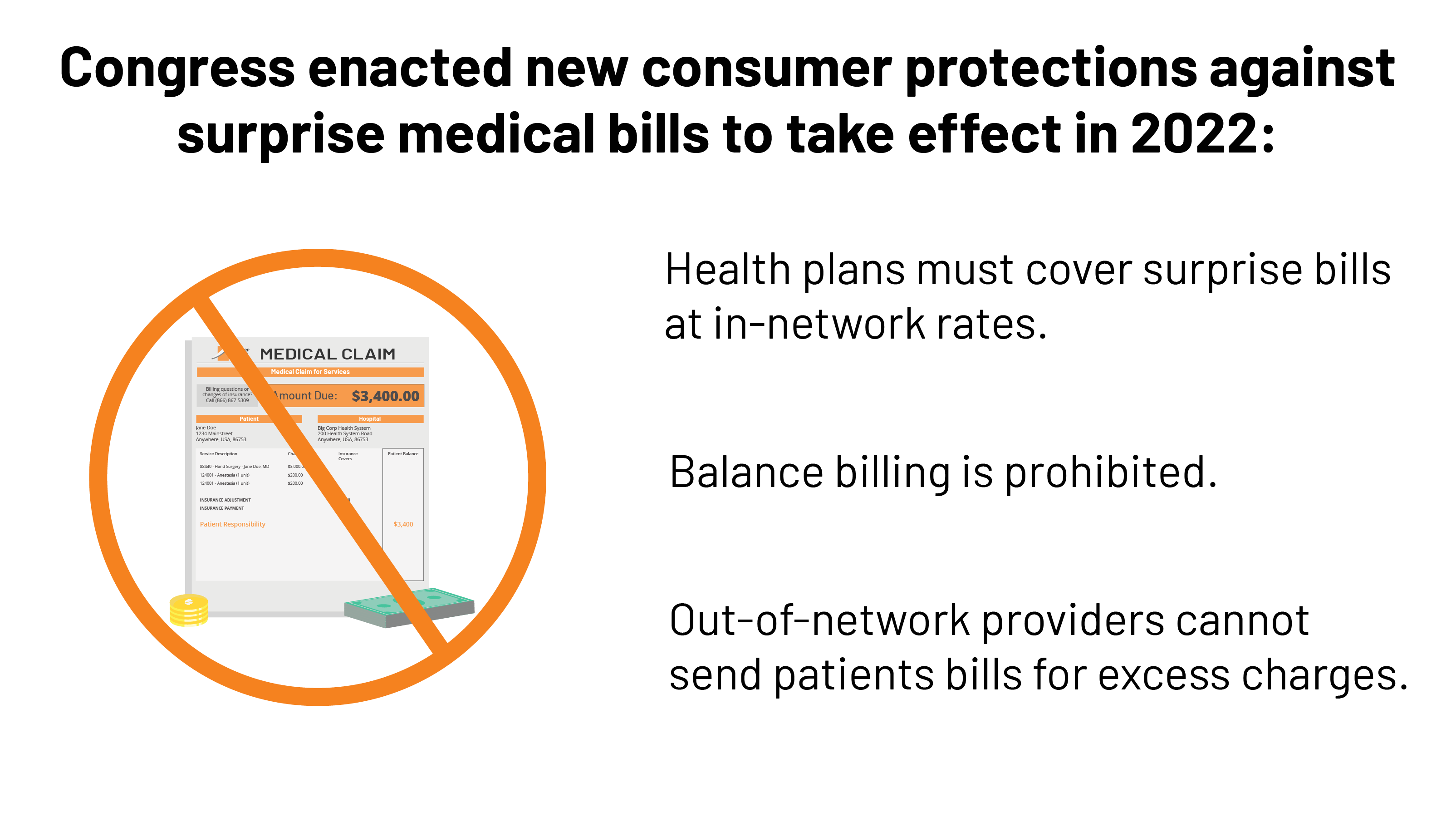
Surprise Medical Bills: New Protections for Consumers Take Effect in 2022 |  KFF

On Thursday the Department of Health and Human Services (HHS), along with other federal agencies, released the long-awaited second half of its proposed regulations implementing the No Surprises Act, passed by Congress at the end of last year, which bans “surprise billing” of patients who unsuspectingly receive care from out-of-network providers.

The interim final rule, which will take effect on January 1st after a comment and review period, lays out a process for addressing disputed patient bills, first through a 30-day “open negotiation” between the patient’s insurer and the out-of-network provider, and then through a federally-managed arbitration process.

Of most interest to insurers and providers who have lobbied fiercely for months to ensure a favorable interpretation of the law, the new regulation specifies that the outsider arbitrator, to be agreed upon by both parties, must begin with the presumption that the median in-network rate for services in the local market is the correct one. The arbitrator can then modify that price based on the specific circumstances of the case.

That method was broadly favored by insurers, and AHIP strongly endorsed the proposed approach, saying in a press release that “this is the right approach to encourage hospitals, healthcare providers, and health insurance providers to work together and negotiate in good faith.” Predictably, the hospital lobby felt otherwise; the American Hospital Association reacted by calling the rule “a windfall for insurers”, saying that it “unfairly favors insurers to the detriment of hospitals and physicians who actually care for patients.” 

The ultimate winners here are patients, who will gain important new protections against the potentially crippling financial implications of surprise billing. We’d agree with HHS Secretary Xavier Becerra, who told the New York Times that the new rule would “[take] patients out of the middle of the food fight,” and provide “a clear road map on how you can resolve that food fight between the provider and the insurer.” It’s about time. 

Still unresolved: the high cost of out-of-network ambulance services, left out of the No Surprises Act altogether. Let’s hope Congress circles back to address that issue soon.

Preparing for generations of Medicare growth

https://mailchi.mp/72a9d343926a/the-weekly-gist-september-24-2021?e=d1e747d2d8

The healthcare industry is now at the peak of the long-awaited transition of the Baby Boom generation into Medicare. The “greying” of the Boomers will continue to bring a rapid influx of new Medicare beneficiaries, but this is just the beginning of a protracted period of growth for the program, with the number of Medicare-eligible Americans increasing by more than 50 percent over the next three decades.

Using data from the US Census Bureau, the graphic above shows how the generational makeup of the Medicare population will change across time. The next decade will bring the fastest growth, as the latter half of the Baby Boom generation turns 65. Over that time, the Medicare-eligible population will increase by almost a third. Gen X will begin to age into Medicare in 2029. (Go ahead, take a minute. It hurts.) While fewer in number, Gen X beneficiaries, combined with the longer lifespan of Baby Boomers, will bring no respite from Medicare growth, with enrollment still increasing 11 percent between 2030 and 2040. 

As the country looks at a prolonged period of Medicare cost growth, we’ll be counting on a ballooning workforce of Millennials and Gen Z youngsters—each part of generations even larger than the Baby Boom—to continue to fund the Medicare trust across the next 25 years, when the first Millennials will receive their Medicare cards. (See how it feels?)

The Biden administration’s booster strategy gets clumsily underway

https://mailchi.mp/72a9d343926a/the-weekly-gist-september-24-2021?e=d1e747d2d8

After a confusing week of mixed messaging and conflicting opinions from the public health officials advising the Food and Drug Administration (FDA) and the Centers for Disease Control and Prevention (CDC), late Thursday night CDC Director Dr. Rochelle Walensky announced her decision to recommend COVID booster vaccines for adults over 65, residents of long-term care facilities, and those younger than 65 with underlying medical conditions.

Controversially, Dr. Walensky contradicted the CDC’s own Advisory Committee on Immunization Practices (ACIP) by also recommending that people who are at greater risk of COVID exposure due to occupation or institutional setting—including healthcare workers and teachers—receive a booster shot. Earlier Thursday, ACIP members voted down a recommendation to provide boosters to healthcare workers, despite the FDA’s endorsement of that approach earlier in the week.
 
By Friday morning, President Biden announced he would soon get a booster shot himself, urging those eligible to do so, and re-emphasizing the administration’s primary focus on delivering first doses to those still unvaccinated. There will be more to come on boosters: the FDA and CDC guidance only applies to those who received the Pfizer-BioNTech vaccine at least six months ago; boosters for the Moderna and Johnson & Johnson vaccines are still under review.

This week’s saga caps a month of back-and-forth between public health officials, the White House, and the medical community, following Biden’s August promise—considered by many to be premature—that boosters would be broadly available starting September 20th. The inclusion of healthcare workers in the booster campaign is welcome news; we were flummoxed by ACIPs decision to bypass that critical segment, given mounting hospital staffing shortages amid the surging Delta variant.

More broadly, we’re increasingly distressed by the relatively uncoordinated and poorly-managed communication approach of the Biden administration on vaccines—particularly following a campaign in which competence was touted as a key advantage over the previous administration.