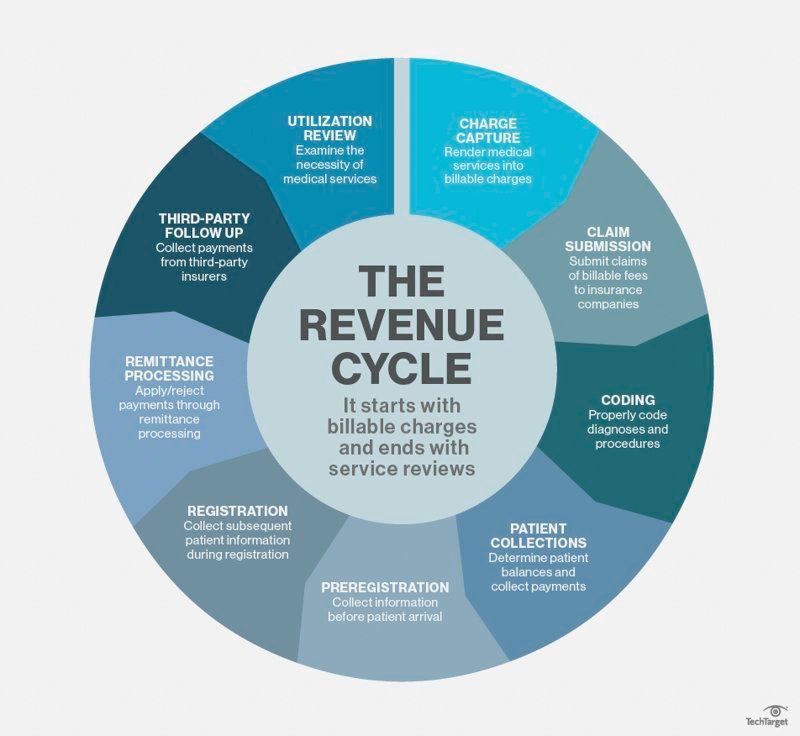
Five components of an intelligent middle revenue cycle

https://www.beckershospitalreview.com/healthcare-information-technology/five-components-of-an-intelligent-middle-revenue-cycle.html

What is revenue cycle management (RCM)? - Definition from WhatIs.com

Keys to achieving revenue integrity and compliance across your organization

It’s old news: Revenue cycle complexity continues to increase, exacerbating existing challenges. And as we tackle those, new ones arise to take their place.

Ever-changing regulations are a given, but adopting value-based reimbursement (VBR) models currently poses a major challenge. New payment models complicating revenue cycle activity become more difficult with additional quality reporting and other requirements. Add in the operational realities of siloed workflows, data proliferation, and disparate systems, and it’s clear why efficient collaboration can seem nearly impossible.  Intelligent middle revenue cycle operations that manage to these challenges are vital to achieving revenue integrity and financial stability.


Use the right solutions at the right time

Today’s environment requires sharpening the way you ensure revenue integrity. Providers need an easy, seamless way to manage middle revenue cycle operations, and there are several effective strategies to accomplish that. Of course, it’s important to recognize and make use of your EMR system’s capabilities. It’s also essential to leverage complementary technologies with specific core competencies that will improve revenue cycle performance. For example, a solution that continuously monitors records in real time enables timely auditing, coding adjustments and case completion to reduce billing turnaround and reimbursement delays.


Take a smart approach to enabling technology

Augmenting your core systems with complementary technologies or capabilities on a single, integrated platform makes it much easier to support internal collaboration between different departments or teams. An integrated platform also enables you to seamlessly deploy additional capabilities onto that platform, ensuring speed to value. Instead of using multiple disparate tools, a shared platform enables interdepartmental communication and helps minimize inefficiency.  A smart technology platform that crosses departmental siloes and brings transparency across teams is critical. Platforms that leverage clinically aware artificial intelligence and other automation enable staff to proactively focus on the areas where their expertise has the most impact. In addition, when leveraging an integrated platform, one expert team’s work will not get cancelled out by another team’s contributions.

Regardless of which core system you use, integrating technology with targeted competencies and connectivity adds value to the EMR. It can provide a depth of specialized expertise that drives better documentation, coding and real time audit interaction — keys to a high-performing revenue cycle.


Prioritize comprehensive, correct documentation and coding

Unfortunately, it seems the battle against claim denials is here to stay. You can’t overlook the importance of front-end data validation to eliminate rework and inefficiency. However, the ability to ensure complete and accurate clinical documentation for every case will significantly impact revenue capture and reduce the inefficiency of denials and rework.

Broaden the scope of your CDI program with technology that uses clinical intelligence to drive concurrent documentation review for all payers. Getting it right up front contributes to better coding, accurate reimbursement, and appropriate quality measures, all of which are vital to success under VBR.


Increase collaboration with payers

As long as payers and providers continue working at odds, the costly onslaught of denials will persist. In a perfect world, both sides would join forces to find mutually beneficial solutions for claim errors, denials and payment delays. Imagine the savings in administrative inefficiency alone. However, we’re not in that world yet. Therefore, it’s important to make a proactive effort to understand the specifics of each payer’s contract and adjust your internal processes and technology rules accordingly. As operating margins get smaller, organizations have no choice but to increase efficiency and accuracy, and working together with payers can contribute significantly to that goal.


Consolidate, collaborate, communicate

Industry pressures to improve performance are unrelenting, especially around smart solutions, innovation, and increasing both efficiency and the bottom line. Organizations are expected to improve these areas while, at the same time, enabling patient-centric operations. One way to achieve this is to leverage innovative, integrated tools to augment core systems and promote partnership, communication and efficiency across multiple related disciplines.

Consider clinical documentation, coding and auditing. Numerous departments need pieces of that information for different reasons, including utilization review, medical necessity determinations, chart audits and quality monitoring, in addition to bill preparation. A single repository containing up-to-date data in a real-time view driven by supporting workflow, rules and alerts provides consistent and reliable information when and where it’s needed.

As patient care becomes more complex, so does the middle revenue cycle. Seek solutions that will simplify and manage the complexity in an administratively efficient way. Consider your prospective vendor’s core competencies when evaluating solutions and look for integration and intelligent automation that will add the most value to your organization.


Pennsylvania hospital to cease inpatient care

https://www.beckershospitalreview.com/patient-flow/pennsylvania-hospital-to-cease-inpatient-care.html?utm_medium=email

Front Page: April 25, 2020

Crozer-Keystone Health System is shutting down inpatient care and non-emergency services at its hospital in Springfield, Pa., until June, according to the Delaware County Daily Times

Springfield Hospital is temporarily shutting down services after seeing a significant decline in patient volume due to the COVID-19 pandemic and suspending elective surgeries.

Crozer-Keystone, a four-hospital system, is trying to find alternative assignments for staff affected by the changes, a spokesperson told the Delaware County Daily Times. If there’s a surge in COVID-19 patients, some employees may be called back to the 25-bed hospital to assist.

Springfield Hospital is experiencing many of the same issues as other hospitals in the state. A recent analysis by Health Management Associates revealed that even with an expected $3.1 billion in federal aid provided under the Coronavirus Aid, Relief and Economic Security Act, Pennsylvania hospitals could still lose about $7 billion this year, according to the report. 


CMS suspends advance payments to providers, is reevaluating accelerated payments for hospitals

https://www.fiercehealthcare.com/hospitals-health-systems/cms-suspends-accelerated-payment-program?mkt_tok=eyJpIjoiWXpNMlpXUTVaakpoTmpJMSIsInQiOiJzU3ViK3ZwV0oyMUxOS3N5T0tXY3h1anlUSW5ndTJ0MDlEMkE1S3BGRDg1Mlc1eDdpY3hGaHRCV0U1eUpFbWxhR3ZoSVlRdlU5M1NCek5FamxZZ0NLMEhxQ25teFwvNVwvSFEzYnlETEpuMnlZM0FJYThWeEhTcUFodElZUEcwS1RlIn0%3D&mrkid=959610

CMS suspends advance payments to providers, is reevaluating ...

The Trump administration is suspending a program that offered advanced payments to providers and reevaluating another program that offered accelerated payments to health systems after doling out about $100 billion. 

The Centers for Medicare & Medicaid Services (CMS) announced over the weekend it is immediately suspending its Advance Payment Program to Medicare Part B suppliers such as doctors, non-physician practitioners and durable medical equipment suppliers.

The agency is reevaluating the amounts that will be paid under its Accelerated Payment Program, which have been made available to fee-for-service Medicare providers such as hospitals in light of the $100 billion already sent to providers through the program.

CMS had expanded the loan programs to ensure providers and suppliers had resources needed to combat COVID-19 as many began furloughing or laying off workers due to sharp revenue drops from elective care amid the COVID-19 response.

CMS approved more than 24,000 applications under the program and advanced more than $40 billion to Part B suppliers in the last several weeks. It approved 21,000 applications for accelerated payments, totaling nearly $60 billion in payments to hospitals.

Prior to COVID-19, the agency had only approved just over 100 of such requests.

The advanced and accelerated payments are not grants, but instead payments that are required to be paid back within one year, officials said.  

In a release, CMS officials said the actions are also being taken “in light of the $175 billion recently appropriated for healthcare provider relief payments,” the agency said, referring to $100 billion allocated in the CARES Act as well as $75 billion allocated to providers through the Paycheck Protection Program and Health Care Enhancement Act.

The Department of Health and Human Services is distributing that money through the Provider Relief Fund. Those funds will be used to support healthcare-related expenses or lost revenue attributable to the COVID-19 pandemic and to ensure uninsured Americans can get treatment for COVID-19, officials said.

Among the recipients of the funding, HCA Healthcare said it benefited from about $4 billion in accelerated Medicare payments provided under the CARES Act, saying that money will be repaid over an eight-month period beginning in August. HCA also received about $700 million of funds from the first phase of the public health and social services emergency fund.

Those two pieces of economic assistance have had the greatest impact in stabilizing the health system’s financials amid challenges presented by COVID-19, HCA officials said during a recent conference call with analysts.


Cartoon – Times are Tough

Times Are Tough - Small Business Trends

In worst-case scenario, COVID-19 coronavirus could cost the U.S. billions in medical expenses

https://www.healthcarefinancenews.com/node/140021?mkt_tok=eyJpIjoiTVdVNE16UmpZMkUzWlRnNCIsInQiOiJtcG1Tc29ZQVREZmlnTG9mSVFXams4K3pwYW1oRGh6b0xVekZnRlFKUUlNN2l4a3loWjBlZXZ0cm1UZFBYeTd1c1NkR2ZsdnI2aW5ZQVV0VlIrZHZPOFlkNFl4UDNsNTFBTmFXMzBhYVFnYUgyMjlYTHNzS3JuK09GTXo4UFVKQyJ9

In worst-case scenario, COVID-19 coronavirus could cost the U.S. ...

If 20% of the US population were to become infected with COVID-19, it would result in an average of $163.4 billion in direct medical costs.

One of the major concerns about the COVID-19 coronavirus pandemic has been the burden that cases will place on the healthcare system. A new study published April 23 in the journal Health Affairs found that the spread of the virus could cost hundreds of billions of dollars in direct medical expenses alone and require resources such as hospital beds and ventilators that may exceed what is currently available.

The findings demonstrate how these costs and resources can be cut substantially if the spread of COVID-19 coronavirus can be reduced to different degrees.

The study was led by the Public Health Informatics, Computational and Operations Research team at the City University of New York Graduate School of Public Health and Health Policy, along with the Infectious Disease Clinical Outcomes Research Unit at the Los Angeles Biomedical Research Institute, Harbor-UCLA Medical Center and Torrance Memorial Medical Center.

The team developed a computer simulation model of the entire U.S. that could then simulate what would happen if different proportions of the population end up getting infected with the COVID-19 coronavirus. In the model, each infected person would develop different symptoms over time and, depending upon the severity of those symptoms, visit clinics, emergency departments or hospitals.

The resources each patient would require – such as healthcare personnel time, medication, hospital beds and ventilators – would then be based on the health status of each patient. The model then tracks the resources involved, the associated costs and the outcomes for each patient.

For example, if 20% of the U.S. population were to become infected with the COVID-19 coronavirus, there would be an average of 11.2 million hospitalizations and 1.6 million ventilators used, costing an average of $163.4 billion in direct medical costs during the course of the infection.

The study shows the factors that could push this amount up to 13.4 million hospitalizations and 2.3 million ventilators used, costing an average of $214.5 billion. If 50% of the U.S. population were to get infected with COVID-19, there would be 27.9 million hospitalizations, 4.1 million ventilators used and 156.2 million hospital bed days accrued, costing an average of $408.8 billion in direct medical costs during the course of the infection.

This increases to 44.6 million hospitalizations, 6.5 million ventilators used and 249.5 million hospital bed days (general ward plus ICU bed days) incurred, costing an average of $654 billion during the course of the infection if 80% of the U.S. population were to get infected. The significant difference in medical costs when various proportions of the population get infected show the value of any strategies that could reduce infections and, conversely, the potential cost of simply letting the virus run its course – the “herd immunity” approach.

Simply put, allowing people to get infected until herd immunity thresholds are met would come at a tremendous cost, and even if social-distancing measures were relaxed and the country “opened up” too early, the healthcare system, as well as the broader economy, would come close to buckling under the weight of the additional costs.

WHAT’S THE IMPACT?

The study shows how costly the coronavirus is compared to other common infectious diseases. For example, a single symptomatic COVID-19 infection costs an average of $3,045 in direct medical costs during the course of the infection alone. This is four times higher than a symptomatic influenza case and 5.5 times higher than a symptomatic pertussis case. Factoring in the costs from longer lasting effects of the infection such as lung damage and other organ damage increased the average cost to $3,994.

Importantly, for a sizable proportion of those who get infected, healthcare costs don’t end when the active infection ends, and costs will likely stay high even after the bulk of the pandemic has passed.

A continuing concern is that the U.S. healthcare system will become overloaded with the surge of COVID-19 coronavirus cases and will subsequently not have enough person-power, ventilators and hospital beds to accommodate the influx of patients. The study shows that even when only 20% of the population gets infected, the current number of available ventilators and ICU beds will not be sufficient.

According to the Society of Critical Care Medicine, there are approximately 96,596 ICU beds and 62,000 full-featured mechanical ventilators in the U.S., substantially lower than what would be needed when only 20% of the population gets infected.

THE LARGER TREND

Data released this week by Kaufman Hall illustrates the extent to which U.S. hospitals are already suffering financially due to the coronavirus.

Looking at earnings before interest, taxes, depreciation and amortization, hospitals’ operating margins fell more than 100% in March, dropping a full 13 percentage points relative to last year. Compared to most months, that’s a much greater change. Operating EBITDA margin was up just 1% in March 2019, for example, and down 1% in February of this year.

These margins likely fell even further across broader health systems, which often include substantial physician and ambulatory operations outside of the hospital, Kaufman Hall found. Overall, operating margins fell 170% below budget for the month.


Hospitals that have disclosed bailout funds

https://www.axios.com/newsletters/axios-vitals-daff1b24-727d-44eb-adb9-9f33cd61bc16.html?utm_source=newsletter&utm_medium=email&utm_campaign=newsletter_axiosvitals&stream=top

Hospitals Need Cash. Health Insurers Have It.

More than $1.2 billion in federal bailout funds have been disclosed by hospitals and health systems thus far, including $150 million that was sent to Mayo Clinic, according to a review of financial documents by Axios’ Bob Herman.

Why it matters: Hospitals do not have to repay these taxpayer funds, which are supposed to offset the lost revenue and higher costs associated with handling the coronavirus outbreak. But there is no central location to track where the money is flowing.

The big picture: Hospitals and other health care providers can receive coronavirus funds through two primary sources:

Where it stands: Axios has found 11 hospital organizations — ranging from small community hospitals to large, multistate systems — that have disclosed bailout funding and Medicare loans through municipal bondholder documents or public filings, and compiled them into a database.

  • Some of the largest bailout payments disclosed so far have gone to HCA Healthcare ($700 million), Mayo Clinic ($150 million), Mercy ($101.7 million) and NYU Langone Health ($73.1 million).
  • $50 billion of the first $100 billion in bailout funds is “allocated proportional to providers’ share of 2018 net patient revenue,” according to HHS, and therefore likely favors systems that are bigger and/or charge higher prices.
  • Medicare has sent $100 billion as loans as of April 24, $7 billion of which has been disclosed to these 11 hospital systems.

Go deeper: The hospital bailout funding database


“I’ll take my chances with breast cancer”

https://mailchi.mp/0d4b1a52108c/the-weekly-gist-april-24-2020?e=d1e747d2d8

Local Health Officials Prepared for Coronavirus - Social Security ...

It’s entirely understandable that consumers would be reticent to visit in-person care settings right now. Given that doctors’ offices and urgent care facilities are where sick people congregate, a patient might well assume their chances of contracting COVID-19 would be higher there than in almost any other public space. But a story we heard this week from a health system chief strategy officer (CSO) reveals just how frightened patients may be to return.

Last week the system began to reach out to patients who had positive screening mammograms in February, before elective procedures and tests were cancelled, and who now needed to return for more detailed diagnostic images. A full 75 percent of these patients were unwilling to schedule a diagnostic mammogram within the next month, with one patient even saying, “I’ll take my chances with breast cancer over COVID!”.

Women with a concerning mammogram finding are typically among the most motivated patients in seeking follow-up care. If a majority of them are unwilling to pursue in-person follow-up, the same will likely be true of scores of patients with other possible cancers, heart disease, and other serious conditions. As fear delays needed care, patients are likely to end up much sicker, with more advanced disease, when they do return. With rigorous attention to symptom and temperature screening, visiting a doctor’s office should be less risky than going to the grocery store—but providers will have to publicly communicate the steps they are taking to keep patients safe before many will be willing to come in the door.


Tentative steps toward recovering from a deadly pandemic

https://mailchi.mp/0d4b1a52108c/the-weekly-gist-april-24-2020?e=d1e747d2d8

Baby Steps – Selah Someonetotalkto's Blog

The death toll from the novel coronavirus continued to mount this week, with more than 50,000 deaths reported in the US, and over 900,000 confirmed cases nationwide. Globally, the disease has infected more than 2.7M people and killed nearly 200,000. On Tuesday, public health officials in California announced that two people who died in Santa Clara County in early February were victims of COVID-19, making them the earliest known fatalities in the US, and altering experts’ understanding of how long the disease has been spreading in the country. New modeling from researchers at Northeastern University this week suggested that the virus may have been spreading widely in several cities by early February, but went undetected because of restrictions on testing.

National attention has remained focused on the subject of testing, as states and localities scramble to secure enough testing supplies and equipment to allow them to understand community spread and identify new cases. President Trump signed an emergency $484B relief bill on Friday that will provide $25B to ramp up testing, give additional aid to businesses forced to shutter, and send hospitals $75B in additional emergency funding.

The new money for hospitals is in addition to $100B already approved by Congress for a “provider relief fund” as part of the CARES Act. Having already distributed $30B of the initial grant money to hospitals, the Department of Health and Human Services (HHS) was expected to pay out an additional $20B today, this time according to a formula based on the net patient revenue of each hospital, rather than the earlier approach based on Medicare billings. The shift is expected to address concerns among children’s hospitals, safety-net providers, and others who were disadvantaged by the Medicare-based approach. It is unclear how the newly approved $75B of additional funding will be allocated.

Meanwhile, states began to plan for the reopening of their economies, with most governors taking a measured approach in coordination with neighboring states. A handful of states moved to loosen stay-at-home restrictions in advance of meeting the Trump administration’s “gating” criteria, including Florida, which reopened some beaches for recreational use, Oklahoma, and Georgia, which controversially allowed gyms, bowling alleys, hair and nail salons, and tattoo parlors to reopen on Friday.

Many states began to put in place plans to restart elective surgeries, which had been curtailed by a patchwork of differing state and local directives. The Centers for Medicare and Medicaid Services (CMS) released guidelines this week to help local officials decide when and how to restart surgeries. Whether for healthcare services or other types of economic activity, states will (and should) be guided by the ability to conduct widespread testing, robust contact tracing, and isolation of those infected with the virus. Ensuring that ability will likely make the next phase of the pandemic a protracted and frustrating “dance” of fits and starts, likely to last into the summer months and beyond.


Medicare trustees again sound alarm about looming depletion of hospital fund

https://www.fiercehealthcare.com/payer/medicare-trustees-again-sound-alarm-about-looming-depletion-hospital-fund?mkt_tok=eyJpIjoiTW1Gak1tTm1NMkZtTkdKaSIsInQiOiJGTGdcL1g2RWlXK2JRSmJQY29nZDZ6ZWszRlVxSnpHaEFwT1RaWkpITVRmTCtDeGpTeUVWWk9PYlZGdlZETFFBaVA1N2xRaXVLV2lpK0h1RVBrWk84dWw3RCtEUzZ5eXpSSkJlMHNYYzlURGYwcXZSY3BJYW9aYmsxRTJXUHpMbFAifQ%3D%3D&mrkid=959610

CMS Solicits Advice on New Medicare Payment Rules

The Medicare board of trustees held steady with its prediction on when the program’s hospital fund will run dry: 2026. 

In an annual report (PDF) released Wednesday, the trustees said hospital expenditures exceeded income by $5.8 billion last year. They expect similar trends to continue until the fund runs out in six years. The 2026 estimate has remained the same over the past several years of reports.

Medicare’s Hospital Insurance Trust Fund has missed the trustees’ tests of short-term financial adequacy every year since 2003, according to the report. It also marks the third year in a row that the trustees have issued a funding warning for the program. 

Total Medicare spending in 2019 was $796 billion, according to the report.

The trustees did say that despite the looming depletion of the fund, Congress has never allowed the hospital fund to fully run out. And the sooner policymakers act, the more time they have to roll out an extensive plan, the trustees said.

“The financial projections in this report indicate a need for substantial changes to address Medicare’s financial challenges,” the trustees said. “The sooner solutions are enacted, the more flexible and gradual they can be.”

“The early introduction of reforms increases the time available for affected individuals and organizations—including health care providers, beneficiaries, and taxpayers—to adjust their expectations and behavior,” they said.

While the fund backing Part A remains a risk, the funds for prescription drug coverage in Parts B and D are set to be stable for the foreseeable future, according to the report.  

That’s because these segments of the program are designed differently from the hospital benefit. Income and premium revenue reset annually, which allows the program to build a reserve for Part B contingencies and cover expected costs. 

The trustees also projected that Part B premiums will be about $153 in 2021. Premiums will be finalized in the fall.

The trustees caution, however, that the constant evolution in medicine makes it hard for long-term projections to be reliable. They also note that none of the projections account for any impacts related to the COVID-19 pandemic. 

“Projections of Medicare costs are highly uncertain, especially when looking out more than several decades,” the trustees said. “No one knows whether future developments will, on balance, increase or decrease costs.” 


Interim Coronavirus Relief Bill

https://heathercoxrichardson.substack.com/p/april-23-2020

Congress expected to announce deal on latest coronvirus relief bill

Today the House of Representatives passed a new $484 billion coronavirus relief bill by a vote of 388-5. The Senate passed it Tuesday. $381 billion is for small businesses left out in the cold when the money from the previous coronavirus relief package quickly ran dry. Republicans wanted to stop there, but Democrats demanded $75 billion for hospitals, and $25 billion for coronavirus testing, as well as a requirement that the administration figure out a strategy to get tests to states.

The relief bill comes as more than 26 million Americans are out of work and almost 50,000 Americans have died of Covid-19. The representatives had to drive to Washington, D.C., or fly unusual routes because regular flights are canceled. They arrived for the vote in the Capitol building in alphabetical groups of 50 to 60 so they could keep their distance from each other. A number of Republicans refused to wear masks during the vote, while all but one Democrat wore one.

Democrats inserted into the bill a new committee to oversee the administration’s “preparedness for and response to the coronavirus crisis,” chaired by Jim Clyburn (D-SC). The committee has the power to subpoena witnesses and documents. Republicans and Trump objected.

But the Democrats did not get any more aid to states, crippled by the crisis, than the $150 billion previously provided. The bipartisan National Governors Association, headed by Maryland Governor Larry Hogan, a Republican, has asked for $500 billion to help the states replace lost tax revenues. Democrats wanted such aid, but Republicans refused.

Senate Majority Leader Mitch McConnell (R-KY) went on talk radio host Hugh Hewitt’s show on Wednesday and tried to make the question of state aid partisan. He said that he opposed granting money to states whose problems, he said, stemmed from their underfunded state pension plans. Instead, the states should consider bankruptcy. A document put out by McConnell’s office called aid to the states a “blue state bailout.”

In fact, Michael Leachman, the senior director of state fiscal research at the Center on Budget and Policy Priorities, said that McConnell has it wrong. States have not been overspending; their expenses for education and infrastructure are actually significantly below what they were in 2008, despite more inhabitants, and they have put about 7.6% of their budgets into rainy day funds, a historic high, up from the previous high of 5% they held in reserve in 2006 before the Great Recession.

The problem is that states have to balance their budgets annually, and they depend on sales and income taxes for 70% of their revenue. The shutdowns have decimated tax revenues as shopping ends and people lose their jobs. At the same time, unemployment claims are climbing dramatically. States are looking at a $500 billion loss between now and 2022.

States need money to avoid massive layoffs and deep spending cuts, actions that would make the economic crisis continue much longer than it would if they do not have to make them. They would not use bailout money on pensions, Leachman writes, but put it in state general funds, which are collapsing. Pensions come out of a separate trust fund (although the general fund does put money toward future pensions, that’s less than 5% spending from the general fund). Federal bankruptcy law currently does not allow states to declare bankruptcy, but in any case, Leachman writes, there is no need for it. Bankruptcy relieves high debt levels, but state debt is not high, and once the pandemic passes, the states should be financially sound again.

If Leachman’s explanation was scholarly, New York Governor Andrew Cuomo was blunt. “New York puts into that federal pot $116B more than we take out. Kentucky takes out $148B more than they put in,” he said at a press conference. “Senator McConnell, who’s getting bailed out here? It’s your state that’s living on the money that we generate.” A recent study by the Rockefeller Institute of Government shows that New Yorkers as a group pay in to the federal government $1,792 per capita more than they take out, while for every dollar Kentucky puts in, it gets $2.61 back.

Cuomo called McConnell out for trying to turn the crisis into a political fight: “That’s not what this country is all about,” Cuomo said. “It’s not red and blue, it’s red, white and blue.”

Today’s other big news was Trump’s suggestion at his coronavirus briefing that it would be worth studying whether injecting disinfectant into patients would kill the novel coronavirus. “And then I see the disinfectant where it knocks it out in a minute. One minute. And is there a way we can do something like that, by injection inside or almost a cleaning?” he said. “Because, you see, it gets on the lungs, and it does a tremendous number on the lungs. So it’d be interesting to check that. So that you’re going to have to use medical doctors, but it sounds — it sounds interesting to me.” He also suggested using heat and light to kill the virus.

Doctors were horrified at his comment, calling it irresponsible and dangerous. Disinfectants are poisonous and are deadly if they are used inappropriately. “To be clear:” emergency medicine physician Dara Kass tweeted, “Intracavitary UV light and swallowing bleach or isopropyl alcohol can kill you. Don’t do it.”

Trump’s emphasis on dramatic cures for Covid-19 reinforces his disagreement with health experts that we must dramatically increase our testing for the disease so we can identify hot spots and isolate them before they spread. At today’s briefing, Trump disagreed with Dr. Anthony Fauci, the director of the National Institute of Allergy and Infectious Diseases and one of the administration’s top medical advisors about the pandemic, who recently said “We absolutely need to significantly ramp up, not only the number of tests but the capacity to actually perform them.” Today, Trump said: “I don’t agree with him on that, no, I think we’re doing a great job on testing.”

In fact, the U.S. lags behind other nations in per capita tests, and Trump’s continuing reluctance to support getting them seems to me mystifying. It is this odd gap Congress is trying to address with its requirement in the new coronavirus package that the administration must figure out a strategy to get tests to states. The bill now heads to the Oval Office for Trump’s signature.

For all the dark nitty-gritty of politics today, it is also a day that begins a joyous month, and that seems to me a far better way to leave you all tonight than with the day’s troubles. For those who celebrate, Ramadan Mubarak.