Kaiser’s net income surges to $2B in Q2

https://www.beckershospitalreview.com/finance/kaiser-s-net-income-surges-to-2b-in-q2.html

Image result for kaiser net income

Oakland, Calif.-based Kaiser Permanente’s revenue, operating income and net income for its nonprofit hospital and health plan units increased year over year in the second quarter of 2019.

The healthcare giant reported operating revenue of $21.4 billion in the second quarter of this year, up 9.3 percent from $19.6 billion in the same period a year prior.

Kaiser’s health plan unit — as well as favorable accounting estimates compared to the second quarter of 2018 — contributed to the growth. Kaiser saw health plan membership increase from 12.2 million as of June 30, 2018, to 12.3 million as of June 30.

As Kaiser’s revenue grew, so did operating expenses. Expenses climbed from $19.3 billion in the second quarter of 2018 to $20.3 billion in the second quarter of 2019.

With operating expenses accounted for, Kaiser reported operating income of $1.1 billion in the second quarter of 2019. That’s up from $345 million in the first quarter of 2018.

Kaiser’s nonoperating income was $930 million in the second quarter of this year, up from $308 million in the same period a year prior.

The boost was attributable to strong investment performance, along with an accounting change that took effect Jan. 1, the organization said. Under the accounting change, Kaiser reported unrealized gains on certain equities as net nonoperating income, which added $223 million to the organization’s nonoperating income and expenses in the second quarter of 2019.

Kaiser ended the second quarter of 2019 with net income of $2 billion. That’s up more than 213 percent from its net income of $653 million in the first quarter of last year.

“Strong results are essential for us to deliver on our nonprofit mission to improve affordability while advancing our high-quality care and service for our members and customers. This also allows us to make strategic investments in technology, people and care facilities,” said Kaiser Executive Vice President and CFO Kathy Lancaster. “At the same time, it’s critical we remain fiscally vigilant in today’s increasingly competitive environment with growing industry and financial pressures.”


Charity Care Spending By Hospitals Plunges

Charity Care Spending By Hospitals Plunges

Image result for Charity Care Spending By Hospitals Plunges

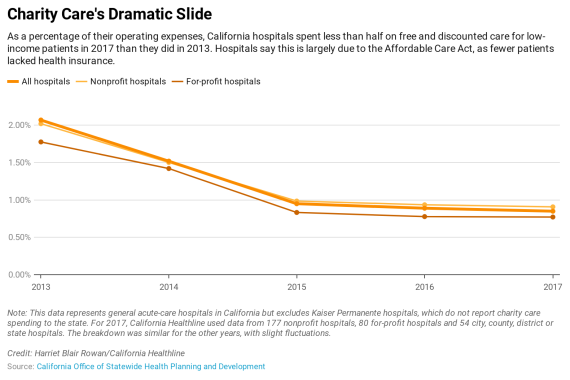
California hospitals are providing significantly less free and discounted care to low-income patients since the Affordable Care Act took effect.

As a proportion of their operating expenses, the state’s general acute-care hospitals spent less than half on these patients in 2017 than they did in 2013, according to data the hospitals reported to California’s Office of Statewide Health Planning and Development.

The biggest decline in charity care spending occurred from 2013 to 2015, when it dropped from just over 2% to just under 1%. The spending has continued to decline, though less dramatically, since then.

The decline was true of for-profit hospitals, so-called nonprofit hospitals and those designated as city, county, district or state hospitals.

Health experts attribute the drop in charity care spending largely to the implementation of the federal Affordable Care Act, popularly known as Obamacare. The law expanded insurance coverage to millions of Californians, starting in 2014, and hospitals are now treating far fewer uninsured patients who cannot pay for the care they receive.

With fewer uninsured patients, fewer patients seek financial assistance through the charity care programs, according to the California Hospital Association.

Cori Racela, deputy director at the Western Center on Law & Poverty, countered that many people still need financial assistance because — even with insurance — they struggle to pay their premiums, copays and deductibles.

“The need for charity care has changed,” she said, “but it still exists.”

The data on charity care comes from most of the state’s general acute-care hospitals but does not include Kaiser Permanente hospitals, which are not required by the state to report their charity care totals. (Kaiser Health News, which produces California Healthline, has no affiliation with Kaiser Permanente.)

For 2017, California Healthline used data from 177 nonprofit hospitals, 80 for-profit hospitals and 54 city, county, district or state hospitals. The breakdown was similar for the other years, with slight fluctuations.

Nonprofit hospitals, whose charity care spending dropped from 2.02% of operating expenses to 0.91% over the five-year period, are required by state and federal law to provide “community benefits” in exchange for their tax-exempt status.

They can meet that requirement beyond providing free and discounted care in a variety of ways: They can offer community public health programs, write off uncollected patient debt and claim the difference between what it costs to provide care and the amount that they are reimbursed by government insurance programs.

Nonprofit “hospitals get tax-exempt status, but they don’t get it for free,” said Ge Bai, associate professor of accounting and health policy at Johns Hopkins University. Charity care “is part of the implicit contract between hospital and taxpayers.”

Bai sees the reduced spending on charity care as part of a trend of nonprofit hospitals acting more like their for-profit counterparts.

Many nonprofit hospitals “no longer consider charity care their primary mission,” she said. “They are making more and more money but they are dropping their charity care.”

The state and federal governments set no minimum requirements for charity spending by hospitals, although the California Attorney General has created standards for a few nonprofit hospitals that have changed ownership in recent years.

Jan Emerson-Shea, a spokeswoman for the California Hospital Association, said hospitals are giving back to their communities in ways beyond charity care.

“You see charity care declining, but Medi-Cal losses are increasing,” Emerson-Shea said. She pointed to the growing shortfalls many hospitals report from caring for more patients covered by the public insurance program. “Every Medi-Cal patient we treat we lose money on.”

Medi-Cal, the state’s Medicaid program for low-income residents, increased its rolls by 5.6 million — or about 70% — from 2013 to 2017.

Racela, of the Western Center on Law & Poverty, would like to see changes in California’s charity care rules to address high out-of-pocket costs.

And she wants hospitals to abide by the state law that requires them to inform patients that they may be eligible for charity care based on their income.

“There is still a big unmet need for charity care across the state,” Racela said.


One of the constants of healthcare: Rising executive pay

https://www.modernhealthcare.com/executive-compensation/one-constants-healthcare-rising-executive-pay?utm_source=modern-healthcare-daily-dose-wednesday&utm_medium=email&utm_campaign=20190807&utm_content=article4-readmore

Average total cash compensation for health system executives rose 6.5% from 2018 to 2019, extending a consistent rise in executive pay that governance experts do not expect to slow.

Annual and long-term performance-based incentives have driven pay hikes of 4% to 7% each of the last four years, according to Modern Healthcare’s annual Executive Compensation Survey. Health systems’ ongoing expansions coupled with a highly competitive executive market will continue to drive up their base salaries and bonuses, experts said. But this dynamic is drawing ire from rank-and-file employees who aren’t happy with their pay and from consumers who are spending more on their care. It is also spurring new legislation.

Nevertheless, with baby boomers retiring in large numbers and demand soaring, the pay hikes aren’t going away anytime soon. “Healthcare organizations are becoming more complex and leadership skills are evolving,” which often translates to higher pay, said Bruce Greenblatt, a managing principal at SullivanCotter, the compensation consulting firm that has supplied data for Modern Healthcare’s annual surveys since 2003.

“Qualified talent is in short supply, which requires a deliberate approach to talent strategy as new roles emerge and new responsibilities unfold,” he said.

Providers look to select metrics and targets that will shape their organization for years to come. In doing so, they toe a delicate line ensuring their bonuses are attainable to keep executives engaged while not making them out of reach and damaging morale.

With more pay based on performance, there’s greater risk of poor program design, said Steve Sullivan, a managing director at executive compensation consulting firm Pearl Meyer. If you make a mistake, there is a lot of money on the line, he said.

“You don’t want to have giveaways and you don’t want to have plans so egregiously hard that they never have payouts because executives will disengage from the program,” Sullivan said. “You have to strike a balance between responsible compensation and something that is motivating and incenting.”

Larger systems paying more

Health system executives’ average base salaries increased 4.2% and ticked up even higher among organizations with more than $3 billion in revenue based in high-cost cities, according to Modern Healthcare’s 39th Executive Compensation Survey, made up of data aggregated from 1,149 hospitals and 401 health systems. System CEOs earned an average total cash compensation of $1.4 million in 2019, a 6.3% increase.

Executives who saw the highest total cash compensation hikes of 6.6% up to 13.3% were business development officers, administrative officers, internal audit executives, chief financial officers, planning executives, reimbursement executives, chief nursing officers, chief human resources officers and chief operating officers.

Incentives are typically tiered with a minimum threshold, a target and a stretch goal. They are often based on quality, safety and patient experience as well as financial performance. They may be related to ambulatory market share, employee and patient engagement, facilitating access to capital, bolstering physician alignment, inking successful joint partnerships and mergers, emergency department wait times and utilization, population health, shared risk, readmissions, hospital-acquired infections and length of stay, among other metrics.

The types of incentives offered are heavily dependent on the provider and the market. Some hospitals and health systems have stuck to the more traditional financial and market-share-based measurements, while more progressive organizations are targeting outcomes.

The bonuses differ based on short- and long-term goals, the latter becoming more prominent in recent years as boards and compensation committees emphasize the entire organization’s performance. Sometimes there is a trigger, such as operating margin, where executives miss out on all bonuses if it isn’t reached. For instance, Mercy Health, which is now Bon Secours Mercy Health, did not pay executives an incentive in 2016 since the system did not reach its incentive thresholds, the Cincinnati-based Catholic health system said.

“You want to make sure everyone is rolling in the right direction,” said Tom Giella, chairman of healthcare services for executive recruiter Korn Ferry. “You want to do what is right for the system, not an individual hospital or inpatient versus outpatient. It creates an incentive for everyone to work together.”

But even if the baseline isn’t reached, there typically isn’t a penalty, experts said. It will only lower their earning potential. “In some industries there can be a negative adjustment,” Sullivan said. “I haven’t seen that in healthcare. In healthcare, if there is a modifier it is going to be positive.”

Long-term view

Nearly half of larger health systems surveyed report using long-term incentive plans.

Dignity Health said a “substantial portion” of executive compensation is linked to organizational performance related to key clinical-quality and patient-satisfaction measures as well as community health investments and financial performance. Similarly, Kaiser Permanente said a third to half of pay is based on performance, linked to membership growth, expenses, operating income, and clinical and service quality improvements. Bon Secours Mercy said each of its employees are rewarded under the same incentive program, which includes quality, growth, financial and community benefit targets.

More providers are using deferred compensation programs, which can amount to hefty payouts at the end of an executive’s tenure.

In a related Modern Healthcare analysis of more than 2,000 not-for-profit hospitals, the 25 highest-paid not-for-profit health system executives received a combined 33.2% increase in total compensation in 2017, as their compensation rose to $197.9 million from $148.6 million in 2016.

The pay increases have spawned rallies and protests from more than 1,000 employees at Beaumont Health and Providence St. Joseph Health, both of which had chief executives in the top 25. Beaumont and Providence said in prepared statements that their CEO pay are not outliers compared to their peers.

California policymakers introduced a bill, recently passed by a state Senate subcommittee, that aims to boost not-for-profit health systems’ public disclosure requirements for executives’ deferred compensation.

“What surprises people I think as compensation becomes very generous because it is a competitive market, some think a hospital administrator shouldn’t expect to make more than the average physician,” said Paul Keckley, an industry consultant and managing editor of the Keckley Report. “Those days are long gone.”

Executives’ pay along with their respective C-suites are growing as health systems expand. New C-suite positions in 2019 included reimbursement executive, communications executive, academic affairs executive and operations executive, according to SullivanCotter’s data.

Physician leaders continue to be in high demand as providers look to influence clinical delivery redesign, population heath activities and quality improvement, said Tom Pavlik, a managing principal at SullivanCotter. Administrative roles in finance, consumer experience, IT, marketing and human resources are being filled by healthcare industry outsiders, he said.

“There is a lot of change as organizations are realigning to be operationally efficient and integrate clinical care delivery,” Pavlik said.

Among hospital executives, average base salaries rose 3.7% for hospitals that exceeded $300 million in revenue compared to 3.2% for smaller facilities. System-owned hospitals saw slightly lower base salary hikes than independent ones.

Average total compensation increased 5.3%, while CEOs of independent hospitals took home the highest raises at 9.2%, followed by chief financial officers of independent hospitals (6.5%), chief operating officers of system-owned hospitals (5.8%) and chief financial officers of system-owned hospitals (5.3%). Independent hospital CEOs earned an average of $758,300.

Providers rely on third-party consultants for accurate portrayals of market-based compensation reports that inform their compensation structures. But some of Pearl Meyer’s prospective clients are concerned about how their current adviser is interpreting the market, Sullivan said.

“With all the M&A, you have to create larger peer groups to generate a bigger sample,” he said.

This is a relatively new dynamic as the number of megasystems have swelled, Giella said.

“There is a war for talent and a big demand as systems have amalgamated so quickly,” he said. “They are getting through these growing pains where they have never dealt with this scale before, so it’s hard to look at historical trends. It’s very fluid so it’s hard to tell if you are paying someone fair compensation.”

One of Keckley’s regional health system clients told him that they are trying to figure out the most efficient and lean model.

“When I asked him what is keeping him awake, he said, ‘I want to be sure we are market-focused and that we are not just busy moving the deck chairs around.’ ”

DATA: Executive Compensation: 2019


Rural hospitals take spotlight in coverage expansion debate

https://www.modernhealthcare.com/payment/rural-hospitals-take-spotlight-coverage-expansion-debate?utm_source=modern-healthcare-daily-dose-wednesday&utm_medium=email&utm_campaign=20190807&utm_content=article1-readmore

Image result for rural hospital

Opponents of the public option have funded an analysis that warns more rural hospitals may close if Americans leave commercial plans for Medicare.

With the focus on rural hospitals, the Partnership for America’s Health Care Future brings a sensitive issue for politicians into its fight against a Medicare buy-in. The policy has gone mainstream among Democratic presidential candidates and many Democratic lawmakers.

Rural hospitals could lose between 2.3% and 14% of their revenue if the U.S. opens up Medicare to people under 65, the consulting firm Navigant projected in its estimate. The analysis assumed just 22% of the remaining 30 million uninsured Americans would choose a Medicare plan. The study based its projections of financial losses primarily on people leaving the commercial market where payment rates are significantly higher than Medicare.

The estimate assumed Medicaid wouldn’t lose anyone to Medicare, and plotted out various scenarios where up to half of the commercial market would shift to Medicare.

The analysis was commissioned by the Partnership for America’s Health Care Future, a coalition of hospitals, insurers and pharmaceutical companies fighting public option and single-payer proposals.

In their most drastic scenario of commercial insurance losses, co-authors Jeff Goldsmith and Jeff Leibach predict more than 55% of rural hospitals could risk closure, up from 21% who risk closure today according to their previous studies.

Leibach said the analysis was tailored to individual hospitals, accounting for hospitals that wouldn’t see cuts since they don’t have many commercially insured patients.

The spotlight on rural hospitals in the debate on who should pay for healthcare is common these days, particularly as politicians or the executive branch eye policies that could cut hospital or physician pay.

On Wednesday, Sen. Elizabeth Warren (D-Mass.) seemingly acknowledged this when she published her own proposal to raise Medicare rates for rural hospitals as part of her goal to implement single payer, or Medicare for All. She is running for the Democratic nomination for president for the 2020 election.

“Medicare already has special designations available to rural hospitals, but they must be updated to match the reality of rural areas,” Warren said in a post announcing a rural strategy as part of her campaign platform. “I will create a new designation that reimburses rural hospitals at a higher rate, relieves distance requirements and offers flexibility of services by assessing the needs of their communities.”

Warren is a co-sponsor of the Medicare for All legislation by Sen. Bernie Sanders (I-Vt.), who is credited with the party’s leftward shift on the healthcare coverage question. But she is trying to differentiate herself from Sanders, and the criticisms about the potentially drastic pay cuts to hospitals have dogged single-payer debates.

Most experts acknowledge the need for a significant policy overhaul that lets rural hospitals adjust their business models. Those providers tend to have aging and sick patients; high rates of uninsured and public pay patients over those covered by commercial insurance; and fewer patients overall than their urban counterparts.

But lawmakers in Washington aren’t likely to act during this Congress. The major recent changes have mostly been driven by the Trump administration, where officials just last week finalized an overhaul of the Medicare wage index to help rural hospitals.

As political rhetoric around the public option or single payer has gone mainstream this presidential primary season, rural hospitals will likely remain a talking point in the ideas to overhaul or reorganize the U.S.’s $3.3 trillion healthcare industry.

This was in evidence in May, when the House Budget Committee convened a hearing on Medicare for All to investigate some of the fiscal impacts. One Congressional Budget Office official said rural hospitals with mostly Medicaid, Medicare and uninsured patients could actually see a boost in a redistribution of doctor and hospital pay.

But the CBO didn’t analyze specific legislation and offered a vague overview of how a single-payer system might look, rather than giving exact numbers.

The plight of rural hospitals has been used in lobbying tactics throughout this year — in Congress’ fight over how to end surprise medical bills as well as opposition to hospital contracting reforms proposed in the Senate.

And it has worked to some extent. Both House and Senate committees have made concessions to their surprise billing proposals to mollify some lawmakers’ worries.


Dignity Health to pay $100 million, make mandatory pension contributions in settlement

https://www.pionline.com/courts/dignity-health-pay-100-million-make-mandatory-pension-contributions-settlement

Image result for drop in the bucket

Dignity Health, San Francisco, will pay $100 million to settle a long-running class-action lawsuit challenging its status as a church plan.

The settlement, set for final approval Aug. 1, calls for Dignity Health to contribute $50 million in 2020 and $50 million in 2021. It also requires mandatory funding contributions to the plan for five years and payment of $1.49 million to a related group of vested participants, according to motions filed June 27 with the U.S. District Court in San Francisco.

The settlement notice filed by the plaintiffs notes that Dignity Health has made previous voluntary contributions to the plan, including $271 million in fiscal 2018, but “has no obligation under the plan document to continue to do so,” and the impact of a merger into CommonSpirit Health on plan funding decisions is “unknown.”

Actuarial estimates provided by Dignity Health project required contributions of $162 million in 2021, $170 million in 2022, $178 million in 2023 and $187 million in 2024, according to the court filing.

The complaint in Rollins et al. vs. Dignity Health et al. was first filed in April 2013 by plaintiffs seeking more than $2 billion in missed pension contributions and other damages. Among other claims, the lawsuit challenged the interpretations made by the IRS and the Department of Labor that allowed the hospitals in the Dignity Health network, which have varying degrees of church associations, to be exempt from the Employee Retirement Income Security Act.

By December 2013, the District Court had ruled that Dignity Health did not qualify for a church plan exemption from ERISA because only a church can sponsor and maintain a church plan. After various motions, that decision was affirmed in July 2016, by the 9th U.S. Circuit of Appeals in San Francisco.

In August 2016, Dignity Health asked the U.S. Supreme Court to review the 9th Circuit’s decision, and the case was consolidated with two similar church plan challenges against Advocate Health Care Network and St. Peter’s Healthcare System.

The Supreme Court ruled in June 2017 that pension plans did not have to be established by a church to be exempt from ERISA, as long as they are controlled by or associated with one. Plaintiffs then filed an amended class-action complaint in November 2017 in the 9th Circuit.


Hospital association: Wage index rule positive, but uncompensated care needs work

https://www.crainsnewyork.com/health-pulse/hospital-association-wage-index-rule-positive-uncompensated-care-needs-work?utm_source=health-pulse-tuesday&utm_medium=email&utm_campaign=20190805&utm_content=hero-readmore

Image result for medicare wage index 2019

The Centers for Medicare and Medicaid Services on Friday unveiled its final rule on Medicare payment policies for hospitals under the inpatient prospective payment system for fiscal 2020. Though the Greater New York Hospital Association sees modifications to the agency’s proposal to address area wage index disparities as a boon, it’s not pleased with the outcome when it comes to uncompensated care.

“On a positive note, CMS modified its proposal to address wage index disparities between low and high wage index areas and will apply a uniform national budget neutrality factor to all hospitals instead of cutting only high wage area hospitals,” wrote Kenneth Raske, president and CEO of the association, in a letter to members.

The area wage index applies to the reimbursement of hospitals and raises or lowers Medicare payments to account for geographic differences in labor costs.

The final rule is designed to increase the wage index for hospitals with a value below the 25th percentile. Specifically, it will increase those hospitals’ wage indexes by half the difference between the otherwise applicable value for a hospital and the 25th percentile value across all hospitals. And there will be a 5% cap on any decrease in a hospital’s wage index from its final wage index for fiscal 2019 to mitigate significant decreases.

CMS’ previous proposal would have targeted only high wage index hospitals—such as those in New York—to address disparities. The modified provision will cost New York hospitals about $26 million, including fee–for–service and managed-care payments, less than half of what the original proposal would have cost them, a spokesman for the Greater New York Hospital Association said. Nationwide, the proposal will cost about $330 million.

Before the final rule, the New York congressional delegation took issue with the initial proposal to increase the wage index for hospitals that fall in the lowest 25th percentile of wage areas at the expense of hospitals that are above the 75th percentile of wages.

“CMS argues that its proposed changes to the area wage index seek to help rural hospitals, yet not one of New York’s rural hospitals—who face the same fiscal challenges as rural hospitals across the nation—would see a benefit from the policy,” the lawmakers wrote in a letter to CMS administrator Seema Verma. “Rather, states like New York with many hospitals that have legitimately high wages commensurate with market competition will be forced to transfer hundreds of millions in Medicare funding to a small handful of states.”

With the issue of wage index out of the way, state hospitals’ greatest concern may now be the finalized uncompensated care pool proposal. Raske noted the Greater New York Hospital Association has “fiercely opposed” the proposal.

“To mitigate the impact of the data issues and reduce the volatility in the uncompensated care distributions, GNYHA had recommended that CMS continue the fiscal year 2019 policy and base the distribution on a weighted average of low-income days and uncompensated care costs,” Raske wrote. “Instead, CMS finalized its proposal to base the distribution on 100% uncompensated care costs using 2015 data.”

In March the Greater New York Hospital Association called the proposal dangerous and said it would base distributions on bad debt and charity care data and cap the pool’s rate of growth, representing a $98 billion cut over 10 years. —Jennifer Henderson


In need of a new lens on demographic trends

As we’ve discussed before, our view is the healthcare system faces two fundamental demographic challenges across the next decade.

The first is how to sustainably accommodate 80M Baby Boomers—all of whom will be over 65 within the next ten years and in the Medicare program. This will entail providers learning to care for seniors in a much lower cost, lower intensity way, and payers (the federal government and insurers) to design benefits, networks and reimbursement approaches that support a more appropriate model of care delivery.

The second, often less discussed, is how to adapt traditional delivery approaches for the (even larger) Millennial generation, who will enter their “fix me” years within the next decade, and bring their high-demand, high-information, digitally-oriented consumption behaviors to an industry that has been built for older consumers more accustomed to the “hurry up and wait” model.
 
Our concern for incumbents, as the graphic suggests, is that they view these two demographic challenges through the lens of their current business models and seek to protect their legacy economics.

We commonly hear provider executives talk about “taking a wait and see attitude” and having a bias toward “no-regrets moves”. Why should we embrace price transparency, destroy demand for our own services, or disrupt ourselves, while we’re still making so much money on fee-for-service medicine?

But self-disruption is becoming an urgent priority as newly-emboldened outsiders look to upend the traditional model. Players like CVS, UnitedHealth Group and others view now as the time to assemble low-cost delivery assets and redesign network and benefit structures to capture the loyalty of those Boomers in Medicare Advantage plans for the next decade or more. And technology companies from Amazon to Google see an immediate opportunity to build new models around consumer loyalty as well, moving at Internet speed.

The sooner incumbents wake up to the reality that these unprecedented demographic forces demand a new approach to doing business, the better their chance of avoiding being outflanked by these kinds of disruptors.


Seventy two percent of all rural hospital closures are in states that rejected the Medicaid expansion

https://www.gq.com/story/rural-hospitals-closing-in-red-states

Image result for rural hospital bankruptcies

States that refused Obamacare’s Medicaid expansion are hemorrhaging hospitals in rural areas.

Roughly 20 percent of Americans live in rural areas, including more than 13 million children, according to the last U.S. census. And, according to research and reporting by the Pittsburg Morning Sun and its parent company, GateHouse Media, those people have been steadily losing access to hospitals for years.

In Oklahoma, Georgia, South Carolina, and Mississippi, at least 52 percent of all rural hospitals spent more money than they made between 2011 to 2017. In Kansas, it’s 64 percent, and five hospitals there shut down completely in that time. Since 2010, 106 rural hospitals have closed across the country. (Another 700 are “on shaky ground,” and about 200 are “on the verge of collapse,” according to Gatehouse.) Of those 106 that closed, 77 were in deep red states where local politicians refused the Obama administration’s Medicaid expansion that came about as a result of the Affordable Care Act.

In short, the federal government provided funds to expand coverage for Medicaid, a program that helps pay for health care for low income patients. But the expansion was optional, and 14 Republican-controlled states rejected to take the money. The only state that bucked this trend was Utah, where rural hospitals were among the most profitable in the country thanks to a policy of shifting funds and resources from urban hospitals. Only 14 percent of rural hospitals operated at a loss and none shut down over the same time period.

The number of rural hospitals has been shriveling for some time now: more than 200 rural hospitals closed between 1990 and 2000, according to a report from the Office of Health and Human Services. Since rural areas have been losing hospitals for decades already, every additional closure is more devastating. And even the hospitals that remain open are struggling to stay fully staffed. According to the Health Resources and Services Administration, rural parts of the U.S. need an additional 4,022 doctors to completely close their coverage gaps.

Just refusing the Medicaid expansion alone doesn’t completely account for the hundreds of rural hospital closures across Republican-controlled states. For one thing, medical treatment and technology has gotten more advanced. Dr. Nancy Dickey, president of the Rural and Community Health Institute at Texas A&M, told Gatehouse, “Most of what we knew how to do in the 1970s and 1980s could be done reasonably well in small towns. But scientific developments and advances in neurosurgery, microscopic surgery and the like required a great deal more technology and a bigger population to support the array of technology specialists.” As a result, the number of services that rural hospitals offered started to shrink, while at the same time rural populations dwindled as both jobs and young people moved away. What’s left were older, poorer populations that needed more medical care and had less money to pay for it. In that situation, hospitals can’t generate enough revenue to stay open, let alone enough to pay the salaries of even new doctors, who carry an average of $200,000 in student debt.

Still, if the state legislatures and governors had accepted the money, billions of dollars could have gone to improving insurance coverage and propping up the hospitals’ bottom lines. In a health-care industry where the average CEO pay is $18 million a year, hospitals have to produce a lot of money to justify their existence to shareholders. The Medicaid expansion was one of the few lifelines available to rural Americans, and their politicians snubbed it.


Healthcare’s number one financial issue is cybersecurity

https://www.healthcarefinancenews.com/node/139027?mkt_tok=eyJpIjoiTURRMk1tVTFaVE15TkRjMiIsInQiOiJPNUYydDU5cFVodjB4bnlnb2M0eVhDNjg2YU53NDl6MWFRQlVpUEpmTzV5cEcrVVZMWldhd1AzbHNlckIwUWJHczlhOVRMZUxxSngyWk02VVhXTktXRjN1OE9mbkQ2V2FhQlBqVFIzOWpMS0pNUEdCYWh0SUQyZWZHRmpBQjRFWiJ9

Image result for hospital cybersecurity

The cost of a healthcare breach is about $408 per patient record and that doesn’t include the loss of business, productivity and reputation.

Cyber attacks affect the finances of every hospital and insurer like no other.

“I’ve seen estimates of over $5 billion in costs to the healthcare industry annually,” said Lisa Rivera, a partner at Bass, Berry and Sims who focuses on healthcare security. “That’s enormous and is not going away.”

Beyond the cost to find a solution to fix breaches and to settle any civil complaints are fines from the Department of Health and Human Services Office of Civil Rights. In 2018, OCR issued 10 resolutions that totalled $28 million.

The HHS Office of Civil Rights is stepping up breach enforcement of private health information, according to Rivera, who is a former assistant U.S. Attorney and federal prosecutor handling civil and criminal investigations for the Department of Justice.

What officials want to see is that the hospital or insurer has taken reasonable efforts to avoid a breach.

“There is no perfect cybersecurity,” Rivera said. “They say it’s not perfection, it’s reasonable efforts. That’s going to require an investment up-front to see where data is located, and educating the workforce on phishing incidents.”

Also, hospital finance professionals who are relying more on contractors for revenue cycle management and analytics should take note on the security issues involved in sharing this information.

“Every sector of business has attacks, but healthcare is experiencing the largest growth of cyber attacks because of the nature of its information,” Rivera said. “It’s more valuable on the dark web.”

It’s also not easily fixed.

If an individual’s credit card is stolen, the consumer can cancel his or her credit card. But in health records, the damage is permanent.

THE IMPACT

Despite the number of breaches, healthcare has been behind other sectors in taking security measures. Four to seven percent of a health system’s IT budget is in cybersecurity, compared to about 15% for other sectors such as the financial industry, according to Rivera.

Hospitals are behind because first, it’s a challenge to keep up with the move to more information being in electronic form.

“There’s no hospital that doesn’t have mobile EHR information,” Rivera said. “Then there was this transition with incentives from the government to go to electronic medical records. There were vast routes to doing that without a lot of experience involved in doing it. The push to become electronic began happening with this enormous uptick in cyber attacks.”

Also, the focus of healthcare has always been patient care. The population health explosion also involves the sharing of information.

And consolidation across the healthcare industry can potentially make covered entities more vulnerable to lapses in security during the transition and integration phases.

RECOMMENDATIONS

The number one way to cut costs is to prevent a breach. Once one has happened, hospitals must be able to identify it as soon as possible and then be able to respond to it.

Hospitals should be able to determine where certain data goes off the rail, Rivera said. For instance, large systems doing research have outcome information that may not be within the system of protection.

“You don’t want to learn about a data breach because the FBI saw it on the dark web,” Rivera said. And some hospitals have.

It’s a constant battle of software updates and checks. Criminals are pinging systems thousands of times a day. It’s like locking down doors and windows.

The first thing that’s needed for systems large and small is a risk assessment. This is the first thing the OCR wants to see, she said. Many hospitals use an outside vendor to do the job.

Prices for other cybersecurity measures vary from a software purchase that could be in the millions, to having vendor monitoring.

But the cost of a healthcare breach is about $408 per patient record and that doesn’t include the loss of business, productivity, reputation and the service disruption.

Hospitals can also purchase cyber insurance, which varies in cost and coverage. Some obtain it for purposes of class action lawsuits.

THE LARGER TREND

OCR enforcement activity during 2018 demonstrates the agency’s continued emphasis on enforcing violations of the security risk assessment and risk management requirements, Rivera said.

Covered entities and business associates are required to: conduct a thorough assessment of the threats and vulnerabilities across the enterprise;    implement measures to reduce known threats and vulnerabilities to a reasonable and appropriate level; and ensure that any vendor or other organization accessing or storing private health information is security compliant.
The OCR concluded 2018 with an all-time record year for HIPAA enforcement  activity. The OCR settled 10 cases and secured one judgment, together totaling $28.7 million. This surpassed the previous record of $23.5 million from 2016.

In addition, OCR also achieved the single largest individual HIPAA settlement  of $16 million with Anthem, representing a nearly three-fold increase over the previous record settlement of $5.5 million in 2016. Anthem was held responsible for cyber attacks that stole the protected health information of close to 79 million people.


Trump to Sign Medicare Order as Part of Attack on Democrats’ Health-Care Message

https://www.wsj.com/articles/trump-administration-proposal-would-allow-prescription-drug-imports-from-canada-11564580906?utm_source=Sailthru&utm_medium=email&utm_campaign=Newsletter%20Weekly%20Roundup:%20Healthcare%20Dive%2008-03-2019&utm_term=Healthcare%20Dive%20Weekender

Image result for band aid

Administration moves ahead to bolster Medicare Advantage plans and authorize lower-cost drug imports from Canada, as it takes on Medicare for All.

President Trump is preparing to sign an executive order next week on Medicare and moving ahead with allowing some drug imports from Canada, part of the administration’s effort to engineer a response to Democratic proposals that candidates say would expand health coverage to all Americans.

The executive order would aim to strengthen Medicare for 44 million Americans and portray the president as defending it against Democrats who want to expand it nationwide under their Medicare for All strategy, a White House official said Wednesday.

The administration on Wednesday also said it would allow the imports of some drugs from Canada, backing an idea most Democratic candidates have also said they support. More executive orders, including one on drug prices, are possible, according to a person familiar with the plans.

Mr. Trump is taking a two-pronged approach to his 2020 campaign message on health care, attacking Medicare for All as socialism and rolling out a blitz of health-care initiatives intended to position him as the person who can drive down costs and protect health care.

The president is expected to contrast the Democrats’ plans with his in a speech set for Aug. 6. “He’s going to indict and impugn the idea of Medicare for All,” a White House official said of the speech. Senior White House aides and agency officials are holding meetings several times a week on health care plans, the official said.

Democratic challengers say Mr. Trump has endangered coverage by backing cuts to Medicare and a lawsuit that could dismantle the Affordable Care Act.

“We are not about trying to take away health care from anyone,” Massachusetts Democratic Sen. Elizabeth Warren said during the candidates’ debate Tuesday. “That’s what the Republicans are trying to do.”

This week, the administration proposed a rule that would compel hospitals to disclose discounted rates with insurers. The president signed an executive order to overhaul kidney-disease care, and the White House relaxed restrictions on pretax health savings accounts so the money can be used on treatment to prevent disease.

Mr. Trump is expected to sign the Medicare executive order next week at The Villages, a Florida retirement community with 120,000 residents that is majority Republican.

Mr. Trump may call for agency action to bolster Medicare Advantage plans, which private insurers offer under contract with Medicare and cover about 22 million people, according to two people familiar with the executive order. The president is likely to focus on curbing waste and abuse in Medicare that can add to the program’s cost. In addition, the order may aim to let Medicare Advantage plans offer a wider array of supplemental benefits. The administration has already taken steps in this direction by letting home health-care providers become partners in the Medicare Advantage contracts.

Mr. Trump also is expected to push for changes that could lower the price of patient visits to hospital outpatient clinics, two of the people said. Those visits can cost more than visits to clinics operated by doctors. “This is part of the president’s broader vision to put American patients first,” one person familiar with the executive order said.

A White House spokesman declined to confirm the details or comment on the executive order.

House Republicans and Health and Human Services Secretary Alex Azar have criticized the plans from Democrats, saying they would end Medicare Advantage and imperil the Medicare program, which covers 44 million Americans.

“Our administration wants to strengthen the program, protect the program, make sure it’s sustainable over the long term,” Seema Verma, administrator at the Centers for Medicare and Medicaid Services, said Wednesday at a press event. “We need to work toward that instead of forcing so many more people onto the program.”